Oregon Art Beat; #318; Chad "Ghost Horse" Mayo
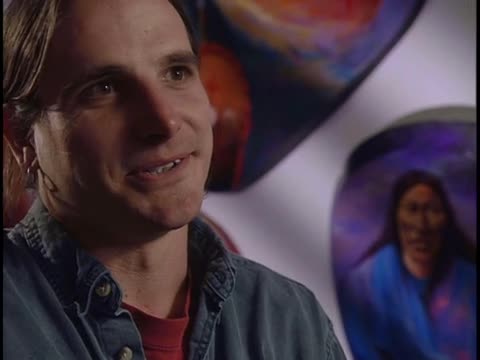
- Transcript
It is like three minutes an hour, but it's pretty slow, but it's a little bit. So this is tape. I may know when you're ready, Bill. I'm ready. Anyway, you really look like you're a fun at this part. Yeah, I do. Yeah, this part, it's really... I'm just kind of going with the shape and using its boundaries to define some of my fields of color. And just keep going with it and see what happens a lot of times. And then further on down the road it will get kind of tighter and tighter as I go along and put different images in. But this is always a pretty free flowing stage of
my painting process. And, you know, like this color I just put on, I don't really like, so I'm going to go over it later. But that's the kind of things that happen all the time. And to get my starting background images, I just build up layers and layers and layers of color until it starts kind of popping in and out. Especially in my kind of skies. They're really a lot more sort of more abstract kind of almost but not quite kind of like Rothko or someone of that nature. Okay, that's all I can do. That's a bad word. No, no, no, it's not you. So proceed. Okay.
Did you start by knowing while I'm going to have a certain amount of blue but then that orange sort of swept over? Right, yeah. And sometimes like I said, that's good. And I was trying to balance some of this out over here and almost framed this kind of blue coming in. But, you know, there again I might step back and say what the heck was I think in her and come back in and do it? It's just kind of like a building process that I keep going and going and I have also have to be thinking of what my next step is. Like there's going to be a lot of kind of stylized birds. Kind of almost like a design coming through in here and then eventually I'm going to put a very detailed sunflower in here. So I have to kind of keep those things in the back of my head when I'm putting down the kind of like the background colors in the sky. And
see what happens. Is this one going to have a figure in it or just the birds and sunflower? Actually this is, yeah, the birds and the sunflower and probably some stones down in there. This is sort of like a new branch of the new series I'm working on and it's going to be dealing more with just really simple natural images. And I'm going to try and get the same feeling of movement and kind of other worldliness maybe as with my other work. But this is kind of like a new direction I want to be going. So this is one of my first pair paintings in this new series that I'm going to be starting on. So who knows how it's going to turn out
hopefully. It's always kind of exciting and scary when you start on a new series of work because you don't necessarily know which direction it's for me anyway. I don't necessarily know totally what direction it's going to go and where it's going to branch off. So you have to just play with it as you go. See what works and see what doesn't. When you started on the series of the Native Americans. Did they come out close to what you would envision or? Somewhat and then you know they the whole series evolved with that also. Some of it did and you know that my my process I have like a general idea sometimes of what I want to portray or get down. And then sometimes it takes off in a new direction
and it really is surprising and sometimes a lot better than I anticipate. And then there's a couple of them where I didn't quite pull off what I wanted to but I think that's just a kind of a normal battle that artists go through. Do you ever feel guided? Well I don't know. Someone else was asking me that and I really don't know an honest answer to that. I mean it's like I have ideas and I want to do them. Or you know I have these things going through my head and I want to do them. So maybe if that's guidance or guided and being guided. Yeah but you know I really enjoy doing this and I just kind of do what comes in my head I guess.
I guess I kind of you know wonder if you feel guided because I feel such a presence from your Indian paintings. Maybe the spiritual guides of that heritage and the influence it may have on you. Well yeah I think for me personally it's a how would you describe that maybe kind of a guidance for me personally. But I don't want to shove that down people's throat or claim that these are I don't know how to describe it I'm sorry. Okay let
me use a big broad stroke. Is that good? Because this is your heritage too correct? Well yeah actually that's a good question I'm kind of glad you asked that because I kind of have an interesting background. And I don't want to give people the wrong impression or anything but the reason my name is the way it is. My name is Chad Mayo Ghosthorse and those come from both of my fathers and either one of them are like a blood father. So I was adopted when I was a baby and everything. And this is just kind of like how my life's evolved. I can't it's kind of tricky because I don't want to claim that I'm a Native American or things like that. But I can't deny the influences I
have gotten from that part of my family. So it's not really hard to talk about but it's maybe hard to explain. I don't want to come across as something I'm not but I can't deny what my life has been either. Your first father you were like adopted twice? Yeah sort of well I grew up with my family in Eastern Washington and then when I was around 20 I met this man later to you know he adopted me as his son. And that's where a lot of this influences come from. Because he's Lakota? Yeah correct. So you know it's kind of funny because it's like sometimes
there's I don't know if you say political but because of my name people you know kind of assume that you know like Native blood or whatever. But my whole life has just been a big adopted family so that's that concept's almost hard for me to understand in a way. But I do understand it. So you don't know if you have actual Native American blood in you or do you know if you don't? Yeah I'd be honest I don't know there's like I really don't know. I don't know much about my I know bits and pieces that I've you know found some paperwork way back when and there's like a possible connection but I can't you know claim that because of I don't know for sure and I don't want to misinterpret my misrepresent myself. But you certainly adopted
the heritage based on how you grew up and your influence of this man. Yeah it's kind of tricky to talk about because you know it's like I want to I want to be honest and everything with who I am but so much of it's personal so I find myself stumbling with words and I don't know how to explain it very well sometimes you know basically I'm I'm just an artist and I my life's the way it is and I don't know I don't know if I can do this. You're doing good. Why don't you
start off by kind of telling me how you got interested in art and how you decided that that's what you wanted to do for our living. Okay I guess it started ever since I was you know younger I was always with crayons and everything and then after high school I went to art school at the Art Institute of Seattle. It took all the lectures I could in high school to get out of math class mostly but yeah I've just ever since I was young I've always liked to draw on and you know create and paint. So it's just it's something one of those things that's kind of been there throughout my life. Now you went to the Art Institute but you said you didn't stay that long. Well it was it's like a two year program and I you know got my associates and everything but a lot of what I do now has been just my continuation of my own learning and just you know working at it.
Yeah just sort of you just sort of evolved. Yeah and that school too was a little bit more commercial and you know like in the graphic arts and illustration it was just kind of that's where it was more based towards but I kind of found out going to that school that I wanted to be more of a fine artist than a commercial artist. So I kind of made the turn after school to concentrate towards that. Why did commercial art not appeal to you? I found out how advertising worked and it kind of put a really bad taste in my mouth and it I looked around also and I decided I saw that the successful successful graphic designers and you know illustrators had to work very hard to you know make a
decent living and I said well if I'm going to work that hard I want to do something that I really love. So I decided well might as well just do fine art because that's what I really want to do and I think you have to work just as hard or you know it's it's kind of a equal trade out so maybe a little harder for fine art. So on one hand you know there's the you know potential of having the steady paycheck but on the other you have the creative freedom. Yeah exactly you don't have art directors telling you what to do which I'm not I'm not this might sound like I think bad of you know graphic designers or illustrators which I don't at all a lot of my have a lot of good friends. It's just for me personally is the direction I want to go and that's I just kind of made up my mind and that's what I just stick to it and try and do it. Now you're not associated with a gallery not
this time no I've had quite a few shows you know throughout but I don't have a gallery representing my work exclusively or anything I don't really have a gallery that I'm working with at this time. So how do you get your work out there to the public. I do have gallery shows every once in a while I've had some like in Portland and Lincoln City and down in Oakland and Seattle and you know but I've really have found it organ especially I kind of been responded well. People have responded well to my work in Oregon it seems like from what shows I have had and everything so I like that. I'm trying to cough in between all your answers. Just give me a signal. And so I mean you're doing this and
you're I would you say your career is still kind of in the building phase where you can because you do something you do another kind of thing. Right right yeah no definitely I'm you know I'm still relatively young as an artist a professional artist you know some some guys that I'm really jealous of making it already when there's 30 and everything but it's just one of those things. You just have to keep plugging away at and keep trying and right now I feel like I'm in a pretty good place. I have a I feel I have a pretty strong body of work to go the next step further but yeah I you know I have another job that I do part time which is like you know house painting stuff you know which is all right but one of these days I won't have to do it anymore hopefully. So right now your schedule of doing one to the other is it's about half and half actually which is good
you know I mean I can't complain too much because I do generate. You know some income off of my paintings it's just I need that little bit extra sometimes to make it through which is you know normal actually. But you look forward at the time and you can just do what you want. Oh yeah definitely definitely. I think every artist does I mean I think there's probably lots of people out there like me they're you know having their day job and then come home and paint. But you know I don't want to just sound like I'm a hobbyist either it's something that I'm very dedicated to that is a you know my main focus actually. So I mean that's that's again that's kind of like where the trade off was I couldn't have kind of a part time.
Graphic design job I know there's there probably some out there but I couldn't I couldn't find there wasn't that opportunity for me and also it a lot of your creativity goes towards that so when you get to your own stuff. You're a little bit empty maybe and so I just decide I'll just paint houses you know it's one color it's easy. They don't have to think too much and then when I come home I can really work because it doesn't require any of your creativity to paint a house. Well no not really you know it's just mechanics of painting and it's you know it's painting a house it's not like a big deal. And you can save your say your creativity for what you really love. Yeah exactly yeah. And when you started first working with these different canvases with a three -dimensional. Did you know right off the bat that this was going to work or did you just think this is really weird but I got to try it? Yeah kind of
I had my I did some other pieces kind of like the step before this one that you see now that we're just you know flat cutouts on panels. Just flat panels flat wood panels and I really wanted to take them further because I knew there was more there but I just didn't really know how to do it. And I was thinking about it for a long time. And I figured out this idea and I played around with it one day and I had a you know couple failures and failures. Everything's wrinkled all over but after I got into it a little bit and understood the mechanics of the frame and the canvas and everything it's like. I really started to understand and work with it as just almost as an art form by itself and it's I think it's really evolved since my first one. I mean I've learned a great deal from
just every time I build when I think I learned something new. Can you even imagine painting flat again? Yeah I mean I can and I say every once in a while I still do a small study or a flat piece but it's almost like I'm missing something sometimes when I go back to that. I just like I heard that curve going where this go and I found now I use it to bounce my imagery off of and I almost kind of rely on that to work with it with my imagery so sometimes I just feel like there's something missing when I go back to a flat piece now. That's great. Let's talk a little bit about the Native American images and your own connection with that you you've been adopted by a tribe basically by by a Lakota
Indian who has adopted you as his son. And that sort of how did that how did you meet him how did that connection start? I had that start that's a good question it's I just met him through kind of a friend and at that time I was a little bit younger I think it was like 21 and I sort of in trouble. I mean not trouble trouble but I was I wasn't really happy with where my life was going I'm part of that involved drinking a little bit too much and things like that. I don't think I was really really bad but I was kind of heading down that road and he for some reason like me and you know we formed a relationship and it just kind of sprouted from there. Any you know kind
of helped me leave some of those negative things behind where I could grow as just as a person in general. So it was and then after that it just became that kind of a relationship you know along with my other father too and but yeah it's just one of those things that happened. But I mean that could have happened to a lot of people and they wouldn't that incorporate it you know into their art what is it that appeals to you. I mean I look at these faces and there's just so much you know so much in those faces where does that come from. Well I think it yeah what I mean one of the reasons I'm a painter is because it's hard for me to describe things but more than just like seeing them as Indians or Native Americans or whatever
there's there's something about people that live in a neighborhood. It's a natural way that have an understanding of the earth and of just the natural things in life and I think that's the kind of feeling that you may or people see in my paintings. It's just like some some kind of understanding or or knowing and that's what I try and do it and it it could be you know anybody it could be you know like lap landers or an African tribe or you know somebody down the Philippines and Morore or New Zealand but indigenous peoples in general just have this knowledge of the earth. And kind of like this natural natural way that I think
as as especially in America as a western you know kind of a western based society that people can really learn from some of the old traditions and or philosophies of how to treat the earth and how to live. So just respect nature and not take you know more than what you need and you know just like very simple basic philosophies but when you really look at them they're very profound and you can you know seeing now some of the trouble we're in environmentally you know with the global warming and you know now the Columbia River the salmon and everything. You know you can see why those that philosophy or that spirituality if you want to say that but
it's it's really just kind of like a way of life why it worked for so many years it wasn't you. And you try and honor that in your paintings yeah I think more than anything that's what I'm trying you know and to say that it's still here it's not like history it's not something that was just part of America's past because it's still here you know it's not like it's disappeared or anything like that I mean it's you know kind of like a live and well I mean there's some scrapes and bruises along the way but you know it's still a living a living thing a living culture I guess you might say it's not. And as you as you move from painting Native Americans and Indians to just more nature thing but you see that all kind of
still with the same basis of a love of nature and appreciation for nature. Oh yeah I mean right yeah this is kind of like you know and if you look at it on more of a grand scheme of things this is like this like work here is like a people's relation to the earth. But my my next series that I'm you know starting to go to is is just the simple things and in nature something simple as a stone and showing the beauty and power in it I mean if you if you look at everything that a stone does I mean even practically all the roads we drive on I mean this may not be like a real good example but you know basically the atomic bombs from stones I mean if you really get down into it you know from Uranium and all those kind of things so something that simple
containing that much you know power I guess would be the right word is is really interesting to me you know and just but there again it kind of goes back to that philosophy and it as human beings we have a choice of how we see it or use it and there's a responsibility there that I think we this is just my opinion but I think we really need to start looking at seriously and then you know in the future because it's getting a little bit spooky sometimes when you think of all the things that we're doing. Where do you see us time now? Yeah time to change. you
- Series
- Oregon Art Beat
- Episode Number
- #318
- Segment
- Chad "Ghost Horse" Mayo
- Producing Organization
- Oregon Public Broadcasting
- Contributing Organization
- Oregon Public Broadcasting (Portland, Oregon)
- AAPB ID
- cpb-aacip-4d101acbe00
If you have more information about this item than what is given here, or if you have concerns about this record, we want to know! Contact us, indicating the AAPB ID (cpb-aacip-4d101acbe00).
- Description
- Raw Footage Description
- B-roll interview with painter Chad "Ghost Horse" Mayo
- Media type
- Moving Image
- Duration
- 00:28:28;16
- Credits
-
-
Copyright Holder:
Oregon Public Broadcasting
Producing Organization: Oregon Public Broadcasting
- AAPB Contributor Holdings
-
Oregon Public Broadcasting (OPB)
Identifier: cpb-aacip-6184d5b65c8 (Filename)
Format: Betacam
Generation: Original
Duration: 00:30:00
If you have a copy of this asset and would like us to add it to our catalog, please contact us.
- Citations
- Chicago: “Oregon Art Beat; #318; Chad "Ghost Horse" Mayo,” Oregon Public Broadcasting, American Archive of Public Broadcasting (GBH and the Library of Congress), Boston, MA and Washington, DC, accessed June 19, 2026, http://americanarchive.org/catalog/cpb-aacip-4d101acbe00.
- MLA: “Oregon Art Beat; #318; Chad "Ghost Horse" Mayo.” Oregon Public Broadcasting, American Archive of Public Broadcasting (GBH and the Library of Congress), Boston, MA and Washington, DC. Web. June 19, 2026. <http://americanarchive.org/catalog/cpb-aacip-4d101acbe00>.
- APA: Oregon Art Beat; #318; Chad "Ghost Horse" Mayo. Boston, MA: Oregon Public Broadcasting, American Archive of Public Broadcasting (GBH and the Library of Congress), Boston, MA and Washington, DC. Retrieved from http://americanarchive.org/catalog/cpb-aacip-4d101acbe00