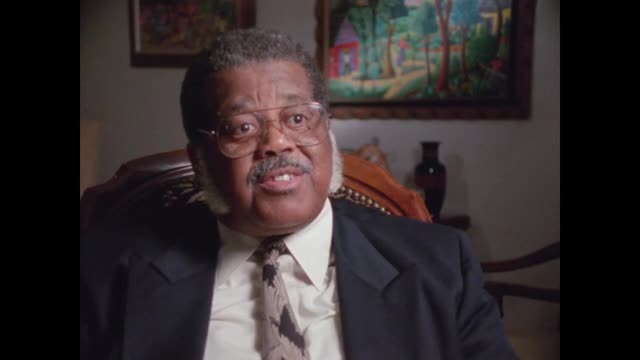
Eyes on the Prize II; Interview with Dewey Knight
- Transcript
I'm sorry. I'm sorry. I'm sorry. I'm sorry. I'm sorry. I'm sorry. Parking? Parking? Parking? Parking? Any time. Tell me about overtime and it's heyday. Overtown and it's heyday was a real positive thing to see. It was a community. It was a place where people came together around common factors. There were viable businesses of all sorts, furniture stores. Team A. Parking? Overtown. Overtown was a viable community in which people had common causes and related to each other. There was economic development, businesses, furniture stores, clothing stores, a sort of water bottle in company.
The professionals, doctors, lawyers, other professionals were there. It was a place, a focal point for black people. It was contributed to that. But segregation caused it to be a community where people had a real sense of community. The youngsters were considered youngsters of the community so that everyone felt some responsibility for youngsters. It was said once by juvenile court judge that there's no such thing as a dependent black child in Dave County that the community will take care of them. It's literally true that no very few people suffered. We saw, however, some significant changes that came about number one because of the aspirations of black people, but more importantly, negative changes that came about because of what was supposed to be something good, something called urban renewal,
which ended up being urban removal. And I-95, which was basically developed to get people from suburbia downtown, and in the process destroyed overtown in that sense of community. I say that because what did it do? It meant that people had to move. They were given very little for their property. There was no planned movement, and people had to do the best they could. And as a result of that, some landlords exploited that Liberty City, which had basically become in Brownsville, an area for upward mobility where you could buy a lot, and work weekends, and build a house. All of a sudden you saw concrete apartment houses coming up, what we call concrete monsters, simply because the demand, because of the push-out for overtown was for space. These were small places that did not accommodate people. It was overcrowding areas.
There was no zoning controls to assure these single-family residents. And next to it, you had all kind of houses. And it really literally destroyed what was the major black community in this area. And you never saw the redevelopment of that sense of community in my estimation that I was informed of and saw the end of overtown. Where did people go who were displaced? Many of them moved to Liberty City and to Brownsville, another black subdivision. We still had very rigid segregation. Subsequently, however, the areas immediately adjoining Brownsville and Liberty City, which were predominantly white, which were all white, were begin to open up as speculated. Real estate speculators got in, and because people did have money for down payment. So you saw areas like the area I live in, Edison Center, and these places open up.
But initially, it was into Liberty City, Brownsville, and overcrowding that area. Then you had some of the other single-family areas that were predominantly white, begin to open up in the Northwest section. It did not happen, however, without resistance. And there was a great deal of trauma for the early families that integrated those areas, which subsequently have become all black. After McDuffy was killed, and those four officers went on trial, what was your expectation for the outcome of that trial? My expectation, as was the expectation of everyone in the black community, was that those men would be convicted of killing McDuffy. To us, the evidence appeared to be overwhelming that they were responsible for the death of McDuffy and should have been dealt with accordingly.
Why were the riots that happened so violent? The riots were violent, I think, because there was number one, a very strong feeling that it was a contrived, misjustice, that people didn't really do their best to try to convict these people. And that this was an attack on all of us. There also, some speculated, might have been some planned and organized activity related to the reaction. You had the normal things that you have of breaking in stores, but you also had some very powerful, destructive devices being used, which no one has really explained to this point to my satisfaction. So that the reaction was one of great, great anger and dissatisfaction about the McDuffy decision. And it was also some feeling and opportunity for some planned destructive activity.
There was a lot of money into this community after the riots trying to rebuild things. What happened to it? Well, we need to be clear. Number one, there was a lot of money promised over $8,800 million. Didn't really that much money get here, President Carter and others that promised the money. The money that came to this community from the federal government and even the money from the state was basically sent to rebuild, refurbish the businesses that had been destroyed. Ninety-five, ninety-eight percent of the businesses that were destroyed were white businesses. They were business like spotly electric company, storehouses, warehouses, large white stores.
And those were the people who maintained appropriate books, maintained inventory. I suspect some inflated inventory. But when the money was flowing down, those people were reimbursed, at least for a substantial amount of that. I think too that those people were waiting to move anyway. So this was an opportunity, really, to get that money and move west of the airport where business was moving at that time. What was left and the money that was supposed to come to the black community to not only help the businesses that may have been hurt by the riot, but to help to rebuild some economic development seems to have gotten retarded in the bureaucracy. That's a kind of funny statement, but people were told come to this office and apply for some money and bring your last five CPA statements and your last statements from the internal auditor and the external auditor.
And just the fact that you have been operating a business successfully for thirty years is not enough. And some very clever, from the private sector side, some very smart and clever MBA and CPA types. Well, I don't see that you have this and I don't see that you have that. And therefore you are not qualified much like what happened to us with the SBA. So the money that did flow here went to people to the white businesses that were burned out in many instances. Very little of it seeped down to businesses in the black community. And that was a substantial complaint. The other complaint was it. And it's a valid complaint that much of the money that did come down to neighborhood organizations or to neighborhood economic development organizations was so tied in bureaucracy that nothing really happened with the businesses except that salaries for people went on and on.
So the impact on the positive impact on the black community of that money was very limited. Tell me about political life here for blacks in Miami. Why are people so powerless? I think that we have to be very careful about what our perception is of power. I don't think that black people are as powerless as it appeared. We are not as economic, we get compared economically to the white community. And we get compared to the Cuban community, people who are the exception. They didn't come here after potato famine, famine. They came here because they were in power and were kicked out. And these were people who had operated viable businesses, had long training, et cetera, et cetera.
And yet when you compare us, we had the reverse. We have suffered with segregation and all that other stuff. One says what does that matter? It matters because the economic aspects of life in this country are most important. And if you don't control some of the pie, for an example, even today, it's estimated that a dollar coming to the black community stays here one and a half to two times. A dollar going to the Cuban community stays a seven to fifteen times. So you don't have that really economic viability. On the other hand, you shouldn't be misled into thinking that there has not been significant movement in this community for blacks. This community was one of the first to get an approved black set aside program approved by the Supreme Court. And not a minority set aside, but a black set aside program,
which in the county and the city and the board of public insurance, which is producing several hundred million dollars a year with black companies and with black employment. That again does not build in the way that the dollar amounts sounds. While we have limited representation on the political bodies, we have one county commissioner. We have one city commissioner. These people are elected countywide and are in position to do trading with others. So that there has been, there is some significant power. We have lost some of our power position, Iowa, because we are not a two ethnic community. We are a triethnic community.
And what the direction now is to try to work out accommodations within that triethnicity. In other words, building strategies to continue to move forward and to gain things, recognizing that the pie is split different ways. I was at the Holiday Inn on Biscayne Boulevard where a group of black leaders had been meeting since early that morning to discuss the actions we needed to take in regard of how the decision was. There was great speculation having seen television reports of the trial that there was a possibility that these men were not going to be convicted. And we were trying to strategize to see how we could help this community to work through that.
But in case it was a negative, and even if they were convicted, right near the end of the meeting, it was really around four o'clock. And we hadn't really formalized things. I got a call from the then county manager who says it got bad news for you that the policemen were acquitted right away when I tell the group that kind of broke up the strategy because everybody is scrambling then to determine what they were going to do. I was told to come to the command post, which was at the central police headquarters. And I was in my car. I went over to the shop to get a county car. They didn't have any unmarked cars. So I took a marked car like an idiot. And I asked which was the best route to get to the command post to avoid confrontation with the crowds. They said 95th Street because they were shooting on 54th, 62nd, 79th.
I was going down 95th Street and in front of some apartments, close to 17th Avenue and all of a sudden, the county car is being shot at. I kind of hit the gas and sped up. Didn't hit the car, but really a frightening situation. I get to the command post and everybody, the police tell me you got to be crazy for driving a marked county car through any of the areas. We went to the command post. At this time, the NAACP and several other organizations that call for a rally on the Metro Justice Building Steps and the local black radio stations were really playing it up for everybody to go to the rally. But that rally... Tell me something about the underclass.
How do you look upon it and what do we do about this rally underclass? I think in order to describe an underclass, I have to go back to what I initially started talking about. Open when, as overtown, as I viewed it and heard about it, was a place where there literally was no class. Because everyone was there to get a segregation required to be there and people were treated as people of course they had to be some. Because people were able to become mobile and to move out as people moved to Liberty City and Brownsville to build their little, buy their lights and build their little houses. And then as we had the great displacement of urban removal and the expressway, the people that were left were basically youngsters, mothers with children who couldn't get out, old people who couldn't get out, men and women with problems who couldn't get out, alcoholism, subsequently drugs, some carry over with immigrants who could not master the language or master the cultural functioning.
So it was really the bottom wrong of the ladder that was left if there's, and we've seen a growing underclass everywhere. But overtown, that does not mean that there aren't people and we're not people there who stayed because they wanted to stay but they were very limited. And that does not mean that these people didn't have great potential. But they were ignored because the upward mobility types had gone. When everyone was there, when the professionals were there and everybody, things moved up, it benefited everybody. And as a consequence, the housing goes down, the streets go down, there are very few businesses, there are police problems. When I say police problems with stealing and that kind of thing.
And as a consequence, the people that are left are not only limited in their mobility, but they're limited in their functioning too. And often, while we talk a lot about doing something about it, it is caught up in many, many plans. The other thing that has limited what has happened overtown, at least in my estimation, is the fact that most people tend to relate every black community in the same way. So when we say overtown, people thank you talking about Liberty City and Brownsville and Coconut Grove. And when solutions begin to arrive, we say we want to do something about overtown. And then what do we do? We immediately do something about overtown by moving programs into Liberty City and Brownsville and Coconut Grove and overtown gets left out. What we're trying to do this time, and I'm working on a committee to try to, is to look at overtown as an independent entity that needs independent attention and try to find some doable deeds and some doable solutions and some doable actions for overtown.
And not just to say overtown needs it, but Liberty City has more people, so let's do it there. Back to the rise, one more question. How did government function during the course of the rise? Well, you had the essential governmental services, police, fire, hospitals, health. We have a large cadre of community relations people who some work for government, some who are volunteers for government who are in the picture. They function well. After having made some deliberate decisions as to how they were going to function, it was a deliberate decision made that we had better sacrifice property to save lives and to save injuries. So that, while that was not a popular decision, really, because people outside of the area and people downtown are here to say, you know, you're the police, get the forces in there, call the national guard, wipe them out.
But a deliberately decision was made to full go to property to save lives, and I think it was the right decision to do. Okay. Stopping down.
- Series
- Eyes on the Prize II
- Raw Footage
- Interview with Dewey Knight
- Producing Organization
- Blackside, Inc.
- Contributing Organization
- Film and Media Archive, Washington University in St. Louis (St. Louis, Missouri)
- AAPB ID
- cpb-aacip-47fd6f66742
If you have more information about this item than what is given here, or if you have concerns about this record, we want to know! Contact us, indicating the AAPB ID (cpb-aacip-47fd6f66742).
- Description
- Raw Footage Description
- Interview with Dewey Knight conducted for Eyes on the Prize II. Discussion centers on the city government of Miami and race relations, with an emphasis on the Overtown area.
- Created Date
- 1989-03-21
- Asset type
- Raw Footage
- Topics
- Race and Ethnicity
- Subjects
- Race and society
- Media type
- Moving Image
- Duration
- 00:20:59:32
- Credits
-
-
:
Interviewee: Knight, Dewey
Interviewer: Lacy, Madison Davis
Producing Organization: Blackside, Inc.
- AAPB Contributor Holdings
-
Film & Media Archive, Washington University in St. Louis
Identifier: cpb-aacip-5098a906166 (Filename)
Format: 1/4 inch videotape
If you have a copy of this asset and would like us to add it to our catalog, please contact us.
- Citations
- Chicago: “Eyes on the Prize II; Interview with Dewey Knight,” 1989-03-21, Film and Media Archive, Washington University in St. Louis, American Archive of Public Broadcasting (GBH and the Library of Congress), Boston, MA and Washington, DC, accessed January 30, 2026, http://americanarchive.org/catalog/cpb-aacip-47fd6f66742.
- MLA: “Eyes on the Prize II; Interview with Dewey Knight.” 1989-03-21. Film and Media Archive, Washington University in St. Louis, American Archive of Public Broadcasting (GBH and the Library of Congress), Boston, MA and Washington, DC. Web. January 30, 2026. <http://americanarchive.org/catalog/cpb-aacip-47fd6f66742>.
- APA: Eyes on the Prize II; Interview with Dewey Knight. Boston, MA: Film and Media Archive, Washington University in St. Louis, American Archive of Public Broadcasting (GBH and the Library of Congress), Boston, MA and Washington, DC. Retrieved from http://americanarchive.org/catalog/cpb-aacip-47fd6f66742