Martin Agronsky: Evening Edition; 205
- Transcript
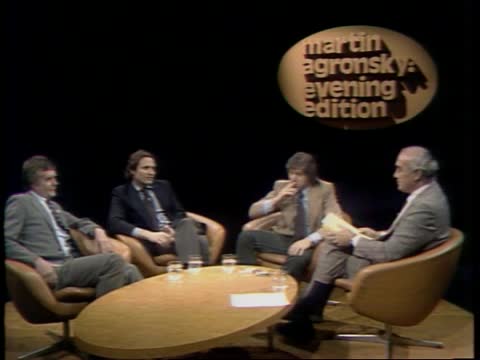
From Washington, this is evening edition. Now here is Martin Akronski. Good evening. The emotions and memories Watergate evokes seem to remain as vivid as ever in the American memory. Like Lady Macbeth's damned spot, they will not out and this is demonstrated once more by the controversy that surrounds a new book by the two young Washington Post reporters who were largely responsible for the uncovering and resolution of the Watergate scandal several years ago. Tonight a discussion of their new book The Final Days with Bob Woodward and Carl Bernstein. Raymond K. Price Jr., the former chief speechwriter in the Nixon administration and former editor of the New York Herald Tribune joins the discussion. Gentlemen, I'd like to begin with Ray Price rather than with you. Good. Just in terms of getting an evaluation from Mr. Price
about in his opinion how accurate is the atmosphere the feeling the general sense of what happened in the final days of Mr. Nixon's term how close Mr. Woodward and Mr. Bernstein have come in your opinion to recreating the mood of that time. Well I think they've I think weren't I think they've tried and I think their book for one thing is much more balanced than the excerpts were and I'd be very much interested in their comments later on on the on the excerpting process. The I think it it has a lot of a lot of new material a great deal of which is true some of which is not it I think it does suffer from a perspective which is probably inevitable in their case that is from a lack of the presidential perspective now obviously they did not talk with Mr. Nixon and it seems to me it comes through a little bit like a book on the Lindbergh
kidnapping without the Lindbergh perspective or a book on the abdication of Edward Eath without Edward Eath's perspective and that to me is a is a is a major shortcoming of it and I think I think you have to have been there or to have been in or close to a presidency not necessarily this one really to have a feeling of what what the way to responsibility is that the president feels on his shoulders and not just the personal agony he goes through but the kind of the agony of state that he goes through in in a situation such as the right have you talked to the president yourself about the book or no I know about that that that period I talked about that period yes but not about the book you tried to talk to Mr. Nixon both of you what was the response there wasn't there any we dealt with his lawyers and we sent a letter and on all those occasions there was a free refusal by Mr. Nixon to talk to us on the book you can see I
suppose raise point indeed and we like many people away Nixon's memoir we'll we'll read it with with great interest I don't know that I agree with you though that you have to have been close to a president or a presidency in order to write about it I'm not sure that that you would gain something by having that experience but you also might lose something and I think that's true but here where you are reporting to get inside the mind of the president and inside the collective mind of the White House then I think I you know I think from outside you can report a lot of facts but but then the question becomes not just what is what is the fact that a street ETE fact but then what what you do it how do you interpret it what does it mean like for just to take one example I think especially in the excerpts more in the excerpts than of the book one of the most sensational things was the collection of comments by Henry Kissinger about the president disparaging comments
now I've no doubt in my own mind that sometimes that at some various times during the six years they worked together Henry probably said those things about the president but the point is that Henry talks that way about everybody and make that point in the book I don't think it really comes through but the and this simply is one of his less appealing personal characteristics and in that context these remarks really mean nothing absent that context they are devastating they let me ask you this I'm sure you saw John Osborne's piece in the New York public which he addresses himself to the points that Ray is making in terms of your evaluation and the course of the book of the Kissinger Nixon relationship we haven't yet if you've heard about it but I haven't seen well let me tell you about it because I think it's a very interesting portion of the book and it's kind of a it tests really in terms of Osborne's evaluation of your evaluation of that relationship and I'd be curious to know how you respond to it Osborne writes that it's simply not true that Kissinger viewed
Nixon with quote loathing in the beginning of their relationship and throughout it loathing Osborne notes is much too simple and strong in term for the attitude of Kissinger a very complex man who had Richard Nixon also a very complex man Osborne notes they didn't entirely trust each other they were somewhat jealous of each other but they needed and served and basically respected each other and he makes this conclusion to have them as he feels you have them secretly warring with each other holding out on each other distrusting each other during the last months of the Nixon presidency and of Nixon's disintegration as the book does is to be incredibly mistaken and wrong I think Mr. Osborne misreads what's in the book certainly the first part of what you what you read there is very much like what we write we write that that Kissinger had an attitude toward Nixon that
indeed was marked by the words we use in the book loathing in contempt but it was mitigated by admiration for certain aspects of the Nixon character particularly the president's ability to take large bites of the foreign policy problems as Kissinger often phrased it there's a description in the book of the meeting that Mr. Nixon had with Brezeniv in which Kissinger was terribly worried that somehow to make his domestic situation better Mr. Nixon might somehow sell out US but he didn't as you know exactly is the book notes and Kissinger also noted that and tended to temper his evaluation with Nixon I think the book shows that relationship is a very too -sided one it also goes on exactly as Ray has pointed out that it was mitigated by by the complexity of what was going on they weren't always worrying Ray Ray is one point that I let me back up on one thing that I don't want to go let go
on said and that has to do with us somehow getting inside Richard Nixon's head at no point in the book do we do that we didn't talk to Mr. Nixon the only time that did we say anything about Mr. Nixon's thoughts are when he indeed expressed them to people but God knows I don't think there's a single example of that in the book and I I would like to go all we did on the Nixon essentially Osborne certainly I think he's a very good reporter I do he was there during all that period and he thinks you're dead wrong that's what he says it to be you were incredibly mistaken and wrong we did the reporting on that relationship Martin we talked to probably 60 to 65 aides Kissinger his closest aides the people are with him over a long period of time Kissinger is acknowledged that we talked to him about it we we did the reporting in this is what we put in the book what others told us repeatedly
that Kissinger expressed these negative thoughts not just about Nixon is a president or Nixon's personality but namely Nixon's intelligence we described there how Kissinger instructed one of the aides and this is only one example we give but it was repeated many time well to condense things you know to the reader's digest level for president Nixon well Dave were you good I'm not Dave right I'm sorry who we're talking about here I think meeting everybody's read the wrong book not just the excerpts no the point the point is then that you are responding to Osborne this sense that that's his judgment you made your judgment and a drive from all of the exactly I mean you get into this this point of our Carl and I are outsiders we we didn't hang around the White House we didn't have this sort of insider status that lots of reporters have to make us a part of the administration
well then you know we deliberately kept ourselves at a distance and we did we spent a year we had two assistants working with us full time and when we first started hearing this about the Nixon Kissinger relationship we didn't believe we didn't believe it and we held the information we were getting to the to the greatest scrutiny and we went back and we went back and as we report in there Kissinger had his phone conversations with Nixon monitor regularly and many of them taped later on and actually installed a taping system and our sources on this who really run into the extent of 13 sources telling us about this taping system knew about the transcripts had read them had overheard conversation really hours and hours of conversation you're looking at Kissinger making denigrating characterizations about everybody is absolutely correct and we we'd remark on it in the book but there was something and I think you know this very much apart
from from those ordinary denigrating characterizations that he made every day a different from his view of Nixon I don't think there's any question that he viewed Nixon as an anti -Semite for example I whether he was correct in his view that's that might be another matter but certainly he had long discussions in which he held that point he had discussion if he held a view he held it on his if he held a review it was we also report that there were there were lots of people who didn't agree with Kissinger's assessment that for instance Arthur Burns did not believe that Nixon was in the anti -Semite and made long speeches had extensive conversations with people about let me let me take another point now we go beyond Kissinger to scope craft to us now replace Kissinger National Security Council and to Eagle Burger now Osborne makes this point he says in a reference to Eagle Burger in the scope craft that
you bright collectively right that Kissinger's frequent descriptions of Nixon as irrational insecure and maniacal could at times as easily applied at Kissinger's to the president that you made that point now Osborne writes I state as a fact known to me that Eagle Burger and scope craft never believe this of either Nixon or Kissinger except perhaps of Nixon in his time of final disintegration well first of all it's qualified already yeah and which it seems to me tends to confirm the accuracy of and we've got to establish something here that public officials in Eagle Burger is still Kissinger's closest aid scope craft has Kissinger's old job in the White House yeah and I think Ray would back this up that people make public statements they they they publicly posture themselves all the time to try to to put the most favorable coloring on things
and to stabilize their own position what we've done in this book is exactly what we did in the in the Watergate reporter is we penetrated that public facade and we went and we checked and we asked the question what are people really think now I would not be at all surprised to have scope craft and Eagle Burger come out and say no we did not hold that view it was qualified to the final period of disintegration and so forth and I think is reporters all of us in certainly Ray is to a certain extent know how to evaluate those sort of well of course this gets you into the question of how you evaluate second secondary interstitial resources which obviously you have to rely on for for an account such as this and not for this particular well but but but but generally the generally the the things that you put forth as fact here even with the best well in the world if you're if you're relying on second secondary tertiary sources you're relying on
essentially here say and there are reasons why here say it's not a bit in court because because things do get well anything any of our information came from the principles in this I think you know this and I think anybody reading the book well some some some do it and some let's take a case of principles this was raised when you did the meat press thing you report on the meeting at which everyone was present after mr. Nixon had fired holdman and early and how furious he was that FBI agents turned up to guard the files and you report that everyone was present there they listened to him rounding and raving in effect and you note that actually the order to do this had come from Leonard Garment who was one of the president's White House Council and you say that neither Garment nor Ruckles House at this meeting responded to the president or nor did Garment for example admit
that he had done it now the fact is that neither Garment nor Ruckles House were at this meeting now when I tell you that Garment was not at the meeting I tell you that because I spoke just an hour or so ago to Garment and he said he was not at the meeting now that is a factual observation that is not accurate if it's if it's an error and I'm not at all convinced it is because you're not be convinced of Garment says he wasn't there well I would have to go back to mr. Garment and I would have and I haven't talked to him but don't you believe that I talked to him indeed indeed I do but don't you believe he told me he wasn't there you're talking about something three years ago who did you have on the show but I mean I certainly believe Len I think you know you're starting to confuse some things I certainly believe Len Garment told you he wasn't there we had records of you know people who were at the meeting and indeed they show that
Garment and Ruckles House were there it's always possible that in writing this kind of an account that you get somebody drinking tea instead of coffee that somebody went out of a meeting in a moment that they were they saw a scene before a meeting when somebody placed them inside and indeed Carl really you can't don't make it that way because it wasn't that way it happened it was a very important meeting it's a part of the record that you reported and it still happens that in this case it appears that you were mistaken it's sort there's nothing so terrible about that oh yeah what I'm saying nobody's in the reporting business is that he never makes me think you know it's time to start to say which is that what we should do is to go back talk to those people find out if indeed we've made an error about whether they were in the meeting or not if we're in error indeed it should be corrected I'm just not at this point convinced that we are an error if there is some mistake exactly you know it's all hard to convey this
this this this goes to I think I think a very important point which came up on the press as this as this item did here the question you know that when you assert that nobody has successfully or effectively I think those were your words challenged any fact and then this was raised and then it seemed to me that your definition of a successful or effective challenge was one that you you agreed with well right it's a very and still Mr. Lofton raised raised that point I don't think anyone had had even come close to challenging anything effectively it's a matter of fact this is has to do with three words in a sentence it says during the meeting and indeed from what you're saying from what Mr. Lofton saying it appears possible that there is an error hard to make we should make this point that we we make no pretext toward infallibility on this at all this is reporting this is the best reporting we could do I hope you personally have a feeling that it was honest reporting that we didn't crank
in any preconceptions let me let me let me say a mistake just like in our Watergate stories there nobody will be happier than to sit up and say let me say to both of you that I don't think that you deliberately were misleading and a thing like this but you never having a fact challenged is is a very strong language facts can be challenged these these these were the this particular instance is being a challenge it's a very and it doesn't matter matter in the book well if it's wrong we I agree with no I didn't agree and I'm not going to say that it distorts a book if I can add this if this is what distresses me about we're sort of and I agree totally with Carl we're talking about whether they were drinking coffee or tea and I think there's things in this book that show how the Nixon administration worked and that we should sort of raise the level of debate on this and I would be interested if if Ray agrees well I'd you know I'd like to on a related thing just like like to raise which as you know
there's been a lot of debate on the on the use of your sort novelistic technique here I don't think we accept the definition but at least one that reads reads as a novel which includes which depends for a lot of its sense of authority on the piling up of the little detail sort of the somebody called the not in relation to this the the things that give artistic verisimilitude what quite otherwise be a dull and unconvincing narrative and this includes some I think some gloss on on the things and it makes it hard for me looking at this in parts that I do know about it makes it hard for me to judge to what to what extent I should believe the parts I don't take one example you quote me at a session when up at camp David on April 29 74 when we just to finish the speech in which he was going to release the transcripts you quote me as sitting with him in his den with president in his
den and telling him that that I had never admired him so much as I had during that past year for the way he stood up under the pressures now that is true I did say that and I also know your source on it it was me not me and and yet and just for part if you want to pile on the details we were having lunch at Martin Stavron in Georgetown and in the first booth to the right of the door so forth and I told you that that I said it but in the book I find that that you say you know price grouped for the words that did not come easily so far that's more larkey that's the that's the artistic gloss and then you go on and both before and after that I see conversations reported conversation between me and the president in which we are saying things to one another not not in quote marks but you know conversation without the quote marks which derive I think from what I told you then about what I was thinking by arguments I was arguing with you at the point at the time about why I felt release was the lesser of two evils and
what I saw as the as the absurd sort of priorities that put avenging the buggy of laria brine's telephone higher than averting world war three and so forth and I don't challenge for a moment the the substance of what you have there which I think you accurately reported from what I told you and yet I find it appearing in forms of conversations which are appeared again artistic device and I wonder about that I don't know that it's an artistic device that I know the description you're talking about where it says price growth for words it didn't come easily came from from what you would told me that day which was that it was a difficult thing for you to sum it up whether that means price growth for the words it did not come easily I don't think we're really debating anything yet I think we are debating something it gets to just what degree of authority we give to these precise details which provides so much of the
semblance of authority I wasn't there when you and Carl had this conversation but as you know we contacted but we contacted lots of people who worked for you you're well aware of that and that after some of these situations in the White House when they were happening you described them to other people not this there is invention in this invention in what in in the details of this again not not on substance I'm not I'm not talking about the atmospheric detail which which builds the I think you know I don't have a proper rather regret in a way that we're getting down to these very specific the whole tapestry is what we should look at I suppose I feel that the book is it's a fascinating book and it's a healthy good reporting job but I do worry about some of these things and I worry about it in terms of taste too that's been raised as you well know for example
Kissinger's saying that some parts of the book is he put it show an indecent lack of compassion a lack of essential human understanding of the part of the authors I think many people who have read the whole book have the exact opposite impression I take a review of our book that appeared yesterday in the Chicago Tribune the staunch Midwestern conservative Republican newspaper that said this is the most compassionate account of the Nixon years that we have to this point and it may be the most compassionate one that will ever have I think I think I think I think you I think you've tried to get that into the book I'd be I'd be interested in your your reaction to the excerpting now the excerpting which just you know piled all the sensational pieces into a heap of garbage in sense I don't mean to characterize that but that's that's the way it came out do you think that these these excerpts distorted the book I think they inevitably did what excerpts do which is to take things out of context I think there's no way to avoid it
in excerpting material the same way I think there's no way to avoid it in having news stories written about the book and the combination of the two it's like on top of each other your speeches for President Nixon inevitably when somebody would take a sentence out or a paragraph I'm sure and in fact you expressed in many people sometimes the whole speech is not being captured but can we move to a larger perspective I'd like to ask you both this you were immersed in water get all through the things are longer most other observers and more more deeply involved I wonder did you think and do you think now that Nixon understands yet what happened why he did what he did why he had to resign does he accept it I think raised the answer would be much more right right well this gets in the areas of private conversations I've had with him since I'd rather be that you're well we do report in the book the perceptions of those around
that that he had difficulty understanding the legal ramifications of what he had done of what not difficulty you you mean really that he didn't want to or could not accept it I'm not capable of a motivational analysis I'm not I'm not a psychiatrist I'm not a psycho historian I don't know that he had I expressed real difficulty yeah in comprehending exactly why it was that he was having to leave office for for his actions I don't you think just as a basic statement that that's pretty accurate well I think it's I think it's accurate say that at the time he he certainly felt that whatever he had done did not rise to a level that justified removing a president he did feel that yes even at the end I think we report that extensively in the book eight after eight saying that he's really not reacting to the trip to the transcript of the last tapes but he's reacting to the
reaction of the people around him like yourself who said he's got a resume Ray would I be wrong in conceiving him literally waking up every day and saying to himself my god I never had to do it well I think I think at the end it was clear as I think comes out clearly in the book that the battle was lost in the Congress that there was no way that if he had fought I don't mean in resigning I mean watergate all the things that constituted watergate that none of them were necessary that he never had to do well most of them don't forget most of them he didn't do he was through a good deal of the water thing he was as mystified as anybody by what had actually happened well he never had to count on some of them when he did now and you know he was he was not you know taking the watergate thing itself he was not aware of it until after it happened and you know I do well I don't want to talk too much about
how this sort of quicksand developed what I think it's often seemed to me that the best analogy is to taking a step into you know the thing of quicks that every time you try to get out you find yourself getting deeper well that's the last word thank you gentlemen good night for evening addition to the evening addition the discussion of the problems of financing a run for the presidency with the John Gaboose campaign manager for Mars Udall and Carl Burke campaign chairman for senator Frank church this program was produced by wta which is solely responsible for its content and was made possible by public television stations and by grants from the Ford Foundation and the Corporation for Public Broadcasting
- Episode Number
- 205
- Producing Organization
- NPACT
- Contributing Organization
- Library of Congress (Washington, District of Columbia)
- AAPB ID
- cpb-aacip-3ee3e661775
If you have more information about this item than what is given here, or if you have concerns about this record, we want to know! Contact us, indicating the AAPB ID (cpb-aacip-3ee3e661775).
- Description
- Episode Description
- A discussion with host Martin Agronsky and guests Raymond K. Price, Jr. (Former Chief Speechwriter, Nixon Administration), Bob Woodward, and Carl Bernstein)
- Created Date
- 1976-04-19
- Asset type
- Episode
- Genres
- Talk Show
- Media type
- Moving Image
- Duration
- 00:30:32.631
- Credits
-
-
Producing Organization:
NPACT
- AAPB Contributor Holdings
-
Library of Congress
Identifier: cpb-aacip-95c6c74e5fa (Filename)
Format: 2 inch videotape
Duration: 00:30:00
If you have a copy of this asset and would like us to add it to our catalog, please contact us.
- Citations
- Chicago: “Martin Agronsky: Evening Edition; 205,” 1976-04-19, Library of Congress, American Archive of Public Broadcasting (GBH and the Library of Congress), Boston, MA and Washington, DC, accessed August 6, 2026, http://americanarchive.org/catalog/cpb-aacip-3ee3e661775.
- MLA: “Martin Agronsky: Evening Edition; 205.” 1976-04-19. Library of Congress, American Archive of Public Broadcasting (GBH and the Library of Congress), Boston, MA and Washington, DC. Web. August 6, 2026. <http://americanarchive.org/catalog/cpb-aacip-3ee3e661775>.
- APA: Martin Agronsky: Evening Edition; 205. Boston, MA: Library of Congress, American Archive of Public Broadcasting (GBH and the Library of Congress), Boston, MA and Washington, DC. Retrieved from http://americanarchive.org/catalog/cpb-aacip-3ee3e661775