Motorweek; 1105
- Transcript
This time on Motor Week 92 you will travel to England. Well we'll take you on a guided tour through the history of Jaguar from the first. To the latest from the street. To the track. And into the future. So come along with us and savor the roar of the cab. It's made possible by the Corporation for Public Broadcasting. Hello and welcome to a very special edition of Motor Week 92. We're glad to have you with
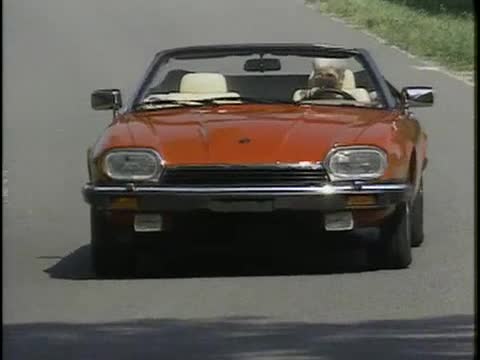
us. There are some cars they carry with them a certain dignity a heritage in character that sets them apart from the run of the mill daily transportation that we all rely upon the cars of Jaguar belong to that unique group and have stayed a part of it by never losing sight of the qualities that made that first Jaguar special. Thank the past for example during its long history changes have come gradually and Jaguar has hampered as little as possible with a magnificent V12 engine for its singular styling. So as part of our Jaguar special Let's look at the 1992 version of the X J.S. and witness evolution in action. The first x J.S. hold off the factory floor in 1975 but it faced an uphill battle for acceptance among Jaguar enthusiasts who were still mourning the demise of the much loved sports car you type. On like the E-Type. The extreme yes was a grand jury car. More then modern world.
Sixteen years of careful refinement later the ex J.S. has lost none of its now classic appeal. Extensive yet subtle changes for one thousand ninety two are meant to keep the coop and our convertible test car competitive in the tough premium luxury car market without taking away from their distinctive Jaguar character. For example I know sports a new European Look grill and head lamps but remains uniquely extreme yes. In fact almost 40 percent of the cars body panels are new. Most of the new sheet metal is concentrated in the rear which has been smoothed out and now features very contemporary tail lamps. But next year US fans will be happy to know that the huge trunk remains intact and will still easily handle a full load of luggage and the new optional compact disc changer has been wisely mounted on a side show so that it doesn't interfere with loading and unloading. In addition the ex J.S. convertible as a handy storage locker and the space normally occupied by the coops rear seat the cockpit has been extensively
revised for 92 eliminating many of the annoying idiosyncrasies of earlier years. The new dash is cleaner and more modern but the extensive wood trim preserves the Jaguar mystique. The biggest improvement is a new analog aids cluster. The old barrel type instruments are gone replaced by a full set of very readable round dials. The old switch gear has also been replaced and many of the controls relocated for easier access. The seats are also new and now feature full power control. The large well marked switches are mounted on the doors and included to position memory function for the driver's seat. There's also more padding and better back support than last year. But more 5 support are still needed. Safety is covered by the airbag mounted in the standard tilt wheel one turn of the key is all that's required to fire the glorious 5.3 leader V12 engine that lurks beneath the ex DSA SLI could now equip with Lucas digital fuel injection. It makes two hundred sixty three horsepower and two hundred eighty eight pound feet of torque.
Would be 12 performances monitored by a new simple to use multifunction for a computer climate controls would be similarly efficient if they weren't divided by the stereo. The sound system itself has been upgraded this year but will mark switches control both the AM FM set and our cars before mentioned optional cd changer. That's all very nice but the best part is putting the three speeds only automatic in gear and driving. Out on the road the sharp cool spring suspension and improved engine response combined to keep our two tons of Jaguar moving briskly. Cornered. Plow is inevitable in a heavy front engine car but the ex-U.S. offers plenty of grip and even heavy bumps are soaked up with a minimum of fuss. Stopping is just as impressive. ABS equipped this brakes bring it down from 60 and a smooth average of 100 1000 feet. If it's Excel aeration that you want expected glide from zero to sixty. Nine
second. Manage a quarter mile and sixteen point eight seconds at 87 mph. The Twelves top heavy power band means plenty of punch for highway passing and a smooth transmission gear changes contribute to the car's very blue would feel. It all makes getting to your destination a very enjoyable experience. Once you've arrived and unloaded closing your convertible it's a simple matter. The soft boot disk connects easily through a series of simple snap some hooks and it requires only the press of one switch to raise the power top to latches secure it and you're on your way. Overall it's a pretty impressive performance for a car that was designed almost two decades ago. Of course the Jaguar x J S is no ordinary car. It's the quintessential grand tour a car with both character and ability. That's becoming a rare combination in this age of sanitized luxury cars. But then the extra yes
is a Jaguar. The Jaguar is still unlike any other. Like the big cat that it is named for a Jaguar has always followed a solitary path and it shows in the design of these unique automobiles. The approach actually began with a tiny company that didn't build cars at all. Here's Jaguar story as told by two of the world's most prominent Jaguar historians. It was a long time ago 1922 William lines met up with a friend within borders a who was building site cars. And these were extremely stylish Polish Alemania devices and they did so well that they decided they would move to the center of the motor industry to concentrate. Then he branched out into making small cars meaning that he put special
bodies so sports bodies on the famous Allston seven in 131 lines launched his first car under his own name which was SS and it was a sensation. It had a bad long bone it's a very short audit which was a sort of that is look it was described as a three hundred ten pound car which looked like a thousand pound car. That was very well received by the public because he was really a super car was an affordable price. Lions having put the business on a firm footing with the SS one really wanted to back up the looks of his cars with real performance and he hired an engineer William Haynes who designed an overhead valve sitting to head for the existing engine and this was put in a new range of cost called jag us that was in 1935. And really the company never looked back from that point
along with the jack a saloon there was a sports car too. And this really shook up the motoring establishment because for three hundred ninety five pounds he was a hundred mile an hour sports car or 11 ounces policy wise juicer beautiful car. With exciting performance. Had to be sold at a price so it was almost unbelievable. And that's what he achieved with yes yes 100. There's no stopping him. The same time he was very shrewd company always made a profit. He was very close with money and he became quite strict. We used to know him in the early days as Bill Bill and of course when I joined the company that was all out of the window and it was just alive. So after that the lines had many plans to develop the Jonkheer range but these were interrupted by World War 2 and the company went went straight into the manufacturing trailers for the armed forces and also for they also
manufactured. Aircraft fuselages. Their 1945 when hostilities ceased and the letters SS hadn't got very good connotations for all the obvious reasons and the name of the company was change messages cost to jack your cost limited. But in 1948 they launched a 120 and this was a remarkable advance it was a smooth civilized sports content look at you hundred twenty miles an hour. They decided to try out the mall in the kind of race which is the world's greatest enjoins race and they did so well with it to their I've been encouraged to have a racing program and from the X they won 20 they develop the same type of tide it was at the time. Jack you had that side of the famous the time
in 1961 and that was built very much on the time lines with the sentiment to calk within the framework carrying the engine and again powered by that and. In the meantime of course William lines gradually relinquished the reins of the company he founded in 1992 and in finally retired in 1972 in the early 70s it looked like drug war might go the way of other English car companies and disappear into an oblivion of debt in bankruptcy proceedings. That's when one of the most important figures in the company's history arrived on the scene. In 1980 John Egan became chairman of Jaguar and began the process of turning the company around. He restructured both management and manufacturing and built a strong dealer base for his efforts he was knighted in 1986 in 1909. He retired that same year Ford bought Jaguar for two and
a half billion dollars. Ford had progressed in itself so much during the last 10 years that if it was a big bowl they were the absolute ideal manufacturer Tobias Ford bought Jaguar for pristine and to add a European luxury line to their existing products. However Ford is leaving the manufacture of Jaguar to Jaguar and manufacturing plants and Engineering Center are located in Coventry England. Yes what effect Ford would have on Jaguar operations. Well we've already made some quite major investments in modernization. But the thing that we really have to do. Now. Is to maintain. What we believe is the proper balance between automation efficiency and something that's very special Jagger which is craftsmanship. You don't find usually in car companies around the world these days. We have a lot of old craft skills particularly in the area of wood and leather. Craftsmanship.
And we're trying to maintain the proper balance in the training the skills while at the same time being an efficient and and bottom producer of quality cars. In 1990 Jaguar produced Almost 43000 cars with 40 percent of those coming to the United States. Well the U.S. recession a new luxury tax have depressed sales. America remains a prime Jaguar market we have a lot to America and we have got to Americans not end because they enjoyed the cars and appreciated the car but also the distributors and dealers who helped us in some cases taught us that much about marketing the quality of Jaguars has always been an issue with their product scoring high in the number of defects per car. We've already made very substantial progress on that over the last 18 months and in fact. They were looking at quality levels as we measure it is the cars come out they come off the production line.
The quality of the cars is already 50 between 50 and 65 percent better than it was just a year ago. Quality is obviously the number one issue because without quality just simply not a player and you want to build business any longer. But if we had to identify one thing that is the aim of the fans for it is to preserve the jank in the service of janky. While road cars are jaguars most important products racing has always been a big part of the company's mistake. Well that tradition of innovation and excellence in engineering continues today in both Europe and the US. Let's join Lisa Beryl for a look at Jaguar Racing in the 90s. Coming down the bit about you think you are going to pick one.
The breadth fourteen when I guess what a spectacular right. Never really. It creates something of an aura of success. It's something we're good at something where we can take on the biggest benefactors in the world on an equal basis and more often than not beat them. Jaguars current racing program finds its roots in the U.S. based group 44 run by Bob Julius from 1982 to 1987. Today the winning force behind the program is Tom Walkinshaw racing but we started racing with Jagger in 1980. We've obviously been quite successful with one. Cup win a championship for the championship. 70 percent of the first three in Europe the silken sponsor Jaguar competes in the World Sports Car Championship or Group C series that includes the world famous Le Monde's in durance race which they won in
1988 in 1990. That success continued in 1901 with the introduction of their latest race car the XDR 14. Unlike many Group C cars the XDR 14 is an advanced formula one derived design. It's powered by a 3.5 leader normally aspirated V8 engine which was developed specifically for Jaguar controls. Even though this car dominated many of the shorter races this year John has his eyes set on Mons. You know what. And apply it to the front for the Sprint places which are the dominant 500. That's what the cars designed to do and that's what it does very well here in the States. Jaguar get me to the NCG TV series has been running this program since 1988 for the 1991 season. The Bud Light sponsor Jaguar team unveiled a new car of its own. The XDR 16
which had an impressive debut at Road Atlanta when driver Davey Jones took the checkered flag by over a minute. I think 16 is the best Jaguar mind that we've had for the series so far. We've done the phone next with both feet on the road and there are the numbers and that's where the similarities between the XDR 14 and the XDR 16 in the XDR 16 gets its power from a twin turbo charged V-6. The car evolved out of a need to improve on the aerodynamic suspension and braking components of its predecessor. This enables it to better handle the variety of tracks encountered on the circuit. So far the XDR 16 has performed well for a new design dominating several of this year's races and that's a trend Jaguar hopes will continue. As far back as 1961 drank it was to a very large extent has been built on
its success in motor racing. So we feel it's part of our heritage we feel it contributes technology which eventually will find its way through to our production. Racing has produced many of the most important technical innovations found in today's cars. It's also given birth to the super car mighty road going monsters like the Ferrari 40 and the Lamborghini Diablo. Well these are racing cars that are have become very important to the prestige of many car companies. Jaguar is no exception. But the Coventry based firm wanted to do more than just build another fast expensive sports car. Once again Jaguar turned to the services of racer Tom Walkinshaw. The result is the Jaguar sport extreme 15. Based on Jaguars XDR nine race car. The extra 15 is unique even by super car standards. Unlike the
Ferrari's and Lamborghinis of the world the XDR 15 is not street legal. Well not exactly 50 were built for the stated purpose of racing in a one make series called The Jaguar sport Intercontinental Challenge series consisted of three races held a supporting events for the 1991 grand pre's of Monaco England and Belgium. The winner of the final race taking home a five hundred seventy thousand dollar prize. Most of the cars were driven by professional racers. The names of the wealthy owners remain a closely guarded secret. After all would you want the tax man finding out that you had a spare two hundred eighty five thousand to blow on one car for that astounding price the owner's got a stunning mint engine coupe powered by a six liter 450 horsepower Jaguar B-12 racing engine. Cockpit is a bare carbon fiber tub but is easily roomy enough to accommodate another seat. Curiously enough the car also lacks the ground effects that are taken for granted on modern
racecars in Cary's full street legal lighting. When pressed some Jaguar insiders admitted that the X JR 15 could easily be made street legal and that they fully expect that some will be since it weighs only twenty three hundred pounds. XdR 15 is astonishingly quick with no downforce producing ground effect car tends to be tail happy. It's a real challenge to drive fast unlimited numbers of XDR 15s built Intercontinental challenge also means that every one of them is already a more desirable collector's item than an F 40 or Diablo. That's unusual even for super cars and proof that the Jaguar sport extra 15 is in a class by itself. Jaguars history continues to be written even as we speak. So here's Lisa
barrow with the latest news about the cars from Coventry. The big news this week John is the Jaguar x day 220 is finally coming in its original form. The X-Day 220 was a stunning all wheel drive super car powered by a massive Jaguar V 12 racing engine. But like many show cars it's changed significantly before reaching for an auction. Today 60 to 20 will soon begin its limited run of three hundred fifty cars all of which have been sold for $500000 apiece. The final car is shorter than the original and now uses a 3.5 lead or twin turbo V-6 to power only the rear wheels. But this hasn't lessened performance to 20 recently posted a top speed of 212 mph in testing making it the fastest production car in the world. Unfortunately it won't be sold in the US. A jaguar that will be sold here John is an upcoming mid range model. It's a smaller six cylinder sedan built to compete with the BMW 5 series. The car is set to debut towards the end of the decade and our
best guess is that it will be priced slightly under $40000. A true Jaguar fanatic knows everything about these cars right down to the smallest detail. The regular car fans usually require the assistance of an expert. Fortunately we have two such aficionados on the motor week staff. HIERO producer Greg Singh Haas and our mechanical expert Pat Goss. We recently put these two together with some fine old Jaguars and now all you have to do is sit back listen and learn. St. Louis a convenient place for me to cross paths with had cost but more than that it was home to the Jaguar clubs of North Americas by any. Luckily for a Jag like myself I had gone. Turned out to mill a wealth of technical information about Coventry best. Now this is an SS 100 right.
That's right this is where the Jaguar main began was with the SS 100 back in 1935. In that era this was made by the SS Motor Car Company and Jaguar was just the model. Six six cylinder to push right engine 3.5 leaders in this particular one develops one hundred twenty five horsepower on its board. It's like as if it's got the long bonnet short bus a look where you sort of see a lot of sports cars. Oh yeah if you look at all of the older am disease and you look at the Morgans even if you think about Corvette long nose short tail on it and certainly it was influenced by this particular car. Gorgeous and it sure is. Now between my always handy history book and Pat's ever patient tutoring I got quite a thorough post-war Jaguar education as well. You know this is one 20 right. Actually an x K 120 x K comes from the engine that's in it. It was designated as an x K engine and it was the first dual overhead cam six cylinder inline engine the Jaguar used and actually the car
itself was designed as a test bed for this particular engine. But the body was so admired and so successful that they actually went into production and it you know where the 120 comes from. Top speed. You got that right on drum brakes. Yeah. Think about who. This is an x K SS and this is what I would consider to be a landmark Karzai's Jaguar's concern. What this is it's a very thinly disguised race car came from the D type D type had the big fin in the back right very noticeable. Now one of the big things about this particular car is that it had 4 wheel disc brakes which made it an absolute terror on the racetrack. Almost any type. That's right. Kid. This is what I remember a sports car look like just about everybody else in the world as well. This is of course is the E-type jag now in the States we always
refer to these as X.. Real name was. Quite a quiet. They had what independent rear suspension all sorts of innovations on as they had four wheel this breaks inboard disc brakes on the rear independent rear suspension overhead cam engine gorgeous car. Oh yeah they were faster I was 0 to 60 what under 7 seconds is that right. And all of that was as a result of the basic x K engine that was introduced back in the 120 that we saw earlier. Fabulous engine and I just keep refining it. That's incredible when you think about what Jaguar contributed so much to the industry. That the independent reason that this is amazing in or you know all of that and the interesting thing about it is they had it all in one car right here. Quite a mark as I'm sure. The people of Jaguar are fond of a certain saying it's past it's very
much it's future and it's true that few companies have held so firmly to tradition while looking so far ahead. They have never lost sight of what makes a jaguar a Jaguar. And through all the company's ups and downs that vision has remained intact giving us some of the world's most desirable cars and allowing thousands of drivers to savor the roar of the cabs. I'm John Davis. See you next week. Motor Week 92 is made possible by funding from the Corporation for Public Broadcasting. And by the financial support of viewers like you. If you'd like a transcript of this program send $4 to Motor Week transcripts Owings Mills Maryland 2 1 1 1 7. Residents of Maryland at 20 cents sales tax. As for show number 11 0 5. Over a week is a production of Maryland Public Television.
This is PBS.
- Series
- Motorweek
- Episode Number
- 1105
- Producing Organization
- Maryland Public Television
- Contributing Organization
- Maryland Public Television (Owings Mills, Maryland)
- AAPB ID
- cpb-aacip/394-90dv49qj
If you have more information about this item than what is given here, or if you have concerns about this record, we want to know! Contact us, indicating the AAPB ID (cpb-aacip/394-90dv49qj).
- Description
- Episode Description
- MotorWeek, television's original automotive magazine: Jaguar XJS
- Series Description
- "MotorWeek is a magazine feauring segments on automotive news, reviews, and road tests."
- Created Date
- 1991-10-24
- Asset type
- Episode
- Genres
- Magazine
- Media type
- Moving Image
- Duration
- 00:29:36
- Credits
-
-
Copyright Holder:
Maryland Public Television
Producing Organization: Maryland Public Television
- AAPB Contributor Holdings
-
Maryland Public Television
Identifier: MOTORWEEK #1105 12237 (MPT)
Format: Betacam
Generation: Master
Duration: 00:28:46
If you have a copy of this asset and would like us to add it to our catalog, please contact us.
- Citations
- Chicago: “Motorweek; 1105,” 1991-10-24, Maryland Public Television, American Archive of Public Broadcasting (GBH and the Library of Congress), Boston, MA and Washington, DC, accessed May 19, 2026, http://americanarchive.org/catalog/cpb-aacip-394-90dv49qj.
- MLA: “Motorweek; 1105.” 1991-10-24. Maryland Public Television, American Archive of Public Broadcasting (GBH and the Library of Congress), Boston, MA and Washington, DC. Web. May 19, 2026. <http://americanarchive.org/catalog/cpb-aacip-394-90dv49qj>.
- APA: Motorweek; 1105. Boston, MA: Maryland Public Television, American Archive of Public Broadcasting (GBH and the Library of Congress), Boston, MA and Washington, DC. Retrieved from http://americanarchive.org/catalog/cpb-aacip-394-90dv49qj