Stokes Birds At Home
- Transcript
It's just my dog and I'm married and stocks dropped off the stocks. Bertha hall today we're going to invite you for a special tour of our own Berry gardens in attract lots of birds and butterflies and it's low maintenance. We'll share with you some tips about how we created it and then we'll take a closer look at bathing in the birds and see what the function is of all that swishing and splashing. And come with us to southern Florida where Watch throwing out those it's all the little birds that live in underground tunnels in people's backyards. They have to win the cute award for birds don't you think. That's for sure. Then we'll tell you the proper way to store your pretty even. And we're taking a closer look at a mother on space beating a chick. So stay with us for Stokes birds at home to the movies. Major funding for Stokes birds at home is provided by wild
bird food waste and killer 15:00 wild bird selected advocates and encourages the feeding of American songbirds and supports education through public television programs like this one. Additional funding is provided by boaters World magazine where birding adventures begin featuring full color photography expert birding tips and birding hotspot. Swift is good but marketers designed with burgers in mind that droll Yankee's makers of bird feeders engineered with a lifetime warranty and by Mrs EK von Merton. My. Backyard Today we'd like to give you a tour of our garden. Our garden gives us a lot of pleasure it's a lot of fun. But people ask us who takes care of this all. We usually say well we have two gardeners. Lilian and dawn. And in fact I'm going to go do some more gardening while Lillian gives you a tour. That's what we're going to.
OK. See it. I'd like to orient you to the gardens. The gardens in the middle of a sunny field. And we have beautiful loam in this garden. Lots of rich earth. There are two long borders there each 60 feet long and 12 feet wide there intersected by a path in the center is the gazebo. And from the gazebo there runs a long path up to our house. Now this garden has three main principles behind it. Plants have to be beautiful. They have to be low maintenance and drought tolerant and they have to provide something for the birds and the butterflies. Here's a plant that fits all those characteristics. This is called purple cone flower. It's a beautiful plant. It's Daisy like and it has these wonderful pink purple petals. It's called cone flower. Because when the plant goes to seeds the heads form these wonderful cone shapes. Now over here
another of my favorite plants is Buddleia. This is also called butterfly bush. Look at this wonderful specimen here I have several in the garden. This plant is loved by butterflies and hummingbirds come to it also. It has this really pretty gray green foliage and these flowers that remind me a little bit of lilacs and they have a wonderful sort of faint sweet smell. I've planted it here so that the butterflies have about a 360 degree access to the plant. So over in this area here I like to think about height in the border and putting taller plants in the center. I'm growing a vine here on a support. This is on is called trumpet honeysuckle. Now being a vine you think how can you put in your border. Well my trick is that I've made a teepee support with some common garden stakes and there's a bungee cord up of the top that wraps the whole thing. This flower is overhead this is pretty much gone
by. But here's a little sample of the flower here this long trumpet. This is a real favorite of the hummingbirds moving down. To the front of the border you always want to keep low plants here. This is a wonderful front of the border plant again. This one fits the bill in that it's drought tolerant and low maintenance. This is called catmint. This is very similar to the other plant called catnip. They're both in the genus nepotism. This one has pretty blue flowers tiny blue little tubes and lots of butterflies come to this especially the tiny kind of butterflies called skipper's. I don't mind waiting this because when I touch it I get this wonderful pungent fragrance. Another of my terrific plants that fit the bill. Are these over here. These are called Cosmos. This one is called Cosmos Sonata. I like it because it's a shorter Bushehr form of Cosmos. It's a very
attractive plant and it's an annual. And what I've done is I've planted it in amongst perennials that have already gone by that I've cut down. There were some daisies in this area. Again one of the things I do for the birds is to let it go to seed Here's a stupid head here to see it stay here and then they drop on the ground. And this is a favorite of goldfinches and birds like white throated sparrows and juncos come and eat the seeds in the winter. This bubbling sound over here is wonderful for birds and people too. When we sit in the gazebo we listen to the music of the water through this wonderful bubbling noise just like she relaxed and it makes you feel cool just listening to it. This is a cistern and it's pretty deep so broad come over here and they land on the Adelaide drink. But it's really too deep for them to bathe so one of the tricks I've used here is I have a flat rock that I placed on some bricks underneath like this. I put the bricks
down in the water just the right depth and then I place these flat rocks on it and there the water is just the right depth of her birth to land on it and to bathe it. Now one of my favorite plants is over here. This is called cardinal flower. Lobelia cardinalities It's a favorite of hummingbirds. If you want hummingbirds in your garden I guarantee if you plant this plant you'll get them. Yes this is a perennial plant. It's actually a native wild flower. I plant it in the sort of shady area in the wall that would grow by streams. So one of the tricks in fact is that you can have it in your perennial border. But what you need to do is you need to give it lots of water keep the roots moist throughout the growing season and it will thrive. And then particularly if you're in the colder areas of the country you get a little mulch in the winter. So this is a real winner plant.
You know another thing that birds need in the garden is a good perch. That's why we've planted this tree called Cornish Crusoe or Japanese dogwood. It really fits our criteria. It has beautiful flowers in June and then it produces fruits in the fall for the birds. You can see those little green fruits up there. Well in fall they'll turn red and birth like Cedar Waxwings will eat them. Ed. goldfinches love to come and land on this tree and then go down into the bird bath. Now Don was working down in the past that's over here. We'll go see what he's up to. I call these the PAF beds because they lead up to the house. This garden is four years old and I love the way the plant material has mature and it overflows into the past softening the edges high and they've already done very good on cutting back these lambs ears. This is a wonderful plant Lou and I love this plant for a variety of reasons. One is the flowers when they're in bloom attract butterflies and hummingbirds but they also attract a lot
of these and you may say well why worry about bees. Well we like to keep our bees happy because they're doing all the pollination of all the trees and shrubs that produce the berries for the birds. So we want happy bees. Now when you cut back these flower heads like this because the seeds actually don't provide much food for birds. It makes a beautiful groundcover. See this this is why it's called lambs ears it's got these lilies soft leaves and it's a beautiful plant for along the edge of our borders. Up here we have another good ground cover that's nice in the front of the border. This is called Vera Berry. It's evergreen so it has beautiful foliage throughout the year. And look at these berries that it produces and I think great they're red already. And the birds come to these and these. We also have a lot of day lilies in our garden. This one here is called August plain.
We put it in our garden for a variety of reasons one is butterflies come to the flower and they actually like big swell to come in and get the nectar. But another reason Lilian I planted this is because we were married in August and so we planted this as an anniversary plant as my august plane. Happy Anniversary money. We have some beautiful big trees in the garden as well. This one here is an arborvitae and it's tall and columnar and we put it there because it provides a vertical element in the garden as a design element and it also has good uses for the birds. It is dense. The birds can get inside here and we've had house benches and songs about build their nests in here off of the blubber and loves to perch on top and and things. That's right. The birds really like places to sing from we had songs passing up there also down here is creeping time. Look at the way this just flows out this is just like a waterfall flowing out of here and it's mixing with the juniper and the berry berry. It's a great plant because the little butterflies come to it.
It also is just plain pretty and there's one thing I have learned about gardening it's that if you have good soil some plants will grow in it. But everything grows in gravel. This is our busy about we built it in the center of our garden so that we could be right next to all of our flowers. I close to all the birds and butterflies that we've attracted enough to come out here and sit in the morning in the evening it provides shelter from the sun and also the rain. It's a real anchoring spot for us. It's a place where we come to de-stress and just soak up the views. There are four of us from the busy about. This is the formal view down to the gate flanked by tall arborvitae knees and by the long formal perennial borders out there we have what we call the country view which is a little wilder area and that's where the Bluebirds entry swallows nest. This way we have a more intimate view because the heads in a small sort of yard and the water element. And finally we have the long view back of the house which is flanked
by the path beds. I don't know about you but I think it's time for a break. Sounds good to me how about some lemonade. Sounds great. Here's my mystery Berry of the week. The first clue is this bird can have a territory as large as one hundred forty acres. That's either a very large bird or a very busy small bird thing. And this bird competes with what ducks for nest holes. Now don't wood ducks nest in tree holes don't tell them home sorry think about it. Birds do many things in their lives that are hard for us to understand and appreciate. For example they fly. They lay eggs. And they migrate. But one of the things birds do that we can appreciate is they bait. All that's listening and splashing they do in ponds and streams is much like the splashing and splashing we do in the tub or in the shower. Here's a
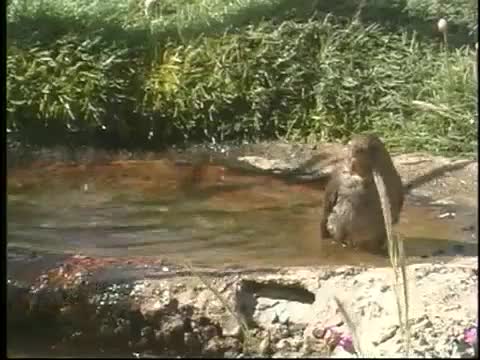
closer look at bathing and birds why they do it where they do it and how they do it. Most birds have only one set of feathers that have to last them for the whole here. These feathers have to remain in good condition through all the flying all the storms all the cold and all the wind. No wonder birds spend so much time each day preening and bathing. Some birds like this California seem almost hesitant to bathe. Watch how it keeps looking up and all around. For some birds bathing may be a dangerous time for their on the ground and out in the open. And maybe more vulnerable to predators. Other birds like this common grackle really get into it. Notice how it flutters its wings and tail and even shakes its whole body to get its By the way. It even takes time out to squash the passer by.
Birds bathe in a variety of locations. Many come to the spots we provide such as this chipping Sparrow bathing in the sunken rocks. Boy is this bird wet. Others like this female mallard may use a natural pool of water for bathing. Even though ducks spend most of their time in the water they get back in the water and say. Another place birds bathe is the ocean. These royal and sandwich terns look like they're having a good time almost playing in the waves. They are really good in the sort of. Birds bait variety of ways but there seem to be some common themes. Many birds seem to start by putting their head in the water and then working backwards. It
may be that the head spreads water over the back as in this black neck still who really gets a rhythm going. This semi pomade of blubber also starts its baiting with its head and then seems to ruffle its wings. It's like a miniature version of the actions of the larger still. Roseate Spoonbills have very large wings during bathing they beat their wings against the water to get water flying in all directions. This individual seems to almost soak its wings and preened them right in the water. This white Ibis is also beating its wings as well as using its head to get water over its body. Notice how wood often scratches or washes the area right next to its
bill. This bird feeds by sticking its peel into the water and sometimes mud and it may have to clean off the dirt from this area more often. Its also an area that I cannot clean with its bill so it uses its feet to scratch and scrub here. When you're near water keep your eye out for birds bathing and take a closer look at how they actually do it. Here's our next clue for the mystery bird. The first is it has a white all under the wings and the second is it it's mostly carpenter ants. We could use one of those around here. That's true. We're here today to show you some very special little Al's called burrowing ells that live in residential neighborhoods like this in South Florida. The owls are here because this is good habitat. The ground is dry and a good place for their burrows and their food source
as grasshoppers crickets and other insects that live in the weedy vegetation. So this is prime real estate for OWL. What do you like to have a pair of these out as your backyard neighbors. Look at the owl sign that people in this neighborhood made this time to mark the Alberto. So it would be mowed around. There's even a little perch for the owls. Yes they are called burrowing elves because they live in underground Burrows often they will choose an abandoned burrow such as that of a tortoise armadillo woodchuck or skunk. These ALS also live out West where they can be found in abandoned prairie dog Burrows. In addition to vacant lots in residential neighborhoods other barreling now have attached our. Prairie. Grasslands. And thousands of golf courses. If they don't find a burrow they can dig their own in as little as two days. They use
their beak their claws and even their wings to do some of the excavation. Look at those long sparsely feathered feet and legs. Most other owls have legs that are well feathered. This sparse feathering may be an adaptation to the dried dirt habitat where they dig with their feet and do a lot of running in and out of dirt tunnels. The boroughs are a place of safety for them. If a predator such as a mammal tries to get in the barrel the Ouze will make a hissing sound like a rattle snake. These are diurnal owls. That is they are active during daylight hours unlike most Elves while hunting they will hover then catch their prey and then return to a post or the ground. These owls are tiny they're eight to nine inches long. Notice how they look around like other ALS their eyes are fixed in their sockets so they have to move their whole head to see in a different direction.
Habitat loss is the real issue for these ALS. If the lock gets old they won't have a home. We hope that doesn't happen for a long time. If you feed birds you're going to have to buy and store bird seed. And if you're very successful you're going to have to store a lot of bird seed. Absolutely. So we're going to give you this scoop on storing bird seed. Here's some tips for some of the things that we have learned that we have learned at least travel here to be just great for story bird seed because they're metal and they're protected and we take the largest cans and we put the seed we use most often in that this is whole sunflower and it's one of the CDs we use the most of we take a smaller can like this one and we keep our specialty seeds in it. Because we have less of these seeds and sometimes they're in different bags. Here we have safflower. And we have a finch mix right here. And then we have some this'll right here that were
storing in smaller containers in there so that way we can keep all those rights together. Now here's a nice container here I'm a sucker for attractive decorative items I really like this container it has all those pretty pictures of the bird song from. I must admit this is. A more expensive container and my husband has some qualms about me buying it. You were right and I was wrong and that is wrong. That's the attitude I like. In this container. I store are mixed. There's a lot of it. Next two scoops you've got to get the seed out you've got to get it in the feeder. Here are a couple of scoops to look for. This is a nice watch a little square scooping has edges that help for the seed right into the feeder so that's a good little one there. There's another school that is a sort of a space age group it's got a large mouth here we scoop the seed and then you pour it out the end. This is how it works. Scoop down here and just pour looks like there isn't anything the great invention. People are really thinking about this.
Absolutely. Here are two scoops I like. One is a very easy. This is just a tenner that I bought in the supermarket is for mixing orange juice or lemonade. It's handy because it contains just the right amount of seed to fill an average tubular bird feeder. The sea just pours out like that. This is a neat little scoop. It has a lever on the bottom and you want to close the lever like that and then see if you hold it over the bird feeder and then you open the low. Right now the next thing to think about is where are you going to store the seed. Billy and I like to stay outside and we especially keep it out of the sun. But there's one more thing to think about and that is the raccoons and squirrels that are outside. This is what we do. We sometimes put a bungee cord over the top so that they can get the top off. We make a good and secure over the top. Through the top little handle and a back
like this. There they can't get in there and we can when we won So you reserve your seed just for the birds. Well honey I think that's about it we have to put these back in the garage. And. Here's the part of the show where we take time out to watch a special bird moment that we've captured on video today. It's a female Osprey. You can recognize this bird is by the band of dark feathers on her breast. This is largely absent on the male. Here is the answer to the mystery bird. It's a pileated woodpecker sometimes called
highly ended with Decker. Both are correct. Pileated woodpeckers range throughout eastern North America and across Canada into the northwest. They're mostly black with a bright red crescent and a white line that goes across their face and down their necks. The male has a red patch at the base of his bill. While in the same area the female is black. The most common calls are loud repeated notes. These are often given between h to help him keep in contact over long distances. Pileated woodpeckers eat large numbers of carpenter ants especially in winter and they can excavate huge holes in trees to get at the ants. A new nest cavity is excavated each year and it's generally made in a dead tree and from 15 to 70 feet above the ground. Both sexes take turns in the
excavation. This bird has excavated in a telephone pole at a busy intersection. We think pileated woodpeckers are one of America's most dramatic and strikingly beautiful birds. That's it for today. I guess we've got to wrap it up. Join us next week when we tell you how to keep those big birds from hopping on the birds eat at your bird feeders. I'll take a closer look at the pecking order of birds and join us on a trip to Maine where we'll see the birds of the rocky coast. So join us next week for more steps toward that home. If you have questions about birds visit Don and Lillian at Stokes birds at home dot com to order a companion products for Stokes birds at home call 1 800 3 3 8 8 4 4 0. The 450 page Stokes Field Guide to Birds includes more than 100 color photographs with color tab indexes to make bird identification easy Also available is a multi CD
collection. The Stokes Field Guide to bird songs prices includes shipping and handling order by calling 1 800 3 3 8 8 4 4 0 0 0 credit cards are accepted. Major funding for Stokes birds at home is provided by the New York wild bird food waste and killer 15:00 by Birdwood mixers inflected.
You make advocates and encourages the feeding of American songbirds and supports education through public television programs like this one. Additional funding is provided by boaters World magazine where birding adventures begin featuring full color photography expert birding tips and birding hotspot. Swift is killer but marketers designed with burgers in mind that grow Yankee's makers of bird feeders engineered with a lifetime warranty and by Mrs EK von Merton.
- Series
- Stokes Birds At Home
- Producing Organization
- Maryland Public Television
- Contributing Organization
- Maryland Public Television (Owings Mills, Maryland)
- AAPB ID
- cpb-aacip/394-22v41qwj
If you have more information about this item than what is given here, or if you have concerns about this record, we want to know! Contact us, indicating the AAPB ID (cpb-aacip/394-22v41qwj).
- Description
- Description
- A special tour of the Stokes bird garden, bathing birds, Burrowing Owls in the backyard, storing birdseed and watching Ospreys. Don and Lillian host a special tour of their beautiful, five-acre bird sanctuary,then -- watch out for the splashes - they offer a closer look at the antics of bathing birds. Next, viewers learn about Burrowing Owls, thesmall owls that live in underground tunnels, often in suburban neighb orhoods. Finally, Don and Lillian show the proper way to store birdseed, then spend a magic moment watching Osprey feeding behavior.
- Broadcast Date
- 2000-01-09
- Created Date
- 2000-01-09
- Genres
- Instructional
- Topics
- Animals
- Subjects
- Five-Acre Sanctuary
- Media type
- Moving Image
- Duration
- 00:28:10
- Credits
-
-
Producing Organization:
Maryland Public Television
Publisher: Maryland Public Television
- AAPB Contributor Holdings
-
Maryland Public Television
Identifier: SBAH000104 (Maryland Public Television)
Format: Betacam: SP
Generation: Master
Duration: 00:27:30
If you have a copy of this asset and would like us to add it to our catalog, please contact us.
- Citations
- Chicago: “Stokes Birds At Home,” 2000-01-09, Maryland Public Television, American Archive of Public Broadcasting (GBH and the Library of Congress), Boston, MA and Washington, DC, accessed October 13, 2026, http://americanarchive.org/catalog/cpb-aacip-394-22v41qwj.
- MLA: “Stokes Birds At Home.” 2000-01-09. Maryland Public Television, American Archive of Public Broadcasting (GBH and the Library of Congress), Boston, MA and Washington, DC. Web. October 13, 2026. <http://americanarchive.org/catalog/cpb-aacip-394-22v41qwj>.
- APA: Stokes Birds At Home. Boston, MA: Maryland Public Television, American Archive of Public Broadcasting (GBH and the Library of Congress), Boston, MA and Washington, DC. Retrieved from http://americanarchive.org/catalog/cpb-aacip-394-22v41qwj