Picasso Electronic Field Trip
- Transcript
I mean. What I say Picasso. What do you think of a great Spanish artist. One of the fathers of modern art. A rebel who learned all the rules of IT BROKE THE LEAD you think of his blue period when he wore blue clothes and lived in a blue room and painted almost everything in deep shades of blue all his roles period. And when he fell in love and into a new home and soul life in much warmer colors because of the cubist when his faceted paintings created a new reality for him and every other artist that's him today. At that National Gallery of Art to see how it all began when a teenager with a passion for I left home for the first time and started on the road to becoming one of this century's most important targets. So thank God. Think imagination think genius. Tasso. Coming up next on our electronic field trip to that National Gallery of Art. The Picasso electronic field trip was made possible by building Atlantic. The
heart of communication. Hi I'm Maggie lighted and this is the Picasso electronic fieldtrip a chance for all of us to look at the early years of one of this century's most dynamic and influential artist. What's an electronic fieldtrip. Well it's just like any other field trip with one major difference. You don't have to go anywhere to enjoy this first ever exhibition of Picasso's early works. Instead the exhibition is coming to you in this broadcast and your distance learning classrooms and on the Internet some of you have already submitted questions for our discussion. But if you'd like to send us one today you can send us an email message at Tripps at NPT dot o r
g. You can access at 800 5:51 0 6 to 9. Or you can call us toll free at 800 1:58 1 2 9 2. We'll repeat these numbers for you during the program today. Just look for them at the bottom of the screen. Cathy Peterson a teacher at suitland high school is in the distance learning classroom in Owings Mills. She'll be coordinating your questions from their art students from Mount Hebron high in Ellicott City with traffic for drawing in August from Quebec as are students from Jefferson junior high in Washington D.C.. They're in a very Verio right. We're at the National Gallery. And from a different floor inside at krausen State University will also be talking with students from House and high school. So let's go. The Picasso will meet today was like many of you. He was young he was talented and he had learned all the rules. But for
this young Spanish artist just learning the rules was not enough room. In 1881 in málaga Spain. A baby born was christened with 10 names in the Spanish tradition. Today we know him by only one name Picasso from the very first Picasso loved to draw on. His cousins often times would challenge him to draw different animals or to draw a dog and start with the ear or to draw a donkey and start with the tail. His father was a painter an art instructor who encouraged some say expected his son to become a great artist when Picasso was very young. It was recognized by his family which included his father that his son evidence to facility for drawing. This was so evident that by the time he was 11 years old he was
capable of being in an art academy classes in provincial towns in Spain. Kaso received a traditional and very rigorous education in art drawings that might be expected to come from a promising adult were crafted by the young artist with accuracy and vision. I think that the technique of drawing that he learned and the the rudiments and Droi that he acquired at that time played a very important role for him later on throughout the early period and later on in his life as well. It was very comfortable with drawing because he was so good at it and he always fell back on it. Some of his innovations appear first in drawing and later painting but it was not until his family moved to Barcelona the center of Catalan culture that Picasso's eyes were open to his future as an artist. Barcelona was really the center of the art guard and it was in Barcelona that he joined the group of modern Nice's
Barcelona really is the place that Picasso establishes his identity as one of these leaders rather than somebody who was going to follow in the academic tradition. It's in Barcelona where he realizes that he is quite a totally different way. Alice Cotterell got Picasso joined poets writers and other artists as they wrestled with new ideas in politics society philosophy and most of all art. It was like a pipeline of the new ideas both artistically and in a literary sense as well. And that pipeline led directly to Paris the center of the artistic world at the time. Eighteen years old and no longer interested in the academic art he had mastered. I went to see this world for himself. Picasso's life while he was living in Paris was not easy. He was very very poor. He was quite homesick. He had been used to being taken care of by his mother by adoring relatives.
Picasso developed many friendships during his years traveling between Paris and Spain. Some would help him financially. Others challenge him mentally and some were sidekick's reveling in the Parisian nightlife. One of his best friends was fellow artist and poet Carlos Kasa famous dramatically CASAR famous took his own life when spurned by the woman he loved. Picasso was stunned by the news. He later said that his friend's death was the reason he started painting almost exclusively and somber blues. And what came to be known as Picasso's blue period lasted almost three years. When Picasso was 22 the wandering artist finally settled in Paris in a rundown building called la la where the laundry barge
the house that Picasso lived in during the summer time would be extremely hot. Or during the winter time would be extremely cold. It was not your high rent. It was really quite a dump. It creaked. It had only one facility for over 30 people. It stay if that's the proper word to use. Despite these living conditions the people at Lobato love war and the freedom they found there was intoxicated. It was a time of experimentation. It was what all adolescents seemed to do and he was successful. And. Successful to the point that he realized his own ability. Late in 1904 mocassins I shifted in color from somber blues to Serene roses. But his work still concentrated on the outsiders the people marginalized by society. The loneliness of the gaunt individuals of the blue period gave way to the melancholy of the salt two moms with whom Picasso closely
identified as artists living apart from the mainstream of society. It was in this time often called his Rose period that Picasso at last found a degree of fame and financial security. Boyd with this he decided to spend the summer in the mountain village of gold souls. Same thing goes over the kaso left behind the melancholy of blue and rose and his eyes were opened to a whole new style based partly on primitive Romanes and or cave painting and sculpture. Something much tougher and more robust. Now 25 years old also becomes a truly modern art is a product of his parents ploys. That
changes the future. This is Sally Shelbourne an educator with the National Gallery of Art. Sandy tell everyone how old Picasso was when he completed this painting. Maggie he was 19 or 20 depending on the exact month that he completed this painting. It's a very interesting painting both historically and artistically historically because it may have been in Picasso's very first exhibition in 1981. And also as a prelude to this blue period artistically because it shows Picasso looking carefully at the artists around him in Paris taking the abstract lines for instance seen in the works of Paul Gauguin or Toulouse-Lautrec to create wavy patterns and abstract forms taking space tilting the table for towards us taking the floor making it go off. But most of all using color to create the mood of this compelling image. OK Sally I'm sure our audience has a lot of questions for you today about this painting. Cathy Peterson Are you ready to go.
Absolutely Maggie. We're ready and our very first question is from Mark Powell over at the National Gallery. What changes might there be if the greedy child was painted by Picasso during the Rose period. MARTIN That's a delightfully question to start us off with. Of course the first thing would be that the paintings color would change from this sort of icy blue to the warmer chalky tones in the Rose period the pinks the terra cotta but also rather than painting isolated figures Picasso painted families. So we would probably see this child with in a band also he was painting circus performers primarily and therefore the proportions of the child would change something much more athletic and we would probably see the child dressed in a costume suggesting acrobatics perhaps a ballet dancer or a tumbling costume. Lots of changes if this had been painted in the Rose period. Sally we have an e-mail from St. Peters school. They want to know is he hungry.
That's interesting too. I wondered how the students knew for sure that this was a boy because we often thought it might be a young girl. Of course the children wore the same clothes up until the age of about two. As you may know but what I think without a doubt that this definitely was a very hungry child. Look how he or she is focusing on scraping out every last morsel from the bowl. Also look and see we have a crumb of bread left that just has been eaten. And look how intently the child is looking into this bowl. Definitely a hungry child. Sally. Our next question is from Jamie Jackson and she is right here in empties Teleflex. Jamie. Why was the painting sometimes called Lego make considering the child's status. Jamie Picasso was one of the artist who particularly enjoyed a touch of irony in his in his art. And I think you see this very clearly of course of Gourmet as you obviously know is someone who enjoys all the finer things in life. And
here we have a child in a very sort of simple dress not fancy and very very plain foods. So what I think we're seeing is this irony that creeps into Picasso's art his biting wit if you will. Also. This had many titles one of them that I liked was the sweet tooth. Our next question was phoned in to us by Suze sharp in Westminster. She says I'd like to see more paintings that Picasso did about children. What would you recommend. So there are a number of them in this show. One of the most compelling I think is called the child with a dove it's just downstairs but also Picasso had four children of his own. And some of the most beautiful images of children are those that he did of his own children particularly one I like in the 1920s of his first son Paolo riding on a donkey and he dressed Paolo in his costume of a harlequin which becomes Picasso's alter ego.
It's a wonderful image. I hope you'll look further in his art for those. Sally Julie triggers that house and university and she has a question for you. To me the message is unclear in the greedy child. Would it still be considered a successful painting since the message is unclear. Julie one of the characteristics of modern art in particular is this ambiguity and artist engage us the viewers to make our own interpretations to really toss into the work so yes this painting can be considered very very successful precisely because of that. The message that remains up to us to bring our own interpretations to. We've received a fax from Paulist in Montgomery County. He asks did Picasso paint this picture because there was a great famine going on in the world. Paul I don't think that he painted it as a result of one specific famine. Perhaps if you look through the exhibition you'll notice that the idea of eating and lack of food was a preoccupation for the subject matter as a people on the
outside outside of society if you will only one of Picasso's great works. Guernica was painted as a result to a specific political or catastrophic event. But what an interesting question. If we didn't answer your question this time you can still contact us during the broadcast. You can send an e-mail message to trips at amputee dot org or fax us at 800 9 2 6 0 6 2 9. Or call us toll free at 800 to 2 to 1 2 9 2. I felt you helped us see. Looking at a painting is quite different than looking at anything else. Take a stop sign for example. You see it and you immediately know what it means.
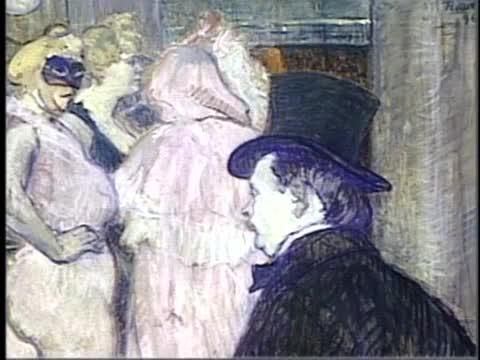
But with a work of art We've got to take some time. There are many ways to look at paintings. You can take in the color contrast and brush strokes. You can decode the artist's symbolism or experience the emotional impact of the piece. You can evaluate a painting by looking at its construction and how the artist moves your eye from place to place. And sometimes if you look carefully you can discover the artist relationship to the subject. Now let's hear some of these approaches to look at Picasso's early work. This is a painting of a dance hall in Paris called the moon one day like that it was a famous dance hall that was painted by many artists and Picasso created this wonderful atmospheric effect both through the color and through the way he painted the laydown the paint
with his brush strokes. Picasso uses a very strong contrast of light and dark color that rich velvety black of the men's evening clothes is contrast to the beautiful color and high color of women's clothes and he makes the whole atmosphere come to life by the glimpse he puts on everything the phosphorescent lights in the background. And Picasso used the paint almost directly from that to get this very thick white phosphorus and gas light effect. He really captured a very elegant and enlivened atmosphere here through the collar and through the application of paint. This is a good example of a subject that was very important to the artist and
symbolism you see here the head is Casa came us to the friend of Picasso. You heard about the suicide of his friend earlier. He's shown here dead and with a very enormous candle in the background. The candle is a symbol of the spirit of the dead friend and we know it's a symbol because of the large size and because of the color the contrast of color is enormous between this red background and the very muted colors of the face of Kasa came us. It's a very good example of an artist painting out his feelings on canvas. This is a painting Picasso made in 1985 when he visited a very tiny town in Holland. You see three Dutch girls that make that kind of column in the center of the composition and they're
standing by a canal and in the background you see a traditional house of this particular village where Picasso has done here is to simplify all the forms. So we see this Colom are a cylinder form in the center and it's stabilized by the rectangular forms of the canal in the background. And then there's the reflection of the house in the canal and like the house itself sort of stops our view from going off the canvas. Actually it's not a canvas that it's painted on cardboard. It's a beautifully constructed and very satisfying composition. This is a portrait of Gertrude Stein that Picasso painted in 1986 Gertrude Stein was a great writer and also a great connoisseur of 20th century painting. She and her brother Leo collected many of the early 20th century works that you see in museums around the world.
How did Picasso paint her and what are the clues that tell us about the character of Gertrude Stein. First of all she's seated in a very low position. She's wearing these warm brown colors and surrounded by different colors shades of brown and red and blue in the background. All of the emphasis is placed upon her face. We feel a very intimate feeling when we look at this portrait. Part of the reason is that Picasso proudly moved his easel right up to her toes to paint her. We get the feeling that we're almost in her lap when we look at this painting. This is a wonderful portrait of a very dear friend and patron of Picasso. I hope you can see that there are many different ways of looking at paintings from technique. Looking at the atmospheric effect of works of art color texture composition and that you can look at paintings on your
own using these various approaches. Right now we have Linda Downe's who is head of education at the National Gallery of Art. Linda just one quick question before we turn things over to Kathy Peterson. The stories behind paintings have always fascinated me. I understand that Gertrude Stein posed for many hours for this painting. Oh yes she did. Picasso was having a real hard time painting her face and he had her set 80 or 90 times and he finally just said I can't see you any longer and he stopped painting and he left the painting went off and actually went to Spain for three months and then came back and when he came back the style of his paintings had changed so much that he painted her face without looking at her. And a friend of his said but Gertrude doesn't look like that at all. And he said she will. That's where he goes that's Picasso for you. All right Cathy Peterson. What else do our students want to know about looking at art the way experts do.
Let's start with Triston made from Jefferson junior high Triston. I'd like to know more about Picasso's work which one of his paintings that he enjoyed the most. Well that's a good question Triston I think at a very early age. Picasso felt that he was doing something very very important. And consequently he collected and saved every painting drawing piece of sculpture that he ever made and and carefully documented it as well. He kept photographs and letters and various memorabilia about the works of art that he saved. So I think he had a very high regard for most of his work. And and also later on in his career he went back to this early work because he was very he was fascinated with what he had done at a very early age and it influenced his work later on. We have an e-mail in Dennet's from my class in Frederick Maryland. They want to
know is one element of our more important than the other. Or does it depend on the work of art. It really does depend on the work of art. For example in the blue period the color blue is very important as are the gestures and the and the positions of the figures and the paintings in other paintings the texture or line is much more important. So you're right it really does depend on the individual work of art. And from here in these tele plaques we have Nicola hobby. Go ahead Nicola Why are all the faces in his paintings. So androgenous Well I don't think all of his portraits the figures in his paintings are in trudges. Perhaps you're thinking about the later period in this exhibition where he's using sort of a mask like face and and there you can't tell between you know whether the face is masculine or
feminine but certainly in some of the earlier periods like the rose period there are very very feminine faces that are shown and later on he was fascinated by the craggy old face of a man that he saw at Gozal. So it depends on the period that you're thinking of but probably if you're thinking of the late classical period that's when the faces become androgynous because he's looking for a universal kind of face. Linda we have a question phoned in by Bobby W. from Bellaire. He says he's heard about looking at shape and form and painting and wants to know the difference between the two. Well Bobbie if you think of a piece of paper as a simple shape a two dimensional shape that's what you can find in Picasso's work as well as forms. Forms are built up. They
have three dimensionality. They have shading. They look like sculpture and you can find both shapes and forms and Picasso's paintings. Linda Virginia Caligari at Towson University has a question. Virginia why are these paintings considered masterpieces and were they considered masterpieces when the castle was alive. Virginia that is a tough question and I'll try and answer it for you. There are many works that of course are considered masterworks in this exhibition. Usually when we talk about a masterpiece we're talking about a work that's a culminating work in the history of the artist's career. It has multiple meanings it has universal. Attraction to people and certainly there are many works like salt and bungs and luvvy and many works in the exhibition that are considered masterpieces and that Picasso set out to paint as major works of
art. But I wouldn't say that every work of art in the in the exhibition is a masterpiece. It also and it's something that you have to evaluate yourself in terms of what are the major works that really strike you and really hold your attention. So viewers response to works of art also adds to whether a work is a masterpiece or not. Thanks Linda. Remember you can still send us your questions for the experts. You'll meet today. The e-mail address is trips at npr.org. Our fax number is 800 9 2 6 0 6 2 9. And our phone number is 800 1:58. 1 2 9 2. Probably more than any of us. Artists are like sponges. The poems they read the place they see the paintings and techniques they admire. And one way or the other
all bring become part of their work. Sometimes these ideas and techniques unconsciously into an artist's work as if they were always there. Sometimes they're coming is more deliberate. One of the things that's really fascinating when we look at the work of an artist like Picasso an artist who so wonderfully and incredibly well known is that we discover that he's been looking at other artists and there are many artists that influence him and that influence and the way that it's revealed in his work changes through this period. Linda Downes has already told you a lot about this picture and about why Picasso was interested in this kind of subject. He was also interested in the art of Toulouse-Lautrec. We have a painting in our own collection by to loose track of a man sitting in one of these dance halls and he seems very calm. He even seems slightly bored. The light is more even so you see more clearly the figures in the background and it just seems to be more
ordinary more commonplace and Picasso seems to not present this as something that's so pleasant or so entertaining or so enjoyable. Instead this is really an aspect of degeneracy and the underside of Parisian society. So already he's a very young man and he's recently arrived in Paris but he begins to interpret this subject matter of a famous painter like Toulouse-Lautrec in his own personal way. What. Picasso was still studying art in Spain. He was also interested in El Greco who was a very prominent artist in Spain in the 16th century. This painting by Pablo Picasso created when he was a teenager is very much in the style of El Greco. You see that his face is long and thin it's thin this is exaggerated. Even the goatee or the beard that the man has is a style that was
fashionable in the 16th and 17th century. In fact this face looks somewhat like the face of an important figure in one of our own paintings called St. Martin and the beggar. So if you look closely at the faces in St. Martin and the beggar you'll see the same kind of slightly greenish power to the flesh. You'll see the same elongated of the face you'll see the same angularity of the features. So we can tell immediately by comparing the two faces that Picasso has followed very closely the example of gringo. The concert comes to Paris and for a brief period at least he emulates the impressionist who were popular a generation earlier. We see the brighter colors and we see some of the individual brush strokes that are identified with the typical Impressionist style. Now in our collection we have many paintings by the Impressionist including a view of one of the Parisian boulevards by an artist
named Camille Pizarro and it too shows figures going about their business on the street. But it gives the same kind of skewed perspective. It's is though it's a little instantaneous slice of life. Now we've seen Picasso rather obviously influenced by painters like El Greco the Impressionists and to loose track. Let's go upstairs and he's still influenced by other painters but it's going to be much harder to recognize. This painting of two women at a bar actually contains a reference to a very famous artist who were often depicted young women in the South Seas. We concentrate on the figure of the woman on the left. We can see the influence of Paul Gauguin for instance. Notice her shoulders the angularity of her shoulders the taper of her torso from her shoulders down towards her waist. Even the torsion in her body. And also note the way her figure is silhouetted against the blue wall and the brown bar
against which he's leaning. We have a painting in the National Gallery's collection called The bathers and the central most figure in that composition almost seems to be a model for this figure in one of these low class bars in Paris. And of course go Gannon's. Art was much more warm and it was more appealing because of the color and because of the sensuous subject matter. And here everything is dark and it's gloomy and it reflects Picasso's own melancholic mood at this period. Now at this point Picasso is still looking at other artists but as he doesn't reveal the influence of Gauguin so obviously or so clearly he begins the process as he matures as he becomes more independent as he becomes more original in his work. He begins to just take what he needs from other artists and incorporate it into his own mature style. And he's going to live for 70 more years and he's going to continue to look at the painters that we've
already talked about. He's going to discover new artists that interest him and he's going to continue this process of looking. But now it's going to be harder and harder to find the influence of these other artists because Picasso is about to embark on a period of continuous innovation and change and incredible originality. In fact that's one of the things he's known for. Now joining us is Will's got an educator here at the National Gallery of Art. Well we just saw that many artists influenced Picasso. We're standing in front of a painting by Patman yock someone who was also very influential in Picasso's life. Could you tell us a little bit more about Minya. Well when Jaquez also Spanish he was about 10 years older than Picasso and had come to Paris and had established himself as a minor dealer of modern Spanish painting. He spoke French fluently. And so he was able to get Picasso established in the Parisian art world rather quickly. He also paid Picasso a modest stipend each month in return for the
production of his studio so that that definitely made him a popular person help them. OK. OK. Let's find out what kind of questions our students have about the people who influence Picasso's Picasso. Kevin Pietersen what our students. Have to ask. We've got a ton of questions. Maggie let's start over there at the National Gallery viewing area. With Maria Bennett. What American artist did Picasso admire. Well Maria that's a great question for this time in history in the late 19th and early 20th century. Most European artists especially young artists like Picasso who were interested in what was happening in Paris knew very little about American art. Picasso may have known the name of James McNeill Whistler but other than that he probably knew no American artists and if he did he probably wasn't very impressed by them. Well our next question comes in the form of an email from Maria g in Washington D.C. She says. Manioc looks like a very
powerful man. Was he really. Well I don't think that you would say that he was terribly powerful in a broad sense. He came from a well-to-do manufacturing family in Spain. He was interested in art and so he came to Paris. But when his father died a few years later he returned and took over the family safe and lock business. But he was very powerful in relation to Picasso who was a young artist who didn't speak French and had few contacts outside the Spanish community in Paris. And so in that sense yes he was extremely powerful for Pablo Picasso. Jennifer's Lalan is here in amputee's tell plex and she has a question for you. Jennifer known rationale behind the classes choice to leave the clothing in the painting of peer Minya virtually formless in the face of such form. And could this have been for a contrast or maybe personal meaning. Well that shows that you've been looking very carefully at the painting and it's certainly true that the face is
better defined. The easy explanation is that Picasso painted this as many of his other works at an earlier stage. And I think you might learn more of this at another point in the program. He had depicted minyak as a matador and then he repainted it. Putting him in more ordinary clothing of the day except for the thin red tie. And he left the face on repainted. And so there is more of that forceful real is him in that sense of character in the face Picasso style was changing as he painted this. And so the costume as you notice the other parts of the costume are more some earlier of sketchily rendered. And so it is partly a change in his style partly the evolution of his art and the changing way that he thought about the art of painting that explains what you noticed. A question that was sent to us in a letter from Gilpin Manor elementary and Elkton. They want to know why Picasso put the black outline around the
figure in this painting. Well the black outline is explained in one way because because I was interested in a lot of graphic artists illustrators and artists that design posters who used a heavy dark outline such as Toulouse-Lautrec did on the other hand as I think one of the earlier segments I helped you see Picasso thought about shape and line and color very much in an abstract sense. By this time and so that black outline helps define the shape particularly of monarchs white shirt and makes that have more impact more significance in his composition because of the heavy dark outline. So he used it both for reasons of interest in terms of the artist that he was studying and also because he saw this as an integral part of his increasingly abstract concepts conception of the art of painting. Well Joe Hicks says the question at Towson University. Joe go ahead.
Did Paul Gauguin influence Picasso did Picasso influence Pogo. Well Joe you've either been looking very carefully or you've been reading and looking at the same time because there's an extremely close relationship between Gauguin and Picasso Gauguin was older. He was very well-established in the avant garde or modern circles in Paris. Picasso as a young artist coming to Paris to see what was happening in the avant garde art world would have looked at to go against works closely. He did that and he was very much influenced by this older more important and better known artist. So the influence flows that way from Gauguin into Picasso's art. As you've noticed. We have a letter from Amber McGuire in Chesterton. Amber wants to know if Picasso always painted people in his paintings. Amber that's also a very good question because Picasso was primarily a figurative artist. He began his training as an artist in drawing
casts of the human figure in the living model. And then throughout the remainder of his very long life and career his primary subject is the human figure. He painted few landscapes. He did paint many still life compositions but he is first foremost and always a figurative painter. One more question will from Jay ass. Did Picasso have other patrons. Did he paint portraits portraits of them as well. Picasso did in fact paint many people who helped him in different ways. Many of his friends his family members patrons as you mentioned who supported his art by purchasing it. He was constantly interested in the people around him and depicting them. So there are patrons and dealers like Can Beiler his next important dealer at manioc another important dealer Ambrozy yard. He painted all of these people and many others who are less known
to us today. Thanks Will for helping us understand some of the things that made Picasso the kind of artist he was. Remember if you still have questions about Picasso's art you can send them to us at our email address Tripps at MPD dot org or fax them at eight hundred nine 6 2 0 6 2 9. Or give us a phone call at 800 to 2 2 1 2 9 2. Picasso loved to play with words his friend Gertrude Stein introduced him to two sisters from Baltimore. Atta and Claribel Koehn who were assembling what would become a great collection of modern art Picasso delighted in
calling them the Miss cones which means hey high heels in Spanish. Evidently they never caught on. Sometimes this sly humor crept into his paintings. Even in this portrait you'll see what I mean. Just keep your eye on the tie. In secluded workrooms at the National Gallery of Art specialists clean and examine priceless paintings. Conservatory and Herron's Wald is caretaker for the Picasso exhibition. Well I think the most exciting thing is to make discoveries on pictures we're able to get very close to them as close as the artists did. We use microscopes we use special cameras and all of this allows us to to really penetrate a picture and understand how the artist's work. By examining the portrait of their maniac conservators discovered that
Picasso's friend was originally painted wearing the bullfighters probably Eleusis or Sudip lights complete with epaulets on the shoulders. Picasso also chose to paint his patron in the traditional bullfighters stands with one hand resting on his him. Today Picasso shows the world his friend in the straightforward guise of a conservative businessman. Or did he even in the picture as we see it today is this thin little red tie which in fact nobody in 1991 would have worn except for a bullfighter. I've always thought that in fact this was Picasso's little joke saying I know that I first painted you as a bullfighter and you remember this. And if anybody is clever enough to know that this red tie is a bullfighters Well good for them that this is this is just the game I'm playing and this is in fact what Picasso does. Time and time again he leaves clues on the surface of his pictures. So you have some sense that there may be something else underneath.
This day. Tasos tragedy is prepped for examination. Clues on the surface of the work such as in Pasto and bits of orange and yellow paint peeking through the somber blue Serapis call for further investigation. Raised. The denser paint below the surface. Showing a faint image of a horse's head. And what appears to be on a porch. When we saw the course initially we were very excited because it was so clear that we had. Something very different from what was on the surface of the picture. The next step. Was infrared. Photography. This camera is so sensitive. He. Said it must be super cool. With liquid. Nitrogen. The picture is taken. And images appear on a nearby computer screen. The figure of a running man appears in. The back of a horse with his tail bunched
up. And the arches again. After meeting with a gallery historian. And Herron's Raul and her team identify the paintings as belonging to two separate bullfight seem similar to those Picasso painted in 19:1 and. What were the arches in the 8:51 one bullfight scene became in fact the headdresses the plumes on the horses that are being left out of the of the arena in the night you know to image the horses is in fact fit in perfectly in the contour of the the man on the beach. So he keeps taking elements shapes and forms and. Reinterpreting them in in every painting he he adds. When Picasso paints over his paintings he is simply revealing the fact that his pictures really are never finished. His mind is constantly moving. He keeps seeing things in his own painting and he wants to then.
Incorporate them in that idea and I think this simply reinforces what a. Genius. Is his an. Artist. I'm here with and needs wall conservator and and Henderson a museum educator and sort of a pivotal work of this exhibition Picasso's family of Salten Bobs. And Hollings Well I'm sure you and your crew have examined this painting very closely. What did you find below its surface. Well actually below the surface we know by using X-rays and infrared cameras that there are at least four other paintings so we have this image on the surface and directly underneath this is a group of people similar group but the man on the left instead of being a Harlequin is a man with a top hat and carrying a satchel. And we also realized that there's a dog. Where were the judges. And we have a sketch in the show that shows. This exact
image with the figure with the top hat. And then underneath that we know that there are two acrobats and a dog. And beneath that is a composition of a circus family where we have a girl balancing on a ball and we have a woman carrying sticks and all of these images one on top of the other. Take elements from from the lower level and then incorporate them into the next one. OK. And Henderson Perhaps you could tell us a little more about the painting itself. Certainly Maggie I think one of the interesting things is the fact that the title family of Salten box this is a group of people it's not really a family like you would think of parents with their children but rather a group of associates they're all circus performers. So they are friends and therefore forming a family together. And I think this was important for Picasso at the time he was in Paris it was painted in 1994 the cost of had just moved to Paris and needed an association and the family was very
important to him at the time. And it was painted it was also quite a major investment for Picasso. You can tell obviously by the size of it that it's a large canvas that would have been a major investment of money for Picasso at this time to buy a canvas at this scale was also investment of his time. He spent 15 months painting this work as an mentioned there are four other compositions underneath it so he worked on it for a while. He was also working on other paintings. But it certainly was an investment for him. He just kept going till he got it right. All right. And and and you know when I first saw pictures of the family salted buns I didn't realize what a monumental picture it was. It's probably the largest painting in the exhibit. Kathy Peterson I'm sure our students have plenty of questions about this work. Where should we start. Yes they certainly do. MAGGIE. How about Cynthia Rivers asking her question. She's from Jefferson junior high and at the National Gallery. OK Cynthia ask your question why do the clowns in Picasso's Rose
period paintings look sad. Well Cynthia I think you've noticed and been looking at the painting obviously to get the mood and the feeling from the work itself these performers the Salten box were part of a group of performers that were more or less on the edge of society they were not really an integral part of it they were kind of on the fringe. And so I think there is a sense of isolation that comes through through their faces but also through their bodies that they're a little bit isolated one from another one so they're not really interacting together as a group like you might expect. So there is this sense of sadness and a little bit of isolation as you noticed we have a question an e-mail from Elizabeth JELAS in Harford County. She asks who were the circus performers supposed to represent. Well that's a very good question and one which has actually interested scholars and art historians for quite a while figuring out who all these people are. There
was a circus in Picasso's neighborhood the Cirque Medrano. So when Picasso was in Paris he became friends with many of these performers and associated with them closely. And so the kaso probably used a lot of these friends as his models. He's also done an interesting thing he's included himself in this painting. He's the harlequin figure here over on the left with his back towards the viewer. Again showing a little bit isolation. But he's included himself as part of this group. We know that the gentleman who is in the jester outfit in the red costume next to him was one of the performers from the Cirque Medrano L-CIO PFA. And other than that though the other figures are not positively identified there's been a lot of speculation about who they are artists or writers or friends. But no one really knows for sure who exactly they are. Fawad Khan here at Petey's Teleflex has a question for and how Hollywood swelled.
A. Why. What cause Pablo Picasso to paint the family of saltimbocca four times. I think the reason why he repainted it over and over again is because. He is working out his problems on the canvas although he did many drawings for his images. It's really on the canvas that he is he is coming to terms with what the final image is going to be and he takes elements from one composition his He's a former shape and then incorporates that into the next one as I've mentioned before I think that he found that one of the things he once said was that the paintings are some of the destructions. And so he takes them apart and then puts them back together again. And and that is why I believe he was repainting the pictures. And we have another question for you from Marie about at Towson University. Go ahead Marie. Hi. What kind of work was involved for conservatories to prepare for this exhibit. Well the preparation for this exhibition actually started several years ago when we first proposed the idea at that point. We.
Decided that we would do the major treatment and the cleaning and the removal of all discolored varnish from several of the pictures just so that they could look their very best for the exhibition. And then the other thing we did was start to closely examine our own pictures in the in our collection doing the X-rays doing infrared and learning as much as we possibly could about them. And then as the exhibition came closer and the paintings came in from the lenders to the National Gallery we in fact examined every painting as it came in to recognize what the condition was. And then at each venue of the exhibition as it comes in and goes out we will check it just to make sure that there are no changes in each work of art. We have an e-mail question from Joe Allen in Hagerstown. He asks
Why is the background in the family of the salt in bonks so bare. Well that's a very good question and that is an important part of this work as you're looking at the painting the background or the landscape is a very important part of the work. It's not a specific place it's certainly not Paris like we might think about Paris. And since we know the performers were there you would expect to see Paris in the background. But the fact that the baroness are really the fact that it's not any specific place the work tends to have a more universal appeal. It tends to be any place that you would like to have these performers. And also I think adds to the mystery of the work a little bit as well. Some of the things we've been talking about the fact that the figures are a little bit isolated you're not quite sure what's happening in their relationship. And then the Baroness of this landscape all contributes to the mood and the mystery in a sense about this painting. So it was a good question. Unfortunately that's all the time we have for questions today if we didn't get to yours. You can expect an answer through an e-mail message or a letter and we'll get those
out to you as soon as possible. As it's been great being here with you today seeing all this wonderful art in exploring the stories behind it really opened my eyes and we hope that it has done the same for you. I'd like to thank Kathy Peterson for helping us get your questions answered today. Our students who are with us in the distance learning classrooms and all of you watching for helping make this field trip a success. This part of the field trip is over but that doesn't mean you have to stop your electronic travels. You can still learn more about this celebrated artist through a visit at our Web site at. W w w dot m p t dot o r g and your family
can also go along on the voyage with you by watching a primetime special on the Picasso electronic field trip scheduled for June 26 at 7:30 p.m. on amputee network stations and on July 2nd starting at 10:30 p.m. on WECT. Now an announcement I'm sure you have been waiting for. We have a contest to create a collage an art form Picasso in Vinet the winner will receive a special tour of the exhibition transportation included. It was tough to make a decision but our judges have selected Carol Mellers eighth grade class from our Lady of hope school in Baltimore. And we're really pleased for them and a very special thanks to all of you who entered our contest. It's time for us to go. But I'd like to leave you with one thought. The Picasso story is just one part of the endless chronicle of art. It's just waiting for you to explore in museums in books on the
Internet or where ever your imagination takes you. It's up to you to make it your own. And while you're at it get out your oils and clay and pencils and start writing your own page in this magnificent story. See you on the next electronic fieldtrip. Is. The Picasso electronic fieldtrip is made possible by Billboard Levick the heart
of communication
- Program
- Picasso Electronic Field Trip
- Producing Organization
- Maryland Public Television
- Contributing Organization
- Maryland Public Television (Owings Mills, Maryland)
- AAPB ID
- cpb-aacip/394-01pg4nfd
If you have more information about this item than what is given here, or if you have concerns about this record, we want to know! Contact us, indicating the AAPB ID (cpb-aacip/394-01pg4nfd).
- Description
- Episode Description
- PICASSO ELECTRONIC FIELD TRIP
- Created Date
- 2000-10-26
- Created Date
- 1997-05-21
- Asset type
- Program
- Topics
- Fine Arts
- Media type
- Moving Image
- Duration
- 00:57:34
- Credits
-
-
Distributor: Maryland Public Television
Producing Organization: Maryland Public Television
- AAPB Contributor Holdings
-
Maryland Public Television
Identifier: 2M6-1283- 55321 (Maryland Public Television)
Format: Betacam: SP
Generation: Master
Duration: 00:56:48
If you have a copy of this asset and would like us to add it to our catalog, please contact us.
- Citations
- Chicago: “Picasso Electronic Field Trip,” 2000-10-26, Maryland Public Television, American Archive of Public Broadcasting (GBH and the Library of Congress), Boston, MA and Washington, DC, accessed December 15, 2025, http://americanarchive.org/catalog/cpb-aacip-394-01pg4nfd.
- MLA: “Picasso Electronic Field Trip.” 2000-10-26. Maryland Public Television, American Archive of Public Broadcasting (GBH and the Library of Congress), Boston, MA and Washington, DC. Web. December 15, 2025. <http://americanarchive.org/catalog/cpb-aacip-394-01pg4nfd>.
- APA: Picasso Electronic Field Trip. Boston, MA: Maryland Public Television, American Archive of Public Broadcasting (GBH and the Library of Congress), Boston, MA and Washington, DC. Retrieved from http://americanarchive.org/catalog/cpb-aacip-394-01pg4nfd