Black Horizons; 3305; Black History Month 2002
- Transcript
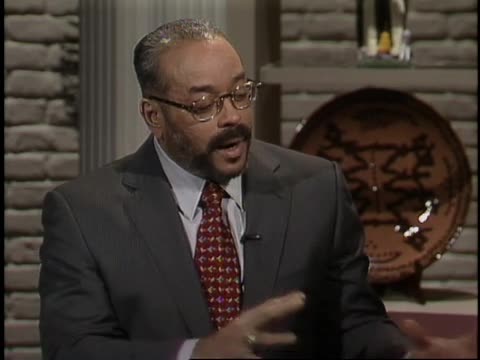
Welcome to Black Horizons. I'm your host, Chris Moore. Thanks for joining us for this special Black History Month edition. Now, if you're a regular view of the program, you know that African American history is something that celebrated year round here at Black Horizons. However, tonight we're going to talk to a few local authors and historians who's work illuminates the African American experience. Our first lady of letters is the author of the battle is not yours. The story of a mother -daughter relationship that spans the turbulent 60s and 70s. Please welcome Trisha Gatson. Welcome to our program. Glad to have you here. Tell me about this title. What does it come from? The battle is not yours. The battle is not yours. It's a line from a gospel song sung by Yelanda Adams. It's very popular. Yes, absolutely. And actually, the song inspired me during some very difficult times. And as I began to pin this novel, I wrote about
life lessons, some life's lessons that I learned. Now, you make the point that this is a novel, this is fiction, but some of it is autobiographical, isn't it? That's correct. What parts? Well, it is true that my mother died of AIDS approximately four and a half years ago, five years ago. And it is true that she and I loved one another dearly, but we had a very conflictual, tumultuous relationship. As mothers and daughters sometimes can't have. Exactly. What were the conflicts you think? Well, as I reflect back now, I think that a lot of it had to do with the fact that I was immature and did not have the chance to work out some, just work out relationship flaws, I guess. Being a mother myself now, I see myself and my daughter. And sometimes I wish my mother was here so that I could give her the opportunity to say, I told
you so. Sometimes the older we get, the smarter our parents seem to get. Exactly. Also, this is very touching because you write about also coming from the DC area living here in Pittsburgh and having sort of homes in both of them. So you touch on some of the aspects of both places, right? Exactly. Exactly. So, Pittsburghers could find this very familiar. Exactly. Pittsburghers would definitely, especially those in the Mon Valley communities would find a sense of recognition because I speak of some of the nuances from the Mon Valley communities and some of the experiences. And then the scenario fluctuates actually back and forth between the Allegheny County area and the Washington DC metropolitan area, which is where I'm originally from. Now, I realize this is sensitive, but your mother did die of AIDS. And I had the opportunity to, you reminded me of meeting your mother once. And I remember the meeting you and your mother were in Columbus, Ohio. And I met you there at a conference once and it was
a meeting sort of in passing year from Pittsburgh. And you told me about this, but this was very trying her illness for you. How did she contact AIDS and how did that have an impact upon your relationship? Well, actually, I'm really glad that you asked that particular question because a lot of people find it difficult to believe that I never once asked her, how does she contract the virus? I never once did because it never mattered. And I think that that is an important piece of information for people who are listening to day whose loved ones may be living with HIV or AIDS, especially in an African -American community and a church communities. We sometimes put our compassion, our compassion is contingent upon how a person may have contracted the virus. I assume that my mother may have contracted it from non -protected sex, sexual intercourse. That's
something difficult for a daughter to probably think about. We don't think I was our parents' sexual breach. It's sexual breach, yes. Exactly, exactly. So I can assume that although she was an emergency room nurse and she wasn't ER nurse and also a nurse in the DCJLs, at a time when OSHA rules were not strictly adhered to. And I remember over the years hearing my mother talk about her career and talk about when he ran out of supplies and rubber gloves and things of that nature. So I'm not... The kinds of things she would do in an emergency where she might contact someone else's bodily fluids. Exactly. Who may have had the disease. Exactly. So I'm not sure. And like I said, I never asked her partly because our relationship was conflictual at times because our personalities were so different. The irony is that some people say as different as we
were, we were equally alike in a lot of areas. But I just never asked her because I learned from volunteering at the Pittsburgh AIDS Task Force that your love should be unconditional. And so it shouldn't matter. And I stress that point in the novel that I wrote that when I use the analogy that if you have a loved one who crosses the street and is hit by a bus, you never stop to ask them what's the light red or green because that doesn't matter. What does matter is that your loved one needs you and that you're able to lend your support. Were you and your mother able to reconcile some of your differences before her death? And is that paralleled in the novel at all? Yes it is. Yes to both questions actually. We were able to reconcile. Actually she had the foresight to say certain things to me prior to her death that I really did not want to hear. I can remember her saying things like I don't
want you to worry after I'm gone. You did everything that you could for me and I know that you love me and she would just make statements like that. I imagine it's very healing at this point. It is healing and it was healing, writing the novel. A lot of people ask me why I did it because it does loosely parallel my life but again it is fiction but a lot of people ask me why I did it. There's some other parallels too. Your father died in Vietnam when you were a very young child and in the novel I believe the daughter's husband dies in war. No the mother's. So that parallel is there also. How did you bring with that to life in the novel having dealt with it so closely personally? Well I wanted to for the two main characters I wanted to show that they really had to depend on one another because they suffered a tragedy very early on in life. In the novel the main characters
name is Lorraine the mother character and Lorraine suffered the loss of her husband. She became a widow at the age of 23 and at that time she had a four -year -old daughter and that is an important piece of the novel to understand why the two characters were so dependent on one another and were so close and you can follow their relationship to a certain point until the daughter character Sharina becomes a certain age and rebels because she wants to be independent she wants to be free of her mother yet the mother is her identity is so tied into the daughter and there's such a large level of commitment that they want to keep the two that she wants to keep the two of them very tightly knit. People have a look at you and say you're too young to know anything about Vietnam. I get that a lot when people
are in general conversation they may talk about Vietnam or I've met Marines and they'll talk about the Marine Corps lifestyle and then I'll nod and they'll make a funny joke and say oh you don't know anything about that and actually a lot of people are shocked when I say yes I do remember quite vividly what it was like during the Vietnam era I remember the stories about the POWs and wishing that perhaps there was a mistake in my father's category they used to use the term KIA which is killed in action and I used to hope and pray at night in my bed that the category was wrong and that he was a POW and wouldn't and would at some point return to us. So is there healing in the novel where people come away with a very sad feeling or will they come away with something else to realize that the battle is not yours? I think that the reader will come
away with a gamut of emotions initially the first part of the novel is called the disclosure and that's where the mother Lorraine discloses to her daughter that she is HIV positive and it's a very moving and heart -wrenching piece and I tried to write it as such so that people could really be moved by the fact that this is a middle class African -American family that their entire world is rocked by the fact that this woman this nurse who has worked to put her daughter through college finds out she's HIV positive but then as you begin to travel through and read through the novel you'll come across some very funny parts, some touching parts, some historical parts. And the daughter also has a sensitive husband too. Oh absolutely. It's tuned with what's going on and that's a good thing because there's a real sense of family that I got in reading the first couple of chapters. Exactly. I want to thank you it's on sale now and
bookstores everywhere. Yes well definitely all of the online merchants and then also you can order it in any bookstore. All right and it's called the battle is not yours. The battle is not yours. Appreciate you very much for being here with us we appreciate it. What makes a community leader? Is it faith, dedication, stamina? Each year a panel of distinguished judges selects four outstanding African -Americans for our community leader awards. The awards are given in the fields of art, culture and recreation, business and government, education and civic and community involvement. Our first winner is Mr. Bill Strickland. WQD salutes community leaders in celebration of Black History Month. As founder, president and CEO of the Manchester Craftsman's Guild, Bidwell Training Center William Strickland helps prepare students of all ages for world full of possibilities. The facility has been here since 1986 and I put together a concept for a vocational school that incorporated the arts, incorporated technology, incorporated
the best elements of the service industry to provide an environment that was positive and reassuring and nurturing for the students who come here. Manchester Bidwell provides a wide curriculum of artistic, academic and life skills classes to serve the community. The working philosophy of Manchester Bidwell is one of mutual dignity and respect. A philosophy, Bill Strickland takes to heart. WQD celebrates William Strickland, a Black History Month community leader. We'll present other community leader award winners throughout the program. Our next guest is the author of an autobiography that takes the reader along his journey through the always changing America. The book is called Breaking Barriers and our guest is author Kenneth Whitlock. Mr. Whitlock, I've always respected you. I've known you for a number of years now, but in reading your book in that first chapter, when you were one of the original Marines, not only from this area, but the original Black Marines at Monford Point and what you
all did when you were going overseas going through that bus station in Atlanta, I have taken my hat off to you. You're a bad man. I have to tell you, sir. Can you tell us about how your book opens being in the Marines? And I know there was an incident before when you were a college student. You might want to even go to that part of it. When I was a college student in my freshman year, I was fortunate enough to have made the first team with the Brewer Twins, Johnny and James Brewer. This is football. You're going to go play Mars Brown in Atlanta. Yes, we won the championship and they won in their division. So now we're going to have a postseason game to play a Mars Brown, a Ponce de Lawn stadium in Atlanta, Georgia. Of course, you know everything was segregated and so consequently, the stands were segregated also. This is 1939. 1939. And our guest, as we were told, was the squad from the University of Georgia. And the first part of the game, believe it or not, was
this punting tool between yours truly and big -trained moody. You were called the Toe. I was called the Toe. Well, Luc Groza was the Toe. Yes. But they claim in high school average of 55 yards. 55 yards a pot? They don't believe it. 55 yards was the average because it did a lot of quick kicking. All right. And so the first part of the game was a kicking tool. It was a kicking tool between big -trained and yours truly. Big -trained kick. And of course, he's getting about 53 yards. I turned around after the coach says it will kick on second down, you know what I mean, because we were up in our territory. Quick kick. So I quick kicked about close to 68 yards. And of course, the safety man traveled for the ball, but no offense is trying to catch it, because the brewer twins were going to take care. And so I must remember when you kick a ball, it's where the line of scrimmage is, to where it stops. And so we did that for about eight times, the
first quarter. We kicked about eight times. And my last punt was close to 73 yards through the year. And the stands stood up and cheered. But you guys lost. We lost 13 -7. 13 -7. We lost. We'd go through the bus station in Atlanta. Something happened. Well, then after the game was over, the president's daughter invited the brewer twins in yours truly to breakfast. So we went to breakfast, permission of the coach. And after breakfast, of course, which was very enticing, when we arrived at the bus at our headquarters, which was the gymnasium, there was no bus. They were gone. You guys had to run eight blocks to get the bus. So we had to run to the bus to make sure we were going to catch that train, because I was told that if Jeff, if you're not there, Jeff's going to leave you. The coach. The coach is going to leave. It's called Big Jeff. And so anyhow, we ran through accidentally.
We walked fast through the white section of the station. And all the once we heard this sound, say, hey, you niggas, where you going? And I said, wait a minute here. I said, Jim, did you hear what a man said? A policeman said, I said, did you call us niggas? He said, no, I didn't call you niggas. I said, oh, I said, he said, you get the hell out of here. You were bold. And so I said, Jim, are you going to take that? I said, it's good. Come on now. We're not in Pittsburgh. So out we went down through the train, was the bus. Years later, I have to move your little fast. Years later, you hit join the Marines and you're right back in the bus station. Only you were the compliment of about 100 and some odd Marines who are getting ready to go to the South Pacific for World War II. And you're going through the same bus station. You're almost looking for the same bus station. At this time, I was provost sergeant of the 51st Defense Battalion, which was the first black Marine
outfit to go overseas for combat, you said to me. And so the captain told me that you're in charge of the Marines, what luck. Now you got to get him to lunch. Now he gave me directions how to get the lunch and returned. Now, I ho ho. I said, well, this is the old same train station. And I remember the white section goes this way and the black section over here. And you purposely went to the white section. Yes, yes, yes, I think. Now you had Marines, some of them had side arms, you had carbines over your shoulder. We had carbines, no side arms at all. We had carbines, it's true, but no magazine. They were empty. Any type of servicemen like that were not supposed to have any ammo. Especially the black guy. And so I had two corpus in front. You lead the group through, and I'm just trailing you, you said to me. All the ones they stopped. So we went to the door. I went up, it sort of curved around. And I saw these two
white Marines, the white soldiers, army MPs standing in front of the door. I said, what's the problem? Corp. He said, well, Sergeant, you know, you're expecting my rank anyhow. He said, the colored Marines aren't supposed to be going through this white section of things. That's why we're here. They're supposed to go around to the colored section. He said colored anyhow. And so I said, I said, oh, is that right? And so to me, I hear it comes my little lieutenant. And he said, what lock? What's the problem, Sergeant? I said, they won't permanence to go through. Do you see any reason why we Marines? Just because we're black in this marine uniform. We're in this globe and anchor. And he started and he said, he said, well, well, well, I mean, let me go see, final, what's wrong here? What's the problem is? And so in the meantime, about one minute passed. And I told the corporal, step to one side, we're coming through. And so they stepped to one side. So my two corpus, I told them to take the doors. And I went in the center of the station. There's 12 o 'clock noon. And believe it or not, it was
jam -packed with white folks. I will say that. And so I said, now here it is. We're coming through. We Marines are going to line up to go downtown and eat our lunch. Now I want you to step to side because these Marines are coming through. And you marched them through. And they stepped to one side. And they went through. I have to admire you for a number of things. You write also about growing up in Sewick. First of all, we got some pictures. Let me see this one of you in your marine uniform. We take a look at some of these pictures as we talk about these things. But there are also some things that you look at in growing up in terms of the segregation that you suffered in the Sewick area. But you almost didn't know it because you had institutions. You had the colored wire there. And you had so many other things. And you've come full circle from a days of segregation where Marines almost had to force their way through the bus station to a place where now you are remembering on the board of the
greater wire that's out there in Sewick. It's a far cry from where you began, isn't it? It is. Very much so. Because remember everything was segregated in Sewick. That's number one. Don't even step on the grass at the YMCA. That's number two. You'd be in trouble. Oh, yeah, you'd go jail. They'll throw you in jail. And your dad was a chauffeur for some of the rich white bulls who were out there. My dad's people had the largest estate in swiftly proper. And yet he would be out of your life for five months because they traveled significantly. And they took the chauffeur with them and said, your dad is your life. Mother had to and my grandmother had to run the family. And you have brothers all who served in the service and everything. Your story is really breaking barriers. It's the story of one very I guess average guy who achieved some very spectacular results going on to be an educator traveling to Africa, one of the first black Marines. It's something you must look back on with great pride. I do. At first that book
was to have been in my marine experience. But my very just Kelly Burgess here, this reporter for the Pittsburgh Post Gazette, when she interviewed me for something and I told her what I was doing. See, and I said, would you like to assist me? She said, well, I've never done that before. She said, yes. But see, I'll give her credit. She is terrific. And so here she came up and said, can you tell me about your whole story, your life story? You just got to put more in there other than their Marines. You got to talk about your school experiences. What's all these schools? It's a fascinating historical document breaking barriers, the Ken Whitlock story. It's available not right now in bookstores and all the things. Yes, yes. And that sort of thing. Yes, it is. All right. It's to begin with, you may write the Ken Whitlock. That's number one. You see what I mean? And you can self -publish it and can sell it yourself. Yeah, I sell it myself. All right. On top of the board, and all sorts of other places. All right. Mr. Whitlock,
thank you very much. I wish we had more time to talk about it, because it is a fascinating story and a great historical document. And I would like to say, too, that Daniel B. Matthews Historical Society has a black exhibit in their basement about the back times, the old times, what I was just discussing about when things were segregated. All right. So you have your chance to turn. All right. Thank you, sir. We appreciate being here and giving us this history lesson. All right. Speaking of history, our next community leader comes from the fields of business and government. Meet our friend, Greg Spencer. WQD Salutes Community Leaders in Celebration of Black History Month. As Senior Vice President and Chief Administrative Officer for Pittsburgh's Equitable Resources, Gregory Spencer recognizes the importance of hard work and dedication. But if you carry yourself the same way all the time, you carry yourself the same kind of interest. I really think that, you know, there's Greg Spencer, the executive of the same as Greg Spencer, the greener father. Same as Greg Spencer, the
person's very active in my church. Greg Spencer's Community Commitment extends to his role as a proud board member of the Boy Scouts of America. I've been anxious to try to find leadership in the African -American urban community to help these young kids become more successful. And with values like be prepared and being reverent, and all those things that are so critically important in scouting, I believe it will really help out what we see in the community right now. I think it will address violence. I think it will address how people treat one another. WQD celebrates Greg Spencer, a Black History Month community leader. Pittsburgh is a city rich with history and its African -American community is no exception. Besides being a history professor at the University of Pittsburgh, our next guest, current project will focus on that same community. Please welcome Professor Lawrence Glasgow. Dr. Glasgow, welcome to our program. Welcome back, I should say. Good to see you again. There's a rich mind out there, a treasure trove, and you're really sifting through all this information. What have you been able to turn up
so far? There is. Pittsburgh, it's like wherever you look, there's something rich and interesting in terms of the Black experience here. One of the most interesting things we found is something that really compliments the fine video that you and QED did on Wiley Avenue Days, which showed what a dynamic bustling community the Hill District was back in the 30s, 40s, and 50s. And what we found is that, in fact, before Wiley Avenue Days or before the glory days, as we call them, there was a lot going on in Black Pittsburgh as well. What? People have forgotten about it. Like what? One example in terms of culture. Now, Pittsburgh is a city of jails. We know how much has come out of here in terms about standing internationally famous jazz musicians and clubs. Well, people here do, but I don't know if people here do. We're going to make them aware. We're going to make them aware. Well, before the jazz era in Pittsburgh, Black Pittsburgh was a place of classical music. We have found, in the periods, say, between 1900, 1920, 1890, 1920, something like six concert orchestras that existed in the Black community here that played
at Black venues. Six churches, clubs, played at picnics, new year's eaves, things like that. Classical. Classical musical concert orchestras. Was this, like, in the tradition of Mary Cardwell Dawson? Yes, this is the predecessor you might say to her. Now, she wasn't in these orchestras. You know, I always thought she was the vanguard of this. You mean there was something going on before? She came out of this earlier era. In addition to these concert orchestras, there were any number of classical musicians, pianists, violinists, and the like. We pick her up, Mary Cardwell, in 1915, giving a classical music recital in Homestead. Seeing that's out of that earlier period. So she was part of a much larger and vibrant community with his interest in classical music. So the National Negro Opera Company, which comes out in 1941, and people think that's, you know, the big explosion of interest. So IEda and the production they put on with the Pittsburgh Symphony. And it's unbelievable. It's
wonderful. But there was someone who proceeded her. That's right. It came out of, they were building on the shoulders. What sort of documentation have you been able to find that indicates that these people were there? Is it just a written record? There was a written record. There was a column, a weekly column in the Pittsburgh Press, called Afroamerica Notes, that ran from 1896 to around 1930. So they did publish some good news, then. That's right. It was a weekly column run by Abram Hall, black columnist at the time, who was quite an outstanding man in his own right. And he published this weekly column. It was sort of a community events column. What was going on in the community? It wasn't really editorials. But you got some obituaries of who died. So you can get biographies of some of the people. You can get things that the community is doing, organizations, and these musical events. So we know who's playing at Bethalea Me Church, or it's such and such, Rodman Baptist Church, or it's such and such a church, or a
club. And we know that that's where we know about the concert orchestra. Does it give you a complete picture of the community? Were there any political, was there political politics? Oh yes, he covered politics. The Republican, that time, blacks were Republicans. And so you have the award Republican meeting, and they were trying to field candidates and get people mobilized to vote. You have people who were building automobiles in Pittsburgh, flying airplanes, going to the University of Pittsburgh, and engineering. It's just a black people. Yes, really. We forgot about the automobiles. Yes, yes, yes. Wow, that is fascinating. Yeah, what else have we discovered? There were, well, just in terms of the music, there in addition to these concert orchestras, there were two groups that specialized just in music of the Renaissance. There was a Beethoven choir, a Mendelssohn choir, an Alpine choir, all sorts of other choirs that I can't. There was a man, a harpist from DuCane, who David Grant, and they said the paper reported, he had an invitation to perform in New York, but he had so many appearances already scheduled here
that he couldn't get away. And I thought, well, that's pretty terrific. So it was a visit to go to New York. Yeah, right. I got so much fun on here in the bird. But in addition to that, at this period, you had, for example, groups like the Delaney Rifles, militia companies, men who marched with their guns, who, you know, had come out of the Civil War and the post -Civil War era kept alive, the memory of black soldiers. Was this named after Mr. Delaney, who owned property downtown on Wood Street, and was an officer in the Union forces there? Absolutely. Delaney Rifles, Delaney Rifles. They would march up to Lincoln Cemetery where they'd have speeches about what it meant to be free and what it meant to fight and die for your freedom, because these were men who were still alive from the Civil War era. And they were commemorating that. They commemorate Frederick Douglass. I wonder how this history gets lost sometimes. Because if this is news to me, when you're talking about the Delaney Rifles, it must be news to a lot of people, my age and younger now. There may be some other people in it, young workers never know anything. But
there must be a lot of people who don't know about this. That's right. Because I have tried, in fact, to contact some of the older people, the oldest people I can find who are around. Some of them have a vague recollection of it. Some of them really wonder, are you sure how many concert orchestras? Are you sure? Sort of thing. So it's faded from memory. I think the dynamism of the 20s, the 30s, the 40s was so great. It's like overwhelmed this earlier stuff and people have forgotten. But when you think about it, that composing with the... It was a barge build. It was here before that era. So you came here in the 1890s. Robert Van, founding the Pittsburgh Courier, came here in the early 1900s. There were all sorts of Billy Strayhorn, the great jazz musician. His family was here before that era, you see. So there's a lot of continuity that we're now trying to establish, or reestablish between what we know and have very well recorded and what preceded. So we can
see this as part of a longer ongoing tradition of achievement. You teach at the University of Pittsburgh. Do you present any of this evidence to your students? And I wonder how those young people react to what you're telling them? Oh, they're very excited. They're very excited. We have a lot of fun in the class. This year, for example, this semester, I had one girl who were working on the history of jazz in Pittsburgh. And we always knew that everyone knows Pittsburgh. Well, I said it's a big jazz place. She went through the, her name is Aaron Lindeman. She went through the International Encyclopedia of Jazz and took down the names of all the people in there and where they were from. And then we counted up by city. And Pittsburgh comes out number three. Is that right? Now, not in terms of total number, but if you control for population size. So New York has more musicians, but New York has a whole lot more people. But if you control for city size and look at those figures, Pittsburgh is number three after
only New Orleans comes out first. What do you think a tribute to that second? What do you think a tribute to that? I think it comes out of this combination of, you know, jazz is a fusion of European classical and marching music and African and blues music. Pittsburgh, by having had this classical background and interest in knowledge, Strayhorn is a perfect example. Combined, and that's before the migration, combined with the migrants who come up in World War One bringing the blues tradition out of the South, that fusion is what creates jazz. And I think that's one reason why Pittsburgh was so creative in that jazz thing. It's this combination that this classical music wasn't forgotten. It just gets blended into and merged with the blues tradition to create this new form. As you gather all of this information, what do you hope to do with it? Well, we're working on several books, projects that we hope to
have coming out in the next few years. We have quite a bit. One, we're going through right now the columns, for example, of John L. Clarke, who wrote a weekly column in the courier called Wiley Days. Wiley Days, Wiley Avenue. The title changed a little bit from time to time. But this is really an incredible documentary record of life, gossip, news of what's going on in the hill. And his son is still here too. His son is still here. Right. And what we want to do is combine that with the Teenie Harris photo collection. So we'll have, on the one hand, this incredibly rich visual image. With a written record. Right, of the hill. Combined with a written document record of the time. Have you been reading his columns? Have you discovered anything interesting or real gossipy that you really shared with him? Oh, he has so much. The man, really, he was out on the street. He loved the street.
He loved to be on the street and to talk to the people. I remember one column he had. He broke down the cost. It's around 1950. The cost of payoffs to the police to keep various types of establishments going. You know, different prices. You know, what they're going through. A house of moderate refute. Right. A house of, if you ran the numbers, what to pay off, what the weekly payoff was. If you had this sort of operation or that sort. And he had a classified right down the line by the quality size and who you were paying. You would have to be in the streets to get that kind of information. I've talked to old retired police officers who tell me that in the old days, it was really cops and robbers. They knew who the bad guys were. And if somebody did a particularly heinous act, they would go to one of those dens of ill -reputing safe fellas. We shutting it down until you give up who did this. And they'd say, well, the word on the street is, you know, that guy Glasgow did this. We know where to go get it. And then they'd go get them and then they'd allow them
to open up and operate again. But they would put the pressure on them and it was pretty easy to find your man. You knew who the bad guys were. This is before drugs and all this other stuff. Picture and the craziness took off. Well, that's one thing that comes out in the Clark column is you find people who were doing things that were at the margin of the law. But who had a real sense of community? In fact, the numbers were the numbers bankers, men were like bankers to the community because many educated men such as yourself who would go to the university and become a lawyer or a doctor couldn't get the banks to lend to them. And Frank Bolton always who also wrote for the Korean was a city editor. Always told me that these were the men who had a sense of community and might loan those guys enough money to establish their practices. That's right, that's right. In fact, Frank was, he was down on the street too. Ian Clark were two men who did the beat. And Clark remained, he lived down there. He was in, I'll equip him when it went up. And he stayed down there
just to be in touch with the man of his time. Well, we look forward to you digging up more information and sharing it with us and seeing those final products. When you get it together come back and show it to us with pictures and examples and we'd love to talk to you again. And I'd like for anybody who knows about these earlier classic music organizations and individuals to please get in touch with me. If they have photos or if they have memories, we're trying to recover that before it's lost. Dr. Larry Glasgow at the University of Pittsburgh they can try on you, right? That's right. Well, thank you, sir. We appreciate you being here with us. Our next community leader, award winner is a young man who's made his mark on this city as well as in the hearts of his congregation. He's Reverend William Curtis. WQD Salute's community leaders in celebration of Black History Month. As Pastor of East Liberty's Mount Erad Baptist Church, Reverend William Curtis recognizes the importance of history in his and in all communities. For me, ministry has to be holistic. And the only way to truly minister to a person is not only to minister to the spiritual but also the emotional,
the economical, the social. It has to be to the whole person. With the dedicated staff and family of parishioners, Reverend Curtis and Mount Erad are always willing to provide a helping hand and a safe haven. We've been able to bless other not -for -profit organizations, smaller churches, been able to invest in some of our social advocacy organizations in double -ACP. So I'm really, really proud of that. Now, members accepted that immediately. They're very excited about it. And we see the positive change in the community as a result of it. WQD celebrates Reverend William Curtis, a Black History Month community leader. If you're looking for more interesting Black History Month programming, don't miss Brother Men, produced by Rebecca Films, along with WQD Pittsburgh and the National Black Programming Consortium. Brother Men is a one -hour documentary featuring five African -American men who use their art to illustrate their particular views. Who of the Black Experience? Here's the clip. To have that kind of universal dialogue that transcends
our difference, and ultimately, you know, issues of the heart, issues of the heart, whatever one's cultural class race, and the artist ability to contribute that dialogue socially is a potentially profound contribution. Brother Men has Wednesday February 20th at 9 p .m., and will be re -broadcast Sunday February 24th at 3 p .m., here on WQD 13. Our final Black History Month community leader is a man who faces the daily challenge of educating Pittsburgh's children. He's Dr. John Thompson. WQD salutes community leaders in celebration of Black History Month. As Superintendent of the Pittsburgh Public Schools, Dr. John Thompson has committed himself to a program of excellence, relying on his staff, his faculty, and a firm belief in his mission. He looks forward to working with Pittsburgh's children. So we have
here in Pittsburgh Public Schools some of the many school districts in this county don't have. We have diversity. Our parents have choices. They have a magnet school. We have the performing arts schools. We have choices for parents. And once again, we have the kind of diversity that the world is going to present today young kids when they leave Pittsburgh and go to other places. With a determination for the future and pride in the past, he's a proud part of the Pittsburgh community. A lot of things we need to do. We have some shortcomings because every child hasn't learned, and we haven't done it one child of time. Until that is accomplished, then we have not accomplished our goal. WQD celebrates Dr. John Thompson, a Black History Month community leader. You'll see our community award winners throughout the month of February here on WQED. Our next guest is the proud descendant of one of the original Christiana freedom fighters. But who and what was the Christiana resistance? It'll tell us more about this important part of American history is the president of the Christiana Historical Society, Darlene
Cologne. Welcome to our program. Glad to have you here. Thank you for having us. What was the Christiana resistance? Christiana resistance took place in Christiana, Pennsylvania in 1851, September 11th, to be exact, where a group of slave owners came from Maryland for what they said was to retrieve their property. They met up against a gentleman by the name of William Parker. Now, Mr. Parker was quite a man. Nat Turner, none of the original revolutionaries, Malcolm X, up to this day, had much on Mr. Parker, but we don't much, no much about him, at least nationally, or even in this area. We don't know much about him. Who was Mr. Parker? Mr. Parker was a runaway slave himself, who came, he was a slave in Anorondal County, made his way with his brother through Columbia, Harrisburg, into Christiana. And that's where he settled. Christiana was a major part of the Underground Railroad. A number of Quakers lived there. Yes, a number of Quakers were there and were very instrumental and helpful with the runaways. So, he established
his own residence, and he had a home there and a farm. Right. Okay, and so, what happens? Some people ran away from a family in Maryland? Yes, there were a number of slaves that ran away from the Gorsuch family in Maryland. Apparently, they were said to have stolen some wheat or something from the slave owner, but they made their way into Christiana. There, when they found out that the slave owner was coming to get them, William Parker, he himself organized a group called a Secret Society, where he had spies from Christiana, Lancaster County into Philadelphia. So, he knew when slave owners were coming to retrieve property. In fact, the slave owners who were coming had hired a couple of people to come with them and act as law enforcement officers and writing the same train was one of Mr. Parker's spies to come and warn him, right? That's correct. This gets interesting. The intrigue is tremendous here. And so, he gets
off and he warns them, but it dawned on one day in 1851 these guys approached Mr. Parker's house. What happened? Right, it was September 11, 1851. It was four in the morning. They approached the house to demand the property back. William Parker answered the door saying there were no slaves there. He had no property there. He says, if you want there's tables and chairs you can come in and see if that's yours, but there is no property here. And he was referring specifically to property with me. Exactly. They bandied back and forth for quite a while. Mr. Gorsuch being a class leader in church. Mr. Parker also being a leader in church. They back and forth with scripture proving and disproving slavery. And the right to slavery. At some one point, Parker's wife sounded a horn from the top stairs. For help to come that there was trouble. This was the network Mr. Parker had in place. Right, when they hear that horn, everyone was to come. Now what happened when she started sounding his horn? Well, they tried to stop her. They started shooting at the
window. This is a woman of determination. Yes, she did. She did not stop. And the thing that saved her, the house being made of stone at that time, they just bounced off. She was not hit at all. And she continued to blow this horn, despite the fact that they were shooting at her. That's it. That's it. And even Mr. Parker, whose brother -in -law wanted to give up, he was so the shooting frightened him and his wife. They wanted to give up. Parker told him, no, you weren't. And even Mrs. Parker, she says, I will take the head off of each for the first one that comes down these steps. You will not give up. They were people of determination. Mr. Parker in his writings. And he did write. He left an account of this. So we have not just a folklore that's passed down, but his own writings of an account. And I understand he may have changed some of the names to protect the guilty or innocent, depending on your point of view. But at that time, when he was documenting this, he had to protect people's lives who may have helped him. Most definitely. Most definitely. He himself had to leave, well,
immediately. Well, the escape itself is in a story because there was a farm of quaker nearby. But before we get to the escape, let's not jump the gun. Go back. There's gunfire going on and there's fighting going on. And these black folks, because Mr. Parker writes that if I'm going to be free, if we had to be free, it's going to be by my own right arm. And he knows that even though they're good people, like quakers who may help him, that black folk have to stand up and demand their freedom with more than just words, right? That's correct. That's correct. And they stood their ground. They were going to burn them out. And he said, burn us out. You know, we're not coming out. What happened in the ensuing battle? Well, unfortunately, Mr. Gorsuch was killed. The slave owner. The slave owner. He was killed. His son took 80 shotgun pellets to the body. 80. 80. But he miraculously survived. It took several months. But he survived. Another nephew was injured. There were very minor injuries on the side of the blacks. Just a few scrapes. A battle that's not often told, right? No, no. But they could say that Mr. Gorsuch's
body was taken back to Maryland. But Parker made his way to New York. He had to leave the area. Oh, he had to leave immediately. Immediately. Immediately, yes. And actually, what they don't say is that part, Mr. Parker, went to get help for the slave owner's son. And he was not a man without feeling. Because he was lying there and they feared he was mortally wounded. Right. And having mortally wounded him, he even went to help. Went to get help. And get help for him. Right, to the Quakers nearby, which were the panels. But unfortunately, got stuck in the house because help was coming. Some of the posse that the slave owner brought with him went to get help because they were. It was a losing battle. They went to get help. They surrounded the Palma home, thinking just to protect the panels. And because they took the Wounded Dickinson to the home to heal, they surrounded the house. Not knowing that William Parker was in the house. They waited till nightfall. And the Quakers daughters
dressed him and his friend, Pinkney, in clothes, as though they were their bows. And escorted them. These walk right past the guards. Bold and dare. Yes, yes. And the Quakers had hidden food in the orchards. And so they escaped. And some of them went on to Canada, is that right? Right, Mr. Parker and his friend, Mr. Pinkney, went on to Canada. They stopped in Rochester, New York, where they stayed with Frederick Douglass, who knew Mr. Parker. They were slaves together as young children. And from there, he helped him get into Canada. Seems to me, Mr. Parker stands on the same ground as Frederick Douglass, because he was a man of letters. He actually wrote and could write. And his documents are very revealing. Why don't we know more about him, you think? I don't know. It's Christianity seems to be something that it's hidden. No one talks about Christianity, perhaps because it's just a small little town way in the country. But nothing is said about Christianity. You are a descendant of one of those people who came to Mr. Parker's aid.
Is that right? That's correct. What did your family do? Well, his name was Ezekiel Thompson, my great -great -great -grandfather. He was one of those that came when Liza Parker sounded the horn. And he went nose -to -nose with the martial cline. Wow. Well, they had no love for one another. You must be very proud of his actions. Oh, I'm very proud and very proud. He was one of those held. They arrested 39, taken to Moyamons in prison in Philadelphia to be tried for treason. Some spent years in prison, too. No, actually, no. I think it was a long time they spent. They were there for approximately from September through December. And there was a trial. And there was a trial. What happened? Well, they had his lead defense attorney, Katla Patti Stevens, and which is miraculous in those days, that they had lava quakers backing them up. And when they brought the gentleman in to try and identify them, the quakers provided clothing and dressed them all exactly alike. So there was a difficulty in identifying
any one person. But what was an outrage in that time? They were all found not guilty. It's an amazing story. Yeah. It really is. Now, Christianity holds a reenactment. It's not an annual thing. But every 50 years, they were holding a reenactment. But you want to make it more of an annual event. We'd like to see it become more in the light for people to know what happened there. Because, like I said, there's so much talked about net turner and this and that. Nothing about Parker and Cristiana. In Marvici, we know of these people, but nothing about Mr. Parker. And the event at Cristiana was quoted as being the first shot sounded in the Civil War. Not only that, it was successful in that those who ultimately tried were found innocent. And so it stood to affirm a black man's right to be free in America, didn't it? That's correct. That's correct. It is an amazing but not well known story. Now, some of the things that you do, we have some pictures here. And some of the things that you do is to reenact the event. Is that correct? Right. We have our 150th commemoration.
All right. These are some of the descendants along with some of the reenactment. There's a gentleman who portrays that. He's Stevens and he's on the top hat. The dark suit and the top hat. And the Johnston's, which was actually, he was one of these slaves run away from a regorced at the slave owner, his family and some other reenactors from Cristiana. Now, you are also a member of the U .S. Colored Troops Memorial that is trying to memorialize these. Colored Troops had nothing to do with this particular event, but you want to tell their story. Yes, we wanted to tell there that they were a very vital part as Cristiana being the first shot sounded in the Civil War and the U .S. Colored Troops, a part of the U .S. Colored Troop Institute based out of Aniante, New York, and these gentlemen came up and gave the history on the third regiment, which was the first regiment in Pennsylvania. Okay. And these are some more reenactors. Now, this is actually one of Frederick Douglass's great, great, great grandsons or something, right? Frederick Douglass IV and his wife B .J. and they portray the original Frederick Douglass and his wife Anna. His original wife. Right, his first wife, right? Okay, and this is the home of the
slave owner? No, this is the Gorsuch home. It looks like a plantation, if I ever saw one. Rich people for that time. Yes, it still exists. Yes, it does. It does. Yes, it does. It's called retreat farm. Retreat farm. Right. People know the, and who are these dangerous -looking characters here? These gentlemen were the descendants. They were participants. Samuel Hopkins with the machete and Peter Woods, who's sitting. And they were participants in the resistance. Right. Okay, and is that the home? And that is the home William Parker's home. This is where it actually happened. That's where it actually happened. Now, the newspaper accounts of the time talk about the Christiana riot. But in one of the books, and there are several books that have been published about this, they talk about the nomenclature. The words used to describe this. And even though it's described as a riot by the newspapers, the people who involved like Mr. Parker want to say it is a resistance because they were resisting being enslaved. Is that correct? That is correct. And we are trying to, in Christiana, trying to re -educate people to understand this, was a planned resistance
to us. Not just the spontaneous riot, not just something that was unplanned in chaotic, right? Right. That was very planned and very methodical. They got the children out of the home, had the children taken away, and they sat and they waited. And it was their intent just to peaceful go home. And we don't want anybody hurt, go home. In fact, that's proven by Mr. Parker's account, and other accounts that say they quoted scripture and argued about this, and he said, you could even come in and look at the furniture, but you're not going to come into my house. And he even writes about how slave owners gave, were no respectors of property, even though they were talking about property, because they were prone to come in by force with arms and shoot at men, women, and take what they wanted or what they said was theirs. Right. Right. Taking back slaves was a, well, it was a profitable business. And there were a number of, of one in particular, Gap Gang, that was their business, kidnapping, slave, or freed blacks, and taking them back and selling them, probably in the South. If people want to know more about the Christiana resistance, how
can they learn more? Well, they can give us a call at 610 -593 -5199, or visit Christiana. Okay. We'd love to give you a tour. All right. And that's in central, it's in near Lancaster. The southeastern Lancaster town. Okay. And there have been at least five books here, three of them that have been written about this, so you can find them in your local libraries, and I hope that you will, and study up on it, it is a fascinating story of resistance and not riot. And we want thank you for being here with us, Donnie. We appreciate it very much. Thank you. Glad to be here. Again, if you'd like to know more about the Christiana resistance, call the Christiana Historical Society at 610 -593 -5199, and that number again, 610 -593 -5199. And if you are a fan of Black Horizons, s is for soul food specials, then don't miss back -to -back re -broadcast of both shows. Sunday, February 10th, starting at 2pm. Well, that about does it for this edition of Black Horizons. Once again, I'm Chris Moore saying thank
you for joining us, and on behalf of all of us here at Black Horizons, have a great evening. Set Pieces Donated by Macondo, South Craigstreet, Oakland, and additional set pieces from The History Store, Craigstreet, and Forbes Avenue. You
You You
- Series
- Black Horizons
- Episode Number
- 3305
- Episode
- Black History Month 2002
- Producing Organization
- WQED (Television station : Pittsburgh, Pa.)
- Contributing Organization
- WQED (Pittsburgh, Pennsylvania)
- AAPB ID
- cpb-aacip-3878f3a940f
If you have more information about this item than what is given here, or if you have concerns about this record, we want to know! Contact us, indicating the AAPB ID (cpb-aacip-3878f3a940f).
- Description
- Episode Description
- Episode 3305 of Black Horizons was hosted by Chris Moore and includes several segments. The first segment includes a conversation with author Trisha Godson about her book “The Battle Is Not Yours,” a story of a mother/daughter relationship that spans the turbulent 1960s and 1970s. The second segment of this episode features Black Horizons Host Chris Moore introducing WQED and Duquesne Light's Black History Month Community Leader Awards. The video that follows honors awardee Bill Strickland, Founder, President, and CEO of the Manchester Craftsman's Guild and Bidwell Training Center. The third segment of this episode includes a conversation with author Kenneth Whitlock, Sr. about his autobiography “Breaking Barriers: The Ken Whitlock Story,” which describes his experiences as an African American U.S. Marine during World War II, as the first Black professional football player for the Toronto Argonauts, and as a school principal. The fourth segment of this episode features Black Horizons host Chris Moore introducing WQED and Duquesne Light Black History Month Community Leader Awards. The video that follows honors Greg Spencer, the Senior Vice president and Chief Administrative Officer for Pittsburgh's Equitable Resources. The fifth segment of this episode includes a conversation with History Professor Larry Glasco of the University of Pittsburgh about his current project focusing on documenting the history and significance of African Americans in Pittsburgh. The sixth segment of this episode features Black Horizons host Chris Moore introducing WQED and Duquesne Light Black History Month Community Leader Awards. The video that follows honors Reverend William Curtis Every, a pastor of East Liberty's Mount Ararat Baptist Church. The seventh segment of this episode features an excerpt from the film “Brother Men” produced by Rebecca Films along with WQED Pittsburgh and the National Black Programming Consortium. The film is a one hour documentary featuring five African American men who use their art to illustrate their particular view of the Black experience. The eighth segment of this episode features Black Horizons host Chris Moore introducing WQED and Duquesne Light Black History Month Community Leader Awards. The video that follows honors Doctor John Thompson, the Superintendent of the Pittsburgh Public Schools. The ninth segment of this episode includes a conversation with Darlene Colon of the Christiana Historical Society, one of the original Christiana Freedom Fighters. Colon discusses the Christiana Resistance, which took place in 1851 Christiana, Pennsylvania, and it’s relation to the American Civil War.
- Series Description
- WQED’s Black Horizons was launched in 1968 and was designed to address the concerns of African American audiences. More than just a forum for the community, the series served as a training ground for Black talent in front of and behind the camera. Through the decades, the program featured various hosts and producers until Emmy winning journalist Chris Moore took over the program in the 1980s. He was later joined by Emmy winning producer Minette Seate before the program evolved into WQED’s Horizons in the 2000s.
- Broadcast Date
- 2002-02-06
- Asset type
- Episode
- Topics
- Public Affairs
- Media type
- Moving Image
- Duration
- 00:56:57;08
- Credits
-
-
Producing Organization:
WQED (Television station : Pittsburgh, Pa.)
- AAPB Contributor Holdings
-
WQED-TV
Identifier: cpb-aacip-66a7b34c73c (Filename)
Format: Betacam: SP
Duration: 00:55:10
If you have a copy of this asset and would like us to add it to our catalog, please contact us.
- Citations
- Chicago: “Black Horizons; 3305; Black History Month 2002,” 2002-02-06, WQED, American Archive of Public Broadcasting (GBH and the Library of Congress), Boston, MA and Washington, DC, accessed June 4, 2026, http://americanarchive.org/catalog/cpb-aacip-3878f3a940f.
- MLA: “Black Horizons; 3305; Black History Month 2002.” 2002-02-06. WQED, American Archive of Public Broadcasting (GBH and the Library of Congress), Boston, MA and Washington, DC. Web. June 4, 2026. <http://americanarchive.org/catalog/cpb-aacip-3878f3a940f>.
- APA: Black Horizons; 3305; Black History Month 2002. Boston, MA: WQED, American Archive of Public Broadcasting (GBH and the Library of Congress), Boston, MA and Washington, DC. Retrieved from http://americanarchive.org/catalog/cpb-aacip-3878f3a940f