Eyes on the Prize II; Interview with Roger Wilkins
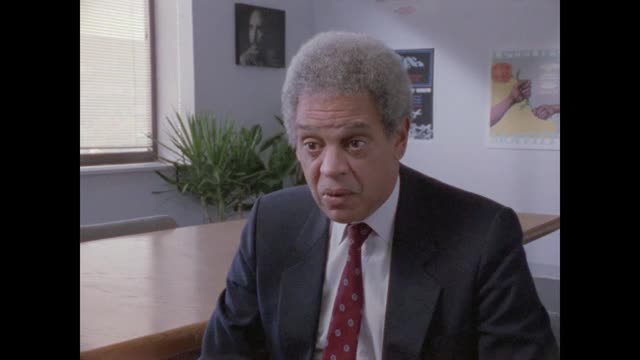
- Transcript
I wanted to ask you about Chicago in 66. You and the seminars told a wonderful story about arriving at King's apartment very late at night. Starting from when you walked into the building with John Dwork, could you tell me that that story again in terms of both what was happening inside Dr. King's apartment and demonstrates in Chicago? We got to King's apartment which all kinds of cynics in Washington had said was probably the only gold plated ghetto apartment in Chicago. The Illinois National Guard was in the streets and there were kids on the streets throwing rocks and bottles that tanks and armored personnel carriers. But the streets were quieter that night than they had been the two previous nights.
King, as I recall, had an apartment on the top floor of a four or five floor walk-up and it was a very hot night, it was in July and Dwork and I walked up and knocked on the door. King knew we were coming, we had talked to him and Andy Young answered the door and the room was just full of people, it was a living room and it was hard to get in me, had to push your way in because there were people in every conceivable looking cranny on the floors, on all the furniture, standing around the walls. And all the people we young men, young black men, they were gang men and King was sitting on the couch and he was talking to them in a conversational tone. He acknowledged our presence and then continued to talk to them. As we listened to became clear that in this conversational tone he was preaching in the simplest
ways possible, his doctrine of non-violence and these were young gang members who desire was to go out and throw stones at tanks and national guardsmen and Dinescence came with saving their lives. A lot of these young fellows sounded as if they hadn't had much schooling, they sounded like they were probably illiterate, they sounded like they were tough in regard to themselves as tough people. King would talk, they would ask questions, King would answer patiently. He would talk more, he would answer and it didn't matter how much he was asked to repeat, he would repeat. It was very hot and uncomfortable in that room. Our Andy Young had Cino pants on and tennis socks and tennis shoes. The stunning thing about it was that it went on for three to half or four hours with the
two emissaries, two presidential appointees, two emissaries in the President of the United States. Standing there waiting as King spoke to these young men, saving their lives, that was one stunning thing. The other stunning thing was that there were no cameras there, there were no reporters there. The view of a lot of people was that King was glory-hound, the publicity-hound that he did for money. When we got there, the streets were quieter than they had been a couple of nights before, but we did see some armoured personnel carriers and we did see a couple of tanks and guardsmen of the trolling and everyone was a little kid throwing a rock and running away. We walked up the four or five flights to King's apartment and Andy Young opened the door
and it was hard to get in, the place was full of people and it was hot, a lot of people were sweating. They were all young men, they were on every conceivable piece of furniture and standing jammed against the walls and sitting crammed up in the middle of the floor. Andy was sitting on the floor, he had Cino's on and tennis shoes. King was preaching nonviolence to these young men. They were tough kids, they wanted to go out and throw rocks and molotov cocktails and King was preaching nonviolence and telling them that they would get killed. He was patient, he would answer questions over and over again. Some of them didn't understand, some of them just were, you could just see they were aching to get out and impatient with this man. King was patient with them and over and over for hours, he did it his door and I, emissaries from the President of the United States, just stood there in a corner while King did his
work. No cameras, no journalists, no nothing, finally one by one all these kids got it in their heads that they would be, either that they would be killed or the nonviolence message and whichever it was, all of them finally said okay, we won't go out and face the guard with rocks and bottles and then King's, only then when King's work with them was over to return to us and then he, they left and he got Mrs. Cain up and got her to make coffee in the back of this railroad flat and then we talked. Can you tell me the story of moving to Detroit and you've gotten called, you've been welcome to Uptown, South of Canada, we have our questions. The Attorney General called a meeting at about six o'clock in the morning and we met over there and then he said the President wants to see us so we went over to the cabinet
room and he had the Deputy Attorney General, the Attorney General, he had Robert McNamara who was then Secretary of Defense and he had been on the phone with Governor Romney in Detroit. Governor Romney wanted troops, President didn't want to send troops in and the issue was in part about the 68 election. Romney did not want to go into the 68 campaign having declared that he couldn't take care of the state of Michigan. Johnson under law couldn't send in the troops until a declaration that the situation was out of control and of course Johnson was insisting. Finally, they reached a compromise and Johnson decided that a number of us, the Deputy Attorney General, Cyrus Fance, the former Deputy Secretary of Defense, John Doar and I would go to Detroit and he started telling us and occasionally he would be on the phone to Fort Bragg to
the General in charge of the second airborne and one thing he kept saying, I don't want bullets in those guns. I don't want our troops to have bullets in those guns. He went on and on and he just got himself all worked up and he said, I don't want anybody to say that my troops are pregnant and he looked at me and his face went red and then he finished his sentence without finishing that word and as he then sent us out to go and pack and then go to Andrews Air Force Base to get a plane he called me over and he took me into his office and he wanted to apologize and he didn't quite know how and he walked me over to the French windows that led out to the Rose Garden and he looked at me and he looked down the floor and there he saw a pock marks on the floor and they were pock marks made by Eisenhower's golf shoes and he said, look what that son of a bitch did to
my floor and then he patted me on the back and said have a nice trip. The Detroit was probably the scariest place I went to during my years in the government. There was a curfew and you'd hear shooting occasionally as you went around at night, a lot of it but it was eerily dark because a lot of the street lights had been shot out. We were safest on the east side of town where the federal troops were. They were disciplined troops, they were not afraid but when you got on the west side of town which was patrolled by Detroit police, by the National Domitia National Guard and by the state police, you were in trouble. I never really felt that I was in trouble from any black rioters or threatened but I remember one night driving out Grand River, a major artery in Detroit and being passed by a convoy
of state troopers. The state troopers were the scariest people because they were from out state and most of them had had very little contact with black people, very little contact with Detroit. They were from little places like Grayling and Zealand and here all of a sudden they were in big Detroit and there were all these black people that they were afraid of and frightened people with guns are terrifying and as we were driving along, there was this convoy of several state trooper cars and I was alone with one of the people who worked with me who was also black and the state troopers called out and said, get off the streets, get off the streets. We were federal officials and we were permitted to be on the streets and their convoy circled around and followed us and pulled us over at the corner of Joy Road and Grand River and they surrounded us.
Well usually you had your credentials, your justice park credentials in your pocket but you knew that if you came out of a car surrounded by state troopers with your hand in your pocket, you're going to be dead. So instead of reaching for my credentials, I got out of the car with my hands up screaming justice department, justice department and as I looked around there were state troopers either kneeling or standing, all of them pointing guns at my colleague and me and they were shivering and I was shivering. There was another car, a right? Can you start the story again and I will just start, I think we've covered one bit. One of my jobs in Detroit was to go out. One of my jobs in Detroit was to go out at night to find out what the level of violence really was because there was no accurate reporting that we could rely on and one night a black co-worker and I were driving up Grand River which is a major harder in Detroit and it was
dark because a lot of the lights had been shot out and the streets were empty because there was a curfew but we were permitted to be on the streets because we were federal employees. And so we went up the street, a convoy of state troopers came down Grand River in the opposite direction, they screamed at us, get off the street, get off the street, snipers, snipers. And we continued up and we're about to turn left on to Joy Road when all of a sudden we realized that this convoy of state police cars had made a U-turn and pulling us over. Normally when somebody did something like that you reach in your pocket and you pull out your justice department credentials but they were screaming get out of the car and I was screaming justice department and I knew if I stuck my hand in my pocket to get out my credentials I'd be a dead man. So I came out of the car with my hands up and what I see is we are surrounded by a circle of state troopers with either long guns or pistols all pointed at us.
They were shaking, I was shaking. They had also pulled over another car that had a man, a woman and some kids in the back. These people were all black and they were telling them to get out of the car and all of a sudden you could hear a cloth tearing, they were being pulling them by the clothing. And while I was still screaming department of justice and somebody was smart enough to reach in, take out my credentials and all of a sudden they said wait a minute, wait a minute, stop, hold it, hold it, hold it. And so they stopped man handling this other person. I then explained what we were there for, the other person explained that he was an essential worker at a GM plant and that he had permission to be on the street. So they had managed us to be careful and they drove off. I got back in the car shaking because I already thought when I got out of the car I said to myself 35 and dead at the corner of Joy Road and Grand River. I was shaking and this old white duet that these other people were in kind of limped off down the streets, spewing smoke and I heard him yell after the cops, mother fucker,
that I laughed and everything was alright. They pulled us over, they were screaming, get out of the car, get out of the car and normally I would go into my pocket and pull out my credentials but I knew if I did that I'd be a dead man. So I came out of the car with my hands up screaming department of justice, department of justice and when I saw around me was a circle of white state troopers either with long guns or pistols all aimed at me and what I thought at that moment was I'm 35 and I'm going to be dead right here at Joy Road and Grand River. They kept on screaming, department of justice, department of justice and I realized that they'd also stopped another car that had a woman of man and two kids in it and they were screaming at them but they were also pulling on the car and you could hear they were clothing ripping and we kept screaming department of justice and finally somebody heard us and pulled my credentials out and looked and they said oh department of justice and then everybody relaxed they started to stop pulling these people out then they let us
go the man said that he was an essential worker and GM plant and therefore had the right to be on the street and was coming home from work and so he was let go we were let go they had managed us to be careful and they drove off and the guy the worker drove off and his old white Buick spewing smoke and he screamed out after the troopers mother fuckers and that was the first time I relaxed okay now I'm looking for another store which one of the main things that we wanted to do while we're in Detroit was to get to the establishment of the business establishment and get them to agree to do major social reconstructive work everybody told us that the person the key person was Walker Sistler who was the head of Con Edison and we tried every way we could to get in touch with him but before we got in touch with him we did all kinds of other work in the city but at night and we'd work
late into the night but we'd all always pause for dinner there was not only a curfew in Detroit but there was also a liquor band but the mayor had provided sivans with a lot of liquor so what we do would be to break off at about six go up to vans is sweet Mrs. Vans was there and we would all have cocktails and then we'd go into the hotel and have dinner and then we'd go back to work it was kind of our routine and that's what we did all the time. One day when John Doar and I had been out at the federal prison nearby interviewing people who had been arrested we got back and I was in our headquarters at the police headquarters and all of a sudden I got a call from John and he said Roger I thought you want to know that we're having dinner tonight with Walker Sistler who we've been able to get in touch with Walker Sistler and a dinner is going to be at the Detroit Yacht Club I thought that
you would want to know that and we will see you later. Hit me like a thunder clap first of all broke our normal thing of always having dinner together but beyond that I knew and John knew and Si Vans knew and everybody knew that the Detroit Yacht Club did not serve black people so what Si Vans and Warren Christopher had decided to do was to go see Walker Sistler at a place where the black member of their group could not go. We were not in Detroit because the sewers didn't work. We were in Detroit because black people who felt oppressed were tearing the place up and yet these guys decided to go to a segregated place for dinner and be to leave the black member. Everybody else went to leave the black member of their club of their group sent by the
president out of it. Fans never apologized to me for that nor did nor did Warren Christopher. They sent John Doar and later they sent another guy who was a law partner of Vansist but neither them ever had the character to do it. So I want to ask you about your responses when we watched Johnston announced the correct commission. The night we got to Detroit we were told by the White House that the president was going to have a major announcement about the riots and we were told what time so we watched this black and white set in the headquarters that we established at the police headquarters in Detroit and the first thing we saw was president with J. Edgar Hoover next to him and I was in
range. I was in range for a variety of reasons. Hoover was a bigot. Hoover ran the FBI in a bigot way. Hoover was an about enemy of Dr. King and Hoover thought that the riots were a conspiracy, communist conspiracy and a lot of us believe that he had sold president on that view so that when we were looking at this and the president is saying that he's going to do something about these riots and then he sets up an establishment commission. First of all I was just annoyed. We knew what was wrong. These people were oppressed. These people were not getting services. They were hungry to have jobs. He didn't need a commission even though my uncle was on a commission. Even though some good guys John Lindsay was on a commission Fred Harris. He didn't need a commission to tell you what was wrong but then to have Hoover there gave credence to the suspicion
that the president also thought it was a communist conspiracy rather than an expression by American citizens of their deprivation and their oppression so I was enraged. Can you tell me what your response was when the president, when the report was issued and he basically didn't do much to celebrate the frontings? I was astonished at what a terrific job that commission did. They worked very hard. They were serious and they issued an extraordinary report that said all the things that I would have wanted said and it was a mandate had the president chosen to take it and say by God we didn't know how serious the problem was. There is racism in the society. It's deep and since I have said that I am going to be the president who finishes what Lincoln started he could have used that as a springboard for more social action. Instead he refused even to have the commission come over and present it to him and basically he ignored the report and that was
the end of Johnson and me really. I want to quit. Ramsay Clark who was the attorney general persuaded me not to quit on the ground and if I quit they would probably point somebody who was awful in my job. And on the ground I was his closest friend in the department and he really needed me around. So I stayed but I made a speech that I made sure I got into the New York Times attacking the president and that did get on the first page, the front page of the New York Times and the president did read it and the president never spoke to me again while he was president and I worked for him which was the way we both wanted it. Okay, so we shouldn't be told concisely. It's one of the great stories about King. Well as concisely as you can and they're basically one of them when you walk into the building. So you don't want to look at what's on the streets? When we got to King's apartment it was after midnight there were troops on the street.
The guard was rolling open on the street and there were still kids who were challenging the guard breaking windows throwing rocks and throwing off cocktails. We went up to the top floor, knocked on the door and Andy opened the door and it was amazing because the place was packed with people and it was the heat from the place just hit you and it was hot outside. And people were everywhere in the place and they were all kids' males and there were kind of kids that everybody hates they were young black street kids and they wanted to go out there and throw rocks and they were gang leaders and King was preaching non-violence to them. They would ask questions and King would repeat King would talk they would ask questions he would repeat this went on for hours as the two emissaries from the president of the United States stood in the corner. The place was just suffocatingly hot but King took time until he had reached every last mind and was sure that none of these kids
were going to go out and get himself killed. Only at that point did he let them go and then wake up his wife and give us coffee and begin his conversation with us. Great, thank you. Okay now thanks. A colleague of mine and I he was also black. We're driving up Grand River one night to find out what the level of violence was in the city when a convoy of state police cars went past the other way and troopers sailed out at us. Get off the street get off the street there's snipers and we continued up the street and we're going to make a left turn on to Joy Road when all of a sudden his convoy had turned around and was I pulled us over and we were surrounded by people screaming at us out of the car out of the car out of the car and normally I
would have stuck my hand in my inside pocket and pulled out of my credentials to prove I was from the Department of Justice but I knew if I did that somebody shoot me so I came out of the car with my hands up and what I saw was I was circled by people with long guns and pistols and they were all pointing at me and they were all nervous people and they were all white and I'm a black guy and I'm a high government official but I was a nigger. A nigger in white America and I thought that that moment I was going to be dead 35 years old and dead at the corner of Joy Road and Grand River. Fortunately somebody heard me screaming Department of Justice Department of Justice and about the time they heard me screaming they stopped pulling some other people out of a car where they were tearing their clothes and they just stopped when they knew they had justice department officials around. We explained who we were the other people explained that the guy was coming from work at a auto plant where he was an essential worker so they had managed us to be careful and they went away. My legs were shaking and I got in the car and this other car drove away as an old
white duet and it was fueling a lot of smoke and I heard the guy yell after the troopers, mother fuckers! At that point my legs stopped shaking and I returned to normal. Here the end of our trip we were successful in reaching Walker's sister whom everyone had told us was the key to getting the business community to work on problems that blacks were having. I had come back from a day trip to a prison to interview people who had been arrested for rioting and I was at our headquarters when I got a call from John Dore who said we were not going to go through our normal ritual of having drinks in Mr. Vance's
suite and then going to dinner together that instead they had made a date with Walker's sister and everybody else was going to have dinner with Mr. Sister and that John said I wanted you to know that the dinner is at the Detroit Yacht Club. Well it hit me like a thunder clap because they knew and I knew that the Detroit Yacht Club was segregated and didn't serve blacks. We were not in Detroit because the garbage trucks didn't work and we were not there to repair the phone system. We were there sent by the president of the United States because oppressed black people had been rioting against the way they had been treated by people and powerful people in Detroit among them Walker's sister and here was Cyrus Vance, Moran Christopher deciding that it was more important to have Walker's sister be comfortable in his spirit than to be decent to a black member of their team. Thanks. The last question I had to be whether there was any.
Having watched all the riots from 64 through 67 it was quite clear to me that the riots were an extension of the civil rights movement, not something different. Poor black people in the north had watched their TV sets just like everybody else and had seen progress being made in the South. Moreover their racial feelings had been stirred just like everybody else's when they saw bull counters, police dogs, when they saw the rioters at the University of Mississippi trying to keep James Meredith out. Then they saw the Congress past these laws, 64 or 65. What they looked around they saw that nothing, absolutely nothing was changing in their lives. They were still poor, they were still jobless, they still lived in
miserable housing, their kids still went to losy schools. What I thought I was seeing in these riots was not what Hoover saw which was a communist plot but rather hopeful people who believed that the political system would respond to them and it was kind of a jagged plea to the political system. Pay attention to us, we're left out, we ache and in a sense it was a hopeful scream because these people had been awakened from being niggers who were beneath consideration to people who believed that the country could and would pay attention to their plight. Now that's not to say that there weren't a lot of thugs among looters, that there weren't people who were doing it for criminal reasons but a lot of it in my judgment then and now was people whose racial consciousness had been raised, who knew that if that was what was happening, if it was hope etc. How did you feel having seen
this hope when the president was not going to act on it? I was enraged, I was enraged when the president wouldn't act on it because I knew that although the government had been responsive we did have a poverty program in place, great society legislation was going into place but I knew it wasn't large enough and I knew that the great bulk of the money that we had available to us was going into Vietnam and it seemed to me that if you wanted to strengthen America and you wanted to make America better for the future you invested in your people and you didn't invest in war. Were we two societies at the end of 2016? We were definitely two societies and they were heading in opposite directions and that's what the current Commission said and that's what has come to be. By the time I went into Detroit in 1966 I had already seen the riots in New York in
1964 which occurred right after the signing of the Civil Rights Act of 1964 and I had been to Watson 65 and I understood that these riots were the result of black people in northern cities having seen all kinds of civil rights activities and civil rights progress in the south and seeing no changes in their own lives. They still faced police brutality, they still faced lousy schools, they still faced joblessness, they still lived in lousy houses and while the country was full of self-righteous rhetoric about the south nothing was happening in the north and these people all of a sudden said well we're black people and something has to happen for us
and these eruptions really were kind of a belief, a expression of a belief that the political system wouldn't be responsive if it were reminded of the misery in which these people lived. Now some of them were thugs obviously the loot, some of the looters but a lot of it was a demand that the political system respond to their needs. The system was responding in small ways the poverty program was in place some great society programs were being put in place but they weren't large enough and greater and greater parts of our national treasure was being sent it off into Vietnam and the longer that went on and the more resources that were shut it off into Vietnam the less was available for our cities and our people and then the president's unresponsiveness at the time of the Kerner Commission report just enraged me because you had I couldn't really believe that the violent movement would be very successful in Chicago
daily was a bigot he had a bigoted machine he ran a bigoted city besides the problems were too vast and too broad you needed massive investments in education you needed massive job training and you had to have the understanding that it was not just a multi-decade problem when you're dealing with it was a multi-generational problem and daily his whole thing was just to absorb king and absorb the non-violent movement and keep on doing what he did anyway and of course you diffuse responsibility you say police, schools, real estate people and nothing happens and Danny said well we tried that's exactly what happened. Were you surprised as if you had answered that first question were you surprised when the movement didn't accomplish any in Chicago? No I wasn't surprised non-violent confrontation could attack various... Were you surprised with non-violent movements in the unless Chicago without much of a
victory? I wasn't surprised when the non-violent movement left Chicago without much of a victory because non-violent confrontation could solve sharp crisp evils like segregation but when you had general cultural social racial bigotry which required repairing of human beings and repairing of systems like school systems like police systems you couldn't do that with just a brief confrontation you're dealing with problems that weren't just multi-decade problems they were multi-generational problems daily was a bigot his whole system was bigoted the culture of the city was bigoted a brief non-violent campaign could not change that by the time the poor people's campaign reached Washington it was two months after Dr. King died he was in he was
Ralph Abernathy's best friend he was the mentor of everybody else and they were still devastated Abernathy was was trying to assume the mantle but he was hurt he was he was he was he couldn't he didn't have his friends talk to the others didn't have their mentor Andy Young was like walking around in circles the only one who was who seemed to be functioning in a effective way was Jesse who became the informal mayor of Resurrection City and Jesse would figure out things to do every day figure out activities but the rest seemed to be in a in a grief-stricken fraud I need to ask you to be more concise also when the poor people's campaign reached Washington what was the state when the poor people's
campaign got to Washington two months after Dr. King's funeral they were still all wandering around in a grief-stricken fog Abernathy didn't have his best friend around anymore and while he was trying to assume the mantle leadership you could just tell that he was hurt bill Wilder the rest were his younger brothers his mentees Andy was just walking around in circles CT Vivian they just weren't functioning very well the only one who I recall functioning at anything near capacity was Jesse who was leading marches who was figuring out that the demand ought to be center on hunger and who was keeping people spirits up because of all that energy of his the poor people's campaign was the culmination of what King had learned in the north he by
then understood that you needed a systemic attack that the congress had to do it and had to be multi-generational and but King was dead and this thing was petering out there was violence and the congress was angry something needed to be done and you did not want them to leave without some kind of victory because their cause was right there were hungry people and there were impoverished people in the country and we as a decent administration wanted them to have a victory and it got home down to giving people who had less than a dollar day in income free food stamps and we had a vicious fight inside the administration with those of us who favored that fighting against people who said well it'll just just use it to drink up a lot of liquor we fought and we fought we got finally we won and president was going for it and he called Wilbur
Mills who was head of was chairman of the ways and means committee in the house and he said this is a bill he wanted to send up and what it knows like and knows that mr. president you know that you're gonna ask us for a tax increase to finance your more in Vietnam if you want that tax increase you better forget this foolish food stamp program and that's what happened to the food stamp program no victory for the poor people can you stop for a second now I want to ask for the second part of that question which is after the president after the president after the president decided not to provide free food stamps for people who made less than $30 a month I figured that our political system had had it at least for that cycle I surely had it I'd
spent all of my energy and all my emotion but I thought it's time to get out of this government because if changes are going to be made they have to be made from energy generated from outside the government this government no longer had the energy to respond to people's needs and I was exhausted I was depleted and I was profoundly depressed because we'd started the 60s with high hopes I had identified with all the yearnings of the poor the women black Hispanic the left outs and sitting there inside the government I knew to a moral certainty at that point that the government had no more answers at least at that time to these problems that was had no imagination for them it had no energy for them I just wanted to get on with the war the night before the resurrection city was to be dismantled and the leaders were to lead the people
out we had to make an agreement inside as to what was going to happen inside resurrection city by that time tension was very very high the police who were around there mainly the park police and the people in resurrection city had clashed on a number of occasions and it was very very uncomfortable very tense SCLC was not letting strangers in you had to have a past to get in so and the hostility toward authorities was such that if an assistant attorney general of the United States was caught in there you had a sense that that person might be in a lot of trouble so I was given a pass by SCLC to be able to come in and attend the meeting that they were having in there that night and I put on clothes that looked like protest workers clothes and went met my man who was near the gate fell named Ron Gold who's an investment banker now and he
walked me halfway to the gate and said goodbye my brother good luck and I went to the gate and identified myself as somebody else and went in and it was eerie there there were very few people out and it was very dark and there was just a tension in the air and I went in hoping against hope that I would not be recognized and finally I met one of the SCLC officials and it was taken into place where the SCLC leaders and I sat down and mapped out a strategy for emptying out resurrection city without anybody getting killed and that's what we were afraid of that somebody we get killed oh it blue jeans and a t-shirt I think no no no I might have had a da shiki but no way I mean I wore my hair long it was right after resurrection city was emptied out it I was told to go out to
14th and you by the attorney general because there was an incipient riot when I got there the intersection was all filled with volatile young people who clearly wanted to start a riot and I looked around and up on the back of a flatbed truck there was young Jesse Jackson who was about 26 years old at the time and he was preaching and he was saying if you know I am somebody if you're somebody you don't riot say after me I am somebody and this is the first time and if you are somebody you go out and you build strong black people say after me I am somebody what Jesse was doing was preaching the riot out of those people and he was taken up you're on 14th street and I want a little more personal reaction what are you seeing you're
watching Jesse Jackson what's happening the youngsters at the corner of 14th and you were volatile angry it was a time when the black power mode was around as time when Stokey Carmichael was saying if you burn one of our churches we'll burn one of yours and it looked like these kids that any moment would just go up and down the street turn out storefronts throwing fire bombs and in the middle of it there's Jackson up on a flatbed truck preaching and he's preaching he's preaching really pride if somebody if you are somebody you build up you don't tear down say after me I am somebody and so on and so forth he kept on preaching he kept on preaching he was taking quite a risk because to preach non-violence and to preach no rioting to a group of kids who wanted to tear the place down was taking a risk that you'd be called an Uncle Tom Jackson
took the risk he preached the people down they became calm they went home there was no riot it was quite a remarkable performance for a 26 year old kid can you tell me the same story in just much shorter and the expressions before was he preached the riot like that and you can not stoke me that way I thought we said that we'd get when we get every these these people only get one shot okay I don't have a lot of time now more patience I got there and I got there and they're at the 4th corner of 14th and you and there are a bunch of kids who looked like they wanted to riot they were angry they were volatile and up on the back of a flatbed truck there was Jesse Jackson preaching to them about I am somebody preaching pride to them and what he did was he preached the riot right out of them despite the fact that to do so was to take a great personal
political risk but he did it in the early 60s Malcolm said things that were just stunning for black people to hear he said that you are you are victims but you are great do not believe the lies that the society tells you about how humble you are that you're descended from the savages that slavery was your shame it's their shame you have greatness within you stand up and face down these people who are your enemies and you're trying to take your souls and your spirits from you it was electrifying and he spoke in the cadences of northern urban streets rather than southern churches so that when people like me who were from the northern streets rather than from the south heard him we heard something that was familiar to us and he was he was just electric he was and even very bourgeois black people would watch Malcolm on the television and say he's
telling him off good he's telling him off I wish I could tell him off like that so he was giving a voice to the rage that powerless people felt and he had a lot of fans in black America can you tell me about your version of how healthy that anger was that white America had been saying you should grateful you should be polite and the Malcolm was saying that you should be well Malcolm was a brilliant man and what he understood was that for years white America had turned black people's hatred in on themselves and that it had turned pathological both in terms of self-destructive behavior individual self-destructive behavior and collective self-destructive behavior what Malcolm did was he liberated the anger and he let it turn outwards where it belonged so that and it liberated a lot of people to do a lot of constructive things now it made a lot of people go around and call people honkies but that's better that the
call somebody a honky is better than then shooting heroin into your veins so Malcolm was a great liberator of black thought and black spirit when stokey Carmichael started yelling for black power you talked about it as a quirk or rafting can you tell me that the sense that this was just going to blow I remember watching it on television and it was I remember watching stokey Carmichael had a rally in Mississippi on the Meredith March shout what do we want black power what do we want black power and I said to my wife I said this is it white people all across this country are going to be scared to death for all kinds of black people who have been bottled up for years are going to feel like God we got to go out and do something we've got it in our hands and we can't be passive anymore we've got to be active shapers of our own destiny sure I didn't say it this eloquently is that but that's what I felt that it was the unleashing of energy and the unleashing of rage
and that's what it became in the cabinet room before we were sent to destroyed when the president had decided to send US troops in he wanted to make sure that US troops didn't kill anybody and he said it in colorful language he said it to us who were going out there to direct the operation he said it to the general who was in charge the 82nd airport I don't want any bullets in those guns I don't do understand me I don't want any bullets in those guns he got worked up and I don't want it said that one of my soldiers shot a pregnant net and he looked at me and his face got red and I understood Jack Johnson was a coarse guy he was a Southern he said nigger but he was embarrassed and he was ashamed of himself and he later apologized thank you thank you very much yes I'm sorry
I've kept you waiting
- Series
- Eyes on the Prize II
- Raw Footage
- Interview with Roger Wilkins
- Producing Organization
- Blackside, Inc.
- Contributing Organization
- Film and Media Archive, Washington University in St. Louis (St. Louis, Missouri)
- AAPB ID
- cpb-aacip-373dad1a806
If you have more information about this item than what is given here, or if you have concerns about this record, we want to know! Contact us, indicating the AAPB ID (cpb-aacip-373dad1a806).
- Description
- Raw Footage Description
- Interview with Roger Wilkins conducted for Eyes on the Prize II. Discussion centers on his experiences during the rebellion and civil unrest known as the Detroit riots of 1967, the Vietnam War, the nonviolence movement in Chicago, Martin Luther King, Jesse Jackson and Malcolm X. This interview also appeared in Malcolm X: Make It Plain.
- Created Date
- 1988-10-17
- Asset type
- Raw Footage
- Topics
- Race and Ethnicity
- Subjects
- Race and society
- Media type
- Moving Image
- Duration
- 00:50:46;16
- Credits
-
Interviewee: Wilkins, Roger W., 1932-
Interviewer: Bernard, Sheila Curran
Producing Organization: Blackside, Inc.
- AAPB Contributor Holdings
-
Film & Media Archive, Washington University in St. Louis
Identifier: cpb-aacip-8e4ef446645 (Filename)
Format: 1/4 inch videotape
If you have a copy of this asset and would like us to add it to our catalog, please contact us.
- Citations
- Chicago: “Eyes on the Prize II; Interview with Roger Wilkins,” 1988-10-17, Film and Media Archive, Washington University in St. Louis, American Archive of Public Broadcasting (GBH and the Library of Congress), Boston, MA and Washington, DC, accessed June 6, 2026, http://americanarchive.org/catalog/cpb-aacip-373dad1a806.
- MLA: “Eyes on the Prize II; Interview with Roger Wilkins.” 1988-10-17. Film and Media Archive, Washington University in St. Louis, American Archive of Public Broadcasting (GBH and the Library of Congress), Boston, MA and Washington, DC. Web. June 6, 2026. <http://americanarchive.org/catalog/cpb-aacip-373dad1a806>.
- APA: Eyes on the Prize II; Interview with Roger Wilkins. Boston, MA: Film and Media Archive, Washington University in St. Louis, American Archive of Public Broadcasting (GBH and the Library of Congress), Boston, MA and Washington, DC. Retrieved from http://americanarchive.org/catalog/cpb-aacip-373dad1a806