Iowa Press; 1524; Congressman Dave Nagle
- Transcript
Why says I what pressure though are 15 20 for it was recorded March 27 38 with Dave Nagle one of the. One major funding for this program was provided by friends of Iowa Public Television which. From farm subsidies to aid to the Contras to the budget and trade deficit. The Congress seems to face continual problems tonight and I will press will talk about those issues and more with third district Congressman David Nagl. This is the Sunday March 20 summons edition of I will cross. Here is the morning.
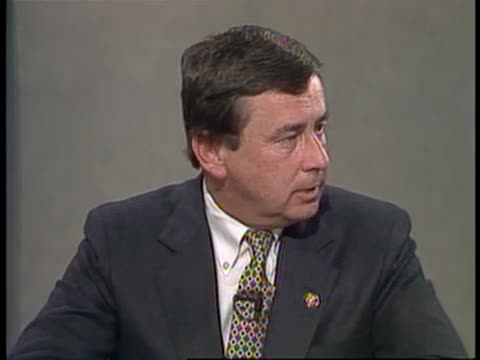
Good evening. Dean Borger is off this week. He was the I would Democratic Party chair for three years from 1982 to 1985 and as Cherry was at the forefront of the fight to keep I was first in the nation political caucuses in February of 1906 he announced his bid for the third district congressional seat being vacated by the retiring Republican Kuiper Evans. And as Nancy Crowfoot reports David Nagle has from his election campaign to the president managed to make his presence known. It may be called a great victory for Democrats in this north and central Iowa district that had held a Republican representative for five decades. That victory for David Nagle did not come without some criticism. He along with nearly half of the US representatives elected in 1906 was criticized by a citizens action group for accepting a large amount of his campaign funds from political action committees. Common Cause reported that Nagel received 58
percent of his campaign contributions from PACs. It seems to me the legal suits on the House Agriculture Committee where he has worked to rescue the farm credit system. He proposed a measure that would put pressure on the nation's two largest farm lenders. The Farm Credit system and the Farmers Home Administration to assist hard pressed farmers in restructuring loans. On other issues he voted for humanitarian aid to the Contras voted for a budget that would raise taxes by 18 million dollars and was just one of two Democratic freshman to support the administration's decision to put the American flag on foreign oil tankers in the Persian Gulf. To get his views on these and other issues facing the Congress we have with us Representative Dave Nagle. And with me to question Congressman Nagl is Allison Hadley with wy Public Radio in Ames. Congressman I go yesterday in Michigan yesterday in
Michigan. Jesse Jackson came out on top. A lot of people are now wondering what's going to happen with the Jackson juggernaut I'd like I'd like your reaction what what influence do you think Mr. Jackson is going to have and what can the Democrats do to keep him from letting Bush win. Well I think that if With Bush the nominee any Democrat that the Democrats can get behind I think stands an excellent chance. And I think the polls reflect that. The problem Democrats have of course is sorting out the candidates and indeed one candidate who's an alternative to Jackson. Jackson himself we could steal off a lot of his message. We could feel his presence. He does not at this point appear to have the popular support in a sort of capture the presidency. I thought Mike Dukakis might just move out in front yesterday and start a process that would lead from Connecticut to Wisconsin on into Pennsylvania to have the nomination up. It's obviously got a ways to go yet. But although I think we will pick a nominee and I don't think it will be a brokered convention as the others drop out of think their support will drift whoever the eventual front runner released.
So you don't see Jackson as the nominee. Do you see him on the ticket. I don't see Jackson as a nominee I don't see Jackson on the ticket I think that the message is just a bit too strident. For the rest of the country at this point in time Jackson has capitalized on something though that the Democrats need to hear need to pay attention to and that is the disparity of income that exists now between not only the wealthy and the middle class but also the drift of the income great gains to the west coast and he's coasting the disparity that we're feeling here in the Midwest that partially accounts for Gephardt success out here in Iowa. You can't ignore Jackson. What role is he going to play. Well Jackson is going to play a very significant role and it's a question of whether or not the platform will reflect enough of his wishes. It's a question of whether or not he'll have a voice and say a name in the vice presidential nominee. And it's a question in terms of what capacity of the future administration should be Democrat promised utilizing men. Do you see any other candidate besides Mike Dukakis as the Democratic nominee. Well I think only if it goes brokered or if somebody gets a lot of Gore gets hot in the West it's conceivable that he could start a stampede at the end. But right now I think the odds do favor
ultimately of the caucus nominations going take a little longer than what we thought. You think you can add enough juice to Michael Dukakis to capture some of that Jackson message. I can't think of two more different politicians in terms of stump style. Then those candidates I mean clearly Mike Dukakis his own people admit it has a passion gap. Cool manager and see strength in how are you going to transfer that electricity and that charisma and that energy that Jesse Jackson has and that has captured a lot of votes more votes than anybody else. To Mike Dukakis Jackson's capture the plurality of the votes of most of the districts if you total up all the votes he's got to capture a majority within any you know any party for any party process. I don't think you can remake a person but I think the other in their hand you have to look if you take Jackson some of Jackson's message the economic disparity that exists in the country today and in the Middle West. And you contrast that with who the eventual Democratic nominee said is Mike Dukakis running against George Bush you know I mean Mike Dukakis awake looks as strong as George Bush does now.
But then expect you to say that Well I think well you know I'm not I'm not really here and he said I was the party chair and I really anymore. Well but but but but you are a respected party leader. And so I'd like your assessment. Who first of all how a Dukakis Bush fight you know I want you got this. DUKAKIS I think that I think the Republicans know that they have a great deal of difficulty in Iowa and in the Midwest. And I think Democrats start to start very well there. You saw the emergence of the commencement of that trend back in 1984 when Mondale finished his fifth best state was I won and you have the rural regions of Minnesota Illinois and northern Missouri northern Wisconsin deserves a bedrock. I think I would Democrats I think realize that I think national Democrats have a propensity to look south look northeast and forget that there may be a political opening here in the Midwest. Who does Mike Dukakis have to put on the ticket with him to be sure to carry them that well I think I think it doesn't matter who he puts on the ticket would be put on the wall and clearly should put Al Gore and Mike Sam Nunn in my in my judgment on the ticket do you have to go south with your. With your vice presidential nominee similar to what Kennedy and Johnson did expand just a little bit on why you think Jackson should not be on the ticket.
Well I think the polls indicate that he can't win. I mean you know that's something Jesse Jackson has faced for a long time through his campaign I still don't see Jackson have the capacity to carry a national ticket. But if what you're getting is in the direction he's going Could it be a backlash against the Democratic Party you know charges of racism if they don't put him on the ticket. Oh I don't think so I don't think that's the case at all I think it's a case of taking his message I think that's but I think that's predominately what he's interested in you know capturing Democrats have to realize the capacity to capture a nomination is not tantamount to an election. George McGovern established that in one thousand seventy two Walter Mondale established that in 1984. You can you can develop a very very fine the Democrats are good at this from doing a very fine machinery to capture a party domination without having the broader appeal to be able to capture the election to caucus with with his restraint. Those seem to have indicated a capacity maybe to go national as opposed to staying in your party Congressman eggless party head. Back in Black last election you were very influential in keeping the Iowa caucuses first in the nation. You have this theory again of course we were considered the first presidential
testing ground once New Hampshire hit though many people were questioning the attention focused on the Iowa caucuses on Super Tuesday through again everything in turmoil at this point. What do you think about the Iowa caucuses and their future given the direction that the campaign has taken. I think that the I would be in first the nation in 1980 80 92 or about 50/50. And that's actually an increase over what we faced in 84 or what we faced in 85 for the 88 election. Why so optimistic. All because we fought this battle a few times and I think we know how to do it I think Bonnie Campbell's up to speed on it and we're going to work closely with her. The fight by the way for the Iowa caucus will always come normally on the Democratic side not on the Republican side because of our rules and you know there's a move now in New Hampshire. The bill introduced a New Hampshire legislature to move New Hampshire about I well there's a there's a move of course in the south to take away I was status. But you know the South got a measure of self respect from Super Tuesday I think they like it I think they're going to
try to repeat that. If we're willing to stand firm if we can full forward any democratic rules shift I think the odds are good to be able to keep it. But there's not going to be anybody in the White House that has any reason to want to keep by what first depends on who it is if it's a Republican he said he doesn't care. If it's a Democrat he may very well General Carter. Jimmy Carter showed something in 1990 in 1980 and that is it's not bad for one president to have an early state out there is an insurance policy to set aside a challenger enough. If a president knows it's going to start a short fight he could very well want I will first Congressman Al Gore wrote Jimmy rewrote Jimmy Carter's chapter in the book. This time Allison raises a good question. If President George Bush is in the White House why do you think he would want to keep the Iowa caucuses around given how savage he was here by Bob Dole given the discontent that said I would think that President George Bush would say this is the last place I want to start the caucuses you know the same token you're mixing your parties.
You're mixing your party so you know remember the Republicans don't have rules governing calendar. They just simply let anybody go when they want to as long as the Democrats are on the lockstep with the Republicans and go on the date the Republican Party sets to keep it first. And as long as I will Republicans make it clear and I think they will every other state that if you move through if you move to January 2nd we're going January 1st. I think the Republicans can hold their front on it. Republicans don't have the rules the fight comes from Democratic side what if you held a party and nobody came. I mean Al Gore didn't show up for this party and you just got through saying he's probably got a shot at the vice presidency. If you have a really caucuses and candidates don't pay attention I want than what we have families always acting and there is there's always something change or in writing the process and the rules on the basis of one election which Democrats have been clearly prone to do we change based on what happened in 76 we change rules from 78 and based on what happened 80 we changed the rules and we'll have an 82. You know you can write what happened I was in 84 and 88 and say therefore that's going to happen in 92. The point I was that we gave a number of candidates who were not perceived as national figures an opportunity to come in. They came in very close together and one of them
now is emerged as the front runner. And that's Mike Dukakis. That scenario could very well take place again or you could have somebody get hot and I would just blow the thing out. You never know from year to year when you start in a small state to give everybody a chance and that's I was roll one of the reforms if any do you think need to be made in the nomination process. No I just leave him alone I think there's been too much trying to anticipate reforms and in one of the things that the Democratic Party has tried to do always is try to write the rules better let them evolve naturally super Tuesday came about because of Southfield need finding good don't write that in the rules now let the changes take place that may need to be changed. Do you think those Southerners feel that. Still like Super Tuesday after having helped propel Jesse Jackson in his candidacy do you think they still think I'm sorry oh yeah I thought about that when they did it but they you know what. You know the Southern attitude towards presidential politics is one I frankly deeply deeply troubles me. I don't understand don't profess to understand and I think if you went back and I think if Texas had a choice again where the vote
to join the union or not I'm not sure that there would. Be One improvement I would make a Southerner if I were asked by the South and I'm normally not that I would recommend that they do is to change their Super Tuesday and put Texas and Florida by themselves or begin to states they deserve enough attention in their own right. But I think south probably going to go ahead and do it again based on what I read the reviews that I read they seem rather pleased with it. Congressman let's switch a bit from the national scene and focus in on on your plans for the future. You've been in politics for a long time your first term in Congress. Let's begin by having you outline your mate what you see as your major accomplishment. Probably the farm credit legislation and being able to get the Farm Credit groups together. You know one of the great things that you have going as a freshman congressman is that you don't know the rules so you don't know what you can do and you don't have historical perspective but you don't have a historical prejudice you know when told or not that and from there you would know you know out there in Congress you couldn't get 35 groups together so I asked coming there in four months later we were able to put a consensus out that we
took to the speaker and the chairman the egg and two weeks later it passed out of committee. You know and I I felt good about having that kind of a role in that I didn't pass a legislation and didn't write much of it but the concepts the principles upon which the legislation moved were drafted in a freshman's office that's a remarkable achievement for a freshman legislator to be able to take part in and I was you know darn happy to do it. Well since you brought up that that that legislation let's talk a little bit about about Agriculture and farm policy that was that the solution what direction do you think agricultural policy should take in the in the short term and the long term in the short term you leave the farm program alone you keep your target price up you haven't ministration it's committed to a low market price. You need the protection and the target price on corn gives you hopefully a loan rate or a marking loan on soybeans you know but you keep your price to the to the producer up that's half of it. For a third of what the second third of it involves making the farm credit system FEMA chief may recognize their losses and write off bad debt and return the half of the farmers that last year didn't make money into a position of profitability. But then there's a
third looming crisis in the state that no one's addressed or no one's talking about that I hope to be able to get Congress to move on this year. In the between 1982 in 1907 we lost 15 percent 18 percent of our farmers under the age of 35. Only 5 percent of the farmers and I would a day are under the age of 35 that's a tremendous wipeout of the future generation. Dad can no longer afford to go down to sign a note for him because Dad got wiped out when he saw your neighbor get wiped out when he did that for his son. You know if the federal government's really interested in family farms the future of agriculture it's clear which in your set is a vehicle not reliant simply on state resources but with federal assistance that enables young people who want to farm to get back on the farm and start taking over their fathers and it's not it's not targeting aid to it to a certain age. I'm talking about setting aside bases and you know right now where you get a decent farm payment or not depends on what the base yield of your land is I'm talking about being flexible on base averages for young farmers. I'm talking about targeted loans I'm talking about taking care of the excess FM ha NFL B inventories with the discount rates for farmers for
the first five years. So if they can get established I'm talking about repopulate not with farms with young farmers as opposed to people 55 or 65 that we have out there now. Congressman a lot of people think we're spending way too much on agriculture now what's the price tag on some of those price tag on it is nothing if you take the existing loan programs and simply retargeting And secondly I was going to have to quit apologizing to a certain extent. About the amount of about farm assistance that we receive. We've we've gone from 26 billion dollars in federal outlays nationally to 17 billion in three years no other domestic U.S. program has taken those kind of budgetary cuts or will take those kind of budgetary cuts as a as a sop to deficit reduction. Now you pay 30 billion dollars for one aircraft carrier. You pay 17 billion dollars for a little food for the country that's not an excessive amount to pay to make sure the foods available in America. Do you think Congressman those ideas that you just mentioned will solve the long term problems facing agriculture. How do you solve a problem facing agriculture when we grow too much when we grow things people don't want to eat anymore when the rest the
world can feed itself. When you've got economic turmoil that you have in the world you think those ideas that you've just outlined will deal with with those kind of problems. Well first of all you know let's let's set our sights realistically you know what will make the farm that you better watch what will stabilize I will farm income what will give us a future a stable decent price for the product. You know debt restructuring for the troubled borrower and an opportunity for young people to get into farming those three points are central. But you know the other thing we have to have to do is we have to change the scope of the research at our universities in our extension services away from how do we grow more and how do we really know how do we use this remarkable product you know Mike Dukakis wasn't wasn't wrong carrying around a bag of plastic made from corn or when we tried to send out our newsletter this month on soy and soybean it turned out not you know it wasn't practical in the house printing office to do it. But there are other uses for the products that were growing other than just simply feeding at the pigs or feeding it to cattle or make it into soybean meal or put it in corn syrup I mean there are other products that we can find those
products with the concentrated research effort. And while we're going off a lot there is still probably what three quarters of the of the world that is not adequately fed and does not have adequate nutrition. How do you go about dealing with that problem. Well you know that's one that we have to sit down and hopefully we can come up with some really hardcore solutions to it is to me it is just in comprehensible that we can have the screening stories over here and we can send it to Ethiopia and someplace between the port in the nations capital of Ethiopia it never actually gets out to the people that are really struggling in Sudan in Ethiopia all across Africa across India. You know a modern aggressive food delivery service has to be instituted the Food for Peace program was started back in the 1950s. It was never really implemented with the force and with a vision of what it should be. That's one of the topics of the new administration. Congressmen can't do that. But a new administration could. Let's talk a little bit about another specific issue education. You have two universities in your district talking about spending money well universities are
complaining about a loss of federal monies and state monies in fact many in the university community are turning to the private sector for funding for research. Do you have some concerns as some others may about. Corporations are directing the research direction that will take place at our universities not just in Iowa but across the country. Well I'm concerned about that but what I'm far more concerned about is you know it's not only where we're putting our educational dollars and where but also where we're putting our research dollars. In the last seven years we've seen NSF funding for example said in about 1.5 billion dollars federal funding per year. Defense research peer defense research was at about 4.5 or about about the same rate but has increased three times in the last seven years to NSF funding until this year was it was frozen at exactly the same rate we've cut the eligibility for Pell Grants we've got the eligibility for college for college loans or guaranteed student loan program. We have an administration has proposed to abolish vocational education. All in the interests of deficit reduction you know one of the things this country I think in my judgment is
going to have to face up to the fact is is that we're going to have to put the resources into a first class educational system if we want that we're going have to train and we're going to have to change a lot philosophy a little bit. We're going have to bring a product of university research into the marketplace much quicker and we're going to have to train their workers to be able to use technical equipment technical equipment that's just absolutely essential. And if we don't we aren't willing to do that then we're going to we're going to be in a great deal of difficulty because we're not going to have the workforce to be competitive internationally. And you know there's there's there's one other thing on this also on that is that that's a fact quite quite simply you know that when we sit here and we look at we look at the this program and we see where we spent where we spend our money and then when we take our teachers which are actually the forgotten footsoldiers and I will if you're a science teacher that the chances are better that you tassel corn in the summertime and you actually go out and study they're better that if you're a math teacher you go paint houses. And I think you know we've absolutely got to put the resources not only into the students but in the teachers themselves and give them the opportunity for that retraining that makes them better teachers.
How do you do that in the face of a federal budget deficit. And if you set your priorities you set your priorities we're going to spend a trillion dollars. And in a trillion dollar budget that we're spending there's got to be some room to do that. So I may not there may not be room for you know for the Seawolf submarine. There may not be room for a missile system that includes both the enemy that you want but cars and that's easy for you to say since you represent a state and the district has very little military spending I was one of the lowest per capita levels of military spending of any state in the country. Politicians always bashing the Pentagon and you're doing that today. But you know those congressmen bash federal farm programs and the my my my question is how do you cut through that political gridlock that has existed in Congress where you all take care of each other and we wind up with a huge federal budget. So you actually have to find try to find some of the common threads there is an emerging national consensus I think within the unit within the Congress and even within the administration. Once you get below the pure ideology of you know the Belen of Bennett that education is an area of research is an area that has been neglected needs to be funded and I
think you can find a national consensus starting to emerge on that. It was interesting the president proposed last year to abolish vocational education it is going or near it this year because the new studies are showing that's exactly the wrong way to go. So you find you find the consensus. But let me tell you one of the educations of a freshman congressman was watching the vote out there on specific defense weaponry. You know I mean we could we could hold off on defense spending we could set a reasonable ceiling in the house we could hold most of the votes on a Sat in the ABM about 230 votes but boy when it came to a weapon system that thing went sailing through like like you haven't seen Eisenhower was right. There is a great danger in the military industrial complex relationship and it has to be attacked by the next administration. Since you bring up voting your voting record usually goes along leadership lines indicating perhaps you're building a base for maybe a Senate run. No absolutely not I'm building a base to try to make sure that my district receives some very fair consideration in terms of fellow appropriations in the allocation of federal dollars. You know you
can't you can't walk in there as some of the members have done and I don't mean this in any way. You know criticism directly but you can't go in there and walk into the appropriations committee and ask them to fund an interstate road system in northeast Iowa and then when their budget comes the floor vote to cut 4 percent. You know I mean you can do that if you want to but you're really going to hurt the you know the causes that you're advocating for. You cannot go in with a Farm Credit System bill and say the leadership I want you to support this measure because it's really vital in my state because we're going to lose nationwide 200 talk farm 200000 farmers in 30 days. And by the way Mr. Speaker I'm going to approach you I'm going to pose your budget and every allocation from the 13 standing committees doesn't work that way so you're so you're you're fashion yourself as a team player and what I'm trying to say I think that that's that's the way I think it's best in the interest of the state. And I you know I don't hesitate to break I think your clip coming in said I voted with the president on the Persian Gulf we feel strongly about something. I voted against the Fairness Doctrine on the FCC regulation I mean you know those you know you feel strongly about you still have to stand
out but you've also got to work with leadership if you expect leadership to work with you. Do you see yourself as maybe running for the Senate someday or running for governor or do you see yourself making a long term career in the Congress I'd like the Congress the United States I mean the House of Representatives an organized street fight every day and it's the most enjoyable dynamic place to be. And you know the other thing about it is David is that we've we've had the luxury and this can in this state of having Neal Smith in the house now since 1958 and there's a great danger if we end up with in 1992 or 1997 or 1998 the year 2000 was six or five or four or whatever we got left freshman legislators. You can serve your state well by serving in the house. Let's talk a bit about reapportionment because your district could be attractively sliced up. How worried are you about something like that happening. If this is right now I'm worried about 1988 get re-elected in 1991 all worry about reapportionment But what do you see happening there with a delegation down the
road. We will lose a congressman's respect that's too speculative David I mean who's going to control the legislature the House the Senate Where's the population shift going to be who's going to be governor. What's their attitude going to be is Neil still going to be there am I going to get eems am I going to get Cedar Rapids I mean you know this I know you sit down you think about I thought about this once and you look at your scenario and you finally figure out until 1990 nobody's really going to know why you're taking so much PAC money. Why me taking so much PAC money is because I don't have a lot of money myself and Diane and I don't have a four hundred thousand five hundred thousand dollars put into a political campaign. Let's talk about that because there's there's really two sides to the coin I want I want to get at is going to you want to do about campaign financing. Well how can you do anything given the amount of PAC money. You know it's easy to do it you know. But let's let's let's try to get that out of the pejorative conversation every five or six congressmen in the state take PAC money Chuck Grassley takes PAC money Tom Harkin takes PAC money and I you know but what we're really talking about here are two different two different things and one we're talking about
access of PACs to to a congressman to quote influences legislation. And if you go out to Washington and you try to raise money from a PAC the first thing you do is to send you back here to talk the Iowa Realtors the bankers or the trial lawyers or the Iowa labor unions and see what they think of you. It doesn't enable small people to be able to maximize their contributions. And secondly there's been such a player for ration of PACs that they almost offset each other. You don't get an AFL CIO bulletin without and without getting one from the U.S. Chamber of Commerce. That's not where the danger of PACs is the danger of taxes is that if you have access to them you can raise the money necessary to run. But your opponent can't. You know there's a real disparity in terms of the income available to an individual to be able to run for public office and most people are not willing to pay half a million dollars. That's the first problem with PACs. The second problem with taxes is they make all of us independent ideologically independent. You no longer have two political parties you no longer have a common accountability to a political party. You've got 435 political parties in the House of Representatives in 100 in the Senate.
So those are the problems. Those are you probably are wondering what you do with what it's about what you do with it you give some people some choices you know you don't you don't preclude choices you run into a heck of a constitutional problem you say you can't form a PAC public financing of campaigns public financing of campaigns to the extent of matching you know financing of campaigns and I think that the country could learn something from Iowa. And the I would checkoff system where you put a buck to either political party and then they then are free to support candidates and provide the resources for candidates you know one of the things the national press always liked about I was that our politics are so clean. Well in that Chekov system here in Iowa we create two strong political parties that are necessary depending on PAC money who can support a candidate. And then you don't preclude a candidate if I can finish this you don't preclude a candidate from taking money. But you don't but you do give the resources to other directions like a political party. So a candidate's not a sort of Congressman I got to run through a lot of sorry. Thank you very much. Thank you Congressman Engel for being our guest this week on I will press. Next week we'll take a look at welfare in Iowa and what the legislature is doing in the area welfare reform.
Allison Hadley. I'm Dave yes and stay tuned for take one with Morgan Howard. Good night. Major funding for Iowa press was provided by friends of Iowa Public Television.
- Series
- Iowa Press
- Episode Number
- 1524
- Episode
- Congressman Dave Nagle
- Producing Organization
- Iowa Public Television
- Contributing Organization
- Iowa PBS (Johnston, Iowa)
- AAPB ID
- cpb-aacip-37-32r4xp5z
If you have more information about this item than what is given here, or if you have concerns about this record, we want to know! Contact us, indicating the AAPB ID (cpb-aacip-37-32r4xp5z).
- Description
- Series Description
- "Iowa Press is a news talk show, featuring an in-depth news report on one topic each episode, followed by a conversation between experts on the issue."
- Description
- Dave Nagle, R, Waterloo. MBR-30.
- Created Date
- 1988-03-27
- Asset type
- Episode
- Genres
- Talk Show
- News Report
- News
- Subjects
- Politics
- Rights
- Inquiries may be submitted to archives@iowapbs.org.
- Media type
- Moving Image
- Duration
- 00:29:23
- Credits
-
-
Producing Organization:
Iowa Public Television
- AAPB Contributor Holdings
-
Iowa Public Television
Identifier: cpb-aacip-c8051f31637 (Filename)
Format: U-matic
Generation: Master
Duration: 00:28:50
If you have a copy of this asset and would like us to add it to our catalog, please contact us.
- Citations
- Chicago: “Iowa Press; 1524; Congressman Dave Nagle,” 1988-03-27, Iowa PBS, American Archive of Public Broadcasting (GBH and the Library of Congress), Boston, MA and Washington, DC, accessed June 7, 2026, http://americanarchive.org/catalog/cpb-aacip-37-32r4xp5z.
- MLA: “Iowa Press; 1524; Congressman Dave Nagle.” 1988-03-27. Iowa PBS, American Archive of Public Broadcasting (GBH and the Library of Congress), Boston, MA and Washington, DC. Web. June 7, 2026. <http://americanarchive.org/catalog/cpb-aacip-37-32r4xp5z>.
- APA: Iowa Press; 1524; Congressman Dave Nagle. Boston, MA: Iowa PBS, American Archive of Public Broadcasting (GBH and the Library of Congress), Boston, MA and Washington, DC. Retrieved from http://americanarchive.org/catalog/cpb-aacip-37-32r4xp5z