Oregon Art Beat; #417
- Transcript
Tonight, on Oregon Art Beat, remember the classic films, Young Frankenstein and Failsafe, we travel to Ashland to visit the director of photography of those memorable movies. Then Art Beat goes behind the scenes with Wimpras, an all -female troop of improvisational comedians. And she's a pop star from the 80s group New Shoes, but Valerie Day has a new passion for supporting the arts and schools. Oregon Art Beat is next. Support for Oregon Art Beat has been provided by the following, the James F. and Marion L. Miller Foundation, the Allen Foundation for the Arts, and O .B. Media. Good evening, I'm Gray Ubank, along with Casey Cowan, and welcome to Oregon Art Beat. We have a great show tonight, including a sneak preview of a new CD
that Gray, I think, is going to be very much in demand. Well, that's coming up, but first, Casey, with all the award shows on in the offing, have you got to see any good movies lately? Oh, well, I just saw Rabbitproof Fence, which is an Australian film, and I really like that, and I'm going to go see gangs of New York. Squarespacee is supposed to be up for Best Director for Oscar, and he's a favorite of mine. Yes, but who's your favorite director of photography? John, John, John Blank here. Director of photography. Most of us have a pretty good idea of the role a movie director plays, but how many of us really know what a director of photography does on a picture? Well, Art Beat did a little searching, and we found that one of Hollywood's most accomplished DPs lives in Ashland. His name is Gerald Hirschfeld. So, we gave Mr. Hirschfeld a call, we said we'd like to hear more about his life, and he said, why don't you come over to my house? We'll watch a few movies. This is a stolen
shot from a hidden camera. That's Marty Sheyann on the left. It's Tony Masanti next to him. The soldier with the broken arm is Bo Bridges. He's back there on the right side of the frame. Jerry Hirschfeld knows this movie backwards and forwards. That's because he shot the film. With more than 50 movies to his credit, Hirschfeld is one of the most respected directors of photography in the business. And that's saying something, because for Hollywood directors, no one is more important to the style of a film than the DP. That's the closest relationship on a picture. I answer only to the, really, to the director. When I first know that I'm shooting a film, one of the first questions I asked the director, I said, how do you see the look of this picture? What do you see as a look of the picture? And sometimes I get a very blank expression. So it's the director of photography who must draw out the director's vision for
a film from script to screen. Jerry showed us a few examples. I don't know how other directors of photography feel, but I know in my blood, I always wanted to do a Western. Doc, starring Fey Dunway in Stacey Keach. For Jerry, this was a photographer's dream. Straighten up, woman. You don't get your picture turned down? Good be. I was so enamored with the set that even when I shot a close -up of somebody, I used a wider than normal lens because the angle of view would incorporate a lot of the background. See you around, you. And it added. It supported the sword. Even though Doc wasn't a commercial success, the film remains one of Jerry's favorites. Here's a film that created quite a stir when it was first released.
Well, failsafe, this was a very serious film. It's about an accidental bombing of Moscow by the US planes. And I wanted it to have a realistic look. And I used a lot of cross -light, like coming from one side of the face, letting the other side just go black. Something failed. A man, a machine. It was bound to happen that did. I try to give it a documentary look. I try to make it look real because in a sense, it was real. Making each shot support the film as a whole is a trademark of Jerry's career from the stark approach of failsafe. The comedies like my favorite you. But no film
showcases Hirschfeld's mastery of the craft better than the look he created for one of Hollywood's most famous satire. Dr. Frankenstein. This has become my claim to fame, I guess, a certain extent. I had no realization of it when I was shooting it. That's for sure. Now, a number of people have asked me about this effect here. Again, this was not computer generator. This is all before computers were into the film. And what happened? We just made a
plastic mold of Peter Boyle's head. And I have a 60 -watt boband at it. It's on a dimmer. Let me just bring it up and down. We have this magical effect. In spite of his ingenuity, director Mel Brooks almost fired Jerry. It was at the Daly's. The Daly's are the time when the director and very few, maybe some key people sit down to look at the previous day's work as it comes from the laboratory. And he was there, and Gene Wilder was there, and I was there. There's the three of us. And he said, turn to me, and he said, well, what did you think of the Daly's? I think they were fine, except one scene was maybe a print a little too light. He said, I didn't like it at all. And I was shocked. I mean, I so I don't understand. He said, that's not the look we want. We're doing a satire. We want more of a satirical look. And fortunately, Gene Wilder was there. He said, Mel, Jerry's right. He said, we never told him what we wanted. And then I said, well, let me try some things tonight and see if it's more
what you would like to have. And I finally came upon it. It took me a while. I realized what I could do is make all the long shots, have that mood that was necessary. And as we got closer and closer to where the joke may come across, I began putting a little more light in, a little more light in, a little more light in. But it was so gradual, people weren't aware of it. And then when the joke came off, they could see the expressions and everything was fine. What a filthy job. Could it be worse? How? Could be writing. It worked. So the next day is Daly's, 24 hours later. We're in the room and scenes come on the screen and say, oh, Mel says, oh, that's more like it. And the next one, oh, that's even better. And they're like, oh, that's even better. That's what we want. It counts. What?
Well, that's part of the job of being a director of photography. And it's meeting those challenges that give you the sense of accomplishment and the pictures over. And that's something that you can't get any other way. You know what you have done to make that picture come out like. Even though it's semi -retired, Hershfeld remains an active member of the Academy of Motion Picture Arts Center. That means he votes on the Oscars. He also teaches the occasional filmmaking class at Southern Oregon University. Lucky students. Now, if you'd like to see some more of Mr. Hershfeld's work, we'll have a list of his films on the Artbeat website. He also told us that he's begun work on the second edition of his award -winning and now out of print book, Image Control. All you aspiring filmmakers should keep an eye out for its future release. In theater, we say dying is easy, comedy is hard. Well, any actor will tell you, improvisational comedy
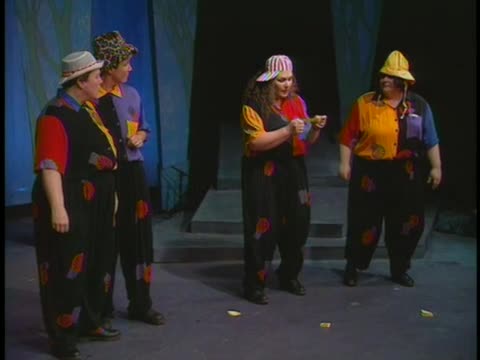
is one of the riskiest kinds of theater. But there is an improv group in Eugene that just celebrated its 10th anniversary. Tom Dantoni caught their act and he's here to tell us how the improv went over with the audience. Gray, they had them on the floor laughing. You know, improv comedy is like a jazz solo. You take a basic structure and then let your instincts take over. Ladies and gentlemen, meet Wimprove. Please welcome Wimprove! Improv is interactive and the group is asking the audience to write down random phrases on little slips of paper. And then they seed the room with them, thusly. You know, the last time we walked this beat, it was full of bums. And you know what I said to them? What? I said, she smells like soup! Well, you
can't blame them, Martha. I mean, you know, I can't. Well, I'll tell you what I would say to that. You know, as somebody said, you know, if you got any soup, I'd say, Mary had a little lamb. Lamb soup? Don't you think it's a bit rich? I'm a bit, bit, bit pricey for them. Yes, it is folks. There's a big noise to come in. If I want to get off the beat soon, because there's going to be a tsunami. Now, I've got to give you the instruction, too. I've been running on the beat. My hanky is all wet. Here's your instructions. If you see a tsunami coming. Yeah. Sunrise in Ash crops America. What a storm! Well, I'll be washed up. Martha, is he telling us that the Senegal Mines after the tsunami are depart? I think he's saying we need to find the bus stop and get the hell off of it. People. What?
Um, did you see my hamster go by? I think it was in the soup. No, no, no. This hamster ate soup. This hamster would just be saying, um, probably something like, um, you know, what she says all the time, which is, um, she snaked her waist, linkily down the aisle. Just kind of like, she snaked your waist, linkily down the aisle. She's like, your waist, linkily down the aisle. It's a wedding of maybe hymns to make a scene such a line. It's a sign. Eid is our, I think of her as our rock. She keeps us, um, focused on improvisation as hard as it may be when we are rehearsing. She's the one that brings ideas to the group to make us grow and training and all of that. And she provides, both Sally needed to provide a warm cozy place for us to work or sit and catch up or eat or pour our woes and do our personal processing.
So, um, but Eid is kind of the, you can always count on Eid. And then, and then where did they go? I mean, that's the question down the aisle. The answer to that question, young thing is the feng shui in this room sucks. Debbie is a great character. She has some incredible, uh, beings living within that come out and in performances and rehearsal. And, uh, Debbie is the, it's going to be okay person. I think we all do that to some degree, but then that's a big one when we're stressing out, when I'm stressing out over something Debbie's really the one to remind us it's going to be okay. I thought you said the beach was better. Well, it has been, don't you think this is a lively path? Yeah. And you know, Harold. Yeah.
If they only knew that Dennis and Edna sin, they would not be here. Vicki's always the peacemaker. She always finds the way to, uh, get us all to agree that we're agreeing to something. I couldn't do it in my own relationship. And, uh, also she's our mom. Because sometimes when we're kind of wandering around and we don't know where we need to go or need to be, she'll say, okay, stop. You stay here. You go there. Just like we were her three year old. So it works really well. We like having a mom. Listen, um, I've got to go catch the bus because I'm going to be late. But, um, you know, see my hamster, the one way to get her to come. If you wouldn't mind, please, is say, um, in sweet, sour, a dazzled dim, she mothers for those whose beauty is beyond passing. Sally is the brainy one and she comes up with words
and poetry and Dr. Zeus and just amazing things come out of her head. And sometimes it's really hard for us to get her to stop. That's her, that's her role to keep going. That's her anger. She's never ever ready. That's her, you need to be funny. Best storm's coming and I'm going to go to high ground and be safe. And when, when you, when you get flooded over, remember, I told you, what's up doc? In real life, Sally is a writer for the Eugene Weekly among others. In it won the Harvey Milk Award for her contributions to the gay lesbian and bisexual communities of Oregon. Debbie works in student activities at the University of Oregon. And Vicki is at the University of Oregon's Office of International Programs. Improv requires intense concentration and a lot of quick reaction. So, whimprov goes through a rigorous warm -up before each show. Laughter
is contagious and most advantageous. Laughter is contagious and most advantageous. Laughter is contagious and most advantageous. We do some things that are just physically listening ourselves up when we realized, especially over the last few years that if we didn't do physical warm -ups, we're really paid for it after the show. Because we will do things on stage during the show that our bodies actually cannot do. And then we might not later make say when it really hurts. So physically to stretch out and warm -up and warm our voices up and that kind of stuff. But also things that are about just quick response, quick thinking, accepting what's offered and just accepting that and building on it. Impossible, probable, likely, must, dust, might, bug, flee,
dog, cat, now, sleep, dreams. Ah, love that. We used to, if we'd have a great rehearsal, we'd go, oh, we just used up all the good ideas. Now there's not going to be anything left for the show. And then we realized that it's eternal wellspring of creativity. Please welcome the renowned, his Royal Highness, McGriff Knockner. I have got better things to do. If you weren't in such dire need of technology, I wouldn't be here. And
don't try to steal my sin, which one I'm talking. So what is the secret of staying together so long and still enjoying it? I really love everybody. It is amazing that we haven't had to have counseling. I think the secret, I think we hit a point, and I can't remember what year it was, but we had a point where there was a realization, and I'm not sure that it was really conscious, but we did some processing, and I really think that we hit this place where we understood our separate roles and accepted that. And so does the audience, even when they're singing a gibberish opera. There will be a special Valentine's Day appearance of Wim Prove. Friday, February 14th, the Saturday, February 15th, at the
very little theater in Eugene at 8 p .m. It's a special production of how we first met. Tickets are $12, and are available at tsunami books, and Mother Colley's books in Eugene. For more information, visit their website, www .wimprove .com. Great you've done a lot of acting. You ever done any improv? I've done some improv. I believe in script. It's dangerous work. It's like therapy. It is very much like therapy. Before you go, I understand that we've got an update on the band that we featured last season on R .P. Yeah, I'm sure you remember Nan Olamen and her band Spigot. They've landed Thursday nights at the Green Room in Portland for what they call the Scrap Heat Swarray. Nan is still singing, playing, and writing David Lipkin, who will be featured in his own art beats story, later this month, is on Harmonica. Each Thursday night will feature a second band of wildly differing styles from Klezmer to Venezuelan romantic to Rootsrock and Bluegrass. That's Thursday nights at the Green Room in Portland. For more information, go to the web at spigotband .com. Okay, thanks Tom. As we all have
seen, budget cuts have decimated many of the arts programs in our public schools. We've also seen kids selling candy or holding fun runs to try to support those programs. Finger Valerie Day, who you might remember from the 1980s hit band New Shoes, decided to come up with a better fundraiser for schools. And the result is this CD, beginning to see the light. Let's take a look at Valerie now in the recording studio. And stars that fell like rain from out of the blue. When my life is through, and the angels ask me to recall the thrill of them all, then I shall tell them, I remember you. Oh, that sounds great. And Valerie Day joins us now. Valerie, thank you for coming. Thanks for having me. Now, tell me
about this project. The first thing you did to help the schools was to form after, which stands for artists for the arts. How did that all begin? Well, I had this kind of crazy idea about getting all the people in the arts community together and using their own art to help fund and raise awareness for arts and music programs in the schools, which, as we know, are in big trouble right now. So you decided to do a CD? Decided to do a CD, because I hadn't done one for a really long time. And I've been singing with a big band called the Woody Hype Big Band. Thought it'd be nice to take a little snapshot of the musical moment that I'm in. But also, my son started kindergarten at Irvington School a couple of years ago. And they did have a music teacher. They didn't have an arts teacher at that time, a visual arts teacher. But now the music teacher's gone. The visual art teacher comes maybe twice a year because of a grant for one day. So I just thought, if I can marry these two things, my passion for music and my passion for arts education, I think that I will have the energy to see the project through, because I know from doing the whole new shoes thing, which I
maybe we can get into later, is a part of being an artist, that you have to market and publicize and all those kinds of things. And I didn't want to do it just for me. Well, you're basically making this available to the schools, to use as a fundraiser, right? How is that going to work? Well, the interest in schools we send some information to, and the ones that want to use this as a fundraiser for their own arts and music programs, can have the kids sell the CDs, just kind of like gift -repper candy sales that they already do. Except this is about music and it's about art. So then the school gets to keep 50 % of the sale of the CD. The other 50 % comes back to us and we have an equity fund that we've created, and we will grant other schools who don't have the wherewithal to do fundraisers money from this equity fund. So we can kind of help level the playing field. And the requirement is they have to use it for arts programs. They can't put it into anything else. Right. What kind of response have you been getting so far? We've been getting a great response. Just calling the principals and saying, here's what we're trying to do. In the midst of all the other budget cuts and everything, they're just scrambling for any help at all. And
so we've sent out tons of materials and we've got a lot of interest at school. Why did you think a CD would be better than the thing we're all used to seeing, candy, and wrapping paper, cards, things like that? Because it's music. And especially swing music is really joyful. And I think that also it's cross -generational. So for this CD we thought maybe the first one should be for all the generations. And then in future years we're going to have other projects and other CD projects because we have a community full of artists as you know who have so much to offer. Well that leads to my next question. How did you get all the musicians to donate their time and energy to producing this? Well it was pretty easy actually because I've been playing with different jazz musicians over the last seven years and I just called everybody up and said, hey you want to do this project and this is what it's more. I don't know any artists that I've talked to about this project, whether they're a visual artist into dance, theater, music, has said, what can I do to help? This is such an important thing and I myself don't teach. I don't go into the schools. I
can't volunteer my time, but I want to do something. So we're coming up with all kinds of different ways to involve artists doing what they're already doing to help create more awareness and funding for this. Now you wouldn't have a CD release party because about that. We're going to have a CD release party at the Crystal Ballroom on Valentine's Day and it's called Beginning to See the Light. And so we've got Tom Grant who's going to come and do some stuff on his own and sing a song with me. We've got Barbara Lesch and Jessica Hollyfield of Bommable and Fame who are going to come and we're going to do a little Andrew Sisters thing. Dance West which is the Beaverton Arts and Communication High School's dance company. They're the only magnet arts high school in Oregon. They have a wonderful dance company and they're going to come and do some swing dance to in the mood. And we've got a couple of wonderful male dancers that used to dance with OVT and Bill Brent and Robert Gietro are going to be dancing with me as well. And that's February 14th. February 14th at the Crystal Ballroom. At the Crystal Ballroom. Now we have very little
time left but just briefly tell me if people want to just buy this, how can they get a hold of it? They can find it in the stores on February 18th at the drop date. And so they can get it or they can go to our website which is www .artistsforthearts .org and there will be some information there about how they can they can get the CD. Great thank you very much Valerie Day and the new CD beginning to see the light. So many good things to tell you about in this week's Artbeat Calendar. The Oregon Women's Caucus for Art presents Erotic, neurotic featuring local women artists of all ages working in all media. The exhibition explores our diverse understanding and interpretations of women's sexuality. It's held at the Black Crow Gallery in Northwest Portland Thursdays through Saturdays through March 4th. See more than 100 works of fine art by regional artists at the Beaverton Arts Commission's Visual Arts Showcase 2003. It opens February 9th and runs through the 22nd. Among the artists featured will be Linda Davis Coghill, who will be profiling on our beat next month. It all takes place at the Beaverton City Library on Southwest 5th. Fans of playwright Edward Albee have a rare opportunity
to discuss his work with him. Profile Theatre Project brings the Pulitzer Prize winning author to the Lincoln Performance Hall at PSU on Saturday, February 8th at 2pm. Best of all it's free with a reserve ticket. You can get them at the PSU Box Office 1825 Southwest Broadway in the Smith Memorial Student Union or by calling 503 -725 -3307. Last season you may have seen Kevin Burke here on Artbeat. This weekend you can catch a rare hometown performance of this Celtic fiddle virtuoso. He'll perform with Cal Scott, who's also been featured on our show. Kevin Burke and Cal Scott at the Hollywood Theatre Saturday at 8pm. Tickets are only $15 in advance, $18 at the door, more information on this website, www .HollywoodTheater .org. And that is our show for tonight. Now next week we'll meet an artist who burns his art. But it's not an art to ashes story. And we'll meet a group of poets who don't exactly fit what you might think of as the typical poet profile. Plus, a fabric artist you won't want to miss. That's all next week. We'll leave you now with a little bit more of Fiddler Kevin Burke. Thanks for watching. Good night.
Support for Oregon Artbeat has been provided by the following.
The James F. and Marion L. Miller Foundation. The Allen Foundation for the Arts. And O .B. Media.
- Series
- Oregon Art Beat
- Episode Number
- #417
- Producing Organization
- Oregon Public Broadcasting
- Contributing Organization
- Oregon Public Broadcasting (Portland, Oregon)
- AAPB ID
- cpb-aacip-35bc51b9552
If you have more information about this item than what is given here, or if you have concerns about this record, we want to know! Contact us, indicating the AAPB ID (cpb-aacip-35bc51b9552).
- Description
- Episode Description
- Profiles of Director of Photography Gerald Hirschfeld; the all-female improv group Wymprov; and jazz singer Valerie Day.
- Created Date
- 2003-02-06
- Asset type
- Episode
- Media type
- Moving Image
- Duration
- 00:29:48;29
- Credits
-
-
Copyright Holder:
Oregon Public Broadcasting
Producing Organization: Oregon Public Broadcasting
- AAPB Contributor Holdings
-
Oregon Public Broadcasting (OPB)
Identifier: cpb-aacip-66fd276cc91 (Filename)
Format: Betacam: SP
Generation: Master
Duration: 00:30:00
If you have a copy of this asset and would like us to add it to our catalog, please contact us.
- Citations
- Chicago: “Oregon Art Beat; #417,” 2003-02-06, Oregon Public Broadcasting, American Archive of Public Broadcasting (GBH and the Library of Congress), Boston, MA and Washington, DC, accessed May 16, 2026, http://americanarchive.org/catalog/cpb-aacip-35bc51b9552.
- MLA: “Oregon Art Beat; #417.” 2003-02-06. Oregon Public Broadcasting, American Archive of Public Broadcasting (GBH and the Library of Congress), Boston, MA and Washington, DC. Web. May 16, 2026. <http://americanarchive.org/catalog/cpb-aacip-35bc51b9552>.
- APA: Oregon Art Beat; #417. Boston, MA: Oregon Public Broadcasting, American Archive of Public Broadcasting (GBH and the Library of Congress), Boston, MA and Washington, DC. Retrieved from http://americanarchive.org/catalog/cpb-aacip-35bc51b9552