Coverage of the 2000 Edward R. Murrow Symposium with Ted Turner
- Transcript
Good evening. Welcome to the year 2000. Tomorrow symposium the students faculty staff alumni and friends of the Edward R. Morrow School of Communication at the Washington State University are pleased to bring you this year's program and award ceremony. The moral symposium is a national forum for discussion of important communication social political and public policy issues. It is also the venue by which WSU and the Moro school. Recognized the contributions of individuals and organizations for the preservation of Edward R. morrow's ideals and professional standards. The school takes pride in bearing Edward R. morrow's name. We also take his legacy seriously. Our goal is to educate communication professionals and members of society
who really exemplify in their professional and personal lives the highest ethical and performance standards set by Edward R. Morrow. More than five decades ago. At this point I would like to share with you a note that I received yesterday from Casey morrow son of Edward R. Morrow and a member of our school's advisory board. I am writing to wish you the faculty students and the Advisory Board members a successful symposium. I truly regret not being with you. I believe that the award that Mr. Turner will receive this year on earth has many contributions to the field of communications just as it also honors my father's memory. At the same time the award reminds all of us of the ongoing success of the MRO school off communication in serving new generations of able communicators
with best wishes. Sincerely Casey morrow. At this point I would like to present to you an award winning video tribute to the morrow for the morrow tradition. Thank you all. Came from a tiny hamlet in northwest Washington. He shaped Washington and. Changed the way we look at the world. But to future generations of mentors lucky enough to follow him at CBS News he was a reporter with a conscience.
But accuracy fairness faced pressure from from big business pressure from power is a sure sign of a good journalist. And he never lost his way. His fresh eloquence and I can think of no higher 1935 station he brought into American living room. From a hearing on radio on television
expanded journalistic horizons with courage to stand up against Sen. Joseph McCarthy into the plight of migrant workers. You know professionalism his integrity his courage. But I want you to think about another of his qualities. He was a progressive. He experimented with television the popular faces he pushed. He did things that hadn't been done before and he did them successfully and worked for the Kennedy administration as head of the United States Information Agency. He was knighted by the Queen of England. And in 1964 was awarded the Presidential Medal of Freedom with distinction. His legacy does not need my endorsement but I cannot
imagine broadcast journalism was out the early front of his values his dedication to the essence of the craft of this business. In a way in which he did it factually but at the same time in a way the country could understand what it was that he was talking about and come to care about those events. However separated they may have been from them. I think it honors his memory not let's do it exactly but let's do it the way I do it today. The truth fearlessness and going after it and broadcasting to set a standard. So sure. Thank you.
Good evening. I'm Barbara couture. I'm Dean of the College of Liberal Arts. And welcome to the 26 annual mural symposium. I'm here to tell you a little bit tonight about the mayoral Ward the Edward R. Murrow Award recognizes the person or organization exemplifying through service or performance the professional ideals of Edward R. Merle Edward Merle graduated from Washington State College in 1930 with a Bachelor of Arts degree in speech and as a member of Beta Kappa a national honorary scholarship dollars shipped honorary in 1962. He earns WSU highest honor the regents distinguished alumnus award and in 1946 he was awarded a WSU honorary doctor of law degree. He is regarded as Broadcasting's most illustrious journalist credited with making
broadcast journalism respectable courageous and sincere. In short Edward R. Murrow established the standards to which broadcast professionals nationwide aspire in today's complex media environment where news comes through many sources. The Internet cellular phone satellite broadcast local national and international radio television as well as traditional newspapers and magazines. Competition for our attention alone has made the challenge difficult for those who bring us the news to stay focused on the ideals that Edward R. Murrow espoused with unusual foresight Admiral predicted the future that we are now facing. Reminding those in the communication professions and we citizens who depend so much upon their work that the communication profession is charged with the responsibility to ensure our common humanity.
It is great wisdom. Edward Moore a warn journalists now. Thirty two years ago do we merely stay in our comfortable nests concluding that the obligation of these instruments that is television radio and other media has been discharged. When we work at the job of informing the public for a minimum of time or. Do we believe that the preservation of the republic is a seven day a week job. Demanding more awareness better skills and more perseverance than we have ever yet contemplated. Our previous winners of the Moore award espouse this ideal of vigilance and responsibility. They include Sam Donaldson in 1997 29 year veteran of ABC News Walter Cronkite in 1998 logged CBS broadcaster who earned the moniker the most trusted man in America. Washington zone Frank Broughton
board chair of the Seattle Times the Walla Walla Union bulletin and Yakima Herald Republic in 1999 Keith Jackson nationally renowned ABC sportscaster and and Al Neuharth who built Gannett publications and is the founder of the newspaper that changed America. USA Today it gives me great pleasure on behalf of the College of Liberal Arts and the Edward R. Murrow School of Communication to turn the floor now to President Sam Smith of Washington State University who will present the award to this year's recipient Ted Turner. Q. It's a pleasure this evening to recognize another true pioneer an individual who I feel carries on the morrow tradition of daring of capability and ability to change. Ted Turner is a native of
Cincinnati grew up in Georgia. After studying at Brown University of professional career started out in a car as an account executive at what would later become Turner Broadcasting System. In 1963 he became PBS president and CEO. In 1982 he inaugurated CNN cable news network and Headline News. Two years later CNN International was started in 1996. CBS merged with Time Warner and became vice chair and a member of the Time-Warner board of directors. In his current role of Time Warner he oversees a cable network division as well as a Major League Baseball and National Baseball Basketball Association Atlanta franchises and expansion National Hockey League team in Atlanta in leading TV s he originated the Multi-Sport international Goodwill Games the 1990 game for held in the Seattle area with some of the competition in Spokane in
1901 he was named Time magazine's Man of the year. More recently he and CBS founder William Polley Edward R. Murrow's boss were named Broadcasting Cable men of the century. In addition to becoming a leader in the communications industry Mr. Turner has also been an internationally recognized philanthropist. In 1970 you donated one billion dollars to United Nations programs four years prior to that he was named U.N. Population Fund goodwill ambassador to recognize his support is support of the organization he's president of the Turner Foundation which focuses on supporting population environmental projects. Now Mr. Turner of you joined me at the podium I'd like to read in the award announcement. Please welcome Mr. Ted Turner. Thank you. It uses. A it
Mr. TURNER. Many people have dreams but few of these individuals are really visionaries and fewer still see the dream become a reality and affect society in profound ways. Your vision of a cable based all news television network is it's an internationally respected provider of news and analysis on virtually every topic. Mr. Turner your contributions have been and shall always be judged by historians as having a major impact on journalism and communications. Society is better informed because of you and CNN. You're an innovator. You took risks and as a result media in general and telecommunication in particular have been forever changed. The Edward R. Murrow Award for communications named for our esteemed graduate a broadcast journalists whose standards continue to be the highest goals for those who cover the news. You exemplify his professional ideals therefore with our sincere thanks and gratitude to you.
Please accept the BSU Everett our moral school communication award. Ladies and gentleman Mr Ted turn. To him. Thank you Sam. Boy this is a big gob thrill and an honor for Rob and for Rob the 4000 or so employees at CNN with who I wish to to share this this great honor. And of course growing up like I knew about every dollar I was too young to remember the radio broadcasts from London but I had knew about
them and I'd seen them in movies and documentary films and so forth so I was intimately familiar with what or at least casually from a with with with his or with his accomplishments. I thought probably. The best way to start. I'll speak for half hour in about a half hour of questions. Would be to give you insights a little bit inside and take a journalistic spin on a journalism award. The first thing that I have to give you a little. It's hard to know exactly where to start but when I went to Brown University and it was a liberal arts school and they didn't have a journalism school and I majored in classics. And but I but I really think it was valuable because. You know
I was inspired more than anybody else at that time probably by Alexander the Great. And what I wanted to do when I grew up was conquer the world. I did I been a military school for seven years prior to that and I when I was nine years old I was carrying a rifle and on my shoulder and marching in uniform with band playing and everything. So I was really. And basically I always looked at that you were out to win you wanted to win quickly you wanted to where they weren't expected to relentlessly follow up when you had the opportunity and don't give them a chance on like Robert. He's a perfect example of a good general who ended up losing the war he won a lot of battles but he lost the war because he didn't follow up on his victories when he had a chance to annihilate the enemy. He was happy to win the battle
and stay in command of the battlefield and he ended up losing the war for the South. Lost anyway probably numbered but. Still having trouble with the Yankees you know they took us for no last year anyway. Anyway so that was. My journalism background was confined to selling newspapers when I was in the fourth grade at the streetcar stop in Cincinnati. I saw all the papers that people got off the street car. And on a good day I'd sell 15 or 20 and I got a penny for each one a copy was a nickel and I'd make 15 cents on a on a good day. I mean it wasn't a lot but it helped me pay my way through grammar school. Actually I had a parents to do that but that was that was all a journalism background I had in and in the late 70s when I really it was in the mid 70s
before we went up on the satellite. I don't know how many of y'all have been surprised out here because when all of a sudden there was a station on the cable system years ago they carried Atlanta Braves games. What the hell is an Atlanta station. That's right that was my idea. That was. That was my idea. That started me on the road. All you need is a few good ideas. You know when I've had my share of them anyway I thought I thought the network of Walter Cronkite and Dan Rather and everything I thought that they'd be the ones to do a 24 hour news network because they already had all the raw material they had all the footage they had newspapers that were sitting around all day waiting for their little half hour newscast to come on they could have done it for a fraction of what it cost me because I had no news infrastructure no background no knowledge no credibility nothing.
And I but I had an idea and I just sat there and watched the years go by 76 77 78 and 79. And I said well look like anybody else is going to do it and I thought well why don't you give it. Gamble everything you got you know it's going to work. I mean I had some radio stations and they were in small markets and. But I went to New York making sales calls from time to time and I knew they had all news radio in New York and it was working there I knew all news television would work because it was on a cable system it would just be a choice you could come in at 5 o'clock or 8 o'clock or 9:00 at night when no news was on the news only on Two and a half hours a day. And I just it was people said one guy said No I don't think it was a terrible risk at all I thought it was a lay down. I don't know anything as I didn't know how much money it was going to take and I didn't have very much money and I knew I didn't have
enough to get finished but I remember reading about Rommel in the desert. You know they call him the Desert Fox and he never had enough petrol for his advances you know. So we had to move fast enough. To to catch the British off guard and roll him back so fast they didn't have time to blow up their raw fuel ducts. And so he would continue his attack with British fuel anybody. But that's a gamble because if they the panzers were to run out of fuel out there in the desert and been sitting ducks for the Royal Air Force. So I had to I but I knew that I would be able to get. Once I got on the air I gambled that I'd be able to get money because it would obviously be such a good idea when people saw it that I could get more investors and that's exactly what what happened thankfully because otherwise I would have gone broke I didn't have enough money to make it a year I was like these dot com companies you know they've got enough money in the bank to make it through the next month.
I appreciate it I hope they all make it and I wish them the very best. Some will I'm sure and some won't but then 19. And then when I had the idea in 82 or 83 to go global with it. I immediately ran into a buzz of negative reaction from all over the world you know. The French didn't want American everybody the Russians everybody thought that there was going to be imperialism that the CIA was behind this and they didn't want to and their country itself was. So they didn't want an American news organization out there coming into their country via satellite which couldn't the satellite signal it couldn't be controlled. And at that time far less than half the people in the world lived in the mocker so far let's I'd say probably only a quarter of the people on the planet when democracy most of South America was not democratic Of course the former Soviet Union including China. The eastern
bloc that was not democratic I mean the world was not democratic. So they didn't want to neither because we were from a democratic country. But what I did was to allay their fears as much as possible. First of all I created something called The World Report I said if I include them. By letting them send in pieces every week and I put them on Sunday afternoon and agree to take them from every country in the world in their long as they get translated into English one way or the other they either furnish him to me in English or we translate them in English that we would take these news stories from everywhere and we'd want to censor. And I had my I was running CNN at the time not on a day to day basis but I was setting the policy. And I had all my news executives in and I told what my deal was and they said you're crazy. You can't do that.
I said what they said because we'll get pieces from Moammar Gadhafi from Libya about what a rotten with the great Satan the United States as well get pieces from Castro and get pieces from Russia China tell him how good communism will get all this propaganda. I said great. That'll be terrific. You know people really want to watch that nobody's ever seen that overhears ever seen a commie newscast before you know that nobody's ever seen before and will get credibility for AROUND THE WORLD. And I said and they said well I said well then just give me your resignation because I guess some people will do it if you won't. Course nobody. And of course it went rather smoothly but that didn't get away with all of the criticism because they still didn't trust us so I came up with another diet. I came up with an intern program from journalists from other countries and we would invite 15 at a time for whatever countries
Russia Russia you name it and we'd let him come over and see our operation and study for six weeks and they could find out anything they wanted to and that they would understand I would meet with each group of them and personally talk to an answer questions from which I do and so on. And we had him from Cuba we got visas we had him from Iran. Iraq. And and when they went back they saw that we did not have a hidden agenda that we were not an arm of the CIA that we were trying to report on national honestly and fairly as we could but differently than the networks. There you have to go back before 1980 when CNN started. We did not have a balanced picture of the Middle East for the most part the national news being this country pro Israel anti
Arab that it was it was not balanced at all. And I said we were going to get both sides a controversial story even though it cost us advertising and cost a lot of grief and self. But anyway so we had these journalists coming in and we had usually four classes a year 60 journalists came from all over the world and came in and studied under us and then went home to their own countries and news in those days was making rapid technological advances we were using satellites to extent no one had ever had before for one thing we had because we were we didn't have a lot of money. We were using lower cost equipment and we were always on the cutting edge of technology because we had to be on the air for so many hours and so forth. So that made that set up. That I P P programme and World Report.
Eventually begrudgingly the rest of the world allowed CNN to come in because I know that around the world you can even get us in North Korea. I just want to tell but my God there's one North Korea and one of our top people has been there a dozen times more than all of us the American generals but they get anyway Intellivision. So. When the Gulf War when we when the Gulf War was brewing when it looked like. There was going to be a war the United States was involved in a special satellite uplink with its own generator and everything went out and we were allowed to bring it in. Saddam Hussein and his broadcast network over there knew that world leaders all over the world at that time were watching CNN had it available pretty much and that it would be helpful to them to have the ability to speak to the rest of the world.
Because clearly we were going to cover all sides of the war if we had an opportunity to do so. And one of the top people in Iraqi television was one of our international journalists that had come over to visit us and we had good connections with him. They let us look like we were going to have the OP or the possibility of broadcasting from there that was the good news the bad news is that never before in the history of journalism I mean when I was in London he was not behind he wasn't in Berlin. He wasn't in the right stuff with him. And they know journalists from another country had ever covered. Before a war from inside the the belligerents the others other sides. And and I was really concerned I knew about the Iran hostage situation and I thought if American journalists were seen on the streets of Baghdad while we
were dropping bombs or the day after we dropped bombs of Froude might just kill us you know just right on the spot. You know they're very angry about that. A lot of people don't like it when they get bombed particularly by a superpower when they can't bomb back you know it's kind of a one sided war you know it's. You got to give him credit for having the courage to stand up to us you know I mean you can't you you've got to question his judgment. But you've got to admire Saddam Hussein. And he's still just like everything we could to get rid of him but we can't do it I mean it's amazing as it is anyway. Anyway we got along with all at that point leading up in the days leading up to the American attack. All the news organizations were they I mean CBS NBC and ABC were there as well as us. But they had not had the connections and they didn't have the world wide coverage and they weren't trusted.
By the regime and I when I say trusted we were trusted to be honest. We are so obviously we're going to bend over backwards to give the Iraqi position just gonna cover reasonably. And so I was in so and prayers United States called Tom Johnson who was and the secretary of state called for five straight days and then the day before the attack the president called and strongly under the very strong. Conditions. Virtually ordered us to get our news people out of out of Baghdad and I told I had a meeting a meeting of the CNE top brass again because Tom Johnson who had been the publisher of The Los Angeles Times before he joined CNN had lost two journalists in Nicaragua they were killed down there covering the war and in
Central America and he wanted to pull our people out and so did the rest of the management team. And I I didn't do this very often I did it in that program before I said as long as we have people that are willing to volunteer to stay there and not make anybody. Tell him that any yellow chickenshits can get out right now if they want to. Have somebody that wants the stag. God forbid. Remember I remember when we had our Israeli bureau and I said How come we never get the footage from the Palestinians they said well we'll get some Palestinians here and we did. And let's go cover the Palestinian side. You can't you know Israelis over there to you know behind Gaza be torn to pieces. So anyway Peter Arnett wanted to Stagg all
Peter once again you'd have to question his wisdom. But you have to admire his courage. You know that's so that's soccer state and. And of course the first day. Bernie Bernie Shaw and John Holliman got caught there by accident they were supposed to get out the day before but we didn't know exactly for sure to the minute when the attack was going to occur. But they got stuck there and they were there the first day or two and then they they got out. But. As you know Peter Stone Well I was in Los Angeles. I had to go out there for business. And I was in Los Angeles at Jane's house in the afternoon and I flipped on CNN and I I knew it was close. I flipped on CNN and five minutes later the war started and we had the shells going across any aircraft fire it was nighttime in Baghdad. Most of them.
And I said Wow. And then I flipped the dial I took my clicker and I would CBS could they had Dan Rather sit in the newsroom talking about the click click. Brokaw in the newsroom talking about Clay Jennings on ABC talking about the water. You got them we got a big win here. Ah. We got a big win here. This one. I mean. Talk about I mean it was pretty amazing and that's how I got that was the year I GOT TIME magazine's Man of the year you know. It was pretty amazing anyway that and this is for a guy who has total journalistic experience up until starting CNN was selling newspapers I mean that's and I'm not talking about publishing them and I'm talking about you know the man standing there when you stepped out of the paper paper get your paper
read all about it really that was you know anyway. What else happened. What else happened in 1979 a year before CNN started while we made the decision to go forward with it I sat down I said you know Turner you don't have a journalistic background they've got not one but you really do. Need to study the national and global situation and really figure out what the great problem of the day are and and then trying here at CNN to cover and deal with those problems and hopefully find solutions. You know I believe that journalism should find investigate find out that benefit our problems and then propose solutions. I mean it is should be of benefit. That it shouldn't just. You know go out there and revel in Columbine or whatever Princess Diana's death and you know I know you've got to cover that. But that isn't all you should do.
And that was my opinion. So I really I really started studying reading. But while we were rushing to get the cameras and what man and hiring people and so forth and it was very clear to me I mean I already knew this anyway but I wanted to really give it some careful thought. And. It was clear to me that the Cold War and the threat of nuclear annihilation was the was the greatest threat that humanity face. I want to see the big picture in the second after that was the burgeoning human population which at that time was less than four billion. Now it's only 20 years later. This is the 20th anniversary of CNN June 1st will be lots of. We're getting ready for a big celebration. At any rate and then the third thing was the ever increasing number of human beings and him the ever growing technology and influence was putting greater and greater strain every year on our
natural environment. So it was you know our population collapse or the environment those were the three what I call survival issues. And I decided not only was I going to cover and I was going to do what I could to change. And like I got on an airplane in 1982 I went down to the Del Castro in 83 I went to Russia and I used to make friends over there and I thought it was horrible. Jimmy Carter who watched the front of my body he boycotted the Olympics in Moscow in 1080 if you recall. And the Russians were talking about when I went over there boycotting the last of 84 and I did everything I could to try and talk him out of it. But they went ahead and did it anyway. And I was really concerned even have a meeting on the athletic field and Reagan had come in
as president and called them an evil empire. And I just get worse with 30000 nuclear weapons on hair trigger alert pointed out as we were calling them names. You know I mean it's like two people sitting at a table with talk to each other. You don't call a guy names in that situation. You say Look Charlie. You know shouldn't we take take him off here put him on the table and discuss this like a gentleman I mean let's don't call godless communists I mean first of all a lot of people in this country live there are quite a few people over here they're godless and we had some socialists over here we didn't have any communists we had a few McCarthy thought we had a lot you know the place was riddled with communists. Very seldom ran into any myself but you know what the Senate says we got time. I was scared at their work. And my father told me when I was a little boy that. That if you were
going to take over someday he thought Harry Truman and FDR were communists. Right wing he was I was really confused growing up. I have to tell you. And I was terrified of the communists. And I started meeting them and see how easily they got drunk. They didn't seem quiet is quiet is imposing. I got drunk with them but I'm a 2 beer drinker and. I was an executive vice president for a bunch of those. And I felt ill and I couldn't make it to the to the restroom on the floor in the Kremlin with the beautiful carpets all of. The Russians. The Russians loved it because they get in those days. Anyway.
So I'm working I'm working so I came up with a good game at a time when I couldn't afford it in my sports guy on a 50/50 basis. If we make money on the World Wide rights we're split 50/50. I said you know you guys got more money always almost broke and this was back in 86. Become a money machine yet and 40 million was not. I mean it's still a lot but it's not as much as it was but. You know I. You know I made my money the old fashioned way and worked for it and it took a long time to get it I would like these guys over and Silicon Valley made it overnight. I spent so much time making it and being cheap that I never learned how to spend it and even now I don't know how to spend it.
Tom Brokaw gave me this jacket the shirts a gift my parents my shoes were for a yacht. I don't pay for anything. Don't I everything I get I go they give me the check and the turn of the restaurant this is on the house I said why do this. I can pay. Anyone. Lived in my office for 10 years I don't have a card you never rent payments you don't have a car you don't have rent payments you save your money I didn't pay for a haircut for 20 years. You do that for 20 years didn't smoke. That's saves money you can save thousands of dollars that way if you invest it wisely you'll be a millionaire in a new. Invest your millions wisely you'll be a billionaire not everybody's one you know they're everywhere. You know of every street corner at least when the market's up. So anyway that's what I live on. I've been working on I've been giving a lecture I gave away a hundred fifty million dollars this year I'm planning to give an A on another fifty. I'm going to
start. It turns out that we haven't got rid of nuclear weapons we've gotten rid of the enemy. There's no more Cold War but we still have three thousand or six thousand right now. Nuclear weapons on hair trigger alert pointed at the failsafe on CBS the other night but it's ridiculous that they're not even our enemies anymore they're capitalists broke capitalist broke democratic country I mean you know why all we got our bombs pointed out and particularly these bombs are extraordinarily dangerous and they have 6000 points I'm going to go over next month and imo see Putin who seems to be young or progressive in the Goodwill Games in Leningrad. He was operative. He was the vice grad and he was the guy that came out and picked me up at the airport when I got to town like the professor here from the Philippines is done here so I know you know what I'm going to I'm going to I'm going to work hard to get
rid of nuclear weapons I'm going to try and get it back on the agenda. I need some help it's it's still there. It's like what it's like there's like having a live rattlesnake welled up under your easy chair in your living room you know you don't see it but if you know it's there it's disconcerting. You know. Be a lot better to get caught. You know not saying you're gonna kill it but getting back outdoors I mean weapons are extraordinarily dangerous and something wrong. I was during the Reagan presidency I was worried I knew his health was not particularly good and I knew that by his bed is a little box with a red button on it and my feeling was wise on time issue we could have a stroke and what you know that's it's could happen. You know. Look at that. I'm not kidding you look at a kid up in Canada. Everybody's Internet system you know I mean screwed up the
CNN website I mean christ sake you know we live in a world where technology goes amok you know every day an airplane crashes somewhere right. And we've had some nuclear accidents they've been hidden from you know Three Mile Island and things go wrong people screw up and the generals I mean I could go on and on about this but let me tell you I've been studying it very carefully and I am absolutely certain that we stand a substantial risk as long. And we're living up to our treaty obligations in the Nuclear Nonproliferation Treaty. The United States and the other then nuclear powers. I'm going to have a wallet. It's important to get it exactly right no matter what my glasses on. We signed a treaty in 1970 that committed us in return 195 countries agreed they would not build nuclear weapons but nuclear power States had to and they agreed and we signed
this to quote pursue negotiations in good faith on effective measures relating to the cessation of the nuclear arms race at an early date and to clear disarmament. We promised that we would work towards nuclear disarmament. Thirty years ago and we've done squat about it it's like our treaties with the got with the Indians and it's time we got them lived up to our word. You know our word should be our bond. That's one. And then the other thing we need to do. Thank you. The other two things we need to do is get off our butts and get our government. And the election coming up this fall we have an opportunity to get an environmentally friendly progressive government in work to close down our coal burning plants and put in cleaner energy sources and come up with a transportation program for our country and encourage off fuel efficient vehicles.
You know our atmosphere is being degraded every day not here out here so much as it is in the major cities around the world but still the pollution is getting up into the upper layers of the stratosphere and blocking in the sun's rays and causing global warming and all sorts of other horrible problems we've got too. We have all the technology we have the resources we all we only lack the will we have the knowledge now of what needs to be done to straighten up the environment and we should do it. We only have one environment and if the environment is the great and so was our ability to live here it's only place we've got and I don't think we're going to find any place out there with Captain Kirk and the Starship Enterprise that go to in the time we have left. I mean some people are predicting that if we keep on our current course in the next hundred years we'll. We're going to lose half the speed. I find that
unacceptable. I have children and I have grandchildren and I want them to enjoy the same kind of maybe a better way. And there's no reason we couldn't do that. And maybe we could. Last century of the last millennium the last millennium was the millennium that humanity's ever and the last century as far as brutality and the purges in Russia and China. More people were murdered in all of genocides in history put together. But now we've got a new turn. And we can and should be different should start. Acting like educated intelligent kind hearted human beings. And on that note I'll start taking questions. Thank you very much. Thank you very much for your.
Are students of submitted some questions and we invite the audience to write down your questions and submit them to turn them over to Eric Austin and and all of our faculty. We have student readers for the questions I'd like to ask the student readers to please introduce yourselves and then you can start reading the questions for Ted Turner and Caroline I'm a senior majoring in broadcast news and production costs has commented that some baseball teams know going into a season that they will not have a chance at winning the pennant because of the way baseball is financed. Do you think this is true. And do you think that baseball finances should be restructured first I've got to tell you I am. A little hard of hearing and you're kind of echoing I know you asked a question about baseball but I missed about half of it.
We're going to have to have some sort of different system you know maybe if you come over here I can hear you while you're talking on the mike. I don't yes. What about baseball. Yes. Comment. I used to be one of those ah tell me ah. Yes I do I think I think what we should do is we ought to have communism in baseball. Every ball ball players make the same way regardless of their talent. Balance. But we have a lot of unhappy players.
OK you got a. Nice surprise. All right. Are you concerned with some of the programming that children are exposed to today and what are your thoughts on regulating unhealthy materials on the Internet unhealthy. OK. Am I concerned about the programming that children are exposed today I'm exposed. I'm concerned of a lot of things that everybody's exposed to. You know we're exposed to a lot of things and obviously a lot of crappy programming on television has a lot of good maybe less but. At any rate it's a problem but you can't you're not going to get everything completely you're not going to live in a Utopia right away. As far as that is concerned but it didn't let their children watch the really crappy stuff made it go off the air very quickly.
We all take responsibility for and I'll tell you one program that I did a children's program as Captain Planet that's an environmental program to cooperate with each other and it's one of the best programs for children that was ever done. And I never made a crappy children's program myself and I never well. What about regulating unhealthy material on the Internet. I don't that healthy. Sex violence how to build nuclear weapons I mean who's going to decide what's healthy and what isn't. I mean it's some things but it's more on others. But there should be a great supporter in blocking devices that and in putting in writing television programs and for material on the Internet and supplying families with blocking devices that will allow parents to decide what their children can and cannot be exposed to.
Yes here. Political science and broadcasting. I aspire to be our next Christiane Amanpour. OK thank you. Moving on to my question for you sir your foundation has done important work focusing on population and the environment. Many studies have shown that the best most effective way to lower population rates is to improve the political educational and civil status of women. What do you think the Turner Foundation can do to assist these women activists. Well it's basically the U.N. Foundation to you know the role of women in the United States is one of the best in the world. They're there most of the problems with with women are in other parts of the world where they're not granted equal status with man and and don't have
opportunities to be educated and some places don't have the vote can't drive cars can't have jobs. And we are devoting millions of dollars in some of those areas to improve the lot of women in numerous ways. Yes. I like that in your communications. My question very quickly is what was your motivation for donating one billion dollars to United Nations and what do you hope that this will. That's a that's a pleasure I I like the United Nations I am absolutely like the League of Nations I'm a student of history. I want to conquer the world I want to help save it. Big difference. That was when I was much younger. I took down the statue of Alexander the Great at my desk and put the statue of Martin Luther King on it. But the League of Nations failed the League of Nations failed because united for one reason because the United
States did not join. And the United States was not paying its dues to the U.N. in the UN three years ago four years ago was really in terrible shape. And I wanted to give them a psychological boost. And that's why I gave them the money and what I want to accomplish with 100 million dollars a year that we give to U.N. causes of and I think there's been close to a hundred different things that we've given to everything as the burgesses as landmine removal to 28 million too towards the eradication of polio to other children's health projects. Women's rights environmental programs and Population Activities. Yeah. Yeah.
And what is a signal. Significant ethical dilemma. And how did you handle it. I guess one of the things that I'm proud of I mean the thing is that I'm saddest about as as as my three failed marriages. I can't get that right. I got everything else right. My kids have all grown up well at least so far. And but I but I haven't I haven't I was raised by my father and my school. I want to honor system. I have just beaten into me from childhood on that ethics was not a question so I haven't ever been tempted to make
any ethical compromise. I've never strayed from what I believe. I'm blessed with an iron will. Had I been born the partner. Of Camelot. But not ethical. Yes and it's all right you heard the question. Work hard work smart early to bed early to rise work like hell and advertise. I don't know. You've got to do that. Paid for that advice.
What are you asking why. How do you think it would take a whole life. What's gotten faster. Everybody knows. Yes a take. How do you feel about people in the public spotlight. How do you feel they are held to a higher standard standard how do you how do you feel about the people in the public spotlight.
Well people out there that's one that's another. Thank you again. Yes. To the top to a comic strip character. I believe it was Little Abner. Whoever that character. For all those. What's a calm cases. Well I'd rather be Captain Planet than plane. That's right. Trying to do good and the others just ahead.
And I have to press this question. Do you feel that the suspension and fines given to John Rocker were appropriate and would you act differently. Hindsight hindsight yes it is. But I act differently. I guess it was appropriate the arbitrator said. You know it's like you go to court you have a speeding violation or something they give you your penalty. You know I mean who am I to question the ABA to arbitrate. He was picked by the Players Association and by Major League Baseball so on but by what he did was unforgivable. But we live in a country where you know you are given other chances and he has whether it was adequate or not. And I think that he isn't as bad as what he said I think he just kind of lost his temper. He's not that bad a kid.
But you know Anyway he's out there and at least he can get people out if he if he couldn't get him out. It's hard it's hard to find a good player I can tell you that. But we did it. We gave him lots of chances. Do you feel that there's more. I have another. Wait a minute. Damn it's the short term or long term. I don't know. I hope not. I don't think because people have short memories. If they forgot about nuclear weapons forget about someone. What is one mess that is going on about you that you'd like to change. What was what one mess that is going to get you. Yes it's not well it's not that I haven't given up on the
law. Yes it's. OK in between.
Well I was just last fall. I was in China at the great hall of the people when they celebrated the 50th anniversary of communism and we China does allow CNN into hotels and into the residence of the residence of international citizens that live there for whatever reason. So it's not totally blocked for some reason they did. Block the Cartoon Network recently which I couldn't understand since they have mice and rats there to. Tom and Jerry. They're just they do not have a totally open society. It's certainly more open than it was. And I I really believe that I'm a great booster of China and I don't like everything about China but I think. We really have. But we have to give them some time because they're going I think they're evolving towards democracy and
yet they clearly don't want to go to war they're not a belligerent or aggressive country they do want to get Taiwan back. But we held on to Puerto Rico when they wanted to rebel from us and I remember a hundred years ago on the south side to get away we got our ass kicked you know. So anyway I'm pro-child even though I'd like to be everywhere there. Technology the Internet and I was what. I was like. I mean
what one. Do you think it's possible especially large organizations to remain objective in their news coverage when many of them are owned by large corporation. I can only speak for what I am involved with and I think it's remaining objective in it to be sure that I don't want to see it turned into propaganda. But there are other people out there that. There's a lot of talk of animosity between McMahon and the World Wrestling. Apparently that's a really meaningful question.
The question is how do you feel about them. Remember what mother told him in Bambi if you can't say something nice don't say anything at all. What are some of the intangible benefits of being a billionaire. About the ALWAYS thing I can think of is you get invited to speak at a lot of functions but that not I'm not sure that's a benefit. And secondly you have the opportunity to give a lot of money away. First of all on behalf of all the students thank you very much for coming out. We really appreciate seeing you here in front of us. It's it's a great honor to thank you. Second of all as a lot of the students out here are COM students or students who are getting ready to step out in
the real world. Do you have any parting words of wisdom for us. I've already said it once. Early to bed early to rise work like hell and advertise. Not a lot just good luck. Well thank you very much again Turner. And I'd like to thank the audience for joining us tonight. Thank you.
- Contributing Organization
- Northwest Public Broadcasting (Pullman, Washington)
- AAPB ID
- cpb-aacip-296-65v6x3dh
If you have more information about this item than what is given here, or if you have concerns about this record, we want to know! Contact us, indicating the AAPB ID (cpb-aacip-296-65v6x3dh).
- Description
- Program Description
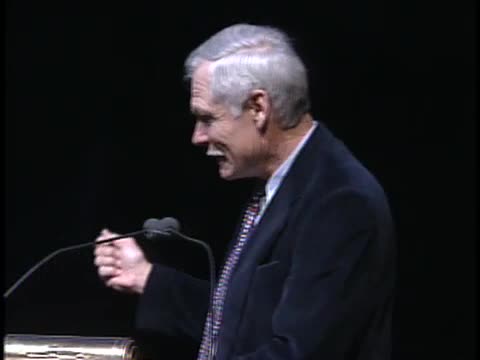
- Ted Turner accepts the Washington State University Edward R. Murrow School of Communications award. He speaks of career highlights, including the founding of CNN, navigating international relations, and his philanthropic work. Following his speech, he answers questions from Washington State University students.Founded in 1973, the Edward R. Murrow Symposium is an annual event at Washington State University created in honor of alumni and news icon Edward R. Murrow. Prominent journalists and others are invited to discuss pertinent media issues.
- Created Date
- 2000
- Asset type
- Program
- Genres
- Event Coverage
- Topics
- Journalism
- Rights
- No copyright statement in content.
- Media type
- Moving Image
- Duration
- 01:08:43
- Credits
-
-
Speaker:
Smith, Sam
Speaker: Turner, Ted
Speaker: Turner, Ted
Speaker: Smith, Sam
- AAPB Contributor Holdings
-
KWSU/KTNW (Northwest Public Television)
Identifier: cpb-aacip-b78fff38893 (Filename)
Format: DVCPRO
Duration: 02:00:00
-
KWSU/KTNW (Northwest Public Television)
Identifier: cpb-aacip-2c2ed1e1916 (Filename)
Format: DVCPRO
Duration: 02:00:00
If you have a copy of this asset and would like us to add it to our catalog, please contact us.
- Citations
- Chicago: “Coverage of the 2000 Edward R. Murrow Symposium with Ted Turner,” 2000, Northwest Public Broadcasting, American Archive of Public Broadcasting (GBH and the Library of Congress), Boston, MA and Washington, DC, accessed September 8, 2026, http://americanarchive.org/catalog/cpb-aacip-296-65v6x3dh.
- MLA: “Coverage of the 2000 Edward R. Murrow Symposium with Ted Turner.” 2000. Northwest Public Broadcasting, American Archive of Public Broadcasting (GBH and the Library of Congress), Boston, MA and Washington, DC. Web. September 8, 2026. <http://americanarchive.org/catalog/cpb-aacip-296-65v6x3dh>.
- APA: Coverage of the 2000 Edward R. Murrow Symposium with Ted Turner. Boston, MA: Northwest Public Broadcasting, American Archive of Public Broadcasting (GBH and the Library of Congress), Boston, MA and Washington, DC. Retrieved from http://americanarchive.org/catalog/cpb-aacip-296-65v6x3dh