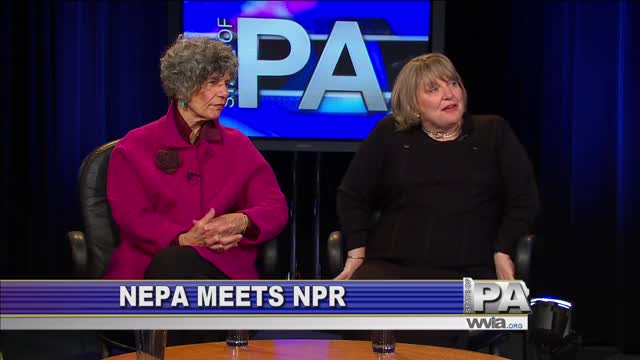
State of Pennsylvania; #725; NEPA Meets NPR
- Transcript
You Live from your public media studios, it's the state of Pennsylvania, the region's premiere, news and information program, with WVIA President and CEO Bill Kelly, and Correspondent Suzanne Kelly. This is state of Pennsylvania, tonight's guest host from WVIA FM, Erica Funke.
As with so many powerful ideas, this one began in a setting of modest means, but with a powerful vision that provided the necessary energy, and with a group of dedicated and creative individuals powered by that vision, who would foster the idea and build an institution which, in its maturity, has become one of the most respected news organizations in the world, and that is National Public Radio. Today, NPR has 784 member stations and serves 26 .4 million listeners for all of its programs, including the award -winning news magazines, all things considered, and mourning addition. Susan Stamberg is one of those intrepid early staffers who would sling a 12 -pound tape machine over her shoulder, spend a day out in the field, and then go back to the studio to create a story that would allow us
not just to learn the facts of a situation, but to experience the feel of the situation, to capture through voice and sound a moment of our history. It wasn't long before Susan Stamberg made history of her own in 1972. She became the first woman ever to anchor a national nightly news program when she became co -anchor of NPR's, all things considered, and she did that for 14 years in an unrivaled way. She has gone on to receive every major broadcast award, including the Armstrong and Alfred I DuPont Awards, the prestigious Edward R. Murrow Award from the Corporation for Public Broadcasting, and she has been inducted into the Broadcasting Hall of Fame. As we'll learn, women were a powerful shaping force in the early years at NPR, and Ella McDonald joined the staff in 1979 at another critical juncture when NPR was developing a mourning news magazine, which was to have its own character apart from all things considered, and that is
the highly lauded and very popular mourning addition. Ella McDonald became executive producer for mourning addition in 1998, overseeing a major transformation and expansion of a 24 -hour staff, and she led the show to its present, two host, two host format. She is currently executive director of NPR News Programming, responsible for overseeing all of NPR's news shows, and the very best part is that she's one of us. Ella McDonald hails from Jessup, Pennsylvania, in Lackawanna County, where her dear mother and father still live, and that is in the studio tonight. She's a graduate of Penn State University in American University, and these two remarkable individuals are our guests on this edition of State of Pennsylvania. NEPA meets NPR. Welcome, Susan. Thank you. Thank you.
I just prefaced this with a little disclosure. My really, my proudest moment here at WVIA was when all things considered asked me to do a report on the Butler Mind Tunnel. I don't know whether you all remember that, but there was a possibility that cyanide gas was bubbling up into people's backyards and homes, so they ran the story. I couldn't believe it, and you did the introduction, and I can still hear your tone of voice in my head, so it's a real honor to have you here. And Ellen, to welcome you back, because being an NPR NEPA native, you aren't shy to come and visit dad and mom and everyone to stop in and give us some pep talks and your good words. We want to know we're lucky enough, and fortunate enough to have you both here. You've traveled up together from Washington, your friends, and longtime colleagues. How did you first meet? Do you remember that? What you first worked on together, do you?
Tell us. Let's see what matters. We're telling the same story. At NPR on the newsroom, we say never let facts get in the way of the story. Thanks for that lovely introduction, by the way. It was just terrific. Here's what I remember. I was doing all things considered. Jackie Judd was the morning newscaster for morning edition, and we were good friends. And she said to me, Susan, there's this terrific new young woman who's come in. You were a news writer, yes? Yes, Jackie's news writer. And she said, you got to meet her, let's go for brunch. And she picked an extremely expensive place. I don't remember. It was the four seniors. This was way above our pay scale. But that's when we met. This is a great gal. We're lucky to have her. I was right. I didn't say you remember the same. No, I remember it was the same. What did you eat? But you were doing something very remarkable.
Did you know that you were doing something remarkable, inventing public radio for all of us? I did. I hope it doesn't sound in modest, but as a matter of fact, I did. I knew that there was just this thing that was... Public Radio has a long history. There have been stations on the air for more than 80 years in small, mostly college town, small universities. Educational radio used to be called. And it was a lot of classroom stuff. And you could take courses for credit over the air. There were language broadcasts. And I started at such a station, much like a WVIA, the one in Washington, W .A. But always there was this dream that there would be interconnection. And once that happened, you could be alive. You could talk about today as opposed to the earlier day. So all you could do was mail tapes to one another. So nothing could be topical because it would get so dated. But from the very first day, NPR, when it was formed, was extremely ambitious. Our first editor had been a foreign editor at the New York Times. And the first host of all things considered, which is the
flagship program, had been at NBC News. And before that, the New York Times. So they started at the top with the very finest people they could find. And I really did feel, although we were a handful of stations then. And we had two listeners, one was my mother. That there was a huge future for us. And I really felt it. And there was that energy that was so wonderful. But I wonder how you felt coming in, if that was... I got there by accident, truly by accident. I had applied for a job at WMAL, which was the ABC O &O station. Commercial station. And commercial station, which was the top local news station in the time. I had finished graduate school. I was working freelancing on Capitol Hill as a reporter, working at a local television station. Anything that... Any place that paid a check and the check's cleared. And I was... I wanted to work at WMAL. And at those who know me, I can be a bit relentless. And I
just badgered them. And then one day they called and said, okay, we have this job for you. You know, why don't you come and off I was going. And then the next day I read in the Washington Post that the person who hired me was going to something called National Public Radio Morning Edition. And I had not a clue. And I thought, I just quit my job, you know. And I called him up and I said, so where does this leave me? And he said, oh, you're coming with me. You're coming with me. You didn't know that? No! So Ted Lentfair, remember. So he comes in subsequently, starts morning edition. He and everyone he brought in were fired. Within a month they're all fired. Well, of course, I am at the lowest level here. I'm the news writer. But I had actually worked at a public radio station, WAMU, where I was getting my graduate degree. So everyone thought, I came in through the public radio station. And I worked there because that's what you had to do to get your graduate degree. So I came in, I loved it, I loved the smarts, I loved the creativity, I loved the curiosity. And I
was hooked. That was 31 years ago. You were. Congratulations, 31 years of wow. Very good. That's a great story. It is a great story. We want to make sure we put the, and keep the P -U -B -L -I -C public in public broadcasting. So we invite your questions. We have a wonderful time. But when we can, but we want to make, we want to hear what you have to say and have to think about having these wonderful guests from NPR here with us. So call the number at the bottom of your screen. Do the digital things. Send us an email if you're like. And please, from the studio audience, make your wave to us. And Larry Boyko, my colleague from WVIAFM will come, track you down. And we'll have a broad conversation here. We know that when you, when we went on the air in 1973, and we were carrying all things considered from the very start, the very first day. And there are two people in this room who were here in those days. And we knew we had a sense that there was something
very different about the sound of the show. What kinds of, can you talk about a sound? You were trying to create a different sound with morning addition than all things considered. But what was that characteristic thing that made it so when we tuned in, we knew that we'd sit up and say, oh, all things considered sound, and not just the opening theme song. Well, I'll tell you, I'll just tell you the personal story, because I'm the first woman to have anchored a national nightly news broadcast. And I was selected to do it by a number of men who have always been helpful to me at every stage of my career, various men. So although I'm an ardent feminist, I don't have blinders. Okay, good. Broadly grateful. And a fellow named Bill Seemring, who was the creator of all things considered. He was really sort of the visionary for it, was the one who tapped me. And there were no role models then for
women. I had nobody to listen to and imitate. There was Walter Cronkite, you know, and there were a lot of men doing it, but no women. So I figured I had to sound like them. So when I started on the air, I spoke like this, and I lowered my voice, and tried to sound as authority, and it was possible. And sounded exactly that ridiculous. And Bill said to me, be yourself. And that was like the magic word. It was a wand that he waved at me. Oh, no kidding, really. This is okay. This is enough. And it was that. It was that interchange. In me, he found the voice that he wanted for this new interconnected radio thing that he was helping to create. And in him, I found an enormous supporter. But also someone who said, be yourself to all of us. That is, here's how we want to sound. We want to sound like real people, people whom you know, who you would talk to across a back fence someplace, or outside your front door. As in a neighborly, conversational fashion, not the all -knowing voice on the top of the mountain,
but instead someone like you, someone as curious and as bright, who may have access to more answers than you do that day, but would ask similar questions. That's how it all began, really. And I do think that we carried that out to this day. I think it's even more important today. Yeah, I do too. Because the temperature has gotten so hot. It's not a conversation anymore. It is a rant. It is screaming. And no one's listening. And I think that's what we really try to do. I know when I was working on Morning Edition, I would tell the staff that Morning Edition, it's not black or white. It's these wonderful shades of gray, because there were so many different ways at looking at a topic. And it was not my role to tell you what was right, what was wrong, or what to think. What it was, my role to put voices out there, to put people there, because the audience are the smartest people. I mean, they're just incredibly smart and curious, and
they want the information, and they'll make their decision. They'll make the decision. This is a good bill. This is a good thing to happen for the country. They will do it, and our job is to put out all those shades of gray, because nothing is black and white. And our audience is brimful with questions. Larry, we have a question. Yes, we have a question here from Marty Walser of Danville, PA. Thank you. First, personally, let me just say, how thankful I am to have you folks doing the job that you're doing, because it's just such an important part of my life, every day, whether it's morning edition, and your story course just wiped me out every Friday. And all things considered, it's just a critical part of my daily life. But I'd like to ask, and perhaps of both of you, if you could just give me an example of something that you would like to say that
here's a story I covered recently, or years ago, that I just think you have to hear. If you missed it, go back in the archives, and hear it. Can you do that? We call that driveway moment. I've got a boy. I've got a boy. Thank you. You answer, because mine's on tomorrow morning. And mine are aired about a week or two ago. Susan Stamberg worked with one of our most gifted producers, Cindy Carpian, who was the producer of Week in Saturday with Scott Simon, and then moved west to Palo Alto. And over the course of the years, she comes up with these marvelous stories. I love having people who don't live in Washington or New York or on the east coast. So I have... Morning edition actually has staff in Miami, has staff in Palo Alto. We had staff in Flagstaff, Arizona. And anyways, she came across these wonderful ladies, the wass, who had
never been recognized for their service in World War II. And over the course of the last year, you had been working with... Yes, it took about a year. It took about a year. ...collecting thread as we went. The Women's Air Service Program. And these were volunteer, non -military, female pilots who flew test planes, planes that had been repaired and sent back for a repair and took them up before any male pilot was allowed to get in at. And the most chilling part of what they did, they flew only domestically and would move planes from factories onto bases to wherever it was that they were going to be shipped out and go overseas. To me, the most chilling was they flew targets. And for target practice for the gunners using live ammunition and the women flew with these, like banners, but solid behind them. Like the planes you see at beaches, have you ever seen that with the banners that
they hold by? But these were solid objects which the men were shooting at. There were a lot of near misses. Anyway, it was an extraordinary story. Magnificent story. So much of that credit goes to Cindy Carpian who is an amazing producer and just fell in love with these women. She really did. And now they're getting, we did it because they just got the Congressional Medal of Honor. 60 years too late and so many of them there were a thousand something during the war. But if there are 300 left, that's a lot. And of those 300, only a handful could come to Washington for the ceremony. So we're so happy to be able to get the program on and for them to get that kind of recognition. But I'll tell you why in public broadcasting we say, we're as good as our next interview. In commercial broadcasting they say, you're as good as your last interview. But I never believe that. So I have a very nice story on the air tomorrow morning. I'll just tell you about it. I hope you'll listen. It'll be in the last 10 minutes of one of the hours. I don't know what your sequence
is here. But there's a fellow in Los Angeles named Johnny Mandel. He's a composer and arranger, a musician. He wrote the theme for Mesh, the movie first and then the TV show. And years ago he did a film. He scored a film called The Sand Piper. I wonder if any of you remember Elizabeth Taylor and Richard Burton and Big Sur in California. The most glorious music that came out of it. And he turned the theme into a populous song, The Shadow of Your Smile. So the piece is, he tells them the circumstances by which those got written and this and that. But the story contains the favorite piece, the best piece of tape I have ever collected in my 112 years as a broadcaster. Because we're sitting talking just like this in his studio in Malibu. So it's right on the ocean and we're getting some ocean sound, although our microphones didn't pick it up. But outside as he talks, I hear this sound. And I realize those crows are noisy
and they're getting on this tape and he's saying something important that I'm not going to be able to edit this later. But we've already established that as a musician, he has perfect pitch. That means he can recognize any note that he hears. And so I said, come on and stand over by the door with me, Mr. Mandel. Well, he doesn't know microphone. He held it up, captured the crows and said, what note are they saying? You have to hear this because he tells it to. And the way he ends is so wonderful. It's too good for me to spoil. I'm not going to tell you. I have to listen tomorrow morning. Thank you. We have another question from the audience. Please, Sandra Meyer. Yes, we have someone very well in the area. Sandra Meyer has done so much work with her discussions on democracy and the importance of conversation within a democracy to keep it strong. Sandra? Yes, thank you. First of all, what it treated is to be here tonight with this kind of bastion of public
conversation. What it made me think of and what I'd like to tell you and ask you about is something that Bill Moyers said some years ago. It was probably part of a pledge campaign on NPR. But he talked about NPR as being the People's University. And he referred to prisoners, you know, that he had heard from whose lives were transformed by hearing something on NPR. And people in their kitchens and people in their workplaces. And I'd like you to comment, perhaps, on this invaluable resource that you people are providing for us. Oh, Ellen. Well, I'm not sure the question to comment on what it is we do. Or
do you see yourselves as a, in a sense, metaphorically speaking at least as a People's University? Well, I think it's my job to find the most interesting, curious people and give them voice and bring them and put them on the air. And to look at topics that are in the news, but look at topics that no one's looking at and to provide information and background on it. But I also think that the role of public radio, especially now, post cable news, post internet, we are blasted with information 24 -7. So I'd like to think that the programs that I'm working with also provide smiles and a little entertainment and a little break. I can, I'll tell the story that Mike of an example of where 9 -11 was the most gut -wrenching, horrible story to ever cover and to work on it. And it was just such a difficult time for all of
us. And after two or three weeks of this reporting and the constant and the terrorism and everything, I remember talking to Susan and saying, we got to give a break. You may have come to me and said we have a break. I can't remember the whole conversation. But we started every day putting a little music piece and I remember the first one. Who was it you talked to? Leon Fleischer, who was the great piano prodigy of his generation and then got a terrible carpal syndrome in his right hand and lost the use of it at the peak of his career. And went out and summoned every piece of left -handed music in the repertoire. And once he played through that, went and commissioned more. He played these days, he's playing a little more softly, but he was extraordinary. And what I did with it was a series I thought of as music for America. What do you want us to listen to? What are you listening to? What do you want the country to
be listening to right now? And he chose, this was the first one, he chose old for joy, old for joy from Beethoven's Symphony. And to me that was so extraordinary to choose something like that in this moment of tragedy, a hymn to brotherhood and to humanity and to pulling together and music about love. I just thought we're really onto something here and we stopped the broadcast for about almost two minutes and only played that. And it gave such an L and to her credit said yes to it. I mean that was, I can't tell you what heroic decision that was. And it would be in any news organization, but for her to say yes, let's just do this. It was an off -the -wall idea. It was really in its own way revolutionary. But it touched everyone. We had people calling and writing in and it was just remarkable. I can't remember how many of them we did.
Until they ran the course maybe ten or so we had Judy Collins singing amazing grays. We had Quincy Jones choosing Debussy. Each one from different disciplines choosing different Beverly Sills, Chosen Aria from Norma. Each one for different reasons chose something. But it just filled your soul at a time I think when we needed it. We needed it. And as much as we needed the news coverage, we needed to come together at National Public Radio. We needed something like that to find us and just give us a little bit of a relief. And I can't tell you the number of times when the news is so dreary and so horrible that I will just go to the show and say, I'm not going to get out of bed. This is what I have to listen to. Just give me a little smile. It's not a joke, not a happy talk, but just a human moment.
Thank you. I love the notion of the university because I do feel we are educators. We're not standing behind lecterns and talking for an hour. But at least so low. But I always feel that and I also feel I work at a grand university. Any question I have, I can go down the hall and somebody on our staff is going to know the answer. And if they don't, you do. Which is the other thing, our listeners. I always know as a broadcaster that somebody who hears me today is going to know more about this than I do. So I've got to get it right. And if I don't, I'm going to hear. And that's wonderful, too, to feel that we are interconnected in that. Well, the conversations we have with our audience all the time. And we don't want to leave that university queue there without asking you, Susan, to tell us about this remarkably proud moment that you'll have another doctorate. Tell us, okay, I'm not bragging here. I'm
very proud of the fact that I'm going to get an honorary degree in a few months from the University of Michigan. That's pretty good. Thank you. But this is better. They called me a week later and said there's somebody else going to get the degree that day. His name is Obama. Wait, there's more. Because then I got an invitation to the dinner the night before. And this, to me, is even more exciting than for myself being honored or getting to meet the president, which I never had. Ornette Coleman. Are there any jazz fans? He is one of the jazz legends, one of the greatest saxophone players ever. And he's got to be. So I'm sure I'll have to decide what to wear. Maybe black, right, with a hood and a funny hat. We want to invite you to join in the conversation. We have another wonderful question from the audience. But please, feel free if you're watching at home or listening on the radio or if you'd like to email. Please, keep
in touch. Use the letter, use the number at the bottom of the screen as we turn to our audience. Larry. Yes, we have a question from Sally Bowling from Scranton. The question is this. Do you imagine that NPR would be significantly different if we're not located in Washington? How might it be different? I can answer that because I was responsible for putting Morning Edition on two coasts. We have a host in Los Angeles and we have a host in Washington, DC. And there are subtle differences that you hear. And everyone says, well, who cares where the hosts are? Maybe, but I'll tell you, West of the Mississippi, they care a lot. That there is an anchor looking at the country and the world going west to east. And I think you can also say that our headquarters are Washington, DC. But we have 17 foreign bureaus. We have 17 domestic bureaus. This is at a time
when newspapers, networks are just cutting and slashing galore. So while our facility is there, our business office is there. We have a very strong presence all around the country. And not to mention our member stations. One of the great things that we're finding now as the country is learning to live without newspapers in their communities, is the public radio and television stations are coming to play and providing a bigger role for them. And they have the bricks and mortar. They have the studios. They have the place where communities can come together to talk about the issues that are being discussed in various communities. The newspapers are pulling out of these areas. They're shutting down. And so it really is public radio and television that we'll be taking over this role in communities. What's your remarkable story? I from one have been listening to your news shows ever since they began. And I tend to
listen to them for rest of my life. And they're just wonderful. Thank you so much. Tell a friend we'd like to keep those numbers going. Thank you. And I wanted to ask a question, Ellen. In your role as with Morning Edition scene. Serena, I like. But you've been in a position to be in Washington making all kinds of decisions for these important programs. To what extent did you pay attention to what's been happening here and in your hometown in Scranton? Always. I mean Susan and I talked about this coming up. She said, you know, where did you learn to be a manager? Where did you learn to do the kinds of things you did? And I said, you know, I think it was my roots in Northeastern Pennsylvania. And I'm not joking about that. I come from a really fabulous close family. I can remember growing up where it was just part of life that you cared what people thought, that you listened to what people had to say, that you were there for them. And I think I took that
with me. So as I'm, I've always viewed my role as hiring the best people and giving them the wings to soar. It's a beautiful thing to say. And you know, we know so well, you were a voice. Susan, and there wasn't, there is an organization in public radio, public broadcasting, of the regional public radio stations. And they saw fit to honor our guest, Ellen McDonald, as one who was a kind of unsung hero, someone behind the scenes who has done so much to impact the shape and the sound of what we hear on national public radio. And we have actually a visual visit from another woman at NPR, a very important woman. In fact, the new president and CEO, Vivian Schiller. And she
wanted to take a few moments to tell us what, how valued you are at NPR. Vivian Schiller, the president and CEO of NPR, roll the tape, please. Hi, I'm Vivian Schiller, I'm president and CEO of NPR. And I could not be more thrilled to be paying tribute to Ellen McDonald. She is one of the greatest leaders, not just at NPR, but throughout public radio. She is passionate, a force of nature. She has a big brain and so much talent. And she's put that talent to work, both at morning edition and now so overseeing all of NPR's new shows. She is really an extraordinary leader, an extraordinary person. And I'm really honored to call her my friend. Wow! My dear! Woo! How about that? Well, thank you so much and we're so proud to know you and how do you as one of ours. And again, please join in this wonderful conversation. It's not every day we have a chance
to have two such fresh and talented and creative folks in our midst. We have an audience question, Larry Voidco. Yes, Tony Brooks from Wilkesbury as a comment and a question. Well, I have a bone to pick with you. Do you know how many times you've made me late to an appointment because I sat and listened to you? Absolutely. So, my question is, I look around the studio audience and I see a wonderful mosaic of Northeastern Pennsylvania. Both Democrats and Republicans in this room. What role you see NPR public television plays in lowering the polarization that is going on in Washington and across the country and creating a civil society for some. Well, I always say that our goal is to be an oasis of civility in all of this noise that's out there. And I think, you know, getting back to the university and the educational aspect, the more people
understand what why things decisions are made. And the more you explain to them and give them the information to understand, the rhetoric comes down. And it really is the learning of things. It was so interesting today as I was coming here, I went to get my hair done. And I was there and what are you going to talk about? And I said, well, I'm not really sure. And they said, are they going to ask you about health care? And I said, oh, I hope not. Because I don't know what's in the bill exactly. And so the women were there and we started talking about it. And it struck me how little some people know about the issues. And so whether you're for or against the health care bill, you have to know what's in it. And so they started talking about and saying, well, it does this, this, and this. No, I don't think so. And I said, do you know that your children who are under 26 are now going to
be covered? Really? Well, why is everyone mad about the health care bill? That's a great thing. And so it struck me is that we have to keep doing this, provide the service of what is happening. Yes, yes. And I also think that we serve as a public forum in that way for the very best and to expose the very worst. And I think that's a role of journalism as well, is to hold up the role models and report as carefully and thoroughly on abuses. And on the undersides of things, but not in an exploitive way, in the most rational way we can. We are, I fear, really, for the democracy these days. I've never seen anything like the kind of schisms that there are surrounding us. And the only way that we're going to be able to pull together is by just not blathering all the time and quitting the tweeting and the twitching and all of this, because it's turning us into opinionation. That's what we're becoming, rather than reasoning people, careful people who are thinking through things before we go to
vote or to give our support or do. And that's certainly our role as journalists, electronic journalists, to get the finest information we cannot on the most consistent basis. And especially uphold the very best in our society, as well as reporting. Right, right, right, right, right, right, right, right, right. But to have some knowledge and base of what is factually true. Yeah. Big job. And we have a question from the audience, Larry Voidko. Our next question comes from Nick Niles. Thank you. I like everybody else in the room. I'm impressed with the great work that you do and follow you daily. Our daughter has always said to us that the really only way you learn is to make mistakes. I think she did that one time to avoid a problem. But in fact, I think she's right. And I was interested. What mistakes maybe have you done or a mistake that you might have learned the most from
in your career? And I drag Susan down with me. Well, it never makes mistakes. Oh, you can tell it if you like. I thought it was another daring decision on her part. I put a radio, I commissioned a radio drama and put it on the radio in drive time in morning edition. It was a ball. We had Ed Asner. And Mary. Who else did we have? Mary Beggley. Ed Beggley Jr. We went to Hollywood. We had reading. Susan was written into the script. And we did this radio drama. And we got so into it. And so Hollywood, we thought it was great. And then the audience heard it. And said, in my mother said, what were you thinking? What makes you think your Hollywood producer, it was an unmitigated disaster? That was fairly early. And that was fairly early in your tenure wasn't it? At least you don't get fired. I didn't get fired. And I remember Kevin close
came and said, you know what? You did it. You tried it. You tanked. You know what, you're back. God bless him though, because the point is to take the risk. Take the risk. Try something new. We know how to do what we do. Let's try this. Everything we've never tried in our lives. Let's put on a radio drama in a dry time. Ellen, you know it's not a bad idea. So you didn't learn. We have a caller on the line. This is Bob from Scranton. Thanks for being part of the conversation. What's your question? Thanks for having me. I apologize for the reception. I don't know. You're coming on and off. It must be UFOs over Scranton or something. Wow. This is great. I'm a big fan of NPR. And I listen to it all the time. Well, I like the classical music. It relaxes me and the news and everything. But I'm a big fan of car talk. And how do you actually rate and get a whole of time and rate to have them respond to that same letter? Thank you for calling car talk. And we'll get all of you. Well, Bob of Scranton. And I happen to
have, because I just talked to him the other day before yesterday, Ray Meliotsi's cell phone number. And if you're really nice, and make a major contribution to tell me how you're talking. I actually, I actually called him because I'm buying a new car. We're old pals. I put him on the air. Those guys had their own local program in Boston for 10 years. Then I put our Sunday morning program on the air. We can do some Sunday. And someone sent in the tape from the station, a little demonstration tape. This is a famous legend in NPR. May I do this? Do we have it? It's about an hour long story. Enjoy yourself. Talk amongst yourselves if you can't pause. They sent in demo tapes. And the news director, who was then Robert Siegel, listened and said, there's no way that these guys are going to get on our air. My producer, Kitty Perkins, I name names through this all. Kitty Perkins, listen, she said, oh, no, there's no way that these are going to hit my own sainted
husband. From Alan Town, Pennsylvania, he said, I don't think so, Susan. But I said, there are many versions of this story, but this happens to be my favorite part. I said, are you kidding? Everyone loves cars. These guys have that accent. We go with them. And they started on weekend Sunday for five minutes. And like that, they took off and got their own show. But we have enough of a relationship that when I think to buy a new car, what happens every 15 years, I call Ray. And I get his blessing or his advice. And I do have a cell phone number. And you're not going to tell us what he told us. No, major contribution. Okay, that's a zero. Okay. Good. We have another question from the audience, Larry. Yes, Erica. We have with us a state representative, Karen Bowback. Thank you. Kudos to you, ladies. I truly enjoy your show. And thank you for being with us tonight. Looking at this as a university setting. What a great analogy that is with your station, of course. You talked about how the media, the general media in this day and age,
whether it be the economy or for whatever reason, is suffering as compared to what you're doing in media. Can you give us the three top reasons why you feel this is so? I can't tell. I started doing one, too. Well, you know, all the pressure on print and the new technologies which have emerged. Make turning newspapers. I love to do it. And I love looking at continued on page 32. And I'm not crazy for scrolling and a screen on which everything looks alike. And I like tearing things out of papers and coming upon ads by surprise. But I'm not in the majority of this, you know. Fewer and fewer people do that as those screens. And as you can get the same sort of information online. So that's one reason. But for radio, which is so portable and can be with you all the time and in your car and you can overhear it, you don't have to sit and look at it all the time. That helps us enormously. It helps us to reach audiences
that otherwise. And I also think it's the impact of the human voice and that tremendous magnet that the spoken word represents to all of us. It's the first sound we hear after we're born, really. I was telling somebody today I did some work with Fred Rogers, Mr. Rogers, and did some television shows with him. He used to say it's the mother's voice. It's that whether it was a man or a woman talking over the radio, it was a primal connection to the voice to the spoken word and what it was conveying. And that's certainly another reason. Another reason is the failure of television in so many ways. Public television is about the only standard. Otherwise, you could sit on light doing this and not tweeting. But just surfing and find so little of any use or any value to look at. So we're benefiting sadly from the decline of so many of those other institutions. But that is why. That's the reason. Thank you. And thank you for the positive effects you have on
Broadcasting. Thank you, ladies. Thank you. We actually have an email question. And it's from Tom and what looks to be like mountaintop. And the email reads, I started my career with public broadcasting in 1972, along with Susan, and always loved listening to her on all things considered, and her book every night at five, and now talk, right? And of all the mail co -hosts of all things considered, does she have a favorite? No, on the spot there. It's so unfair. It is. George Clooney. Oh! Okay. Maybe that will get him to do that. Do you think that this is broadcast in Hollywood and he just might hear and see us? That's, you know, they used to ask that of Fred Astaire, and he's saying, oh, not to compare myself in any way, but he had a lot of very wonderful partners, and he said always that his favorite was that hat rack that he danced. Oh, that was... I'm very lucky, and I have had a lot of wonderful, wonderful people within my work. So, not fear to
pay. And are Larry Boyd co -standing by with an audience question, Larry? Yes, we have with us a very, well, familiar face to many of us, a question from Debbie Dunleavy, who spent a good portion of her career as a broadcast journalist. Hi, Larry. Ladies, I salute your words, Smitha, and your storytelling. You know, clearly you love what you're doing, and that's such a gift, and you're so lucky. But surely you must find yourselves in a position where you have to field questions and critiques about NPR, and the mainstream media for that matter, swaying more liberal. Would you speak to that tonight, and how do you try to strike a balance? Well, you want to talk about the balance, and I'll just talk about the liberal part. Here's my grand answer on the liberal part, because it is the third time I've been asked this question. So I've practiced the answer a little. But it gets back to the university in a way,
because we're liberal the way a liberal arts education is liberal. That's part of my answer. That is, there's a wide range of information and courses made available to you, and that's a definition of what liberal arts are. It's not a political liberalism, it's a different kind. But mostly I would say that journalism itself is a liberal enterprise. We are not there to conserve. We are not there to uphold the status quo. We are there to raise the questions, and shine the brightest light that we can, particularly on government and its possible abuses, but also on the society as a whole. And that in itself, if we're liberal, we are liberal that way. Certainly not in terms of political agendas or any such thing, but just by the very nature of the work, and by its definition, what's involved in doing it. I think that's
the key. Balance. Balance. Balance is a very important part of what I do every day is to listen to the broadcast and to make sure that we have all voices there. And that you get to the balance, and it's a complicated thing, because it's not just about the, it's the topics you choose to cover. It's also what you're choosing not to cover. It's the people you're interviewing. It's the people who are at the table making the decisions about what it is you're going to cover. And I think one of the best things that happens at National Public Radio is when you bring such a diverse group of people, geographic, political, color, religion, that you'll have an automatic check -in balance on that whole system. So you have people who are saying, no, I don't view it that way. Let's look it at this way. Let's go get that other point of view, that other voice. But I think
it's something we have to be very, very vigilant about, that we have to look at our programming, not just how one show did it. And I think that was part of the reason that I was put in charge of the seven shows, so I can look to make sure that we're not skewing one way or the other. Very important. You mentioned it at the table. And we began by talking about Susan's being, you're being the first woman to anchor that national nightly news program. But there were a lot of women on the ground floor in those early days in the formative stages of NPR. What difference has it made and does it make to have women in the news room at the table asking those questions? The emergency argument. It broadens the discussion. In my very first months and years, we were a 90 -minute program on all things considered, and the idea was to be alternative. And so I lobbied because I was a new mother, and I had a young child at home,
to look at issues of child care, to look at issues of elder care, things that no commercial broadcast was paying any attention to in those days, to look at consumer issues, which are so -called women's issues, but they're not. They're all of our issues. They're family issues. They're human issues. And so to that extent, it was a woman's management style is very different from the style of men. And that has made an enormous difference as well to the way the dynamics of NPR and the way decisions are made. I think that too. I also think it's that frame of reference. I remember this so vividly, was during the early Clinton years, and I think I was the only woman manager at the editorial table. And the whole issue of Zoe Baird, not paying her taxes on the nanny came up. And everyone's, oh, it's not a story. And I thought, man, she's out of here in 30 hours. There are way too many women in this country that are paying a lot of money to have legal child
care that somebody making X million dollars, the American women are not going to buy this. And they're like, no, no, no, it's not a story. And sure enough, by the weekend, she was gone. But in another way, it was an enormous story, because again, it was to the issues I was talking about. Child care. And the dual, and sometimes triple role, that a woman and a family has to play, compared often to her partner. Things are different now, even in this handful of years. And there's more of a shift in balance in family raising responsibilities. But it's a much broader picture than simply obeying the law or paying in that way, although you're absolutely right. So it's both, both hands. Yeah. And Larry Voidco, you have a question for us from the audience. Erica, it's a comment, comment from Leslie Brarratton. Thank you. I'd like to say, first of all, thank you so much, like everyone else has said, for your wonderful, wonderful, intelligent programming on the radio. My husband and I moved
here from Washington in 1982. And without a doubt, the best thing for me for that move was being able to turn on the radio and hear the same wonderful voices that I heard when I lived in Washington. And when we lived in Pittsburgh and when we lived in Atlanta. And that's what's so important is that it's all over the United States. And so it's a friendly reminder of what good radio should be. And for me, it really helped with the move, as I unpacked boxes, I had the radio on in the kitchen. And put it on in the car when I picked up the children in the afternoon after their activities. And so I didn't really feel like I was in a strange foreign place. I felt like I was in a familiar place. So thank you for that. Oh, it's such a lovely comment. Thank you very much. Thank you, Lisa. She raises a comment that the kids in the car seat, that became the next generation of public radio listeners. They all come in saying, I listened to you because I was tied in the car
and couldn't get out. And now I love it. But I know that there was that whole generation of kids who hated me because it got to be five o 'clock when we went in there. And their mothers driving the car were saying, Shh, be quiet. I'm going to turn up the radio. But luckily they grew out of it. But I love what you said. I remember finding myself in the desert in Arizona one time. And the car radio was on and there was my friend Noah Adams. And to me, that was the sound of home. It so grounded me just to hear those voices. And you know we have people who make moves as you did. And aren't lucky enough to have a WVIA in their new community. And they're the ones who start the public radio stations in those towns. Because they feel they can't live without them. So they go to all that trouble of getting the licenses and getting the station started. That's great. Larry Boydko, you have an audience question for us. Another question. And this is from Chuck Cohen. Ladies, hi. Thank you for being here. We certainly have come through a very interesting
time talking about the healthcare issue. And regardless of how you feel about the outcome, I was hoping you could comment on the quality of the media coverage. And really the role the media coverage could have played in the outcome. And was it effective? Was it not effective? Where did it shine? And where did it fall down? You know, they need to give a Pulitzer Prize to radio. They can give Pulitzer Prize to Broadway musicals. The Pulitzer Prize is about journalism. And they need to give it to broadcast journalism. And it should go to Julie Rothner of National Public Radio, who was our health policy correspondent, who relentlessly, and day after day, outlined the issues of this bill and the shifts in it. And the way it was moving through the houses of Congress in the most extraordinary fashion. And as a matter of fact, all of our reporters who tackled it from the political ones to the people around the land, I mean, we really covered it. Covered it like mad. I can't speak too much to other media. Maybe you can't. You know,
we're sort of duty bound, and intellectually bound to listening to public radio. So we're not too good about whatever you're doing. Yeah, what everybody else, we're not too good at it. I bet you Fox did, couldn't touch us in there. I don't know that we have listeners who, we have many listeners who know about the annual ritual of Mama Stambers. You know, I was thinking, we've gotten through an evening. No, no. And it's not going to come up. No, no, no, I'm not going to. But I wanted to introduce Ellen's. Tell us about your dad. Yeah. That's what I want. Max Salsa. Which now comes in the flavor of cranberries, because Susan went to Vegas. Didn't you come back with, you went to Las Vegas, and you came back with cranberry salsa. Because my dad always made salsa when he retired. He'd make salsa and jam. And Susan went to Vegas, came back with cranberry salsa. And he said it was terrible. He said, terrible. I can make it better. And he did. And he did. But this is because every year I give, from
Allentown, Pennsylvania, my mother, my late mother, and my martyrie stamper, recipe for a very spicy and very odd and peculiar cranberry relicants. My tradition in the nation of strangers and movers and people to make a tradition on the radio, the Friday before everything, giving by reciting this recipe. So that's how it all started. I really thought we'd get through this entire time without anyone raising a button. No. I had to do it myself to see. But I wanted to say that one of the things that we have learned here is we've known your voice so much. It's unmistakable, Susan. It's a beacon of your personality. And we're so grateful for it. And Ellen, we just have a chance to get to know your voice here for the first time, perhaps, for many of our listeners. But we do know the results of your choices that you've made and shaping the programs that we love. And they have distinctive voices. So in both ways, we know your voices. And I think that we can be so thankful
for all the voices in the country you've given range to, so that we could hear, as you so well put in each of you, that mosaic that we are and learn, not just who we are as a country, but who we might yet come to be. And so I think we can't be more grateful for your helping us to listen better, because isn't that the hope? It is. Thank you so much for being with us. Thank you. Thank you, Ellen. Thank you all for your tremendous support. Thank you for your wonderful program. So stay the front of the video. I know a couple of you. Thank you all. Thank
you. Thank you. Thank you.
- Series
- State of Pennsylvania
- Episode Number
- #725
- Episode
- NEPA Meets NPR
- Producing Organization
- WVIA
- Contributing Organization
- WVIA Public Media (Pittston, Pennsylvania)
- AAPB ID
- cpb-aacip-294-81jhb5bj
If you have more information about this item than what is given here, or if you have concerns about this record, we want to know! Contact us, indicating the AAPB ID (cpb-aacip-294-81jhb5bj).
- Description
- Episode Description
- Host Erika Funke talks with Susan Stamberg (Special Correspondent, Morning Edition) and Ellen McDonnell (Executive Director, NPR News Programming).
- Copyright Date
- 2010
- Asset type
- Episode
- Genres
- News
- Topics
- News
- Subjects
- NEPA's Man Behind the Washington.
- Media type
- Moving Image
- Duration
- 00:58:59;22
- Credits
-
-
Producing Organization:
WVIA
- AAPB Contributor Holdings
-
WVIA
Identifier: cpb-aacip-d969dc3f0e2 (Filename)
Format: DVD
Generation: Master
Duration: 00:56:00
If you have a copy of this asset and would like us to add it to our catalog, please contact us.
- Citations
- Chicago: “State of Pennsylvania; #725; NEPA Meets NPR,” 2010, WVIA Public Media, American Archive of Public Broadcasting (GBH and the Library of Congress), Boston, MA and Washington, DC, accessed May 1, 2026, http://americanarchive.org/catalog/cpb-aacip-294-81jhb5bj.
- MLA: “State of Pennsylvania; #725; NEPA Meets NPR.” 2010. WVIA Public Media, American Archive of Public Broadcasting (GBH and the Library of Congress), Boston, MA and Washington, DC. Web. May 1, 2026. <http://americanarchive.org/catalog/cpb-aacip-294-81jhb5bj>.
- APA: State of Pennsylvania; #725; NEPA Meets NPR. Boston, MA: WVIA Public Media, American Archive of Public Broadcasting (GBH and the Library of Congress), Boston, MA and Washington, DC. Retrieved from http://americanarchive.org/catalog/cpb-aacip-294-81jhb5bj