Northeast Business Journal; #400; Kerby Scott Confer. C.C.
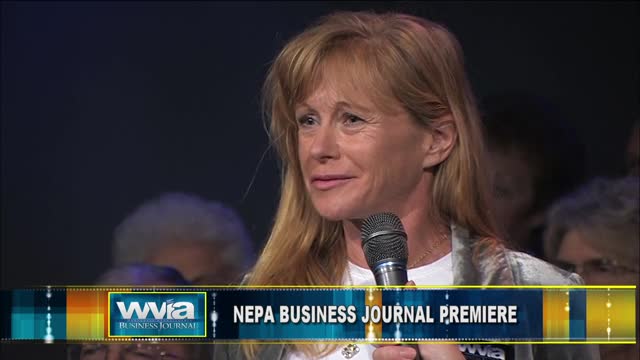
- Transcript
You 4 years and 100 interviews with entrepreneurial women and men from this region. They were taught they're grateful they give back and they share the secrets of success with the next generation. Welcome to season 4 of the Northeast Pennsylvania Business Journal. This WVIA program live from the theater is one of those very special evenings. Each year in early October, we kick off a new season of our most popular local television series. It's called the Northeast Pennsylvania Business Journal. For
the last two hours, almost 100 business people who have actually been interviewed on the program have gathered here in the public media center over dinner. They've socialized, they've networked and they've done what you would expect successful entrepreneurs to do. Except these folks are a bit different. They agreed to tell their personal and business stories on television. For some of them, that was a very difficult decision and it meant a very significant loss of privacy. But literally thousands of you have thanked them in person on the street at a meal through the mail or on the phone. And tonight, WVIA is thanking them with this evening of hospitality. Welcome to season 4, 30 new interviews starting tonight. It's also our tradition to kick off the series by introducing you to a business person who really made the region proud. Like you to meet Kirby Confer, once known to a
huge radio audience here as Kirby Scott. If you're old enough, and I'll admit that I am and I'll tell you many of the people in the theater are, he was one of warm radios that's the mighty 590 Sensational 7. So he was a big time DJ. What's the big deal? Well, this Williamsport boy who started sweeping radio station floors at age 12 grew up as we all did, but he grew up to own, build, and sell at great profits over 200 of those broadcast stations across America. But you want to talk to him. Our number is 1 -800 -326 -9842. If you're old enough, and you don't have to make that confession, if you're old enough to say you remember Kirby Scott, call him up and say hi, or you can email him and we'll put your email on the air, and we have lots of folks in the theater who are going to say something. Trust me, they're going to say something. Kirby Confer welcome to WVIA. Thank you, Bill. Pleasure to be here. Wonderful to have you.
You and I have been reminiscing the last 15 minutes while we waited for everything to get ready, and I had to stop you countless times because you were giving up great stories, but something tells me the great stories are unending with you. There are stories that probably only my wife's only heard about 30 times, so it's going to be really fun to tell somebody else somebody that hasn't heard it before. Well, let's cover a little bit about you just for fun. You've told me that your home when you were a disc jockey at the 9590 when in the mid -60s, early 60s? I actually came to warm in 1960, and I left in the winter of 64. So you lived on Quincy Avenue in a small apartment in Scranton. Today you have a ranch in Texas, a home in suburban Baltimore. You have a home in Maui, and have I forgotten one? I think that's enough. I'm getting ready to go down size. You want to finish the rest of that story? Well,
it's just that you can't be in Maui and be worried about my lifetime dream about the first station I ever owned. Myself was in Helo, Hawaii, and I fell in love with the Hawaii, and I said, you know, someday I'll have someday I will live here, and that was I was 30 then, and I'm 70 now, so it took me 40 years, and the thing that really tilted it, and not that I'm afraid of snow, because I'm, you know, I'm a Pennsylvania boy. I know what snow is. I know how to drive in snow. But we had 82 inches of snow in Baltimore, where the average snowfall is 17 inches. And all the gutters fell off the house, and the ice slid down off the roof on and then at the top of my car, and I said, you know what? Maybe it's time to go to Maui. So that's why I have a home there. So I'm downsizing in Baltimore to a little small house and kind of spending time at both places. I'm going to get Kirby to talk a lot about business, because he's extraordinarily successful. But we aren't going to talk a little bit about radio. Those of you who are Harry Chabin fans, certainly remember the song W -O -L -D.
Kirby's got is the polar opposite of the character in W -O -L -D. Bill's because of that song. It's funny you should bring that song up because I was working in Baltimore when that song came out. And there was a guy at the station who was there who was 55 years old and it was a union station, and they really wanted to get rid of him, because he was bad on the air, but he was hanging on for a dear life. And I heard that song, and I said, I love being on the air. I love being at a disc jockey, but I don't want to be that. And that record had a big impact on me, and some other events then started to change my life in a very short history. We had to come to that history. It's a great history. But before we do that, you leave W -A -R -M 1964? 64. And by the way, I remember, I'm a high school kid in 1964 in Tawanda of all places. And I can remember having a little six transistor radio. You probably don't remember those, do you? Well, that's how like, when I was 13 years old, the transistor radio came out.
And up until that time, I had the radio next to my bed, but the radio was this big. And my mother would come up at 10 o 'clock and say, you have to shut your radio off now, which I did, because there's nothing else I could do. But when the transistor came out, it was under the pillow. Yes, exactly. To a clock in the morning, three o 'clock in the morning. Well, I remember, here's my best Kirby Scott memory. It was probably a freshman in high school, but already in love with radio. And warm radio was Hollywood. Absolutely. If you were brought up in Tawanda, warm radio is Hollywood. I remember you playing rhythm of the falling rain by its age. It's age. Come on. It's like Jackie Gleason, was that the cast gains? It was the cast very good. To be five, baby. But it's a vivid memory. You were playing that song, and you were on afternoon drive time, which for those of you who don't know what that is, was like
three to seven? Three to seven. Anyway, you did that. And so on anyway, you leave warm radio, you get a job offer in Syracuse, New York. You go to the WOLF. Oh, yes, the mighty wolf. The mighty wolf. Now, why do you get a chance to be programmed around? Well, it's because it's my chance to be management for the first time. And you go from making $110 a week at warm to $160? That's right. $160, which was enough to support me and then also to send money home to my wife and child in Scranton. But when I got there, then I realized I was going to have to have some money for a room. So I went to see a lady that had advertised a room, and it was a special bargain. It was close to the station, so I could walk. And I was the morning man. And everything that I needed, and she said I had a special deal, $20 a week. But you will help me out. And I said, of course, what do you need? I mean, to carry something upstairs, what do you want? She said, no, I just want you to keep that walk clean in the morning. Because you get up at four o 'clock, and you have to be the station at five thirty. It's only if you
just keep the walk clean. I said, well, I'm sure that's not going to be a problem. You didn't know you were in the snow belt at that point, did you? I should have known better. But every morning was two to three to four inches, and every morning I was out there shoveling or walk. So when I got a call then to go to an opening in Baltimore, that I took off. You stay two months. Yes. You get an offer to go to Baltimore. You go to a very popular radio station for anybody who knows Baltimore, Maryland. W -C -A -O -A -M. In those days, A -M really mattered. F -M really was not a factor at all then. So you go to a big time radio station, but you're surprised if I got the story right. It's unionized, and you don't have anywhere near the kind of freedom. Well, it certainly wasn't warm. Warm was like off the top of our heads every day, and every day was different. Whereas W -C -A -O in Baltimore, we had four engineers for every disc jockey. So when you went on the air, you had four engineers, and we didn't touch any equipment. We weren't allowed to touch microphones. We had a boom microphone, and if you wanted the microphone adjusted, you made a signal to the engineers up in the
booth to come down and adjust the microphone. When you wanted a record plate, you gave them two fingers. When you wanted a commercial plate, you gave them one finger, and so it was always, you know, it just was not anywhere near as much fun. But you sounded like you were having fun, because I heard you several times on the way to Baltimore. Well, it still was a very, very wonderful crossover time, because this was 1964, and we were coming into the British invasion. Yeah, of course. Let's go back to warm. You mentioned to me earlier that, as we talked about your radio career, warm, you said this in the dining area before, the best time of your life was the time you were here. No question. Why? Learning so fast. I mean, I'm coming from William's sport to Scranton Wilkesbury, which I had never been to Philadelphia. I had never been to New York. And when I heard about warm, and they said, this is the most fabulous station you've ever heard, and I drove over here, and I sat in a parking lot in 44, writing down notes of stealing material and stuff that I could run back and do on the radio and William's
sport, because warm was just, it was spontaneous. It was everything was about the community, and it was so plugged in, you know, a public service bulletin board, and all the things that they did, and the record hops that they did, you know, when I went to warm, I was making $80 a week in Lewis Town, Pennsylvania, which is another little stop along the way, and they recruited me out of Lewis Town to come to warm, for $105 a week starting. But it didn't matter, because they did appearances. Record hops. Record hops. And you made money doing that. Well, you see, if it's $105 a week to work at warm, but it was $25 for three hours to do a record hop. And they were the most fun of anything that I ever had, that it had ever done, because they were all different. I learned every little nook and cranny in Northeastern Pennsylvania. I spent a night in, have you ever been, have you ever been to Marchunk? Of course, Jim Thorpe. It's Jim Thorpener. I know. It's an artist colony now. But this is, this is... Probably wasn't
when you were there. An artist colony? Yeah. Ooh, I don't think so. We had a record hop there at the high school, and when I went in, everything was fine. And when I came out at 11 o 'clock at night, an ice storm had hit. And if you've ever been to Jim Thorpe, Pennsylvania, you know that it sits down in the bottom of this hole in the mountains. And the salt trucks just don't show up. And I'm there. I'm like trying to get up that hill all night. You know, finally I just gave up and slept in the car all night, and I wish it could have been with me when I got home in the morning and tried to explain that. Today you can take a 26 -mile bike hike on the trail. Times change. Oh, yes. All right, we want to keep moving you toward business if we can. By the way, we have a call from Williamsport. Yay. Bill, go ahead, Bill. Are you there? Hey, this is Bill Keane and Kirby. This is your life.
Hey, Bill. Hey, it's good to talk to you. Do you have a ban? Do we have a ban set up for Saturday? Yeah, that's an idea. I'd love to get together with you and talk about what's happened in the last 50 years since I've seen you. Well, we'll do that. I don't know. We might have to do it on computer, but I kind of miss your coworker, Freddie Pankenhorn. I went to his funeral. I was in Norway when I heard and I flew home to go to the funeral and Fred Pankenhorn. Absolutely. He's the memory merchant and a legend in Williamsport who will, you know, we started as DJs together when we were both 16 years old in high school. Bill, thanks for calling. We've got to move on. Let's go to the audience. John Nackley is with us. And he was an interviewee this year. Did you like the clip of you and that we saw earlier? Very much so. I don't have a choice. Go ahead, John. You mentioned inspiration that
led you to listening to DVRM and they ultimately helped you progress into being a DJ. Inspiration often gets us to a higher place, if you will. What or who was the inspiration that moved you from DJ to being a professional business person? Johnny, I wish I could tell you that there was one person, but you know what they say? They say that we all stand on the shoulders of giants. And I can take you back to my grant because I'm from a broken home. I'm from a blue collar family that my dad was a welder and my mom worked at the paper plate factory. And we lived with my grandmother. I had my two sisters. My aunt and my uncle lived in my grandmother's two bedroom house. But I slept with my grandmother every night when I was seven and eight years old. And every night, as I went to sleep, she would say, Kirby, you can be whatever you want to be. And she was planting those thoughts then. My grandfather was a railroad engineer. And he took me on the steam locomotive when he could have lost his job
for it. And he would take me in the night. He'd sneak me on to the locomotive. And we would go from William's port to Lockeven, a short run of maybe half an hour. And flying through the night with shoveling, and he had a fireman in those days, would shovel coal out of the tender and into the locomotive firebox. And it was like the biggest thrill of my life. And when I was 11 years old, he sat me down and he said, I know son, you want to be a railroad engineer. But the glory days are over. And he said, it's never going to be like that. And they just announced today, there will be no more steam locomotives. And my heart was broken. Then I found astronomy, and I wanted to be an astronomer. And then by the time I was about 13, I figured out that it was going to cut into my none, non -existent social life with girls, because you had to stay up from 9 at night till 5 in the morning. So that wasn't working out for me. Then I discovered radio at night, listening to out -of -town stations. And I was about 13 when that started to happen. But
so I'm from a broken home, and there's a guy across the street from me. I'm living, as I told you, with my grandmother, aunt and uncle and my mom. And a man across the street is a stockbroker. He's a well -known stockbroker, but a young man. His father was a stockbroker before him. His name was Evan Rosser, Jr. And he took me in and treated me. He had already a daughter, a little baby daughter. He was 27, and I was 13. But he took me in and treated me like I was somebody. And I will have to tell you, I was way overeating. I was 140 pounds in the fourth grade. And I was emotionally wondering who I was, and where was I going to go? And he just took me in and treated me like a son. And he said, come on over. Let's wash some dishes. So every night, after dinner, I would go to his house and wash dishes. And he would talk to me about, what do you want to do? You want to go to the baseball park? You want to go to the game? Let's wash the dishes and go to the game. I never had a dad that did that. And he
became my surrogate dad. And I wanted to be like him. But then in the final analysis, I couldn't afford to go to college. He wanted me to go to the Wharton School of Business, because that's where he went. And finally, when I left, when I graduated from William's Sport High School, I was already working at the local radio station there when I was 16. So I worked there for about a year and a half. Now I'm graduating. And I get a chance to take a job in Harrisburg. And this is one that we've never talked about this. But I got a call from the owner of the station in Harrisburg who said, we've heard about you. We'd like to have you come down and interview. We've had some problems in the station, and we haven't, we haven't opening. And I ask around, what is the problem? And I found out the next day that the star DJ on that station had been indicted on payola charges. And he had been taking money to play records. Yeah, I've got to bring you back. Was that an answer, John? Very much so. But
I got 20 more of those, but I just want to tell you that. I went down to get that job. And I was totally naive. It was my first time even away from home. And he interviewed me and said, you know what? You said, you might fit into our plans, but have you ever taken payola? And I said, I don't know. What is it? He said, I think you're our guy. And that was how I got my first break out of town. Now, I want to be able to know Kirby, wondered whether we'd be able to get through the hour together. Yeah. Piece of cake. I'm having a good time. I'm having a good time. I'm glad you are. And so, I think all of us. I'm going to skip ahead a little bit. I want to go back to Baltimore. Okay. You see the 55 -year -old man who reminds you of W -O -L -D, Harry Chapin's song. And you say to yourself, you're in your 20s, right? I'm, I get to Baltimore, I'm 23. Okay. You see this man, and you do not want to be him. You don't want to grow up to be him. That's right. So, you're motivated to pursue other things. And an opportunity comes your way to get engaged in management, to learn sales and management in where a nappiness. Well, you know, there's
a step between that. That doesn't really happen as a result of CAO. That was like the beginning of building a career in Baltimore, but a crazy door opened, which was I was, I was the low guy who was only on two hours a night. And when the station closed one night in the spring of 64, the manager called me up and said, everybody's gone home, capital records need somebody to come and do some MC thing. I don't know what it is, but they're on the phone. Why don't you take it? You're the only guy here. So, I took the phone call, and he said, we need somebody to MC a group, and they're coming in. And would you be available September 25th? This is like March. I said, uh, uh, yes. Don't let me look at my schedule. I had never, you know. I said, yes, in that of fact, I am available. And he said, well, would $200 be sufficient? I was boggled. I'm used to $25 record hops. So, the next thing that happens is, I go back up and I tell everybody, I got my first
gig for $200, and they said, who is it? And I said, I go so excited, I forgot to ask them. I went downstairs, called the guy back, and he said, oh, you don't know much about him. Yeah, he said, but it's called the Beatles, and it's going to be big. Whoa. And that led to some other things, and a lot of voiceover work, and, you know, doing commercials and so forth. And then before I knew I had a TV show. Yeah, and it was big time. You mentioned in your bio that what you did has later been linked to hairspray. The Broadway show. When I got the, when I, I got the TV show, which I actually did the first show in Washington, D .C., they called me up because it was a UHF channel, you know, about those. But in those days, it was called the Codehanger Network because the only way you could see them was to put a Codehanger in the back of your TV and turn it, you know, and you could get all these shadowy pictures. So, that was my first TV show, which was called Wingding. And it was a dance show. And I used to drive around and pick kids up at the high school, because no one knew that there was such a show. In order to get kids that could dance on the show.
Man called me up from record company and said, I've got a young lady that's going to be really be something. And she's afraid to come on the show. And I needed live bodies to come on the show. I'm talking about entertaining. And so I said, we'll bring her out. I'll see if I can talk her into it. She comes out and she goes, oh, I don't think I can do this because if my dad finds out about this, I sing in the choir at church. And he's very... I can't do secular things, but I made this record. And I want to do it. But I really... I said, well, let me ask you this. Do you get channel 20 at your house? She said, I don't think we do. I said, see? No problem. So, she came on shaking like a leaf. And her name was and is Aretha Franklin. And that remarked. So, that's just that little show on UHF led to the Baltimore because I was no one in Baltimore from the radio led to them calling me and saying, would you like to do a real TV show in color on a VHF Channel 11 NBC station?
And I was like, let's go. I think your bio says it was the first, what, biracial TV show? Well, it was because actually the one in Washington was the first biracial because I didn't know that you shouldn't do that. But prior to me in Baltimore, from 55 to 63, there was another show and it was segregated. It was all white. And it was run by a DJ from Arkansas who knew that nice white children should not mix with black children on the same program. And so, through a series of things, I could do the 10 -minute story, but the one -minute version is that there was finally a riot outdoors at an amusement park on his show where he made an arrangement with the owner of the amusement park not to let them in. And they had been picketing for months. And they turned over all the cameras and smashed the cameras and the show went off the air. I want the audience, the heart interrupt you, but we're halfway through the program. I can't believe it. I can't believe it. It flies. It flies by. You are
an extremely high -energy person. I've described people who have fascinated me my whole life because they have what's called a restless mind. And you are the poster child of a restless mind. You offered me a job once. And you don't remember that, do you? I do remember that. Well, and my earliest memory of you was, and I'm getting ahead of the timetable, we're not going to have enough time to cover the timetable here. When you bought WILQ in William's sport, was your first station that you owned, I think? My partner, Paul Rothfuss and I bought that station. We had two school friends, met in the seventh grade at Thaddeus Stevens, junior high school. William's sport. Two elementary school buddies grow up and work together in Baltimore. Worked together in warm radio. Worked together in Baltimore. Exactly. Worked together in warm radio. And you end up buying a radio station in William's sport. And there you are. But I can remember visiting that station in terms of my responsibilities here. Visiting the station. And there you were. And you were so far ahead of your time.
You had little earpieces in long before there were iPods. You had a little earpiece. God knows where the radio was. But you were constantly listening to your radio station and you were a buzz. You were constantly moving and energy and always wanting to change something always. And it made a real impression on me. Where did that come from? I honestly don't know. I just don't know. You accept the characterization. I do. I accept that. This is the type of thing you probably ought to edit out. But my first wife, who basically was separated when I was 40, said, you're a very boring, one -dimensional person. And you really don't know anything but radio. She said, and I really have no identity but yours. And I really don't. I don't want to be Mrs. Radio anymore. And so we parted amicably, you know, those 30 years ago. And I look back on it and
I go, I probably did miss a lot because I was so driven. There's a book called Passages by a famous psychiatrist named Gail Sheehy. Yes, I think Big Book. In it, she has a chapter called The Winterkinder who are the driven dogs who are just driven to succeed and they don't know why. And she said usually they're the product of an absent or alcoholic father, which was my case. And I looked at that and I said, so why exactly am I so restless? I don't know. But I have a challenge now from my wife. We've been married 27 years. She's a radio lady. But, you know, we found each other in radio. She's totally relaxed about the whole thing. She thinks radio is great. She knows we're all crazy. By the way, you also said something. Melanie, we're coming to you in just a minute. You also said something to me earlier that the first years of your life. I think you said from your, I guess, from your teens to 40 was about making money. But from age 40 on, you became different. Was the breakup of your marriage related
to you becoming different at age 40? Absolutely. Because I think you just reassess your whole life and you say, where am I going to do with the rest of my life? What mistakes did I make? And how much of that was my fault? And you start to realize. I started to have some, I think, infrospection for the first time where I started to think, really, what was I really all about? But when I was 20, it was about money because I'd never had any. And I was luckiest guy in the world because I was making some decent money while I was having the greatest fun of my life. But as I got into owning, you know, by the time I was 40, I was back in Williamsport, owning a radio station. And now, for the first time, people were saying, how do you do that? Where did you learn that? How did you think that up? And I was thinking, now is my moment. Now is my moment to be the mentor that all of these other shoulders that I have stood on have inspired me to do all these years. And my whole attitude just changed. From then on in, it became the people. And you talked about mentoring. At age 40 on, you wanted to be a mentor. Uh, wanted and
still do. Yeah, really. That's still, that really right now, especially in retirement, that is really all I think about now. And I still, we still have radio stations. And, you know, this morning, I did a sales meeting. And I did two hours of boring them the same way I'm boring you. I'm not boring anybody. Melanie Maslow Lumia, one of our interviewees this year. Melanie? I was reading about how you had very innovative programming, a station that would have just country music. And that kind of thing that I believe was new when you began doing that kind of thing. What, what kinds of things like that did you introduce to the marketplace? And what were the biggest risks in our awards? Well, thank you, Melanie, at the risk of sounding egotistical, I would tell you that I have been dubbed by a number of people as the father of stationality. And that came about simply because I had been in the business for so long. And I looked out across the landscape of radio stations and I said, you know, station, the personality of radio stations to me all blurred
together. They were Q 102, Z 103, 99x. And I said, what is that? It's just, it didn't, I didn't find it to be, which is what we learned back at warm. I didn't find it to be fun or entertaining. And a life, what do we want to call it? A life changing, defining moment happened to me. And I will tell you the story about how I started to think differently about things. And they were mentors that have remained my best friends, my wife and myself are best friends for the last 27 years since we met them. We met them right after we got married. I adopted my wife's son of age seven who had never known his father. And I said, we're going to Africa because I want to bond with this boy. And we got in the Land Rover in Africa with two little people who called themselves the Munchkins. And neither one five feet tall. And we had three weeks in Africa together, just, you know, photographing animals. And I'm bonding with my new seven -year -old son. I'm going
to adopt him and everything. And one day after we got familiar with this couple, I said, what do you do? And she said, I'm the head imagineer at the Walt Disney company. Oh, really? She said, what do you do? I said, well, I'm kind of in the radio business, but I'm also, as I was telling Andy Sordoni earlier tonight, I'm also a big collector of Disney art. That's my hobby. And she, well, then it really started to flow. And they, she said, well, tell me about your favorite radio station. I said, right now, my favorite radio station is, happens to be, just happened to be, because I have all the formats, but happened to be country. And it's in Bowling, Green, Kentucky. And I found the call letters WBVR. And I named it the Beaver. And I have a little cartoon of a Beaver in the logo. I said, and people just think it's fun and funny. She said, that's great. What's the mnemonic device? I said, I don't even know what a mnemonic device is. She said, well, close your eyes. I said, okay, she said, hi kids, this is Mickey. I said,
okay, okay. So she said, well, who is it? I said, that's Mickey Mouse. She said, I didn't tell you. How do you know that? I said, well, I don't know. She said, you've known that since you were probably two or three years old. And you can never forget it. Because the mnemonic device relates to the logo, those three circles. You know when you see the three circles, what it sounds like. And when you hear it, you know what it looks like. I said, that's pretty good. You said, so where's your radio station that has that? Because the Beaver doesn't make any sound like. It doesn't make a sound that we can identify. I said, you're right. And I thought about that, processing it for the next six months. And then we had so much fun on that trip. I decided to take my wife and son. Let's just go to California and visit with them. Because they had invited us out. And we went out and they took us on a tour of Imagineering and showed us how they, because basically what she did was she and her team designed the theme parks. That's what they did. So I went out to visitor and I said, guess what? I just bought a station in San Bernardino, California. And I'm all excited. And I found the call letters, K -Frog, K -F -R -G. And she said, what's the
mnemonic device? And I said, it's rivet. And she said, now we're talking. Got out a bottle of wine. And we sat there together brainstorming, because it's the Disney thing. It's called, what if? You never say, we're going to do this. What if we did this? What if we did that? And she said, this is going to be great K -Frog. She said, who are the cast members on your station? What do you mean cast members? She said, Kirby, Kirby. This is a theme park on the radio. And you're going to theme it. Okay? She said, so who are the cast members? You mean the disc jockeys? She said, yes. I said, I don't know. And we sat there and we'd be by two o 'clock in the morning and a couple of glasses. We had tadpole, polywag, salimander. And within a very short period of time, we had people, we hired metro traffic from L .A. And even the chopper reporters who reported traffic on the freeways named
themselves Senor Sapo, which was Mr. Frog in Spanish. And Fibian. They were naming themselves. So that's how it got started. And the next thing I did was eventually, you know, I got the station, it's Grant and Wilkesbury, and transformed it from GBI into G .G .Y. And it became Froggy. Froggy 101. So the station we all have here. You can tell a story that has safari animals and tadpoles boring, I would not say. How's that for an answer to your question, Melanie? Wasn't that great? Okay, let's go to the phone and see if these folks are still there. Joe, are you still there in Laughlin? Joe, are you still there? Good evening, Kirby. Yo, Joe. Two of my, well, Bill Kelly and I, grew up listening to you, Kirby. You're the Brazons. We got into radio and eventually made it to WA -RM. And one thing I like to talk about. Is this Bill, Joey? Not a little. Who is it? It's Joe Middleton. Joe Middleton. You got into radio because of me? Last time I visited you, I was in up over Trift Rocks in Williamsport, Bob. What
he was out of work. We were banging the pavement to try and get him again. All right, this is inside the beltway talk. Let's keep it public. All right. But the one thing, Kirby took it. He took one of his best friends. When George Gilbert went to Whipage, talking about, about being mentors, he brought Paul Roberts into warm. And Phil Everley from Susquehanna, which I'm sure you could talk about what you learned there. You guys talk so much about the warm days at Rocky Glen Park and Music. You care to talk more about that, please. Joe, thanks for asking. That is, like I said, there will never be fun days ever again. I have, because there will never be another radio station like a warm that can pull it off. And I remember that our manager came in and said, guess what we just did. We just bought Rocky Glen Park for a day. I said, no way. We are going to have warm day. And we are going to invite all of our listeners. And the park is open and free for the entire day. And then the big free warm land show at night.
Guess who we have for the warm land show. Well, we're going to Crown Miss Warmland. That's one thing. Then we've got Dee Dee Sharp, who's going to do the mashed potatoes. And we've got Bobby Vintin, who's going to sing something called Roses Our Red and Blue Velvet. And so there we are, the warm jocks with our lovely red coats and our names and everything embroidered on them. We really thought we were hot stuff. I don't know how much of the myth is true, but I remember being told. I spent four years at warm, long after you were there. But they continued to talk about warm days. That the traffic back up on the San Sui Parkway was so bad that the disjockeys had to be brought in by ambulance and fire truck to get around the traffic. I know that's absolutely true. I can tell you that from the stage looking out there, it was reported to be 50 to 60 ,000 people. Because there really was the number one station from Binghamton to Allentown. And the idea of a whole day at an amusement park and free entertainment was great. And of course, this grant in times, the following day had a huge headline. It was one of those headlines like
World War III declared. I believe two teenage boys were arrested with some beer. It was. Teeners arrested at warm beer spree. A beer spree. Let's go to Anne and William's sport. Anne, are you still there? Anne? Yes. Oh, please go. Thanks for waiting, Anne. Go ahead. Hi, Kirby. It's Anne Plank and Horn. God bless. Just to take you back a little bit to the old night train show that you and Fred had on the second floor of the Burrow Hall in South Williamsport many, many years ago. Kirby conference of wonderful, wonderful person. And I've enjoyed this show so much. I heard 45 years of memories from Fred's side of it, but I've enjoyed this so much. I have a record to give to you, Kirby, and the record is night train. I just cataloged it several weeks ago. Oh, Anne. Thank you so much. And thank you so much. I have no idea where I could ever, ever find that again. And that, of course, is
the beginning of my whole career. And I just want to say I love you. Thank you so much, Kirby. Yeah, thank you. Tawanda. There's a lot of Tawandians around these. And here's Randy Williams, who's a Tawanda boy -made good and an interviewee this year on the business journal. Randy? Kirby, I have a question for you. When you were a young man and you decided that you ultimately wanted to buy your own station, how did you go about finding the financial backing to do that? What a great question. Thank you. You know, we touched on it earlier, and that is that when I was on television in Baltimore, I am the most fortunate guy because I never had to seek the money. A man called me from anapolis and he said, I've had a heart attack. I watch you on TV. I think you could sell. I said, sell what? He said, you're selling to the wrong people through that class on that camera. I want you to sell face to face. I'm going to teach you to sell radio commercials. He said,
and if you will take, if you will quit television, cold turkey. I don't want you working there and here. Come down. I've had a heart attack. I can't work. I will train you. And he hand taught me every day sitting at a chair. It came in at seven o 'clock in the morning. He would plan out my day. And at the end of the day, when I came back, he would say, who did you see? What did they say? What did you say? What did they say? What did you say? Oh, no. Don't ever say that. Don't ever say that. That's the wrong thing to say. He hand trained me for five years. And eventually, he retired. He sold the station. But he cut me in for 10 % of it. And that's where I got the money to buy the first station in Williamsport was because he was my purely my mentor, the most important mentor in my professional career. And when we parted, I was to get, he sold the station for a million dollars. And we had the closing and they gave out the checks. And my check was for $130 ,000. I looked across the table at him and I said, Marvin, there's a mistake on this check. And he said, oh my goodness, I'm so embarrassed. Oh, he's calling the lawyers.
And he said, what's wrong? What does it say? I said, it says $130 ,000. And he said, oh, thank goodness that you're giving me another heart attack here. I said, what are you doing, Marvin? And he said, that's for you saving me my retirement and our radio station. And I always want you to cut, do what I did with you. Always in the future, cut in your partners for a piece of the action. And that's one of the most vital, valuable information that I ever received. Have you done that throughout your acquisitions of stations? Always. Now, right now, to answer your question, and I hope to ask you again that, but then in a few years, the Arkansas situation came up where we bought a bank rupt $100 ,000 Watt FM. And a man came to me that had seen the number of stations that I was doing and said, I'm the CFO for William F. Buckley. And I've watched you grow your company. And Disney has just offered
me the job of CFO. But I don't want to be a green eye shade guy. I want to know what you know. And I said, well, I'm just getting to know him. And I said, you know, the thing of it is is, I'm an I know advertising. I know marketing. I know programming. I know promotion. What I don't know is financing. I don't have that kind of training. He said, he said, what you have money can't buy. He said, but I know what to do. And I, he's been my partner for 30 years. Never had a fight with him. And he's the one that called me up one day as we were in Arkansas. And he said, there's some venture capital people here. And they want to meet with you. And we met because they saw, we took the Arkansas station, which we bought for $700 ,000. And we eventually sold it for $8 million. But they heard about this and came down from Boston and said, how much money do you have, Kirby? And I said, what do you mean? How much money do you have? So
are we talking about my kid's college fund? He said, whatever money you can get your hands on. I said, totally everything. Beg Barrow and steal $50 ,000. He said, are you fine? We'll take it. I said, you'll take it where? He said, we'll take it. And we'll give you $10 million. I said, what's the hitch? We'll give you $10 million to go by radio stations. You'll pay us $22 % interest on the $10 million. And when we sell them, you'll get 50%. Which is a deal that, from my understanding, doesn't exist today. But I then tried it all around the Mid -South into Jackson, Mississippi and Baton Rouge. And I was on the road like a crazy person, buying up four or five radio stations. And I think we probably had a total in those radio stations of about $6 or $7 million. And we sold them for $25 million. So they walked away. And finally, I had a company now that really had some basis. Randy, while you're standing there, this rings, I know from the interview we did together,
that this, the concept of involving, making your partners, if you will, your employees, your senior people, partners is something you've done. Yes, I have. And where did that model come from for you? I'm not sure. I'm really not. I guess, you know, when they contribute to the growth of your company, they really shoulder to shoulder, help you grow the business. I think you owe them something. And I've only done it a couple of times. And I assume I'll have the opportunity to do it several more times before I'm done. But it's always worked out. It's always been meaningful. Randy's an example. Ladies and gentlemen of a guy who started with a small oil distributor ship in Bradford County, Tawanda, and today you own how many auto dealerships? Five. Five and 70 dandy mini -marts. Wow. Yeah, that's growth. Thank you for getting up, Randy. Okay, thank you. Very modest guy. He won't
take the credit. That's a question. Sure. Of course, do you have the floor? How did you assess the value of the radio stations that you were pursuing? Did you have, is it from previous stations you'd purchased, or did you do a base on a multiple of earnings? I actually, over a period of years, have a criteria that I actually, you know, that I refer to every time. But now I know it all by heart. First thing was that I would look for the most undeveloped property that I could find. And a dead giveaway would be, as an example, the McGarge sisters stations, WGBI, AMNFM, which had been really dormant for quite a number of years. But powerhouse frequencies? Powerhouse. I mean, 50 ,000 watts and just undeveloped. And there are no more of those stations. But I would look for a station owned by people that shouldn't own them. Someone who inherited the station and just thought it was great to tell people. Sometimes, please, doctors in the audience don't take
offense at this, but sometimes doctors make a substantial amount of money and they like to own a radio station so that they, and I will tell you that two doctors, for a very short time, I got involved in a station in Atlantic City, which I renamed Wave, an ocean of beautiful music. And I had two doctors who were my partners to very wealthy doctors from Washington, D .C., who would call me up at my house at 11 p .m. to midnight after visiting Atlantic City with their wives. And they would call me up and tell me, we didn't have nearly enough per se faith or Montevani. And that we needed to make that chain and they would call me every time they went up there. And so, in a short period of time, I realized that. But that's the kind of radio station. I like to buy them from people that don't have a reason to be in radio and it's undeveloped. And that's the number one thing I look for. But then there's so much research that has to be done in the market. Who's the competition? How good are they? Is it a good radio market? Do they charge enough for the spots that, you know, that the stations can make a profit?
What's the television competition? What's the newspaper competition? There's a lot that goes into analyzing the marketplace. Okay, Randy. Very good. Thank you very much. Thank you for asking. Have you ever lost a decision you made, bought a radio station? I thought we were going to get through this in a real friendly... Come on, everybody. But I ask every one of these interviews. Interview is, what's the bad decision you made and did you learn from it? Does that apply to you? Well, you know, Oprah is always an inspiration. And, you know, they ask her, what's the biggest mistake she ever made? And she said, I don't know it. I really don't know about the mistakes. I just had some really great learning experiences. But I think my best one was in a place called Mobile, Alabama. And I bought a radio station, that, an FM, that had a chance to move on to a 1600 -foot tower that would be the first one to cover Mobile and Pensacola. And I was really, all ready to do really, really big things.
I sent a manager there from Utica, New York. And he was a pure Yankee in Mobile, land. So we get the station launched. And the first thing I know is I get a call from a gentleman. And my secretary, I'm in Augusta, Georgia at this time, all right. That's where I had the headquarters for the radio group. And she said, there's a man on the phone from Mobile, Alabama. He must speak to you immediately. And so I answered and he said, Mr. Confer, he said, this is Austin Jennings III in Mobile, Alabama. And I'm calling you about your Yankee manager, Dennis Martin, Ryan III. And we've had a little problem over here. And I just thought that you as the owner would like to know about this. I said, what's the problem, sir? He said, what's the confer? Dennis Martin, Ryan, he said, well, I am the Budweiser distributor for the Gulf Coast. So I'm the distributor for everything from Jacksonville over to Mississippi. I said, that's very impressive. He said, your man was in here and he made a presentation to me. A mighty fine presentation. You have a
very powerful radio station. But he ended up his presentation by saying that if I didn't take his program, the way he had it laid out for me, that he was just going to go over and see the Milliman at the Milliman distributor. I said, well, that's not the way we do business, sir. And I'm very, very sorry. He said, well, I am too. And I can see that you're a reasonable person. But he said, Mr. Dennis Martin, Ryan III, the third CRMC is no longer a person who was welcome in my distributorship. Oh, there's one more thing. I think it's going to be disappointed because the Milliman is my son -in -law. That station went, blah -bye, because I had a Yankee in southern land who thought he was pretty cool. And I was going around telling everybody how great he was and how great the station was and they were going, blah -bye, get lost. So what, obviously, that's your story. The story is we ended up,
he also made other decisions like when we became number one in Pensacola. He decided that he wasn't, he was going to continue to try to be number one in Mobile. And when he did that, the Pensacola ratings went completely down. Did you lose money on the station? You bought it at a price. We lost money. We sold it and said, you know, sometimes you get the bear and sometimes the bear gets you. So we made that one goal. It's funny, you should say, that has come back in these interviews time and again, that you have to be willing, obviously, to risk proposition. You have to be willing to take the hits and learn from them. Absolutely. And that came back to one of the earlier interviews. You know the name Blaze Alexander? Car dealer. Yeah, exactly. Absolutely. Well, you're talking about letting your senior people have a piece of the action. Blaze was interviewed last season and he made a real point of that. That the secret to his success and he has auto dealerships throughout Northeast North Central Pennsylvania has been precisely that. Making partners of his senior people so that they're, they're vested.
So let's go back to the audience. From Proctor and Gamble, Mahubini, America's largest diaper plant, Alex Fried. Thank you, Bill. Kirby, obviously, radio has been such an important part of your life and you spent basically your life in it. Where do you see it in five to ten years, given the proliferation of various forms of media? You know, people ask me that. I had somebody say to me the other day. A man moved in to the ranch next to me and we invited him over for dinner in real Texas style and everything. And he came over and told me how sorry he was for me and you know, just must be really terrible times and radio right now. But you know, I'll tell you the truth. It is acts. I absolutely the opposite. From an emotional standpoint, I've never been more excited about what radio's future is going to be for a number of reasons. But the landscape right now is that it looked, everything, ten years ago, started to look scary. We got satellite radio and it came in and when it got 20 million subscribers, it just, it needed 50 million subscribers to really,
really take off and be, really be huge. When it got to 20 million, iPod was invented. And all of a sudden, they had to share time with the iPod. And now we have Pandora. It's another interesting development. But they're all music delivery systems. And I can tell you that in 1952, there was a full page ad in the newspaper when I was 11 years old that said the death of radio. And it was because you could now get continuous music without any commercials in your car. And it was a, it was a 45 RPM record player in the dash. You pressed a button. It came out. You could stack up 14 records. That lasted one year. Because you see, there was no fun in that. There's always going to be all kind. You can have CDs. You can have your iPod. You can have satellite radio. You can have any number of music delivery systems, but the human touch of that person. You know, we had a, we had a DJ that I always think about because I
loved him so much. He was our all night DJ on warm. His name was, and God bless him. I hope he's still alive. Lynn Wallace. No, he's passed on. He's passed on. I'm so sorry to hear that. But Lenny was naturally funny. And every night, he would do the sports scores. And he would do the legitimate sports scores. And at the end, he'd say. And today in the cold dust league. Final score. Honeypot cheaters 42. Macaduce Dompers. Nothing. We never got tired of it, but it was something different every day. There was always an electric give and take with the community. Radio still has that. And let me tell you what, it's still magic in these markets. Where they're in trouble with radio are in markets like New York City. Where they got into the thing where they just wanted to play. 40 records in a row. And they couldn't say, hey, congratulations to Bill Kelly and his wife on their anniversary. They can't say that in New York, because nobody knows who they are. It's in personal radio in the big cities.
But in towns that I'm in, like Altona, Johnstown, and so forth, everybody knows everybody. And if you say anybody's, say a birthday on the air, 20 people will call them up. Congratulations. We're part of the fabric of their lives. And if we ever lose that, radio will lose it. But what's happened is there are a thousand new websites coming every day. And we see in our markets, an advertiser says, I don't know what to do. There's like, I got 10 different website people in here. And now I got 11, 12, and 13, and so forth. But when they come to see one of our salespeople, we have five FM's, two AM's. They can reach 75 % of the market and talk to one person. TV even can't deliver that in those markets. So how is radio right now? Well, there's big problems in the direct mail situation and in yellow pages. And in print and in newspaper, radio has just moved right into having websites and interacting and is in the process of going digital with something called HD. But that's another chapter for five years now. Thank you, Alex. More than 200 stations you've owned and operated.
Yes, sir. You are semi -retired. Or are you retired? Well, my wife says, we're going through a situation right now where I'm in serious test. And that is, can I really exist in Maui from December to March? She's out there now, waiting for me. Yeah, right at this minute. She's waiting for me to come out there because I am subject to pacing the floor after a while. No kidding. With a computer, you know, we have the Magic Blackberry. The stations are all right there. Yeah. I can listen to all of them. I can call up and say, why are you running those two car dealers back to back? I don't want to hear that. A minute left. I'm sorry. So no, it's okay. So you'll be leaving here tonight. No, I'm sorry tomorrow. Very early tomorrow morning. Are you getting up at four o 'clock tomorrow morning at a hotel? Yes, sir. You'll leave it quarter to five to go to Altoona where you still own. You no longer own and control 200 in some stations. No, it's a semi -retired means you own how many? 70. 70. But I have three companies, three operating partners, who have been with me for 25 years, and they run those
companies. And I talk to them on a very regular basis. Kevin, you're 20 seconds. What's the lesson of Kirby Confort for young entrepreneurs who want to have a chance to make a big time? It's all going to be about the mentors. Find somebody that wants to spend time with you and cares about you and really can tell you something that you don't know. Don't change jobs for another $1 ,000 a year. Change jobs because there's the big opportunity to learn. I would tell them it's love of people, natural curiosity, and flexibility. Thank you Bill. Thank you very much. Thank you very much. Thank you very much. Thank you so much. Thank you.
Thank you. Thank you.
- Series
- Northeast Business Journal
- Episode Number
- #400
- Episode
- Kerby Scott Confer. C.C.
- Producing Organization
- WVIA
- Contributing Organization
- WVIA Public Media (Pittston, Pennsylvania)
- AAPB ID
- cpb-aacip-294-547pvv29
If you have more information about this item than what is given here, or if you have concerns about this record, we want to know! Contact us, indicating the AAPB ID (cpb-aacip-294-547pvv29).
- Description
- Credits
-
-
Producing Organization:
WVIA
- AAPB Contributor Holdings
-
WVIA
Identifier: cpb-aacip-6864d1fdff7 (Filename)
Format: DVD
Generation: Master
Duration: 00:55:00
If you have a copy of this asset and would like us to add it to our catalog, please contact us.
- Citations
- Chicago: “Northeast Business Journal; #400; Kerby Scott Confer. C.C.,” 2011, WVIA Public Media, American Archive of Public Broadcasting (GBH and the Library of Congress), Boston, MA and Washington, DC, accessed April 30, 2026, http://americanarchive.org/catalog/cpb-aacip-294-547pvv29.
- MLA: “Northeast Business Journal; #400; Kerby Scott Confer. C.C..” 2011. WVIA Public Media, American Archive of Public Broadcasting (GBH and the Library of Congress), Boston, MA and Washington, DC. Web. April 30, 2026. <http://americanarchive.org/catalog/cpb-aacip-294-547pvv29>.
- APA: Northeast Business Journal; #400; Kerby Scott Confer. C.C.. Boston, MA: WVIA Public Media, American Archive of Public Broadcasting (GBH and the Library of Congress), Boston, MA and Washington, DC. Retrieved from http://americanarchive.org/catalog/cpb-aacip-294-547pvv29