7 Central; 103
- Transcript
The. Tonight on 7 Central. I'd like to have any of the new transplant patients recipients to please identify yourself to the group and we'd like to welcome you. [Woman] "I'm Kay and I had my heart transplant on the 21st of July of this year." [applause] [Narrator] This ordinary looking picnic is anything but ordinary. There are two dozen people here who are transplant recipients. [Woman] "People get very confused. You tell them had a heart transplant they say, "Oh, yeah, I had bypasses too," so then you have to explain to them that you have the heart of another person and they're going, [silence] [music]
I'm Dave Iverson. Welcome to 7 Central. Our topic tonight is the human heart. Dr. Ted Goodfriend will show you how to keep yours healthy, and producer Art Hacket will show you how some people get them repaired, and some others wind up with someone else's heart beating inside them. That sound- the human heartbeat- represents life. So it's not surprising that the heart has become a symbol in our society. [song] The heart. It represents what is most human to us. What matters most in our lives. [song]
In our society, the heart is much more than a muscle, a body part. But in our culture a symbol that we prize is also one we advertise. [Chevrolet commercial jingle] And it's the emblem of romance. Valentines after all are not shaped to look like a pancreas or kidney. Even the language of love uses imagery of the heart. Sweetheart. Heartache. Heart break. [song] Looking for the heart [song] The heart of something. The important part the part that matters. We are
fascinated by the heart because we are fascinated by what matters. By the ancient beat first felt and heard before were even born. And now this week seven central three stories about the human heart. This is not the story of the heartbeat you hear the sound of a pump that provides audible proof that you are alive. This is the story of the heart beat you see on the monitors that are a standard fixture in the operating rooms and intensive care units. The heartbeat you see is electricity. Currents that flow through the heart telling you
when to beat. This is the story of what happens when the wiring of the heart develops a short circuit. But it just feels like a jackhammer. Really, really fast. Like it's going to explode. Get real tired and faint. Do you usually uh sitting down thinking of nothing when all of a sudden I have a rapid heart heartbeat. And that's when it happened. And you blackout. Yeah. For very different reasons. Seventy-eight year old Frank Rebouska of Kenosha and 16 year old Stephanie Bowlen of Manawa have a common problem tachycardia. An uncontrollable rapid beating of the heart. It seems every year something happens. Uh I don't know like last year durring volleyball it went wrong fast Had to go in the ambulance to the hospital. The episodes often come during sporting events because the positive effect of the drug Stephanie takes to control her heart rate are reversed by adrenaline, a hormone secreted
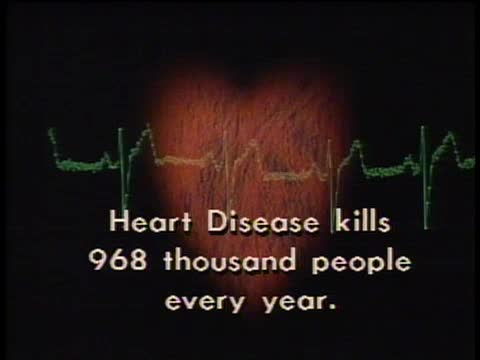
when a person is excited. Stephanie's heart has been clocked as fast as two hundred eighty beats per minute. That's about four times the normal rate. Stephanie's mother Pamela Bowland - If she was out in the woods they had been in some kind of a plane accident or something was out there and it was going fast. Then her lungs would fill up with fluid and she would eventually suffocate. Because your heart beat so fast that it can't take the fluid that's in your lungs that it normally does with each beat. What few people realize is that heart rhythm problems kill 400000 Americans each year. That's about two thirds of all cardiac deaths. It's a fairly common misconception people die from heart attacks when they die suddenly due to heart disease when in fact the most common reason why they die suddenly is a rhythm problem. A rhythm problem that results from the heart attack. Dr. Patrick Chu is a cardiac electrophysiologist at Sinai Samaritan Medical
Center in Milwaukee. Think of him as an electrician fixing things up. When Mother Nature blessed you with a botched wiring job. There are many types of rhythm problems that don't have anything to do with higher taxes. Nothing wrong with the muscle of the heart there. It can work perfectly fine as a pump it has normal pacing functions that it can regulate its own heart rate wellwell, And there are only some electrical abnormalities that cause the rhythm to misbehave. Dr. Chu suspects Frank Grebouskas may be the victim of those misbehaving rhythms. What Chu is trying to figure out this afternoon is where the short circuit that may be causing them lies. To do that. He fires tiny electrical pulses into the heart trying to trigger the condition that's known as ventricular tachycardia. [background audio Tachycardia. Are you dizzy? No, lightheaded. Lightheaded?]
[background audio] How are you doing? Very good. Lightheaded? No With every beat of the fast rhythm, there is one of these things preceeding it. From the subtle differences between these many waving lines Dr. Chu finds evidence of the tachycardia is the result of the slow deterioration of Grebouskas' heart at one time it would have been assumed that the problem was the result of a heart attack and treated with a defibrillator that would shock the heart back into its normal rhythm. Giving him a defibrillator. Is not treating the tachycardia is not preventing it is just rescuing him whenever he has it. So we like to prevent it from ever happening. That would be a better solution than just rescuing him every time he gets a.
Shot out of a foreign information. Will make a difference in how we think. Are. You planning a defibrillator requires an open heart operation because this problem can be corrected without major surgery. Thus he was back home in can Osho by the end of the week. Early the next morning. Stephanie Bowlen is headed for the operating room in search of her surgical cure. In her case the rapid heartbeat is due to a congenital condition known as Wolf Parkinson White syndrome. In a normal heart the electrical signals travel through a pathway in the center of the organ, a path that contains a regulator that stops rapid heart beats but in two or three people out of a thousand something goes wrong it's the heart tissue is dividing during the first few weeks after conception. There's another wire a short circuit of a sort without a regulator. It doesn't really have any of the problems associated with it hard. And
once that electrical extra electrical pathway is gotten rid of her heart is you know. Until about five years ago Wolf Parkinson White patients were placed on a lifelong drug regimen of therapy Dr. Chu feels was less than desirable. Actually I'm not sure that the risk associated with taking such a medication for a long period time 30, 40, 50 years is any less than the risk of surgery given that the risk of surgery is quite small in the end from what we have been told the drugs that are involved do have potentially some side effect. Yes potentially some serious side effects such as dying. Some of these drugs that are used can cause electrical abnormalities that can kill somebody. On their own? On their own, yes. Two surgeons, Doctors Paul Werner and Edward Dunn, are working with Chu. As their hands and tools touch Stephanie's heart, it triggers the rapid heartbeats they
hope to correct. [machine noise in background] "Let me look at what the VA is here." Chouse job is to electrically trigger the rapid heart beats so the extra pathways the short circuits can be mapped. [Machine noise] "There it goes, tachycardia. Alright, lemme- let's put the band back on. Ok ?Paul?" The band is studded with metal contacts that measure currents flowing from 56 different places at once. Through a bundle of wires, the currents flow into a computer which paints a road map complete with coordinates which will be used by Werner as he tries to cut away the accessory pathways. [Machine noise] "Do you want this - uh - do you want ?any off the side?. I'm sorry I'm sorry. A ?sonaptolese? is the earliest on this one. The areas in yellow are the pathway where currents flowed first, bypassing the normal connection, triggering rapid heart beats. Dr. Warner, the surgeon, tries to destroy the extra tissue on the surface of the heart by freezing it with a
probe filled with liquid nitrogen. But further mapping efforts disclose Stephanie is the one case out of 10 where this relatively simple procedure won't work. [Machine noise] "But the pathway is ? on the inside?" "Yeah." "What happened is that This is the area we mapped the pathway. Week. Maybe. It's actually. Inside the heart. Instead of being an outside where we could have easily gotten it with ? this one ?." [Background voices] In a matter of minutes Stephanie Bolan's case has turned into an open heart operation. She will have to be hooked up to a pump while the surgeons go inside the heart to eliminate the extra tissue. What seems at first to be the most complicated part of the surgery actually goes the most quickly. It then takes only about half an hour to freeze the pathway and suture the heart shut. [Machine noise] "Very, very well. It took a little longer than usual, but she's doing fine and there are uh-." ?cautious approach ? I'd say in an- in an- hour." [Background noise]
[Background Noise] "I can just do anything I want. Every once in a while though it will skip a beat or two. but, that's- the doctor says that's nothing unusual." In the fall Stephanie Bolen was back in school. She no longer needs daily medication. She no longer worries about a volleyball game triggering a trip to the hospital. She's a reminder to her fellow students that heart trouble is something they may have to learn to accept. "I thought of that a lot of times you know, I'm like, I'm me, you know, Stephanie Bolan n' you know, has to have heart surgery and it took a while to sink in. You know I never thought of myself as, you know, having a heart problem or anything until it started going fast, you know, I think of old people as [chuckle] the ones that have to have heart problems, or it's not just old people that have problems it's younger too. [Gym noises, shouts] [EKG beeps] [Rhythm beats] I'm Dr. Ted good friend. The story you've just seen is about a relatively rare form of heart
disease. What I'm going to talk about now is the most common form of heart disease, heart attacks. Now heart attacks are thought to be largely preventable. And one way many people try to prevent them is through exercise. There are lots of reasons people exercise. [sounds of weights clanking in a gym] Some do it to build muscles. And even more do it to melt fat. [Music in background] But the motive that drives the vast majority of middle age men to the gym with a jogging path is the fear of sudden death, [sirens in background] and by far the greatest cause of sudden death is a [monitor beeps] heart attack, a plugging of the coronary arteries that supply the heart with blood. [sustained beep] [Background noise] "Regular exercise in middle age men reduces the risk of heart attack by about 25 percent. Exercise has several benefits. It helps control obesity which is one of the risk
factors. It helps adjust the cholesterol, another risk factor, and it may even increase the circulation to the heart by causing new coronary blood vessels to sprout." [background music] You don't have to become a world class athlete to reap the heart benefits of exercise. The prescription is fairly simple. First of all check with your doctor. Can you take it. You wouldn't want to drop dead on the day you began a program for a long life. Second begin each session with a warm up. That's to prevent the side effects of exercise like strained muscles and sprained ankles. Third, do at least 20 minutes of aerobic exercise. What is aerobic exercise? Exercise that makes you breathe hard. It's relatively easy on the muscles, but takes a lot of wind. It doesn't matter what form of aerobic exercise you do. The goal is to drive your pulse rate up to 80 percent of its maximum and keep it there for at least 20 minutes. One word of warning.
Middle aged men and women probably should avoid isometric exercises Isometric exercises the kind that makes you hold your breath. Grunt grit your teeth. Isometric exercise sets up a reflex in the heart and the blood vessels that can raise the blood pressure sky high. It can be dangerous for people who have weak hearts weak blood vessels or high blood pressure. Finally after your aerobic exercise cool down gradually. Repeat the whole process at least three times each week. The more the better. But the bulk of the benefit can be achieved with three sessions a week. [Loud music] So let's review. Three episodes of exercise, aerobic exercise, every week can reduce your incidence of heart attack by about 25 percent. Twenty-five percent doesn't sound like a lot, in fact for a man my age an aspirin every other day might reduce my chances of a heart attack by 50 percent. So why do I exercise? Well for one thing it enables me to eat more and not gain weight. An another thing it gets me away from the hospital, away
from the telephone and out here among all these healthy people. I might even do this if it did nothing for my heart. Three down. Eleven forty three
three. That was the moment the teenaged boy was pronounced dead following an accident. It was also the time a human heart began a journey from Waukesha to Milwaukee. A trip taken in a picnic cooler surrounded in the back of an ambulance by half a dozen surprisingly calm doctors and nurses. A trip that will mark a new beginning for someone else's life. Heart transplants, big news less than a decade ago are now close to common. This scene is repeated over 2000 times each year. The only limitation is the shortage of donated organs. Who gets those organs turns out to be a lotto of life and death. Pat Burke is a nurse who serves as a transplant coordinator for the teams of transplant surgeons at St. Luke's hospital in Milwaukee.
"The very first candidate who could have taken the heart from this donor at the very, very last minute ran high temperature on us, and showed some signs of being infected and because of the kinds of medicines we must give post transplant we had to rule her out. We would have made her sicker instead of better. She would have probably developed overwhelming infection. The second one we looked at, that young man rather carefully and decided that while the weights were closer the bodily proportions were quite close they probably weren't quite close enough. And he was our number two person, so number three was this young woman. And at probably about 9 o'clock tonight we had to call her at her home and tell her come in as fast as you can bring your toothbrush." The patient who did receive the heart doesn't fit the stereotypes. Number one, she's female. Number two, she's only in her early 30s. She had never had heart problems before she became sick two years ago. She's unusual in another way. She only had to wait three months for
a donor heart. Most patients have to wait much, much longer. Transplant surgeon Alfred Tackter, "Well, this woman had what we call a cardiomyopathy and I would assume that it was probably due to a viral infection that destroyed her heart muscle cells. So she had a very poorly contracting heart and uh- her activity was severely limited almost uh- to a ?chairy? existence." The patient's diseased heart lies in a stainless steel pan less than 10 minutes after the donor hearts arrival in the operating room. The quicker the heart can be restarted the better the patient's chances of survival. "Well we do work under uh- a time constraint. Uh- We like to have uh- blood flowing into the heart after it's removed from the donor at least within four hours. And if we can keep it under three hours it's that much better. [background machines and voices]
Her. Oh. [in the background voices] the right atrium finishing up here. You can see the heart is starting to beat a little now. Hearts want to beat. Often the old heart continues beating after it's removed. The new one often starts itself as soon as the blood hits it. [Background machines] "Sometimes they'll fibrillate, and that's why you have to shock 'em, but frequently they'll start up spontaneously again on their own. That's when we let the clamp off and the blood goes into the coronary arteries. [background noise] It needs the blood, yes once it gets that then it'll start to beep." [background voices] The heart is beating inside the chest of 31 year old Kate Curshack of Menomonee Falls. As further proof of how routine transplantation has become she will spend only 8 days in the hospital recovering. She'll then be sent
home with memories of what things were like before she got her new heart. "I couldn't lie down I lie down n' breathe. I'd lie down and I couldn't get my breath. It was just like my lungs wouldn't work." Today she stands a 3 in 4 chance of surviving at least 10 years. She'll be part of a growing group of people who live with an amazing reality the fact that someone else's heart is beating inside their chest. [traffic noises] "I'd like to have any of the new transplant patients recipients to please ah- I identify yourself to the group and we'd like to welcome you." "I'm Kay and I had my heart transplant on the 21st of July this year." [clapping] This ordinary looking picnic is anything but ordinary. There are two dozen people here who are transplant recipients. These are people who are often very public
about what has been done to them. Partly because they feel they are walking proof that donating organs is a great idea. And partly because they feel the public still doesn't really understand what heart transplantation actually is. [outside wind] "People get very confused. You tell them you had a heart transplant they say oh yeah I had bypasses too. So then you have to explain to them that you have a heart of another person and they're going oh no, not really. Unless they see somebody walking around they have no idea what a heart transplant is." [Voices] "I had one day to live at the time, and uh- you take what you can get. [chuckle]" "Same with me they give me about three months at that time it went on to about two weeks and I said it's my chance I'm gonna take it." Bill and Gene are the two longest surviving heart transplant patients from St. Luke's near the top of the list that is now 75 names long. "And they called me a miracle. [chuckle]
He wanted to touch me just as for the sake of it." "They were in awe they couldn't believe it. Know if somebody had a heart transplant you know it's quite rare that em- you can take a kidney away you can live, but ya can't live, you can take a lung away you can live, but you can't live without a heart." [voices] "It is a miracle, you get SECOND CHANCE on life. It is one month to the day after Kate Curshack received her new heart. She's exercising to try and build up the capacity of her cardiovascular system. "I do more exercise now than I ever did when I was in high school." Still she will have to learn to live with limits. Her old job packaging printed material is probably too strenuous for her to return. She's planning on going back to school to learn a new career but that's a second career that otherwise would have been impossible.
With that we wrap up tonight 7 Central. Art Hackett produced our program. The segment on heart and exercise was produced by Dr. Ted Goodfriend. If you'd like to get copies of Dr. Goodfriend's advice, by the way, on how to keep your heart healthy you can write us at 7 central, Wisconsin Public Television, 821 University Avenue, Madison, Wisconsin 5 3 7 0 6. And one other comment as reporter Art pointed out the only reason more organ transplant operations are performed is because people are willing to become organ donors. If you're ever interested in doing that doctors recommend that you simply sign the statement on the back of your driver's license and even more importantly talk about your wishes with family members. I'm Dave Iverson, thanks for watching. We'll see you again a week from tonight 7:00 Central.
- Series
- 7 Central
- Episode Number
- 103
- Contributing Organization
- PBS Wisconsin (Madison, Wisconsin)
- AAPB ID
- cpb-aacip/29-95j9kqdr
If you have more information about this item than what is given here, or if you have concerns about this record, we want to know! Contact us, indicating the AAPB ID (cpb-aacip/29-95j9kqdr).
- Description
- Description
- No description available
- Genres
- News
- Topics
- News
- Rights
- Content provided from the media collection of Wisconsin Public Broadcasting, a service of the Board of Regents of the University of Wisconsin System and the Wisconsin Educational Communications Board. All rights reserved by the particular owner of content provided. For more information, please contact 1-800-422-9707
- Media type
- Moving Image
- Duration
- 00:27:20
- Credits
-
- AAPB Contributor Holdings
-
Wisconsin Public Television (WHA-TV)
Identifier: WPT1.70.T14 MA (Wisconsin Public Television)
Format: U-matic
Generation: Master
Duration: 00:30:00?
If you have a copy of this asset and would like us to add it to our catalog, please contact us.
- Citations
- Chicago: “7 Central; 103,” PBS Wisconsin, American Archive of Public Broadcasting (GBH and the Library of Congress), Boston, MA and Washington, DC, accessed September 21, 2026, http://americanarchive.org/catalog/cpb-aacip-29-95j9kqdr.
- MLA: “7 Central; 103.” PBS Wisconsin, American Archive of Public Broadcasting (GBH and the Library of Congress), Boston, MA and Washington, DC. Web. September 21, 2026. <http://americanarchive.org/catalog/cpb-aacip-29-95j9kqdr>.
- APA: 7 Central; 103. Boston, MA: PBS Wisconsin, American Archive of Public Broadcasting (GBH and the Library of Congress), Boston, MA and Washington, DC. Retrieved from http://americanarchive.org/catalog/cpb-aacip-29-95j9kqdr