The Wilder Davidson Story: The End of an Era; Part 2; Working in the Minds
- Transcript
You The following program has been made possible in part by a grant from the Tennessee Humanities Council a not -for -profit corporation whose principal funding is provided by the National Endowment for the Humanities by contributions from businesses and individuals in the upper Cumberland region of Tennessee and by WCTETV. When I got the Wilder I thought I was in the city. Davidson used to be a pretty place and nice
place and Wilder was too and Highland was too down there but it's just all disappeared the people just all gone out and left. I never dreamed but what that it would be like that always and that I'd live out there all my life. I love to live there didn't you? I sure did back then there's a good place to live. There was a lot of people in there too. For six months it was just like a war going on in Wilder you could hear shooting day and night dynamite. Mine and companies was king of the hell buddy. You stooped and you bowed. They own the mines, they own the house, they own the store, they own everything. Now Wilder's best coals have been dug out in this country they say. I know it's got a bad name but they've never been no better people in the world.
It's hard to talk about it. The Wilder Davidson story the end of an era is a community -based oral history project that tries through the voices of those who lived there to preserve the history of the five Upper Cumberland coal mining communities of Wilder, Davidson, Twinton, Crawford and Highland, Tennessee. At the turn of the 20th century the railroad and coal mining came to the rugged isolated area where the Tennessee counties of Overton, Fentress and Putnam come together. The five communities sprang up to form a coal mining complex that thrived until the early 1930s. Part one of the Wilder Davidson story the end of an era looked at life in the company towns through this boom era. Part two working in the mines will examine wages, working conditions, tools and procedures, attitudes towards
safety and mine accidents. Residents of the mountainous Upper Cumberland region were a hardy independent people accustomed to the hard work of subsistence farming and logging. They quickly adapted to the backbreaking labor of coal mining and welcomed the attractive wages. Along with good pay however came a loss of independence as miners lived in company housing, shopped at company stores and submitted to regulations, supervision and time sheets. Tom Lowry who started working in the mines as a teenager in Davidson remembers receiving his first wages. The richest man that ever come to Jamestown was me. The first payday I ever drawed in my life was eleven dollars and a quarter. They paid me money then, put it in a little brown envelop. I come to Jamestown, hamburgers about a dime, bought a beer about a dime I guess. It's been so long I don't remember.
I with old man Dave Potties. I'll tell you how cheap it was. I could get a good clean bed in my breakfast for a quarter and I hitchhiked to Jamestown or walk or whatever. I don't remember spending so long. But I got to Jamestown. I went to a picture show and I ate me three or four big hamburgers and I guess I drunk me, I don't have any beer. And then I went up there and I had plenty of money. I had eleven dollars and a quarter and I felt like I was the richest man that ever been out there. And I stayed all night and I started back home and I still had plenty of money. Now that was eleven dollars and a quarter. I never forget it. First pay they ever draw in my life. Money. First money. It's the most money you can make in them days. And the quickest money you can make in them days. After the Shaw's got theirs and after Ernest got one, just pretty well everybody else began to get a radio then. And now the miners was pretty good to whatever they wanted they got. And
they'd pay it so much a month you know. And get what they wanted. They bought cars, just anything they wanted. And they'd pay for it by the mob. When you worked in the mine and say I went in there and load ten tons of coal, it was weighted to temple and they would transfer that information into the office. And if I was getting forty three cents a ton, which I did work some forty three cents a ton, they would put that on the books and I had that credits. And if I wanted to draw, they very seldom let you overdraw in there. Those coalmines would go and work all day and then they'd go down there and draw out what they'd earned or they'd go the next day. But if you didn't draw all this off the books, they would hold a payday on the sixteenth and the first of month. And if you had any money left on the books, you would draw it out in cash. They paid in cash if you had any, you know, they wouldn't know money. Nobody drawed any money much. There's a few fellers. See, it took all, it took it all, what you'd work. The company had what they called
a script. Script was paper money that they printed out that was perforated and you take it in the store and you could, they would, you buy stuff and they would tear off the amount of that, off of that script. It's just a piece of paper with numbers on it. It's a piece of paper. Just an old piece of, Davidson's script was blue and wild. was white. It had a dollar would have a dime, have 50 cents to the side. Two dollars and quarter up here in this piece of paper with numbers. A dollar had a dime at the top on each side and I see that would be, that nickels rest the way down. If you bought 20 cents worth of goods out of the store, they would tear off four nickels or diamond, two nickels or something like that and they'd tear off the amount that you'd spend in there and you would keep the rest of them. Incidentally, that script was negotiable with the bootleggers and other people. You could buy stuff from other people with it and they'd go to the company store and spend it. You couldn't hardly
use it anywhere without to use it in the company store. If any other merchants took it, they'd take a discount. know, they'd discount it, but actually it was worth a dollar for dollar if you could, if you could have held on to it. The company store, they sold their goods a little higher than the neighboring owned stores, which there was a bunch of them around outside the town of Wilder. They had three down in Glover's Hall or four down there, different merchants that was selling down there. And some of the people didn't use the script. They were able to get through without script and then they would go out to these neighboring merchants and buy their goods from them. But it was awful hard to get ahead of the company there because you had to live from day to day and the only way during between the paydays is to get anything to buy groceries and stuff with was to draw a script out of the office. But them days, it was labor. Now
that was natural labor now. That's what it was. I was 14 year old when I came and went on the payroll. But I'd been working in the mines before, about two years, see. Back at them times, didn't pay no attention to a kid of me. if they're dead or some of their people, know, they didn't have no laws in like they didn't care. I was between 15 and 16 now. And I told him that I 16 years old. And he signed the paper and I wanted to work with that. I quit school when I was about the eighth grade, probably in the ninth grade. I quit school and I decided I wanted to make a fortune working in the mines. I signed my daddy's name for the release. And they knew it. And my daddy didn't like it, but he didn't do anything about it. And he told me if anything ever happened to me or if I got
hung in there and it was left up to him to get me out, I'd stay till I'm lost over. And he meant that. I think kids ought to work, but I don't think they ought to work that young. I can say that it hurt me any, but you know, you, well, maybe it did. You can work a kid too hard. I think they ought to work, but not like I had to work. I wouldn't want mine to work that way. I didn't want mine to know anything about coal mines. There's a lot of conditions I didn't like. You see, we didn't have no, we worked bad air, we worked water, we worked, oh, this air was, if it was good or it was bad. it was dangerous. Of course, I didn't think of it in them terms, but at that time. A flame has got to have oxygen. when you've got an oxygen deficiency in black and damp, the flame will go out. light would just go out. And detecting methane, you and, I'll use this later, when you've also, you like this, that's the lighter, know. It
didn't light, but they probably load the fluid, because it's been five or six years since I had any fluid put in it. Use coal and lantern oil fluid for fuel for them. You just take this lamp, this is what the foreman carries around with him, checking for methane. And he'd come up like that and he'd be a little, on that little small flame, maybe a cedar tree, picture of cedar tree, look like a cedar tree come up, and then he'd take it down. He'd know there'd be over two percent methane. We have here tools that was used in the coal mines around the turn of the century on up to about 1920. And these tools are all man -killers. There, what did you say? Man -killers. And taking quite a man to operate them.
And how did the typical day go? Well, the first thing, when we entered the mine, entered our rooms, ready to work, we had a coal we shot down the evening before. And the first thing is get it out of the load it. And in loading it, we used what is called the number two shovel. That's a number two coal shovel. And we used them to load the coal out when they got the place cleaned up in the coal out. Then we made preparations for the next day's coal. First thing, we started drilling. We start out with a two -foot bit. We run that two -foot bit up, change again, put on a four -foot bit. And we run the four -foot bit up, we change bits
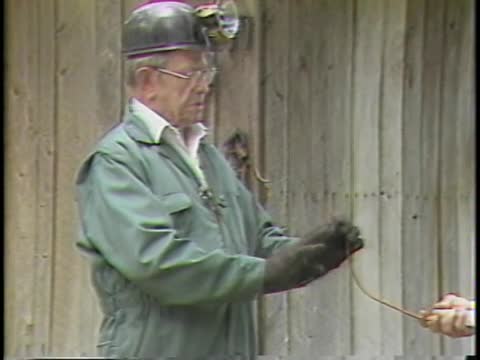
again, and go to the six -foot bit. And what was the name of the man who was helping you do all of this? He was called a choke -eye. Well, yes. Because of the height of the coal seams, the miners remember doing most of their work in a stooped position or on their knees. I still got prints on my knees while I've been down on my knees. We have the holes drilled and we're ready to load them. And we make a cottage out of paper, stiff paper. We're wrapping it around a round piece of wood. And we use ordinary laundry soap to seal it with. Now, that's it. It's important here in the working coal on the solid. You notice I have a knot tied in the end of this. And that knot is split down to the powder in the center, center coarse powder. And that's to make sure when the fire gets down
to here, it's got two, three pieces in place. It's just spew out and make sure we get an ignition. And it's inserted into the cottage. This is closed here. And you approach a hole and you insert the cottage into it, push it on back to the end, and then you start your tamping. And you leave so much of the fuse out. If you want this hole to fire first, you make short fumes. And you lengthen it as you go down so they will fire in sequence to the way they should. And you put a white piece of paper on this to get up with the shot farming. You can always see it where you have a shot farming as far as all the shots.
You combine the enders of the room to fire the shots and they're all got a white tag on them where you can get them in the hurry and get out. We used double F Atlas bison powder to fill those cottages with. We used slow burning powder, to shoot coal, you needed a slow burning explosive. And you load those things with a stick of dynamite and all it does is blow out a plot hole. It's so fast. So that's why they always used a very coarse double F Atlas bison powder. Well the light, back then we just had carbide lights. Now you put your carbide down in this and then you'd spit in it, or Charlie did, he'd always spit in it and put this then back on like this. And
then you put your water then down in that there. I'd be at the hotel. Sometimes my friends run the hotel. I'd go up there and be with some of the girls that you know that lived there and they always had to have help there too. And boy when the boys had begun to come in from work there was all them dinner buckets. They had to wash it. Oh it was a sight. And I always just hated to wash the dinner bucket. I'd just fill whatever I had now and meat. I'd usually have pork chop or something you know like that to go with his biscuits. And I'd just fill it up and then he'd go by the pump then and pump his water in here. And then just set his food back down in there and put the lid on. And he is ready to go. When he'd have a little dinner left he'd throw down his scraps for the he'd feed the rats. He said when the rats
know when it's danger and he said he'd watch them you know and he said that they would run whenever they was danger. I never seen a coal miner bother to kill a rat. They said the rats know more about when it's going to fall in than they did. So they never they superstitious I'd say. But I'll tell you what I did do. I done this myself. I had it lit up not as bright as it is here but it was lit up till I could see good. And I took a pork chop bone and hung it on the trolley line which was 420 and I tried to figure this rat about how big he'd be to right up there and get that and there's two of them come out there they're smart too. And this person right up there to get that bone and they just knocked a far out of him and he thought this rat behind had done. Now this is the truth that he thought this rat behind had done something to him and they turned around there and fit just like two big bulldogs. And I laughed till I cried but they were smart enough that that hung the rest of
the day and they never did come back. Now that's the truth. I've done that. I've seen that. I never did get hurt too bad. I never did lose a serious work over getting hurt. And I never seen nobody hurt too bad. But I come here getting killed two or three times. That didn't scare me too bad though. I don't know why. Generally speaking a coal mine is no safer than the men that are working in it. And I'm talking about them and the precautions that they take. I don't know what the company can do anything. I come on up in the years and I found out that it's not the company it's not the government passing laws. It's the man it's doing the work at the place that's where the work is done. That's the man that counts. They pass all the laws they want to but if the man don't don't do it and see it it's done it's just a waste of time. And we've not only had white damp and black damp and methane to be worried about but
we also had dust explosions to be concerned about. It seems to me that that there was one that was caused entirely unnecessarily by an individual making noise in the mine. In wilder mines back quite a number of years ago there was a dust explosion in the wilder mines that killed 17 miners and it was all caused by a teenage boy who was a trapper in the mines and I mean but trapper he had to control the air and they had to put a door to each entry to deflect the air up another route and his job was to open and close the the door to let a motor in and out just holding the
coal out and when the motor had come by running pretty fast this coal was all over the track and it grinds it up into dust just like flour more or less and when he comes through with a loader running pretty fast that dust that goes everywhere just clogs everything up and this boy was playing with a carbide can which the kid fooled with it quite a bit. They take a carbide can put a cup of three grains of carbide in it a few drops of water and they had a whole bunch in the bottom of it the lid on tight they put the finger over that hold it so long and stick a little light to it carbide light and it'd make quite a boom and then when he did that of course that flash come out and that did it it just like setting powder on fire the whole entry was just one solid flame and this
particular one ended up by taking the lives of 17 miners and Dowl Lusk and Maj Alexander remember the night of February 13th 1928 when during a supper break a young substitute worker leaned back against a can of blasting powder setting off an explosion with his carbide light that took the lives of four men. Maj's husband Charlie Alexander died along with his brother Sam, nephew Lee Peake and coworker venerable Woody. Jim Dowl Lusk, Robert Alexander and Arthur Dial survived the accident. We filled up our lamps and ate about a supper and Woody was laying down on the bottom and had his head propped up in his hand and his lamp pulled his cap back off his head and that blaze was setting that against that full keg of powder had never been open and it burned it
hot enough a place just about the size of a silver dollar I guess and that's what caused the powder to explode we didn't even know it was there and that was the cause of the explosion. It knocked me out, burnt nearly all my clothes off and two of the boys I never did see Robert after after the powder went off in fact I didn't know what happened I just remember seeing a flash and I imagine it it made a racket but I didn't I don't remember that I just remember seeing it when it blowed up and it blowed me about 14 feet from where I was sitting it blowed me across the entry into this old crossover where we kept the powder and when I come to the first thing I heard anybody say Sam Alexander told us to get our clothes off was on fire so what I could tear off what I couldn't take off get off I tore it off and when I come out I had a pair of shoes and a leather belt on all that had on one
when they brought me to the bathhouse and there was a on the ground and it was cold I of course gone to bed and gone to sleep it was night you know they were working nights and I was asleep so tipped banks came in from work and he knocked on my door and he just said Charlie and them's had an accident and he said tell you he'd be home directly and I said well but I laid there and I waited there's about we got hurt 15 after I knew there's something wrong I could hear the doctor's car he had this February and he had chains on his car and I could hear his car racing up and down the road just hard to see it could go and I knew there was something wrong so I said oh there's something wrong and and so we got up nine unearners got up I got up and we dressed and we went up there well they were
all of course still had that black cold dust on them and wrapped in them blankets you couldn't tell one from the other and when he saw me come in he said oh his he wasn't the kind of a person though said darling dear and so on sweetheart so he said old woman don't you worry about me now I'll be all right but he wasn't all right they got us out there were three hours me and robert and lee peak they got us out about must have been around eleven o 'clock sometime around there and then they got the other three sam charlie and and venerable they brought them out about I guess about 12 one o 'clock I don't remember just exactly but they had to send to Crawford to get doc Collins he was a doctor he was a company doctor at Crawford and dr. Ed Stone was a company doctor at wilder and they had to send get Collins to help stone because he had more than he could handle and
Collins was the one who got me ready well all he done was just wrap bandage and gauze around us and pour them seed oil all over this happened on a monday night and they took them from they had to stay there at the boarding house at wilder they brought them to the closest boarding house not to the hotel and put linseed oil on them and wrapped them in blankets and kept them there and the train coming to Monterey left the next morning around 10 o 'clock and they carried them on the train now to Monterey well they had to wait at Monterey till the three o 'clock train going to Nashville then came through there and they got into Nashville about seven o 'clock Tuesday night well Wednesday morning Charlie died the first one I imagine I'd have stayed on for quite a while but after I got hurt while that done away with my mind and I graduated that night Charlie died Wednesday
one of boys died a Thursday his nephew died I think the next Thursday Sam his brother lived a month and then he died it was a horrible time I thought he did kill me I really did I thought he did kill me I was just 23 years old and he was just 31 but you've got to make a life and go on you can't just because oh I thought I'd die when my husband I really did you hear people say oh I thought I'd die now when they don't know what's coming I thought I would really I did and but you get over that terrible horror after a while you don't ever get over it I don't mean that you don't ever get over it but you get over that awful awful feeling of horror
it's all night long from midnight on you go in the mines find water up to your knees you sure don't like to work in it but you don't do as you please it's all night long from midnight on they'll take you by the collar they'll maul you in the face put you in that water hole fits right up to your waist it's all night long from midnight on you come out by the office after working hard all day your shirt shoes and doctor bill you surely got to pay it's all night long from midnight on then go through the office they go through one by one they'll ask for two dollars in script said oh gee make it one it's all night long from midnight on you get your hand and pull a script and go right in the store you find the fellow where the black must tell you're
riding it down on the floor it's all night long from midnight on you ask for a bucket of lard and what's meat worth a pound we'll set at you at any price called a space weekend now it's all night long from midnight on you ask for a cycle flower and then you ask the cost it's a dollar and a quarter of a sack and 50 cents a yard for clothes it's all night long from midnight on i went in the store one day mr. cow was frying steak i want him give him scab colic and the belly ache it's all night long from midnight on
- Episode Number
- Part 2
- Episode
- Working in the Minds
- Producing Organization
- WCTE
- Contributing Organization
- WCTE (Cookeville, Tennessee)
- AAPB ID
- cpb-aacip-23-4947ddxg
If you have more information about this item than what is given here, or if you have concerns about this record, we want to know! Contact us, indicating the AAPB ID (cpb-aacip-23-4947ddxg).
- Description
- Series Description
- A four-part documentary about life and labor in the coal-mining towns of Wilder and Davidson, Tennessee.
- Created Date
- 1987-06-17
- Asset type
- Episode
- Genres
- Documentary
- Topics
- Social Issues
- History
- Employment
- Media type
- Moving Image
- Duration
- 00:29:05
- Credits
-
-
Producing Organization:
WCTE
- AAPB Contributor Holdings
-
WCTE
Identifier: cpb-aacip-24e006200ff (Filename)
Format: U-matic
Generation: Master
Duration: 00:28:46
-
WCTE
Identifier: cpb-aacip-f2b3b76bf0f (Filename)
Format: U-matic
Generation: Master
Duration: 00:28:46
If you have a copy of this asset and would like us to add it to our catalog, please contact us.
- Citations
- Chicago: “The Wilder Davidson Story: The End of an Era; Part 2; Working in the Minds,” 1987-06-17, WCTE, American Archive of Public Broadcasting (GBH and the Library of Congress), Boston, MA and Washington, DC, accessed September 21, 2026, http://americanarchive.org/catalog/cpb-aacip-23-4947ddxg.
- MLA: “The Wilder Davidson Story: The End of an Era; Part 2; Working in the Minds.” 1987-06-17. WCTE, American Archive of Public Broadcasting (GBH and the Library of Congress), Boston, MA and Washington, DC. Web. September 21, 2026. <http://americanarchive.org/catalog/cpb-aacip-23-4947ddxg>.
- APA: The Wilder Davidson Story: The End of an Era; Part 2; Working in the Minds. Boston, MA: WCTE, American Archive of Public Broadcasting (GBH and the Library of Congress), Boston, MA and Washington, DC. Retrieved from http://americanarchive.org/catalog/cpb-aacip-23-4947ddxg