Upper Cumberland Camera; 722; Halloween Special
- Transcript
Billy Westmoreland's fishing diary will not be seen tonight so that we may bring you the following special Halloween program. Huppercornland folklore is filled with stories of the supernatural. Many of these stories seem to ring with the notes of imagination, however others take on a more realistic role. For the most part, most spirits seem to originate locally while others are supernatural imports. The two accounts that we will look at in this program have to do with supernatural
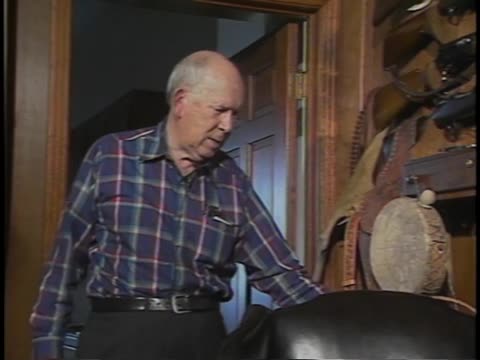
imports. One brought to Putnam County from Mexico, the other from closer to home, Crab Orchard, Tennessee. Any few moments will tell you a story that occurred in eastern Putnam County. However, first of all, we'll go to the home of Attorney Dick Mitchell. I appreciate your interest in my Indian drum. I think it's a very interesting story and I know that you're very interested in this type of thing, and I'd be glad to go over it with you again. As you know, this is the infamous drum. This is a Tarahamara Indian drum. It was a medicine drum or a shamans drum that was used by the Tarahamara Indians. Now, I got that drum from a Tarahamara Indian. It's a hard name to pronounce. I spell it nearly better than I can pronounce it. Eleanor and I were in Mexico
in the Sierra Madre Occidentals about 18 years ago or so, and we're up in what is now called, people know it as the Copper Canyon area. It's probably the roughest mountain area in the United States. In fact, there were no roads over there at the time we were there. I don't know if there are now. There was a scenic railroad built by the Swiss from there to Los Moches on the Gulf of Cortez. It has 89 tunnels and 26 bridges, I believe, to give you an idea of how rough that country is. But we stopped, Eleanor and I did, a few years ago, and spent the night at the one place up there on the top of the mountains. It's called the Devisadero. Overlooking the Devisadero Barranca, a part of the overall Barranca Eureke, where the Eureke River causes this great chasm in the mountains there.
And we were spending the night there and going to go with a guide and see what we could the next day. A little background about it, the Tarahumara Indians have lived there ever since the Spanish first came into that area, their first mission in the years in the 1600s. But anyway, there are about 30 ,000 of them about at that time. I don't know how many now. They were the poorest Indians I imagine in North America. They lived in the roughest country. To give you an idea of the scope of that Barranca Copper Canyon, the entire complex is four and a half times the size of the Grand Canyon of the Colorado, 2 ,000 feet deeper. These are the Indians you've heard about who can run so far and so long. They run down deer. They run down wild turkey.
I think it comes from the fact that these mountains they climb, they live down in the bottom of the canyon, which is tropical, in the winter, in caves. And in the fall, in the spring, they come up to the top of the mountain where they do their planting and growing their maize and so forth. And climbing up and down those thousands and thousands of feet mountains, builds the rungs up and they can run. A young Taira Hamara can run 175 miles in 24 hours. And they're noted for that all over the world. That's just that little background. anyway, the next morning when Elder and I got a guide and had him to take us out on some of the paths going a little bit down into the canyons and around the rim and so forth, he took us by this cave where some of them lived. As the guide was taking me and Elder around the rim and part of the way down into the canyon complex and
so forth, he took us by a cave in which a family of Indians lived in. And now they've reached the point where they love to make money off of tourists and they carve things and have carvings and effigies and things that they like to sell. so they were showing us some of those things this family had in their cave and their home to sell. And I sort of wandered back in the back and dark part of the cave and I saw this Indian drum, this drum here, hanging in the dark, nearly dark. I could hardly see it. And I asked the guide, told the guide, I wanted to buy it. And he dubiously sort of asked the Indian head of the family, I assume, if I would sell it to him in, he says, no. And it was very emphatic about it, the guide said,
and looked almost frightened or startled but wasn't even considered and seemed to be irritated that I'd even seen it or found it back there. But I wandered very badly and I spoke up and said, well, I'll give him $5 for it. Well, his wife, I assume it his wife, just stepped up real quick and took the whole drum, picked it up off the things hanging on and turned around and gave it to me and took my $5. Now, as we were walking back from that cave and other places we had gone that morning to the little motel we stayed at, Devisadero, I was asked the guide why the man in the cave was so hesitant about setting me the drum. He seemed almost frightened about it or something. And the guide says, well, he was disturbed. The guide was Mexican and part to Rahimara. He could speak, of course, Spanish and to Rahimara both very plainly.
And he said, it's an unusual drum. It's what we call a medicine man's drum or a shaman's drum. And I said, well, what's extraordinary about it other than that? He says, well, you'll find out someday. And that picked my curiosity even more. So I says, well, tell me. What do you know about it? don't know. He says, well, the story about that drum is that this shaman used it and every time there was a battle of any type that the Indians were in, his tribe, he would beat that drum and they would start winning the battle. If he didn't beat the drum, they would lose the battle. And as many, many, many years ago, and I don't know what tribe of Indians it was that attacked a group of them that he was with one night just before dawn, they were either yaks
or comaches or apaches, one of the three most probably. They were the warring and raiding type at that time. The yakis were the closest, so I guess it was probably them. But it could have been the comaches or the apaches because in the fall, under the full moon, particularly, they both, especially the comaches, raided deeply into Mexico. But anyway, they were being raided. And this shaman was asleep with the drum by him. And he awakened and heard the noise of the fighting beginning and the raid and he jumped up real quick and grabbed up the drum. with the drum stick, he held the drum up and started to hit it. And just as he started to hit it, an arrow hit the drum and went right through the drum and into his heart. And he failed without beating the drum. They lost the battle. But his
tribesmen found him afterwards lying there with the drum on his chest, stuck there. Now this hole you see right here, that is crudely but firmly sewed up with animal skin, was the arrow hole. And the guide said that this, I don't know whether you can see it or not, circle around here is what they considered roughly the shape of a heart. They repaired that drum and someone has asked me, why doesn't the backside have an arrow where the arrow went through it? Well, it's very simple. There was so much blood on it that it rotted and they had to replace that with animal skin. It's all made with animal skin except the light wood,
like even some type of tropical wood from the bottom of the canyons I imagine around it. And that's about all he would tell me. So Ellen and I got home and I hung the drum up here with my other stuff and forgot about it temporarily. And sometime after that, it was several months after it. I'm sure the best I could remember is the time. Early one morning it just turned out to be just before dawn. I heard a noise, an unusual type of noise, in my bedroom upstairs, the far side of the house. And I got up to see what it was. And as I got to the head of the stairs there, I could tell that it was coming from this room and sounded
like a drum beat. And as I slowly crept down the hallway toward that door, I could hear that drum beat just like that. Well, I thought maybe that someone was pulling a prank on me, that my son maybe had slipped in the back door and around here. So I slipped up to the door in the dark and before I even looked in at the drum and reached my hand around and turned the light on, everything stopped. The drum stopped completely, no noise. I looked in and came in. The drum was perfectly still, nothing moving at all. Just dead. Well, I wondered what in the world. I still said, well, surely somebody's pulling a joke on me. I looked around and I didn't even check the door. I was so upset and away. The door to the garage, he could come in or the door back door there, he could come in too.
But anyway, I did think I could cure it one way. So I just took this drumstick out and I took it upstairs with me and I put it under my pillow and went back to bed. Now, I can't say I went right to sleep. No, a long way from it, but I finally did go to sleep with it there. Well, I went on the next day about my business so forth and it was on my mind, wondered about it and was going to ask my son about it and neighbor about it so forth. At the next night, I went to bed and up just before dawn, here again, I'm up there in bed, I'm awake and just like that. I reached under my pillow and my drumstick was under my pillow. It was lying there right under my pillow. Well, I was shook up then, believe
it or not, I was shook up. I got up and I got my pistol and flashlight and I came sleeping back down real quiet. All the time I drum was boom, boom. So instead of coming right into this door here, as I did and turned the light on, I turned and went through the little hall that goes around into the kitchen right around behind here. And as I got around there, still going, the noise was going and I got just the word that I could see the drum. The drum was throbbing. It was like a light right on it. It was throbbing, reddish looking. I don't really remember if it was really blood red, but I got the feeling and feeling that it was like blood. Blood red was going and just throbbing by itself. But I noticed a light right on it. And I looked and saw that
full moon was just before sitting through my kitchen window. This door had been open all the time, incidentally. It had been open all the time. And that moon light was shining directly on this drum and right on this picture of the heart. And the heart was throbbing. I flashed my flashlight up on it. It stopped. I turned the kitchen light on. It stopped, all stopped and everything. Well, I really wandered in the quandary. shook me up about as much as I had been shook up in a long time. What did I do? And I thought, well, it's very simple. A man had warned me, but I can handle it without a bit of trouble. I just told him do this. I just turned the drum around with the heart there to the, and it has never beat again that I've heard. Now,
I'm not going to test it in a full moon in September. But if you want to come up and test it sometime at the right time, there's a bedroom right upstairs. We're in location now in eastern Putnam County, just north of what was once known as the Village of Standing Stone. Shortly after the Civil War was over, General John Thomas Wilder, a Union Calvary Officer from Indiana, came into the Tennessee region to invest. One of his investments occurred at Rockwood, Tennessee, in terms of iron foundry. General Wilder would often go across the Cumberland Plateau in search of sources of coal. It was on one of these trips when General Wilder came into the small village of Standing Stone and met a young man and his son. The young man and son had been mining coal in this region for years for their own purpose, but they had agreed that they would indeed carry coal to Rockwood for the purpose of the iron foundry. It was on one of these trips that the young man and his son went
by the old Crab Orchard Inn. This was a famous stop by on the way up to Walton Road from east to west in the early 1800s. It was on one such visit that they met a young girl and invited her to come back to Standing Stone to live with them. Indeed, the girl did. She came to Standing Stone, and only a few months after she arrived, she disappeared. It was shortly after the disappearance that the apparition of an older woman began to appear to certain members of families in the region. Several interesting stories have been handed down over the years. One has it that three men out wallent hunting one afternoon had gone down to a creek. They had found several wallents and began to fill their bag. As they were filling the bag, two of the men heard a scream going up and down the creek. One of them realizing that it was supernatural in nature looked at the other one and both fled up the hill leaving the wallents behind. However, one of the gentlemen continued to gather wallents, obviously having heard no sound at all. One of the most fascinating stories to
come out of the sightings of the little woman occurred by Uncle Frank. Uncle Frank first saw the little woman when he was only a boy of eight years old. He said that he was sleeping one night in the old living room watching the glowing embers as the fire began to die out when all of a sudden the little woman appeared in front of the fireplace. As the little woman approached him, he covered his head with the covers, only to look up again thinking it might be his imagination, but only to look up again to see her appearing in his eyes. In the 1950s, it's the only time we've ever known the little woman to leave the area going out of state. We're told that she went to Dayton, Ohio and visited Uncle Frank where he had actually asked her, what can I do to rid myself of your honnings? We're told that the little woman told him to go to Tennessee to a point where she would meet him, take silver dollars that he had been collecting, bury them under a specific area, and
she would indeed set him free. Uncle Frank did indeed, just as the little woman had told him. He came to Tennessee. He buried his silver dollars underneath the rocks where she was actually standing and pointing, and then he went back to Dayton, Ohio where he died in 1958. What did the silver dollars have to do with the operation? Since the little girl was believed by many to have been killed at a wood pile, it's believed that she had on her person at the time of death silver dollars. Some seem to think that money, grouse, ghost, and if that's the case, perhaps the little apparition was seeking her silver dollars, because Uncle Frank was known to have been a collector of silver dollars. Another reason we perhaps believe that she was seeking silver dollars is simply because we have individuals that have said that she would enter homes through doors that were locked and go in and have searching for something on the old dressers in the living room. We have one situation where she actually entered a home one night while two young girls were sleeping in the living room. One of them awakened only to see her moving around in the living room,
and then without hurting anyone or saying anything or making any noise, she actually stepped through the door and disappeared into the night. The little girl, scared, went running to her grandmother and told her what she had seen the grandmother told her to go back to bed that, quote, the little woman will not hurt you. The apparition of the little woman was also determined to be a warning of unfortunate events to come. On one occasion, a small girl was walking down the road, and a long paralleling her on an embankment was the ghost of the little woman. When the little girl went home, she told her mother what she had seen and the mother had told her, she said, this is a sign that something bad will happen tonight. That night, the grandmother passed away. Another sighting involved a grandmother and her granddaughter as they sat on the front porch of their home. They saw the old woman coming up the road. She had stepped sideways, went up an embankment, and walked into a cornfield.
It had been raining the night before, so the grandmother and granddaughter went on down to the cornfield to see what the old lady was doing. When they got down there, they found no tracks at all, and it was at that moment the grandmother realized that they had seen the apparition of the little woman of Standing Stone. Some say the little girl simply disappeared after moving to Standing Stone, while others hold that she was murdered while gathering wood at the wood pile. Her body taken in to the fireplace and unsuccessfully burned where the body was later removed and thrown in the old mineshaft directly behind me. There was something very strange going on around the old mineshaft because the miners that worked nearby would often tell of the screams that would emanate from the mines. Even the mules working nearby would refuse to go into the mineshaft, and as the screams would come out, the mules would bray and try to run off. There was one miner who said that he was approaching the mineshaft,
getting ready to walk in one evening. When all of a sudden a scream came from the mines, a jingling sound came out of the mines, and as he looked up, he could actually envision the jingling going over his head, and as he followed the sound with his ears and eyes, it landed in a tree nearby. He never could understand what the jingling had to do with the scream, but nevertheless, he would not go in the mines and work that evening. One may wonder why a teenage girl being killed would precipitate a ghost in the form of an old woman. We don't know why, the only thing we do know is that shortly after the disappearance of the little girl, the old woman's apparition began to walk the hills of the Standing Stone region. As to where the little woman is today, we don't know. Perhaps the events in the 1950s, the silver dollars buried here behind me, perhaps this ended the little apparition. Perhaps the ones
that have said they've seen it since then were only imagining that they've seen the ghost. However, if the ghost indeed still walks the area around the Standing Stone region, no one is saying. ...
...
- Series
- Upper Cumberland Camera
- Episode Number
- 722
- Episode
- Halloween Special
- Producing Organization
- WCTE
- Contributing Organization
- WCTE (Cookeville, Tennessee)
- AAPB ID
- cpb-aacip-23-418kpwd6
If you have more information about this item than what is given here, or if you have concerns about this record, we want to know! Contact us, indicating the AAPB ID (cpb-aacip-23-418kpwd6).
- Description
- Episode Description
- This Halloween special features two segments about local folklore.In the first segment, "The Medicine Drum," local resident Dick Mitchell describes his encounter with a haunted Indian drum. In the second segment, "The Old Woman of Standing Stone," host Dick Mitchell recounts alleged appearances of the ghost of an old woman in Standing Stone. The episode includes dramatic reenactments.
- Series Description
- Upper Cumberland Camera is a magazine featuring segments highlighting local Tennessee communities and culture.
- Created Date
- 1991-06-17
- Asset type
- Episode
- Genres
- Magazine
- Topics
- Local Communities
- Rights
- Copyright 1990 WCTE-TV Cookeville
- Media type
- Moving Image
- Duration
- 00:26:10
- Credits
-
-
Host:
Walker, Opless
Host: Walker, Opless
Interviewee: Mitchell, Dick
Interviewee: Mitchell, Dick
Producer: Walker, Opless
Producer: Walker, Opless
Producing Organization: WCTE
- AAPB Contributor Holdings
-
WCTE
Identifier: cpb-aacip-5ce698e9786 (Filename)
Format: U-matic
Generation: Master
Duration: 00:24:05
-
WCTE
Identifier: cpb-aacip-1b49844dd91 (Filename)
Format: U-matic
Generation: Master
Duration: 00:24:05
If you have a copy of this asset and would like us to add it to our catalog, please contact us.
- Citations
- Chicago: “Upper Cumberland Camera; 722; Halloween Special,” 1991-06-17, WCTE, American Archive of Public Broadcasting (GBH and the Library of Congress), Boston, MA and Washington, DC, accessed September 20, 2026, http://americanarchive.org/catalog/cpb-aacip-23-418kpwd6.
- MLA: “Upper Cumberland Camera; 722; Halloween Special.” 1991-06-17. WCTE, American Archive of Public Broadcasting (GBH and the Library of Congress), Boston, MA and Washington, DC. Web. September 20, 2026. <http://americanarchive.org/catalog/cpb-aacip-23-418kpwd6>.
- APA: Upper Cumberland Camera; 722; Halloween Special. Boston, MA: WCTE, American Archive of Public Broadcasting (GBH and the Library of Congress), Boston, MA and Washington, DC. Retrieved from http://americanarchive.org/catalog/cpb-aacip-23-418kpwd6