Dialog; Encore - Fat to Fit: There's No Quick Fix
- Transcript
I'm sorry, sorry I
sorry yeah yeah good evening and welcome to the return of dialogue to the airwaves Of what you public television we are once again coming to you live From the khd studios for the next hour and we'll be talking about how to get From fate to fit and the fact that there really is no quick fix, although we wish there were it takes discipline, it takes commitment, but it can be fun and we'll be talking about that. Before we meet the guests in our studio tonight, we at Public Television would like to take this opportunity to
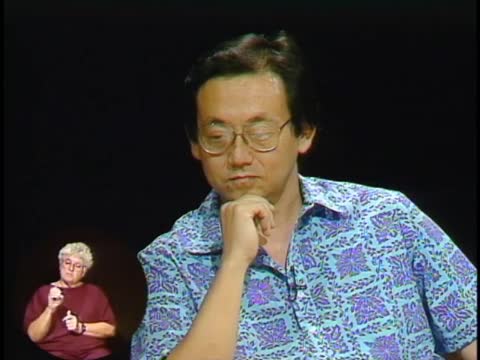
thank Hawaiian Electric Company for stepping forward and underwriting dialogue for the next two seasons here on Hawaii Public Television. Hawaiian Electric Support means a great deal to this station and the audience we serve, which is you, the viewers. We are very grateful for their civic participation and for the fact that several of their employees have actually given up their Friday evening to come down and answer our telephones tonight and relay your comments and questions that you call in during the next hour as we talk about how to go from fat to fit. The number is 955 -7878. And if you're watching from a neighbor island, please know that you can call us, collect, same number 955 -7878. Our sign language interpreter for the hearing impaired tonight is Loretta McDonald and tonight's dialogue is being simulcast on Hawaii Public Radio, K -I -F -O -A -M 1380 on the dial. Now that I've gotten that out of the way, I'd like to introduce my guests with me tonight to share their expertise are Dr. Terry Shantani, Director of Preventive Health Services
at the Wion Eye Coast Comprehensive Health Center, Preventive Medicine, actually, I should say to be more accurate. And he's also known as the founder of the very successful Wion Eye Diet, which we all have heard about and have great success. Glad to have you with us and is also a nutritionist as well. Robert Schultz is a physician specializing in plastic and reconstructive surgery at Straub Clinic. Judy Thompson is a clinical dietician with Queens Medical Center and also has her master's degree in public health and Heidi Dininger, who has a degree in exercise physiology, is a YMCA health and fitness representative and also a sports service coordinator at Hawaii Pacific University. Welcome to all of you. Thank you for all for being with us tonight. And before we do start taking calls from our viewers and those of you who are watching at home may call us anytime now. I'd like to ask each one of you how you react to the title of our program, which is there is no really easy way to get from fat to fit. What do you think, Heidi? I think it's a great title. I think it's absolutely true. I think all of us have at one time, but maybe there is a quicker route to getting the results that we've wanted.
I believe the results that you want come from a lot of hard work, but that hard work will keep you healthy for a lifetime. How about you, Bob? Is there an easy way or not? No, my specialty sees a lot of people that feel like life is suctioning is the answer to eating most anything you want to. And we've found that a lot of counseling and a lot of pre -planning is needed for you result to a surgical endeavor in order to get rid of some of the fat cells. Well, we've got two no votes. How about the other two guests? What do you think? I'll go along with the title. The title of the show. For most people, it takes a long time to get fat or unfit and so it does take a while to reverse that too. And Terry, I guess you know this from having worked in the Y &I diet. It took you a long time to assemble that diet first of all. Right, that's right. There's absolutely no quick fix. Easy is a relative thing, I suppose, but there's nothing that's quick that's gonna last a long time in this field. And I think what it really takes
for long -term weight loss, which is what you want. You don't want short -term weight loss. You want long -term weight loss. You've got to make a lifetime diet and lifestyle change. Now, I'd like to ask each one of you what may sound like an odd question, but has any one of you ever had a weight problem yourself? Anybody? Well, in college, I used to have an extra 25 pounds on me. So it took a lot of a change in my lifestyle to really get me around finally to losing the weight that I wanted to lose. I tried a lot of the quick fix diets to begin with. And eventually, when I started majoring in my field, realized the kind of harm I was doing to my body to change my approach. And what eventually worked for you? What was the key to success for you? Key success eating my breakfast every day. I'm really minimizing the size of my meals, spreading them out through the course of the day, eating in moderation certain types of food and just well -balanced, much more well -balanced meal. And then, again, keeping the exercise, you know. Not getting too stressed out about things
and relaxing, getting good rest. College is a time, I think, when we're all in our worst physical condition because we're so involved with studying. Medical school, for me, was worth about. I think I came the closest to 200 pounds I've ever been. My goodness. And it was just really a very sedentary study lifestyle. A lot of fast food, terrible things that you eat when you're in medical school. And it's a slow process. And I think it's adjusting all the facets of your life, exercise, diet, and the type of stuff that you eat as well. Want to remind our viewers that we are live here in the K -H -E -T studios. If you have a question for any of our guests about how to get from Fat to Fit, you can call us at 955 -7878. And if you're watching on a neighbor island, please remember that you can call Collect. How do we, in Hawaii, compare, I guess, as a state to the rest of the nation? Are we in better shape? Are we in worse shape? What is our profile look like? Well, overall, Hawaii is known as the health state, actually, for good reason. We've ranked anywhere from
number one to number three in terms of health statistics in general. But what I call the Hawaiian paradox is that in Hawaii, which is the healthiest state in the union, the native Hawaiian people have just about the worst health in the nation. And that goes across the board from heart disease, cancer, diabetes, and obesity. So it's unfortunately a dichotomy situation in Hawaii. Now, is the native Hawaiian health profile improving since you started the Y &I diet? We've all been hearing about it for several years and you've got a track record going now. What does it look like now? I know they're starting to get more statistics. I don't think it's changed a whole lot as a state in general. In terms of our participants, however, we've actually noticed some fairly long -term weight loss about, let's see, after about, our project started six years ago. And in terms of long -term follow -up, I believe we have, in
the first three series, about somewhere around 39 % of them have retained a significant amount of their weight loss, which is actually quite good for that period of time. And about, let's see, 10 out of, I'm sorry, nine out of 46 of them weigh 40 or more pounds less than they did when they started. So that's pretty good. So you've got some good statistics to look at. But if you look at the Hawaiian picture in general, I'm not sure how that's doing. I think statistics are coming out soon. Now Ken, the Hawaiian I diet work for non -Hawaians. Oh, absolutely. I mean, we take non -Hawaians on the program. And one of the greatest missed conceptions is that the Hawaiian diet is just Hawaiian food. Well, Hawaiian diet is actually, we don't call it the Hawaiian diet because we actually use what we call transition foods, that is foods from any culture that fits the profile of being very low in fat, focusing on whole foods. And
of course, it's a whole person concept. What about, I've been reading recently. We are starting to see like bigger woman models in advertising and we're hearing people talk about, well, this is just my body type. What do you think about the feeling out there that people say, well, this is how I was born. This is how I'm going to stay. The mood towards accepting larger people as a standard. To some extent, it's true. We have to accept the fact that what the media might portray as the thin people that that's the standard that we should strive for, that's not appropriate for everyone. And I think we need to get people to accept what's a realistic weight or size and not necessarily what does the chart say that if you're this tall, you should weigh this much. Aren't there like all those some health ramifications, though, to, well, yeah, that's not an excuse for not trying to do all the changes that
you can. Lifestyle -wise, exercise, watching what you eat, managing stress, the things that you can change to manage your weight and manage your fitness and your overall health. We should just write it off. You talk about managing stress. So many people in Hawaii work. A lot of people work two jobs. They have families. They have traffic commutes. It seems like exercise and dieting and really paying attention to nutrition sort of gets short shrift. And it's really difficult for people to make a priority. And he thoughts on how that can be improved. I think everyone hits a point in their life. And it can be a friend. It can be a friend gets sick or an acquaintance gets sick. Maybe an illness in the family. It calls our attention to the fact that we possibly need to take better care of our health. And I think that's when most, or we visit a physician that tells us where we're significantly heavier than we should be. I think
that's when most people will begin to think about what they can do and can't do. But in general, I find exercise here to be probably more utilized around the year than I do in other parts of the country. I really have trouble getting patients involved in an exercise program, because our weather here is so great. We're very fortunate in that respect. We do want to remind our viewers that we're live. If you have a question for any of our guests about how to go from fat to fit, please give us a call. And this viewer wants to know, she, I'm assuming this is a she, because the viewer says started estrogen replacement therapy recently and gained 15 pounds in six months is this normal? You can gain some weight on estrogen replacement, partly because you retain water. Estrogen also has a slight lipogenic effect. I don't know if 15 pounds in six months is normal, however, that may be a little bit more than one might expect. But there are individual variations as to their response.
Yeah, I agree. I think that's more than you would usually see. Really? You usually would see a one pound, 15 pounds is a fair amount of fluid or weight. It's normally maybe a one or two pound shift, but that would be the end of the spectrum. So she should check with her doctor to find to see what's normal and what's not normal for her. Question for Dr. Shintani, will you be bringing the Y &I diet program to the windward side? Collar would like to pay on weekly basis for prepared food. When we all like to be able to turn that. I actually have a practice on the windward side, on a limited basis, whether I bring the diet program there actually depends on funding sources. Even in the Y &I coast area, we do rely to a large extent on the good grace of the Office of Hawaiian Affairs who help support our program. And the Y &I Coast Comprehensive Health Center. If for me to do something on the windward side, I'd have to have a supporting organization, but
it's possible. So you're pretty much focused in the Y &I area for right now. My full -time job is in Y &I, but I do have a small private practice on the windward side. What about things like liposuction, skinny thigh creams that we read about? Any validity to those kinds of options for weight loss at all? The thigh creams normally don't lead to weight loss. They will shift weight. We all have a fat depot or one or two of them that are very hard to mobilize. And at a certain age, as Jajagabora once said, when you're 40, you have to decide between your face or your fanny. And what she means by that is that when you hit a certain point in life, significant weight loss will make you age or appear aged. And so I think the diet cream basically or the
skinny dip that we heard about does, for some reason, mobilize the thigh fat. And for a while, people were rubbing it everywhere on their body. Seemed to work, took a lot of discipline. And I think many times if you could take that discipline and parlay it into exercise or possibly diet, your overall long -term results would be a lot more beneficial and long -lasting. Okay, question for Judy. Is algae a good food? There is a marketing system like Avon for algae food products. Are they any good? Are you familiar with this? I don't know how it would be nice to weight loss. I haven't seen any kind of research into algae and weight loss. It probably has some trace nutrients in it that could provide some vitamins and minerals, but as far as something that helps with weight loss, I haven't heard that. Anybody know anything else about that? I've got a high proportion of protein or
amino acids, but you just got to realize it's a high proportion and not high quantity because it's such small amounts that you can get just as good quality from regular seaweed or regular other foods, other. Okay, want to remind our viewers once again that we're live here at public television. You can give us a call if you have a question or comment about dieting and getting in shape at 9557878. Question for Terry. Is it healthy for each culture group to eat their cultural diet? I .E. Hawaiian's eating Hawaiian food, Italian's eating Italian food, et cetera. I think it's healthy for all people to eat traditional, the traditional diets of just about any culture. If you look back far enough, all of us had traditional diets that were really quite healthy, focused on whole grains or whole starchy foods, such as tarot or potatoes, with lots of vegetables,
very small amounts of fat. And if we look far back enough, we could all find it and we would all benefit by it. And doesn't just about every cultural food group have a staple in the Hawaiians have poi. That's right, that's some starchy, some whole starchy staple. It was a main food basically, all the major civilizations throughout history. This caller wants some hard data on specific foods that are really good and really bad. I could probably list the really bad ones, but why don't we start with the really good ones? What should we all be eating as just a basic, daily part of our diet? You know, it's hard to say there's foods that we should always eat and foods that we should never eat. It's really a question of how much of any kind of food, depending on, unless you're on a real, some kind of therapeutic diet for medical reasons, just about any food can be worked in to a healthy diet or a healthy eating plan. So you can't really say this food is good, that food is bad. It's true that if you,
the food pyramid that you see on the food boxes now, that's a guideline that kind of gives us a rough guide of what kinds of foods we need to everyday. There's six categories of foods. We need all those different foods every day. And then the pyramid shape implicates how much, relatively speaking, we need more of the foods that are on the bottom of the pyramid and less of the foods that are from the top of the pyramid. And beyond that, it just really depends on the individual. I think a lot of times, most Americans high fat, high protein diet, they tend not to eat maybe as much of the complex carbohydrates, the vegetables and the fruits, they can. A lot of times people have a hard time getting into their diet. They want something, fat gives you that feeling of satiation, you're satisfied, and people need to really concentrate, I think, on eating more fruit, more vegetables. Fruit and vegetables. Those are missing and most people's intake. Actually, a really good food, just for example, would be broccoli, low fat, high in cancer preventing elements such as
beta -carotene, indolamines, it's a cruciferous vegetable, and it's also quite high in calcium. Really bad food, well, our favorite spam, for example, it's about 83 % fat, most of the large amount of it is saturated. Lots of sodium, lots of nitrates, lots of cholesterol. I mean, those are things that are quite bad for you. Is it a good rule of thumb? I remember reading once that foods that have strong color are a good choice. Like you mentioned broccoli. Right, the dark green and the dark orange. In a fruit and vegetable category, that's true. Not chocolate. Dark brown, huh? Strong color dark brown. This color wants some specific information on the Atkins Low Carboh diet. You can briefly tell us about that. That's from kind of way back. So I don't know the specific info. I don't know specifics on it. The Atkins diet was actually
derived from what used to be called a military diet where they ate lots of protein and fat and limited the carbohydrate, so low, a very low amount. So that what would happen is you'd run out of carbohydrate, which is the primary food for humans. And you'd start burning fat, which is good, except that, and what would happen as a result is you produce ketone bodies as a result of metabolizing fat. And ketone bodies actually suppress your appetite. And so what would happen is your appetite would come down. You wind up eating fewer calories in general. The problem with it and the Atkins diet was soundly denounced by a number of organizations because it's high in cholesterol, high in fat, high in saturated fat. The protein. It sounds like a low in fat. Yeah, right. The protein content is so high, you'll start wasting calcium through the urine, put a load on the kidneys. And most people just can't keep it up very long.
That's right. So restricted. Yeah, and some people well actually gained a lot of weight because of the fat content was so high. So not recommended. I would not. No, no. Pretty much the consensus here. OK, this caller says she is 10 pounds overweight, exercises about five days a week just before menstruating, craves, fatty foods. Is this a mental or physical problem? Is there a physiological reason for something like that? Food craving. Actually, there is some research that just before a woman's menstruation, the metabolism does gear up a little bit, speed up a little bit, and you do burn a few more. Not a lot. You may be a couple hundred extra calories a day. So some researchers think that there could be some physiological basis in the cravings, you know. You'd better to replace the fatty foods that I have high complex fat behind you. Yeah, she's going to go over a couple hundred calories more easily if she's eating high fat foods. Even if you crave it, try to crave something that's closed,
but not quite as bad for you. Yeah, actually, there's also evidence that high complex carbohydrate diets will help suppress appetite by increasing the amount of serotonin in the hypothalamus. For whatever that's worth. Want to remind our viewers, once again, we are live. If you have a question or a comment, please give us a call at 955 -7878. Question for Bob. What is the right type of person to have liposuction? Obestive or someone who can't get fat off after dieting and exercising? Who is a prime candidate for liposuction? Good question. No, overall obesity obviously would not be an indication as would someone that had trouble getting their overall weight down. Very good indication for liposuction is a fat depot that no matter how much weight you lose, you don't seem to be able to touch it. A person that would train and do the iron man race and yet would have lateral fat pads or a spare tire, they just couldn't get to it. They're an ideal candidate. Their body
fat is basically low. Their skin pinch and their body fat everywhere, except in the stubborn depot, is very good. Like some little deposit area that no matter how many sit -ups you do. You can't get to it. On men normally around the stomach or the spare tire, ladies, lateral thighs, sometimes flanks, and occasionally fat pads under the chin. And those are good indications because people have done a great deal of exercise. They watch their diet and they will tell you when they come in that either they can't mobilize it or they have to lose so much weight to do so that friends start asking them if they've been sick. Any age limitations or any other health profiles that make somebody a possible candidate or not a candidate for liposuction? No, I think as you get into the older age groups, the skin elasticity sometimes doesn't support
liposuctioning. You wind up with more wrinkling and have to have skin excision as well. Usually prior to a 50, not a problem unless you're dealing with a fairly large area. It's caller wants to know does chromium picolinate have any benefit in reducing cravings and losing weight? This is available over the counter. I've seen it in health stores. It's got a lot of press lately. What does it do? It's sort of an anabolic trace mineral like sanitary. It has apparently a trace mineral in carbohydrate metabolism. Supposedly speeds it up slightly. Actually there's a fairly good control study which indicated that it did help in weight loss a little bit. But emphasis on a little bit. But there was some statistical significance. But I don't think it was in my view a substantial amount. This caller says I'm quitting smoking. Congratulations. We're glad to hear that. But I get hungry all the time. What can I do?
Any tips? Tough. For a while the nicoderm patches and that does seem to help it. It may help in transition. I think that there's a certain physical. Something in your hand. Something around element of smoking. That possibly the nicoderm patch would help them get from quitting smoking to the point of where they were a lot more free of it. But that's a common complaint. The most common complaint of people that quit smoking. The reason a lot of times they'll go back to smoking is as a profound weight gain because they're eating life savers. They have something in their mouth. Anything to keep from putting the cigarette in. Is there a place that you would recommend people calling for more information or assistance on helping to quit smoking without suffering the weight gain? I think most of
the quit smoking programs at different like Queen's has one and Castle and the different institutions do cover that as part of the class. Part of it I think is just keeping your hands busy. Something that's really helpful is just so that you don't lose track of what you're eating is keep a record, a written record of everything that goes in your mouth. And that just at least helps you stay aware and try to make better choices so that at least maybe some low calorie things instead of some high calorie things until you break that habit, that hand -to -mouth habit. I think that in terms of smoking, a good substitute is exercise. Sure, definitely. And that would help. And I think keeping paying extra attention to keeping the fat content low I think is important. Since you mentioned exercise, this caller wants to know what's the difference in burning up calories walking on a level surface versus walking up a hill, which we have quite a few up over here. What's the
difference? Going up a graded surface is going to cause them to burn a few more calories. But again, it comes to personal preference. People need to find what they like to do that's going to keep them going for a long run. If a person can walk up a hill once and then get so burnt out that they walked up that hill and never do it again until next year, then it's probably better for them to walk on a level surface and do it four or five times a week and be able to do that for a good two or three months. So you're going to burn more calories going up a hill and a few more calories. But again, what is a personal preference? What's going to keep them going for a long run? And then maybe if that interests them to work that in to where they do find themselves getting burnt out and doing that all the time, combine the two. Do a little bit of each. Isn't it a common problem with somebody starting on an exercise program that they are going to go five miles the first day they go out to run? I mean, not being able to run ever again. We see it all the time. They've got all this energy. They want to go out and expend it. But they push themselves just a little too hard. They're sore for a good 24 to 48 hours. And we don't see them again. And so even if the body
feels good at the time, that doesn't mean that 48 hours later, and delayed onset of muscle soreness is not going to set in. So they want to be extra patient with their body and take it real light and real gradual at first two to four weeks. And this caller wants to know what is the minimum exercise that you would recommend someone do daily or weekly to maintain a constant weight? It's going to maintain a constant weight. I think I need a little bit more information about the individual, about what their lifestyle has been like. You know, are they active now or are they sedentary? You know, we give different recommendations for each type of population. If the person is just getting started on a workout regimen, then maybe what they want to do is find something they like to do. They should, the American College of Sports Medicine recommends, you know, a good 15 to 20 minutes, at least three times a week to keep them basic. Yeah. Basic starting plan. They have rest in between so the body can heal up. But I can't emphasize more. If these people are going out walking or running or doing aerobics, so whatever they
choose, you properly geared up. Because a lot of that storm is coming from running in, you know, tennis shoes or going out in sandals. And then, you know, that all that motivation is there, but they're not properly geared up. They push themselves too hard and they don't have proper education and they do the same thing again two weeks later and find themselves in the same spot. So even though you're enthusiastic, take it slow. Take it slow. It takes 20 minutes three times a week starting out gradually in Greece. Proper equipment and how do they choose? Yes. Okay. Terry, this is probably for you if a person with diabetes loses weight, could their condition improve? Absolutely. Actually, one of the best ways to improve diabetes type two, that is the adult onset type, is to lose weight. And sometimes it takes just as little as, you know, even a five or ten pound weight loss and I see blood sugars improve. And it may be because you're right at the threshold where your body has just enough insulin to handle it. And you gain that extra few pounds and then you can't handle that anymore. So absolutely weight loss can help diabetes. Because he dramatic
drops an insulin need sometimes 10 -20 units with his significant weight loss. All right. More physicians recommending that also as a way to help, maybe less than the amount of possible medication that an individual might need to increase exercise? Oh yes, absolutely. Yeah, that's great. Yeah, exercise alone, even though you don't lose weight. Exercise alone will help control blood sugar. So that's good. This collar is a 74 -year -old man who has lost 52 pounds in nine months by eating low -fat cottage cheese and fruit only, alternating with slim fast every other day. Went from 212 to 160 pounds. Is this safe? This reminds me of all the diets I used to read about in college where you ate nothing but strawberries for two weeks or you know the ones that we're talking about. What about things like this? Are they safe? What was the time for you? Nine months, 52 pounds in nine months. Is that it? That's it within a reasonable realm. Yes, that's,
you know, one to two pounds a week for someone who started out at about his amount of overweight is reasonable. If you're heavier than that, maybe even a little faster on the average than one or two pounds a week is okay. Even if you're doing less than one to two pounds a week, that's progress. So he probably wasn't too fast. You know, I hope that he was seeing his physician during that time and monitoring any health conditions that he had so that they didn't get any worse. In the long run, yeah, it would be better to start getting a little more variety in the diet. That's what I was going to ask me. What about limiting yourself to just a very narrow group of foods for that length of time? Right, right. I mean, that has psychological, it helps sometimes not to have to make a lot of food decisions and to just keep eating the same thing over and over. But eventually, that can backfire and you get burned out on the same stuff and just nutrition wise, you're missing out on some nutrients. So it would be better to build up the variety. Yeah, go ahead. And I
think what's really important to you with everybody I'm calling in and trying to find out, you know, losing weight, taking the pounds off is just remember, you know, lean a muscle tissue weighs more than fat. And as they're going on these, you know, trying to balance what they intake, they also need to remember exercise an important part to keep that lean muscle tissue up, which in itself burns more fat, keeps helps keep metabolism high. And maybe, you know, you won't see the pounds come off, but maybe just the inches come off and what is the end result that we all want? Is it to see the scale have a little bit less on it or to reduce the inches? You know, that's a great point. A lot of people will say they lose weight on a vacation. They don't understand it because they eat more. But normally on the vacation, they're more sedentary. And they lose lean muscle mass and pick up a little bit of fat. So that's a very good point. That's why fast weight loss is not always the best weight loss. We're almost at our halfway point. I want to remind people this might be a good chance to give us a call. We're going to take a brief station break. We'll be back with more of dialogue from fat to fit in just a moment. What gives your
imagination wings? A side long glance? The dance of a restless dreamer? A free exchange of ideas? The silence of miracles? The shock of recognition? The sweep of our own drama? Come with us. Let your spirit take flight on PBS this fall. If PBS doesn't do it, we will. It's that time of year again. Hurricane season is here. So it's time to replenish the canned goods and time to restock the batteries and flashlights. Just what is a hurricane? How will you know when one is headed your way? And what should you do if one is coming? Join me for another encore presentation of dialogue. When hurricane storm busters from state and county civil defense, the U .S. Weather Service and the construction industry discuss the hazards of a hurricane and how you can plan for your safety. Dialogue Friday at 8. Welcome back to dialogue. Our topic is how to get from fat to fit and stay there. The number to call with your questions or
comments is 955 -7878. Neighbor Island viewers, please call us collect. Our operators from Hawaii and Electric Company are waiting to take your call. We've had quite a few calls this evening about late night eating. Those midnight snack cravings that we all get. Is it more fattening to eat in the evening? I've heard that. Is that true? Was there a diet for a while that you couldn't eat anything after 6 p .m. I remember a couple of patients just thinking it was magic. It worked very well for them. Actually, I think there was a fairly recent study that showed that you put on weight a little more easily when you eat close to the time that you go to sleep. I think logically it makes sense because when you eat just before you go to sleep, then all the calories get put away. You digest them, it goes in your bloodstream, and then you're not active. So rather than burning the calories, you put them away. And I think that's really what happens. So I think it's a good idea not to eat just before you go to sleep.
We've got a lot of specific questions. So I'm going to try to get to as many as I can during the second half of this program. Bob, please comment on liquid face peel techniques and the use of retinates. This is a little bit off the fat to fit subject, but I guess because you're a reconstructive surgeon. Yeah. Retinate, very good, a little bit. It photosensitizes you, but it does almost everything else good. It seems to take a lot of the little keratosis away from your skin. It has very little to do with fat metabolism. It will not do like skinny dip and make your face thinner, although possibly a little less wrinkled. The alpha hydroxy acid group, it's been very popular, trendy lately. Almost every makeup has that in it. A fair amount of benefit to the skin, facial skin, sun damage skin. I guess you could rate it related to Hawaii. But probably appearance is about the only thing that will do for you. Okay,
Terry, a question for you. Natural herbal pills to lose weight, non -prescription, are they safe? Generally non -prescription things tend to be safe, but if you're looking at herbal pills to lose weight, there's a specific example, ma huang, which is a Chinese herb. It actually contains a federy, which is potentially a very powerful cardiac stimulant. And if you have heart trouble, that could be a problem. I think there was a recorded death because of overconsumption of ma huang containing herbal pills. So they're not necessarily safe. So would you recommend still consulting with your position before you even purchase over the counter? I think the first thing people have to look after their diet. Then if they're going to do things, I think that's a good idea. Okay, what is the best way to transition to a vegetarian diet? And how long does it take for the fat cravings to disappear? Boy, I guess that varies from person to person. Some people just go vegetarian overnight and they're fine. And other people have
a little more difficulty parting with animal food, and they can do it a little more gradually. As far as the fat cravings of vegetarian diet isn't necessarily a low fat or fat -free way of eating. So that isn't necessarily a solution for fat cravings. I believe the best way to decrease the fat cravings is just to, probably for most people gradually, get onto a lower, successively lower and lower fat diet and you just adjust and it becomes normal. My experience with that, personally, I switched to a vegetarian diet overnight in 1976. That was a long time ago. I keep telling folks. That was before it was popular. I haven't had a stake in 19 years except once at a health conference when I was kind of stuck in the social city. It kind of made me sick. But I think people vary in, I think Judy's right, people vary
as to how fast they adjust. For me, it was overnight. And my fat cravings disappeared almost immediately. I mean, there are times when I crave it. But in the beginning, it didn't bother me in the beginning. But I think people differ in terms of why they're doing it and what their life situation is. At the time I lived alone, it was a little bit easier. I was in law school at the time. I had something else to occupy my... Question I think for Bob. This collar had liposuction on their tummy and straw. When your later weight is back, is this common? Does it come back when you have liposuction? I understood that the cells were like taking out for good. But can you... No, you don't remove all of that fat, Depo. And you tell everybody ahead of time, this doesn't reduce your body's incredible ability to take the extra calories and put it into fat.
And it will put it somewhere. And there was for a while a bit of press on the fact that women were becoming very busty after they had their stomachs or thighs liposuction. And the breast is a fat depot like any other part of the body. Usually, if you liposuction an area to get fat back into that area, you have to eat a fair amount of food. It's a very common thing, though, that for men as an example, belt size is one of the ways that we say, my belt's getting tight, time to diet and exercise a bit. And when you liposuction, you take that away for a brief period of time and it's not uncommon to see people eat their way back into that tight belt again in that grace period they have. We've had quite a few calls this evening about the long -term effectiveness of liposuction in general. Very important that people understand. I mean, again, the exercise person that is dieting and you have that difficult to mobilize
fat pad, very good indication. But if it's really more of a weight control, very poor indication for liposuctioning, you're going to be disappointed. And you have to get your eating patterns under control and your exercise patterns. Whatever it's going to be, taken care of prior to liposuction, I think to really make it worthwhile. This caller says, after 10 years of exercise, I've been burnout for the last three years, now trying to lose weight by a high carbohydrate diet. Is this healthy and will it work? Still depends on the total calories that you're taking in. A low fat and high carbohydrate diet, even though foods are low fat or high carbohydrate, they still have calories and you need to watch your total calorie limit. So, and obviously the muscle mass isn't as Heidi was commenting earlier, you need to maintain your muscle mass somehow. So, I would urge this person to get into a
little bit, maybe the maintenance levels that we were talking about, the 15 minutes, three times a week at least. Because there's so many other, besides weight loss, there's so many other positive effects of exercise. You know, on the circulation, on the circulatory system, you see a lot of people, you know, when we're talking earlier, how people don't have time to exercise. They're so busy, they work this job and that job. I think what people forget that they try to do 15 minutes, three times a week. It can actually help reduce their stress levels and their anxiety levels and give them more energy so that they can actually do the two jobs, be a mom, take care of the children, do their own specific hobbies. You know, they just need to find something that's convenient for them. And again, it's something that they like to do. You know, but they do exercise, again, not only for weight loss, but for the other physiological things that happen in the body that are for good health. Good point. One more comment about high carbohydrate. Simply carbohydrate doesn't mean it's a good diet. Carbohydrate includes sugar. It includes white flour. I think it's important what kind of carbohydrate, preferably whole complex
carbohydrate foods. Okay, this color is breastfeeding a two -month -old baby. Will cholesterol that the mother eats go to the baby or to the mother? Well, cholesterol that the mother eats goes into the bloodstream. The baby gets cholesterol through mother's milk anyway. So, I don't know what else to say about it. There's a regulatory method. Something in there that will protect the baby's cholesterol levels to some extent, unless there's a genetic tendency towards high cholesterol. And in infant, I don't know that they ever measure cholesterol levels in infants to know exactly how much cholesterol, how high. What's a normal cholesterol level in that age of a baby? Good enough. Sounds like that. So, the baby's probably okay. Is it true that the traditional Eskimo diet of fat and fish lessens the risk of heart disease and related diseases? Actually, there's a lot, a long line of research about Eskimo's diets. And came about because
Eskimo's eat a high fat, high fish diet. And they had relatively low risk of heart disease almost paradoxically. And part of the reason was that it was high in omega -3 fatty acids, which primarily thinned the blood. And so, what happened was you had low risk of heart disease because you had thin blood. You had higher risk of hemorrhagic stroke because of bleeding tendencies. And you also had the highest rate osteoporosis because of the high protein content. So, it may lessen the risk of heart disease. They caused problems in other areas. And they actually tried a trial by increasing fish amounts in people and didn't lower the heart disease risk that much. This collar has a comment. Agree, there's no quick fix. Have been on a dietitian's 1500 calorie a day diet since January and has lost 37 pounds. Well, that's great. Collar says it's only one pound a week. I mentioned that must be really tough to stick to, probably frustrating to see just one pound a week, although I think that's terrific.
Is that a major problem with people that are going on a really good physician's diet, such as this collar has been on? And just getting discouraged because it's not all falling off immediately? I think what they have to remember is physiologically the way the body works. If you were to take 8 to 10 pounds off in one week, like most of us wish we could, the body tends to hoard the fat. Burn, lean, muscle tissue. Lose a lot of its vitality that it needs. And then, in turn, it also lowers the metabolism. So, what's happening is you're building up this fatty tissue. You're lowering your metabolism. When you get off of this quick fix diet that lost that 8 to 10 pounds that you wanted to lose. Again, your metabolism is lower. You start eating how you used to eat and you start putting on more calories and the body becomes more fatty and more fatty. And again, emphasizing the point, what do we want? Do we want a low body fat composition or do we want to just see pounds come off the scale? I say congratulations. This person is more likely to keep the weight off than they lost. Not only have they lost more fat
than muscle, which maintains their metabolic rate, but they've allowed time to get used to this new way of eating and change the habits and the old triggers for eating whatever was making them 30 pounds heavier. And actually, one pound a week is pretty good. So, keep up the good work. Thank you very much for calling. This caller wants to know if swimming is a bad exercise. I heard that when you're swimming you can't or don't burn fat. Is that true that you don't like to do another exercises? You burn fat. I think what people are, there have been some studies out that say, you know, because of the decrease in temperature, you keep this layer of fat on your body that you're never going to be able to lose. But again, you know, it needs to be pretty cold in Hawaii for that to be real important with the weather conditions we have here. I think people need to, again, is swimming is something that they like to do. And they're not going to do anything else and they love it. It feels good on their body. They need to do it. And they are going to lose fat. It burns calories. It takes energy to,
you know, move your body across the pool. Okay. Terry, we've had a lot of questions on the Y &I diet, which I know you're happy to hear. How do you join it? Is it only for Hawaiians? Where do you go for information? Well, a Y &I diet is primarily for people in the Y &I coast served by the Y &I Coast Comprehensive Health Center. It's not only for Hawaiians, but because our patient population is predominantly Hawaiian, it tends to be that way. If people want to find out about it, they can call the Y &I Coast Comprehensive Health Center, the direct number is 696 -1527, and they can ask about it. Okay. Great. This caller wants to know, or says, this information should be given to children rather than older people. Schools should be serving healthier foods. We talked about this before. We got started with the show this evening about how important it is to establish good nutrition and exercise habits in children, so that it isn't so difficult to
try to implement them when we're adults and we're more set in our ways. What about school lunches? Healthy, not healthy? The hard thing, the school lunch people are always fighting with what will the kids eat versus what they can make on their budget that's good for the kids. So it needs to go beyond the schools and come from the homes as well, and kids need to learn to eat more fruits and vegetables at home, for example, or less fat and not all the commercial snacky kind of foods all the time, too, at home. And what they see in the home is the foundation. I also think that USDA puts certain restrictions on the school lunch program that makes it difficult to make the changes that we want to in our schools. More importantly, I think getting young ones, even kindergarten age children, starting then instead of just having one class a week that's directed towards physical fitness somewhat to have a good three times a week when these kids are moving for 15 to 20 minutes.
With constant, maybe a constant light aerobic workout, whether it's walking or some kind of fun thing in the music, they need to do something like that. You know, they talk about hypertensive children and a hard time focusing on the tension span. Well, all these chemicals that build up in your body from eating these junk foods, these convenient foods, lots of times exercise can help balance all that out and give them some peace of mind. You know, maybe help with their studies at school. And actually, schools are, I mean, it's a really good point. Schools are really, I mean, not just school lunches, but the education program. That's, to me, that's the future of our health. If we can get through to the kids, through our teachers, this week I did five presentations to teachers, because I think that's really important. And I've worked with some of our department of education, HOMEC teachers, who were doing a cookbook, which will come out soon, using local tastes, so that we can make healthy food taste
good. And that's based on our HOMEC teachers' experience with our local kids. This caller wants you to recommend any published materials concerning balanced vegetarian diets, especially for children. Has lots of veggie recipes but concerned about balance? Any tips on that? Well, I mean, you know, the book that I wrote, The Eat More Way Less Diet, has what I call the inverted pyramid, and I inverted it just to make the point that I thought brains ought to be emphasized more. I think that's a fairly good way to start. In terms of balance, I mean, food groups are there, and it's a vegetarian diet. But in terms of... I mean, there are other books. You can call the vegetarian society, for example, they're in the phone book. They're listed here in the... On a little bit? Yeah, I just don't know all the examples right at the top
of my head. A good thing to do is when you see the book, check to see if there is a registered dietitian, maybe as a consultant or one of the co -authors. And that's a good sign that there will be the nutritional information that you need to have in there. I'm trying to get to as many of these questions as we can. I'm going to hold stack here. If we don't get to your questions, I do want to let you know that all the guests will receive a copy of your questions. So they'll know what you're interested in and wanting to know about, even if we didn't get to it on the air. Lots of calls about artificial sweeteners. Is it bad for your body to drink a lot of diet -free diet sodas or sugar -free drinks? Can they work against you? What are your thoughts on those? Well, and the health of fitness business, what I think is what we see all the time is that when people drink a lot of sodas, they tend not to drink any more water. They also, you know, they want the Coca -Cola, they want the caffeine, and they forget what the liquids, the types of liquids are that are going to help them when they're exercising. And they stay away from water and fresh juices. And I think to minimize that, to an extent, you see people going through a six pack
to a case a day without it being out of the norm. And, you know, again, the chemical compounds that are in those things are detrimental to the system, to a certain extent, especially when they want to get their next choice. The Bidenese water definitely get a lot more liquid. Can you have thoughts on artificial sweeteners or diet sodas? Well, a lot of these things, we don't know what that long term effect is. That's a little scary, yeah. And the point is if it's in soda and it's a caffeine containing soda and you're drinking a case of it a day, you're getting an enormous amount of caffeine. So I think Terry's right, we don't really know so many of them are still in our generation. And you also get things like phosphoric acid, which can actually cause wasting a calcium. It gets a thumbs down. This caller says, I am five foot three inches tall and 87 pounds. I can't seem to put on any weight. This is a problem for a lot of people. Not as much as those of us who'd like to take it off at any suggestions for where
this caller about putting on weight. I'd say see a doctor first and find out why. That's the first thing that I would do. Okay. This caller says exercise makes me hungrier and more thirsty in any suggestions on how to deal with the increased appetite. I question, you know, this increase in appetite, is it because of your prior exercising? We didn't need anything all day long. But again, to make sure you're eating well spread out meals throughout the day, exercising like you are and taking in plenty of water. You know, you're going to lose water through perspiration. So again, take that water in. You know, utilize it. Take the water first and then maybe you won't eat as much. Okay. There's a good tip. This caller wants to know does sugar make you fat or does fat make you fat? Well, actually, fat clearly makes you fat. I mean, they can buy it. They buy -opsied people's fat and it reflects the nutrient content of the fat they've been eating over years. So we know that that's true. Sugar makes your fat mainly because it's such
concentrated amount of calories that if you eat sugar, then every little bit of fat that you eat, it's going to store away and use the sugar preferentially and it won't burn the fat as much. So it can contribute to it that way. Yeah. They're both real concentrated source calories. Caller wants to know what the relationship is of aging to weight maintenance. Is it normal for it to be more difficult to maintain your weight as your age? It seems to be. It is normal. It seems and it's an insidious thing and I don't know if it's an insidious decrease in activity. But you do find, I know in my patients, they seem to need less calories as the years and decades go along. Tadlism tends to slow with age. Your muscle mass decreases with age. If you can keep your muscle mass up with some decent exercise that helps you not gain as much body fat. I think exercise is really an antidote for that type of game. And a balance within your exercise program. There's lots of people who want to go out and walk all the time but they neglect
stretching. They neglect strength training. You need a balance of all three. The aerobic workout, the strength workout. To keep that lean muscle to shoot very high and also then again stretching the flexibility to keep your body mobile. So as you get older, you know, a little bit less pain, a little bit more mobility, less rigidity. Okay. Question for Terry, what kinds of foods do you eat on a daily basis? Well, for me, I eat a lot of complex carbohydrate. Obviously, I preach that but that's really what I do. A lot of times, unfortunately, I do skip breakfast. That's one of the problems. But I'll eat whole wheat bread sandwiches. I'll eat pasta. If I can get whole wheat pasta, I do that. I love to eat potatoes but no butter or sour cream. I put a one steak sauce or something else on a cream corn. Of course, brown rice, I eat daily in large quantities. And then I actually eat lots of vegetables. And I always have a leafy green every single day or broccoli. I
consider that a leafy green. Okay. That leads us to, I think, what will be our last question because we're almost out of time. What is each one of your plan to get from fat to fit? Now, you mentioned your diet. Anything else that you do to keep yourself in good shape? Actually, in my book, I actually describe the whole picture. Whole foods that fill your stomach up. That's really important to eat whole foods, not just complex carbohydrates. Keep the fat content low and I recommend very low fat around 10%. If you can get it that low. Any move in that direction is helpful. Keep the metabolism high. That includes exercise. Keep your nutrient mix to a higher complex carbohydrate and not trying to diet too hard. Okay, real quickly. We're almost out of time. What's your plan, Judy? What works for me is when I have to talk about nutrition to people every day. It makes me so aware and I'm thinking about it all the time.
I think stress management is a big thing too. It's not allowing myself to get so stressed out that I start using food for the wrong reasons or skipping my activity and exercise. Bob, how about you? Very exercise program, low fat, as low as I can get it. Like Terry says, probably can't get it down to 10. It's worked for me so far. Well balanced eating habits, don't depend on supplement so much. Good balanced exercise program. Get each part of that strength, cardiovascular and stretch. And then take time to relax and have fun. Lower your stress. Good advice from everybody. Thank you. We are out of time. It's really been a pleasure being back on the air with you. On dialogue and my thanks to the guests this evening, Dr. Terry Shantani, Dr. Robert Schultz, clinical dietician, Judy Thomas, and health and fitness instructor Heidi Dininger. Next week, my colleague, Dan Boylan, will be here on Friday night at 8 o 'clock with a program devoted to education, private, public or homeschooling. Joining him will be Hawaii School Superintendent, Herman Izzawa, Kamehameha Schools President Michael Chan, St. Louis Schools President, Father John Russi,
and Judy Wilhoid representing the Hawaii Home Schooling Association. Should be an interesting discussion and we hope you'll join them. We'd like to say a final thanks this evening to the good folks at Hawaiian Electric Company. It is due to their generosity and support of dialogue and Hawaii Public Television that we are back on the air and will be on the air for the next two years. A big thank you, Mahalo to Hawaiian Electric. I'm Lynn Waters. On behalf of Hawaii Public Television, we thank you for watching and we wish you a great weekend. Hey!
Dialogue is brought to you by Hawaiian Electric Company, people with a powerful commitment.
- Series
- Dialog
- Producing Organization
- KHET
- Contributing Organization
- PBS Hawaii (Honolulu, Hawaii)
- 'Ulu'ulu: The Henry Ku'ualoha Guigni Moving Image Archive of Hawai'i (Kapolei, Hawaii)
- AAPB ID
- cpb-aacip-225-81wdc11g
If you have more information about this item than what is given here, or if you have concerns about this record, we want to know! Contact us, indicating the AAPB ID (cpb-aacip-225-81wdc11g).
- Description
- Episode Description
- Repeat broadcast of DIALOG. Moderator: LYNNE WATERS, Guests: TERRY SHINTANI, MD, MPH, ROBERT W. SCHULTZ, MD, JUDY THOMPSON, MPH, HEIDI DEININGER, YMCA Fitness Instructor
- Created Date
- 1996-07-11
- Asset type
- Episode
- Topics
- Public Affairs
- Rights
- Copyright, 1996
- Media type
- Moving Image
- Duration
- 01:01:59;03
- Credits
-
-
Director:
Joy Chong-Stannard
Producing Organization: KHET
- AAPB Contributor Holdings
-
PBS Hawaii (KHET)
Identifier: cpb-aacip-f397f8ffeaf (Filename)
Format: Betacam: SP
Generation: Dub
Duration: 00:59:59
-
'Ulu'ulu: The Henry Ku'ualoha Guigni Moving Image Archive of Hawai'i
Identifier: cpb-aacip-fd05574aa7b (Filename)
Format: Betacam: SP
If you have a copy of this asset and would like us to add it to our catalog, please contact us.
- Citations
- Chicago: “Dialog; Encore - Fat to Fit: There's No Quick Fix,” 1996-07-11, PBS Hawaii, 'Ulu'ulu: The Henry Ku'ualoha Guigni Moving Image Archive of Hawai'i, American Archive of Public Broadcasting (GBH and the Library of Congress), Boston, MA and Washington, DC, accessed August 25, 2026, http://americanarchive.org/catalog/cpb-aacip-225-81wdc11g.
- MLA: “Dialog; Encore - Fat to Fit: There's No Quick Fix.” 1996-07-11. PBS Hawaii, 'Ulu'ulu: The Henry Ku'ualoha Guigni Moving Image Archive of Hawai'i, American Archive of Public Broadcasting (GBH and the Library of Congress), Boston, MA and Washington, DC. Web. August 25, 2026. <http://americanarchive.org/catalog/cpb-aacip-225-81wdc11g>.
- APA: Dialog; Encore - Fat to Fit: There's No Quick Fix. Boston, MA: PBS Hawaii, 'Ulu'ulu: The Henry Ku'ualoha Guigni Moving Image Archive of Hawai'i, American Archive of Public Broadcasting (GBH and the Library of Congress), Boston, MA and Washington, DC. Retrieved from http://americanarchive.org/catalog/cpb-aacip-225-81wdc11g