Dialog; Executive Decision: The Governor
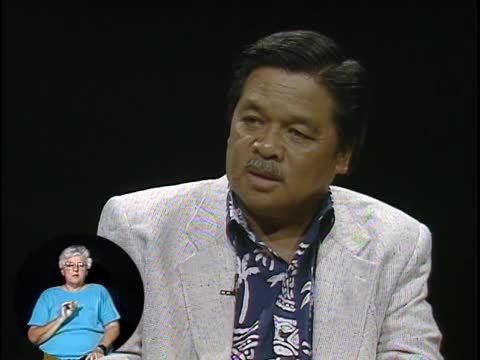
- Transcript
You Dialogue is brought to you by Hawaiian Electric Company, people with a powerful commitment. Throughout the spring, Hawaii's lawmakers labored over a long list of controversial and
important issues. Same -sex marriage, high -three pension reform, auto insurance reform, economic development legislation, a balanced budget. In the meantime, Governor Ben Coyotano watched and waited. He of course had some other matters to attend to, most notably public employee union contracts. Then there was the most important event of the gubernatorial spring, the governor's marriage. At the conclusion of the legislative session, Governor Coyotano said he was pleased with the legislator's work. But now he must look at specific legislative products, and apparently not all have satisfied him. He vetoed pay raises for state judges, and the solar tax credit. And while the veto deadline has passed, some other bills may become law without the governor's signature. Why? What's required of a bill for it to meet with the governor's approval? Governor Coyotano knows the legislative dilemma. A lawyer by training, a Democrat by political conviction, Ben Coyotano spent 12 years representing a leeward of Wahoo
District in the legislature. As a state legislator, he chaired important committees, including energy and transportation and ways and means and health. In the Senate was ways and means and health and economic development. In 1986, Coyotano won election as lieutenant governor, opposed he held for the next eight years. In 1994, he won a three -way race for the governor's ship. He's already stated his intention of running for re -election next year. And at least one other politician, Maui Republican Mayor Linda Lingo, has stated her intention of opposing him. Before we te - before we te - before we talk, we're not going to have any tea with Governor Coyotano. A reminder that this is really your chance to talk with him. We have eight telephones ready to be answered by members of Beta Sigma Fies, Zeta Chapter. All are waiting for your questions and comments for the governor. You need only call 973 -1000 to pose your question. Neighborhood in
residence, of course, is always make call collect 973 -1000. Our sign language interpreter this evening is the red amic Donald. We also urge our listeners on Hawaii Public Radio's KIFO 1380 AM to call us at 973 -1000 with questions and comments for Governor Coyotano. Before Justice Ronald Moon, Chief Justice Ronald Moon gets to his telephone, I want to ask you, Governor Coyotano, why did you veto that very small judiciary pay raise? If I'm not mistaken, certainly in school teachers, the professors got a pay raise. A lot of other people did. Why did you veto that? Well, first of all, the other pay raises were either arbitrated or negotiated. But my veto should not have come as a surprise to the legislature, nor to Justice Moon, because I told them very early in the session that I could not support a judicial pay increase unless the 10 -year provision was reformed. Judges and legislators have
the right to retire after only 10 years of service, and retirement means, of course, they collect benefits immediately. They earn 3 .5 percent for each year, whereas the ordinary state employee earns 2 percent. My cabinet members earn only 2 percent and do not have the same privilege. Now, I felt that if all we did was increase the judges' pay, there would be a great incentive at the end of 10 years for some of these judges, and they're younger now, the ones who are being appointed a younger. To retire after 10 years, collect a tax -free retirement, 35 percent of your high -three, so suppose it's 90 ,000, 35 percent of that would be 31 ,500, I believe. Tax -free and have free medical and health benefits for you and your spouse for the rest of your life. And then go back to practicing law. And that has been a major problem with the system. I am in favor of giving our judges more money. In fact, I would be perfectly content to giving them
more than was set forward in the bill. But until they change this, it's not going to solve the problem of retaining judges on the bench. Well, how do you want to change? If it's 3 .5 percent now in 10 years, what is your proposal? What would you like to see? Well, my proposal would be to at least they should wait until age 55, like all of the other state employees before they could retire. You know, I appointed a judge as only 46 years old. One was only 39. The 39 -year -old judge would be eligible for retirement at 49 years old. She could collect right away. Just imagine a 31 ,500 a year pension. You know what it would cost in the private sector to earn the kind of money? You would have to put $50 ,000 a year away to earn that kind of money. So, you know, the impact on the system, even though it's overall, it's not very big.
It's one that's very, very heavy. And so, I told Justice Moon that I support the pay raise, but you need to change this. And it wasn't changed. Why? That's an interesting question. Why are so many judges so much younger than they used to be? It seems to me that Governor Aryoshi used to appoint fairly older judges. Now, you're appointing young people? Governor Mahaye appointed young people. Why? Well, because as we go through the Judicial Selection Commission, that's the process now. The nominees, which have been submitted to me, have been simply younger. I appointed Walter Kirimitsu to the Intermediate Court of Appeals, and Walter was only 54. Now, that's a little older side. But the three other circuit court judges I appointed, one was 39, one was 42, and the other one was 45, I believe. That's fairly young compared to the ages of the judges who are appointed when Aryoshi was governor. He would appoint, for
example, Shinichi Kimura. And Shinichi Kimura had gone through serving as mayor for two or three terms. Or Hiroshi Kato, who had gone through the legislature for 15 or 20 years. It's different today. We have questions already coming on. And obviously, this one you knew you were going to get. Well, Governor Kaitano called back the legislature to OK privatization. The whole privatization controversy has got everybody up in arms. But you seem to be very quiet about it, calm about it. Why? Because I think it's an overreaction to the Supreme Court's ruling in the Kono case. That ruling basically applies to that case. And I suppose you could apply to other landfill operations by the city. The key to all of this is when you look at the judiciary, which has about 800 private contracts, they're not making any moves to cancel any of their contracts. These are the judges themselves.
And so I think that my posture has been to my cabinet. I told my cabinet people, we will continue to privatize as we have in the past, as we have by custom, by history and tradition. And if the union objects, we will sit down and discuss it with them. If we are not able to reach an agreement, then we will litigate the matter in court, one by one, case by case. And I think that to panic at this time, such as they've done on Maui and my good friend, Steve Yamashiro, on the big island, and the only thing that they've accomplished is that they have scared people. The end result in everything that we do should be the continuing delivery of public service to the public. And as long as I am able to continue to do that, I will do it. I will not cancel something beforehand because I think that, according to me, adversely affect me, I'm going to challenge each one as they come up. But now you know that a cynic is going to
respond. Well, he talks like that. But the fact of the matter is, he's owned and operated by the unions just as all those democratic politicians are. Now, how do you respond to this? Gary Rodriguez really pulling all the strings in this day? No. Gary Rodriguez, first of all, Gary and I have had our disagreements. Pending at this time are literally dozens of lawsuits that Gary has in his union and file against me and my administration. These are matters which will be litigated and, of course, resolve in the courts. But you know, Gary Rodriguez is a good label leader for his union. His membership should be very pleased with him because he's done a good job for them. I think if people have a problem with Gary Rodriguez and what he does, then they should have a problem with the people in government who, when Gary says, jump, the answer will be how high? This is not this governor. Whether I was in the House, the Senate,
or as a lieutenant governor, I've never had that kind of relationship with Gary or any other of the other labor unions. They have supported me. They have supported other elected officials. I think you need to be somewhat discriminating as to who are the ones who are overly influenced by him because it's not Gary's fault. On the other hand, you have some legislators in the who are overly influenced by people in business. Now you and Mayor Jeremy Harris have something in common here, don't you? I mean, Gary Rodriguez seems to approve both of you and you of him. Well, Gary, excuse me, the Senate County of Honolulu has a agreement with the UPW to privatize the landfill and that's kind of an unusual situation. I'm not sure what's behind it, but I thought that the civil service law applies to all of the counties. And so I guess Mayor Harris himself would have to answer for that. But on this particular issue, I think we're on track. Now, Judge Matsuboka on the island of Kauai
threw out all the lawsuits that Mayor Kusaka filed. Basically, he took the position we took. There's no controversy, there's no claim, there's no lawsuit. I have nothing to decide before me. Governor, I want to ask you, since we're talking about your executive decision dealing with vetoes, how does this work? I mean, when the parcel of laws comes down to you from the legislature, do your departments then review each one and say to you, we don't like this one or we don't like that? Do you see things passing the legislature yourself that you immediately say to yourself, there's no way in the devil that I'm going to allow that pet through? Well, there's some that I have that impression about, but every bill that passes is reviewed by my departments and the departments which are affected. The Attorney General's Office, of course, is involved in almost everyone. And when the review is done, it comes to me. And I have 45 days from the end of the session to veto
a bill, and recommendations are made by the different departments. If there's a recommendation for veto, they will state the reasons. And so I may veto a bill, although personally, I did not have any reason to be against it. But the Attorney General comes in and says, this bill is legally defective for the following reasons, if I agree with it, then I will veto the bill. Now, you're a lawyer yourself. Do you find yourself ever arguing with them on these points? Or do you find yourself arguing with the department heads? I have signed bills which department heads have recommended that I veto, because in the end, the policy is my call. I have veto bills which they have recommended that I sign. But my cabinet is very, very good as far as I'm concerned and their opinion weighs heavily with me. Someone already wants to know, will you sign the new driver's license renewal proposal into law? No written test, a six -year period. If so, when will it go into effect? You're going to sign that one? Yes, I'm sure I'll sign it. I thought I signed it already, but I'm going to
sign it. Well, I know you have to sign a lot of them. We'll forgive you if you forgot what you didn't sign. Why did you veto the marriage and family license therapist, the licensing of marriage and family therapists? I'm trying to remember. I think there was a recommendation by the Attorney General and the Department of Human Services that I vetoed, and I'm sorry to the list, I'm sorry that I can't remember the exact details as the way I did that. Why are you adamantly opposed to electing judges? Well, I know how the political process is. I know what it takes to go and raise money for a campaign. I know what it takes to campaign standing on the road with a sign or running ads and all that. And I just don't think that that's conducive to a good judicial system. I think that judges need to be as much as possible free from the pressure of the executive branch, of the legislative
branch, and of the public, because they interpret the laws, and sometimes their interpretation is the only thing that stands between the tyranny of the majority, if you will, or against the right of a minority. And that's why I think that judges should not be elected. We had prosecutor Carlisle here a couple of weeks ago. I think he agreed with you. Why are you denying taxpayers the tax credit for solar panels or a heat pump, the veto of the energy conservation income tax credit? Why did you do that? I mean, here we have all the sunshine. Shouldn't we continue to support that? Well, you know, then, when I was in the House of Representatives, I was chair of the Energy and Transportation Committee at that particular time, and this is in the 70s now, 75, 76, we passed the first tax credit law. And this was to promote alternate energy usage, because as you know, it was only in 1972, I think, when we had the oil crisis. And at that time, the federal government also
had a tax credit for solar energy use. In 1986, the federal government repealed a tax credit after about 10 years. We kept ours going. 20 years have passed now. And the idea for the tax credit is to get a fledgling industry up and on the road. The solar tax, the solar energy vendors have had 20 years now to prove themselves. This bill would have given them another 10 years. And I think that it's bad policy to permit a tax credit for 30 years, because tax credits are meant to help an industry, which is just starting. Now, the better way to do this, and I said this in my veto message, would be for the legislature, if it is serious about energy conservation and alternate energy, to develop some policies, which will require the installation of alternate sources of power. And
new homes, for example, that might make it more expensive, but the overall good is that we will be heading in a direction which is, you know, away from the use of oil as a fuel. Someone asked, did the government ever self ever take the credit? Did you ever do that on your new house or your house in prison? I took the credit in my house in Pearl City, and you know what I found out? I found out that, in fact, I bought a solar unit the year after the tax credit was passed, and did a little research, and I found out that the price for my solar unit had gone up in one year, the exact amount of the tax credit. That can make a cynic out of it again. A lot of people are calling asking about agriculture. What are you doing to promote agriculture and small farms, not agribinists, but small farms? Well, we have many programs to help agriculture. We amended the enterprise zone
law, for example, which provides seven years of state tax breaks, and some county breaks also. We amended that to now include agriculture. Most enterprise zones don't include agriculture, but we did, and we focus primarily on the small farmer. I have seen enough examples of so -called small farmers who are now producing 55 % of the tomatoes that we use, and soon to be more 85 % of our bell peppers, 95 % of our sweet potatoes. These people are doing what the big agribusiness people told me 15, 20 years ago could not be done, but it's done by the small people, and they're making money. Isn't this because the opening up is so much land? Isn't that got a lot to do with it? That's part of it, but also I think it's smart farming by the farmers today. They have developed expertise and marketing in different kind of ways. They use the Internet, for example. Gallium and Larry Jeff's has been very, very successful. He exports
watermelons to Canada, and he sells them cheaper to Canada than they are selling for in Los Angeles. That's unheard of. So how does he do this? Well, he's just managed to find a niche market. When Canada is in winter, you can grow watermelons there, and California, when California is cold, they don't grow watermelons there. So this guy, he's a CPA incidentally. He's not really a farmer. This guy is a smart farmer, and through the use of the Internet, telecommunications, and all of that, he's developed niche markets, and now his stuff is going to different places. He is also, I think, a good example of the small farmer, although he has about 120 people working for him, who is able to produce the kind of vegetables, for example, and fruits that we need. Another fellow is this fellow, Alex Su, a young guy from Punohau, also a CPA, and he's doing, like, can't the
lobes and stuff like that, which ordinarily we didn't grow here. So we may be staying out of a trot bag and going to accounting, it's not cool. Governor, there's several people asking, you promised to eliminate the annual safety check when you ran for election. Why haven't you done that yet? Because the legislature disagrees with me, and we introduced the bill, and they killed it. And it was such a resounding defeat that I didn't think we should introduce it again. And is it because of the lobbying that they're facing from the service station owners? I think you talked about this earlier, but what today in a press conference, but what is your position in the future use of Barbara's point? We have a reuse commission, and the reuse commission has developed a plan for Barbara's point, which I have approved. The legislature, this past session, established what amounts to an authority to oversee the development of Barbara's point,
and I will be appointing four out of six people to that authority. The future for Barbara's point is varied. It'll be a place where you'll have sports and recreation, parks, the city has plans for that. Department of Hawaiian homes has scheduled or intense to build homes there, but that airport we intend to use for general aviation to take the general aviation from Honolulu International Airport, move them to Barbara's point. And the University of Hawaii also is negotiating an agreement with the University of North Dakota to have an aviation school which will be using the facilities at Barbara's point. It's exciting because it's going to attract students from Asia and the Pacific Rim in particular. Now, I have gone to Washington DC as you know, and we were there. Just got back today, just 5A trip. I got back today at about 130. That explains the bags, you know. I'm kidding, you look fun. And we went there to lobby for the carrier. When I
got there, I was told by Neil Abercomb, that Hawaii is at a real disadvantage because every time our congressional delegation pushes for a carrier to home port at Pearl Harbor, the question is, well, what are you going to do with the air wing? Because these carriers have 70 to 80 planes, you know. And it doesn't make sense to leave the planes in San Diego and the carrier here. So we talked about it a little bit, and I proposed that if the Navy was interested, the state would be willing to sit down and talk to them about developing perhaps a joint use agreement to accommodate the air wing of the carrier. The carrier is very, very big for us if we ever get it. Four or five thousand Navy personnel, support ships, dependents, big money, big work, a lot of jobs for our people. Do they know which one they're talking
about, which carrier? They're about three, they're deciding where they're going to home port, and there's a lot of politics involved in this. Well, we're very fortunate that we have Danny Neue leading our congressional delegation because he has a lot of chits with the senators there. But the very, very big interest groups, whether they be defense organizations or communities, which have probably more political club that we do is California, for example. They are lobbying very, very hard, you know, San Diego, Bremen, Bremington, and so we really had a disadvantage when we didn't have any place for the carrier. Now, let's put added a new dimension to our offer. Governor, what are you doing to reduce the size of government, or at least reduce how much the top level management people get paid? You know, let me discuss this for a few minutes then because I think it's really important that people understand why the Hawaii State government is structured the way it is.
1995, US Census Bureau, 1995, ranking of state governments, ranked Hawaii State government as having the highest number of state employees per 10 ,000 residents. 78 % of the public employees that we have here, local and state government, are state employees, compared to a national average of about 34%. So people drop their hands and they say, that's a lot of state employees. But the difference is this. The state here assumes many services which are normally carried out by the counties on the mainland, education, for example, airports, harbors, health, welfare, even jails. When you add all this stuff up in our budget, it comes up to about a billion dollars that's added to our budget. And it adds, if you look at the DOE, 13 to 14 ,000 employees to the state
payroll. The better way to look at government here is to look at the totality of the numbers of state and county employees and then figure out what you're getting for your money. This 1995, ranking, ranked as 23rd when you count all of the employees. Because if the city doesn't provide police, for example, the state will. And vice versa, if the city does not provide education, the state will. So in the end, to the public, it should not matter where it comes from. You need to understand that before we can talk about reducing the size of state government and don't get me wrong, it needs to be reduced. But that same survey, just, I just got it last week. Also, ranks Hawaii did last in the number of fiscal and administrative employees per 10 ,000 residents, which means that while we may think of Hawaii as being top heavy with bureaucrats,
compared to the rest of the country, we're less in terms of the number that we have per 10 ,000. Where our costs are high, the cost of living, everything here costs a little more. This doesn't mean that we don't have the threat that we can cut, we do. And we are cutting it. Somebody says, speaking of that point, vacation, 21 days for a state employee, sick leave, 21 days, holidays, 13 or 14, these are two generous. How can we vote or how can we reduce these benefits? Well, you know, these benefits were negotiated a long, long time ago, a long time before I appeared in the scene. And they have pretty much become part of, in fact, they're in law, I believe, the number of holidays, for example, are all stated in law. I suppose that we could negotiate a new collective bargaining agreement, but public employees already have this. To take it away, you're going to have to compensate them for it. And that means adding costs. Some people have called in and asked about the privatization
decision and privatization of the schools. Can we expect to see privatization of Hawaii's schools to some extent? Do you see any movement in that direction? You need a big study of the schools I remember when you were LG. A privatization of public schools in the mainland have had mixed results. In some cases, they haven't worked very well. In other cases, they seem to have good results. I think here, the sentiment among the Board of Education, which has a responsibility for determining education policy, and also the legislature, is to go move to, say, charter schools, and not charter schools, but magnet schools, and give people choice to try and create some diversity and competition, if you will. But to give the public employees first crack at doing this. In Maryland, for example, there was great hopes for the privatization of the schools there, and it hasn't quite worked out the way people hope. You're not a proponent of
privatization. No, I have not shut out privatization. For example, there are things that I want to privatize in the state government. For example, the small board harbors. We need to privatize things like that. I would consider privatizing the airport. What about the hospitals? County hospitals. The hospitals, I favored privatizing the hospitals, but we could not get the support for complete privatization. So what happened instead was a quasi -public corporation was created. And it has a fairly autonomous board, people who are appointed, running the hospitals right now, but they still got to come back to the legislature for money. What about, I want to bring up the Forbes article. The Forbes article, which called us the People's Republic of Hawaii, and your response to this was something to the effect that you thought Hawaii's businessmen, and you were tired of a Hawaii's small businessmen of whining. Why didn't they get out there to work a little bit? You didn't say that? Am I mispoding? I said I was tired of conservative publications, and some business people continually whining
about saying negative things about our economy. The Forbes article had some truth to it. The problem is that they use half -truths to make points. Any article that comes out and immediately describes a state as being a socialist republic of sorts is not very objective. When the author never talked to me, I wish they had come to see me to get the other side of the coins that I speak. He went to see Sam Sloan and Linda Lingo, and it kind of tells you where he's coming from. But let's head that aside for a minute and you just talk about the article. He talked about Hawaii having the highest state personal income tax. That state managed the truth. But for the reasons I mentioned earlier, where the state takes responsibility for education, which is normally a county responsibility, that in large measure goes to explain why we have a personal income tax. If we give to the counties, education, airports, harbors, jails, and those kinds of services,
normally assumed by the counties, I could wipe out the personal income tax, $1 billion. We'd wipe it out completely. You wouldn't have to pay a personal income tax. That was in the first paragraph, too, didn't they? They said we're so heavily taxed, and then they didn't point out that we also do education, which other states don't do. But you wouldn't pay personal income tax, but your real property tax would go up. I was interviewed today by a news person from Los Angeles, and we were talking about this. And he told me in Los Angeles County, his home is worth about $490 ,000 assessed value. Guess how much he pays on it? A lot. 6 ,500 a year. Oh, property tax. Property tax. I have a home in Milan, which has been assessed at about $670 ,000, I think it is. And I pay $2 ,400 a year. And that's because the responsibilities that have all been assumed by the state. You put a credit. I'd tax you higher if I could. We have to take a break right now to allow a travel -weary governor of respite. But we'll be back in a little over 60 seconds for more dialogue
with Governor Ben Coyotano. Oh, my name is Dan Boyle. A wise economy continues to stagnate. Forbes magazine attributes it to over -regulation and a bloated government. Many business people point to the state's tax structure. Still while there's talk of the Gulf War, a slow Japanese economy, and smaller military and agricultural sectors. What is the problem and is there a solution in the foreseeable future? Join us Friday night at 8 for a dialogue on Hawaii's economic outlook. Commemorating 25 years of broadcasting excellence. Join us this week as we present another treasure from the archives of Hawaii Public Television. Today at the International, it really goes international. And we're here on location in Asia. It doesn't look delicious.
A Chinese opera will open tonight. But these performance will be different. Saturday night at 7. Welcome back to our dialogue with Governor Ben Coyotano. The volunteers answering the phones tonight are from the Beta Sigma Phi, Zeta Chapter. And as always, we really appreciate their help. You can reach them and through them, Governor Coyotano, by calling 973 -1000. Neighbor Island residents, of course, may call us collect. You wanted to say something about the centralization of Hawaii state government. What was your point? Well, then, you know, people ask, why does Hawaii have the only state centralized school system in the country? And it's because we're a fairly young state. And in the early part of statehood, we had a governor named Jack Burns, who I thought was the greatest governor we ever had. And he sold the philosophy to the elected officials at that time. And this has carried on that we cannot allow Hawaii to
become a state of heaven, have nots. For example, if education was funded by the counties, as they are in the mainland, or who would do well, because or who is rich, can generate a lot of revenue. Perhaps, Mario might do well as well. Hawaii wouldn't do well, Molokai wouldn't do well, you see. For example, you take highways, the same reason. The big island would never be able to afford to build its own highways. They don't have enough people who are driving it to generate the amount of fuel tax that people are going to have to pay. That's why it's a state system. In this state, basically, the people of Oahu subsidize the people of the name islands. And we do that because it is our philosophy that the kid in Hana, at least from a monetary funding point of view, for
his school, will have the same amount allocated as the kid over here in Mililani or Kahala. If you didn't have a state centralized system, you couldn't do that. And there are actually some states in the mainland, while we've been talking about decentralization, I understand. There are some states in the mainland are heading in our direction, aren't they? Towards centralizing the school system. Because as the economies of different counties begin to change, they find that they have developed into school systems where you have some that are halves and others which are have nots. When I was in Boston, this was a big, big subject of debate in Massachusetts. There were some schools which were really poor, others which were doing well. And you could see the results in the quality of education that was being delivered to the young people. I wanted to know. Have you, as Washington Place, privatized their laundry yet? I mean, is it going out to that laundry company owned by that Vicki kind of old woman? Is that, is that
happened yet? No, no. Actually, it goes, it goes to her competitor, her competitor. Yes. And she says that she thinks that United laundry can give a better price. And you couldn't change that if you wanted to. Well, you could document that one. There's no way politically you could give her that contract, it ruined you. No, no. I think if we, we demonstrated to the people that the one we have now is charging $10. And you, you heard the laundry would charge $5. That would be slammed on. People would understand that. We had a couple of callers who congratulate you on your marriage. Don't mean to get too personal with you, but how has it been? This is the second time around. Is it, is it made like better? Worst, nicer? Are you being able to hold up okay? Is it going to last? No, it's going to last. I don't have too many years left. I'm 57 already. I know it's been wonderful. The people of who I have been, and just so very warm, you know, they've kind of, really, everywhere we go, they've expressed their good wishes. Republicans and Democrats doesn't make a difference. They just want to see, I think,
I think they want to see the governor happy. And they like the idea of having a First Lady, and she's a very good one, I think. Your employees telling you are much easier to get along with, too, since married. Why do government employees continue to justify their pay raises by saying that the cost of living is so high, since it's the cost of government, which is the top reason for our high cost of living. You want to deal with them? Well, you know, the, this is a long, long story. I mean, the government workers are all unionized. The way pay raises are negotiated in this state is that if we don't reach agreement, we've got to go to an arbitration process. The arbitration process, whatever the result is, is binding. And the arbitrators have been finding on behalf of the unions. I've told the legislature, we need to change this, because these arbitrators don't take into account the entire state fiscal situation. They only look at the unit before it. They don't take into account the money that we need to pay for services, for
example. And we have been really on the short end of this. And the legislature did not reform the law last year. We're going to go in again and ask them to reform it again. A couple of people calling in to thank you for your good work. So there, you get a bouquet for the night. You can keep those and take them home. Put them on the wall. It's my secretary and my wife. Your secretary and your wife call. Is there any chance several calls about mass transit? Is there any chance of still getting mass transit? How do you plan to deal with the increased traffic? Well, you know, mass transit is the responsibility of the city and county of Honolulu. And we would be more than willing to work and cooperate with the mayor and the city council if they should develop a mass transit plan. As you know, the heavy rail transit plan that they develop was voted down. And funding for that project was no longer available. Light rail transit, I think, is feasible. And I think that the city and county needs to take a look at that. What we're
doing to help, we're moving. I'm going to move a thousand state jobs out to Kapolei. We're trying to diversify the employment. Because the studies have indicated that... Excuse me, Governor. When will that movement take place? Next year. Yeah. Studies have indicated that you need to deal with traffic in a variety of ways. And one way is to begin to spread out the centers of employment. Because traffic is caused by people going to and from work. That's the basic cause of traffic. So we're going to move people out into Kapolei. And I think that with the university going up there, perhaps in about five years, with the development that we're promoting out there, I think that more jobs will be moving out there. Certainly, the private sector is beginning to move that way. Why don't you want to change the civil service laws to allow for the privatization of various government? Oh, I do
want to change it. In fact, we introduced a bill. The administration introduced a bill. And that bill was rejected by the legislature. And then the Senate came up with its own bill. Senate over to the House. And the House did not like the bill, and the bill was passed. We did introduce a bill. I don't quite understand this question. But how much is the government equivalent to a two -star major general in the National Guard? No, the government is the commander -in -chief. They don't give you any stars. They don't give us any stars. But they tell me I'm the commander -in -chief. And I had the opportunity to fly to Washington on a National Guard plane with 30 veterans for the dedication at the tomb of the unknown soldier. And I saw the National Guard air guard in action, and they're very, very good. Now, don't you have to go visit the Guard this summer somewhere? Don't you have to annually do that? I go to watch them on maneuvers at Puhokalaw. And today I was in a plane, and they were refueling in midair.
And I was in the back of the tail, you know, the fellow working the boomer. I was right next to him. And here was this jet came up, and it was the wildest thing you ever saw. And the pilot holds up a sign. This is a log of an archite tunnel. It gives me the shock as well. The shock as well. Sorry, our boys. How much tourism has resulted from all the trips you've taken this year to the Europe, the Philippines, et cetera? I think that's a scenic question. Do we have any way to study that, do you know? No, first I did not go to Europe. I did go to Asia, not only for tourism, but to try and drum up business and investment. We did appropriate $10 million. I, along with the four mayors, went to Japan to kick off the marketing campaign to try and get more Japanese tourists to come. You know, so I can't tell how many people came. Which brings up this other point that I want to raise, however. I'm a little disappointed
with the hotel industry. They came to us, they asked us for an emergency $10 million appropriation to step up advertising. We did that at a time when we could use the money for other things. And while occupancy rates were going down, they jacked their prices up. Now, I'm not a hotel business person, but it would seem to me that if you want to attract more people, you don't raise the prices. You've got to provide a bargain or some kind. And I think what they're looking to, they're looking to just the bottom line, you know, immediate bottom line rather than, which is a very short term, rather than look long term and work with the state. It's very difficult for us to give that kind of money and to help them with marketing when they are not doing their share. So you'd like to job on them into lower hotel room rates? Well, you know, see, what happens is that when the occupancy rate drops, I think they've done studies which indicate that a certain segment of people will pay rates up to a certain price. And what they do is they take advantage
of that, you know. But it doesn't help attract more people. And we want the hotels filled so people go out and spend money. So they patronize the restaurants, they go to the movies, the visit attractions, they take care of them on their own rides and all of that. What are your opinions about paying at the pump to reduce insurance costs? I think that's the best idea that's around. And we didn't introduce legislation at the beginning of my administration. It didn't get anywhere. I think that because, primarily because there were certain parts of the state whose constituencies would drive very long distances. You know, like on the neighborhood, for example. And the representatives and senators who represented those people felt that it would be unfair to those drivers. But the other side of the coin is that when a person drives longer distances and is on the road longer, their risks in terms of getting into an accident are greater. And so it's fair. I think
that the legislature is going to take another serious look at the pump. The Senate and the House have both indicated to me they have open minds on this. And we're going to broach the issue again. You'll push it again in the next session. I've got to ask you a political question. A couple of polls came out showing that Jeremy Harris would walk you if he ran against you. And his numbers against show that Lingo would walk you. Are you worried? You know, I don't even think about it. Every, you know, again, I was behind 30 points in the 1994 election. And when I ran for Lieutenant Governor 86 against Eileen Anderson, I was behind 28 points. We had time to make it up. We had a good message to the people. We campaigned very hard. And I think that at this particular time, I've been under a lot of criticism for some of the calls that I've made. I think Mayor Harris has been playing it pretty good and the press has been kind to him. Nobody ever looks at what he does. Nobody really knows Mayor Lingo.
When we get down to campaign time, the nice thing about that is that I will have an opportunity to say in detail what I've done. And perhaps what my opponents have done will be able to define each other. And I think that when we're able to do that, then we have a good chance of prevailing. Can you tell us a bit about your plans to boost the economy on the big island if you have any? Well, right off the bat, we're working with not only Japan Airlines, but we work with Japan Airlines to get the flights, number of flights to Kona increase. And they started with three. They got permission to put in more and they're working up to seven now. Every 747 that comes into Kona brings in about 400 something people. And I think it's provided a real boost for the people on that part in West Hawaii. At least that's what they tell me and the signs are that that that part of the economy is moving again. We are looking at things like
forestry. We're looking at, for example, building the prison there on the big island. If Mayor Yamashiro can ever decide where they really wanted to go because I'm ready to go. We're helping the farmers there. Very controversial. I'm supporting Mayor Yamashiro in his move to build an irradiation plant so that our farmers can sell their produce on the mainland. Right now they're shipping it to Chicago for irradiation. We have many other kind of programs, tax incentives, enterprise zones. But it's been tough. And it's been tough, I think, because the construction layer of the economy is just all but disappeared. The construction. Our economy over the past has had three major leagues. Tourism, which is the major one, military spending and construction. Since the Japanese economy ran
into trouble, we find that Japanese capital has really dwindled in this state. In 1989 or 1990, someone told me we had as much as $4 billion at one time. Come into the state. Now it's down to maybe half a billion. You've got about 10 ,000 construction workers out of work. And while we're developing jobs and creating jobs in, for example, the unit then comes in 200 jobs, but the engineers. Square USA comes in 200 jobs. But these are designers for software. Continental airlines coming in building a $24 million facility. We did this in six months incidentally. About 200 construction jobs. When that's done, 120 jobs, but these are for airline mechanics. What I think we see happening is that in certain parts of the economy. And there's no one answer to all of this. There's many little answers. Opportunities are developing, but in the construction area, there's never going to be enough
construction work to put those 10 ,000 workers back to work again. All of them in the way that they were employed in the past. So workers now have to look at retraining and moving into different areas. And that's the future for our children. People estimate that your son and my daughter will have to change jobs maybe six, seven times, a profession, six, seven times in the course of their work life. And that's what's going to happen. And I think what we need to do is work with the unions to try and get some of these folks to begin to move into other areas. We've got people asking, when will the EV State Park be added to the State Park system? Well, I'm pleased to say that the legislature gave me $14 million to acquire this parcel. I've already spoken to a few of the trustees, and I told them that we intend to acquire the parcel. We would like to do it in an amicable way with the Bishop's State. I think they're open to discussion. I expect that July
1st is the day that the money will be available. I think that before the next session, we will begin serious proceedings. Somebody on Kauai wants to know what kind of response you've gotten from Washington regarding a battle group for Hawaii. Is the stationing a battle group here? I think he's talking about the carrier. Well, it's going to be very tough sledding because the number of surface ships is going to be reduced, and it's great competition for these ships now. Secretary Dalton, and incidentally, we had great success there because we met with the Secretary of Defense and the Secretaries of the Army, Navy, and the Air Force, as well as General Kruleck of the Marines. And Secretary Dalton was very, very candid with us. He said there's going to be great competition for this carrier, or for these carriers. There are about three or four of them. And I think that our providing, once again, the option for Barbara's point is going to help us. Whether we get it or not, it's not my
decision. People are asking you about your campaign promises here. Education is your priority. What are you doing to improve educational standards and expertise of a white -born educators so they won't need to bring in those from the mainland? Well, the first thing we did was to negotiate a contract with the teachers, which gave them a very good pay raise, very good considering the fiscal circumstances. And that's because I gave public education my highest priority. That pay raise, or that contract also requires that the school year be extended by seven days. And this will give our teachers not only more time to teach subjects that they need to teach, because we have one of the shortest school years in the nation. But also, it'll be a benefit to our children, because now they'll be able to have more time to learn more subjects. As far as the standards of our school teachers,
our school teachers are pretty good. I think from a standard point of view, they match school teachers throughout the country. And we have a teacher's standard board right now set up that is drafting the minimum requirements for teaching in Hawaii. You can't teach in Hawaii unless you have a teaching certificate, and you can't be tenured in as a teacher in Hawaii unless you have a teaching certificate or some advanced degree. Someone wants to know, why did you reign on campaign promises to one, not build any more prisons? Now you want to do that, I understand. Repel mandatory auto insurance, and deregulate marriage. Do you regulate one? Marriage. Did you make a campaign promise to do that? I don't think so. You were divorced then. No, no, no, no. That prison is mistaken about that. But how about repealing mandatory auto insurance? I'm for repealing
mandatory auto insurance. I'm for going back to the old torch system, but the political reality is that there's no support for what I'm for when it comes to repealing no -fault insurance. And so, you know, you need to work with what you got. And what we got right now is the amendment that we made to the no -fault auto insurance law, which we think reduced premiums by 25 or 35%. Now, what was the other one? Not build any more prisons. You made it. I applauded when you said that. Now, what are you promising to build them like, man? No, no, no. What I said was this. On the books, there was an appropriation to build $170 million prison. I said at the time that I ran, was that I was not going to use that money to build a prison that cost that much. I was going to build schools. My plan for building prisons is not to spend that kind of money for prisons. We need prison space. There's no question about it. If you look at my plan, it involves
not state -of -the -art, huge concrete buildings. It involves cheaper structures. It involves things which are not really sophisticated. But we need to have prisons. What I was talking about is going the way of California. California, for example, because the politicians promised to do so much about crime, I've been told that in the last decade, California has built 19 prisons at one college. I promised that I would not get into that bind. And we have not gotten into that bind. This administration is going to build a bunch of schools. And I think we've already built a 304. Before we're done, we probably will be building another 405. Have we built them quick now? We don't take 405 years to build a school. I went to Kapaa Middle School, state -of -the -art school. And they built that school in 16 months. Charlie Tuguchi told me under the old system, before we came in and made all the reforms, it would have taken 405 years to build a school.
And it came in $7 million on the budget. How come Kaya Tano appoints people to his staff or high positions, people like Poe and Gralty? When they were ousted at the last election, the people didn't want them. Why are you giving them jobs? Well, they were ousted from elected positions. That's totally different from, you know, they're working for state government. I don't think that being defeated at the polls or rejected by the voters should be a prohibition on your resume for state employment. Ray Gralty is a fine legislator. Peter Apoh was a fine legislator. In fact, I thought Peter Apoh retired. Was he defeated? He was defeated. You know, he ran for a Senate position. I tried to move up. And, you know, I don't think I disagree with the call. I don't hold it against people because they are defeated. You know, I thank them for, first of all, getting involved in the political process. But Ray Gralty and Peter Apoh bring a lot of experience with them. And I
would put them, for what they're doing, I would put them up against most people. Governor, does the reciprocal beneficiary bill cover the private sector as well as the public sector? The caller has asked around but he's gotten, got no straight answer does, doesn't it? We, we say, you say we have the least government employees per capita. Figures range drastically. The advertising may see, Toronto, the government employment. You get different figures. How can you make these? Do you know exactly how many employees we have in the state now? You got caught on this one. I didn't say that we have the least number of public employees. In fact, in quoting the 1995 U .S. Census Bureau ranking of states, I said that Hawaii ranks number one in the number of employees per 10 ,000 residents, just the opposite. We have the highest number of state employees per 10 ,000 residents in the country. I think the point that we were trying to make earlier, you and I in our discussion, was that the reason for that is because the state assumes services that the counties usually do on a mainland, education, jails, et
cetera. Governor, this hour has gone too fast. And we've had an awful lot of questions that we weren't able to get to. We thank you for calling and we apologize that we weren't. We'll try to see to it that the governor gets them all. We're out of time and he thanks to Governor Coyotano for coming in after your trip. I know it was tiring for you rushing from the airport to CS. And thanks to our phone answers from beta signifies data chapter for joining us tonight. Dialogue goes on hiatus for the next few weeks. Our program will be repeats of dialogues we had during the past year. Next week, for example, you can see a repeat of tonight's discussion with Governor Ben Coyotano. So you can really pin him down if you think you heard something yet in the like or if you heard something you like. Until sometime in mid -August then for all of us at Hawaii Public Television. Thank you for watching Dialogue. Aloha. .
. . . Dialogue is brought to you by Hawaiian Electric Company, people with a powerful commitment. . .
. When Governor Ben Coyotano last visited Dialogue, he was bargaining with the teachers union, worrying about the economy and trying to push his program through the legislature. Since then, he signed a teachers contract, made a trip to Asia selling investment in Hawaii, and been presented with a fistful of legislative bills to sign. And he got married, the riskiest enterprise of all. We'll talk with Governor Coyotano about the economy, the 97 legislature, and his new bride, Friday night at 8, on Dialogue. . When Governor Ben Coyotano last visited Dialogue, he was
bargaining with the teachers union, worrying about the economy and trying to push his program through the legislature. Since then, he signed a teachers contract, made a trip to Asia selling investment in Hawaii, and been presented with a fistful of legislative bills to sign. And he got married, the riskiest enterprise of all. We'll talk with Governor Coyotano about the economy, the 97 legislature, and his new bride, tonight at 8, on Dialogue. . .
. . .
.
- Series
- Dialog
- Episode
- Executive Decision: The Governor
- Producing Organization
- KHET
- Contributing Organization
- PBS Hawaii (Honolulu, Hawaii)
- 'Ulu'ulu: The Henry Ku'ualoha Guigni Moving Image Archive of Hawai'i (Kapolei, Hawaii)
- AAPB ID
- cpb-aacip-225-46254cpt
If you have more information about this item than what is given here, or if you have concerns about this record, we want to know! Contact us, indicating the AAPB ID (cpb-aacip-225-46254cpt).
- Description
- Episode Description
- Moderator: Dan Boylan. Guest: Benjamin J. Cayetano, Governor
- Copyright Date
- 1997
- Asset type
- Episode
- Media type
- Moving Image
- Duration
- 01:05:20;29
- Credits
-
-
Producing Organization: KHET
- AAPB Contributor Holdings
-
PBS Hawaii (KHET)
Identifier: cpb-aacip-2306ad8d735 (Filename)
Format: Betacam: SP
Generation: Master
Duration: 00:59:02
-
'Ulu'ulu: The Henry Ku'ualoha Guigni Moving Image Archive of Hawai'i
Identifier: cpb-aacip-2c60264ab5a (Filename)
Format: Betacam: SP
If you have a copy of this asset and would like us to add it to our catalog, please contact us.
- Citations
- Chicago: “Dialog; Executive Decision: The Governor,” 1997, PBS Hawaii, 'Ulu'ulu: The Henry Ku'ualoha Guigni Moving Image Archive of Hawai'i, American Archive of Public Broadcasting (GBH and the Library of Congress), Boston, MA and Washington, DC, accessed March 13, 2026, http://americanarchive.org/catalog/cpb-aacip-225-46254cpt.
- MLA: “Dialog; Executive Decision: The Governor.” 1997. PBS Hawaii, 'Ulu'ulu: The Henry Ku'ualoha Guigni Moving Image Archive of Hawai'i, American Archive of Public Broadcasting (GBH and the Library of Congress), Boston, MA and Washington, DC. Web. March 13, 2026. <http://americanarchive.org/catalog/cpb-aacip-225-46254cpt>.
- APA: Dialog; Executive Decision: The Governor. Boston, MA: PBS Hawaii, 'Ulu'ulu: The Henry Ku'ualoha Guigni Moving Image Archive of Hawai'i, American Archive of Public Broadcasting (GBH and the Library of Congress), Boston, MA and Washington, DC. Retrieved from http://americanarchive.org/catalog/cpb-aacip-225-46254cpt