Dialog; Majority's Perspective: The 1998 Legislature
- Transcript
You You Dialogue is brought to you by Hawaiian Electric Company, people with a powerful commitment.
You When the legislature adjourned last spring, lawmakers were still talking about the state's budget budgetary problems. Much has happened since then. The governor, the senate president and the speaker of the House have endorsed the proposals of the economic revitalization task force. The state council on revenues has forecast that the economy doesn't appear to be improving. And earlier this week, governor Ben Kaya -Tano asked his
department heads to trim their budgets by yet another 10%. Obviously, the state's budgetary woes persist. How will lawmakers deal with them this session? We're about to find out. Good evening. I'm Dan Boyland. And joining me in the studio tonight are leaders of the majority Democrats in the House and Senate. They're here to share their perspective on the 1998 legislature. Next week, we'll give the Republicans their chance. Norman Mizoguchi has been president of the state senate since 1994. A member of the legislature since 1974. He has chaired the education committees of both houses. An educator himself by training Senator Mizoguchi holds degrees from Springfield College in Massachusetts, Michigan State, and the University of Utah. Nathan Suzuki has represented Moanalua Valley and Salt Lake in the state house since 1993. He chairs the House Finance Committee subcommittee on taxation. Representative Suzuki was educated at Farrington High School in the University of Hawaii. He has a certified public accountant and a realtor.
Maui Molokai and Lanai claim Rosalind Baker, the co -chair of the Senate Ways and Means Committee. Senator Baker has been a lobbyist for the National Education Association and a small business owner. She and President Lyndon Johnson were educated at Southwest Texas State University. Baker did graduate work at Southwest Louisiana. LBJ didn't. Calvin Say has grown weary these last few years, struggling with the state's fiscal matters as chair of the House Finance Committee. He has represented St. Louis Heights and Palolo Valley in the house since 1976. Representative Say studied to be a teacher at the University of Hawaii and he chose politics instead. More is the pity Calvin. Carol Fukunaga enters her second session as co -chair of the Senate Ways and Means Committee. A University of Hawaii trains a lawyer. Senator Fukunaga has been a champion of using new information technology for the public's benefit and access
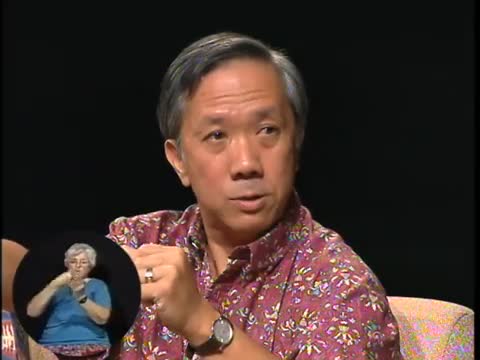
to the legislature. Maui's Joe Suki has been speaker of the House of Representatives since 1993. Prior to that he chaired the House Finance Committee. Speaker Suki is a realtor and former executive director of the Maui Economic Opportunity Program. These Democratic lawmakers bring much experience to our discussion. But there can be no dialogue without your participation. Our telephone lines are open and the number to call is 973 -1000. Neighbor Island residents may call us collect. We will entertain all PG -13 rated questions or comments. Our phone answers this evening are from volunteer access Hawaii. Our sign language interpreter is Loretta McDonald. Senator Misaguchi, I've heard that everything is fine with the task force report and all of its proposals accept the General Exercise Tax and raising it from 4 to 5%. Is this going to make it through or is this going to make a liar out of you and Joe Suki saying that you're going to deliver this economic revitalization program? Well I think the
rise in the General Exercise Tax has taken the greatest attention because people understand and increase in the taxes. But I think you have to step back for a moment and to look at what Hawaii really needs. And Hawaii really needs fundamental and bold changes. We've experienced great growth and success and prosperity over the last 38 years of statehood. But the types of government structure, the types of financing that were appropriate in the 1950s and the 60s and even the 70s are not appropriate right now. So one needs to look at the philosophy behind the revitalization task force's tax proposal. It's a shift from taxing production and income to consumption. And you need to look at the reductions in the income tax, 400 million over the next three years. A reduction in the permitting that is so vital to small business, they're complaining about permitting. And that will save the small business and business, $180 million.
And of course the increase in the exercise tax, 25 to 30 % of that will be exported because you need to tax the tourists and you'll tax a consumption on goods and services. So we believe that this is a starting point and we need to take this into the legislature and debate it. And if anyone has a better idea, then I think the legislature will sit back and listen. Speaker Suki, easy from his a Gucci to talk. He's not up for re -election this year, but you are and say is and Suzuki is all the house members. So if you pass this raising the GET, you guys have to go out and defend that. You think you can? Yes, because again, you'll need to look at the total tax package and we're looking at $400 million that will be put in people's pocket. It will provide a few jingles in their pocket. And I think as they begin to understand what we are doing, also you need to understand that we are going to be providing tax credit for those who are $30 ,000
and below. And if you earn less than $10 ,000, you won't be paying any taxes at all. That's for the adjusted tax. And you look at $30 ,000 and you look at someone who earns $50 ,000 to come with and adjust the tax at about $30 ,000. Well, we are providing significant relief and it's quite quite historic and not nowhere in the past of any tax package have been presented to the public like this. Javan, say you got to sit there on that committee and get people to buy it. Are they going to buy it? Well, I believe most of them will maybe consider it as we have our public hearings and deliberations. Like I stated earlier that a lot of times we have to give those proposals an opportunity for the public to react at the public hearings. Don't get me wrong because each of these proposed legislation will have three hearings in both House and Senate. At that point, I believe the leadership of the House will try to address it with the members of the majority caucus to see how they feel about the issue of the increase. Because if you don't have the increase, you don't get the decrease. That's a fact.
Someone told me that Ross Baker said the GET going up to 5 % is dead on arrival. Did she say that? No. That's a lie. The way they surmised it was not what I said, let me put it that way. What I said was basically what representative say said. It was a good starting place. It's something that we're going to consider but we need to take a look at all of the activities. Actually, I was giving the young man a civics lesson and he sort of took that out of context. Well, tell me though, I think there are six Democrats here and as I understand you're going to raise a GET Democrat. Six Democrats are going to raise a GET tax which is a regressive tax in order to save rich people, cut their income tax raise from 10 % to 6%. Is that what Democrats are supposed to do? How do you rationalize that? Well, I think it's an opportunity for us to take a different approach and a different look at our tax structure and try to see the goal in all of this is to try to find ways
that we can stimulate the economy to create jobs. This certainly one approach is an approach that we're going to take a look at. We're going to put it on the table. We're going to listen to the pros and cons from people out in the community that maybe have not had an opportunity to interact with the task force, to give their manate or to give their ideas on it. We'll look at other proposals that may come up but I think the bottom line for all of us is that we know we need to do things in a different fashion. We need to look at things in a different way. This is one proposal. We're going to give it every consideration. It may need to be tweaked. It may need to be massaged a little bit. But that's what you have the legislative process for and that's what we intend to, we've already begun and we'll continue it until we adjourn sign a die in May. California, you went through this for this past session. Were you surprised that this tax package that the economic task force came up with? It's not entirely. I think there have been a number of proposals that have been coming forth. Representative
Suzuki and I looked at a whole bunch of tax measures last year, part of which came out of the Tax Review Commission and many of the ideas were very similar. The notion that you've got to do something with the GT, you've got to do something with the income tax if we're going to make any kinds of meaningful changes to kickstart the economy. I think the thing that's different this year, that we didn't have last year, is you've had sort of the six to nine months to really spend some time to debate, to discuss, to ask many different experts throughout the community to come up with their best ideas. So this year, it's sort of having done a lot more homework, having engaged the community on the front end and now we can go forward into the session and really have a much broader range of ideas and viewpoints that we can start with. Representative Suzuki, you come from a small business background, right? Yes, I do. Now small business people in Calvin say you have a lot of small business. Small business seem to be the people are bleeding most about this task force package. Do you think it's
appropriate? I think, for example, from my professional background, the CPAs, certified public accountants, I think for the first time they may come out and endorse a legislative package and this one would be the task force recommendations. I think next week, I'll be meeting with them in a seminar we're conducting at the Pagoda Hotel and we're going to go over all the task force recommendations, especially the tax portions. And I think it would be significant that they would come out and want to know about it so they can take a position and they are the advisors to many of the small business throughout the state. Let's talk about something other than the GET. What about the recommendation to get rid of the Land Use Commission? I know a lot of environmentalists have squawked about that. What's going to happen to that in your mind? I think that eliminating the Land Use Commission was the first in many discussions that we'll have at the legislatures. I think the real problem was bureaucracy, the length of approving a development here in Hawaii and
eliminating the Land Use Commission. This was one way of not only reducing the time that one needs to put a development in place, but it's a signal that you give developers a venture capitalist that Hawaii is a good place to do business. Of course, now you have the environmentalists that have come in and said that they would not want to eliminate the Land Use Commission because that's the only place where you could have contested case hearings, they can go and argue their points against the development. But I think that the discussion has started then and I think this is important. For too long it's been environmentalists, big business, labor versus big business. But that process as Senator Fukunaga stated started six months ago where there was collaboration and a development of a consensus and the 26 members of the revitalization task force did just that. We went into collaboration and came up with a consensus and we all signed a charter. We bought into this particular plan. It's not perfect, but it is a starting
point to enter the 19th state legislature. Do you at this juncture feel that the desire to get rid of the Land Use Commission is going to fly? I believe it's going to be a disgusted land. I think the chances of it flying is pretty good because once the begin to understand that the Land Use Commission adds to the cost of the property value that we have in the state of Hawaii. The high cost of living that we have here in Hawaii is primarily because the high cost of land and high cost of homes. Now if we can cut the land of the time in the Land Use Commission and you put it into the counties, you'll save at least a year. A year means more dollars in the pockets of the consumer who will ultimately buy the house in a lot and for the business man. Now if you bought in and you bought in, I mean part of the fun of watching the legislature is finding out what the house and senate disagree on.
Don't isn't there anything that you folks are going to disagree on this session? There will be many disagreements really. Is there anything up front that it appears that you folks are definitely at logger ads on? Well I think you know the process that you've watched us in action for many years then and I think the devil is in the details. These are 30 ,000 foot level proposals that have been put out and we are now ending our drafting of these bills and 76 legislators have to look at the details of each proposal. And that's where the fun begins, the six readings to get things passed and there's always an attempt to move down the process. But I think that we can't have a wait and see attitude. This year we must deliver and the speaker knows that, I know that so it's up to our chambers to produce for the people of Hawaii. Then you'll probably see a different philosophical policies as far as the proposals. But I would agree with both the
speaker and the president and the two co -chairs and represents Suzuki that these proposals are the beginning of a journey that starts next week Wednesday. We've got 51 members in the house with 51 ideas about the Land Use Commission, about the tax proposals. And what we'll try to do is to develop that consensus through the public hearing process and the deliberations. I'm very excited about it because this is the forum where all of us, all 76 members of the legislature will be educated on these particular issues. Getting back to the Land Use Commission, I believe the Commission lost sight of its roles and responsibilities during the Japan bubble era. Why I say this? Because the Land Use Commission got involved in telling developers these are the impact fees that you would have to do. The public has to realize that the Land Use Commission's whole objective in the previous
years when it was first incorporated was to address land use reclassification. You've got four classifications that the public should be made aware of, your conservation districts, your agricultural districts, your rural and urban. When a developer goes before the Land Use Commission, it's on these four classifications. The zoning as far as the details of a particular project is at the county level. What the law side of is that the Commission was telling the developer, if we're going to reclassify these properties, you put it in the schools, you put it in the infrastructures. Are you saying Calvin that you're for keeping it but redefining its role or returning to the original role or do you think it's got to go? Well, at this point, the proposal, which I haven't seen, what Mr. Speaker, talk about having the Land Use Commission
just addressed the conservation districts? The Land Use Commission, there would be no state Land Use Commission and the responsibility would fall with the floor counties. And the Illinois. The Illinois. See for the conservation districts. Agriculture, rural and urban with the counties. And that's what the task force is asking for. Representative Suzuki, you can tell this. Why does the state allow one group not to be taxed? The retirement pension is not taxed. Why do these people not contribute to society? That's a good question. And that question was raised by the former various tax review commissions recommendations. And last session, we considered it. In fact, there may be bills on the table this session to consider taxing pensions. The federal government does. The federal government does. And in all, all but six.
All but six other states, right? When we look at the taxation, I know the tax foundation of why I came and vigorously supported not including pensions as taxable. And they go into the history of why these laws were enacted previously. And a lot of it was to attract the high tax, well, retirees come and bring their savings or their pensions and contribute to the economy. Maybe the time has come that we can look at this type of taxation. And of course, I'm sure it's going to be raised and it's on the table. We already have been lobbied by pension groups against even considering it. But I know it's going to be on the table. Maybe you ask me because I will be introducing a bill for the taxation of pensions and treat it just like we do on the federal level. A couple of guys like Joe, I mean, we don't like the sound of this, but that makes all the interesting
work we're going to have there. Carol, you know this was coming. Someone saying you got enough money and there's not a problem of tax revenues. Why don't you reduce the size of government? Why this nickel -diaming? Why don't we get rid of some of the functions we try to do in this state and close schools and do some things? Why don't we do that instead of decaring around the edges, so to speak? I guess part of the historic problem of trying to reduce government is that when you begin to look at the range of services that government provides, every time you begin to identify an area that you want to eliminate, the group that is going to be affected immediately throws up their hands and horns says, not this type of service. So part of what we started to do in our deliberations and budget briefings this year is ask every department, every agency that's come before us to tell us what their mission was, to tell us what their accomplishments were, and to tell us how we can measure their performance. So, you know, we've already started the dialogue and I'm sure that as the governor starts asking each of their
departmental agencies to re -examine where they might be able to reduce further in their budgets, we're hoping that our questions will begin to get departments to start looking at what their core functions are and what are the things they really should be doing. And if there are some areas that we should be eliminating, let's do it rationally, you know, let's get the whole community involved in the discussion so we can actually bring government to a level that really meets all of our needs. I guess anybody can handle this. Yesterday Mayor Harris said that the Xi's tax increase would force counties to raise tax on property. Was anybody want to respond to this? Is that what's going to happen, Russ? Do you think that's for real? The way that I've heard most of the counties talk about it is if the state takes back, it's the county share of the transient accommodations tax, but I haven't heard them speak in terms of it reference to the general Xi's tax. So I'm not sure just exactly where Mayor Harris is coming from. Let me add to this, there will be some loss, but I don't think the two degree that the
mayor is saying, let me give you an example. I believe in the county of Maui, there will probably be a loss of approximately 12 million dollars, but it's my understanding that the county has been running with a good surplus these past years beyond 12 million dollars. So I don't anticipate any need for an income tax to raise the property tax. And what need to be mentioned, due to the good work of the finance committee and the ways and means of the committee this past year, there's going to be in the year 2002 that the state and counties will not have to provide any contributions to the employee's retirement system. What it means will be a savings of approximately 270 million dollars. And at least 40 % of that will be for the counties, that money will be going to the counties in their pockets. And the net effect of that is they'll be having more money in their pockets
in 2002 than they're doing right now, due to the effects of the less legislature. And yet all the counties are bleeding at you, aren't they? Well, I think that's always a veil threat. They always come before the legislature and say, if you raise the GET or you have a change in policy, we're going to have to raise property taxes for residents. But we need to set the stage here. There is great duplication among state and county governments. Why should a state and county government be involved in road maintenance, in park maintenance, civil defense? And so I think we see, we need to set the stage at the legislature to discuss duplication. And the only way you're going to do it is to bring the county and the state officials together under the need for change and talk about reducing the sizes of government, both at the state and the county levels. Senator, Mr. Gucci, you are pro gambling, is that true? I support
gaming. I knew that question would come up. Yeah, just a person just wanted to say, if people gamble, they should go to Las Vegas. It shouldn't be done in a while. Why do you support gambling? Well, I think that we have 400 ,000 residents that go to Las Vegas every year. And most states have developed gaming as a revenue source, as a job creator, and as a revenue source to support the various programs. And I think in time, I think it will come to Hawaii, because the people need to decide. And right now you have the critics who are the newspapers and those that can convince will create public opinion. But people don't want the taxes, right? 5 .35, no way, they say. And when we bring gaming, and I've brought it up for three years, there's also said no. But when people, when we talk about education, long -term care, human services,
everybody wants that piece of that pie. And so the people have to decide, and this year it will be very interested. If no taxes, maybe there will be no programs. Nathan Suzuki, are you pro gambling? Yes, I believe it can contribute to the economy. What kind? You want a lottery? You want casino gambling? You want offshore? I think if it's casino, it should be a limited access, mostly to tourists. And I don't know how you limit those that might be on general assistance or welfare. But the house at one time was backing up the lottery. And I think it can have a place in our economy. Calvin, say you're forward or again it? Also for it, some form of recreational gambling. For it? I'm for it as a means to raise revenue for the state of Hawaii. Carol? We passed Shipboard Gaming bill to the house a number of years ago. And at that time, I think we were really interested in looking at it. Right now, I guess we would have to take a look at how great our needs are. Ross, how do you feel? I voted for Shipboard Gaming. I think it's
another activity for our visitors. And it adds to the Vizermix. And maybe it keeps visitors in Hawaii. What do I have to add? I don't think there's any changes that's going to be any gaming bill. That's right. That's true this year. But the vote six zip here. Six out of seven to six. Right. Out of 71. 71. All leadership folks. Is it detrimental that one party dominate the legislature and the state for so long? There are six Democrats. That's the wrong question. I really don't think that's the appropriate question because if you look at Democrats, we are all very diverse. We've got lots of different opinions. Our tent is very big. And so we've accommodated lots and lots of people. So the diversity of the state is represented in the Democratic Party. And I don't think that that's been a detriment. The fact that we've been very inclusive has allowed lots of different viewpoints and lots of different perspectives to emerge. Any other thoughts on it?
Is it a better legislature because there are not, be honest. I mean, we just have a few people watching the night. There's a baseball game on. Now, be honest. Is it a better legislature because there are 12 Republicans now in the House instead of seven? Well, nothing's changed in the Senate. But is it a better legislature? I don't think they made a bit of difference. Really? That's right. You asked me for my opinion and I will tell you. It's basically the majority that sets the agenda. And it's a majority that passes the bail. In my case, I would say that the legal opposition has been very, very vocal as far as contributing to the debate in our committee hearings. I'm just saddened by the fact that after one or two terms they decided to leave for higher office, whereby there is no continuity of the institutional memory about how a budget is developed, what is a general fund, special fund, revolving fund. Things of that nature. You know, Dan.
We'll ask him about that next week. You might guess. More than 1 ,000 mentally handicapped people are currently not receiving assistance due to a legislative error. What will the legislature do to rectify this oversight? Anybody know about that? At this time, if they're talking about the immigrants for food stamps, it's going to be awfully difficult. If they're talking about general assistance, which is for individuals who need some financial aid, it's going to be awfully difficult also. I'm not trying to paint a bleak picture, but a realistic picture. When I told the finance committee this past week and a half of our budget briefings, that the public should realize that 10 % of this population of the state of Hawaii is in the quest program, which is a health insurance program, that's a tremendous amount of our population. And then you add on the other services that we are providing, it becomes very frustrating to say, can I provide money for this program, like what Carol was saying, or this program, or this program? I've
always tried to ask the subject committee chairs. You make the priority within your budget. That's only fair because you're the subject committee chair. You should know what the budget of your department or program is all about. Even like this past week, when we did send a memo to the administration for the 10%, 8 % to 10 % reduction, I wanted to go through the exercise on behalf of the finance committee members, because it's not going to be any vertical, excuse me, horizontal cut. It's going to be vertical, which are programs. And the coach here is correct. Every advocate group will be pounding on our doors and the president and the speaker's door to say, save my program. How come I got to take the hit then for school consolidation? Good at it. How come I got to take the hit for leave without pay? I don't know anybody who says no, aside from Ben Coyotano, with more relished than Calvin Bennett. What benefit to small business will the economic revitalization task force proposals
bring? One of the biggest benefits to small business that the revitalization task force proposals would bring would be to end the tax on the tax at the end of a retail sale and to diminish the amount of pyramiding. That is the tax on all the intermediate transactions from the beginning to the end of the service or product cycle. It will save them hundreds of millions of dollars. And that's, is there more? And the personal income tax. Most all of the small business don't have corporations. So they pay their taxes to the personal income tax. The 40 % savings in personal income tax will be a big windfall for the small business. Senator President Ms. Gucci, House Speaker Suki. Our program is half over and we need to take a 60 -second recess subject to call of the moderator. But we will be back with more of the majority's
perspective on the 1998 legislative session. I think CEOs are in charge and don't you feel it? Sure. Sure I feel it. Find out who's really calling the shots. I'm Guy Buttonheads. And that's what I enjoy. And who's paying the price? You're hired as a town. When they're through with you, they let you go. We'll take you from the Wall Street. To Main Street. I'm surviving the bottom line. Saturday night at 8. A once thriving crop with widespread plantations throughout the state. The pineapple in Hawaii is now mostly a piece of history. On the season premiere of Hawaii Cooks, we'll learn what makes Hawaii's pineapple worth preserving. In his kitchen, Chef Roy will prepare this roasted pork in a pineapple
broth. And Chef Oliver Althair makes a smoked salmon non with pineapple horseradish. Plus Chuck Furry's wine list. It's the pineapple from Maui on the season premiere of Hawaii Cooks. Tuesday at 7 .30. Welcome back to the second half of Dialogue. My name is Dan Boylan. Answering Dialogue's phones this evening are those friendly people from volunteer, access, Hawaii. We are grateful for their help tonight. We are discussing the 1998 legislative session with six Democrats. Ms. Gucci, Baker, and Fukunaga from the Senate. And Suki, Sei, and Suzuki from the House. That's the letter, what a cheap I know, but I had to do it. All the cuts, the tax cuts that were made in 1997. What do you have to show for this? Come on, Fukunaga. There were cuts in the budget. I shouldn't say tax cuts. It cuts in the budget in 1997. What do we have to show for that? Well, certainly the original
position of the Senate was to move forward with ending the pyramid on commercial leases much more rapidly than what we ultimately ended up with. And I think for those of us who went through that round of discussions, we want to see that process speed it up a lot. Because seven years in which to actually implement this kind of elimination is far too long. For the people who are waiting for relief, they may be gone in seven years. So I agree with you 100%. That's the kind of stuff that we want to tackle. And that's where we want to hear from people as we go through this next year's session. The representative, Suzuki, do you think we have anything to show for all of that? I think, finally, because of the recommendations from the task force, we're ready to do that. And of course, as we've discussed at the beginning, the way you do it is by increasing another revenue source. And that's a general excise tax. We can accelerate the leasing, sub leasing, exempt elimination of the pyramid meeting. Effective when all the other recommendations take effect. So it's really important that we have
another revenue source. When will the legislature set priorities for goals and services? Secondly, make public plans to meet these goals. Now, that's what you're talking about, right? Well, well, what we have. We had a retreat where the members of the house got together and set up their plans and priorities. And now we have a majority package, which includes all of the plans and priorities that the house retreat produced. I like to say that the house retreat included Democrats and GOP, both. And the vote came to agreement that this should be tax relief. So I think this is the first time in history of the house, anyway, that you have both sides of the aisles coming to agreement. Someone says, please nail these people down on term limits. How do you people stand on term limits, Carol?
Well, as one who has run and faced the voters, I really believe that the best term limit is every time you're up for reelection. Because when you go out into the community, basically you are bringing your record back to the community and saying, this is what we've accomplished. If you agree that this is the way to go or if you want to see changes, it's really all up to you. And the voters have, in most instances, made specific choices that have begun to make changes. Ross Baker? I agree with my co -chair. If you look at the legislature, we've had a nutrition rate year after year. And so you don't have a lot of folks that stay in beyond what most people recommend as term limits anyway. But it's really, the term limits is in the hand of the individual voter every time we stand for reelection. Norman, is it good you arrived there in 1974? How do you stand on term limits? Well, I should be the person to talk about term limits because I've been in for 24 years. And so I think that in the Senate every four years, you need to ask
your constituents to return you to the Senate, the House every two years. And so that is a process that is a form of representation form of government, which is a good form. But when you talk about vision and you talk about the ability to get things done, I really think that the House, two year term, really is really too short. Because you are expecting the House members to create a vision, to conduct themselves, and to produce legislation. So we need to look at term limits, but term limits are really a result of frustration and cynicism on the part of the voter. So we need to get the job done and face the voters and face the consequences at the election. Is there anybody here of the three in the House who are four term limits? No. Well, then... So another 6 -0 vote here. We have a term limit right at the end of the election. November
6th, my term ends. Then I need to run for office if I want to get reelected. There is natural attrition. Someone calls. If you are also concerned with balancing the budget, why not take a salary cut? Is there any discussion of taking a salary cut by legislators? Well, in fact, we have. We have not gotten a raise for the last, I believe, 10 or 12 years. We won't be getting a raise for the next 5 or 6, at least, or 8 years. The legislature, and I wish this person would come in and spend some time in the legislature. They are hardworking people. They don't make much, much, much money. A member of the House and Senate makes 32 ,000 a year. If you would put it by the hours that they put it in, it would probably make less than 50 cents an hour. And if you think that's an exorbitant pay, I think you should come in and put some time in here. I look at it from a different perspective that
salary is not the issue. The 32 ,000 that we all get here is not an issue about why we run for public office. It's for the public service that we want to provide to the general public at large. Just talking to Rep. Suzuki, and correct me if I'm wrong, the two co -chairs and the president, was it had two years ago that we did reject a pay raise, which reflects that the legislative body realizes the economic conditions we are in, and that we'll stick by for another 10 years in regards to not having any pay raise. What is the salary? 32 ,000 and then there's a 5 ,000, 5 ,000 more for the president than the president. The president offices of both offices get 5 ,000 extra. So you two get 37. But then the normal gets 5 ,000, everybody gets 5 ,000 more for legislative allowance. And that can be used for things like postage, postage, newsletters. What happens for those of you who are neighbor island legislators? Do you have a travel money or any kind of
allowance for staying in town when you have to stay here? We have an $80 per DM, and we get our airplane ticket to come over and to go back at the end of session. At the end of session, not in between? No, we can go back in with the permission of the presiding officer. Why can't voters and why have referendum in initiative? How do you feel about initiative in referendum are part of the process over in California? I know. Aren't you pro -initiative in referendum Carol and the old days? Well, I think I came out of the constitutional convention with Spikusuki, and we had extensive debates on initiative referendum and recall. And I think at that point, you know, people had proposed that as a way of solving some of the problems that they perceived in the legislative process. But if you look at many of the changes that occurred in the 1978 constitutional convention, those changes then paved the way
for all of the major structural changes that you see in government today. So, I mean, you know, many of the things that actually occurred were as a result of people's ideas without initiative referendum and recall. And I think if people want to see change occur, they can go down and visit their legislators. You know, I'm amazed to see how Hawaii is probably the most accessible state of all. You know, when you compare capitals in other state jurisdictions, the state capitals are usually far away from the communities or the most populous locations. Hawaii's capital is right in the middle of the most populous city. And, you know, we've spent a lot of time to try and make public access possible. So, I think it's a real different kind of environment in Hawaii. It's more a matter of, are we willing to work on change? And if we're going to work on change, people can very, very readily approach the legislature to get that kind of change started. The downsides of initiative referendum recall is that money talks in politics and people that have been very cynical about
money. But if you take, for example, the economic revitalization task force proposals, if that was put on the ballot, it would pass. Because people are saying that corporate big businesses behind the proposals, they could put the advertising on television and the thing would pass. So, I think Carol is right that Hawaii has the most accessible legislature, but people have to get involved in the process. And they have in the past, and we need to do more in terms of registering people to vote, having these particular observer programs with our youngsters. And people, I think, have access, and people need to get involved. Norman, somebody calls and says, you say the people should decide about gambling in Hawaii, so you should be for initiative referendum and recall. No, they should just call our offices and let us know they support it. So, you don't want them to vote on whether we should have gambling. No. I think they should let
us know through a public opinion poll or speak up. It's really an abdication, though, of legislators' responsibilities. If all of the hot issues are the difficult issues, we say, oh, we're just going to toss them aside and we're going to put our finger to the win. I mean, we have an opportunity to engage our constituents in a dialogue. And that's really why they elected us, was to represent their point of view. And if they work with us, we can achieve the kind of change that they want without letting it become a popularity contest, as it's happened in California. About a year ago, a couple of years ago, the House had a constitutional amendment request to allow gaming, and that would necessitate the public to vote for or against gaming. Unfortunately, the bill died in the judiciary committee by one vote, but we did attempt that. Nathan Suzuki, CPA, what's up with auto insurance reform? Coverage
is the same, but the premium went up. Several people have asked that. I think the premium went up for those that need the coverage because of their asset base that they need to protect. But the hope was to get the auto insurance premiums down, so the majority of the people who may not, who otherwise did not buy coverage or protection, could get covered because the premium rates did come down substantially. Where does the money taxes from tobacco sales goal? If it doesn't go to tobacco illnesses, it should. Is it, tobacco taxes are not earmarked, are they? No, it's not. Everything goes into general funds. I am a lifelong Democrat, this show has convinced me to never go Democratic again. The position of the speakers on gambling and the excise tax is unacceptable. So there you have it, you just lost a Democrat tonight. Why does the government have such a village mentality? We are the 10th largest state in the U .S., and we need rapid transit. Having been a little bit late tonight, as you know, I hope I second this comment. Well,
there's no discussion of this. The legislature has passed the rapid transit, and it died in a console, and we're willing to look at it again. I think you need to speak to the console on that measure. Exactly. What was it eight years ago that we authorized a half percent increase, that could be level, that the city and county level, but the proposal lost five -four, and that's why we don't have a reputanza today. The federal government is ready with their monies, and it is a city and county responsibility. And the state did it to revitalize our economy at that time. How did most of you react to the mayor's talk yesterday, the mayor's state of the city? Any immediate reactions from you? Well, I think in a state of the city address, it has some hope, and it has some optimism, and what he needs to do now is to work with the council and try to put these things together, but they all cost money, and here he is crying about no money at the city level, so I'm not too sure how far he'll go on those proposals.
Anybody else have a response? Is there a chance the state minimum wage will be raised this year? That hasn't been a burning issue at the state legislature. I know it is at the federal level, and so I'm not too sure until we go into session and hear about that issue. Norman, someone's after you again, you favor putting duplicate functions between the state and county, all at the county level or creating more state super bureaucracies, for example, road and park maintenance. I think this is where we need to get a joint committee to look at where these functions should be placed. Some of these functions can be better done at the city level, others at the state level. Why doesn't the legislature have legislate TV free time debates? For example, over issues like the Land Use Commission, and I suppose in election campaigns too, you're into public access, Carol, why don't
we do more of that? Well, I guess the House and Senate do pay for the coverage of our legislative proceedings, and I know over the last several years both the House and Senate have tried to broaden some of the kinds of discussions that were carried live, and we have continually moved forward in that area. I think now it's a matter of availability of airtime, and certainly on the programming side, you know, we're looking to improve the quality of our programs, so I'm off for that. What about a one -house legislature? Someone says, can we have one legislature, one house, to save money? Why not? I mean, we're a small state. Why do we need two houses? We've got judiciary to check and balance. We've got the governor to veto. Why do we need you guys to veto each other? And now we have not just one share of money. We've got three shares of money. And these two can disagree, and they can disagree. Three heads are better than one.
And why don't we go to one house? Well, we can. That's what the public wants. As long as it's a state house and not the Senate, we don't mind. If you're looking at it from a money standpoint, in terms of the overall expenditure, we make up 1 .4 % of the entire expenditure that the state makes in terms of its total budget. So, I mean, we're really a very small percentage of expenditures. But you're a political scientist, a major, or were, Ross, you know that Nebraska's had a one -house legislature forever, and they haven't crashed. And they're considerably bigger than we are. Why don't we go to one house? Well, I think if you talk to a lot of different people throughout the state, they would tell you that they like the diversity. They like the opportunity to have the interplay between one house and the other. That creates a dynamic that allows good and different issues to come forward.
The folks in Nebraska in some ways are very envious of the two -house systems in the other 49. Whoa, whoa, whoa, whoa, whoa. That's getting me so shaken up that everybody disagrees with the other time, losing the questions. Is anyone going to do anything about the problem of the Bishop of the State? Are we going to see any Bishop of the State legislation this session? Anybody smelling out? Is there a problem? Oh, sure. Where have you been? Do you hear any? Well, the governor has been speaking about introducing a bill that will look at the salaries of the Bishop of the State. And so I think that will be before the legislature when he introduces his administration package. That's about the only role that the legislature would have with Bishop of the State in the area of the salary. A comment, a comment. You don't raise taxes to fix the economy. I guess they're talking about the GET. History has shown that you must reduce taxes. Are we going to reduce overall or are we
going to reduce taxes? We're going to reduce taxes by $400 million in three years overall. Does that look right to you, Nathan? Yes, that's right. It may not seem that we're to certain individual taxpayers. And that's part of the process as we go to the hearing process and the considerations we need to do. I think the tax package... 400 million in income tax reductions. A hundred and 58 million in reducing the permitting tax and the general tax tax increase will still leave us a deficit of about $100 million. That's going to push you. That's right. We've had several of these with the Democratic's record of leading the Senate into the state economy in the entire country. Why should anyone vote them back into office? I think that's a rhetorical question, not a real question. Does anyone want to raise the donkey and say anything? Why are the Democrats against privatization of
government functions? We oppose privatization... No, we are not. The House had a bill and we debated the issue. And we almost passed it. The House and the Senate. But let me just say this. There is a lot of privatization that's going on right now on the grantee and age and in human service programs. We have about $100 million. Most of the hospital laboratories are privatized. In fact, it's the community hospitals right now are privatized. There's a great many programs within the states that are currently privatized. Are there others that you can see that should be or can be? I think the argument that some people try to make is that if it's a private service, it's going to be cheaper than government. And if you look at what's happened in other places across the country, that hasn't necessarily been true. If you're looking to maybe instill some competition, there have been ways that other jurisdictions have allowed their public sector
to compete with the private sector and by engendering some competition, you get a better cost and services done more efficiently. But I think what we need to look at is how what's the best way to deliver the service, make sure that government is customer friendly, that the services are streamlined, that we are getting the most bang for the buck. How will the state deal with the present lawsuits mandated by the federal government? That is the OCC, County -OE State Hospital, the FedEx consent to decree which deals with, explain to me, the special education. How will the services be cut or affected when federal mandates such services be provided? Well, then, this is where the issue begins as far as the problems. The FedEx case, as far as the special needs for the particular child, has grown tremendously. The OCC problem, as far as our prison bed space, the Department of Public Safety is coming in for another 5 million for the next supplemental year for the transfer
of prison inmates. But the bottom line is that we've got to build a prison. And third, all of these consent decrees, I hope the families who are affected realize that it's costing the state of Hawaii a lot of resources. I just wait, let me say this, I just wait for the day when a child who is in a regular instructional program, parents, maybe sue the state for discrimination as far as the inequities of what the child in special ed is getting, in services versus the regular ed child. As far as prisons, we have a great debate going on right now as far as the two co -chairs of the judiciary with the chair of the judiciary in the house in regards to truth and sentencing which is 85 % of mandatory sentencing for a particular felony. But we also did put in a provision to address the overcrowding by the privatization of a private contractor building and operating a prison. It is on the table as far as
conference, and I hope the two leaders can work out some agreement to have that measure. Amy, during the first week after opening, to go back to conference to see if we could do something. The reason why? Are you lobbying these guys, huh? Oh, yes. The reason why is that it is a major crisis. If the federal court goes on on us on ultra -pussy, we have lost our control of our prison as far as ultra -pussy. And then this past week, the two chairs, the public safety chair, which is representative Mr. Garcia and Chairman Tom, went to Y -Avo to look at our 10 cities. And now the city and county is filing a violation in regards to the fire code. Where does it hit? I don't know. I don't know. I don't know. Private sector has experienced pay cuts. Why not cut the pay for public employees and politicians? Is there any talk about across -the -board state pay cuts? No. Although some of the policies that people have tossed
around might have that effect. Now, this is rather frightening, folks. Why are these Republican proposals promoted tonight without Democratic proposals to counter? That's how the parties have changed over the years. These folks sound like Republicans. That's my question. Why not close the UH Law School, get rid of 30 ,000 workers and not raise the GET and property tax? 30 ,000 state workers and close the UH Law School. Would that set things the right way? Well, that will set things up pretty good. In fact, we won't have a public education system anymore. And then maybe we can privatize all of the schools. They all can go to private schools because most of the budget that we have $1 .2 billion goes to public education, lower education, not even higher education. So I think that's a very broad question and they need to understand that we would have to make that we won't have any education system at all if that does come about. Oh,
that's, I can't use that. That's way too broad for this late in the hour. How will the noise and traffic be addressed when the conventions are held at the convention center? Shall we talk about that at the legislature? That's a city issue, isn't it? Actually, that's an issue that has come up with the issuance of the noise report that the convention center authority recently released to the community and guess the noise report says that there will be noise problems. So I think by identifying that, certainly they are saying that, hey, we need help and if the legislature can help us solve that, then we all need to pull together. Someone calls on once we know we should bring back capital punishment to help with our prison population problem. How many of you vote for bringing back capital punishment? Do we have anybody for it? Everybody's again it. On that, we got unanimity on three votes here tonight
and no disagreement. There's a Democratic wall here. We're out of time. Many thanks to our legislative guests. We wish them all a good session. And many thanks to our phone answers from volunteer access Hawaii. A reminder that if you would like to send in your questions or comments for dialogue, our email address is dialogue at kgt .pbs .org. I love to say org. Next week the Republicans get their say. Representatives Kavanaugh Nakawa and Myromoto from the House and Senators Anderson and Sloan from the Senate. On Wednesday, January 21st at 10 a .m. please join Lynn Waters and myself at the state Capitol. We'll bring you the opening of the second session of the 19th, right? State legislature. Senate President Mizoguchi and Speaker Suki will be doing some serious specifying that day. So you'll want to listen. Two weeks from tonight, dialogue's guest will be governor Ben Coyotano. That's a lot of dialogue coming up and we hope you'll join us. For tonight, thank you for watching Hawaii Public Television. Aloha.
Thank you. Thank you very much. Thank you.
I'll see you next time. See you next time.
See you next time.
- Series
- Dialog
- Producing Organization
- KHET
- Contributing Organization
- PBS Hawaii (Honolulu, Hawaii)
- 'Ulu'ulu: The Henry Ku'ualoha Guigni Moving Image Archive of Hawai'i (Kapolei, Hawaii)
- AAPB ID
- cpb-aacip-225-45cc2kvq
If you have more information about this item than what is given here, or if you have concerns about this record, we want to know! Contact us, indicating the AAPB ID (cpb-aacip-225-45cc2kvq).
- Description
- Episode Description
- Moderator: Dan Boylan. Panelists: Sen. Rosalyn Baker, Senate Ways & Means Co-Chair; Sen. Carol Fukunaga, Senate Ways & Means Co-Chair; Sen. Norman Mizuguchi, Senate President; Rep. Calvin Say, House Finance Committee Chair; Rep. Joseph Souki, House Speaker; Rep. Nathan Suzuki, House Finance Committee Member.
- Copyright Date
- 1998
- Asset type
- Episode
- Media type
- Moving Image
- Duration
- 01:01:42;16
- Credits
-
-
Producing Organization: KHET
- AAPB Contributor Holdings
-
PBS Hawaii (KHET)
Identifier: cpb-aacip-89065316217 (Filename)
Format: Betacam: SP
Generation: Master
Duration: 00:59:19
-
'Ulu'ulu: The Henry Ku'ualoha Guigni Moving Image Archive of Hawai'i
Identifier: cpb-aacip-cf441f34875 (Filename)
Format: Betacam: SP
If you have a copy of this asset and would like us to add it to our catalog, please contact us.
- Citations
- Chicago: “Dialog; Majority's Perspective: The 1998 Legislature,” 1998, PBS Hawaii, 'Ulu'ulu: The Henry Ku'ualoha Guigni Moving Image Archive of Hawai'i, American Archive of Public Broadcasting (GBH and the Library of Congress), Boston, MA and Washington, DC, accessed March 17, 2026, http://americanarchive.org/catalog/cpb-aacip-225-45cc2kvq.
- MLA: “Dialog; Majority's Perspective: The 1998 Legislature.” 1998. PBS Hawaii, 'Ulu'ulu: The Henry Ku'ualoha Guigni Moving Image Archive of Hawai'i, American Archive of Public Broadcasting (GBH and the Library of Congress), Boston, MA and Washington, DC. Web. March 17, 2026. <http://americanarchive.org/catalog/cpb-aacip-225-45cc2kvq>.
- APA: Dialog; Majority's Perspective: The 1998 Legislature. Boston, MA: PBS Hawaii, 'Ulu'ulu: The Henry Ku'ualoha Guigni Moving Image Archive of Hawai'i, American Archive of Public Broadcasting (GBH and the Library of Congress), Boston, MA and Washington, DC. Retrieved from http://americanarchive.org/catalog/cpb-aacip-225-45cc2kvq