Dialog; Tsunamis: Waves of Destruction
- Transcript
You You Dialogue is brought to you by Hawaiian Electric
Company, people with a powerful commitment. Good evening and welcome to Dialogue. This is tsunami awareness month, and it's a good opportunity for all of us who live in Hawaii to live in Hawaii. To educate ourselves once again on what these natural disasters are, the danger posed, and how we can prepare for these destructive forces. Hopefully they will not come our way in our
lifetime. If you do have a question or a comment about tsunamis, please call us at 973 -1000. And if you're calling from the neighbor islands, please call us collect. Our phone volunteers from Ask 2000 are waiting to take your calls and we thank them for being with us this evening. Our sign language interpreter this evening is Loretta McDonald and I'm Lynn Waters and I'm happy to be here tonight with four experts in this field. And I'd like to introduce them beginning with Harry Kim, who is administrator for the Civil Defense Agency on the Big Island. We usually see him when he's giving updates on volcanic activity on his home island or warning visitors and residents away from unsafe areas. But tonight he's here to talk about tsunamis. He is a graduate of Hawaii's public school system and Southern Oregon State University. Paul Takamiya is the plans and operations officer for the Oahu Civil Defense Agency. He's responsible for developing, maintaining and implementing the city's emergency operations plan. He is a retired army officer and has a bachelor's and master's degree from the University of Hawaii and Pepperdine University.
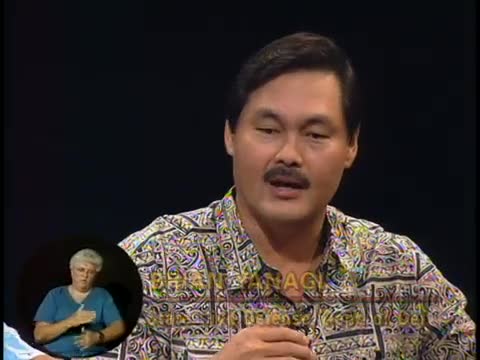
Brian Yanagi is the earthquake and tsunami program manager at the States Department of Defense Agency. During Hurricane Iniki in 1992, he coordinated shipping of telephone poles, ice and roof tarps to Hawaii. That must have been quite an endeavor. He is a retired naval intelligence officer and is a graduate of the U .S. Naval Academy at Annapolis. And Chip McCreary received his PhD from the University of Hawaii in geophysics. He is today the geophysicist in charge at the Pacific Sunami Warning Center located in Eva Beach. He was previously director of the International Sunami Information Center in Honolulu, which is sponsored by the National Weather Service at UNESCO. And thank you, gentlemen, for being with us on this Friday evening. Before we begin our discussion, we would like to share with you this video. It includes an interview with Stan Higashi -Hara, who was a student at Lapa Hoi Hoi School on the Big Island 52 years ago. Also includes excerpts from the Department of Education Science in Hawaii series on Sunami. So let's take a look at this.
These are rough ocean waves. They are strong, but imagine something more powerful. Imagine a wall of water so strong that it could rise up out of the ocean, roll over the beach, pour across the highway, break over the buildings of a town, and still keep on moving ahead, crushing everything in its path. And when this wave has finally spent all its energy, imagine another one just like it or even bigger, thundering along the same path. This is the way of Sunamis. I do not remember the time of the day, but it was early in the morning. It must have been before 7 a .m. Every day we go down to the beach before we go to school. And for some reason in that morning, the ocean was really unusual. The tide would come up and we seed, comes up and we seed. So the students would
run back and forth from the beach to the school and the world started to spread. And on one of my running back and forth, my sister caught me and for some reason she was frightened so she started to cry. And she told me she wanted to go home. I really got upset. I wanted to go back and continue to observe what was happening with the ocean. So I was embarrassed by her crying so I said, okay, I'll take you home. So we started walking towards home and you know, she would see all the students still coming to school. And then she said, oh, take me back to school. I said, oh, I'm taking you home. It's April 1st, 1946 and this is no April Fool's joke. 15 ,000 feet beneath the black waters of the illusion deep, the earth
moved. An earthquake registering 7 .4 on the Richter scale sends tsunami or seismic sea waves traveling 2 ,300 miles across the Pacific. Five hours later, Hilo was hardest hit. And when I got up to the hill, that's when I looked back down at the school. I did not believe till today what I saw that morning. I did not know it was a tsunami. I didn't know anything about tsunami. All I remember was this big, big wave. Teachers' cottages were lined up in front of the school on the far end of the park. And I saw this wave just crush the teacher's cottage and I said, oh my God. One of the most destructive tsunamis to hit Hawaii was the one on April Fool's Day, 1946. Sonamis kill when they catch people by surprise.
Sometimes the first thing that happens isn't a wave at all, but a mysterious drawing back of the ocean. As the thing we see it, it just left the bottom bare and you can just see the fish is just flapping themselves. So there was something else that I guess the people, kids got excited about and maybe that caused them to forget about everything else and just go after the fish. This is the hill ocean front just before the 1946 tsunami totally destroyed those buildings. Our school had a stone wall that circled the ball field or the park or whatever you want to call it. But that stone wall was maybe two feet high at the highest and the wave was like 29 feet there. You won't stand a chance but some people thought that the stone wall would have protected them.
But that stone wall was just rocks on top one another without no semen. So those people that hit behind the stone wall did not have a chance. And also we had a grandstand for the baseball diamond. Some kids went into the grandstand. That grandstand got wiped out by the wave. The waves caught the residents of Hilo by surprise. The waves swept onto the shore unannounced. My brother didn't come home. I don't know how long we waited but we waited and we waited. Maybe half an hour, one hour. I cannot remember but when he came home, if you ever saw somebody white, he was white, white, just like he had no blood in his system because he had to run for his life.
When the waves finally stopped coming, 159 people were dead. So I lost two cousins in the 46th idol wave. And my aunt got saved because she got entangled in some close line that wrapped around her neck. In 1946, there was no advance warning system. We went down to that point where we were and then try to see what happened. And till today I can still hear the cries for help. And that's something that I can never get rid of. You see the people in the water just floating and crying for help and you saw helpless. There's nothing you could have done. In 1948, a warning system was introduced. Sirens would
warn the residents of future tsunamis. 14 years later on May 23rd, 1960, a tsunami struck Hawaii. Again, Hilo was hardest hit. I witnessed a tsunami and I tell you, if you ever see the wave itself, it's scary. It's scary. The strength, the force. Because when that wave hit that teacher's college, I can just, I still can see that wave, the crushing of the teacher's college, the people out there calling for help, the cries for help. It's something that will stay with me until I die. So I said, just listen to the warnings or better warnings and you'll be safe. Stay away from the ocean.
And thank goodness today we do have a warning system and the four gentlemen who are here tonight are going to tell us a little bit more about what to do if we ever do hear that warning. Chip, let's start with you. Can you explain to us in layman's terms what is a tsunami, what causes it, and what does it look like? Well, basically, tsunami is a series of ocean waves. They're a special kind of ocean wave. They have periods that is the amount of time it takes for one cycle of the wave that ranges from about maybe five minutes to even an hour for the biggest tsunamis. And this puts them in a category between our ocean surf which has periods between about maybe 10 to 20 seconds and the tides which have periods of about 12 hours for one cycle. What tsunamis can be generated by any large scale disturbance of the water in the ocean. Most tsunamis are generated by earthquakes, although tsunamis can also be generated by
volcanic explosions such as the eruption of Krakatoa or by submarine landslides and slumps. And also probably by asteroid impacts, although we don't have any of those in the historical record. Now, a tsunami travels at great speed in the ocean. Its speed depends upon the depth of the ocean, but in the deep ocean it can travel at speeds up to 500 miles an hour or more. Sunamis can cross the entire Pacific in less than 24 hours. And the reason a tsunami is a hazard as this wave approaches the shore, the wave slows down, the energy in the wave gets compressed and consequently the height of the wave can grow. The tsunami can rush on to shore as just a gentle flood that comes on
to shore or in bad cases such as the one we just saw in the film about the 1946 tsunami striking helo, it can actually form a wall of turbulent water that rushes on shore and causes great damage. Now, in Hawaii we face a threat from two kinds of tsunamis. Sunamis that are generated locally and historically the tsunamis in Hawaii generated locally have been generated near the island of Hawaii and have caused damage only on the island of Hawaii. However, our historical record is too short to know that in the future that's all we would have. And so we worry at the warning center about waves that could come up the entire chain and caused damage. But the most destructive ones in history of Hawaii have come from outside. And as you know around the
rim of the Pacific is a zone where a lot of great earthquakes happen in Japan and in the Illusion Islands and South America. These areas have all generated large tsunamis that have come to Hawaii and caused a great deal of destruction. Since the 1800s we've had 21 tsunamis in Hawaii with heights greater than 2 meters and we've had seven tsunamis that have caused deaths here in Hawaii. Well it's pretty scary looking at that footage and hearing stands comments. Once again we want to remind our viewers that were live the numbers 9731000 if you have a question or a comment about tsunamis. Harry I have to ask you you live on the big island where you obviously maybe not there for the 46 one but for the 63 one that was pictured in the island. I think so that land but I was there for 46. I was trying to be nice to my guess tonight. It's very hard to address this subject without flashbacks of all kind of
negative memories obviously. You're not going to talk to anyone on the big island that has roots there on time that did not know someone or heard of someone that died or suffered tremendously. I live right in town at the street cop on a Hawaii and as Stan said the memories of a tsunami will stay with you forever. Mine wasn't fortunately like here but mine was an element of lots of friends looking for friends and this is something that stays with you but it also is positive in a fact that in this job capacity you will swear it will not happen again as far as that kind of losses. So we do have a warning system now and maybe we can hear from our two county representatives. What does that system involve? What does it mean when you hear a siren? What basically what plans are in place Paul? Well on the island of Oahu we have 140 sirens, outdoor sirens. When the siren is sounded
it means that we have a problem at hand and we want the attention of the general public. So what we want people to do is to turn the radio on so that they can find out exactly why the sirens are going off. As you know the sirens are nothing more than an attention getting device. So if a tsunami warning has been issued by CHIPS organization it's our responsibility in civil defense to make sure that the general public is given this word. 24 hours around the clock whether it's two o 'clock in the morning or eight o 'clock in the morning it doesn't make any difference. It's our job to warn the people, make them aware. And what should people do if they hear a siren go off? Turn on the radio. That's what we want them to do. That's exactly. We even go to the point by saying not to dial 911 or civil defense. Turn on the radio first. Find out why the sirens are going off. And that's the best way to get the
information. And if it is a tsunami alert then they should open their phone books and look at the front pages of the phone books. So there are evacuation maps there and this and determine even right now before tonight if you're watching this tonight. Look at your phone books. Is your home in the tsunami evacuation zones? Is your business in the tsunami evacuation zones? If they are and if the tsunami alert or siren sounding does take place you need to proceed out of these evacuation zones immediately. Go ahead. That's right. And that's what we want people to do. And people need to realize that it's not necessary for them to go to a high mountain peak to escape the tsunami. If you look at the tsunami maps in the telephone directory as Brian had just mentioned simply by moving outside of that zone you'll be safe. So go to the mouth side of the zone that's shown
and chances are you're going to be safe. You don't have to move but maybe a couple of feet in some cases. In other cases you might have to get into the car and drive out or walk out on the island of Oahu. We have buses that will provide transportation, shuttling people from the danger zone to nearest shelter locations and these bus rides are going to be free when any tsunami emergency is in progress. That's good to know. The handy van can also be used to transport people out of the danger zone to locations close to the shelter. Want to remind our viewers we're talking about tsunami. This is tsunami awareness month here in Hawaii. If you have a question please call us at 973 -1000. This caller wants to know national geographic states there is a gigantic fault on the Pune coast. If it should collapse it's expected to generate a huge tidal wave that will eradicate the Hawaiian Islands. Can anybody comment on this? That's a chip's question. Chip, you're on.
There is some scientific evidence that the Hawaiian Islands chain, not just the southeast coast of the big island, occasionally has episodes where you can have a large block of an island slide into the ocean. This would certainly cause a big tsunami and a big problem for us here in Hawaii. These are events that take place on geologic timescales. Maybe you might have something like this happen once every half million years. There are such rare events that we don't have that much information about them and frankly we're more prepared to deal with a tsunami disaster that we're going to face much more often which is one generated
by a normal earthquake. Now you were talking about the sirens and evacuation plans. We've had a couple of instances in recent years where we did have sirens and evacuations and no tsunami. So people might think well third time around should I really get in my car and get into a giant traffic jam. Can you comment on those two previous instances and maybe some... Well, the last two, tsunami evacuations occurred on May 7, 1986 and on October 4, 1994. The May 7, 1986 evacuation occurred in the afternoon hours and the October 4th event did occur in the early morning hours before businesses opened. So I'd like to maybe correct the statement that you just made and the fact is the tsunami did arrive. However small it might have been. And so from our standpoint I think we want to be sure that the
public understands that when the Pacific tsunami warnings and our issues are warning we can expect a wave to arrive. Fortunately on the 7th of May, 1986 the waves were very small. We have evidence however, video evidence that shows waves working its way up what we call key key stream up on the North Shore in Haliva. And that wave traveled all the way up the stream more than a mile up. And it was small but you can just imagine if it were 10 or 20 times bigger it would have been flooding the entire area around Haliva and Wailua. That's right. I remember the second time it was a very small tsunami. So they can be very small. How can you, is there any way of predicting when an episode does happen and you know something's headed the way our way? Is there any way of predicting how big it's going to be? I should probably feel that question as well. But the state of tsunami prediction is still not exact. We can't tell at this point how big a wave is going to be in Hawaii.
In fact there can be a tremendous variation even from one coastline to the next for a given tsunami. But in general we try to think at the warning center we would try to call a warning for anything we thought might be a meter or more. Because well a meter may seem like a small wave for a surfing type wave but really this is a flooding a whole flooding of a meter and if you raise sea level by a meter you can have the ocean waves coming much further the regular surf waves coming much further ensure you can cause damage. So the one tsunami warning we had in 86 and the one again in 94 both of those were tsunamis that in some places measured close to a meter. So like I said these were not
warnings for no tsunami there was tsunami waves they just weren't damaging and thankfully so. Yes they're not complaining believe me. The state of Hawaii is trying to assist the Pacifica tsunami warning center in acquiring what they call deep ocean tsunami detection buoys. These buoys are in the deep ocean and if they are placed in the deep ocean they can give a signal of the tsunami in the open ocean because there's nothing sitting between the Pacific rim of fire and Hawaii we're in the middle we're a target here. There's nothing that can detect the tsunami coming in the open ocean if these buoys are in place it can give the tsunami center what is called a pure tsunami signal which is what they're lacking right now. They need data they need more data than they have and technology needs to be expanded and these buoys are cost between 200 to 300 thousand dollars and Congress has allocated money for initial construction but it's a year to year allocation process. It's going to take about probably six to nine buoys to circumvent
the Pacific rim to give some coverage and it won't be for many five years or more assuming Congress does fund to get these buoys in place it'll really assist you in your forecasting capabilities but it puts a very these emergency managers in a very difficult position as you can see because we need to evacuate the public. If there is any potential potential for flooding for any potential loss of life we have to assemble sirens if we don't then we you know we're not doing our jobs. This caller wants to know since this is a good question since they always test the sirens on the first Monday how would we know if a real tsunami came on that day. It's an interesting question. He would have to precisely eleven forty five on a work first working day that would have the only scenario if it's not eleven forty five on the first working day it is you need to turn on your radios and see what's going on. The other way you can tell is that on test days the sirens are sounded for forty five seconds
and a real situation will sound the sirens for at least three minutes at a time and pause and sound it again for a second time. So you'll know you'll definitely know that there is an emergency that it's not just a test. I think we want to we we focus every your viewers that of all the natural disasters that have occurred in Hawaii. The tsunami has killed the most people over two hundred people this century have been killed by tsunamis in comparison to only seven by hurricanes. And and the doing the first half of the century tsunami wave heights of tsunami flooding occurred rather frequently in the first half of the century but there's been a quiet time since nineteen sixty sixty sixty four very quiet time what we haven't seen a destructive tsunami in the past thirty years. And it's and it's a kind of a false sense of security is being lulling our public right now. We need that's why we haven't this little awareness program right now. A lot of comments from people who who like Harry lived through those two tsunamis this caller this woman lost seven members of her family in the forty six
tidal wave on the big island and there were only three members left in her family. This caller says Albert Stanley took pictures of the nineteen forty six tsunami if anyone is interested there in the low Pahoyhoi Museum right. And a question for Harry if they're so concerned about people being hit by a wave why do they allow them to build houses along the coast we taxpayers have to bail them out. Good good question in regards to that because we have the same question in regards to volcanic zones flooding zones. And unfortunately we're talking about a building in hazard areas the question is real the answer is yes if people are going to build in a hazard zones government going to have to come to their aid. I have mixed feelings of some of these especially volcanic zones but we're talking about the entire coastal area of the state of Hawaii. It's far some is far inland is a mile or less. It's just
no way because of our limited resources of land and availability of land that you can condemn all areas along that I exposed the hazards of tsunami so other hazards. But I would like to expand on the question of a siren. There's one of the greatest problems that people think that the sirens are going to be these so -so of warning people and we have unlike Rahu 10 times their square miles but we don't have about 64 sirens. We will use sirens as one of the elements to warn people because it's such a tragic event possibility. We'll use everything and anything that we have on hand including television, radio, mobile units, aircraft to get people's attention what's going on. That's a good point. Rahu is obviously well covered with sirens but besides the Big Island, Maui, Kauai, are they adequately covered? They're all covered too. And like the Big Island we also use the police fire several defense volunteers in the media to get the word out about us.
The key is individual responsibility also and that is if the ground shakes, don't stand around, head for higher ground because the tsunami wave may be coming in a matter of minutes, particularly on the Big Island, it's a scenario. And if you see the ocean recede, take heed, don't stand around and head for higher ground. This caller says on Maui in 1957 this caller was camping on the beach at YHA when the sirens went off at 2 a .m. saved by the warning system. Is that a correct year? Did we have a tsunami that year? Yes we did. And this is an interesting couple of comments. Comment. Pronunciation of the word tsunami accent should be on the first syllable not the second. Is that correct? And how did a Japanese name come to be used for these tidal waves? Maybe I can answer that one. I hope I get it right because I'm not Japanese. But well if not somebody
will probably call and correct you so take a stab at it. It is a Japanese term. The first syllable, two means harbor and the second part, tsunami is wave. Japan has a long long history of tsunamis. They have records of tsunamis going back over a thousand years. And this was a name that they used for tsunamis because that's where tsunamis were often observed was in harbors. So the international community has called the phenomena by a number of names including seismic sea wave and tidal wave. tidal wave was confusing to people because the waves really don't have anything to do with the tides. seismic sea wave was a little more descriptive but tsunami seems to be the appropriate term and that's the one we all use now. And also because tsunami means harbor wave because it is very noticeable in a destructive tsunami scenario that harbors because of the way they're underwater
bathymetry is, you see the waves getting magnified in harbors perhaps more so than a typical coastline. And the inundation and the flooding will be very different along coastlines. Nothing is equal. Harbors are accentuated. If you're going to heal a harbor, a heal a bay is very accentuated. It's kind of like the tsunami bay of the world. Scientists just love to model and study it because the bay is such that it accentuates like a bathtub effect. You're sitting in a bathtub and you start swishing around in the bathtub and the water starts swishing in the bathtub and you keep on doing it. After a while, it gets to a resonant free frequency and it just topples over the sides of the tub. And then because of the bay is such that it waves a bouncing back and forth and reflecting back and forth. It just accentuates harbors accentuate the tsunami phenomenon. This caller wants to know how reliable are the maps in the telephone books. It is my thought that a 30 -foot wave could come inland more than two or three blocks. Well, the maps were developed in the late 80s and early 90s and they were based on a 200 -year recurrence interval of historic tsunamis. Again, the record
of historic tsunamis in Hawaii is limited but it doesn't encompass the worst -case scenarios of the 46 and the 60 tsunamis. And whatever data was available, that data was factored in plus modeling into the determining where the inundation levels were. And then a factor of safety was added to that such that streets and well -known landmarks can be used so the public can evacuate to. I will say this, that if you have a tsunami that is beyond the 46 and beyond the 1960 level of energy that obviously these maps are not designed to go beyond the historic record. So they're based on those two actual occurrences? It's all the tsunamis of recorded history of 200 years, yes. Right. And this caller says, one speaker said, go to the front page, it will tell you where to go. I don't see it in my phone directory. Is there like a page number that you can give us or somebody direct this call? The white
pages of the telephone directory is what we're referring to and that civil defense section is coded yellow on the edges of the pages. So those are the pages that you should refer to. How fast is the wave or water after the tsunami hits the land? Not quite sure what that means. I'm guessing that caller means once the tsunami hits, how fast does that wave or water move in? You said sometimes it can be a very slow flooding, sometimes it's a definite wave that is rushing at you. So I guess the answer is, could be any speed, basically. The key thing is, it comes in faster than you can run. That's true. You don't want to be on the beach observing this tsunami. That's not the place to be. I think if you can run at 30 miles an hour, you might be able to run this tsunami. How many of us can do that? Raise your hand. Paul, it might be good to mention that in the October 4th, 94 tsunami evacuation that there were 200 to 400 surfers
on the north shore of Oahu in the water. At the time of the tsunami estimated wave arrival time. And this is unconscionable because if this is a destructive tsunami wave, the wave is going to potentially pull a surfer or swimmer's up to a mile or more out to see an undercurrent or it could take the surfers and the swimmers, push them because it's a rapid rise, like a rapid tide rise coming. It could actually take the surfers and the swimmers and land them into a parking lot or the beach on shore. But if it was a very destructive tsunami. I think it's really, people need to understand that it's not a writable surf. It's not a writable wave. I think that's the bottom line. So we don't want surfers out there. Don't go out in the water. Think you're going to catch the great 40 -foot wave of all time. You know, laying on that, I think because this is tsunami awareness week and the whole
purpose of this program tonight. Just to hear the statement that 200 to 400 surfers were out there waiting for the waves. The longer we go without a tsunami, I feel that the greater misconception of what the tsunami is, is going to be. And unfortunately, as we were saying before we came on air, it's not a prediction of doom but because of what was just said, I really believe that when the next tsunami impacts the state of Hawaii, we are going to have 200 to 400 or more surfers out there. I really don't know what they're expecting, but I do know Paul's got a problem and your problem is going to be body recovery and surgery. Exactly. We're afraid that we're going to lose lives the next time a tsunami arrives, a destructive tsunami arrives. So people really need to understand, as Harry says, that you need to understand these things, you need to heed the instructions. And when we say evacuate, that's exactly what we mean. And we don't want people in the water when the tsunami warning has been issued. There is a destructive
wave hitting the coastlines. People may want to know that it could last for three, four up to maybe eight hours after the first waves arrive. This could be a prolonged, prolonged time period of wave, destructive waves. That's not just one wave in that. It's a series of waves. It's a series of waves exactly. And more than one. This caller wants to know, did they ever get warning sirens up on the North Shore areas that didn't have them last time you did this topic? Can't remember the last time we did this topic was I'm thinking it was maybe a year ago but how is the North Shore adequately armed with sirens? Well, we have planned and installed sirens around our shorelines to include the North Shore. And we're constantly adding new sirens to cover any known gap areas. And so it's a program that we work at constantly. We're not through. And I'm not sure when we can say that we're through. But if ever that
is. We're the only state in the nation that has a statewide sirens system. And Japan also has a very good sirens system. Japan and Hawaii lead the nation and the world in Islamic preparedness. But yet we still need to do a better job educating the public. Which is why we're here. But we are going to take a brief break. We've reached the halfway point in our program. So we will take a short break. But we will be back with more discussion on tsunamis, waves of destruction in just one minute. So please stay with us. We'll be back. The most highly developed and efficient machine on the face of the earth is the human body. And humans complain the only brain Spartan up to study itself. That after thousands of years trying to understand their place in the world, what makes this human that amazing brain is still searching for answers. What makes us tick? Find out in the next eye witness.
Human machine. Sunday afternoon at 4 p .m. El Niño, the most powerful weather phenomenon on Earth, strikes. Is the worst yet to come. Now, Nova's website takes you into the heart of El Niño in real time. Trace its impact through the ages. Follow its course across the globe. Tracking El Niño, a Nova PBS online adventure at www .pbs .org. Welcome back to Dialog. I'm Lynn Waters and our gracious phone volunteers who've been taking your questions and comments are from the Ask 2000 group. We'd like to take this opportunity to thank them for answering Dialog's phones tonight. We're talking about tsunamis with Chip McCreary, Brian Yanagi, Paul Takamiya, and Harry Kim, for gentlemen who know a lot about tsunamis and their destructive forces. I'm going to try to get to as many comments as I can. We've gotten a lot of calls tonight from people who are from the
Hilo area. Let's see, this lady said she was from Hilo. She said she was there when the 1960 wave hit. After the first wave hit, the ocean receded. They smelled a strong odor of algae or something. The second wave almost wiped them out. Is this typical of every tsunami that strong smell? I think most people will all talk about three things in regards to tsunami. The smell, the bottom of the ocean, that would be algae or any other type of smell. The noise and obviously the sight of the tsunami. And all three are equates with the phenomena. But it is surprising how many people when you talk about the memories of tsunami will mention the smell and the memories of the smell. This caller says she or he was a baby in 1946. It hit our family. Our family was saved because our home was carried to the Coca -Cola building. What was the Coca -Cola building made of? Concrete? Do you remember that building, Harry? No, but I know where it was.
And the people that are calling for big island, I like to say the difference in regards to the big island. What is a plus? It was a negative. The plus is that we have so many people with very bad memories of 1966. That will help us during the next alert or warning. People will remember and evacuation problems will not be near as much as other jurisdictions where there are no memories. Before we went on the break in regards to the surface, hopefully we will not be counting dead. So I value this program. We know we've got to do a better job in regards to telling people what tsunami is all about. There is, excuse me, right here on the island of Oahu, we have so many people who have moved here from other places who have never experienced a tsunami. At least they weren't here during 1960. We have many, many people who were born after 1960 who don't understand what a tsunami is. And so that's what we're up against right
now. And so it's a matter of education trying to make people understand what these are and trying to precondition them so that when the siren goes off or when they're worn that a tsunami is coming, people will know what to do. You know, then the force of a tsunami is so awesome. And Harry knows this, that we have pictures of parking meters, which are normally erect, are bent down to the ground like this. And if you think about the force it takes to bend a parking meter, it's tremendous. You could take a bat and whack a parking meter. You couldn't get it to bend 90 degrees. It would take a car going over 50 miles an hour to bring down that pole. I also heard that the Hilo Ironworks building, they had a bulldozer which was thrown by the wave across the roadway in inland. It's tremendous, the force. Hard to imagine. Hard to imagine. This collar was on Maui in 1963 and saw the tsunami, lived on Oahu during the tsunami warning, working in Waikiki and saw tourists run toward the water
instead of away from it. And this collar says, I've lived here 40 years and have seen tsunamis. How do you keep the visitors from running down to the beach to see it? I guess this is all the educational aspect that you're talking about. That's what we're trying to include from happening. Surprisingly, the Japanese are well informed of what a tsunami is. And an experience on Guam where they had the Guam earthquake in 1993. The Japanese, during the Quake Hit Guam, they rushed up to the hills immediately, whereas the rest of the foreign tourists were staying right there in their hotel. They all didn't move from the beaches. The Japanese are well -educated on tsunamis, but a visitor population, a transient visitor population, a transient population in the state is very, very difficult to educate them on a phenomenon which hasn't struck in those years. But it will strike again. And in our lifetimes, I think you can probably call on it. But you know, Lynn, I'd like to make a difference between the other counties in Hawaii and answering the question, how will we get the tourists or locals out of there? We will order them out on the island of Hawaii. We'll dictate the
time that they will complete their evacuation. And we will have the area secured as far as all ingress to the coastline. Okay, let's clarify one more time. In the file phone books, this caller says, you should let the public know the tsunami warning is around page 100. It's not on the front page. It is in the front section of your phone book around page 100. And this caller says, it's very confusing. If the caller is confused, is there, can they call the civil defense and ask to clarify? I live in such an area where should I go? Sure. Please call us. This caller says, tsunami warnings are on page 98. Okay. Let me get through some more. A couple of calls from people who live in high rises. I live on the 25th floor of a condo in Alamawana. How safe is that during a tsunami? And another one called here earlier that was in the, I think, the yacht harbor complex. What about those high rise condos that are close to those? The procedures, at least on Oahu, is that if you are located on the shoreline in a building, concrete reinforced building, six stories or higher,
the procedure is go to the third floor or above, evacuating to the third floor above, and you should be safe. And that's the procedure that we've established here on this island. A condo, people need to be advised that if there is a destructive tsunami that does hit a condo or a hotel structure with that is reinforced concrete, even if the structure does survive, the fact is there's an enormous amount of sand and debris that's going to come into the lobbies and lower levels of these condominiums and hotels that it could block staircase, it could block elevators and egress routes out of the condominium. But the buildings themselves will be safe? They should be safe, yes. I'm Paul is defining the process regards to the island of Oahu, sitting kind of on the island of Hawaii, we do not allow vertical evacuation. People will be ordered out of all low -line areas, regardless of the type of building. There will be six stories or nine stories. They will be ordered out. If people have the time to evacuate out of a condo, do so, get out of the
evacuations zones. Don't think, don't sit there in a condo if you have the time. It just makes sense to get out. That's exactly right. Our vertical evacuation applies particularly to the YTK area. YTK is going to be very difficult to evacuate in a matter of three hours. We know that in three hours time, we're still going to have a lot of people stuck in YTK. These are the people who should go vertically if they run out of time. If you can leave YTK fine, leave. That's what we want people to do. The hotels all know the procedure of vertical evacuation. If it's necessary, they'll execute that procedure. Lots of questions from boaters. I'm a boater and have been told in a case of a tsunami take the boat out to sea. Is it better to take your boat out to sea or just leave it and head for higher ground? What should boaters do? Again, here on Oahu, we're going to tell boaters to leave. Get out of the harbors if they have time. If they don't have time, leave your boats and get out of the evacuation zone, leave. If you can
trailer your boat out of the water and you have time to do that, then by all means that's your option. But taking the boat out to sea where you can ride the wave out is better than trying to stay in the marina. But general agreement on that? Well, the thing is the wave arrival time, and as Paul said, if the wave arrival time is such that you don't think you can get your boat out to sea out of the harbor, it's not worth your life to save that boat. Eric? Our position is very simple. It's a matter of the time out. If time was not a factor, yes, where everyone could be advised. Take your boat out to sea, stay a mile or so out. I'll be prepared to stay out several hours because of the length of tsunami warning or if you can take your boat out of harbor to higher grounds. Unfortunately, the system does not allow that. If we have a tsunami that the earthquake is from the Aleutian Islands, the maximum time the chip will be able to give
us will be three to four hours. And you can imagine the congestion, and that is to impact, from siring to impact, to get boats out of narrow harbors for people to rush down what people try to evacuate, adds a kind of a problem that is a nightmare for all. Our advice is very simple, unless the conditions are ideal that you happen to be there, just leave your boat. Nothing is worth your life or the lives of others in regards to your boat. Harry is absolutely right. Again, it's a matter of time. If we know that we have ten hours, fifteen hours before the wave is to arrive, well certainly, you know, that's enough time to move boats out of harm's way. But in a worst -case situation where we only have three hours, leave it, and get yourself to safety. This caller wants to know during a warning with the military roads in the Y &I area be opened to allow people to get to higher ground.
The Y &I evacuation, again, people need to understand that you don't have to climb the highest mountain to get away from the tsunami. Refer to the telephone directory and merely get out of that danger zone, the evacuation zone, whichever way you can, whatever road you can use to get out of the danger zone. That's the key to it. Okay, this caller wants to know. This is a good question. Why does the ocean first recede? That's a chip question. A phenomenon question. Well, basically, a wave in the ocean has lows and highs. And depending upon the mechanism that caused the tsunami and the distance the tsunami is from the shoreline, either the high part of the wave may arrive first or the low part of the wave. And so there are cases
of both. The nice thing about the low part of the wave arriving first is if you're knowledgeable about it, you'd recognize that as a warning sign and leave the area. If it's the high part of the wave that arrived first, of course, that's much more dangerous. And as we've referred to earlier, of course, one of the real problems with not understanding the phenomenon is that if the low part of the wave arrives first, you may be curious if you don't realize this is a warning sign for a tsunami. And you may want to go out and take a look at what's going on. And that's the worst thing to do. And it's been the cause of many, many deaths around the Pacific in a tsunami. You know, Lynn, in the past since 1992, over 1 ,500 people have been killed by tsunamis in the Pacific Rim. It is one of these natural hazards that is generally not really known and respected because it happens at different countries at different times.
But the Stunamis, the Stunamis visit the Pacific five times a year in varying locations. And we just haven't had our turn in a while here in Hawaii. Along those lines, this caller wants to know, where are most tsunamis happening now? Is there a place on the globe that seems to have a greater occurrence? Well, go ahead. Well, just most tsunamis and the ones that Brian was referring to, most tsunamis cause most of their damage and casualties in an area near the source of the earthquake. And there is no place that's having more tsunamis now than any other place. We have had 10 destructive tsunamis in the last five years. And they've included places from Russia, Japan, Indonesia, Nicaragua, Peru, Chile, pretty much all around the Pacific Rim wherever
you have a seismic zone. And the thing is, you know, the media, by the time, you know, because these tsunamis happen in very remote areas and coastal areas and villages, the devastation is great, but the media doesn't have a CNN bureau right there to capture this destruction and send it around the worldwide for awareness. Because once the event happens and the day or two passes, it's a non -event to the media in general. But so that's why the awareness level is so low. Comment from a 46 -witness. Shouldn't say tsunami is a wave. It's more like a wall, like in the Ten Commandments movie. The water recedes first and then comes slow and overflows. Very good description. That's a good description, yes. A couple of comments on the whole issue of public transportation. I think anyone in public transportation should be educated in tsunamis so they would be a source of information and says this is a great show. I wanted to comment on the terrific panel assembled and a great topic being discussed. Info is very helpful. Thank you. How could I get more information on tsunamis other than what's available in the front of the phone book as we've talked about? Is there a source of information? Let
me answer that one. Your viewers can call the Oahu Civil Defense Agency. And we have brochures like this that would be more than happy to send out to them. So give us a call and we'll be more than happy to mail them. We also have a disaster preparedness brochure here that can also be mailed out to you. We've got various types of materials for the general public so please give us a call. And do you think all of the civil defenses they won't be able to get that information? They're in their own counties. Do you know your office number right now? It's 523 -4121. 523 -4121. That's for the Oahu Civil Defense. 935 -0031. 935 -0031 on the big island. And there's also the Pacific tsunami museum in Hilo. It's also a great source of information and they're also sponsoring public lectures at the state libraries and at boarders bookstores. Are there some of the events coming up for
us? In April tsunami awareness month. Yes, check with the respective libraries and boarders bookstores for the next public free public presentations this month. Also I'd like to mention at the Pacific tsunami warning center for public tsunami awareness month, we're having open houses on Saturday mornings this entire month. So if any of the viewers would like to come visit the center, please call us at 689 -8207 and make an appointment and that's every Saturday morning for the entire month of April. And Chip, you're located and have a beach, aren't you? Have a beach Hawaii. Okay, great. This is a call from an eight -year -old girl and she wants to know is there a fish that is large enough to make a tsunami? That's interesting. Not even Moby Dick. Not even a giant one. I think the Japanese legend is of a large catfish. Yes, generally tsunami. Really?
Okay. In a tsunami, do you expect the lower portion of Alamwana Center to be inundated? No. Our boundary is drawn right on Alamwana Boulevard. And so the shopping center itself is safe. As a matter of fact, if you're on the beach at Alamwana Beach Park, and you hear the tsunami warning being issued, go across the street to the Alamwana shopping center and you should be safe. Okay, that's good to know. Several years ago, a tsunami alert was given on a Wahoo. The result was total gridlock. You're talking about this Brian. How can this be avoided in the future? Well, I think what we really need to do is to have people understand we need planning on the part of businesses, on the part of government, on the part of everyone who lives here on the island of Oahu in elsewhere, to understand what to do and what not to do. And I think that'll go a long way rather than taking things at a random basis. If you are,
again, checking your full books, if you're home or your businesses in the evacuation zones, yes, move out of them. If your home or business is not in the evacuation zones that you're further inland, stay where you are if it's during working hours. Do not get into your cars and contribute to the gridlock that is going to occur. And remember also that our schools that are located along the coastline all have tsunami evacuation plans. And so your children should be safe in the event of a tsunami warning. Good, good note too for all of us to check where we work and where we live right now, to see if it's in the evacuation zone. And if the siren ever does go off, don't jump in your car, go look in the phone book first and see if you're in the evacuation zone or not, right? That's right. And if you're not there, stay put. And don't contribute to the problem. This is a good question. Does the vandalism of buoy number one compromise our warning system? That's the buoy that's been vandalized a couple of times. Is that part of the tsunami warning system? Those buoys
are not part of the tsunami warning system. Those are for measuring the ocean swell. So they're not sensitive to the longer period waves. However, you may have heard about some tsunami buoys that Brian mentioned earlier. These are buoys that are going to go up off the illusion islands in Alaska and the west coast of the U .S. And they have sensors that are actually on the ocean bottom transmit up to the buoys and the buoy retransmit through a satellite to the warning center. Well, currently there's only one buoy in the illusions and one buoy off the coast of the Pacific Northwest. And again, we need an array of about six to make the entire buoy system viable. Which you're hoping to get. I'm hoping to get across our neighbors. And I might also add that vandalism of buoys is a real problem for the national weather service. And it is expected to occur on these tsunami buoys too. There will be some vandalism of the buoys.
And fishy boats tie up to these buoys and damage them, et cetera. Well, gentlemen, believe it or not, we are out of time. But I would especially like to thank our county and state civil defense guests, Harry Kim, Paul Takamia, Brian Yanagi, and to Chip McCraery from the Pacific tsunami warning center. It's been a very interesting hour. And I'd also like to thank our phone volunteers from Ask 2000. Thank you, folks, for being with us this evening. Next week, we will be repeating our fifth show in a series of shows on Hawaii's economic outlook. Dan Boilin will be back the following week with another show on legislative issues. And until then, I'm Lynn Waters, wishing you a good weekend from dialogue. Thanks for watching tonight. . . . .
. . . . . . . .
. . . A April 1, 1946, a tidal wave struck the big island of Hawaii, sweeping helos front street into the ocean, resulting in lost lives. Hilo rebuilt for a few years later, another tsunami flattened its downtown. Big Islanders know about tsunamis, the rest of us remain blazey. April is tsunami awareness month, so
on dialogue this week, we'll gather a seismologist and civil defense officials to discuss the threat of tsunamis, waves of destruction Friday night at 8. . . . . . . . . . . . .
. . .
- Series
- Dialog
- Episode
- Tsunamis: Waves of Destruction
- Producing Organization
- KHET
- Contributing Organization
- PBS Hawaii (Honolulu, Hawaii)
- 'Ulu'ulu: The Henry Ku'ualoha Guigni Moving Image Archive of Hawai'i (Kapolei, Hawaii)
- AAPB ID
- cpb-aacip-225-343r259x
If you have more information about this item than what is given here, or if you have concerns about this record, we want to know! Contact us, indicating the AAPB ID (cpb-aacip-225-343r259x).
- Description
- Episode Description
- Moderator: Lynne Waters, Guests: HARRY KIM, County of Hawaii Civil Defense Director, CHIP McCREERY, Geophysicist, Pacific Tsunami Warning Center, PAUL TAKAMIYA, Plans & Operatoions Manager, C&C Civil Defense, BRIAN YANAGI, Earthquake/Tsunami Program Manager, State Civil Defense
- Copyright Date
- 1998
- Asset type
- Episode
- Topics
- Public Affairs
- Rights
- Copyright, 1998
- Media type
- Moving Image
- Duration
- 01:03:38:27
- Credits
-
-
Director:
Joy Chong-Stannard
Producing Organization: KHET
- AAPB Contributor Holdings
-
PBS Hawaii (KHET)
Identifier: cpb-aacip-40f4e3e04d6 (Filename)
Format: Betacam: SP
Generation: Master
Duration: 00:59:36
-
'Ulu'ulu: The Henry Ku'ualoha Guigni Moving Image Archive of Hawai'i
Identifier: cpb-aacip-a3ede1658d6 (Filename)
Format: Betacam: SP
If you have a copy of this asset and would like us to add it to our catalog, please contact us.
- Citations
- Chicago: “Dialog; Tsunamis: Waves of Destruction,” 1998, PBS Hawaii, 'Ulu'ulu: The Henry Ku'ualoha Guigni Moving Image Archive of Hawai'i, American Archive of Public Broadcasting (GBH and the Library of Congress), Boston, MA and Washington, DC, accessed June 24, 2026, http://americanarchive.org/catalog/cpb-aacip-225-343r259x.
- MLA: “Dialog; Tsunamis: Waves of Destruction.” 1998. PBS Hawaii, 'Ulu'ulu: The Henry Ku'ualoha Guigni Moving Image Archive of Hawai'i, American Archive of Public Broadcasting (GBH and the Library of Congress), Boston, MA and Washington, DC. Web. June 24, 2026. <http://americanarchive.org/catalog/cpb-aacip-225-343r259x>.
- APA: Dialog; Tsunamis: Waves of Destruction. Boston, MA: PBS Hawaii, 'Ulu'ulu: The Henry Ku'ualoha Guigni Moving Image Archive of Hawai'i, American Archive of Public Broadcasting (GBH and the Library of Congress), Boston, MA and Washington, DC. Retrieved from http://americanarchive.org/catalog/cpb-aacip-225-343r259x