Dialog; Personal Finances: Money Matters
- Transcript
I'm sorry, sorry I
sorry . . For too many of us financial planning is something we're going to get to perpetually tomorrow, next week, next month, before the year is out after the first child is born perhaps. And of course many of us never do get to it. We have an insurance policy here and I, They are there, IRA there, and a couple of thousand dollars in the only non -income producing mutual fund in America.
How should we plan for our financial futures? Where should our precious dollars go? Good evening and welcome to dialogue. My name is Dan Boilin, and I have absolutely no worthwhile advice to offer anyone on personal finances. Mine are a shambles, but our guests tonight bear much financial wisdom. They are Ruth Komatsu, a certified financial planner with Komatsu Financial Incorporated. Ruth trained to be a teacher at the University of Hawaii, but she's been involved in financial planning since 1989. She specializes in the financial needs of divorcing couples. David Larson practices law in the firm of Cade, Shuddy, Fleming, and Wright, where he specializes in wills, trusts, probate, and inherent in Staxes. He's written two upbeat books, who gets it when you go, and you can't take it with you, and writes a bi -weekly column for the Honolulu Advertiser. Bert Doman is President and
Founder of Doman Capital Research Institute, and is an expert in forecasting the major investment markets, interest rates, and economic trends. He was a chemistry major, by the way. He publishes the Wellington Letter and Private Portfolios, which helps mutual fund investors to manage their own portfolios in a worry -free fashion. Merna R. Justice is a certified financial planner and registered investment advisor associated with financial security planners. Educated at New York State's Elmira College and Syracuse University, Merna came to Hawaii in 1976 as a member of the United States Air Force. She left the Air Force in 1983 and has been doing financial planning since. Our guest possess a great deal of financial planning expertise. You can tap it by calling 955 -7878 with a question. Waiting to receive your call are members of American Savings Bank Consumer Loan Department. The number again, 955 -7878, neighbor island residents may call collect.
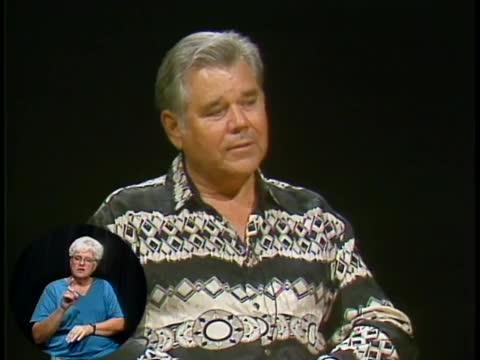
Our sign language interpreter this evening is Loretta McDonald, a reminder that dialogue is simulcast on Hawaii Public Radio's KIFO 1380 FM. Our listeners are urged to participate as well. All right, Merna Justice, what constitutes good financial planning? Well, I think it incorporates a couple of things, money accumulation, and the preservation of that money. So, on the accumulation side, you get involved with such things as investments where Bert is an expert and savings programs for school and for retirement. And on the preservation side, you get involved with things such as life insurance and estate planning. Bert, would you add to this? Well, I'm not a financial planner, as such. I concentrate on trying to interpret what the investment markets are going to do in the future, where the best places for your money on a risk -reward basis. You always have to consider
risk, not only the potential reward. So it's basically a very specialized area that financial planners should utilize. But the financial planning process incorporates wills, et cetera, and we leave that to people like Mr. Komatsu and David Larson, et cetera, Merna. Ruth, would you add anything to Merna's definition? Hmm. I think a good financial plan begins with an assessment of where you're at. What have you got? You know, it's maybe a net worth statement, a cash flow statement. But looking at where you're at and then deciding where you want to be. What is your goal? Is it for, you know, do you need X number of dollars for college education for your children? Is it X number of dollars a year for retirement? Then putting that plan into action. And then periodically, and I would say, at least every year, reviewing your plan that's put into action. But, you know, you start with where are you at now, where do you want to be, and then take some action? David, somebody comes to you and
obviously they're at the, they're looking toward the end. But what else is a lawyer? Do you tell them? Well, Dan, one of the things I'm here to learn tonight is from these three very well intentioned and well meaning and well intelligence to people on how to stack it up while I'm living, because I want to make a bundle while I'm living. After that, though, when I pass away, I want to be sure that my wife gets every penny that I've got and after she passes away, I want to make sure that I can get it all down to my daughter without probate and without inheritance tax. So that's what a lawyer really looks for, Dan. Bert, I have an Uncle Ben, Uncle Ben Remel, but every time I see Uncle Ben, Uncle Ben sort of grabs me by the lapels and he says, put your money in mutual funds, preferably grow funds and I'm going to do fine. Now this seems to be, this seems to be the doctrine now. Does anybody need you anymore? I mean, everybody's in mutual funds, right? You know, Dan, it used to be very simple. 20 years ago, maybe there were
50 funds that you had to consider for your investments and most people could do that by themselves. Now by some measures, you have over 7 ,000 mutual funds. There are many more mutual funds out there than there are stocks and a New York stock exchange. So once again, it's become much more complicated. Yes, people need some help in deciding which fund to go into and when to buy and when to sell. There's no investment forever. And that is where we try to be helpful to people in order to give them a nicely diversified portfolio. I see many times that people always try to go with the hottest sector. Technology, for example, has been the hottest sector this year. Most people have gotten into technology just the last few months because they have seen all the stories and business week and money magazine on how well technology has done looking in the past. So they say, well, I'm going to get in on this. Well, of course, in the last three months, technology has done nothing but go down. So telling people when to get in and when to get out is very important. You can't be perfect in making those decisions,
but we have developed a strategy over the years that allows us to at least get a good chunk out of the middle. We probably won't catch the exact top and the exact bottom. But if we can get a chunk out of the middle, that's good. I want to go back to the question somebody says right here, I have trouble with my finances. Is there someone I can call and really trust? I assume, how do we know you two are trustworthy? Don't you guys just hang up a thing that says, you know, Merna, Jessica, Ruth, Commodseup, financial planners? Well, when you're checking someone out, you look at their credentials. You look at how long they've been established. You ask for references. Almost all of my clients come to me on a referral basis from someone who has known me and worked with me. I'd say it's really important to look for somebody with credentials. You want somebody who's a certified financial planner, someone who's passed the examinations and all the education requirements, someone who keeps up with the continued education units. They're licensed with a national board. That's really critical. I think you also, like Merna said, you know, she gets people from referrals and I think
like when you look for a doctor, you might ask someone, well, who do you go to for this problem or that problem? And I think asking several people and getting referrals and then checking these people out, I mean, come talk to us. And if fit is good, then I think, and Ruth are probably agree, most of us have the initial interview is complimentary. So you get a chance to check us out to see if we're a good fit. In the same token, we look at you to see if we can be of assistance to you, if we can add something to what's happening in your financial profile. Well, somebody comes into you and they say, you know, I don't know anything. Here's where I am. What do you look for? What's your sort of your basic program for a person? What do you tell them they should have money in? Well, before they even should be investing, I tell them they need to make sure that the foundation is there. Do they have three to six months of emergency reserve set aside? If they don't,
I mean, this is money that they can easily get to should something happen and they have no income. Three to six months they should have set aside three to six months worth of living expenses. And only then should they even be thinking about getting into investments. Money to pay mortgage by food. Right. Keep the car going. Right. Right. And you need to make sure you have all your risks taken care of disability insurance, life insurance. I mean, who's depending on you if anything happens to you. And then get into whatever their goals are. Is it retirement? Is it estate building? Is it college education? Then you can talk about investments. But I really want to be sure that that foundation is there for you. Okay. I got savings. Let's say I've got savings for three to six months to take care of. Now, how much insurance should I have? Depends. What are you trying to protect? A house, the wife, the education for the kids, all that good stuff. I usually tell my clients, if anything happens to you, what would you like to have taken care of? Is it the rest of the mortgage balance? Is it the children's education?
What is it that you'd like to have taken care of? Should you be gone tomorrow? So when you hear these people say you should have so many 100 ,000 per what, how do you respond to that? Is there, there's not a magic formula? No, it's not an automatic formula. Sometimes people come to us and they're overinsured and we'll scale it back. Like what's overinsured? They have much more insurance than they need. So they're spending out money for premium for insurance that they, that is really too much. Well, what a, they can put it into their retirement program or some other savings program. Let me give you an example, Dan. Before the show started, you said that you had two young kids, one I think six and the other nine and 16, nine and 16. If you and your wife were to flop over dead tomorrow, hit by a car or whatever, we're gonna have to get those kids through college somehow, we're gonna have to get them through if they're going to a private school here, we're gonna have to somehow pay off the mortgage on your house. How are we gonna do all that? Do you have enough savings, Dan? I'm sure you do. Well, maybe
after tonight's meeting, you'll have some ideas for how to crank up that savings. But that would be a good reason for life insurance for you, Dan, is just to get your kids through college and then launched a little bit. Okay, so let's, we've got the insurance. All right, let's assume that we've got the, the thing we've got the insurance. Now what, now what should we do? Well, we need to look at accumulating money and how much you are going to need to keep you in the lifestyle you've grown accustomed to. If you're saving for your kids' education, we can do projections that will show how much you need in lump sum or if you're gonna start a regular savings program. And also to, because we're juggling many things at one time, you've got your emergency funds, your vacation funds, you've got some intermediate needs, maybe the children's education. And you have your financial independence, your retirement, whatever, so we're trying to fund several things at one time. Any, any? No, I think we have to look at timelines. Yeah. You know, the college education is a
shorter time frame than your retirement, so we need to fund that in a different way using different kinds of vehicles because of the time frame. Now what about, you know, those good people over there at American savings, they want me to bring, I have an account there, they want me to bring all my money down to them, right? And the guy over at the credit union wants me, somebody at the mutual fund got, what do I do? I mean, what percentage should go where? What kind of savings or projections should we, when do I go to Berk, you know, and start investing serious like? Well, I think then, after you've done your estate planning, your financial planning, that is really the first thing that you should do. I have sent a lot of people, I've recommended them to them that they go and get their estate plan done by an attorney, their living trust, et cetera. And after people have made a plan about their total financial situation, then they end up with a certain amount of money that they need to invest. Then they can come to us. Now we don't manage investments for
people, but we have advisory services, these are subscription services that people can subscribe to and they will give them great help in constructing a portfolio of mutual funds, for example, and a portfolio that's probably right for them. That's the last part. Now, I concentrate very much on investments that do not have any commissions attached to them. So, many financial planners will not recommend those type of investments because they need to commissions. I don't believe in paying high commissions. If you have a good source of investment advice, you don't need those. You can get into no -load funds very inexpensively and if you have the right advice, you can do very well with these funds. But the investment process is probably the final, but probably one of the most important is because if you do poorly on your investments over the long term, then all of the financial planning is not going to pay off. That's an important question. How do you guys make your money? Fees or commissions or a combination thereof? If I walk in the door, I know if I walk in the door with this
lawyer, he's going to start belling me at an hourly rate. Not right away, though, Dan. Not right away. Give me a couple minutes for free. Just to kind of feel each other out. Find out whether there's anything you can do for us right now. But what about you two? I mean, if I walk into you guys, the minute I walk in, I'm paying you. No. The first meeting is usually complimentary. So that's one of the things that will be covered at the initial meeting. How we get paid. And you decide right then and there whether you want to deal with a fee or you want to let the investments pay for our services, and that's when you get involved with commissions. So that if you tell me to invest my money in one thing or another, then you will make money off of those investments because the investment pays a commission. So they, but you're not likely to send me to Bert because he's not going to get me into the thing. Well, I have clients that would rather just pay me a fee, in which case we can use no load funds. It makes no difference because I'm not off the commission
or if there's a commission, I might use those to pay for the fees. Okay. I'm sure a lot of people are in my position, namely they've got to send a kid to college. College is classed in enormous amount of money now. And even the University of Hawaii, if you stay at home, is going up. So, so when should parents start planning for college and how much should they be putting away? Right when the child is born as much as you can. To start putting it in a fund, we call them a HUTMA, HUTMA. You can get them at the bank, you can get them at any brokerage house, you can get them from these ladies or from Bert, I am sure. And it is a separated little fund for your child. You put the money in and the money is there for the child when the child eventually goes to college. That should pay for college, if you put enough in. And it's called a what for a HUTMA? HUTMA. HUTMA. Do you really want to know what it stands for?
Hawaii, uniform transfers to minors, act, HUTMA. And you get some sort of tax benefit from doing it. What do you do? You do. Up to a point, you get a benefit. And from that point forward, once you put in a substantial amount of money and it starts earning a substantial amount of interest, then you really start to lose that tax benefit. Can you start before the baby is born? You can as a matter of fact, as long as the kid is liable to be born, as long as you have one you think you are going to have. But depending on the circumstances, you may not want the money. You might want to pool the money and set it aside for the education, but you may not want it in this HUTMA account, because there are pros and cons to that. How about, what do you say to the guy who comes to you, Bert, who says, I want to invest this money and you, do you ever tell a person, stay away from me? You don't have enough money to invest with me?
Yes, yes, we will. For the service that we have, which is called private portfolios, you should have at least $30 ,000 to invest. If it's less than that, then probably you would run into trouble with the mutual funds because every mutual fund has a minimum investment to start with. So you should have at least that much. And that doesn't mean that people cannot start with less. Well, I don't need to talk to Bert anymore. But people can start with less. Absolutely. You can buy a mutual fund. There are many mutual funds that have a minimum of $500 or $1 ,000. And you can start with one fund. I started many years ago when I was still in graduate school with $400 in the markets. And I learned very fast that I had to be in a hurry. I first tried all the traditional advice from a major brokerage firms and they got me into a sock that maybe went up and down an eighth to point a day. And finally, I said, this is no way I'm going to get rich with it, started with $400. And then I started day trading the markets and paying really good attention, doing my own
research and getting into more active issues. And then I started being very successful. But so there's a lot of work that people have to do. And I always tell people, you know, start reading books on the investment markets. You're talking about your life savings. That's worth reading a few books about. You know, many people think, well, it's so easy to invest. All I have to do is pick up the phone and call my broker and say, bye. You know, they wake up and I say, well, IBM seems like a nice stock. I just saw an advertising on TV. I think I'll buy some at IBM. That's not good enough. You know, you should really work at it. If investing were that easy, nobody would be working for a living. Everybody would just be investing, right? I see you shaking your head, man. Well, I founded my company based on being able to answer those questions that my broker was never able to answer for me, like how much money have I really made in the past five years? And by the time you're putting money in, taking it out, they, most brokerage firms can't answer that question for you. So I,
I provide reports to my clients that that bottom line them saying, hey, this is, this is where you are a year to date. This is what you've done over the past 10 years. And so that I make it easy for them to pay attention to their money. Because most people that come to me are not reading the books that we all suggest that they read. They are too busy doing the things that they're good at, earning a living, putting the money to one side, and they are trusting that we're investing at the way they feel it should be invested. So I make it easy for them to watch me and watch what I'm doing so that they can take some action. Did you follow the same policy? Yes. You were asking with our, you know, we ever turned people away. And I recall a young couple that came to me with an inheritance, some $50 ,000, and they wanted in a year or two to move to the mainland and go buy a house. But they wanted this money to grow real fast in the meantime. And you know, that's really unrealistic. And I tell people that you can't, you know, make money fast.
And that's a big risk. They have such a short timeline within which to buy this house that it would be a big risk to put this 50 ,000 away into some investment and even paying me sales charge or fees to get into this investment. So I tell them that they really don't have the right idea right at that point for that $50 ,000. They should not be investing. But your specialty is divorce planning for divorce, whoever plans for divorce. No one. And you read books about planning for divorce. You mad at the woman. She's mad at you. You were ready to kill each other, right? I mean, what's the chances of people? Gosh, you know, we plan weddings, but we don't plan divorces. I don't think anyway. And it's really, it's not, I sort of backed into it. People came to me after their divorces and I went, wow, you know, they come to me. They say, well, this is what I've got out of the settlement. Help me. And I always wish that I were there when they were in the process, you know, of the divorce and helping them make the
financial decisions. It's a really tough time to be making financial decisions. So emotional time, it's really good wrenching, I think. It's, it's really a hard time. I helped them to figure out where the, where are they going to go from here? Are they going to rant? Can they really manage to keep the house? What are the tax consequences of some of the investments? If they split the investment portfolio, you know, what are the tax consequences of each of those kinds of investments? Do they understand that some of these are limited partnerships that are not liquid? If they don't understand the tax consequences of some of these things that they may end up in, within the settlement, you know, it's really hard to put life back together after. But, well, what do you do? When you see somebody, a couple arguing, do you sort of get them inside and say, you may want my services in your car? It's, it's a difficult, you know, it's a difficult service to promote and advertise. I don't advocate divorce and I really, you know, try to get them to understand that two households cannot be run, but the same amount of money is one household. It's going to cost more to run two
households and no matter what, some belt techniques going to have to take place on both parties, parts. But if it's inevitable, I really think that people need to think through what their financial plans are for short -term and long -term and make sure that they're positioned properly to manage, especially if they're children involved. Sure. The financial difficulty just really no matter what affects them too. As a divorce lawyer, a friend of mine once said, don't. Is a gift worth $5 ,000 to one of the family members tax deductible, David? No, no, no gift to any family member or any human being is tax deductible. So on your 1040, which we all file on April 15, the only kind of gifts that are tax deductible are two charitable organizations like this television program. So I said, well, no, I can't make a pitch, you know, comment for the financial planners. Life insurance salespeople are saying they're saying their financial
planners to get information from prospects. Is this legal? What can be done? That's right. I haven't known a life insurance salesman, as it's said to me now, let's, we're coming in and we'll give you a financial, I don't think they say plan, they say profile or... Well, it's a kind of a catch -all term these days for anybody that's working in the financial services industry. I think you go back to, you really have to look at what the credentials and educational background is. Yes, they do some form of financial planning, but it might be a very narrow focus. In the case of Ruth and myself, we're certified financial planners. We have completed a course of study that looks at taxation, looks at savings, looks at retirements and different pension plans, and also a state planning. So we have, when someone comes into our office, we want to get a total picture of who that person is and where they're going. I think this question may be for you, it has a TSP plan, should he keep in
bonds or the market? Do you understand that? The Thrift Savings Plan, the Fertil Thrift Savings Plan, they have several investment choices and I think that's what that may be referring to. Do you have an answer? Should he keep in bonds or the market? Well, you know, it depends on the situation, age, what their goals are, how close are they to retirement? There's so many variables that there's no one answer for a question like that, it really depends. David, what is the difference between a living will and a living trust? We get this all the time, a living will is the direction to your doctor, that if you are terminally, hopelessly ill, you do not want advanced medical techniques, you want to be allowed to die in dignity, that's a living will. Living trust is a document like a will that says where things go when you pass away. The advantage it has over a will is that it does avoid probate, whereas a
will does not avoid probate. Now, I told you before the program came on that I didn't have a will and you looked at me as though I was the worst form of a vermin. I was just shocked, shocked, here they are, shocked, scandalous, especially for a gentleman with a wife and two young kids. If you and your wife, again, were to pass away without a will, you're going to have two problems. First, you have not named a guardian for the kids. The guardian is the person to whom the kids go and live with the guardian, and guardian wakes them up in the morning and sends them off to school and buys cheerios and baseball uniforms for them. That's one problem you're going to have. You haven't named anybody, so who are we going to point is the guardian. There's going to be a big fight potentially. That's one problem. The other problem is, if you don't have a will, your kids are going to get your wealth at age 18. Just think, Dan. A lot of CDs. I mean, that money is going to go right out the window by about 18 and a half. When your son inherits his wealth at 18,
it's by a bronchle. It's gone. You can kiss goodbye to those college plans, you know, so what you want to do is you want to make a will to nominate a guardian. You want to make a will to postpone the date at which your kids are going to get your money. Let's not let them have it at 18. Let's have them get it at 25, 28, 30. We can even do staggered distributions, a third at 28, a third at 30, a third at 32. Fala has $10 ,000 in a savings account now. How should I invest it? Right now, I'm recommending a balanced approach and then balanced means you have part of your money in bonds or bond funds and part in the stock market. I expect interest rates to go down considerably over the next two years. Down. I expect long -term bond yields to go down to about 5, 5 and a quarter percent. That's basically because of the very slow economy. Our interest rates are much
too high now given the current rate of inflation. So you can expect bond prices to go considerably higher. So first of all, you're locking in today's higher yields and you're getting capital appreciation on the bonds as they go up. But also advise people don't buy individual bonds. I see it so often, especially here, people are buying new issues of Hawaiian tax exempt bonds and so on. That's the worst way to buy a bond because you're paying a huge markup by the brokerage firm. This usually is spread of 8 or 10 percent between bid and ask. That means that if you buy a bond from a brokerage firm in small amounts like that and you go and resell it to them five minutes later, you've lost 8 or 10 percent of your money. Okay, I don't like to do that. Therefore, buy a bond fund, you're in there with a big pool. The fund manager knows what those bonds are worth, what he should be paying. He's getting the manager doesn't get any commissions himself and he pays the lowest commissions when he goes out and buy a bond. That's the way to do it.
I should be taking notes. But I'll take notes after we get back. We need a break here, but we shall be back in 60 seconds with more dialogue on personal finances, money matters. It's summertime and that means time to go to the beach. Then it can also be a time that many people dread. With so much emphasis on being thin and toned, it's no surprise the diet industry is making millions with pills, shakes, and sculpting machines. Hi, I'm Lynn Waters inviting you to join me on Friday for an encore presentation of dialogues first program of last season. Though we won't be taking any phone calls, there will be a lot of helpful information about the struggle to get from fat to fit on dialogue at Friday night. But I really look for in -depth coverage, I look for in -depth coverage. I like to watch PBS. PBS offers a banquet of programs. I like to keep informed.
A lot of time they don't have time to read newspapers and I've watched a lot of the different channels, but when it comes to my choice, I know I will never get the in -depth coverage from any other channel except to PBS. Welcome back to our dialogue on personal finance money matters. My name is Dan Boylan. Our phone answers this evening are from American Savings Bank Consumer Loan Department. They will take your calls for our guests at 955 -7878. Neighbor Island residents, of course, may call a collect. Someone calls in and says, I am a self -employed carpenter. I can only put away $100 to $200 a month. What would be the best option for me? Actually, after taking a look at him, it's hard to say for sure, but I'd probably have him put some in an emergency fund and maybe a little bit starting in a mutual fund where they could go and maybe split it or have $25 to $50 a month in a mutual
fund to make sure he had the emergency money handled. Agreed? Agreed. And you'd also ask him if he's getting along with his wife. Right. And if he has children, does he have a well taken, you know, done and living trust? And does he have, you know, adequate insurance? I mean, there are a lot of questions to ask before you start putting their money away in investments. You guys also look at disability insurance and that's one of the things. Absolutely, but frankly, when we're doing financial planning, the very last thing that we do is put in the recommendation on the investments. Callers single and has no dependent. Should she buy a life insurance policy? Depends. Is there anybody she needs to leave this to? She may be single, but she may have people depending on her, like her parents or brother. If she's not around, are they going to be able to take care of themselves? She might feel a responsibility there. Or she may be charitable minded and would like to leave something to her family. Maybe a rich charity, then a life insurance policy makes
perfect sense. David, Caller has a living trust, wants to revise it. Should he go to the original lawyer or use a new lawyer? Well, if he was happy with the original lawyer, I think the original lawyer could do the job very adequately. If the person is a little who -who with the original lawyer, then go out and find another lawyer. A change to a living trust is very, very simple to make. Very simple. Tell me what I'm supposed to do with a living trust again. Living trust avoids probate. Avoid You don't want to go through probate when you die. I don't want to. My wife, your wife, nobody wants to go through probate. It's time consuming, 18 months. It costs about 5 % of what goes through probate. You avoid the 18 months. You avoid the 5 % with a living trust. It's also, will and probate is public knowledge. So anything that is in your will is open to public observation. That's exactly how we found out what was in Chief Justice Berger's will this past week, week and a half ago, because he just
rode out of will if he'd had a living trust, and none of us would have found out what was in his will. After I'm gone. Yes, and Jackie. Jackie Onassis too had a will, and here she was a very, very private person all of her life. Bert, explain the difference of trading in a margin account versus a regular brokerage account. Well a margin account you need at least $5 ,000 with your brokerage firm, and then that allows you then to buy stocks or with some firms, even mutual funds, by borrowing money. You can actually, for $5 ,000, you could buy $10 ,000 worth of stocks or mutual funds. So it is more risky, but you can also make money faster. If you're right on the market, you get twice the kick for your money. If you're wrong on the market, of course you lose money twice as fast. Bert, how do you make your money if you tell people to go into no load funds? They pay a subscription fee to our service. Oh, to your service, that's your, I'm sorry. So we have no axe to grind. I can tell
people all year long to stay in money market funds if there are no opportunities and it doesn't affect my income. People who are on a straight commission, they always have to come out with a recommendation in order to get that commission. And sometimes they should. In your mind. But if you know the mortgage payment is due, I suppose you have to make a recommendation. We don't have that pressure. What are the advantages? Oh, I ask you that. I'm sorry. Oh, please answer this question to all panelists. What investments are you personally into? Come on, Rick. Let's have it. I have my IRAs in some growth mutual funds. I have, I have puttin' new opportunities, fidelity growth. I have a Oppenheimer equity income, kind of balanced middle of the road. But balance is the key. Well, you know, I figure retirement's a long way away for me. I have kids still in college,
so whatever I did put away back then before I started making all these tuition payments, it really needs to work hard for me. And I have a long timeline, so I feel like I can take some risk. And it is going to go up and down. It has been going up and down, mostly up recently. But because of that timeframe, I feel like I need to be in those kinds of funds, where there is a little bit more risk, but there's opportunity for much more growth. Murna, where's your money? Primarily, mutual funds, fidelity advisor, Oppenheimer, Putnam. I'm using some of the same ones she's using. And in my pension account, I have more money there, and I'm actually using a private money manager. Bert? Well, I have divided my money up in three different chunks. One is my long -term portfolio, which is strictly mutual funds. More intermediate -term portfolio, in which I buy stocks and sell stock short. Selling stock short, of course, you're betting that the stocks are going to go down, and you can make money that way,
too. And then the short -term trading portfolio, which I really enjoy, and it involves trading futures and options. It's much more risky, much more volatile. I get up many times at the 2 .33 o 'clock in the mornings to trade the foreign currencies around the world, but it's a lot of fun. Some people like to go to Las Vegas. I save myself the airfare and do it right from home for my credit. David, where do you look at this? I've got about 60 % of my money and mutual funds and stocks, and just a whole variety of mutual funds, none with one single broker. I've got a bunch of brokers, and I've got a bunch of different strategies. I've got about 30 % in bonds, and again, no particular strategy there, but just try to spread the eggs out in a whole bunch of different baskets, and about 10 % in cash, and liquid readily grabable money. If a spouse dies and a house is sold, is there a capital gain tax when the house is sold for
less than the appraisal price? There would be, wouldn't there? There would be. That really depends on how the surviving spouse got the house. If the house belonged entirely to the dead spouse, and then when the dead spouse died, left it to his wife, and it was appraised at $100 ,000 at that point, if she then sells it for less than $100 ,000, there's no capital gain. Question for Bert. Bert, you mentioned bond funds. What should the call or buy? Government or private company issue? In our private portfolio series, I recommend several different bond funds. One is US government bond funds. Either you can buy zero coupon funds, which like the Benham Target funds, they invest in US Treasuries, which are zero coupons, it gives you more bang for the buck again. If the normal treasury bonds go up 10%, then you can probably make 20 to 30 % gain on these bond funds. Also corporate bond funds, like the strong, corporate bond fund,
it's the name of the fund groups, the strong group out of Milwaukee. The Benham European Government bond fund, which invests in the European government bonds, I like the European bonds because interest rates in Europe are very high. The economies are virtually flat, there's no growth, they're overtaxed, and they're going to be overtaxed from here to eternity. So the economies have no chance of recovering over there, and interest rates will go down. The bond markets love weak economies, and that's why the US bond market is going to do well too, because Washington will continue to kill our economy, so we can bet on that. There's no growth ahead, and if you would tell the bond market is going to be a depression next year, the bond market would skyrocket upward, it would be good for us. That's why, so many times I have to smile when the bond market is down, and they say on TV, well the bond market is down because they don't like this deficit package. The bond market loves a weak economy. If they would come out with a package cutting taxes and really
doing something to assure good economic growth, then the market would go down, because the bond market does not like prosperity. As a trustee, I have been advised that the estate money should be handled by a money manager. What are the pros and cons of this? Well, let me just start out with the trustee's liability. The trustee is legally responsible for all of that money, and that means that if things go down under the trustee's tutorship, there are going to be some questions asked of the trustee. So the trustee ought to get some professional assistance. Now, whether that means going to BERT, or to one of these ladies, or to First Hawaiian Bank, or to Hawaiian Trust Company, or to Merrill Lynch, or to Dean Witter, that's going to be up to the trustee. Someone's called in and wants to know what are those books. You said people should read books about investment bank, you're investing. What's the first book you would advise
them to read? Well, it all depends on the individual. I like technical analysis. That has really helped me in my investment career for 35 years. And technical analysis of the markets used to be called Voodoo, 20 years ago. Now, every Wall Street firm has a big technical analysis department, because technical analysis works. That is what allows you to time the market when to get in and when to get out, okay? So I would get a book on technical analysis. Stan Weinstein has a good one out. I would get another book, all who is the guy from Magellan, Peter Lynch. He wrote two good books. I think one of them probably suffices that tells people a little bit about how to invest. I think people have to learn that not every investment is going to be successful. I have found that the most successful traders in the world, they will tell you that 90 % of their gains come from about 20 % of their investments,
okay? They make mistakes all the time. The thing about successful investing is to cut your mistakes short. Don't let a small loss turn into a big loss. So set yourself before you go into the investment. Decide where you will sell it if it goes against you. Not after you've bought it, because then you can no longer make an unemotional decision. You have to do it before you go into it. If you buy a stock at 50, you say to yourself, okay? If it goes down 8%, or 10%, or 12%, these are stop points, as I would say. I will get out and look at it from the sidelines. It could be that he's still correct on the investment. He's just wrong under timing. So then he'll watch it from the sidelines. That's a lot less expensive when an investment is going down. And then when it starts picking up again, he can get back into the investment. So risk management in your investment is the most important thing. You don't have to know the future. You don't have to be a guru and sit around with your legs crossed in a turbine on your head. You risk management. Where were your turbine lines?
That's in my office, actually. In my crystal ball, too. In fact, I have a crystal ball in the office. The staff gave it to me one time with Christmas. Both husband and wife are retired in their 70s. Since CDs are dropping, should they get into mutual funds? Depends on how much wealth they have, frankly, and how much income they need. Many of my retirees have a combination of stock and bond funds and to supplement their income and to continue to grow for their future needs. Someone called, you mentioned Jackie Kennedy a while ago. Someone called and said, what do you think of her given all her stuffed her kids for a buck? Does that seem right? Giving all her, what did you say? Well, why do the, what do the panel think about the Jackie Kennedy selling all her property to her children for a single dollar? Oh, well, I can comment on that. I haven't heard that story, but I hear it almost on a weekly basis in my office. People come in and they hear, oh my gosh, there's going to be an
inheritance tax when I die. I know how to avoid it. I'll sell my house to my son for one dollar. Well, you can do that. The catch is there's going to be a whopping gift tax. There is a gift tax because the value of the house far exceeds the dollar that you got back. And the differential between what the house is worth and the dollar you got back is a gift. And you have to report that to Uncle Sam. David, well, someone called and said, you mentioned Huttma Kahn's. What are the pros and cons of this vehicle? Well, one pro is that you've got a nice discrete little bucket there that you can throw the money in and that belongs to little Jennifer. One of the cons is that that money, if it is not spent before the kid is 21, has to be turned over to your daughter at age 21, a disaster, at least for my daughter. David, does not trust you.
Do you get that feeling? Is a home, I agree with him. Is a home a good investment in a Y at the present time? Depends. A home is a roof over your head. Now, if you're buying investment property, that's another question. But, frankly, many people should not look at buying a roof over the head as an investment. You know, that's someplace they have to live. If they're going to get returns on it, they must sell it and move someplace else. A lot of people like to speculate with their home and that really worked in the 1970s and the 1980s. But in the 1980, my forecast was that the decade of the 1990s, with 10 years, we're going to see disinflation or deflation. And it was no time to look at real estate as an investment. Right now, the renter is much better off. Real estate is not going to go up in Hawaii. There are the Japanese boomers over when the Japanese bubble burst, the Hawaii bubble burst. And now, we have to pay for the sins of the past. And that sobering up period is always directly proportional to
the amount of fun you had at the party. And we have a lot of fun at that party. Oh, yeah, we did. When will the inevitable market correction happen? In 1996? Where's your crystal ball? Well, yeah, I wish I had that crystal ball here. Everybody's been expecting that correction for about the last nine months. It has not occurred yet in the general market. And it probably will not in the general market for some time. But we're having a humbling of a correction right now in technology. All of the darlings of three months ago, micron technologies, et cetera, they're down 40, 50, 60 percent in the last three months. And most people haven't even recognized that. So we have seen a big correction. And it's not over. You just wait till Microsoft finally has to admit that Windows 95 sales are a big disappointment. And you see what technology and then computer stocks will do. Right now it's the chip stocks that have been hit. Then it's going to hit the entire technology sector. So technology is not something you want to be in. But there's some other very good areas. Because now you have money flowing from technology to smart money
managers. I've taken their money out of technology. They're putting it to work in other sectors like the health sector. That's a good area to be in. The utility sector is a good area to be in. You take a look at those mutual funds that going very steadily but nicely upward. Caller has a 401k plan. What's a 401k plan? A type of retirement plan. No. We'll retire in three years. What is the best strategy to invest to avoid taxes and have an income stream in three years? I'll try that again. I'll repeat the question for you guys. I know two guys were pretty out of my group but maybe I'm wrong here. Caller has a 401k plan now. We'll retire in three years. What is the best strategy to invest to avoid taxes and have an income stream in three years? I'd like to know how he's going to avoid taxes because the money that he put in there he's never paid taxes on it. So when he starts taking the money out for his retirement that's when the taxes become due. But he could buy some tax
credit programs. Now that's a bet. That's very good. The taxation of that 401k money because that's probably the only way he can avoid it. He can offset it with some tax credit programs. Do you guys ever get together for coffee? You know, you won't help each other. Yeah, you didn't take it off. I didn't mean that. So that'd be fun to watch. Do financial planners also take care of tax filing issues? I don't. Some do, but I personally don't. In my office, I provide them with schedules to take to their tax repairs for their dividends and interest and another schedule for their capital gains. And so that pretty much takes care of it. What is the tax rate, David? Someone wants to know for an inheritance worth over $600 ,000. Starts at 37%. So the next dollar over 600 ,000 is going to get taxed. That next dollar at 37 % and it goes up, the more you have, the more you pay, goes up to 55%. Once
you get over three and a half million dollars. Dan, you and I don't need to worry about that. But there are financial planning techniques you can do to take a big chunk out of that bite in your estate. Well, I think that's a good point. That's really what lawyers who practice in the estate planning area do. Not only do we make the wills and the living trust to make sure your kids Dan have a guardian and don't get it at age 18, but we're also very conscious of these inheritance taxes. They start at 37%. That is a huge chunk out of one's estate. So we're very conscious of that and there are lots of things that we can do to reduce or eliminate those taxes. Is there a minimum amount necessary to establish a living trust? No. 10 ,000, 20 ,000, you know, whatever. It just depends if a person has a bank account and a few stocks and maybe even a condo or maybe even not a condo. If they don't want to go through probate, they should be talking to
somebody about getting a living trust. Again, someone calls another call in Huttma. He wants to know that tax advantages of Huttma. Are there tax advantages to Huttma? Well, prior to the time, the child is 14. There are certain credits and exemptions that the income gets that is earned by a Huttma. After the child reaches 14, then those, some of those credits and exemptions and deductions go away, but other ones step in place. So you don't really set up a Huttma to avoid taxes or to reduce taxes. That really isn't the purpose. The purpose is to get a college fund going for the child. Yes, unless you're very wealthy, that tax advantages are not worth it. Yeah, they're just, they really are not worth it. But what do you think about a local tax -free fund? Well, there's some local tax -free funds that have what I consider very high commission. Load. In fact, you know, someone at the front end load will take you about a year's worth of interest while they're
about to just pay for that load. So one year, your money is not working for you. It's working for someone else, the salesperson. I don't like those kind of investments. There are so many no -load funds out there. Why not buy a no -load fund? Unless you think you really need that advice from a person that sells it to you. You really think that you are getting impartial advice. Those are a lot of ifs. What does a person have to pay for your newsletter? Well, the Wellington Letter is $450 a year. Our private portfolio service that gives you a specific portfolio of mutual funds. And we supervise that. We'll give you exact buying cell signals when we get them from our strategy. That's a little less $45 a month. So, so how do you spend your life? Do you spend your life in front of a computer looking at company reports and stuff like that? Well, I can't tell you everything about my business. Come on, come you can tell me. The working part of my life, I spend a good part in front of the computer. Exactly. We have
fantastic computer software that we've developed over the last 18 years. And it's incredible what you can do with computers nowadays. It used to be that you needed a whole room full of computers to do the kind of analysis that we do now on a PC. You know, scanning 7 ,000 mutual funds for their, you know, see what is in their portfolios, how they have performed, who the money managers, how long he's been there, etc., etc., the volatility, the sharp ratios, etc. This is something that the average person could never do for himself. Someone wants to know, what's the cost of using a financial planner? Fees, very, my fees are $100 an hour. My run a little bit more than that, but I also manage investment portfolios. There are a large number of financial planners who are unqualified. How do we distinguish good from bad? No, we have to credentials. Go back to credentials. You can call the institute for certified financial planners or the CFP board. Certified financial planner, board of standards, and you can find out if these people are licensed. You can give them the name and they'll tell you what the person's license is. Is that
a guarantee that they're good? No, no. That's just like a dentist or a doctor or an attorney, right? David, this was called in by your publisher. David Larson wrote two books. What are their titles and were they written for normal people or people in his field? Go ahead, David. Oh, how nice of you to give me this picture. There are really two books. One's called, who gets it when you go and the other is called, you can't take it with you. And they're both for the lay person. I think the most complicated word I use in both books is will as in last will and testament. So it's not for lawyers. They are deliberately not for lawyers. They are for just general people who would like to know a little bit about wills and trusts and probating inheritance taxes. This woman called it quite early and I've looked at her card. She owns property in Kahala is cash poor but looks good on paper. How can she afford to set up a trust? I don't know. It just
isn't going to be that expensive. No. It's going to be I'm trying to think now across the state what a lawyer might charge. Maybe somewhere between $500 and maybe $1 ,500. That's all a trust is going to cost. It doesn't need to break her. Most lawyers will allow her to pay if and when she gets her money. You know, they'll stretch her out on installment payments over the next five years or whatever. There's no rush. Then I'm wondering why she says she has property in Kahala. Maybe that's investment property. Maybe she wants a charitable remainder trust or something to provide her an income stream. So she doesn't have to be cash poor or maybe a reverse mortgage. What's that? Tell me that. Reverse mortgage allows you to use the equity in your home while you're living. Instead of making mortgage payments to the lender, they're making payments to you. You can either get monthly checks from the lender or a lump sum. You have to be over 62, I believe, and there has to be no debt on your house. That'll never happen. How can a retired person living on a fixed income increase her income? That's tough.
How can a retired person living on a fixed income increase her income? Maybe she needs, maybe depends what she's invested in. She invests for a better return. As they say, junk bond funds. She's getting this. Junk bond funds, in fact, it's a misnomer. Some of them are very good and they're yielding substantially more than CDs. CDs, you might be getting what? Three and a half percent. Something like that in Junk bond funds. You can get the level of 12 percent. Utility stocks or some good dividend stocks? Utility stocks. They'll yield you to about 8 percent. I want to buy into a mutual fund without going through a bank or a broker. How do I get the information I need? Call all the mutual fund directly. But how do you know which mutual fund to buy? For that, you have to subscribe to the newsletter, such as... Or see a financial planner who can get you some guidance. A retired person. How much disability insurance do you need? Quick. I need it quick.
If they're retired, they have no, they don't need any. What income are they protecting? What earnings? I don't have that information. Ask me nothing. We're out of time. Our thanks to Ruth Komatsu and Merna Justik, David Larson and Bert Doman for their wise and free financial counsel tonight. Next week, Lynn Waters will return with a dialogue on shared rights and responsibilities, world -aged day. Until then, for all of us at a Y Public Television, thank you for watching Dialog and Good Night. It's brought to you by Hawaiian Electric Company, People with a Powerful
Commitment.
- Series
- Dialog
- Episode
- Personal Finances: Money Matters
- Producing Organization
- KHET
- Contributing Organization
- PBS Hawaii (Honolulu, Hawaii)
- 'Ulu'ulu: The Henry Ku'ualoha Guigni Moving Image Archive of Hawai'i (Kapolei, Hawaii)
- AAPB ID
- cpb-aacip-225-32d7wq01
If you have more information about this item than what is given here, or if you have concerns about this record, we want to know! Contact us, indicating the AAPB ID (cpb-aacip-225-32d7wq01).
- Description
- Episode Description
- Repeat broadcast of DIALOG. Modertor: DAN BOYLAN, Guests: MERNA JUSTIC, Certified financial Planner, RUTH KOMATSU, Certified Fiancial Planner, BERT DOHMEN, Investment Analyst, DAVID LARSEN, Attorney, Estate Planning
- Copyright Date
- 1995
- Asset type
- Episode
- Topics
- Public Affairs
- Rights
- Copyright, 1996
- Media type
- Moving Image
- Duration
- 01:00:19;08
- Credits
-
-
Director:
Charlotte Simmons
Producing Organization: KHET
- AAPB Contributor Holdings
-
PBS Hawaii (KHET)
Identifier: cpb-aacip-6a50cbeff82 (Filename)
Format: Betacam: SP
Generation: Dub
Duration: 00:58:27
-
'Ulu'ulu: The Henry Ku'ualoha Guigni Moving Image Archive of Hawai'i
Identifier: cpb-aacip-325d2ea7288 (Filename)
Format: Betacam: SP
If you have a copy of this asset and would like us to add it to our catalog, please contact us.
- Citations
- Chicago: “Dialog; Personal Finances: Money Matters,” 1995, PBS Hawaii, 'Ulu'ulu: The Henry Ku'ualoha Guigni Moving Image Archive of Hawai'i, American Archive of Public Broadcasting (GBH and the Library of Congress), Boston, MA and Washington, DC, accessed May 16, 2026, http://americanarchive.org/catalog/cpb-aacip-225-32d7wq01.
- MLA: “Dialog; Personal Finances: Money Matters.” 1995. PBS Hawaii, 'Ulu'ulu: The Henry Ku'ualoha Guigni Moving Image Archive of Hawai'i, American Archive of Public Broadcasting (GBH and the Library of Congress), Boston, MA and Washington, DC. Web. May 16, 2026. <http://americanarchive.org/catalog/cpb-aacip-225-32d7wq01>.
- APA: Dialog; Personal Finances: Money Matters. Boston, MA: PBS Hawaii, 'Ulu'ulu: The Henry Ku'ualoha Guigni Moving Image Archive of Hawai'i, American Archive of Public Broadcasting (GBH and the Library of Congress), Boston, MA and Washington, DC. Retrieved from http://americanarchive.org/catalog/cpb-aacip-225-32d7wq01