Dialog; Hawaii's Economic Outlook II
- Transcript
You You Why is businesses just can't seem to sail through the economic
doldrums? The state is now in its fifth year of slow growth, and the council on revenues predicts next year will bring more of the same. Yet some people say that no growth is an economic blessing. Others argue that small business suffers the most and gets the least attention from those working to stimulate the economy. We'll try to give voice to both points of view this Friday at 8 when dialogue looks once again at Hawaii's economic future. Hawaii's businesses can't seem to sail through the economic doldrums. The state is now in its fifth year of slow growth, and the council on revenues predicts next year will bring more of the same. Yet some people say that no growth is an economic blessing. Others argue that small business suffers
the most and gets the least attention from those working to stimulate the economy. We'll try to give voice to both points of view tonight at 8 when dialogue looks once again at Hawaii's economic future. We'll try to give voice to both points of view tonight at 8 when dialogue looks once again at 8 when dialogue looks once again at 8 when dialogue looks once again at 8 when dialogue looks once again at 8 when dialogue looks once again at 8 when dialogue looks once again at 8 when dialogue looks once again at 8 when dialogue looks once again at 8 when dialogue looks once again at 8 when dialogue looks once again at 8 when dialogue looks once again at 8 when dialogue looks once again at 8 when dialogue looks once again at 8 when dialogue looks once again at 8 when dialogue looks once again at 8 when dialogue looks once again at 8 when dialogue looks once again at 8 when dialogue looks once again at 8 when dialogue looks once again at 8 when dialogue looks once again at 8 when dialogue looks once again at 8 when dialogue looks once again at 8 when dialogue looks once again at 8 when dialogue looks once again at 8 when dialogue looks once again at 8 when dialogue looks once again at 8 when dialogue looks once again at 8 when dialogue looks once again at 8 when dialogue looks once again at 8 when dialogue looks once dialogue is brought to you by Hawaiian Electric Company,
People with a Powerful Commitment. Why is unemployment rate dropped at 10th of a point in August? A friend of mine in the Building Supply Business tells me things seem to be getting ever so slightly better. Business people throughout the islands look for some sign however fleeting that the pace of the economy may be quickening. Business people throughout the islands look for some sign however fleeting that the pace of the economy
may be quickening. Business people throughout the islands look for some sign however fleeting that the pace of the economy may be quickening. Business people throughout the islands look for some sign however fleeting that the pace of the economy may be quickening. My name is Dan Boyland. Tonight we bring you dialogue second installment on Hawaii's economic outlook. Our guests include folks from both inside and outside the governor's high level task force discussions. By the virtue of his position, State Senator Mike McCartney is at least tangentially in on the process. An educator by training Mike is a co -majority leader of the Senate. It will be his task along with that of the House leadership to move the governor's economic plan through the legislature. David Frankl didn't make it in. A University of Hawaii trained planner and attorney Frankl serves as the legislative coordinator for the Hawaii chapter of the Sierra Club. He is the author of protecting paradise a
citizen's guide to land and water use controls in Hawaii. Fetty Tatum did not make it in either but then she did a little bit but she's complaining loudly. Miss Tatum is the Hawaii director of the National Federation of Independent Business, the largest small business advocacy organization in the United States. Miss Tatum hosted television program of her own Hawaii for Business, a biweekly community affairs talk show, an ABC's KITV4 that's been on almost as long as dialogue. As a majority leader of the House of Representatives Tom Okamura is part of the House leadership. As a financial services officer for the sales and marketing division of the Bank of Hawaii representative Okamura is as close as you can get to seeing firsthand the ups and downs of a wise economic market. Alan Murakami is outside the tent as well. Alan is the litigation director for the Native Hawaiian legal corporation. He also chairs the community -based economic development advisory board
which helps communities strengthen themselves by developing viable economic development projects. Our guests are all shy, reserved people. They need to be brought out of their shells by your questions and comments which can be answered by calling 973 -1000. Neighbor Island residents may call us collect. 973 -1000 again is the number. And the phone volunteers answering our calls this evening are members of Siroptonis. Siroptonis I messed it up after asking you, International of Honolulu. And our sign language interpreter is Loretta McDonald. If you're running out of the door right now and don't want to miss the discussion, tune us in on your car radio. Dialogue is simulcast on Hawaii Public Radio KIFO 1380 AM. Let's start with those who are involved in this whole process. And Tom Okamura, I know that you are. How is this task force proceeding? What is it doing? Are any proposals shaping up as yet?
I think it's a very exciting process. The economy is our biggest issue facing Hawaii. And let me just clarify however that this task force was strongly convened by the speaker, the Senate President, and the governor. And the intention was to bring together people throughout the community to address the economy of Hawaii to come up with some real heart -heating solutions. And we have a task force made up of 27 members. It was intentionally set up where there would be the least amount of elected officials as possible. So we only included the governor, the speaker, and the Senate President who represents all elected officials. We wanted to get a good cross -section and this is the first time that we are having government, business, labor, academia, and others coming together to address the issue. Does that mean you are not attending task force meeting? No, I am not a member of the task force. Are you attending me? We
attend as a planning group, but we are not members of the task force. We just help coordinate and make sure everything falls in its place. What do people do the speaker and the governor and the Senate President expect to have come out of this? Well, I think they have very high hopes and expectations that they really feel that it needs to be a change in the political paradigm and change in the economic paradigm to do something very different. And as Brad Mossman from the Department of Business and Economic Development and Tourism said that our economy, if you look at Hawaii, the world has changed more than Hawaii has changed. And we are a global economy and Marcus Oshiro talks about Hawaii being an island state, an island nation. And we need to look at it that way and we need to position ourselves so that our children have a future and an opportunity to have choices. So I think the hopes are very high and people are optimistic. We have a lot of work to do yet because I think we are just beginning, we are at halftime, we are in the locker room. And it is a Notre Dame game and we are winning 3 -0 and everybody says, well, I don't believe it. And we have a lot more to go. Is the
expectation a legislative package? It is a combination of legislation for an accession. We are looking at short -term and long -term goals. It is also rules and regulation changes within the administration. We are also hopeful that business and labor, they also may be probably will be making certain changes and concessions. So this is a concerted effort for everyone to look at what are the long -term needs of the state and everyone making some sacrifices. Betty Tatum, you are not on the task force, are you? No, I am not. But you are where? I am on a working group, but I have to smile when I hear my friends from the legislature say, you know, this is the first time this has ever happened and so forth and so on. You know, I am a born optimist, but a pessimist is an optimist with a lot of experience and a good memory. And I was on in 1983, George Arioshi called a task force, a conference on doing business in Hawaii. On that task force were labor, academia,
I was representing small business, there was big business, I mean it was really a good task force. I happened to look at the report that came out, although I remembered most of the things that came out, the very same things that are coming out today. The very same things, and this was 14 years ago, we were saying then, everybody was saying there was a problem 14 years ago because there was an anti -business attitude in Hawaii. And that has not changed. Now, I'd love to go back to the optimistic portion and say, okay, let's erase the past, let's erase it, and let's say something is going to come out of this. The work group, I'm on the business climate work group, they have five work groups under the task force. What are the fun? I don't. Business class. Tom, what are the economic development, business climate, taxation, education and workforce development, and what does that one more? Education, no. I think you've got five there. That's fine. Okay. Well, I'm on the business climate work group. And how many members are in there? Oh, I don't know. They've added four Wednesday. Originally, I worked 24 originally
because we looked through to see how many were small business people, even on the work group of business climate, and there were eight at the time. And each task force has about that number of people? Yes, they do, about 24 each. And then the task force itself, the main task force has how many? 27. So that's 150 people plus the 27, 180 people. Why couldn't you find a place where people who are environmentalists like Frankl? I certainly not. I thought the ones put it together. We do have an environmentalist. Represent with this. Patricia Cummins from the Big Island was a very well -known environmentalist. A wise environment. Her newsletter. What are 1000 friends? And that's on the business climate. That's right. The lady from 1000 friends, David. We have two out of over 120. Yeah, judging is on the task force. Yeah, judging is on the task force. And he made it very clear at the first task force meeting that he is going to be a real advocate for the environment. And let me also add to, however, that all of the people that are on
the task force, all of them recognize and have stated that the environment is one of our strong assets. And nobody is going to do anything to ruin the environment because that is our future. That is what brings in especially tourism for Hawaii. And I think the other point about participation. We have a very aggressive public information, public gathering information program that's going to take place. And what we're telling people is we have these sheets, we have these forms. We're on the internet. We're telling people, have your own meetings in your own home. Have your own task force. Just because we have a task force doesn't mean you can't have one. And go meet in your homes and your offices. Send us that information. We have a whole team of people ready to bring that information to the task force and have that kind of input. So it's not just a dialogue with 180 people. I feel guilty because I didn't let Betty finish her complaint about small business not being involved. Well, actually, I know people came back and said small
businesses involved. But their small business is the backbone of the entire economy. And small business in 1995, two years ago, had the Hawaii Congress on Small Business, which was a two -day conference, including small business people from all over the state, working hard for two days to bring in what would help this business climate because we were going downhill and people were moving out in droves. We came out with 20 marvelous recommendations. The first five being what's coming out now in this work group. And did we get heard? Did anything pass out of those 20 recommendations? One recommendation passed that had to do with limited liability companies and limited liability partnerships. That's the only thing that really passed. So what, it's kind of exciting to me to say here's small business who has recognized the problem and has given the solutions but has not been heard. And today, it's the key people, the administration, the House, the Senate. And I might say, we haven't had that much trouble with the House. I
just have to say that, the small business community. But anyway... Off camera, there was a pat there for the Senator. But anyway, what's thrilling is that now, finally, it's recognized that jobs and the economy is number one. Betty, a few minutes ago, you define yourself as a pessimist, you're sounding like an optimist now. David, frankly, you don't like to make up of this. Well, you know, I think it's interesting that Betty says, 14 years ago, people came together, small business, a bunch of other folks interested in the economy. And they came up with all the woes and all the prescriptions. And nothing was done. Well, the economy, 10 years ago, five years ago, was booming. Tells me that the prescriptions and the woes that some small business people are talking about, the Sam Slums of the world, they're just... It's a broken record. These are the same things they're always talking about. And there's nothing to do with what is going on in the economy. It has everything to do with what's going on in the economy, David. Small
business is the backbone of the economy. When small business leaves this state, which it's doing in droves, that's why the revenues are not coming in. Without the revenues, how can you have programs that everybody wants? I mean, it's just so simple. I'm not disagreeing that small business is important. What I am saying is the prescriptions that were prescribed 14 years ago were not adopted. The economy boomed and now it's busted. The prescriptions that you talked about had nothing... didn't weren't adopted and yet we had a boom. There's all this mantra of getting rid of regulations that protect the environment. Well, getting rid of regulations that protect the environment aren't going to do anything for the economy. In fact, they're going to worsen the economy in the long term. You know, I don't really know anybody that doesn't love our environment and want to protect it, including small business. What small business wants is common sense in regulations, both federally and statewide. And I think that if we had a long time, we could
discuss that there are a lot of common sense... common sense ideas that are overlooked. And people in too many... I hate to say radical environmentalists. I don't want to call you a radical environmentalist, but too many are... Well, David, you're a radical environmentalist if I ever saw one. Because, you know, everybody does some good. But not when it comes to the economy. I mean, when you're putting regulations outlandish regulations... Name one. Small business. Name one environmental regulation that's outlandish. I can tell you one being from... I've lived here 33 years, but I was born and reared on a farm in Iowa. And I can tell you one federally. And that is... It's ridiculous that they're worried about the gas coming from the pigs and the cows. You know, they eat and pass gas. They're actually worried about this, and they're making the farmers do
some of the most ridiculous... I was brought on a... Regulation. There's no regulation. Look up. Look it up federally. Depending on how close you are to the cow at that moment. Alan, why aren't you on that task force? Have you figured this out? No, I haven't. I chair the Community -Based Economic Development Advisory Council for the Department of Business and Economic Development and Tourism. Tea got stuck in there as you know in recent years. And our concern is... And trying to sift through all of this dialogue so far... is maybe more to deal not so much with what everybody wants to do. Because I think this general agreement about all the good things that people want to do. I think the general maybe disagreement if there's any. And there's probably not just two sides to this. There's probably ten or more. But what I see coming from the perspective of the Seabed Advisory Council is that the process is messed up. What I see as being more helpful to this environment and this economy, which shouldn't be viewed separately by the way,
is that there needs to be a grassroots grounds up approach to attaining a shared vision of Hawaii's economic future. If you go about appointing people, and basically as I read it in the newspapers and I don't know if this is true, the idea was to get the movers and the shakers together in order to get this economy going again. You know, my initial gut reaction was, well, there are the people that got us here in their first place. Why are you going to ask them? I mean, we need to ask the people who are affected. The people whose children cannot come here because there's a brain drain, because they don't have economic futures. The people who look at $10 million emergency appropriations to the HVCB and they can't get enough money for their schools. And I looked at the paper deal just this past week. Our tax revenues are down 9 .6%. The tourism count is down in three of the last four months. What have we gotten for that $10 million investment in our economy? Alan, whenever I hear that discussion though about
community -based economic development, I always find myself coming back and thinking about the problem at least of political apathy and the problem that one's finds with people being so stressed out and having so many things to do that they haven't got time to get involved in things. Is what you're talking about a bit of a pipe green, or does your economic development... Do you really have examples of where it's worked here in Hawaii? Well, I have examples of where it's worked, yes, and I have examples of how it is working in a different manner than what has been stressed upon the state today. Well, years ago, a lot of my clients who I represent were seen as the radicals out there, environmental, Hawaiian, or otherwise, but they were opposing traditional development. There were proposals dealing with tourist development, resorts, golf courses that were claiming beaches, fishery areas, water, land that were precious to Hawaiians, and these concerns were not
being considered in the land -use regulation process. Our job was to make those views known and to let that be one of the guiding principles in determining whether or not such development should be allowed. Well, my clients were asked the right question, well, if you don't want that development, what do you want? And that led to the formation of the Hawaii Alliance for Community Based Economic Development. And their job as outlined in their brochure that they formed seven years ago was to come up with a shared vision of this group to try to promote what they see as the economic futures for Hawaii. From the point of view of the people who were being victimized but a traditional modes of development that occurred in Hawaii. And we have put together in this brochure a shared vision of what we would like to see. It's kind of lengthy, but the short of it is that the Hawaii Alliance would like to see economic development geared toward meaning community needs so that communities become strengthened. And we get healthier communities as a result. Now, if you
meld economic development with the shared vision of getting healthier communities, strengthening families, keeping them together, then maybe you will start to make economic choices that make sense. But if you start with the premise that you just need jobs and you don't ask those questions in advance, then you make choices. And the paradigm shifts completely to another form of economic choice that I think a lot of people are reacting to, not just from the Hawaiian community today, but from a variety of other corners that are not adequately represented in this group. Tom Okamora, Mike McCartney, that's sure makes sense to me. Why are representatives at this point of view on this test? I think it is. Unfortunately, not everyone could be conservative on it. A lot of people wanted to serve, but there wasn't room for it. But as far as the Alliance community based economy is concerned, that's why we have the public process also. And we're welcoming, we're encouraging the public to bring their input to us. And one of the ground rules is that nothing is off the table as far as consideration of recommendations are. Go.
Collette Machado, I believe, has been an individual very much involved in this. And we do have Hanani Apolliona on the task force. And she's one who's worked very closely, who's very close to Collette also. And so, that input definitely is going to be heard on the task force. And I think we just begun. This is the beginning of a process that's evolving. And I think that we are going to continue to find ways of getting everybody's ideas incorporated into the product. And ultimately, this comes to the legislature. That we, you know, and in the legislature, we have to shepherd this thing through with public hearings and public input. And so, there's going to be multiple opportunities for different groups and different community members to participate in this process. We're only in the very, very beginning. And I think they need to be given a chance because they are getting together. The intent is there. And they are the institutional leaders of this state. They're the ones that need to change. The ones on the task force. That they need to bring about the change. We need to have them change. Otherwise, the state's not going to
change. But you know, I've dealt with businessmen before on occasion. Ever. So, big businessmen. And, you know, they'll listen to you a little bit. But then they sort of, you know, we really know how the world is organized. Well, you're not. You don't really add anything to tell us. Now, you sure that Pat Tumman's in being treated like that? Or if Frankl comes up there, Murakami comes up there, you're not going to get sluffed off like that? No. And you'll be, you know, even on the task force, the 27 -member task force, we do have some very vocal small business persons on the task force. Would you tell me who the very person is? Stephanie Sofas. Go to the first meeting. She found a very beginning. She has been very vocal. We also have Patricia Louis of the small businesswoman on. You know, we really wanted to include people like Betty, who really should be on that. And others, unfortunately, you know, it's hard to find spokesperson's for it. And so the closest we came was, okay, we're going to choose someone. Let's go with Stan Hong.
Since he represents all businesses. The Chamber of Representatives. That's the Chamber of Commerce, right? But in addition to that. Most of them are small businesses. In addition to that, we said, let's get some actual small business persons who really know the problems that they go through. And that's, and the most recent member on the task force is Charlie King. Who's a small businessman on Kauai. And he is, in fact, Mayor Kusaka's campaign manager. And a Republican to boot. And the governor said that's - But he's the very newest, just put on Wednesday. Because Charlie King is one of my NFIB members. I'm very proud of Charlie King. Charlie King took the place, though, of a big businessman from Kauai, who couldn't make it over. So they put Charlie on. Charlie was not one of the originals on the task force. But you still think there's not enough voice for - Yes, I do. Because, yes, I do. I mean, small business represents about 98 % of the businesses in this town for heaven's sake. David, conservationists are always preaching conservation. And the difficulty is that it gets in a way of business. And there's -
You never seem to deal with that idea. Are you folks just piling the skyers? Did they do the right thing? Keeping you guys up? I think it's clear that a healthy economy is dependent on a clean, healthy environment. That, for the good of the visitor industry, you need to have beautiful areas. You need to have land preserved. You need to have - Our beaches protected, et cetera, et cetera. You destroy the environment. You destroy the economy. There's a lot of economic development things you can do that are compatible with the environment. For example, we could invest in solar energy. By investing in solar energy, we would stop millions of dollars from leaving this state annually. And we would keep that money in our economy circulating over and over. We can invest in recycling products here in Hawaii and selling those recycled products so that instead of buying new products that are made on the mainland, we buy products made locally. We create jobs here. We
reduce garbage going into the landfills. There's a lot of economic development proposals which are compatible with the environment. And it's unfortunate that people are not thinking about those things. And too rarely are we listened to. Alan, you and David can get your input into the task force by calling 586 -2355 or you may fact your input by faxing 586 -7228. The email address is economy at pixiepixi .com. Those numbers again are phone 586 -2355, fax -586 -7228. Is the task force taking testimony? Well, we had a meeting on Saturday where there was maybe 225 people broke up into workgroups and a big discussion. That information was passed on to the task force. More and more of those kinds of
events and activities are going to happen. So yes, they are taking input to be used in a constructive way to help resolve some of the concerns that are being faced right now. Not testimony per se, you have to say. That's the old paradigm. See, what happened years ago and even now, everybody is adversarial. Everybody is special interest. Everybody, we have to realize that we are in the same canoe, the same island, the same state, whether you came on the first canoe that landed here or you came here the other day from California. You came here or your ancestors came here for the same reason to seek a better life. And what this task force is trying to do is break all the old alliances and allegiances of the cold war between labor and business and all those things that have taken place. We are not in the 40s and 50s anymore of that plantation era. We got to break those relationships and those mentalities are still very prevalent. And so what we are trying to do is get out of this adversarial environment of you in, I lose, and create an environment where everybody can get something out of the economy. Not only the environment, not only small business, our children, their futures. And so it's a different discussion taking place in a much different context. And
that's the difference. When these task forces were convening the past, there was no plan on how we're going to transform these ideas into reality. The small business congress was small business people. Again, special interest advocating. Forces on the other side came back labor fighting it. Boom, it's a mess again because it's win -lose. The task force is to try and change that paradigm to say, hey, we got to get out of that. Everybody got to change. Otherwise, we all lose. You know, paradigm shifting is a real key concept here. And I guess my message, and they'll get me wrong here. You know, I think the attempt to try to get all these different parties together is great. My only comment was about the process and how it was set up. And in that manner of doing this particular task force, several things happen. One, the people who are directly impacted by this. And I tend to speak generally for the Hawaiian community because that's been largely part of my work. They've been left out. Okay, so they end up being in the stands in
this football game rather than playing on the field. And that's one big thing that I think this task force needs to deal with. The other thing is that look at the formation of the working groups. You've got 27 people in each. You've got 150 plus people working. And one of my community -based economic development advisory council meetings that was attended by outsiders, because we had a guest speaker with Michael Kinzley from the Rocky Mountain Institute, who wanted to talk about sustainable development, which is a, should be a key part of this whole discussion. I asked anybody here on any of the working groups or the task force, one person raised their hand on a wall. And so that told me that there was something wrong about the degree to which people will be able to listen to the people who are not the mover -shakers in this community, but nevertheless should be incorporated into the very concept that this group is trying to make it to a reality in terms of economic planning. And what we don't have right here is really, we don't even have a cultural task force. Why isn't there a cultural working group
and a one that deals with values? Because to me, the essence of community -based economic development is that it has to be driven by values that are shared by the larger community, or you're going to start picking each other apart because you don't have that shared vision. Betty? No, I have to say that as a member of one of the working groups, we really are receiving from the public. We receive from the public everything that they have put in, because just today I read letters from David Frankle. So it's definitely being read. If it's being read by the business climate work group, it's being read by the other work groups. And listening to the people that are on my work group, the 24, they're so conscientious, and these are the busy people of this state that if I took the time, which I did, to read every letter, and I brought them with me today, but I wasn't going to bring them on the stage, I have stacked this high of public input, printed in handwriting, emailed, you know, every kind, faxes emails, even letters to the editor that they have shared with us.
So I know that personally, I'm certainly reading everything, so I knew what David was going to say today. And he has said just about the same thing as he said in the letter, which was great. I was happy to hear from, so it isn't just small business people sending these things in. It's the David's of the world, and the educators of the world. I am an educator myself, so I certainly know there's a big, big structural change needed in our education at this time. Do you really think that we're, I mean, the initial response to the task force was same old faces, same old, same old power brokers, and so forth, same old big, yeah, thumbs up. Okay, everything's all right a while. Do you really think that with that kind of sort of top umbrella, that the kind of rather innovative change that Alan's talking about or that David, alternative issues, that it really has much of a chance? I mean, really, really. You guys are in the business of being out there. Let me say this. You know, there's a lot
of skepticism out there, and I think it's healthy skepticism. I think that's great. And even when we call people to serve on the task force, and especially on the work groups, whether they be environmentalists, like Tamar Choltson or small business people, and we have dozens of small business people, and the response was, why are we going through this? It's more to say, nobody's going to make changes. Why should we be in subordinate positions? So they came on, but you know the working groups, and you have people like Roy Yamaguchi taking time off from his busy restaurant. You have small business people like the... Great work and lunches, huh? The owner of the McDonald's in Waipahu, from the Naval Islands, and these guys, you see them working together, and you know that they realize it's a very sincere and serious effort. Our program is half over. I haven't gotten to a single viewer question, but we'll be back in 60 seconds with more of Hawaii's economic outlook, with Betty Tatum, Alan Murakami, David Frankel, Representative Tom Mokomura, and Senator Mike McCartney. And we're going to ask him your question.
This month... Let us be your guide. To the world around you. Where masterpieces are revealed. And the past comes alive. The performance comes to your house only on PBS. Hawaii Public Television continues its 25th anniversary celebration with another archival favorite. Here are some scenes from that show. Please
join us as we celebrate 25 in retrospect. Welcome back to Dialogue Second Go at a WISE Economic Outlook. My name is Dan Boilin, and those good people who have volunteered to answer our phones are members of the Seroptimus International of Honolulu. And tonight they're taking any calls made to 973 -1000. If you have a question or comment about Hawaii's economic future, call them at 973 -1000. Neighbor Island residents may call us collect. I should also mention again the numbers and the facts and the email for the economic task force. The phone is 586 -2355. The facts number 586 -7228. The email economy at pixie .com. Let's try to get to some viewer questions. All panelists give one example on how you would address the economy or improve the economy. One example. Education. Make it the best system it can be because that's our future. Alan.
Follow the process that the Molokai community engaged in their own economics summit, which just concluded about two to three weeks ago, in which a grassroots bottoms -up approach was taken. Highlighted by a person like Mike Kinsley, who talked about sustainable development and how Molokai was well on its way to doing that with the kinds of shared vision and process that they followed in their summit. Tom? Change the tax system so that, you know, more monies would be in the people's hands so that more monies would be in the economy. Betty? Tom took mine. No. Reduce the size of government so that we can reduce the taxes. That, to me, is the number one way to get our economy moving. David, invest in solar energy to reduce our dependence on oil. Someone says Betty talks about Hawaii's anti -business climate. Blames regulations. But should look into policies of large landowners. Their policies affect small business. I've heard that completely Betty. No, no question. People do not. The states
don't lower rents. I was going to say the lease rent for small businesses is one of the biggest problems they have. There's no question about it. It's not just one problem in our state that's causing our small businesses to leave. As I say, it's tax, it needs to reduce taxes. We need to reduce government. We need the only way to do that is to start privatizing or corporatizing. We need to do something about lowering lease rents. There's so many things. It is not one thing. So it's hard to say one thing. Here's a skeptic. What is the point of having economic conferences if the recommendations are not followed? That's the whole key. I mean, that's the whole key. How do we transform these ideas into reality? And there needs to be a personal commitment by everybody who's involved. And including the community at large to make this happen. And the only way change is going to happen is if everybody makes that commitment. So that's been the problem in the past. We've had all these reports. We've sat on the shelf. They look good. People talk about them. And that's it. Well, the key difference here is, you know, as Betty stated, there was a much
earlier task force put together. The key difference here is that you have people who can make a difference and you have the elected officials, meaning the governor that's speaking to the Senate president, on the task force themselves. That has never happened. They're putting themselves on the line. Are they showing up? And that's, yes. The election in 98, that's where it's going to count. Because if these things that are brought out seriously, and with this big task force and these big working groups and everything, if all of this is brought out and we're working our heads off to try to improve this climate, and if the legislature does, as it's done in the past, and just ignores, there's going to be a SOS put out. Save our state. And how do you do that? We're going to sweep. The fact that there is an election you're coming up, it's got to give a lot of sympathy to that. Oh, it's great. It also makes the driving force something up a real likely end of somebody. You're not running. It's going to say that, you know, how serious you can see that this is. You know, a lot of the names, especially the small business persons that are serving on
the task force and the work groups, came from the 50 most successful businesses in the last year. They also came from the task force, the commission on small business that was created a year ago on regulatory relief. And these names were all recommended from the business community, the small business community. And there's from that group, I think there's about seven or eight of you. Serving on the various work groups. If the governor is so concerned about the economy, why did he veto the energy conservation income tax credit, which then jeopardizes over 200 jobs? Why did he do that? I asked the governor that and I'm not satisfied with his answer. What did it say? I can't even explain what he said because it makes no sense to me. Be sure to call next time we have him on. I think one concern, I'm not assertive, I believe one concern was that, and the administration is looking at it,
is that, you know, by giving the tax credit on the solar, that this thought that companies actually just raised the prices and that the consumers did not get the savings. And so that's one of the questions that the administration has. And there's no truth to that. And, you know, one of the other thing the administration says as well, the solar industry is no longer a fledgling industry, so we don't need to support it. But we give the Hawaii Visitors Convention Bureau over 25 million dollars every year. These are the wealthiest corporations, not even American corporations. All of these are foreign owned corporations. Not exactly a fledgling or a business anymore. We give them 25 million dollars a year, which they do not need, because as soon as we give it to them, they increase their room rates. I mean, you want to talk about an example of our public tax dollars being used for corporate welfare instead of supporting small business. That's your most flagrant abuse. Everybody in the solar business is pretty small, aren't they? I would think so. But, you know, I did serve on
the Tax Review Commission too for the last two years. And another thing, I really think if it took the entire package of the Tax Review Commission, it would have done a lot of good. But one of the things, I learned a lot on the Tax Review Commission, David, and had to do with something like what you're saying. We do have a lot of tax credits, like the cruise lines, for instance. There's a time when you're trying to even... I can understand they're trying to help a business in a way. But there are, you know, 24 ,000 small businesses here at Need Help. And it's not really right to pick out this one, this one, this one, and this one. But, and the Tax Review Commission, what we were thinking was, if they have a tax credit, it should be cut off after a certain amount of time. I mean, if they haven't been able to, you know, get going well, why should you be subsidizing this forever? So you would agree that we should cut off the HVB as well. The Hawaii visitors bureau of funding, you know, it's very important. It's the number one industry in Hawaii. And it's
compared to other jurisdictions, whether it's other states or other nations. Our dollar is the amount of dollars that we actually put in for marketing. It's very, very small. And we feel it's very important that we support that industry. So we have a chance to point out to everybody in this discussion. What the Task Force is trying to do is look for things bigger than what we're just talking about here. You know, whether it's a tax credit here, those things aren't going to work. Those are just small, small things. We're trying to get things that are structural big time changes, four or five big recommendations. Not focus on little things. And so, you know, I think that's going to be the real calling of the Task Force. And then, again, not just have the politics of blame, where we blame each other and we're all dead. We're in the same boat. We've got to make this work because we're an island, we're a state. We make our surgery. No, I couldn't agree more about this notion about this subsidy. We subsidized corporate industry here to untold extent all hidden, generally all hidden. The HVB, HVCB, I guess, is a very convenient target because it's a budget item.
They've got 10 million extra dollars today on some kind of emergency appropriation to save our tourism industry. But, you know, one of the key principles, for example, in the Molokai Economic Summit, a message coming out of that was, you know, we don't have to gain so much foreign capital in here to boost our economy. If a lot of that is going to leak out back into the mainland and other foreign countries where a lot of these profits are being taken, if we set a policy to plug the leaks of our economy, we can gain so much more in terms of long -term growth, stability, and prosperity by simply focusing on local business, small businesses included, encouraging these local businesses and try to find strategies that will foster development of those specific businesses without having all this money leaking out of the state because we need hundreds of millions of subsidies. I'm sorry. Give me an example of a specific business. That should be supported. Well, the solar industry. I mean, we have the brightest, literally,
state in the nation. We have sun in the longest days of the year, of any state in the nation. Why not encourage that? We're importing millions of gallons of barrels of oils every year. We could save on that by simply turning to the sun and using that energy in a productive way. And we can do this locally with local businesses. We keep circling that money within our economy. We don't have to rely so much on spending $10 million on outside publicists who are going to spend that money in Chicago, Tokyo, and New York to get our tourist chair. It's consumer education, that's neat. David? Another example is we have the visitors coming in here. We should make sure that they're eating locally produced crops, rather than importing our food from the mainland because the visitor comes here and every dollar they spend, if 90 cents of it goes to the mainland to import goods to support the visitor, it doesn't do our economy much good. So if we, instead of giving $25 million to the HVCB for marketing, use just half of it to subsidize diversified agriculture, we would do wonders. The money would
recirculate an economy, and it would improve everybody's... David, can I just share? Yesterday, we met with Roy Takujo, the chairman of that, you know, visitor, Hawaii Visor's Bureau, that's exactly what he said. He said, we got to be selling lettuce growing in Waimeo in the restaurants. I mean, they're saying the same thing, and why I'm hopeful is that those kind of discussions think it's Alan saying, they're happening in these task force meetings. I mean, the president of HVB just said that yesterday to us, that that's what we should be doing. It's a great... It's not just doing, but it's actually happening already. A lot of the locally grown crops are being sold in the restaurants. We are now 90 % or more self -sufficient in the tomatoes, and the green bell peppers that we grow in Hawaii. Also the water melon, Ron Jeffs, Ron Larry Jarger, is a member of the task force, and he's to a great extent responsible for that happening. And so we totally agree with you. Tom, or Mike, last year, a small business coalition introduced about 25 items to the legislature.
What happened to those proposals? I think, as Mike stated, one of the problems was that small business... Until recently, they have not been very effective in their educational program and lobbying programs. And I think what part of it also is that they have been sort of working in a vacuum. The difference now is that part of it is to help educate other people, whether they be the labor, big business, government, or whatever. And that's what's happening now. And people like Betty have been very, very instrumental in that. And so we feel very hopeful. I think last year, the Cold War still exists. I think it still exists today, business versus labor. And we've got to end that Cold War. We've got to get people to say, hey, we're on the same team. And part of it is changing the approach, having the dialogue where it belongs, where people can figure out how to identify each other's needs, and solve the problems versus, I win, you lose. And last session, and I hope not this session, and we're committed to doing that, that we don't have that same adversarial environment that exists today. Betty's, I think, doubting.
Well, no, when he says labor versus business, that's not accurate. Because last year, when we were fighting hard to get the privatization passed in the legislature, the Carpenter's Union were right up there with us. I mean, we were all working together. It was the public UPW that wasn't working with us. So I mean, don't say labor and business are fighting because they're not. The trade unions and the private sector unions, if that's what you call it, they're working very nicely with us. You know, we all work together. Let me get this question. What are the legislators doing to stop, excuse me, what is the task force doing to stop the mega corporations that buy off local companies, cutting the guts out of local families? Yeah, what about these big box companies that come in and, I mean, you know, you can talk about, you know, help for small business. You know, the biggest Walmart's got to be a bigger enemy to most small business than the tax system, isn't it? But it's free enterprise system. Yeah, but it is the free enterprise. So that makes it all right. No. No, I feel the local, the small business owners, what they've learned to do, you know, they
really, their number one is service to their customers. So I know the big box people are hurting. What do you do? Do you legislate big box people out of here? I don't think so. I think you know what we got to do? We got to educate consumers because they have the power. Every time they go into Costco or Walmart, they're putting money that's going right out. Instead of going to a little store like Nakahara store on the big island that can buy, sold a cheaper at Costco than it can from the distributor. Something is happening in our economy. That's a structural change. We as consumers also need to make choices about what is good for our economy, what is good for our state. Spend your money in places where it goes to a local community. What about big investors? Why don't they invest in Hawaii instead of sending it out to the mainland? I don't have a bad business environment. Well, you know, that's just an extension of what I was saying earlier about plugging leaks. We're trying to find ways to get the money to circulate here. And we can talk all we can about, you know, trying to track outside business, the big, the big bang theory. You get one big business to come in here. To follow the failed
history of the sandalwood trade, pineapple and sugar. I mean, we don't need one big answer. We need many, many, many answers. And small businesses are key to that. But we have to realize that on a value -based system of recognizing that's how we should do business in Hawaii. If we fail, however, to first achieve that vision in a shared way, we are doomed to fail. Because we will not have that shared strategy. This caller asks about population. It says, shouldn't we be talking about the population problem and carrying capacity of the islands and so forth? The islands before we talk about that should be our first discussion. Is there any discussion about that discussion? We'll be taking place. The Department of Business, Economic Development and Tourism, our chief economist for the state. Yes. Well, if you push it, they have done a carrying capacity study for Oahu. And so they have that kind of information. But the problem with these studies is they don't look at the natural infrastructure. We know now that we get
almost 7 million visitors here a year. We know that Anamo Bay is overcrowded. In fact, they're reducing in half by the number of visitors who used to go there. Punchbowl, they cut off access to a lot of the tour companies several years ago. Arizona Memorial is operating way over capacity. And Waikiki's beaches are way overcrowded. We, Oahu, cannot handle increased in the number of visitors. But we need to switch from transform our economy to quality tourism rather than quantity tourism. Our natural environment cannot handle mass quantity tourism. The Michael Pollan, the president of Mark Resorts, same discussion yesterday said that. That he rather have, and he knows it's against his self -interest. But he rather have 7 million quality tourists and 10 million. And I think, again, what's really exciting is that the same discussion that you're sharing right here is taking place with hotel executives on this task force. We had a state goal at one time of attracting 12 million tourists here a year. I don't have people remember this. But
I mean, I look at this and I think it's simply incredible that we could even consider that. And that points out a very key point about this carrying capacity, the idea. And that is that people don't understand the costs of things like tourism, the big bang. Unless we have accurate information, reasonable objective information about the cost of a particular type of business performing in Hawaii. We will not truly understand whether or not we should continue to put all our eggs in that particular basket. Tourism is the boogeyman right now. It now accounts for 95 % of the employment growth in this state in the last decade. 95%. We're now four fifths, a service industry. What kind of future is this going to lay for our children and grandchildren in five, ten, fifteen years? Good sign is like what happened with the unit and coming into Hawaii. But we've got to address what the hell is going to happen to this island. And if we continue to bank on economic growth as the cure all
for all our economic woes, there are now very credible and objective economists on the national level, an international level, who are basically saying that economic growth is a misnomer. And the premise of economic growth being good is simply false. And one big reason for that is not just the fact that we're trying to limit our growth because of the caring capacities, because we measure growth in terms of all the economic activity that happens. We measure things like the cleanup of toxic waste. How does that contribute to the overall good in society? But it goes into the positive side of the measurement. It goes into what we consider to be growth that's good. Every time someone gets in the car accident, that's good for the economy. It's good for a quality of life, but as far as economists are concerned, if you get in the car accident, it's great because somebody has to pay someone to repair your car. You don't have to pay a doctor to take care of you. But that's terrible. But it's
great for the economy. People are thinking it's almost not right. I could see that. I didn't even know I was saying this question. You just don't understand all the money that's made of it. I contributed a lot in the last year. The GNP included things like paying attorneys millions of not billions of dollars in their attorney's fees to perform divorces. That goes into our GNP. It probably goes into our GSP. Is that at value? Is that at value? Is that better? But we continue to belabor this notion that economic growth is always good. But what are we measuring? Yeah, but why should we consider alternative future economic futures? We should focus on understanding then improving what we already have, which is the equivalent of accepting what must be changed in order to improve. I don't know about that last part. But the point is, isn't that a legitimate question? I'm not sure what the question is. Well, we know that tourism has provided us with a
sound economy for a long time. Wait a minute. Sound economy? I would bake to different now. Well, if you started looking around, people got jobs and tourism. Fair number. Sure. Sure. If we're going to put all eggs in that basket, and what we have for that particular industry is statistics that show that these are probably the lowest paid people in the economy, just above the retail service worker. That's not true. I mean, that's not true. That's not true. I just read an article by our... You're forgetting tips. Some of the things. I'll show you the article after the program. Okay. But it shows that basically that you have people that are doing very well in tourism, in the upper -level management, and lots of people who are doing very meteorically in the lower level. And what we're having is basically an evaporation of the middle class in that particular industry. And as that industry grows, what's going to happen in middle classes that's going to get squeezed out? Alan, this is a comment that we better respond to it. We need to wake up in Hawaii and understand that every time a native Hawaiian group rears its head, we discourage new business. The Hawaiians need to concentrate on teaching their children and
not... That's a racist thing to say. It's a racist thing to say. Racist thing to say. Why should a native Hawaiian bear the brunt of all this backlash? That has nothing to do with the progress that this kind of needs to make in terms of its long -term stability and prosperity. Some property lawyers might disagree with you on some of the legal decisions, for example, right? Are you speaking of the so -called past decision? Yeah. Something that is really a reflection of our law for 150 years? I don't think so. I think what's happened is... A lot of property lawyers would disagree with you. But those property lawyers should look at our legal history. All right? Let's look at what changes are made in the law in the early 1900s. When the sugar industry dominated courts were changing laws left and right, the height of a judicial activism in our territory and state short history, where major laws were changed to the detriment of the conservationists, the people in the Hawaiian culture that were trying to protect certain resources for the benefit of the sugar industry.
We need to look in the long -term perspective, you're going to start talking about what the impact of decisions like the past decision has had on our current political scene. Because what the court did in that case was simply to look back and see what the law already says in order for us to understand what it says in the current context of Hawaii today. Has the task force included any person from the partnership of the environment, which is the city and county recycling office initiative? I don't know this. Environmentally friendly practices can save money for small businesses. Do you know something about this? The organization? Yeah. I've heard of it. I know not much at all, but as Tom points out of the over 150 people participating as four people from the environmental community, not that organization. How does panel feel about low -impact programs sponsored by the state, such as developing information technology and giving a high pay back to average citizens, this is from somebody on Maui.
That's one of our futures to look at growing the economy, not just tourism, but that's the economic expansion. Two really separate industries here. One is the high tech telecommunications who are doing beautifully and we're behind them all the way. We think we should get into more of the electronic stuff in the state and small businesses and everything else. The other is everybody else. We all agree totally what Alan said. Everyone wants to diversify our economy more. And even in the high tech area, we now have over 100 companies, mostly small companies, small businesses, in the high tech area. Most recently, Uniden and Square USA have come in. They're going to be hiring hundreds of well -paid engineers from graduates from the University of Hawaii. So we agree totally with that. Yeah, I'm glad that there's that agreement, but it kind of brings up a related point in my mind. That is that until we get a world -class university in certain areas, we are not going to see sustained growth in that area. And to me, that brings back to the basic question
of the role of government. If we have limited resources and we have priorities, do we invest in physical capital or do we invest in social and human capital in order to spur the long -term growth and stability we want to see in the kind of growth in these areas that we want? I told you these folks were reserved and shy. We wouldn't get them out before the program is over. A reminder of those numbers, if you'd like to submit your input to this task force, 586 -2355 is the phone, 5867 -228 is the facts. The email is economy at pixie .com. We must call a halt to this enlightening discussion with these shy people. We are out of time. Our thanks to David Frankel, Alan Murakami, Betty Tatum, Senator Mike McCarthy, and Representative Tom Okamor. And we're all going to wait with beta breath to see the task force results. And we also thank our phone answers who belong to the Sriraptom International of Honolulu. I got it right one and three. Next week, I'll be here again to moderate a dialogue on irradiation, the controversial process for ensuring the
harvest on the big island. We hope big island viewers and all the rest of the state will join us. Until then, for all of us at Hawaii Public Television, thank you for watching Dialogue. Aloha. Hey! Dialogue is brought to you by Hawaiian Electric Company, people
with a powerful commitment. Thank you. Thank you.
Thank you.
- Series
- Dialog
- Episode
- Hawaii's Economic Outlook II
- Producing Organization
- KHET
- Contributing Organization
- PBS Hawaii (Honolulu, Hawaii)
- 'Ulu'ulu: The Henry Ku'ualoha Guigni Moving Image Archive of Hawai'i (Kapolei, Hawaii)
- AAPB ID
- cpb-aacip-225-29p2nk3s
If you have more information about this item than what is given here, or if you have concerns about this record, we want to know! Contact us, indicating the AAPB ID (cpb-aacip-225-29p2nk3s).
- Description
- Episode Description
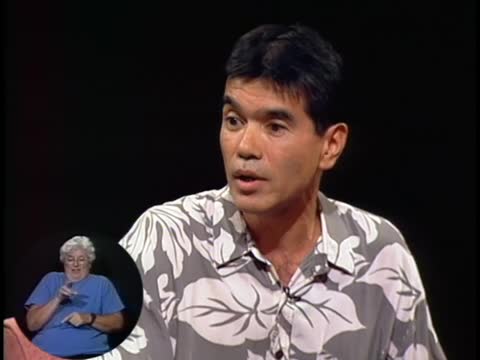
- Moderator: Dan Boylan. Guests: David Kimo Frankel; Alan Murakami, Litigation Director, Native Hawaiian legal Corporation; Sen. Mike McCartney, Senate Majority Leader; Bette Tatum, State Director, National Federation of Independent Business; Rep. Tom Okamura, House Majority Leader
- Copyright Date
- 1997
- Asset type
- Episode
- Media type
- Moving Image
- Duration
- 01:04:30:29
- Credits
-
-
Producing Organization: KHET
- AAPB Contributor Holdings
-
PBS Hawaii (KHET)
Identifier: cpb-aacip-2edd61b2734 (Filename)
Format: Betacam: SP
Generation: Master
Duration: 00:59:30
-
'Ulu'ulu: The Henry Ku'ualoha Guigni Moving Image Archive of Hawai'i
Identifier: cpb-aacip-e324f924ab3 (Filename)
Format: Betacam: SP
If you have a copy of this asset and would like us to add it to our catalog, please contact us.
- Citations
- Chicago: “Dialog; Hawaii's Economic Outlook II,” 1997, PBS Hawaii, 'Ulu'ulu: The Henry Ku'ualoha Guigni Moving Image Archive of Hawai'i, American Archive of Public Broadcasting (GBH and the Library of Congress), Boston, MA and Washington, DC, accessed March 12, 2026, http://americanarchive.org/catalog/cpb-aacip-225-29p2nk3s.
- MLA: “Dialog; Hawaii's Economic Outlook II.” 1997. PBS Hawaii, 'Ulu'ulu: The Henry Ku'ualoha Guigni Moving Image Archive of Hawai'i, American Archive of Public Broadcasting (GBH and the Library of Congress), Boston, MA and Washington, DC. Web. March 12, 2026. <http://americanarchive.org/catalog/cpb-aacip-225-29p2nk3s>.
- APA: Dialog; Hawaii's Economic Outlook II. Boston, MA: PBS Hawaii, 'Ulu'ulu: The Henry Ku'ualoha Guigni Moving Image Archive of Hawai'i, American Archive of Public Broadcasting (GBH and the Library of Congress), Boston, MA and Washington, DC. Retrieved from http://americanarchive.org/catalog/cpb-aacip-225-29p2nk3s