Dialog; The Task Force Report: Economic Outlook III
- Transcript
You Governor Ben Coyotano's Task Force on Economic Revitalization proposes deep cuts in the corporate, excise, and personal income taxes, autonomy for the University of Hawaii, non -unionized school principals, and much much more. Are such changes warranted? Through the Task Force's recommendations have a chance of becoming law. Members of the Task Force and UH President Kenneth Mortimer will be here to discuss those questions. That's Friday night at 8 for a dialogue on the Governor's Economic Task Force.
Governor Ben Coyotano's Task Force on Economic Revitalization proposes deep cuts in the corporate, excise, and personal income taxes, autonomy for the University of Hawaii, non -unionized school principals, and much, much more. Are such changes warranted? Do the Task Force's recommendations have a chance of becoming law? Members of the Task Force and UH President Kenneth Mortimer will be here to discuss those questions. So join us tonight at 8 for a dialogue on the Governor's Economic Task Force. Dialogue is brought to you by Hawaiian Electric Company, people with a powerful commitment.
Last summer, Governor Coyotano appointed an Economic Revitalization Task Force on Economic Force, comprised of business executives, labor leaders, and education experts. Their assignment to develop and implement an economic plan that would ensure Hawaii's growth
and prosperity in the 21st century. In other words, to come up with ideas and ways to revitalize Hawaii's stagnant economy. The challenge was met, and on Wednesday, the plan was unveiled. Governor Coyotano changed the task force suggests a 10 % cut in state taxes, elimination of the state land use commission, increased autonomy for the University of Hawaii, county -based public school boards, a dedicated state tourism fund of $60 million annually, and the elimination of duplication of state and county services, and much, much more. Good evening, welcome to dialogue. My name is Dan Boyland. With me this evening are four who served on the Economic Revitalization Task Force, and who pledged their support for its recommendations this week. They are Tom Leppert, a vice chairman of the Bank of Hawaii and the Pacific
Century Financial Corporation, and as of January 1, 1998, congratulations, a Campbell -State trustee. Mr. Leppert came to Hawaii in 1989 as the president of Castle and Cook Hawaii, and he was one of the task force facilitators. I guess you still are, aren't you Tom? Tom Leppert holds degrees from Claremont Men's College and the Harvard Business School. Dr. Kenneth Mortimer is in his fifth year as the president of the University of Hawaii. Prior to assuming that post, he served five years as president of Western Washington University. Dr. Mortimer received his Ph .D. in higher education from the University of California, Berkeley. Diane Plott's has been involved with Prismeter in hotel development in Hawaii for almost three decades, until about a year or two years ago, I guess. At least three or four, Dan. Three or four, okay. Ms. Plott's has also served as a director on various corporate and community organizations, and she is currently the chairperson of the Hawaii Health Systems Corporation.
Her degree is in business accounting from San Jose State. Bob Clark is president and chief executive officer of Hawaiian Electric Industries Incorporated. Prior to joining H .E .I., Mr. Clark was the senior vice president and chief financial officer at Alexander in Baldwin. Before that, the corporate controller for the Dillingham Corporation. He too is a Berkeley graduate with degrees in economics and finance. Our guests bring their experience and expertise, but for dialogue to work, we need your questions and comments. So you may call in those tough questions, we hope, and we'll even accept easy ones. The number is 973 -1000. Neighbor Island residents may call us collect. Waiting to receive your calls, please note Dr. Mortimer, are the brilliant undergraduates from the University of Hawaii, West Oahu. Our sign language interpreter is Loretta McDonald. A reminder that our program is being simal test on Hawaii Public Radio, K -I -F -O -1380 -A -M on your dial. Mr. Leopard, there are an awful
lot of suggestions in this report. Lowering income tax rates, raising the ex -size tax, but eliminating the pyramiding of the ex -size tax, acquiring the East West Center for the University of Hawaii, an appointed school board, and on and on. It's quite a list. Now, is this just a list, or are you going to get this through the legislature, or if we lose part of it as the whole package in danger, what do you think the prospects are? It's a plan. It's not a set of individual actions that were put randomly together. We think the components are interrelated. The challenge is that we have here in Hawaii go beyond a single program. They even go beyond a single area. Truth of the matter is, we need to address the problems we've got from a structural standpoint. We think this program, this plan does it. We think it's bold, we think it's aggressive, and we think it's going to generate benefits not only today, but also for our children tomorrow. What about the taxes? That's what everybody thinks about first. Everybody
looks at first. What about the tax package? I mean, it calls for having the corporate income tax bomb. It calls for raising the excise tax to 5%, but eliminating the pyramiding, dropping the income tax from what is it from? 10 % down to 7 % at the top marginal rate. And then down to 6%, and then down to 6 after 3 years. That's right. That's a lot of tax cutting. Well, it is, but if you look at the individual income tax to start, we have the highest rate, except for California, and that kicks in at a very high income level. We have one of the highest tax rates in the country, and it kicks in at $40 ,000. Now, a couple of making $40 ,000 is not rich, but the highest tax rate cuts in right now at 10%. And if we're looking at attracting people to come to Hawaii, which is part of our plan, we have to lower our tax rates for individuals. And this is really a small business initiative. You mentioned that we're going to cut the corporate income tax in half, but the corporate income
tax is only 2 % of revenues. Most Hawaii business is small business. If it's so small, then why do we need to cut it? The symbolism. For the governor to go national and say, Hawaii is a business -friendly state. We've cut the business, the business corporate income tax in half is a very powerful message. Diane Plotz, you've dealt with investors. People wanted to invest in Hawaii. Is this tax package, you know, I've had cynics say to me that they don't really believe that lowering taxes like this brings investment in. There are other problems. I think I was one of the cynics in a state like this. Other problems stopping investment. Do you think it's enough to do it? I think it's an excellent part of the package, but we need a lot more. The cuts and the streamlining of the regulatory process and the taxes and all of the other things that are in here that are burdensome to business as a package, it'll send a very strong message that we're a good state to do business in and that we want business. Not only are our own businesses that are already here to grow, but new businesses to come in. We've seen our
state lose jobs in four of the last five years, total of about 20 ,000 jobs, and we brought in a number of resources from the mainland across the world to try to visit with our working groups, visit with the task force on the issues. And taxes came in number one, time and time again. And that didn't matter if we were talking to people that were related to business relocation firms or academics. That became a key and important element in trying to bring jobs back. It's interesting if you look at over the last six or seven years, the ten states that have cut taxes the most addressed it. Their job growth is about 10 .8%. If you look at the ten states that have done the least on taxes or even raised them, the job growth is exactly zero. So that gives you a sense for how important taxes can be if we're going to add jobs back in our economy. You mentioned that reducing taxes is bold, but as Tom mentioned, we've got to be bold. Our economy has been virtually stagnant since 1991. Hawaii has sat out one of the biggest boom times in the history of the whole United States. I
think we're the only state that's had stagnant growth since 1991. The stock market is boomed, its businesses on the mainland are trying to find employees, the housing prices are soaring, and Hawaii has been stagnant. So yes, it's bold, but it's got to be bold. Ken Moirmer, I think this comes to, I think this tax cut will come to something like 10 % state budget. No, no, no, no, no, no. State budget is 3 .2 billion. The tax cut's about a little over 100 million the first year and about 350 the third year. So you're looking at about 3 % if you look at it from the standpoint of the general funds. It's about one and a half. You look at it at a total expenditures of about a little bit over $6 billion. Ken, it's less than I thought. I think I was looking at the original something. 100 millions a lot of money. 100 millions a lot of money. You and our state employees, I think, are you uncomfortable about this tax cut? I mean, you've been cutting things right and left for years now. We've all been taking cuts in state government. Do you think we can take these? Dan, I think that's precisely correct. There were a half a dozen of us in the room who were doing little calculations about
that, it doesn't matter. Well, we came to believe, and I've long believed that we've got to invest in our future. This tax cut is an investment in the future. If it's a short -term measure, then I think it's not going to work. The major issue that we're all concerned about is what is the year 2000 and 2005 going to look like, and we've got to take actions now, so things will be better than. So it's almost like an investment, and it's going to create some hardships. The governor and the speaker and the president of the senate realize that. We believe we can manage it, but we just simply have to do something that gets us to a new future, and so that's why we supported this package with some enthusiasm. And with luck, it'll jumpstart the economy quicker and start getting some revenues in, too, to offset some of the cuts. Now, this sounds like we're going to Reaganomics, isn't it? Trickle down? Yeah, it is, isn't it? Well, not exactly. I think you're really talking about the whole structure that helps the people at the bottom, too, with the tax credits that are coming back, and it'll help give discretionary income to people in the lower brackets,
also. Investing in the future is not Reaganomics. The question of the means is what we debated long and loud, and it was quite a diversity in the room, but I think everybody has the descent that the linear projection for us is not very good. That's as a state of Hawaii. What do you mean by linear projection? I mean, if we don't, as she said, kickstart the economy. If we let things go like they are, we're not going to stand in place. We're going to fall back, so we've got to do something to generate the base on which things can be better for the people on the way. People don't appreciate it, but the truth of the matter is, if you look at the state revenues from the first part of the 90s, we've gone down about $170 million in real terms. So what we've been doing is going through a slow death on this piece. Better to deal with it now, use it as a way to encourage business, so several years down the line, we're going to see our tax base start getting stronger, because the truth of the matter is, these aren't business or economic issues. The sorts of things are impacting throughout this entire community, on our ability to meet the social needs of our citizenry. They're getting at the charitable needs, our
ability to raise funds for nonprofits, for charities, and it goes to our ability to provide infrastructure for our citizenry. So it goes way beyond economics. This is a question that I've wondered about, too. The exercise tax, the plan says that you're trying to get rid of the pyramiding. How do you expect that how do you get rid of the pyramiding? How do you control that? Pyramiding is when there's a tax on the intermediate delivery of goods and services. California does that right now. They have an intermediate tax. It would reduce the tax from 4 % down to half a percent. A good example of pyramiding is when a retailer has a shop at Alamo in a center, and he pays lease rent. The tax on the lease rent is now 4 .167 percent. It would go down to half a percent. The exercise tax, though, someone has brought this question up. How can you increase the, how can you justify an increase in the general exercise tax? I think what they mean is, it's a regressive tax, isn't it? I mean, you're taking an awful lot of progressivity out of your taxes, in corporate income and in the personal income, but you're going back to the exercise tax, and that's the regressive tax.
That we are concerned about that, and that's where the idea of low income tax credits came from. Therefore, incomes below $20 ,000, there will be tax credits, because we're concerned about the very same thing. But you had to have a higher gross exercise tax in order to offset the effect of the other tax packages in the package. And a good part of the gross exercise tax is exportable, as you can see, because the tourist also pays a great deal. The visitor to Hawaii pays a great deal of the tax. And it's difficult to believe that the income tax is progressive when, as Bob said, the top margin rate is 10 % and kicks in at $20 ,000. It's really a flat tax system. It's really a flat tax right now. I want to ask you something, President Mortimer, because it's something that interests me as a faculty member at an outlying institution. Why is autonomy so important to us to the university? This calls for greater autonomy for the university. Explain to me why autonomy is so important.
We had a long conversation about the role of the university in this whole economic recovery of the state of Hawaii. In the 21st century, we're going to have to turn around faster, not slower. We're going to have to respond more quickly to opportunities. And we're going to need the flexibility to work with the private sector to do the things that will get us into world -class status at some of our campuses. All of that means you've got to decentralize and get action to where the faculty and the students are, and not somewhere in a state bureaucracy. So that autonomy, it goes to the simple statement that no good first -rate university in America is run by the state government. And the greater the distance between the state government and the university, the better the university. All that realization came bubbling up from an immense feeling that the university of Hawaii has been too long, too much tied to the agencies of state government. And those ties need to be broken. So I personally have been talking about that since I got here. And I'm delighted
to see such a groundswell of support. A 150 or 60 people on those task forces moving into a situation when in a two or three days this is a slam dunk. The only issue is how to do it. Explain to us briefly how the structure of this task force operated if you relatively simply. The governor, the speaker, the House, and President of the Senate convened the task force. There were 26 members, importantly including the three of them. It wasn't a situation where a report was passed on. They were actually part of the task force that met. In advance of the task force meeting over the last several days, a series of working groups were identified in five specific areas, taxation, economic development, role of government, et cetera. That, as Ken said, encompassed about 150 people from throughout the community. Small businesses represented as well as about every constituency. They identified a number of options that were considered by the task force. Those were augmented by some that we received from public input. We received about 828 comments from the public. And then a series of options over somewhere over 50 were presented to the task
force. And they identified a number of issues and then looked at these options and put it together in the program that we've been talking about. Did you serve on one of these, one of these sub task force dianns? No, I didn't serve on it. I was assigned to the taxation subgroup to make sure that we had representation of the task force members at the various sub -level groups. And how did they operate? They operated in a format with a facilitator in each of the subgroups to bring the ideas to the fore. And then they were able to request outside information. In the tax case, they were able to have the statistics people run analysis of what the effect of some of their recommendations would be. And there was a tremendous amount of discussion. And then they came to a consensus of the recommendations that were bold that they were going to send forth to the main task force. As you're probably aware, I think everybody's aware. When the task force was first announced, there was some criticism that everybody was high monkey business executives, big business. Not enough small, not enough input from from small
business or from common citizens. From what you saw of those subgroups, did that ever come in? I feel there was very wide representation. Yes, there was a lot of suspicion, if you will, that there wasn't enough representation, but I feel that they had all walks of the community well represented in the task force. The subgroups that I attended. In the task force itself, the number of small business people that were involved in the task force, and they were very active in discussions over these last couple of years. Tell some point when the labor was involved. The heads of the two public employee unions were involved and very much participated and endorsed the final package. Russell Ocata of HGN and Gary Rodriguez. Gary Rodriguez. You said that the state government plans to cut taxes. I don't understand the tax cut proposal to increase the hotel tax 18 % in general tax by 38%. This is not a tax cut. But when you talked about the hotel room tax, there was a proposal to increase the TAT by 1 % and to earmark 3 percentage points to the TAT for tourism. One of the concerns of the tourism task force is that tourism marketing
has been a big problem in the past because every year it was dependent on funding from the legislature and there's been a call to provide permanent funding for tourism marketing. This would earmark 3 % of the TAT for tourism marketing, which is something that the tourist industry, our most important industry, has wanted for years. Can't someone said to me the other day, why does the university, which is having trouble financing what is doing now? How can they expect to swallow the East West Center, which has a budget at the moment of equal to about three colleges at Manoa? Is this realistic or is that the pipe dream? That's one of the plan. Part of the plan. Actually, the state has to think carefully about the future of the East West Center. And there was a real feeling on the TAT force group that that's a precious resource. And a number of us have said over the years, if federal government were ever to withdraw its support, the state would have to find a way to recreate it. We're saying here again,
let's not wait till that eventually. Let's get busy and figure out a way to help the East West Center here in Hawaii. We've too long been passive and say that's something for Washington DC. And we strongly believe that the East West Center has a very strong local presence and is a very strong part of our self identity and we need to find a way to help it. Dan, I think a lot of people don't understand that all the students at the East West Center get their degrees from the University of Hawaii and it's a very important part of our relationships throughout the Pacific Rim. And East West Center has got a great reputation in Asia and having it an institute and part of the University of Hawaii would really help the University of Hawaii's image and programs in the Asia Pacific markets. One of our viewers had raised the tax questions, actually a question before. At some point we ought to make sure that we step back and summarize that because I think that is an area that can be misunderstood. Go ahead. I think that's important and I think we should all do it because it is a tax cut.
It is a straightforward tax cut that addresses the citizens of this state. If you look at it in the first year it's 100 million. If you look at it in the third year it's over it's over 200 million dollars. Now these are all the cuts and the tax. And that's taking and total. And as your viewer pointed out appropriately there are some tax increases in it but you need to look at the entire package and importantly look at what it does for every citizen of this state. There's a number of components and maybe it's useful to go ahead and recap those because as Bob said the personal income tax falls by about $300 million. So that's about 30 % in the first year alone. Now that's an important tax because it not only affects all of the citizenry and all of the issues that Bob raised but it's also the primary tax on small business. Small business is largely made up of sole proprietors, partnerships or escorts. All of their income flows through and it is tax debt from a personal income tax so that's one piece that's 30 % goes to 40%. Importantly as part of that are also the credits at the lower income
levels that give a significant advantage to our lower income and address some of the other components of the raise in the GET as Bob mentioned. Then there's the elimination or half of it of the corporate income tax that Bob mentioned. Then there's the GET. The GET does go up apparently from the surface from 4 to 5 .35 % but the truth of the matter really doesn't. The pyramiding which actually is a cost that we all pay when we go by goods and services as Bob mentioned since it's been paid several times before. About $157 million worth of the tax cut is to eliminate pyramiding. That is a key issue for small business and it's a key issue for any of us that are buying goods and services in here. So when you put all of these pieces together it's a tax cut of $100 million and as Diane mentioned a large component that GET side of it is exportable in the sense that there's about 30 -35 % somewhere in that area that is actually picked up by the visitors. Now one might say that that's a problem
because our largest industry is visitor oriented but if you look at the total of where we are now with the TAT plus the general exercise tax and even look at it from a hotel bill right now you would see that we're among the lowest in terms of at 10 % with a 6 % TAT and a 4 % if you pay a New Yorker San Francisco. Right and if you move this up to what it would be at 12 .35 % at the 7 plus that we tend to be right in the middle. Number of cities are in the 15 -14 range and awful lot are in the 11 -12 range so we fall in the middle. I think it's important to understand as Tom mentioned this is a total package. You can't just pluck one tax out here and one out here and criticize it. You have to look at the total package I think it's important to realize that every citizen of a way would get a reduced tax bill whether it's from the income tax or the way all of these work together everybody will get lower taxes. Ken Mortimer you've spent a little time working down the legislature trying to get things fast and trying to get budgets approved and so
forth. Do you think the total tax package has a chance of making it through as a package? I think it has a chance that I think shows like this that we explain to the public what it is and you can address each of these proposals singly and pull it apart and then it will like a string it'll all come unglued. It just as you are suggesting some people think in some when they look at one tax it's a tax increase and so you can't take the package apart and look at all of these little pieces it has to come together as a whole. I'm hoping the legislature will see that and they'll want to argue about the parts of it but I think they'll come sometime in the middle of the session to realize that it can't be taken apart and analyzed one piece at a time unless it's put back together later on. I know that you were charged with with structural change but one of the things that bothered me about it was there was an awful lot of emphasis on tourism in your economic development part up designated $60 million a year for for marketing and then there was mention about bringing a major league
sports franchise within 10 years and that was it. I mean all your business been you came up with two propositions is that as far as our thinking is going on economic restructuring. I want to lead the football team to the men down but we women were involved in the tourism piece of it too. Tourism is such a large part of the economy of our state and it offers the best opportunity to generate change in the near term. Yes we all addressed the need for diversification down the line and hopefully some of our attractions of new business will create that but in the near term we really have to bet on our best industry which is tourism and so if you can do something to help start that up quickly then perhaps we can start the process movie. I think the sports franchise was a dream it would be great to have and some cities have really transformed their economies through having a sports franchise but that's not something that we're necessarily going to put in first priority. I think Diane is absolutely right. Tourism is anywhere from 25 to 40 % of our economy and that's where we should be putting our emphasis. We've had several people ask about the about the excise taxes as
compared to a sales tax. Why didn't you go to a sales tax instead of an excise tax? And if anybody can tell me the exact difference between the two I'd appreciate. Well an excise tax in this case the big difference in ours is it applies to everything goods and services and typically a sales tax normally applies just to goods. In California for example if you go in and buy something by a television set it's a sales tax if you if you go to the doctor you don't get a sales tax on that in Hawaii it's an all -encompassing tax and it's like by people in the legislature because it's very efficient it raises a lot of money and it's very broad it allows us to have it over a broad base and reduce the rate and that's something that I think every tax expert would tell you is desirable to have a broader base lower rates as opposed to narrow base higher rates. I'm sure you've heard this one question over and over again this is a small this is a small business state the government is still in the plantation stage this whole task force is sort of a plantation idea of folks paternalism telling them how they should do it when will
small business owners be given a break. Now I think we've got to you've got to answer that question because obviously you're going to have to answer many times. Where does this package do that? That wasn't the case and it clearly wasn't the case in the process coming up as Diane mentioned we had 150 people that were involved in the working groups and there was a very high proportion of those of small business people we had small business people on the task force look at the different pieces of this program we've talked about the tax reducing the marginal tax rate eliminating a large chunk of the pyramiding those are all elements that clearly address the importance of small business in our state in addition to that the regulatory side of it is key that is something that every small business person will tell you is not only a frustration but it's also a problem in encouraging them to invest or to get the benefits of new investment coming into the state if we can make those structural changes taxes regulatory etc small business is going to be a major
benefactor of this program any other thoughts on that I want to talk about education at another level what what what what what what what's the thinking behind going to an appointed board I can understand that I've heard that argument for a long time although I've heard the argument against it but to four county boards what what was the thought there oh we need to go ahead thinking was to and we had a long discussion about this it wasn't black and white but in the end the predominant thinking was it was important to get the boards closest to the schools the idea of giving more power to the local school lump sum budgeting to the schools and then having the school boards on a county by county basis puts them closer to the individual school rather than one big centralized board calling the shots from Oahu I was just going to say that I think what Bob stressed that it's closer getting the the governance system down closer to the schools more responsive to the individual islands where they have special problems of their own that they like to address but in no way did we want to diminish the parity that a statewide funding system brings so I think you're trying to get
at the best of all worlds but there's still going to be the central office right it's still going to be a central that's now going to have to answer to four bosses instead of one now you've dealt with this does that make sense it makes sense to get the action as close to the students and faculty as you can that's what makes sense do you like this kind of whether does this sound right to well I've been along in favor of two things Dan that this thing talks of one of it isn't appointed as opposed to an elected structure and I have been on that horse for a lot of years I've also been involved in the purposeful decentralization of action it takes great leadership at the central level to decentralize but that's the most effective philosophy particularly in a creative world where you're trying to get faculty and students to use the creativity in order to solve educational problems so I think that's a sound philosophic base and you think it'll make sense it does we need to take a break this is coming fast and furious here at 9731 thousand but we'll be back
with more on the recommendations of the governor's economic task force with Bob Clark Dr. Ken Mortimer Tom Lepert and Diane Plott's 60 seconds some secrets are deep and dark and some are closer to the surface some secrets are too small to see and some are bigger than anything on earth beneath the waves lurks a world of secrets dive into secrets of the ocean realm coming soon it's deep you would you know what to do on a land hospital I lost all my speech
in the event of a brain attack how quickly you respond to the symptoms may affect the quality of your life for the rest of your life join us December 3rd at 8 p .m. for brain attack followed by a special interview with Dr. Chevrolet Chang welcome back to our dialogue on the governor's economic revitalization task force my name is Dan Boyland a telephone call to 9731 thousand will connect you with one of our phone answers of the evening all come from the University of Hawaii Westawahu aren't they a handsome lot the number again is 9731 thousand neighbor island residents may call us collect if you have a question or comment for our guest members of the task force Diane Plott's Dr. Ken Mortimer Bob Clark and Tom Lepert someone calls and says how can we avoid future high proportion of labor in state and city and county government I noticed that in in your report you started out or one of the subcommittees started out by
saying that presentables and vice presentables should be removed in the union but when the final report comes in you put them back in the union where what has happened on sort of the privatization and the attempt to deal with the loggerhead of unionism well I think the flexibility that we were looking for was the ability to assign principles where they're needed and compensate them appropriately and they really were two major recommendations one is that we put incentive based performance based compensation programs in place for principles and vice principles and second that we that we be able to assign them where they're needed rather than based on seniority that was agreed to by all members of the task force and that achieved most of what the goals were of getting the principles and vice principles out of the union our goal wasn't necessarily to get them out of the union it was to get them the flexibility so they could manage their school appropriately and were you going to say something can on that no I think that there's a lot laid at the wrong feet for some of their rigidities that one finds in a system and
in this task was we talked a lot about incentives to get folks going in the direction we think economic revitalization takes so you want one hand is a solution to a problem we get them out of the union what's the problem and the problem is in creating incentives and flexibility in the management structure incentives for people to want to manage effectively and that's the big issue there were two fine principles incidentally on the sub agreement who spoke to the issue of being out of the union but basically their their discussion along that line was to be given the autonomy to run their schools and and to be compensated for that and I think we have created and that was their desire someone calls in with the comments slow growth is better for Hawaii overbuilding will cause problems some tax breaks are good for the poor we've had people on this program and our economic programs over the last five months or so make that point that all of all of the hand wringing we're doing
is on the basis that there's no growth that the economy is staying and the argument is maybe we've had too much growth and maybe a moderate economy isn't a bad thing how do you respond a moderate economy may not be a bad thing we've got a stagnant economy as I said you look at it from 1989 in real terms our state revenues have gone down by 170 million we've lost 20 ,000 jobs I think everyone on the task force was very conscious of the sort of issues that were raised by our viewer there but the truth of the matter is we need to look forward to how we provide needs of this industry and also how we provide opportunities for our children here one of the real challenges that we've got is we're losing an awful lot of our children in mainland and they're not going to come back and that's a problem when I can see for 10 or 20 years because they are the ones that should be the leaders of this state 10 or 20 years down the line I would add to that managing growth was a legitimate concern back in the 80s when we were building a lot of hotel rooms the infrastructure was catching up
but I think the kind of increases in tourism that we should be able to achieve in the next few years will not require any new hotels we can achieve growth in our economy without having to build new hotels and have that I think that's the kind of growth that people have been afraid of because it puts pressure on the infrastructure someone says did the panel consider taxing retirement income someone always falls with this question that we're one of only six states that does not tax retirement income at all the federal government taxes retirement income why don't we tax retirement income we had a long discussion on that and I think the conclusion was the feeling was that there was sort of a compact with a social compact with workers that it would be unfair to abruptly change that at this point in time and put a tax on retirement retirement income but it certainly was discussed at also point out it's not a large number either if you did tax it would not be a large number wouldn't provide that much revenue again Mortimer what will the UH system on the neighbor islands what will autonomy for the UH system do for the neighbor islands in terms of the
economy if we get true autonomy then we can talk about a managed decentralization within the university system so that's an important ingredient a large part of what we often talk about in the university system is the need to do things in a standard way if we're able to increase this distance then we'll have the ability to start talking about decentralizing within the system and I think that can be a major plus for our neighbor island colleagues someone calls and says are the people and where the people on the panel the legislators on the panel I guess on the on the same kinds of committees in the legislature and then the comment these are the same heads who created how can they fix it were there members on this committee who were from the legislature well for example in the taxation committee sub subgroup I saw Carol Foucanaga senator Carol Foucanaga and she's co -chair of the ways and means in the Senate so she was very heavily involved Calvin say sat in on that taxation
perhaps some of you who were in the other subgroups would know where the legislators fell in the task force itself you had the governor the senate president and the speaker the house but those were the only people from government that were on on the actual task force itself but in the sub working groups there were lots of folks I believe about halfway through the the committee's work didn't the governor respond and say all these task force are talking about what the government should do now what about I want to know what business would do to help in revitalizing was any of that worked out did anyone in the committee hearings speak to that in two ways come to mind I think in a number of ways the real challenge is to allow the private sector to create jobs and create a strong tax base because that's going to benefit everybody maybe that's the most the private sector can do but there were very two very specific areas as we talked about the education we felt that there was a need to set goals in two different areas one is we're in the Pacific we need to have graduates that understand the cultures of the Pacific and are able to compete in that world one was to
establish a goal of having a requirement for all graduates of high school by the year 2004 being bilingual the second one was technology to have all of our children moving out of the eighth grade in the public school system be computer literate the private sector during these meetings committed to a ten million dollar contribution investment etc to put computers and computer networking in our public schools in addition to that that's that's that's real money that's real money that's in addition to that there's a very important it's called a school to work program and really what it does it provides an alternative education avenue and that we have federal funding for up to the year 1999 and then we'll run out or I guess in the year 1999 the private sector committed to continue that so that'll be a private sector program will be very interesting because the private sector will fund it and the public sector will commit to encourage participation by the individual schools so there you have the public and private sector working together why isn't downsizing government a committee recommendation we have recommended very strongly the elimination of all duplicate services between the county and the state you
did away with the land use commission I think that in and of itself is going to create a tremendous amount of downsizing just to just to keep people from doing the same thing twice why is there always been this tremendous unhappiness with the land use commission I understand a little bit a part of it I guess but I guess I don't understand well I think primarily is because you have to go through the entire process at the county level and then you have to come back to the land use commission and redo it at the state level and while they perhaps could be argued that they served a purpose of looking at statewide utilization of land the counties we feel can do it better so we felt we could leave that to the counties to and that the the land and natural resources department could look at the area of covering the things that need looked at from the state okay we have a pink card that means that there are a lot of this repeats of this question explain pyramiding of the excise tax and how the new plan will eliminate it people are confused
let's try it again I think we did it once you tried it the first time you want to try it this time you want to try it this time Diane you want to I think Tom's Tom's more articulate and I don't understand I mean he's just a knack a dynamic like me maybe the easiest way is just to take a simple example let's say that a product comes into into the state and it gets shipped in and the wholesaler buys it the wholesaler pays a tax on that 4 % then it may go to another intermediary another tax on that then it goes to the retailer and the retailer sends it sells it to you they pay another tax on that a 4 % so in effect although we thought of the taxes being 4 % it got charged several times throughout the cycle now that increases cost to all of us and especially to our small business people what this fundamentally does is it eliminates that 4 % or a large portion of the 4 % so there's a goes throughout the system
throughout the economic system be it manufactured or be it just shipped here as an imported product it eliminates that going through so what it should do is reduce the cost of those products and services to all of us several that help us yeah but several people have asked how can you guarantee that a reduction in the pyramiding will be passed on to the consumer you can't but I can tell you exactly what will happen and that is that you will have that savings and Bob who runs a competing business will have that savings it will be if he understands that's in his interest to pass that on because he will get more sales then you will be forced to do it exact what's going to happen is the competition will make it so is there a guarantee no is there an awful lot of evidence that will happen yes there is how was the task force able to get poor Gary Rodriguez I'm sorry Gary Gary Rodriguez to go along with privatization when publicly he seems to be against it now we're asking for the inner dynamics the task force here actually a ground rule is very important here and we
agreed as a group not to attribute positions to any person on the task force so it's very difficult for us to say what Gary might have said in that process because because we agreed that I could take as President University completely outlandish positions in that task force and I wouldn't be punished for that later or voted on that particular matter so we had a very extensive discussion about that and particularly about the cost advantages of outsourcing or privatization and there was extensive discussion about what is the more cost effective way to do even to the point we started thinking about the state really can't engage in high class cost economy and so recommendations to do a better job in collecting information about what things actually cost really grow out of this it's difficult to tell whether outsourcing really saves money so in some cases it does in other cases it doesn't so we had a long debate about that and Gary was very active in that so we're a lot of other people I think it's a real credit to the people again
we wouldn't want to attribute individual comments but I can tell you that the 26 people that were in the room all approached it from the standpoint of what's best for the state and the people of this state and I think that's the same attitude that we all need to have as we evaluate this plan as we move into the legislative session and we try to do something that's going to benefit the state now I understand you sat down for three days and three days in one room well two different rooms two different rooms you've learned an awful lot about people when you sit down with intensive discussions trying to do what's best for the state and Gary I must tell you I was very impressed with Gary Rodriguez I had not really known him before all I had known is public persona but I tell you I was very impressed with him I have a feeling that the criticism of the media is going to take place right now so I'm going to move real quick over it since the counties were excluded from the task force how does the committee justify reductions in the hotel room tax and if they consider it fair where the
counties is that true where the counties excluded from the task board I don't view that they were excluded again I view that there's 26 people that came with different perspectives and different expertise and they were there trying to figure what was right for the state and that involved everybody and including people from the neighbor islands as well it was not just a wahoo there were people who were flying in every day from the neighbor islands what what did the task force do to decrease the increase in lease rent now and I just meant this interest me I've talked to small businessmen and they don't tell me about taxation oh well they do tell me about taxation but what they tell me about a lot is the cost of rent in this state but the cost of rent is one of the big problems of doing business one of their biggest problems did was there any sort of structural discussion of how to lower rents in this no the high cost of land is something that hopefully will has let's say leveled off in our seven years of stagnation and that's always going to be something I think we're going to have to live with in an island economy hopefully if business is stimulated the way we hope it will be the
percentage rents will start to take a hold in many cases and that will make it more refreshing this was a group that could get together and not talk about same sex marriage and not talk about paying people too much and those things never came up and there are other things that never came up that's a unique group why didn't the task force address the most important issue facing the state the death grip that the death grip that the public unions hold over the state economy we didn't talk about that per se but we certainly did talk about privatization we talked we talked earlier about the teachers and school teachers in the union and the impact of that but that that's the pejorative and it wouldn't have been very productive to talk about that about that subject and I think as it as we learn more from the two representatives the public employee unions I think all of us in business had a renewed respect for the job they do and what they do for the economy and I don't think we
felt they were in a death grip the other part of it is we need to understand that we're a population of about 1 .2 million people in the middle of the Pacific he went back 40 years it was probably all right to run our economy in an insular fashion the truth of the matter now be it technology or what we call now a global economy we've got to compete throughout this world and we've got to put aside a lot of our historical differences where it might have been labor versus business or business versus government or government versus labor and we've got to find ways to work together and find a way to have all of the same jerseys and we're all the same jerseys and work together because if we continue to kind of fight against each other we're not going to be very effective competing in a global world our economy has produced two groups the halves and the half knots which group could would profit the most from this from this plan we truly hope that it's brought enough in scope that every one of our citizens be they considered by one group or another to be have or have not we hope everyone will have some benefit
and we'll find a way to improve their situation in life in some way by these packages that we put in someone asked an interesting question what is the answer for over 650 ,000 people from Hawaii I wonder where they get that number probably maybe right going to Las Vegas and gambling over a billion dollars leaving it to Nevada's economy and not Hawaii they wouldn't discuss gambling in that meeting Joe Suki was there he must have we discussed it and it didn't take very long because it was pretty clear there wasn't any support that we would ever find unanimity that support for gambling in our group there were some people who favored it but I think the overwhelming majority we're not we're not going to endorse that someone calls in and says how will private capital be directed to small business ventures was there ever was there any there didn't didn't that constitute structural change that kind of a discussion discussion about venture capital and again we didn't come up with a recommendation on about what it was talked about how can the state ever chart is oh this one's for you how can the state ever chart its
own economic destiny without doing something like an act of condemnation to the large private land holders that's your next job do you have any thoughts on that I think you're going to see in a number of ways the costs come down you're seeing the the cost from a government standpoint come down I think the regulatory process by streamlining that making that more efficient that's going to provide benefits for everybody um did they study the report of the secretary the secretary of the treasury of California and what turned the California California economy around based on the based on their tax revenue collection did you guys look at comparative data actually during this process the treasure of California came out and although they didn't speak to the working groups a number of the working groups did visit with them and I think the chamber and a number of other organizations had sessions with them so that perspective was there in addition to that we had a gentleman by the bill Ochi come out who is a vice dean
at the Anderson School at UCLA but he's written a book and is a famous book on the theory Z book but in addition to that he was the chief of staff for Mayor Reardon as they've gone through a lot of changes so that California perspective was very important and in fact his perspective was one that really addressed the UH and the importance of making that a more autonomous unit not just from an educational standpoint but from an economic development if you look at the UC system and he brought this home and the treasure would too the reason that they have had some success in a number of smaller businesses smaller industries that now have grown up is because entrepreneurial ideas came out of the University of California system if we can replicate that that's going to be additional job opportunities for ourselves can excuse me you know you know can reference to the transfer of the East West Center of the University I guess something said before what is your vision and why does what it says vision and why does he think he can do a better job with the East West Center than they've been doing I think that's not what we said what we said is we
should continue to explore ways in up to and including a variety of words but the main issue here is that the state of Hawaii needs to step up to that concept of the East West Center it's been for these last two decades almost a thing in which local people could wash their hands and say that's a federal operation there needs to be a new compact if you will between the people of state of Hawaii and the East West Center and if that's going to be the case the University of Hawaii has to be a major player in it so we've begun to talk two or three years ago with the East West Center about how we could be more cooperative in nature it's very clear that the state of Hawaii's got to come to a consensus about the future of the East West Center there's no other solution to that that I know about again we should also I think emphasize that there's no no intention of criticizing the East West Center and what they've done they have a marvelous reputation what we're concerned about is sustaining that into
the future so that it doesn't just die from lack of funding yeah I think it's pretty clear that if we don't do something there's there's real danger that the East West Center could die their funding was at 30 million it's been reduced to 10 and Republicans in Congress have pretty clear that they want to reduce it to zero and so if if nothing is done there's a very good chance we could lose the East West Center altogether and I think our feeling was we wanted to save save it and preserve it in the future as part of the university system but I didn't I just see a press release today where the congressional delegation immediately quickly said now wait a minute we appreciate what you're saying about the East West Center but we want to make very clear that we intend to try to fight for a continued fight for complete federal funding for this and they said that and they also said however they immediately the University of Hawaii and the State of Hawaii examine its obligations so we're if we're able to sustain federal funding that would be just great but we'll never get it back to where it was never dying you were on that taxation committee what
did they do to address the property tax somebody wants to know property taxes really here in this state are generally quite reasonable and that is a vital source of course for the counties and so we felt that that was something that did not need to change at least at this time will the small business owner who makes a living through professional services and not through good still have to pay the monthly 4 % tax that's what he means the excise tax right which will not be a 5 % tax if the recommendations yes that would continue the services will continue we're not educated oh a contradiction we're not educating the the young in a why but we're complaining about the brain drain does the does the task force feel that in terms of education you've talked about computer literacy and a second language literacy did the task force go any further in terms of educational
recommendations well I think the structural aspects that Bob and Ken talked about earlier were aimed especially at trying to improve the the quality of public school education by putting more accountability in the system and by putting the decision making closer to the schools and closer to the parents and closer to the faculty that's where we need to be successful why do they I guess someone's accusing us of something here the task force keep passing over the subject of downsizing the state government I assume that the answer is that the elimination of the implication that but also as it's recognized that when you reduce revenues as we do by a hundred million in the first year and up to three hundred and fifty million and third year that's got to reduce government but we didn't go in and we didn't have the expertise of going in and restructuring government and saying this department ought to be combined with that department that's not something that the people in the task force had expertise in doing but by necessity when you reduce resources you're going to have to reduce spending it was an important
distinction for us not to get into the question of how to cut government that was not our job it was attempting for us to try that but I think it was wise for us not to get into that but the overwhelming implication of a hundred million dollar tax cut is obviously a summation in the size of government someone calls it a pause the task force efforts however says it is ill conceived that only people with money to invest can help Hawaii's economy this is all sort of based on the idea that by lowering taxes and so forth we're we're going to bring investment in from the outside haven't we been down that street and seeing that there are limitations doing that's one piece how about the other piece though of a hundred million dollar tax cut that goes directly towards our citizens we think as Diane said that that's going to be a near -term stimulus and that's going to produce some significant benefits so it's not just the component of attracting from outside it's really generating some support inside and providing a stimulus from ourselves I want I want to ask a speculative question I know you don't know people don't like speculative questions
but if you had if you had to pick what you consider the most important part of this of this plan this task force recommendation what what would you point to time I think it's got to be an integrated plan I very much believe that I think the taxes may be one of the more important components of it but I would hate for the plan to be viewed as simply a taxation plan as I said our our problems our challenges are much wider than that and this is an opportunity that we ought not to lose Diane I would agree I think it's very broad in its scope and to I think each one of the four of us could sit here and argue perhaps that one component was more important than the other but in the overall context of what we were trying to accomplish it really shouldn't be that way they all have different weights for different reasons quickly again I would I would support that the integrated view yeah and I would agree as well we're out of time I feel very frustrated we didn't get to a
third of the questions but that's our dialogue for this evening many thanks to our guest Dr. Ken Mortimer Bob Clark Tom Leopard and Diane Plants we appreciate their time with us tonight and on and the time they spent on the task force as well and for you skeptics out there you can have your say on dialogue on the next issue of our economic outlook series in November so if you'd like to contact us by email our address is dialogue at kht .pbs .org we'd also like to thank our phone answers from the University of Hawaii Westawahu they did very well next week my colleague Lynn Waters will moderate a dialogue on insight perception and revelation it's about spiritual counseling and energy healing and so forth and that's all I can tell you about it until then for all of us at Hawaii Public Television thank you you dialogue is brought to you by
Hawaiian Electric Company people with a powerful commitment I don't know we have a gal out there who does the outside phone and she'll be able to just look at the size of the inch and tell you the figure but I guess it's 120 well I think the money part of it I think the money part again and again and again the taxation part I think that I think you've got to make that clear and that's and that's and that's very tough to do because it's complex taxation is like you know scrambles is like scrambled eggs and I think it's very hard for people to get that you've got to make people I think you have to see I think you have to make people understand that combination of tax credits lower you know the raising exercise to actually regressive tax lowering upper level income taxes and
so you've you've got to make it clear I I would spend an awful lot of time Tom if you if you've got it or if you've got somebody who can help you with it writing commentary pieces for the advertiser and the star bulletin and everywhere else and anytime two or three people gather in front of a TV set I get there I just get there and do it until nobody's calling in anymore because they understand it and at that point at that point you'll win the battle I frankly think I'm not that I'm not that I don't think you
- Series
- Dialog
- Producing Organization
- KHET
- Contributing Organization
- PBS Hawaii (Honolulu, Hawaii)
- 'Ulu'ulu: The Henry Ku'ualoha Guigni Moving Image Archive of Hawai'i (Kapolei, Hawaii)
- AAPB ID
- cpb-aacip-225-26xwdfd9
If you have more information about this item than what is given here, or if you have concerns about this record, we want to know! Contact us, indicating the AAPB ID (cpb-aacip-225-26xwdfd9).
- Description
- Episode Description
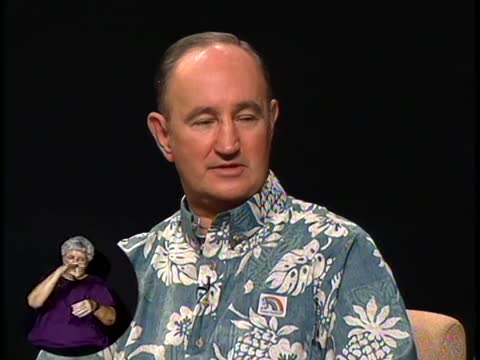
- Moderator: Dan Boylan. Panelists: Robert F. Clarke, President & CEO, Hawaiian Electric, Inc.; Thomas C. Leppert, Vice-chair, Bank of Hawaii; Kenneth P. Mortimer, President & Chancellor, University of Hawaii; Diane J. Plotts, Chair, Hawaii Health Systems.
- Copyright Date
- 1997
- Asset type
- Episode
- Media type
- Moving Image
- Duration
- 01:03:16;14
- Credits
-
-
Producing Organization: KHET
- AAPB Contributor Holdings
-
PBS Hawaii (KHET)
Identifier: cpb-aacip-16394653eb8 (Filename)
Format: Betacam: SP
Generation: Master
Duration: 00:58:54
-
'Ulu'ulu: The Henry Ku'ualoha Guigni Moving Image Archive of Hawai'i
Identifier: cpb-aacip-4549f2c5cc2 (Filename)
Format: Betacam: SP
If you have a copy of this asset and would like us to add it to our catalog, please contact us.
- Citations
- Chicago: “Dialog; The Task Force Report: Economic Outlook III,” 1997, PBS Hawaii, 'Ulu'ulu: The Henry Ku'ualoha Guigni Moving Image Archive of Hawai'i, American Archive of Public Broadcasting (GBH and the Library of Congress), Boston, MA and Washington, DC, accessed March 4, 2026, http://americanarchive.org/catalog/cpb-aacip-225-26xwdfd9.
- MLA: “Dialog; The Task Force Report: Economic Outlook III.” 1997. PBS Hawaii, 'Ulu'ulu: The Henry Ku'ualoha Guigni Moving Image Archive of Hawai'i, American Archive of Public Broadcasting (GBH and the Library of Congress), Boston, MA and Washington, DC. Web. March 4, 2026. <http://americanarchive.org/catalog/cpb-aacip-225-26xwdfd9>.
- APA: Dialog; The Task Force Report: Economic Outlook III. Boston, MA: PBS Hawaii, 'Ulu'ulu: The Henry Ku'ualoha Guigni Moving Image Archive of Hawai'i, American Archive of Public Broadcasting (GBH and the Library of Congress), Boston, MA and Washington, DC. Retrieved from http://americanarchive.org/catalog/cpb-aacip-225-26xwdfd9