Dialog; Who Will Speak for the Children and the Youth
- Transcript
How long did you say? Oh, so then water is the other water reader. Yeah, she's the professional I didn't realize she was faith in he's wife. Yeah, yeah, we have to be careful and we have certain kinds of programs. We can't let her do. Dialogue is brought to you by Hawaiian Electric Company, people with a powerful good evening. Welcome to Dialogue. My name is Dan Boyland. Hawaii Youth committed
26 % more violent crimes in 1996 than in the previous year. This while the national rate dropped 9%. Compared to a decade ago more Hawaiian children are bearing children of their own. Hawaii employers report young workers are less motivated than the previous generation. According to a recent survey, one in 10 Hawaii intermediate and high school students needs treatment for abusing alcohol or drugs. And it seems that we read almost daily about parents who beat maim or kill their children. Are we in the midst of an era that devalues children in youth? As a society, are we endangering our children's futures? What is being done? What should be done? We have with us this evening four adults and a student who in their professional and personal lives are absorbed with issues pertinent to children in youth. Representative Dennis Arakaki chairs the Human Services and Housing Committee in the State House of Representatives, a veteran of 11 years in the legislature.
Representative Arakaki is a co -founder of that body's Kakeakakis. He has been recognized repeatedly for his contributions to families and youth. Representative Arakaki is a proud graduate. I hope of the University of Hawaii. Marsha Hartsock is a project coordinator of Hawaii Kids Count, a project of the University of Hawaii's center on the family. And for the past three years has prepared and published, what's the kids count in Hawaii a data book? Ms. Hartsock holds degrees from Ball State University and the University of Hawaii where she is currently working on her doctorate in sociology. Her research interests include child abuse and neglect, teen pregnancy, and the effects of a father's absence on a family. Judge Michael Towne has been a district family court judge since 1979. From 1994 to 1997, he was the senior judge of the family court. He has lectured both locally and nationally on domestic
violence, child abuse, child custody, and child representation in court. He is also taught juvenile justice and family law at the University of Hawaii's William S. Richardson School of Law. Judge Towne holds law degrees from Yale and Hastings and his baccalaureate is from Stanford and we will forgive him that. Dr. Calvin Sia practiced pediatric medicine for almost 40 years and holds the position of clinical professor of pediatrics at the University of Hawaii School of Medicine. Dr. Sia has long been an advocate for children in the areas of child abuse and neglect, school health, special education, and emergency medical services for children. Dr. Sia is a graduate of Dartmouth College and Western Reserve School of Medicine. Pedro Haro Arvisu is 17 years old and a senior at Lahainaluna High School. He's been involved with the Hawaii State Student Conference for the last three years
as a member of the Maui District Student Council and is currently the vice chair of the Hawaii State Student Council. At the legislature, Mr. Haro Arvisu has lobbied to improve school security for better technology and for a vote on the Board of Education. Mr. Haro Arvisu was also the first neighbor Islander to represent his fellow students on the Board of Education. Our guests bring their experience and expertise but for dialogue to work its viewers and its listeners on Hawaii Public Radio, K -I -F -O -1380, must bring their questions and comments. You may do so by calling 973 -1000. Neighbor Island residents may call us collect. 973 -1000 is the number. Waiting to receive your calls are wonderful students from the St. Francis Catholic School for Girls and they write very clearly. I'm told up there. They teach penmanship. Our sign language I'm hoping.
Our sign language interpreter this evening is Loretta McDonald. Judge Michael Towne did I indulge in hyperbole there to say that Hawaii's youth are in crisis? Is that an overstatement or is it a fair statement? I think it's probably an overstatement Dan. Arrests are down in the last couple of years. Some violent crimes are up but I think this community stays right on it in terms of trying to intervene early and get these kids help and it doesn't it's not just the court and the government that has to help it's the community and the parents. I know you've thought a long time about this and that you've actually come up with isn't it judge towns ten recommendations for how to keep your kid from not ever meeting up with judge town in an official capacity. What are the what are your ten suggestions? Why brought them along it probably take too long to to go over give us some highlights. Okay let me give you some highlights. It did come a little bit prepared. I think the real obvious ones are to know your child's friends know who they are to know where your child is when you're during the day and to
make your child's friends welcome in your home and also to be very involved in the school and the child's activities. The other the other one I think that's very important is to talk with your child daily about what's going on no matter is too insignificant because these kids change on a daily weekly monthly basis and to keep that line of communication open. I'm going to leave these here and so if any reader wants them or listener viewer they can get a coffee. Kids are hard to talk to nowadays. They are hard to talk to. The older I get the harder they get to talk to. The older we get. Marsha tell me a little bit about your project and what you've been finding out about kids and prevention problems. Sure kids count is really part of a national network. There are kids count projects in all the states and so we look at things comparatively when you're talking about the juvenile crime statistics. Yeah the trend in Hawaii is not going the way we'd really like it to go but we're far below the national average and I think we kind of have to keep that in perspective that yes there are
there are problems but I was glad that you answered that maybe that's an overstatement to say that the kids are wearing crisis. Do you read the paper when you see these kinds of headlines and does this anger you or because I find myself seeing relatively negative stereotypes. They bother you Pedro. I mean very much so thinking about a community as a yet it's unfair to judge youth by only what has been happening 50 years ago per se when you're not judging the adults or the rest of the community in the same way. We're too hard we're too hard on kids. The focus has been very much on what kids are doing and what kids are committing compared to 20 years ago compared to 10 years ago compared to five years ago when we all know that society has been changing along its way and that five years ago the same society was not available to the same to those youth back then. Dr. C if I read anything that bothers me it's what seems to be
an epidemic in child abuse. Is that a fair thing to say? That's a fair thing to say in terms of the changes. I think the major changes is changing family structure and the changes as far as environment with our economy as it is we have working parents and therefore our concerns as to who cares for the child especially in early childhood becomes a caretaker problem and a nurturing problem. Single parents, teenage parents, working parents all go through changes in who handles that child and really cares for the child is very important. So abuse neglect becomes a major issue as we go along. When you see a abused child can you almost can you are there common traits in the family that are causing me? I think here you're going through changes as to the isolated parent who is not when it comes in with baby to my office the eye contacts with a child you can sort of detect the neglect or abuse and the way the child responds the stimulated child is certainly
different than the ones that's very bland it doesn't smile and doesn't respond. But I think I've read that are in we're ranked what is it number 10 as a youth friendly state and yet one category where we're falling down is more and more of our youth are having more and more of our young girls are having babies in their adolescent years right and that that number is rather frightening isn't that's going on? Well it went up until about 1992 and it has leveled off considerably since that time so I think we are beginning to attack that problem and similar to the juvenile crime problem our rate of teen pregnancy is below the national average and so you know when we look at at how we're doing I think we have to take that into account the real worrisome part is that among 16 and 17 year olds where I think people would agree that that's more problematic than for older teenagers
18 19 year olds there the rate has not slowed quite as much as it has among the older teenagers yeah is is there a problem with sex education or is it is I mean this is always an issue right politically I think one of the most telling indicators when you talk about statistics is the fact that we have more and more kids growing up in poverty and one of the reasons why is because a lot of our children are growing up in single parent forms a lot of it has to do with the lack of you know proper guidance and maybe even you know teaching the proper morals and you know this is because I think a lot of families have parents both parents working or if you're from a single parent you know there there isn't much supervision or involvement in the child's life and I think you know when there's there's no support and the love at home they tend to look elsewhere for that and I think a lot of them look at having a baby as sort of a replacement for that kind of love Dan one number that has gone up has been the number of kids born out of wedlock
10 years ago was about 19 percent last year it was roughly 29 percent that tracks a national average that around 5400 kids a year in Hawaii are born out of wedlock and those kids need a lot of a lot of support and the dads need to be identified and if if nothing else pay child support but hopefully provide proper role modeling and support for their children Dan I guess this is where 10 years ago with the help of the legislators we initiated the prevention program called Healthy Star the prevent child abuse neglect which is a home visitors program supporting the families the single parents the parents like housing like contact isolated distrustful of the system the home visitors are picked up through the birth all babies born at the hospital are interviewed the parents are interviewed and in interviewing they identify high risk factors and then they approach the mother and ask mother whether they like a home visitor and a home visitor is a welcome
wagon type of thing because they have no friends no one to fall back to and the whole visitors follows them through it's a paraprofessional supervised by professional and there's levels of care where they follow through in following them through the identify then the medical needs access to health care they identify the needs for nutrition, WIC programs, housing and in doing this the family gets a stable relationship 24 hour call availability following through linking up with the system and being the advocate for the family this has been very successful in prevention of child abuse 99 % of the follow through on the healthy start have not been abused 98 % have not been neglected unfortunately we've carried this only 50 % of the state across the state and obviously if we could extend this further some of our instance of child abuse would certainly be good is it a state supported thing it's a state supported
thing Dennis what about the legislature I mean there's no money the state hasn't got any money are youth getting hit unfortunately one of the problems is you know the way that the system works is you know we're crisis oriented and we tend to fund institutions rather than looking at how we can prevent the cost from occurring we all know at the legislature we all know the effectiveness of a healthy start but it's it's a so -called soft program and you know if it's if it's a choice between building an institution like like prisons or funding a program like healthy start somehow the prisons get more attention than these programs Judge Towne is that is that a fair thing to say I mean I to be honest I've always been bothered by this every campaign season Peter Karla hate to hear me say this but every campaign season we stay sit around here you know with prosecuting attorney candidates and they all sort of compete with each other talking about slamming the doors shut and put in of course in the process they put pressure
on judges to slam doors shut on people is that in fact what's happening that we're building prisons rather than dealing dealing with intervention program I attend to the children that come in front of me I like to think at the macro level but they say the old saw is put the money in the play pin not the state pin and I think that probably makes makes sense I also think though that the community has to step up the churches the service clubs the extended families and there's some real good things going on in this state where communities are stepping out to help out and sometimes confidentiality gets in the way if everybody that cares about little Johnny knows about it you get a lot of people to stand to follow through the poverty problem the problem families that are children that are under nourished under fed not tended to not spoken to and abused end up with prison and what we need to do is change the paradigm to prevention and early invention and look at the whole child and the family and this is very typical of what we're doing and what we see obviously reflects the
breaking of the cycle of the views exactly what Marsha has mentioned where you have a teenage pregnant mother and you go through the school failures and you go through the cycle we've got to break that by strengthening the family structure the very start otherwise all our problems go through the side but who's in charge of the holistic view of the child I mean it seems to me that we get we get the punishment view of the child but who's in charge of the holistic view basically it should be the family family empowerment is where it starts and it's on the community level we start with family support getting families to understand this getting the community to support this and raising the model now let me tell you we've had very successful Carnegie has given us a planning grant and the good beginnings alliance has just been started to look at the first three years we know brain development now is very significant in the first three years learning and brain development is a reflection of what happens nurturing stimulation of the cognitive behavioral and
social life of the child and this is where I think we can gather our forces and we have a few good examples and a few areas in the communities are starting I think that's one of the reasons why you know we want to say you know when you look at a child when we look at these issues you can't just look at one issue at a time for example there's a lot of controversy about this Felix Caetano consent decree or lawsuit and people only think it's a it's a mental health problem but actually it's a you know it's a lot of different problems that are sort of being funneled through this one avenue called mental health this is the Herman Felix Felix why hey let's why hey explain it well what the advocates are saying is that there are many kids in our school who need mental health services that are not getting it and as a result they filed a lawsuit and as a result of the lawsuit there's now a consent decree on the state which requires the
state to spend a lot more money on services to these children and also to identify who these children are and you know that's where I think the legislature's hands are tied we're forced to now spend that money on that certain population instead of looking holistically at how we deal with the problems facing our children youth Peter are you understanding? yes I think that a lot of things that both sides have been talking about is that one side is saying but we need change now and the other side is saying yes but that way it takes a long process we need to break this process the thing is that we need to compromise and come into the middle I'm seeing a lot of things such as goals 2000 whereas at the year 2000 everybody will be able to read at grade three and such what happens to those classes before then I'm class of 1998 I am I'm seriously not seeing anything of that happened with my classes where where we're focusing a lot in the future and we're focusing a lot in now but there's that middle that is not getting approached
and I think that when I was talking earlier about different environment I think that a lot of those prank and mothers come from from from mothers who were young when they were when they were when they had those children these mothers had three children now three children are having more kids as teenagers I think that it's it's very much has to do with the environment and the family and it takes a lot of initiative from the parents but unfortunately here in Hawaii we have a very unique situation where the parents can't usually get involved a lot of times because they're immigrants they can't relate to their kids problems and don't have the time because they must work all day long and I think that's a very unique problem to Hawaii that none other no other parts of the country have we do have a high percentage of women who work but not the highest in the nation you might be surprised to know and I think that we who that's higher oh um Minnesota Vermont New Hampshire there are several states yeah yeah I'm sorry we're about 10 to 12 something like that yeah I was I'd like to I guess support the whole idea though that the family really is of a very key institution and that but the family
can't parents can't do it alone and so as a society and as some of the institutions that we are talking about the church the government and so forth we've got to support parents and support families the whole the isolation of many of our families really is a very root cause for child abuse and neglect and it's one that it's it's difficult I think that's one of the beauties of the home visitor that it tends to draw the family out of isolation but neighbors can do that too you're you're sometimes amazed when the guy next to us has the same problem you had because you're the nuclear family tends to keep you isolated yeah Pedro would hit another area that's very important because good effective choices for child care in the early years are going to be critical if you have immigrants working where is the child care we have after school care but that's a little late when you talk about the critical brain development the first three years we need effective child care and how do you make that quality or standardized that quality as we see this so that we do elevate that whole realm
what happened to the excuse me well going back to you know why these problems are coming up now I I think people have to realize that you know they have this old African saying that it takes a village to raise a child and I think it was really that wasn't Hillary Clinton but I thought they she claimed I think when you talk about that that concept you know Hawaii was sort of that picture because we had more or less a paternalistic society where everyone looked after each other and including each other's children but you know all those conditions have changed you know the extended family is sort of breaking apart we have a lot of single parent families as I mentioned earlier and I think people have to realize that that support if we want to continue the concept of the village then that support has to come from somewhere else and you know even though they don't want government to be played that part and the question is who plays that part who provides the support if the extended family and the neighborhood and community no longer can or is willing to do it Pedro I want to ask you
something I'm sorry might I say you understand well I keep hearing single parents almost demonized that this is a big part of the problem and I think that's really unfortunate because there are many single parents that are really working very hard and I have received some criticism and with the point that a harmonious single parent family may be much better off or better for kids than a real acrimonious violent two parent family I think so we have to kind of look beyond the surface things on as far as parents are concerned Judge John you're 18 years in that family court time and time again you're seeing kids come in front in trouble if you it must be three times a week you go I don't know here it's same thing same same what is that same thing what are the what are the factors about time and again is there single parent family is Marshall wrong is it that have the most trouble and you see more of those or is it what is it every kid and every family is very different and in Hawaii I think that
every family has tremendous strengths in every culture and every neighborhood has tremendous strengths I really think that we still a community of neighborhoods if people can go out and find those linkages that Calvin was talking about they could find it I also reject the concept of the dysfunctional family that's a very middle class professional way of marginalizing or demonizing our families most families have a lot of strengths they have some problems if we build on those strengths find out who's important in their lives to answer your question the one thing that seems to make a difference the data is a high school education if these kids can get through and get their high school diploma they that's the main thing that keeps them out of trouble apparently that and having one adult in their life be it an uncle a parent hopefully hopefully two parents a grandpa a coach a pastor a clergy person some one person there's really a group who's what he says they do need that mentor the hero that they do model it's a modeling the critical years
and you can see this so much in terms of the schools but especially in the early age group one of the areas that bothers me is I don't know if there's an increase but the presence of substance abuse and alcohol abuse and a lot of the these problems Pedro explain this to him I drive by a high school right after all we know and all the teaching that's going on about cigarette smoking and I you know kids are waiting for the bus they're all standing with a cigarette in their hand why are why are 16 17 year old still going to smoke them will we know what we know about smoking I think it's and it's your fault I think you're right that youth have a lot to do with it I think we're hearing a lot about the family having the most the most important job in a youth's life yet it does take a lot of of the youth's own options and own views on things although
it is very important to realize as we were talking about single parents I think that we were talking about is when there is no parent involvement that is when they get in trouble and that is when there is no parent involvement where kids have to make choices on their own when they have to start thinking okay should I smoke should I not smoke do I have to do I should I drink should I not drink they have no no parental guidance whether it's a nonco whether it's an ant or whatever there's no parental figure there to guide them through as I suspect all of you did and and and and gave you a hand to hold on to isn't saying smoking is bad for these reasons and although we see teachers as public figures we do not see them as family who you see as family who you see as family are those who stand by you a lot of times those are not the parents those are the other kids in your school of course these kids I don't consider myself an adult because I don't have the knowledge that most people who are adults have which is why I make but it's pure pressure so strong that even though we know that smoking is sort of like taking a hacksaw to your throat it's going to take six or seven or eight years off your life kids still do it it's not pure pressure I don't believe pre -pressure you can you can say no to
it is the knowledge that is given to you if you don't have any knowledge of that subject you some people claim we give all this information in schools are they really learning it though you're giving it out do you have a do you have an effect the way to saying are they really learning it it doesn't matter how much information you give and and I think you're also kind of fighting the idea that most youth have that they're really invincible that there may be bad things I think that's involved in teen pregnancy it's involved in substance use smoking and so forth they and and it's good that they have that confident feeling but it sometimes works against them yes it does our first half hour is behind us and we have to take a short break but we will be back with more dialogue on a wise children in youth with Dr. Calvin Seah, Marsha Hartsock, Pedro Harrow, our our Visua, I'm sorry Pedro Judge Michael Townham representative Aracocki on July 21st 1969 with the entire world watching one man realized a dream as old as
humanity itself that's one small step for man new Armstrong reluctant hero next time on the adventures Monday night at 10 everybody's back from the war okay I'm ready to go go where once upon a time our government said to 60 million veterans and better times began for everyone the GI Bill made such a difference education job training housing loans people realized I'd go to college too in my house on the GI Bill the GI Bill the law that changed America the GI Bill was the way that people said thank you Wednesday night at 8 welcome back to our dialogue on children and youth your phone calls for our guests are being taken by those wonderful student volunteers from St. Francis Catholic high school for girls in Manoa look at those SF t -shirts there and you may reach
them and through them our guests by calling 973 1000 neighborhood residents may call us collect again the number is 973 1000 to kids viewer wants to know do kids have too much free time is this causing problems do kids have too much free time no I mean there there is it's not the free time but it is the activities I think that a lot of times you're seeing in our schools where teachers are saying let's cut the recesses that's when they make the most trouble of course at that time you're also punishing those who are actually using their time wisely I think that if you give them something to do the the time that they're used that they have now will be used wisely it's not that they have too much free time they didn't have enough to do with it when you're a teenager when you're a child you need all of that time I don't think you should take it away at all but any other thoughts on this I think you can go the opposite side and have too much structured time and they don't have the time for themselves so there is the opposite side well one of the areas we're concerned about and when I say we I'm talking my
my counterpart in the senate senator Suzanne Chan Oakland we've been working on a task force to provide more after school activities for intermediate in middle school age children and these are children in transition you know they're about to become teenagers and they're the most difficult I think to program for because you know you can't program children's activities for them on the other hand you know they're not really ready for the adult activities but you know these are the formative years in terms of attitude and you know their values so it's so important to provide these activities but we're not doing that do you want to tell us about this button now that you you've gotten all these good folks to put on well yeah I should I should remind everyone that this is children and youth month and we're celebrating the whole month by recognizing what a great asset our children and youth are here in Hawaii and in fact I have a button for you but if I if I put this on does this make me a friend of youth or something
well the next kid not not the next 17 -year -old not cut me off in traffic in his truck politically correct I'll be put on the correct all right how do you judge town how do you explain the differences in the way judges handle molestation cases this this gets a little specific for example why was Chinky Mahoy turn loose I don't think you wanted to handle that generally judges balance the the offense and then the offenders history they look at community safety accountability and and treatability of the person so it's it it's an individual case -by -case discretionary call it's not just pure offense driven so the offense doesn't necessarily determine what the what the sentence is going to be there should be some accountability but it does the the answer is yes it doesn't automatically determine the punishment for the sentence is child molestations child molestation on the rise or is it a fairly common constant you may know the statistics better than I do
it really increased greatly through the 70s and 80s particularly in the 80s but since the early 90s it too has begun leveling off we've not seen declines but that's happened nationally as well does anybody know why Marsha I'm sure people with healthy start would like to say that that's a part of it I think we have become a much more aware I think also one part of the reasons for the increases that as a community we're less tolerant of of maltreatment of kids we tend to think now spanking is something we shouldn't do and not too long ago that was very accepted method of of discipline and so our standards are changing at the same time the number of reports has continued to increase I was speaking the leveling office been the number of confirmed cases and so that discrepancy is something that really needs further investigation I don't have those answers for representative of our cocky and judge Michael Tom what can be done with dead beat fathers and mothers who are skipping out on child support well I think in terms of legislation you know we've we've there is federal
legislation that's come down in fact requiring states you know if they want to continue to receive welfare welfare monies that you know the states need to go after the dead beat dads and also for the parents I think there's also incentives for them to go after or at least identifying who the father is so that the state can go after some child support well somebody says as of January 1st the state is supposed to to crack down on dead beat dads if there's such a lack of funds how can this be done maybe well yeah the legislature passed the uniform interstate family support act and of these 5400 kids born out of wedlock for example we've been only getting about 1700 that's going to go up real quickly there's going to be aggressive determination in the hospitals of who these parents are there are computer programs to find them given social security numbers and I think that environment is changing and that's billions of dollars the other the other good news
is to some of these dads step forward and do the right thing they really care they're not just a what I call a wallet biopsy when you measure their wallet and figure out how to child support is they step forward with their hearts and a wallet biopsy somebody told me that in court or something they come down all they want to do is measure their their bank account and but these dads are much more than that and they'll help with their kids and they'll be custodians to do visitation and and be there and most kids are very interested who their dads are and as I often say do they do they like you know what kind of food do they like and do they like the Dodgers of the Giants serve you know they're very interested in dads and the kids need much more than the money I mean the money is an important thing and it's an important thing for the state but for the kids the dads presence in their lives interest in them is our moms what whoever the absent parent is that's much more important uh you talk about community nurturing of a child but who dares to correct or even praise another person's child it would be intrusive I'm not sure if that's a question or a comment any thoughts on that I hear that
attitude a lot I think that we kind of need to um look beyond that because I personally believe very strongly that that these are all our kids we have a real vested interest in how well they turn out and not to override a parent I'm not saying uh you know I'd be really intrusive but take an interest particularly in your neighbors and in the other kids and your family the people that the kids that you know I would agree I mean I feel like Marsha does it you know all the wise children should be considered our children after all you know if they end up on the negative side if they end up in prison you know who's paying for it we'll all pay for it but you know I think like I grew up as what they call a latchkey child I mean both of my parents were working you know from morning to evening but you know there was always that neighbor or or auntie or uncle there you know to say you know you better it's getting dark you better get on home and you know do your homework Dennis if if if if Hawaii is so village like and raising kids why does it have as I understand it is it the worst in the nation in finding permanent homes for
foster children I mean that's a shocking I know you know a loha we take care of everybody down the lane well apparently we're not willing to take them permanently though well I you know I have a simple answer maybe the I think the judge has probably a better explanation but a lot of it has to do with the economics you know as we mentioned earlier we have a lot of families now where both parents are forced to work and if that happens you know who can take take in a foster child it becomes very difficult economically even though you know either spiritually or morally they want to do it it becomes almost impossible Judge Towne did you want to come in? There's around there around 500 children ready to be adopted and people are stepping forward and I think that we have to look at the mainland too there's other adoption opportunities and it's that's working and also it's this concept of adoption people are getting past being worried about adopting a child and they're willing to do it so you think the trend is toward more adoption yes Pedro and this is what you get for
getting on these consoles and things why are the parking lots and bathrooms at the school so dilapidated? Well actually the Hawaii States and in council is looking at specifically bathrooms because there are very very important thing in any in any public facility we are working with the Department of Education on these matters and the the fact is that they're not supposed to be that way they're not supposed to the department claims there is no funds which comes from the legislature and and the principles claim that there's no money from the department so it's all going up the ladder but I think that we're starting working with with with both sides and we're going to get somewhere pretty soon why don't parents just get over the fact that kids will get into at least some trouble it's part of growing up and being independent focus on keeping kids non -destructive and not try to make them perfect I think that that it is that kind of kind of view that actually gets a lot of parents from from their children's lives and we'll say well my kid is going to get into trouble I'll just let them off and I think that is that that type of
view that it drives the parents away from children's lives thoughts well actually I want to go back to the previous question because one of the things we wanted to address tonight was advocacy and you know I do hear a lot of complaints from the students you know about bathrooms that's probably one of the biggest complaints they're afraid to go into bathrooms because you know people the wrong kind of students are hanging out in there you know they're smoking in there and I don't think there's really anyone advocating for the students you know at that level because the teachers don't go and use the bathrooms there's no one to control them the administrators don't know what's a lot of times don't know what's going on and I think there is a need to advocate you know for the students of them. I wouldn't go in a high school bathroom if a person is a witness to a parent abusing their child what are some suggestions you might have to help. If you're a witness obviously with the reporting law you have to report this and follow through it's an anonymous
call although you can give your name but it's by law you do need to report. We're legally bound to report abuse any abuse or neglect. But you know. I'm so happy my neighbors. Before it gets to that point though we've all been in all of a sudden in the grocery store and you see some kid really acting out the parent is nearing the end of their rope. I think there's a time there the kid has not been abused yet but we have a chance to say gee you know they really drive you crazy don't they or you know that they can really be a problem or need any help in there. They're friendly ways that we could help to lessen the risk of the child being abused at all and I so I want to push that it's a community thing we all can do something. Yes reporting if it gets to the point that child has been abused that has to happen. Judge Tom this one's for your teens committed to
drug rehab facilities cannot be held more than 24 to 48 hours without their consent unless they are in danger to the self or others. What is your opinion on this? Well if they're under probation with a court they can be if they're under some kind of status and I'm unaware of that concept unless they're I guess they're committed I'm not quite sure what the viewers talking about. What role does Ken religion play in children's education? Touchy that is something very very important I think and now people's lives are coming back again into religion after the society has less religion is coming back in. Now though there's a lot of civil liberties and a lot of civil rights that will be violated and I think it's playing a big role in Congress and in everywhere about that subject and it's been left untouched for so long that I think that Congress our legislators here in Hawaii should start taking a look at that very much so and start thinking about what type of role which is usually a good one does religion play in youth? Well the problems we
wrestle with in the when you talk about moral values you're often talking about religion and I don't see how they can teach religion less values but unfortunately like Pedro said there's a constitution and civil rights to deal with and I think we can get past that you know we should be able to bring religion into the educational setting. This is the same kind of question I guess does religious training help a child or just make them rebel more when they're teens? Mostly I think the research has shown that it does help that while they may go through that some rebellion that if they've had a good underpinning at least they have a better concept of right and wrong and that probably they'll come back
to it or at least back to a more moral life whether they're affiliated with a church or not. I think they need to see the values and attitudes practiced by their parents, by their teachers, by everybody around them because kids are great they will identify a disconnect or see if that person walks the talk so to speak and that's what's key to need. I think you know when we've talked about it this earlier Pedro mentioned the need for role models and he said you know our kids own have role models anymore I mean who can they look up to? I mentioned a specific character target woods when he first came out when he had a positive lifestyle everything was positive about him every kid wanted to be like him and I think that a lot of times our athletes are teachers everybody does not they don't need a positive lifestyle and I think our public figures nowadays have a very public life and you know who's doing cocaine and you know who's doing drugs. Therefore if you have a public role model you need to have a very public lifestyle that is all in good that is all around good
and I don't think we have that anymore in our society. Of course professional athletes always sit there and say well I can't be a model for everybody. I'm only making an honor to have a million dollars for five years and man's got to have this cocaine. As a young man 40 years ago girls used to say no no matter what and guys would leave it at that. What has changed? I think this gets back to a whole moral cultural changes and maybe Margaret has the data is true. I was just going to say actually fewer than than half of in Hawaii of our high school students have had sex that's something that you know so when you talk about the majority and the kids say everybody's doing it well everybody's not doing it and I so I think that is a picture that we kind of need to re -examine. There's a national move on sexual abstinence which is now the big thing going through the nation and obviously their grants for states to move in this direction.
As a physician what do you think about that is abstinence training the best way to go or is teaching as teaching kids about contraception and that type of I think this is very much related getting back to the religion and morals of the family and the family structure. Obviously in terms of prevention you're you want to prevent some of the sexually transmitted diseases and aids that gets back to your use of condoms, family planning and concerns. On the other hand sexual abstinence is part of this as we go along and the family has 50 signs. Yeah but we have we have great arguments in the schools right about the board of education meetings about whether we should teach kids or make available condoms and so forth to kids in the school. Should we or shouldn't we? Well again it goes back to what Pedro was saying that we need to teach kids to make good decisions and whether they choose to use condoms or whether they choose abstinence you know there has to be the reason for doing that and you know the also the avenues like like Pedro said they have to be taught these things
and why it's so important. And I don't think you can cover the child's eyes and say I'm sorry don't look beyond this wall abstinence is the only key. I think abstinence based education is something that is very good as long as it goes in hand as in teaching them what happens if you if you happen to cross that wall that you can't cover their eyes. What is being done by Hawaii leaders to coordinate a schedule between working parents in the schools. Parents need to be there to pick up the children up after school so they can care for them and do things with the children. That's a good point. I think we're still scheduling on a agrarian society you know type of scheduling. We're starting to move away from that where you know schools are becoming more flexible and I think a lot of it has to do with a worker friendly environment at the workplace and employers have to realize it you know if we want good strong families that their policies have to be
supportive of them being able to you know reach their children. Make teachers and administrators use the same bathrooms as the kids. That'll fix the bathroom problem. I believe so. Why do you think the media still promotes violence when today society is trying to teach children the violence is wrong? Is the media a problem? Well I think the AMA and Academy of Pediatrics finally has gotten to the the violence rating and they have a new rating except for one network which is apparently a parent's discretion but now you have a different labeling as far as the violence program beginning this next month and I think we do need to control what the children watch as we go. I think goes back to that other question that you know what was the difference between 40 years ago and I think the media is a major difference and the way they portray women and relationships with women is the reason why I think a lot of young men think you know they need to go beyond
the know that you know no no longer means no it also means yes and I think the media and the movies and television sort of gives that interpretation to our young people you know and they're impressionable. Now do I hear Dennis Aracocchi perhaps about to say that he would impinge on the first amendment right of the media to televised or anything that they wish? Well I think the important thing and again I'm going back to what Peter was saying there has to be an education the part of the family to to tell the kids that you know your decisions are have to be based not on what you see in the movies but what's going to be your consequences? Well I also think that you don't have to turn on the TV to see violence unfortunately there's domestic violence in the home many of these kids may not be direct victims but they're indirect victims and so the very people that should be loving each other and protecting them or fighting and we I know that the physicians see it we see it in court and
it's probably better reported but it's epidemic and it's a it's a terrible problem. The fighting in the home fighting in the home domestic violence. What I first heard when the first introductions came in along and I turned to the judge and said children killing children that's what you announced and I said it's funny that they're focusing on that. The Hawaii State Student Council is sponsoring a program called Help Hungry Kids which all it is is tiling up all the food that children are collecting in food labs in schools they're not collecting any more food than is already collected and that is one of the strong pushes to again bring role models back to the schools and saying kids are actually doing something good you can keep it along you're already doing it we're just showing the world that you're already doing it and I think that the media does have an important role when kids are told several times that the youth is going downhill kids will rise to the level of expectation and I think the parents are also expecting that. But what is it historically I mean you know when I was growing up it was that juvenile delinquents right the woods on the other side of you know
sat in the back row and and slept and caused trouble and so forth are we are are we in any worst shape I mean you you're keeping the numbers March are we in any worst shape. Some of the things don't show up much in numbers I think we've made we have gone in two directions I think that there are probably more kids that are doing more things right now and look at the things that kids are able to learn the creativity of kids I have a lot of confidence in the future because I see really good things happening but you also see these problems yeah I was a teacher for a number of years and I remember that the you know the major things yeah there was occasionally a real disruption in the classroom but that kind of disruption would be someone talking loudly or something not violence that we see in schools now we do see less of it in Hawaii and I don't want us to borrow problems from that we just see elsewhere but but we have to be vigilant I think there is some some increase I think one of the major differences you know the the weapons that kids use nowadays they're more
lethal the drugs and alcohol are more lethal and so I think the consequences you know even though kids are expected to get into trouble the consequences are much greater I mean you when when kids get into auto accidents these days it you know it usually means someone someone dies just telling you to well you know that I never saw a drive by punch out but we've seen some drive by shootings guns guns are obviously lethal they're there that's a big difference in when I started 18 years ago and the kinds of drugs are very different it's this ice crystal cocaine is is very very lethal and destroys people very quickly is that is are those is that the single fat our drugs the single factor that is most evident in the changes you've seen in in your court well that's that's the manifestation that in guns but I think the question is what brings the kids to drugs and that is what we really have to focus on and what what do you think well it again going back again it goes back to the
family the expectations that the parents have for the kids and a lot of times the parents don't have time to give the kids expectations or don't have the though cannot relate enough to the kids to give them the same expectations that they had excuse my amateur but I've just been through a teenager one teenager and it seems to me that there's a point where you know you don't seem to have much influence anymore and whether there are drugs out there or liquor or whatever whatever you say it doesn't seem to do much Dan it's your upbringing of your son or your child from the first few years that are very critical that's why I'm getting back to that early childhood what you did in the first few years is very much what's going to happen as you grow older adolescents a normal rebellion the rebellion is going to be very common adolescents dress differently they don't want to be the same as the adults they act differently they smoke simply because this is their adulthood or rebelling from what is the norm then they grow out
of this if they've had good nurturing in the early stages there's a resiliency that they bounce back and you see a lot of them coming back with proper guidance so no I don't think it's changed that much but we do need to refocus on the family structure the family structure reflects on the child especially in the early stages and we really have to think about that whole brain development how will making students clean classrooms teach them that that we value their mind so I guess this is saying don't have I guess that common means don't let we shouldn't let children clean classrooms this goes back to do you think that a certain amount of problems of youth can be attributed to the lack of activities to occupy them you'd say no Pedro right I'm not I didn't say that there there were a lot of activities I said that there's not enough activities to use with their time which are constructive options I'm talking about options not things that they must take participate on but options they must have more options
what about gangs are gangs on the rise or are they stable or or what's happening well you know the state of Hawaii has had one of the best gang prevention programs and you know I think the legislature was very progressive in that area that we saw the problems that were occurring in places like LA and we've had the police the courts the youth service programs all working together and in a sense they've diffused a lot of the gang issues that exploded into violence so I think that's one of the areas that Hawaii can really take pride in of the gang a representative of family in a sense and the need to be in that type of a family especially when we have working parents do you keep numbers on this no not I don't look at the gangs situation the Center for Youth Research has done quite a bit in that area though Judge Tom do you see it in your courts yes in my view the street is a powerful competitor for these other programs I
think every parent needs to know where their kid is this should be at the Y or the whatever league it is the Boys and Girls Club and then you're going to get the right values with the right modeling and the right mentors otherwise your kids on the street and it's can be a lost cause rather quickly are you seeing are you seeing in the schools Pedro more gang activity or less I see it in my specific area in this way there are gangs forming up in front of elementary schools elementary children are walking out seeing them thinking okay you know this is the thing to do there's no parents to say you know what gangs are bad gangs are this the people who are teaching this are the teachers teachers are viewed not as family again they're not viewed as reliable sources again when thinking back about the early years if you have a family member that nurtures you that loves you I think you're going to give them as much respect as you could teacher does not do that so it's time what can
the courts do to hold parents libel for the acts of their children well let's let's just already done it Hawaii has vicarious liability statute that has no cap in other words California's 50 ,000 or whatever and it whole there's no it's strict liability there's no negligence so if my kid gets in trouble even if I lock the kid in the house and lock the car I am 100 % liable for any damage my kid does and and that is the law and that does get regularity implemented just Tom what do you think of the prosecutors who want to what more kids tried as adults long as the judges have that final say that's fine which is what we have now so discretionary judicial call because every kid is different um what would provoke a child to act on a ruling at school and there are no signs at home of this kind of behavior what signs can a parent look for I guess recently everyone's talking about hyperactivity and ADD attention deficit dysfunction or disorder one of the concerns is school failure or having trouble learning learning disabilities and
obviously this is one of the factors the other thing you look for is drugs whether this is although at home maybe fine maybe at school there's some other problems uh Cal well we've got you at what age or how can you tell when it's okay to leave a child alone after school from two thirty and five thirty impossible questions this is a very tough question very John why do you think we got you out there the doctor would take those and act or rotate it you have to look at the family structure and what's happened in terms of the discipline and what is in terms of the child's relationship we get a doctor and we get a really nice response and a research you're almost as nearly as you you also have to look at that child and at how responsible they have been uh sometimes our hours gone we greatly appreciate our guest time judge town miss harsock uh representative our cocky dr. seah and paedrow hurl our visu thank you thanks as well to our forum dancers from st. Francis catholic high school
for girls for those of you who'd like to contact us by email the address is dialogue at kct .pbs .org next week dialogue will explore whether the governor's task force and economic revitalization is doing good work members of the task force and university of a wide president Kenneth Mortimer will be our guest uh get your questions ready please i'm going to have a few of my own as you might guess until then for all of us at a wide public television thank you for watching dialogue aloha dialogue is brought to you by hawaiian electric company
people with a powerful commitment where where is he she's pepperoni uh done a lot of the extra something uh i'm take care great pleasure my take care thanks Dennis i tried to get you to abandon your liberal credentials but you wouldn't do it and i'm proud of you that's a tough one you know that's exactly right that's exactly right i think i'd be the last guy in the world to want to screw around with the first amendment but i sort of feel about some aspects of the first amendment
- Series
- Dialog
- Producing Organization
- KHET
- Contributing Organization
- PBS Hawaii (Honolulu, Hawaii)
- 'Ulu'ulu: The Henry Ku'ualoha Guigni Moving Image Archive of Hawai'i (Kapolei, Hawaii)
- AAPB ID
- cpb-aacip-225-16c2fsjz
If you have more information about this item than what is given here, or if you have concerns about this record, we want to know! Contact us, indicating the AAPB ID (cpb-aacip-225-16c2fsjz).
- Description
- Episode Description
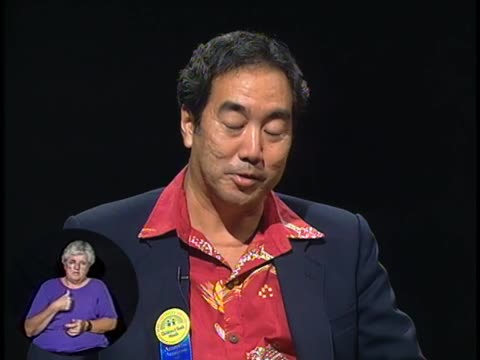
- Moderator: Lynne Waters. Guests: Rep. Dennis Arakaki, Chair, Human Services & Housing Committee; Marcia Hartsock, Director, Hawaii Kids Court; Dr. Calvin Sia, M.D., Hawaii Medical Association; Judge Michael Town, Senior Family Court Judge; Pedro Haro-Arviau, Vice-chair, Hawaii State Student Council
- Copyright Date
- 1997
- Asset type
- Episode
- Media type
- Moving Image
- Duration
- 01:01:55;13
- Credits
-
-
Producing Organization: KHET
- AAPB Contributor Holdings
-
PBS Hawaii (KHET)
Identifier: cpb-aacip-74acf8c3339 (Filename)
Format: Betacam: SP
Generation: Master
Duration: 00:59:27
-
'Ulu'ulu: The Henry Ku'ualoha Guigni Moving Image Archive of Hawai'i
Identifier: cpb-aacip-b136785aaaf (Filename)
Format: Betacam: SP
If you have a copy of this asset and would like us to add it to our catalog, please contact us.
- Citations
- Chicago: “Dialog; Who Will Speak for the Children and the Youth,” 1997, PBS Hawaii, 'Ulu'ulu: The Henry Ku'ualoha Guigni Moving Image Archive of Hawai'i, American Archive of Public Broadcasting (GBH and the Library of Congress), Boston, MA and Washington, DC, accessed March 18, 2026, http://americanarchive.org/catalog/cpb-aacip-225-16c2fsjz.
- MLA: “Dialog; Who Will Speak for the Children and the Youth.” 1997. PBS Hawaii, 'Ulu'ulu: The Henry Ku'ualoha Guigni Moving Image Archive of Hawai'i, American Archive of Public Broadcasting (GBH and the Library of Congress), Boston, MA and Washington, DC. Web. March 18, 2026. <http://americanarchive.org/catalog/cpb-aacip-225-16c2fsjz>.
- APA: Dialog; Who Will Speak for the Children and the Youth. Boston, MA: PBS Hawaii, 'Ulu'ulu: The Henry Ku'ualoha Guigni Moving Image Archive of Hawai'i, American Archive of Public Broadcasting (GBH and the Library of Congress), Boston, MA and Washington, DC. Retrieved from http://americanarchive.org/catalog/cpb-aacip-225-16c2fsjz