Dialog; 98; Irradiation: A Big Island Issue
- Transcript
Why county is known more than a share of controversy in recent years, space ports and thermal energy wells immediately come to mind. The Big Island's most recent debate has been over construction of an irradiation facility to kill bacteria on island fruit. Opponents see it as a health hazard. Proponents argue it's imperative for the health of Hawaii County's economy. We'll hear the merits and demerits of irradiation, Friday night at 8, on Dialog. The Hauaiia County is known more than its share of controversy in recent years. Space ports and energy wells immediately come to mind. The Big Island's zw most recent debate has been over construction of an irradiation facility to kill bacteria on island fruit. Opponents see it as a health hazard. Proponents argue it's imperative for the health of Hawaii County's
economy. We'll hear the merits and demerits of irradiation, tonight at 8, on Dialog. We'll hear the merits and demerits of irradiation, tonight at 8, on Dialog. Dialog is brought to you by Hawaiian Electric
Company, people with a powerful commitment. We'll hear the merits and demerits of irradiation, tonight at 8. Good evening, welcome to Dialog. My name is Dan Boylan. By a 7 -to -2 vote, the Hawaii County Council recently approved construction of an irradiation facility on the Big Island. They join Mayor Steve Yamashiro as advocates of the facility. According to its proponents, irradiation is a process that will preserve food and
kill food -borne parasites and diseases. It will also also end the rejection, or at least the quarantine, of Hawaiian produce by markets fearful of infestations by parasites in the Hawaii crop. Opponents cite fatal accidents that have occurred at irradiation facilities around the world, the economic burden to the county of a $2 million plant, and uncertainties about the toxicity of irradiated products currently, more than 35 countries, including the United States, have approved the commercial use of irradiation. But dolls persist as the long -running debate in Hawaii County demonstrates. This Friday evening, we've brought the debate to Dialog. Our guests have been up and down this issue for months. They are Dr. Lyle Wong, who is the Plant Industry Administrator for the State's Department of Agriculture. Prior to taking his present position, Dr. Wong was the Director of Environmental Affairs for Dole -Packaged Foods. Dr. Wong did his undergraduate work at the University of Hawaii in Solology and received his doctorate from the University of California at Irvine. Councilman J. Curtis
Tyler III is one of two councilmen who voted against building the facility. He is the Vice Chair of the Council's Planning Committee, and he represents the people who live in District 8, that's North Kona on the Big Island. A small business and community leader, Councilman Tyler also chairs the State's Planning Council on Developmental Disabilities. Dr. Mark Cohen is a pediatrician and a Macedonian nut farmer on the Big Island. One of several MDs who's opposed to county irradiation facility, Dr. Cohen and his wife, Naomi, are also members of the group, Parents Against Iradiation. He studied at Princeton University and trained in child development in Portland and Philadelphia. Big Island Mayor Stephen Yamashiro is a proponent of the irradiation facility. Before becoming mayor, this is his second term, by the way. Yamashiro was a county councilman for 14 years and chairman of the council for 11 years. A strong supporter of forestry development and diversified agriculture, his aim is to boost the county's economy.
You must know by now that dialogue runs on telephone calls. If you have a question or comment on irradiation for our guests, please call 973 -1000. Hawaii County residents and all dialogues other neighbor island viewers may call us collect. The number again is 973 -1000. Answering our phones this evening are the wonderful people from Alpha Delta Kappa ATA chapter. And our sign language interpreter is Loretta McDonnell. A reminder that our dialogue is being simulcast on a Hawaii public radio KIFO 1350AM. Dialogue grants mayor some deference, I should point out, particularly in non -election years. This is a non -election year, Yamashiro, so we'll start with you. Why are you willing to commit the Hawaii County taxpayers to the construction of such one an expensive facility, two potentially dangerous facility, and certainly a controversial facility? I think you have to start with the premise, Dan, that I am a
strong proponent of agriculture in our community. I believe agriculture has a very significant role in the economy of the big island. Tourism is a major role in the university and other things help us, but agriculture will be a major player. And in order for agriculture on the big island to grow, we have to be able to market our products. We in the United, all the 50 states are the only area that's under quarantine. In other words, our products that are grown in the big island and in Hawaii generally are not free to go across state lines into the continental United States without some quarantine treatment facility. There are treatment facilities for some of our products like the double dip and vapor heat for papaya. There have been some approvals for some other fruit, but if you look at the whole spectrum of agricultural product from fruits, vegetables, cut flowers, landscape plants, there is only one protocol that has the versatility, that has the ability to address this need. And
that is why we and the county council are proceeding with this operation. It is to provide the one strategic tool to our farmers to get their products to market. This councilman beside you is one of two who said no, that he thought you were wrong. Why, Kurt Stalin? Well, first of all, I don't think it's a public improvement. And, you know, we've appropriated this money for a public improvement. It's not certain whether this is going to be a public improvement or not. I think also I represent the people not only from North Kona, but throughout the island there's approximately 140 ,000 plus people. And the vast majority of the people that spoke to me, sent me letters, faxes, email, came and testified. We're really against this. And so as a representative of the people, I think that certainly carried a lot of weight with me. I think questions in terms of possible problems that might occur in the area of safety. I mean,
we know that these kinds of things have happened in other areas. Granted, they've been feeling far between, but when they've happened, in some cases, they've been pretty, pretty big. And I'm not sure that the people of Hawaii Island are ready to assume that kind of liability. But you said it's not a public improvement. Isn't it a public improvement? Isn't it a public improvement? If this quarantine is dropped because it's known that the papayas are not getting parasites or the products, whatever they want. I know that the private industry has spent a lot of money in terms of the papaya double dip, as the mayor has indicated. They're doing a lot of other work in terms of other alternatives. And my feeling is that given the possible risk, what is acceptable? And I think that private industry really should be the one to do this. And then that is a good point. And that is what has happened. After the consult took their action, we have had a private
developer step forward and say, we will do it. We'll do it on private land with private money. We don't want the county's money to assist us. We are doing it on our own dime. And we still have certain people say, this is an acceptable. And I think we have to realize that irradiation is a tool. It's a process that started probably in the 1960s at the driven by the medical products industry. The need for sterilization of single use medical products sort of evolved into the irradiation industry because there was no chemical residue on these products. And single use medical products are probably one of the biggest users of gamma sterilization in the country. I'd venture to guess that Dr. Cohn, if he threw out everything that was sterilized in his office, would have quite a bare office. Or even if he looked in his refrigerator and had to throw out the milk containers or the juice containers or other things that food is packaged in that are sterilized by irradiation because you don't want chemical residue on these containers that will contaminate
the products of production. We're not talking about is irradiation good or is irradiation used. We're talking about the safety of constructing a facility which produces radiation at a level at least 25 to 50 times the lethal level on an island using a technology which is problematic at best has had serious accidents in an area that depends on people and depends on machines, both of which are fallible on an island which has one of the highest rates of seismic activity in the world. And the nrc in their rules for licensing these facilities takes into consideration one of the one of the factors that has to be considered in the design is seismic zones and building codes. What we're saying is this is a what's the nrc for the nuclear regulatory commission and one of these things this is a tool and this is a tool that what I have a hard time with the medical industry depends upon this if Dr. Cohn depends upon
this for his business and his practice. Why is he so against our farmers having the same tool to help them. I'd like to answer that. I don't believe that that's I believe that's a smoke screen. If you told me that you wanted to build a or if I told you that I wanted to build a gasoline refinery next to put well event the active volcano. You'd probably tell me that was a pretty dumb idea and it would be a dumb idea and if I responded to you well then why don't you stop driving a car in order to be consistent. You would say that's ridiculous. What I'm talking about is safety. I'm talking about an issue where radioactive material has the chance of contaminate of of endangering workers endangering workers unborn children of contaminating the environment contaminating the surrounding area. For what? For no strong benefit to anybody except a few growers. Let's ask another doctor. Is this a safe procedure in your mind? Is the
radiation a safe method of dealing with this problem? Yes it is. We started this project three years ago with the idea of making one shipment to a papaya to Chicago to a commercial radio to Chicago. To see if we could one move a quality product to a commercial radio and to see if we could market that fruit in the Midwest. Since then we have made over 50 shipments of tropical fruit to the Midwest. For a radiation treatment we've marketed that fruit in Illinois, Indiana, Ohio, New York, Florida, Texas, California, Washington state, Philadelphia. A number of different cities with excellent consumer acceptance. Let me ask one question. Is the fruit labeled as irradiated? They're labeled in two ways. One with a poster or with a sticker right on the individual fruit. Now these facilities are relatively simple. What we're looking at on the island of a wise building a facility which or isometrics is looking at building a facility that's going to be
26 feet by 26 feet exterior dimension, 16 feet by 16 feet interior. You will have roughly 150 ,000 curies of cobalt in it. The gamenive curie is a measure of radio activity. The gamenive irradiated with St. Francis will install. We will have about 6 ,000 curies. There are a couple of cesium irradiators on Oahu for fruit fly sterilization. A couple of cesium blood sterilizing irradiators on Oahu. How big are those cesium irradiators? I thought those weren't permitted and the cesium wasn't permitted in the state. We have chosen not to use cesium on the big island because of the baggage with the new weapons industry. Let's see what that is. The cesium is not banned per se and like Lyle just said, they're claims about how bad these things are but these facilities are not you. Gamma irradiation was used in Hilo hospital for about 15 years
as part of their procedures here. It's not being used now. It was discontinued because they were safer methods. That's right. There are safer methods and I believe there are safer methods to treat fruit. There are no safer methods to treat these products at present time. We've looked at electron beams. I've said that if somebody can come up with an alternative that will meet the flexibility and allow us to proceed, we'll welcome them with open arms. But nobody's stepped forward. The ones that have stepped forward and say we'll do it on our dime are people who believe that this is the most efficient safest method. You have an alternative to it. If we had two million dollars of public funds to help these people out, they might be able to step forward. I think there are alternatives that have been presented. Some that have been talked about in the newspaper. I think Dole is working on some. But there's another issue here in terms of the safety aspect which Dr. Cohen spoke about. That
Hawaii is a non -agreement state. We spoke about the Nuclear Regulatory Commission. The mayor said that they have protocols for earthquake zones, etc. But something that's critical for the audience to understand is as a non -agreement state, government officials and various bodies really don't have a home room. There's a rule situation. The Nuclear Regulatory Commission controls that. And Hawaii County Civil Defense Director, Mr. Harry Kim, I think you probably know. Has expressed grave concern about this and indicated that Hawaii County is not prepared to deal with an accident or something that might happen which has happened. It's also clear in the literature, if you read the Nuclear Regulatory Commission materials, that the Nuclear Regulatory Commission has not been following all the protocols and been as strict as it might have been which has caused some of these accidents. Let me give you some examples of things that have happened that are radiators.
Let me explain a little bit how an irradiator works. Their product is brought in, whether it's fruit or whatever. In this case, it's supposed to be brought in and conveyor belts into this concrete chamber. There's an array of radioactive cobalt. Cobalt 60 is an isotope which emits gamma irradiation. Gamma rays are ionizing radiation. This is not x -rays. This is not microwaves. As some county councilmen have tried to tell us, this is gamma irradiation which ionizes molecules and damages biological systems. That's why it kills fruit flies. The problem is it takes a lot more radiation to kill a fruit fly than it does to kill a human being. The lethal dose to a human being can be as low as 300 rads. The amount they're planning on using for the fruit flies is 25 ,000 up to 100 ,000 rads. A chest x -ray by comparison uses 120th of a rad. We're talking about a dose that's between 500 ,000 and 2 million times
the amount of radiation in a chest x -ray. This is not a little safe little box sitting on the street that doesn't do very much. The other thing is that at these irradiation facilities, and there are lists available from the NRC, there have been instances where safety mechanisms failed. There have been instances where alarms didn't go off. There was an instance where a Geiger counter that was supposed to indicate how much radiation in the room didn't work because it had been exposed to too much radiation. People died in El Salvador, people died in Norway, people died in Israel, not just because they were stupid, but because the safety mechanisms didn't work. In some cases, safety mechanisms were bypassed. Isometics, the company that's planned to build this, was cited in 1989 for deliberately bypassing safety mechanisms, two safety mechanisms, two different plants. One, which was to prevent the entry into the chamber when the source was elevated, was active. See, this source is in a pool of water, which absorbs gamma rays.
In order to work, it has to be brought up. There's a machine that does that. Machines break down, valves break, switches break, switches corrode. Isometics was cited for bypassing a safety mechanism that would prevent entry into the chamber. They were also cited, and I find this particularly disturbing, for using jumper cables to bypass a ventilation system, which was designed to protect the workers against noxious gases, that resulted from radiation. That noxious gas is ozone, and the workers then were exposed to a toxic gas because it was felt by that company to be in their best interest to endanger their workers. Now, I don't know anybody who wants a job badly enough that is going to endanger his own health and safety and well -being, and then well -being of his unborn children. Dr. Wong, is Mark Cohen's case, does it carry weight with you? You know, we're not saying that the cobalt irradiation is a trivial
matter. It's not toxic. It is toxic. Gamma irradiation is something that has to be handled carefully. Consequently, the Nuclear Regulatory Commission has regulated irradiation facilities over the years and has required changes in the operating procedures of these facilities over the years to minimize risk of operation in the commercial setting. Now, if you look at the track record of the radiation industry in the United States and worldwide, I think you cannot help but conclude that it's been a remarkably safe industry. There have been problems. There was another death in Israel. Now, the Israel -Italy -Norway accidents were because of individuals deliberately bypassing safety procedures. Now, the facilities in these three countries have been tightened up. The design of those facilities has been tightened up. Now, we have 40 irradiation commercially -raders, big commercial -raders in the United States operating for medical supplies and pharmaceuticals, and if you look at the history of these facilities, the track record is excellent. Now,
I think on why we do this in the Department of Agriculture for the past 50 years, we've been under federal fruit fly quarantine. We did this project. We started this project not to necessarily benefit the papaya industry, but the fact is that we have a developing tropical fruit industry needs that needs a commodity treatment. The commercial quantities of fruit are becoming significant right now, and we wanted to see if we could move quality fruit to an irradiator. We have been able to do that, and if you look at the procedures that are in place, these facilities can be operated safely and at relatively little costs to the state. Dr. Wong, let me just run this one. Someone calls in and says, which product would you choose for yourself and your family, irradiated or natural? So I'm looking at two papayas, and I say to myself, and once as irradiated, when says doesn't, isn't? I'm going to choose the one that isn't. Now, don't ask me why. Don't ask me why. I have a feeling that I'm probably flamed out on irradiation in a way that may not be. I was one of those guys who, when they said, you know, they were getting some sort of radiation stuff from the cell phones. I thought that maybe I
wouldn't ever use one, but all that said, isn't there, are there other ways that we could do this without using irradiation? The commodity treatment for papaya is excellent grapey heat and dry heat, and okay, so we have excellent commodity treatments for those fruits right now. Iradiation is also an excellent commodity treatment. Now, it all depends on where I'm sitting when I'm presented with those two papayas. Okay, if I'm sitting on the mainland and all things equal, perfectly equal quality, if you would make absolutely no difference to me. But I can tell you that we have an opportunity to present a better product to various commercial markets with irradiation, with other commodity treatments at this point in time, and the markets will determine which product will be preferred. Well, I think one of the things that happened just recently here in Honolulu is there was a test shipment of papaya that was irradiated and brought back and put out for sample and display,
and they were all sold. Was it marketing you? Yeah, let me explain this. We brought back papaya from Chicago that had been irradiated. We sample the papaya at the Hawaii farm fair. At the conclusion of the farm fair, we had 24 cases of papaya, 240 pounds of papaya left. I was on the mainland that point in time, I told the staff to give it away. Instead of giving away, they decided to sell it in the open market at the farm fair. They sold 240 papayas in one arc. It was marked. Large posters indicating the fruit had been irradiated. And what was the fruit marked though? Absolutely, absolutely. What was the marked? What was the marked that was on the fruit? If somebody had two papayas that did one of them had the redoer on it? No, the redoer was on large posters right where the fruit was displayed and staff was there. Now, this is nothing unusual. This has happened in case of strawberry. This has happened in the farm fair in Florida with chicken wings. I'm not saying that people will buy an irradiated product just because it's irradiated.
There are other considerations made in the absence of an irradiated product in a grocery store. The only concern would appear to be one of safety. In the presence of an irradiated product, either papaya, rometon, lychee from Hawaii, it's a different set of questions. What is that fruit? What is the advantage of this fruit over any other? What is it taste like? What's the cost? People don't know what it is. Are there any unique advantages to the product having been treated by the irradiation? 25 % as I understand it, 25 % of the papaya crop from the state of Hawaii goes to Japan. Well, Japan except the radiated fruit? No, Japan will not. Why is that? Because there is a perception in Japan. There's a bias against anything irradiation. But the Japanese were one of the first to install the irradiator for potatoes and onions. Now, we are not planning to move irradiated papaya to Japan. The fact is, we are moving irradiated tropical fruit to US mainland markets where it has been well accepted. Now, in the absence of an irradiation facility in Hawaii, we are left with commodity treatments
that greatly diminish the shelf life and really the appearance and value of the tropical fruits that we have to offer to US mainland markets. In the two and a half years that we have been working this project in the Department of Agriculture, we have made 50 shipments over 110 ,000 pounds of commodity. We have made 200 ,000 dollars for our growers in excellent first class markets. There are a couple of important points here. Number one, the recent CBS News poll, this is a national poll, said this is on the CBS News in August 25, 1997. 77 % of the people, and a scientist, this is not just a phone and poll, a scientific poll, said they would not eat irradiated fruit. These are the people. I don't believe that at all. Not from our experience at all. Well, how is your experience? Well, let me, I think it's a more important point. It's the issue is not, do we irradiate fruit or do we not sell our fruit? Well, there's lots of ways to sell fruit. You can process the fruit here on the island. You can, you can, just like C. Brewer announced, they're starting a plant for,
for extract. So, I'm glad you believe, because I think the most important thing is to find a way of getting a diversified agricultural economy safely without danger to the population. I think this is really important. If you're, you know, in a free market, free enterprise system, free market system, if you want to grow something in the diversified agricultural area, and I happen to agree with the mayor that Hawaii County has great potential in that area, you're going to hopefully grow something that you'll be able to market. I don't think I would go into a business that was not marketable unless it was irradiated. Now, we have a growing organic farming, other kinds of products in Hawaii, and I don't know what this is going to do to the name, Hawaii, homegrown organic. How are these two going to go together? You seem to be incompatible. Sure, I respond to that. You know, if you look, Councilman Tyler at the, you know, that body of literature that's coming out critical of what we're doing, right?
A lot of it is coming from organic growers. The organic growers feel that this project will greatly diminish their opportunity to do business. I can tell you that is solely within their hands to control. Well, if they want that to be the case, they can choose to make that happen. They can choose to network with the other environmental groups in the mainland or the other organic farmers to greatly diminish the value of their product because of the possibility it might be irradiated. That is really a hell of a way to choose to do business. Are you saying that the people on the mainland who don't want to buy irradiated food are going to do it because the organic growers tell them not to? No, we're not going to be able to get our organic product off the island anyway to the mainland market anyway. Well, we have to do and we like to get, because you can't get it past the quarantine. There's no quarantine procedure. What about value added products? Let me address value added. You know, it's a great idea. I mean, I worked for Dole
Pineapple, the value added for the pineapple we can. That added value goes for the person that processes the food. Drives it, cans, it bottles it, whatever. Okay, not to the farmer. The farmer's value, the farmer's return for that value added product. Okay, that product that went to be value added is diminished further. We have an opportunity to move quality product to quality markets with a quality treatment that will be accepted because we have demonstrated repeatedly in others have. We've got a lot of calls on this question. Discuss the effect of irradiation on fruit, the loss of vitamins and the people who eat it. Is there any effect? I eat some irradiated fruit. Am I going to start? The FDA has not found any detriment to the fruits that they have approved. They've approved papaya, lychee now, star fruit. And there'll be a generic fruit protocol that is. This is a question several people have asked if the irradiation industry does have the kind of accidents
that Dr. Cohen's talking about. Who's going to pay for it? I mean, if this county bills the facility, they can sue the county, right? The county is approved. But a private person is building a facility, a private person will be responsible and they are willing to assume that responsibility. In the end of Georgia, an accident in a irradiator cost $47 million. That was not just type of facility we're looking at. That used cesium, which is water soluble. This is a cobalt facility, which is a metal, which is not water soluble. We'll not contaminate the pool if it leaks. What we're saying is these are things if this thing is so bad. I would venture to ask the doctor, why don't we close down all irradiation facilities? If this thing is that bad, what would we do to process our milk containers? What would we do to process the medical products that are needed? This is a tool and I think the real choice is let us use this tool. The FDA has approved it. The American Medical Association has approved it. The American Dietetic Association has approved it. Why are certain people trying to hold themselves up as God to tell somebody else you cannot eat
this product because I say it's bad? I'm not talking about eating the product. I'm talking about constructing this facility. So you agree that the product is bad? I did not say that. Please don't put words in my mouth. I believe that there is a great deal of debate about this product. You didn't answer the question, which was, what does irradiation do to the fruit? There's no question that irradiation decreases the vitamins and the natural enzymes in the fruit. One of the reasons people eat papaya is because it's healthy. It has papain, it has vitamin C, vitamin A. Every post harvest treatment, either double depth or the vapor heat treatment, has basically the same detrimental effect on the fruits. They all affect, it's like a cooking procedure, they affect the nutrient value, but the FDA has reviewed the literature and done the testing and has basically said there is no detriment to the product. We've got to take a break right now Kurt. I'll get back to you. It's time for a 60 second break during which we're going to irradiate our set. When we come back, we'll have more on the
big island and irradiation, but without bacteria. Stay with us. This month, let us be your guide, to the world around you, where masterpieces are revealed. And the past comes alive. The performance comes to your house only on PBS. For anyone who's ever questioned, what can one person do? He comes a story of one man who brought relief to Ethiopia, water to Sarajevo,
and try and desperately to bring peace to churchmen. The complex life and mysterious disappearance of an American hero coming October 14th on frontline. Welcome back to Dialogue's discussion of an irradiation facility on the big island. My name is Dan Boylan and those good people who have volunteered to answer our phones this evening are from the Alpha Delta Kappa Eta chapter. They will take your questions and comments for our guests. If you will call 973 -1000, neighbor island residents may call us again. Of course, you can call us again. You can call us collect. The number is 973 -1000. Our guest this evening, our Hawaii County Mayor, Steve Yamashiro, Councilman Curtis Tyler, and Dr. Mark Cohen and Lyle Wong, so they are different varieties of doctors. Curtis Tyler, you want to say something? Yes, sir. I did. You talked about if something happens. Well, something has already happened in Hawaii and Dr. Wong might tell us about it a little bit later. But
it's important to remember that accidents do happen. I took an oath when I came into office to uphold and defend the Constitution not only the United States but of Hawaii. And there are specific mandates and calls in their thread running through the Constitution, calling for the protection and conservation of our natural resources. It also talks about preserving the right to control our destiny. And while the mayor has indicated that a few people might be opposed to the radiation plant as I indicated earlier. The vast majority of people that have called me and I am their representative. I have indicated to me that they don't want this facility. They don't want to take a chance. It is not an acceptable risk. They don't want the liability. And the last time I checked, we have
one person, one vote, not one dollar, one vote. In point of fact, there was at the county meeting, we presented 1 ,000 letters to the county council opposed to this facility. We have another 1 ,000 or more. It is unquestionable. There is overwhelming opposition. There was a radio poll in which 96 .7 % of the people expressed opposition. The people on the big island do not want this facility. And we had a councilman tell me, I don't care what I hear here today. I don't care how many people are opposed to what I am supporting this. It is not the councils and the mayor is right to subvert the will of the people. That is not democracy. That is despotism. This is a comment from a PhD physicist. He says he is or she says he is. This dialogue is stupid. Thank you. We appreciate you. The process is good and needed. The only problem is one of safety. Safety is really simple. It is a matter of picking a company with a good track record. Dr. Cohen, the local chapter of the American Radiological Society, the Hawaii Volcano Observatory and the State Civil Defense have all rejected your claims of danger from a radiation. Why should we believe you instead of
these reputable parties? The Hawaii Medical Association has gone on record as being concerned about the danger. Harry Kim, who is the director of Hawaii County Civil Defense, has gone on record as being concerned about the danger. We have a sewer system in Kona that can't work because it was poorly put together and there were faulty equipment. Now, what we are assuming is that this is a procedure. This procedure is safe. It is safe. We have a great track record. Number one, we don't have a great track record. We have a company that has had problems with fatal problems. Number two, you are assuming that company. I apologize. I misspoke on that point. The industry has had fatal problems. It has been cited for safety violations. The point is, we don't need it. Why take a chance just to benefit a few people? Dr. Warren, this is a pattern that I have seen emerging more and more in my
lifetime as a 51 -year resident of the district that I represent. That pattern is quick fix, treating the symptoms, not dealing with the situation. Our economy has continued to get worse and worse and worse because we have a few spin doctors who get in here and try to thwart the will of the people. Let me address that. The economy is getting worse because we have not been able to address the needs. The needs is a protocol that will allow our agricultural product to be marketed. We have allowed people to use mass hysteria or extortionary tactics saying they are going to boycott us if we do that. Are you saying that thousands of people who are going to include answering this question? What I'm saying is, this is not something that is a quick fix. It is something that has been thought of. There's been a lot of thought of thought put to whether or not this facility should be built. What are the needs of it and what the benefit will be. The benefit
will be that we will be able to develop an agricultural industry on the big island. We will be able to get our products to market. We will be able to support thriving industry right now. We do not have the potential but we cannot realize it because we don't have the quarantine protocols. I haven't heard one thing out of you to Dr. Cohn or Kurt Tyler to say there is another protocol that will allow rambutan to move. There is another protocol which will allow mango steam to move. I want to make a point on this because I think it is important to recognize this. We could have substituted sugar for this for the last few decades when sugar was going down because we couldn't compete on the international market. It has been pointed out to the council. It has been pointed out to the public that there are many thousands of acres of these kinds of products that are being developed throughout the world. I am wondering how products from Hawaii have high land costs,
some of the highest labor costs are going to be able to compete. One of the proponents of this, in fact the executive director of the Hawaii Island Economic Development Board recently said when someone suggested that bamboo would be a good product to grow, that we couldn't compete on the international market because of labor costs. Now what is good for the goose ought to be good for the gander, it seems to me. It is going to be tough competing with the world with cheap labor. But the reality is that we can produce a very high quality product of Hawaii. It is a big market out there and the markets are telling us don't waste your time looking over your shoulder. Get a positive attitude about this, you put out a quality product in a consistent business like fashion, we will stick with you. And we have seen that happen and we are convinced in the department of ag that if it is a facility like this and other activities that is going on within the department of ag, to assure that we can put out a first class product, we will give ourselves, give the city for an opportunity to compete.
Nuclear radiation is inconsistent with the image that Hawaii has throughout the world. I think that is you choose to frame it that way. On the mainland Dan, irradiation is not a quarantine issue, irradiation is a health and safety issue. And that is what is going to move the technology, US wide, world wide, a safety issue for meats, chickens, poultry, and the quarantine use of irradiations will benefit from that. Excuse me, the problem is, number one, I would like to correct a mistake that you may Mr. Mayor. It is true that cobalt 60 is not water soluble, but it is dispersable in water. When the Hawaii experimental irradiator at Fort Armstrong was confronted with leaking cobalt 60 rods and there was contamination of the entire facility which took more than 12 years to clean up, radiation, radioactive contaminant and water was washed onto the lawn, could still have been detected 12 years later. That was cobalt 60, that is clean up cost. That was $100
,000. I don't care what it was. If one person got cancer when he shouldn't have, that is too high a cost rate. Yes, but one, I just cleaned up part of our bay front that used to have the gas works. The sparging for that alone was over a half a million dollars. Are you telling me that if the cost is low enough, it is okay to have radiations? I am saying there is no acceptable cost for radioactive contaminations, but what I am saying to you is that you are using totally theoretical arguments. It is not theoretical. Let's move the, we have a disagreement, I don't think we are going to solve on this one. Dr. Cohen, everything is dangerous, gasoline, propane, electricity, steam, etc. The number of people who die from these are much greater than from radiation. Aren't you being a little precious about this? I think that one thing you are not taking into account is that although we have only had a handful of people actually killed in irradiator accidents, we don't know how many people got cancer. We don't know how many people will get cancer. Atomic bomb
studies in Japan, there has been some new studies of the data, shows that at levels of radiation as five rads or even less than one rad causes brain damage and unborn children, caused increased leukemia. We are not talking just about industrial accidents here. We are talking about the product that we are talking about. Does not become radioactive, Dr. Cohen. You know that, say that. And that is where we begin. Why don't you just say that? There have been, there have been, there have been, there have been. Of radioactive effects on people. When, when an isomatics facility in New Jersey in the 1980s had a spill and radioactive water was flushed into the public sewer system, that is significant. And that's something that I don't want to have happen. Why did by the nuclear regulatory commission, that was something that they could legally do. Maybe they shouldn't, they can't do that today. Well that's a very good point. That's a very good
point. No, no. Wait a minute, sir. That's what I just asked you. I asked you if you're the public. Yeah. Okay. If you're the public, is that an acceptable risk? From my perspective, as a public servant and as a steward of those things over which I've been given some authority, that's not acceptable risk. And I'm hearing this from, from, I'm just saying is that. A cobalt facility, the cobalt facility that's planned for the, for the, for Hilo. Okay. It will be a very small unit. The, the risk associated with the facility will be very, very small, if negligible. The consign has not, here's a, here's a question that is, I think it's a good one. Why are you pushing eradication for export agricultural products when a, why imports 95 % of the food it consumes? Why not support agriculture for local consumption? We're doing that too. We're doing that too. Maybe I'll do more. No. You mean, when I use some of that too. Well, I think it was good. Yeah. We're doing both. But we're trying to fix one part of the agricultural problem, the state of why, which is how to, how to help promote one of the best, fastest growing
segments of our diversified agriculture with the trouble of the food industry. That industry will not expand to its potential without an export opportunity. What about other opportunities, like the nutraceuticals, the pharmaceuticals, and, and things that, that grow here, and that, that have great potential, they don't grow anyplace else. Why don't we build on, on the strengths that we have instead of importing, importing, it goes back to what, it goes back to what Councilman Santangello said. These are all great ideas. Will we support them all? Will you do it? Well, he has talked much effort into that as you do on some of these other things. Here's another good question, Mary, I'm sure. Have, have you identified a safe area to build on the eradication plant? What areas are safe? The radiation, that's different than eradication. Oh, right. Yeah. I'm sorry, I read it wrong. The radiation is the same. We're doing both over there, Dr. Wong. Oh, yeah. We're looking at sites right now. The ordinance has provided certain restrictions, and we're in compliance with that, the ordinance. So, we are identifying sites, which will then be subject to an environmental impact statement, and then
final site selection, we assume we have not, we have not chosen any particular site as of the present time, but we are in the review process. I'd like to clarify that, because that's a very important point. The ordinance has a number of restrictions. It said it cannot be built on a tsunami and a nation zone. It said there must be an environmental impact statement. It says that only cobalt 60 or electron beam can be used, not cesium. That ordinance is for the $2 million, which was appropriated by county funds. Now, you yourself said that this is going to be built on a private dime. There is nothing in that ordinance that restricts that company from doing, using cesium, from building in a tsunami zone, from not having an environment. I'm not going to use cesium. Well, how do we know that? How do we know? How do we know? There is a gray star radiator, which the state already has it. They are planning a cobalt facility. They are looking at an electron beam facility. They are trying to do the research that is necessary. Unfortunately, to their results, the
technology has not proceeded to the point where electron beams are reliable and give you the penetration that is needed to process the variety of tools you have. So you agree that the restrictions that were placed by the council are important for maintaining the instructions? So the restrictions that were placed on the council were placed for whatever reason they chose to do so. I was not party to their deliberations. We are complying with them. The Nuclear Regulatory Commission is the regulating body, which will review private applications. Here's a question, Dr. Cohen or Mr. Tyler. The caller says, do they realize the tropical fruit industry has no profitable way at this time to expand without the irradiation, quarantine treatment? Do they support the tropical fruit industry and diversified agricultural expansion? The tropical fruit industry does not equal diversified agriculture. Papaya grower is not diversified agriculture. I'm not an agricultural economist, but there are those who will point out many ways of diversifying the economy. I'm a macadamian, I don't need a radiation. There are lots of
products which can be, which can contribute to the diversified agriculture. I want a diversified agricultural economy for this island. It was so sort of why. One of the conditions that the council put on this ordinance was an economic feasibility study, independent one. To my knowledge, that still hasn't been done. Now, you know, Dr. Cohen brought up this subject of the conditions. The mayor has indicated that they are conforming to those conditions. But there is no obligation on the part of private industry to adhere to those conditions that were placed on those public funds, which may or may not be used in conjunction with that. And if they really do, if isometrics or any other company, really intends to adhere to that, I'd like to see a letter to that effect, or I'd like to see the council be able to pass an ordinance that would indicate that it applies to all facilities, because there's no difference. Two reasons. I think, you know, you say the financial feasibility study. I think we have the best financial feasibility study in a private company, deciding to take the risk of the facility. That's
what you said you wanted, and they have done it. Well, the council hasn't seen it. Well, by committing the resources to do this thing, they're saying they're financial feasibility stasis. This is a feasible instrument. If there is an earthquake, and it jams the source in an upright position, and it breaches the wall, and I could be standing a hundred yards away and be subject to a hundred times background radiation, and I could be standing closer to it and die. The private company is not taking that risk. If there was a earthquake that breached that concrete wall, we would have bigger problems in Hilo to worry about the two pounds of cobalt. All right, you're tough of a lie, guys. I want to regain control of this program, if you guys don't mind. Can I butt in here? Someone calls and says, a lot of people are calling and asking, is radioactive waste produced in this process? If so, what plans exist to deal with waste and how long would it last? There's no waste. That's not true. What do you call the cobalt? The cobalt? The cobalt, if you use cobalt. What about the water? It would become nickel. No, I beg your
pardon. The radioactive cobalt is used up until a point where it's not efficient to keep it radiating. It is still very radioactive. It is not nickel. You could recharge it or you could move it. Can I finish, please? It is shipped to... It is currently the understanding is it will be shipped back to Canada, Ontario Hydro Plant, or reprocess it. Ontario Hydro just had more than the third of their reactors shut down because of mismanagement, carelessness, and lack of attention to routine maintenance. What if Ontario Hydro has more of those plants shut down and they say, oops, sorry, we can't take your cobalt. What if the chalk river plant, which is 200 miles away from Toronto, says, oops, sorry, we don't want any more. What do we do with this? What is truly nuclear waste? We have a caller here that says that she doesn't care what it takes. She just wants a fresh taste made of in her next salad. What ever it takes. Dr. Wong, someone said the
shelf life of Mango Steen and Rambutan is only one week. How will it radiation prolong shelf life for these two products? Why not just use hot water like they do on papayas? I don't think irradiation will present pre -extended shelf life for those two products. I don't know about Mango Steen because I have not seen any data on Mango Steen, but I don't think it will extend the shelf life for Rambutan. What it does is provide for a commodity tree where the end product and the market on the mainland is California or New York, but look just like the fruit that had come off the tree. If you heat treat Rambutan, the spindles turn black. Dr. Wong, someone else says there's only one irradiation plan in operation in the entire United States. How can you state that irradiation is not experimental? There are 40 irradiation facilities in the United States. There's a huge irradiator for food in Florida. It's not doing very well financially, but it's still a food irradiation. Because of the sorts of problems that we have faced in pocket markets, which is targeted orchestrated efforts to kill the opportunities to move that fruit to market, because those that are opposed to irradiation know that if we move the product
to the retail market, it will sell and it will sell well. So what they have to do is kill the discharge. I did 77 % of the people say they wouldn't buy irradiated food. Well, I don't know anything about that particular. Well, I just won't lose that. Dr. Cohen, are you empirically opposed to irradiation, or are you opposed to the location of the plant? I am primarily opposed to the irradiation of the plant. I don't like irradiation, but in some cases, I don't have any choice in what I use. But I am opposed to putting a plant on the island of Hawaii. A caller is not sure why irradiation is such an issue. It seems that a bigger problem is pest control substances on products. That probably is more harmful than a irradiation, isn't it? It's harmful to the agricultural industry, because those pests will not allow us to ship our product out. Someone calls from Papakeo and says they want to state strongly that they don't want the plant in Papakeo. Plants. Nuclear regulatory. And a lot of comments here. Nuclear regulatory agency is not to be trusted as the people or residents of Los Alamos,
New Mexico. If the federal government uses irradiation, why are small minorities opposing it here? Is it the money factor? You're mainly concerned about health, right? Well, I don't think it's a small minority. My experience has been. It's a huge majority. And Dr. Cohen has indicated that a scientific CPS bull says 77%. We'll say why are overwhelming majority is opposing it here. I think we've heard the reasons this evening. There are viable, more sustainable alternatives that actually will keep more money circulating in the community. Dan, just for the record on polls, right? There are a lot of polls. It's not some done by the University of California. Davis, others done by Purdue University, University of Florida, Florida State, that indicate that consumers will accept the radiative product. I think it's also worth mentioning that many of the times radiated food has been presented to people. They were euphemisms used. Pico -waved products. No, no, no. I have never seen that. You've never seen it. Absolutely. Then it's not true.
Yeah, I don't think it's true. How was it marked when it was on the mainland? I'm just kind of curious. Because I heard different stories. We have a large sign. But was the fruit itself marked? No. But these poses are right over the fruit. It's clearly this fruit has been radiated. Dr. Wong, is it true that many of the supermarkets on the mainland refuse to sell radiated fruits? That is true. True. Okay. That's changing. What evidence do you have for that? There's changing. I mean, how do you know that? From our experience of moving tropical fruit, if you look at what's happening in the pack of magazine, what kinds of news coverage radiation is getting right now for food safety, meat, you'll see that. You can draw that as reasonable conclusion. Let's be clear on that, though. It's very important to realize that the irradiation doses to sterilize meat are 10 to 100 times more than the irradiation doses used to sterilize fruit flies on fruit. So this is apples and oranges? No. It's the same thing. We're talking about irradiation. In the United
States, the maximum dose you can apply to a pulp piece of chicken for it to control pathogens is 3 ,000 grays. Retreating tropical fruit at a minimum of 250 grays for quarantine. The exact 10 ,000. What I said. But it's not an issue. That's not an issue at all. The irradiation doesn't kill the fruit flies. It only sterilizes them. But the vapor he does kill them. So, you know, there's a possibility that that's not entirely true. So couldn't you cut open the lia? That's what the lia was saying. Couldn't you cut open an irradiated papaya to find a maggot inside? Yeah. You could. No, no, no, no. That's exactly not entirely. Only half a maggot. No, that's not entirely true. I'm sorry. At 250 grays, not to exceed 1 ,000, which is the max of food and drug, you end up killing most of the a's and larvae in the fruit. Not necessarily all, but you kill most, okay? The tropical fruit that we're eating from time supermarkets and for safeway is not vapor -heated. You don't have people calling in
and saying they're getting maggots in their papaya on a waho. So, the same fruit that goes to Germany untreated is not being rejected for fruit -fly maggots in Germany. You have to select, you put a quality product into the right market, and you get a good dollar for return for that product. I have lived in Buffalo, New York for 21 years, is the panel aware that Canada has been irradiating vegetables for 35 years and sending it across the board to the US. The rest of the world has no problem with it, so why is it a problem here? Is that true? The rest of the world does have a problem with it. Many countries have banned importation to make it true. So, what? Japan? I thought France might understand some of the Scandinavian countries. The truth is that most countries have not acted on... They have approved protocols for regulation. ...regulations, not that they have banned it. They just have not acted on it. Establish rules? No, there's a difference. So, in other words, they're going to establish protocol in Japan to allow importation of radiated fruits, not based on the information that I saw.
Well, I think you'll have to look at... In terms of Japan, we had a rejection of tropical fruit. In San Francisco, because we had some scales, I couldn't verify that the document of the scales would be dead. That was last year. This year I move light -sheet into the California markets, based on data from Japan. So, what I think you should know also is what Dr. Wong is saying. Year 2000, a lot of the chemical fumigants, methyl bromide in particular, are going to be banned. According to some of the figures that have come out, about 30 percent of the methyl bromide, is used to process product that's going into Japan. And when you remove that fumigant, while the Japanese position initially is, it's your problem. If they cannot get food product into their country, it's going to be their problem. And they are looking at other protocols. Yamashiro, actually, there are two questions of this nature. Why are you disregarding the coalition against a radiation which represents 40 ,000 big island residents who do not want the plant? And why don't you have a referendum on it? We're not disregarding anyone. Everyone has the right to
proceed and what they want to do. If they want to do the referendum, find it. There's a procedure for them to proceed on that. We're not saying yes or no. We don't think that we agree with them that they're correct. If they want to proceed with the referendum, they should, but they should read the rules and make sure they're proceeding properly and that they follow all the rules in the referendum process. And in fact, there is a referendum and an initiative procedure. The referendum is to repeal the bill which appropriated two million dollars and the initiative is to close the loophole so that nuclear material cannot be brought on to our island for the purpose of commercial irradiation. The Councilman Tyler, someone says, this process is going to affect products coming into a why, like coffee. Is it going to affect it? Yes. I don't think so. You're 2000. You're not going to have methyl bromide to fumigate coffee beans that are imported into... Well, you don't need to irradiate coffee beans. You can just give them a cold water treatment. No, this is coffee coming in. We would probably bring in more coffee than we're
producing a why in it. And there's a requirement... There's no opportunity. There's no requirement to methyl bromide fumigate coffee. We're going to have coffee beans coming in. Well, then we can actually irradiate coffee beans to meet their quarantine requirements. Well, you know. Dr. Wong, this is an important point that you make because I think many, many people that have written to me called spoken with me personally, send me email, have asked, why can't we spend more of our effort, more of our time feeding ourselves instead of exporting ourselves? That's a good question. It's going to have to go on to answer tonight. I fear... Because we're out of time. Our thanks to Mayor Yamashiro, Councilman Tyler, Dr. Cohen, and Dr. Wong. Our viewers go away tonight. I hope more enlightened. Certainly aware that you folks over on the Big Island know how to fight. Next Friday, my colleague, Lynn Waters, will moderate a dialogue on women's issues. Until then, for all of us at Hawaii Public Television, thank you for watching Dialogue. Aloha. Aloha. Aloha.
Aloha. Aloha. Aloha. Aloha. Aloha. Aloha. Aloha. Aloha. Aloha. Aloha. Aloha. Aloha. Aloha. Dialogue is brought to you by Hawaiian Electric Company, people with a powerful
commitment. Thank you. Thank
you. Aloha. Aloha. Aloha. Aloha. Aloha. Aloha. Aloha. Aloha. Aloha. Aloha. Aloha. Aloha. Aloha. Aloha. Aloha. Aloha. Aloha. Aloha. Aloha. Aloha. Aloha. Aloha. Aloha. Aloha. Aloha. Aloha.
Aloha. Aloha.
- Series
- Dialog
- Episode Number
- 98
- Episode
- Irradiation: A Big Island Issue
- Producing Organization
- KHET
- Contributing Organization
- PBS Hawaii (Honolulu, Hawaii)
- 'Ulu'ulu: The Henry Ku'ualoha Guigni Moving Image Archive of Hawai'i (Kapolei, Hawaii)
- AAPB ID
- cpb-aacip-225-04rjdgb8
If you have more information about this item than what is given here, or if you have concerns about this record, we want to know! Contact us, indicating the AAPB ID (cpb-aacip-225-04rjdgb8).
- Description
- Episode Description
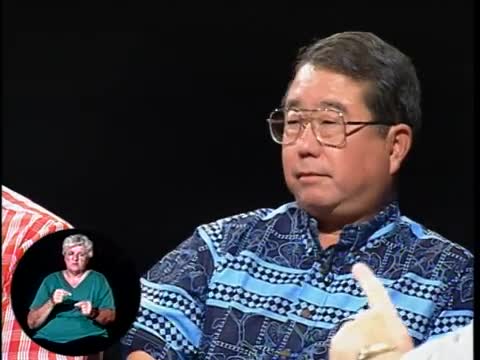
- Moderator Dan Boylan facilitates discussion between Dr. Mark Cohen (pediatrics physician), J. Curtis Tyler (Hawaii County Councilman), Lyle Wong (Dept. of Agriculture Plant Industry administrator) and Stephen Yamashiro (Hawaii County Mayor) on the construction of an irradiation facility.
- Broadcast Date
- 1997-09-19
- Copyright Date
- 1997
- Asset type
- Episode
- Genres
- Talk Show
- Topics
- Social Issues
- Subjects
- Food Safety
- Media type
- Moving Image
- Duration
- 01:04:16;02
- Credits
-
-
Director: Robello, Edward J.
Guest: Tyler, J. Curtis, III
Guest: Yamashiro, Stephen K.
Guest: Cohen, Mark H.
Guest: Wong, Lyle
Host: Boylan, Dan
Producer: Robello, Edward J.
Producer: Simmons, Charlotte
Producing Organization: KHET
- AAPB Contributor Holdings
-
PBS Hawaii (KHET)
Identifier: cpb-aacip-8f1a1503802 (Filename)
Format: Betacam: SP
Generation: Master
Duration: 00:58:58
-
'Ulu'ulu: The Henry Ku'ualoha Guigni Moving Image Archive of Hawai'i
Identifier: cpb-aacip-244aecdbfb3 (Filename)
Format: Betacam: SP
If you have a copy of this asset and would like us to add it to our catalog, please contact us.
- Citations
- Chicago: “Dialog; 98; Irradiation: A Big Island Issue,” 1997-09-19, PBS Hawaii, 'Ulu'ulu: The Henry Ku'ualoha Guigni Moving Image Archive of Hawai'i, American Archive of Public Broadcasting (GBH and the Library of Congress), Boston, MA and Washington, DC, accessed March 11, 2026, http://americanarchive.org/catalog/cpb-aacip-225-04rjdgb8.
- MLA: “Dialog; 98; Irradiation: A Big Island Issue.” 1997-09-19. PBS Hawaii, 'Ulu'ulu: The Henry Ku'ualoha Guigni Moving Image Archive of Hawai'i, American Archive of Public Broadcasting (GBH and the Library of Congress), Boston, MA and Washington, DC. Web. March 11, 2026. <http://americanarchive.org/catalog/cpb-aacip-225-04rjdgb8>.
- APA: Dialog; 98; Irradiation: A Big Island Issue. Boston, MA: PBS Hawaii, 'Ulu'ulu: The Henry Ku'ualoha Guigni Moving Image Archive of Hawai'i, American Archive of Public Broadcasting (GBH and the Library of Congress), Boston, MA and Washington, DC. Retrieved from http://americanarchive.org/catalog/cpb-aacip-225-04rjdgb8