Literary Explorer Presents Hemingway in Cuba
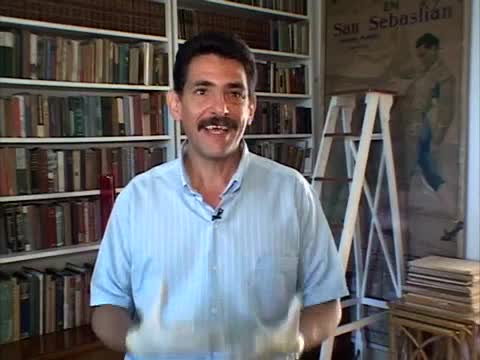
- Transcript
It. Ernest Hemingway. No other American writer has ever had his stature and influence both literarily and culturally his impact on every writer who followed him and the worldwide popularity of his work is unparalleled. And yet Cuba the location where Ernest Hemingway lived over half his life and wrote many of his most significant works the place that to some extent made him who and what he was has been largely overlooked. Why. On this program we'll search for the reason Ernest Hemingway once said In Cuba I
found the perfect place to write. We'll examine how Cuban culture religion lifestyle even its volatile politics influenced this great American author. And we'll analyze what real life events and the author's life served as the inspiration for some of his greatest fictional works like to have and have not. The old man and the sea and Islands In The Stream. And finally an answer from Fidel Castro on why he chose to preserve the memory and work of this great American author through a cold war. And over 40 years of a U.S. led embargo his answer will surprise you. So prepare for an exciting journey as a literary Explorer defines the real and fictional world of this great American author Ernest Hemingway. You know when people think about Hemingway in Cuba they usually think of a bronze giant with a
salt and pepper beard sitting in a bar and enjoying the island's fine dark rum. But the truth is when Hemingway first visited Cuba he was only 29 years old. He and his second wife Pauline had a two day layover here in Havana. Unroot from France to Key West. And when Hemingway returned to Cuba four years later it was not the lure of the island's rum that led him back. But the great fishing. It was the summer of 1932 when Hemingway returned to Havana. Ernest chartered a low slung 34 foot cabin cruiser. The Anita from a bootlegger named Josie Russell Russell who made over 150 rum running trips between Key West and Cuba knew the water he brought with him his mate a rummy name Joe low. Once they cleared Havana customs they hired a black Cuban fishing mate and headed out for what promised to be a superb Marlin season. The need is for fishing lines fed out from the tip of the Rodd's like long trailing whips
directly off the stern wooden teasers Trold zigzagging through the water and churning up a white foam trail. Russell was the first to spot the silver purple boat moving fast underwater it's wide pectoral fins spread like bird's wings. The bill fish cut out of the way revealing its long dark and silver body. Ernest grabbed the rod then sat down in the fighting chair. Strike when I tell you and strike hard. Russell coached. Now Ernest locked the gear and jerked the heavy rod back hard and fast. He then felt the sheer power of the giant fish pulling against the line and rod. This Marlin would only be the first of hundreds. Hemingway would catch off Havana but Ernest would learn more than fishing from his old bootlegger friend. In the backroom of Donovans bar Russell and Hemingway met with an old Cuban who filled Russell's bootleg order. The Cuban asked Russell if he had ever considered carrying anything else across to the states other than liquor. No Russell said. I won't carry anything that can talk.
Hemingway used this adventure with Russell to create one of his most memorable characters. Harry Morgan the protagonist who was asked by three wealthy Cubans to be smuggled into the U.S. but Morgan decides it's too risky. Listen I said I told you I didn't carry anything that can talk sakte liquor can't talk Demi Johns can't talk. There's other things that can't talk man can talk to have and have not long before Hemingway one is hard earned literary acclaim his life in Cuba had become layered with insight into differences between the classes and the sexes. His own marriage to his second wife Pauline had begun to have problems after the difficult birth of their second child. Pauline had been warned by her doctor not to get
pregnant again. Being a devout Catholic Pauline made a very difficult decision. She chose abstinence a decision that sent her husband into the arms of another woman. Her name was Jane Mason. I think she realized that Ernest had that substance because he was an artist. I think they were mutually attracted to each other because I think that there was an infatuation with a certain recklessness and a sense of burning brightly. They were still living some of the fantasies of the last generation. I think Hemingway was obviously attracted to to Jane Mason she was featured in national advertising in magazines an extraordinarily beautiful woman who had sex appeal and knew how to use it though the specifics of Hemingway and Mason's affair remain largely on
published. Most people agree the song took place here. The ambos windows hotel. In fact. Ernest once boasted that Jane climbed through his hotel window. And into his bed. Known for her thematics. Jane Mason may have thought nothing of stepping out onto the narrow ledge that runs the perimeter of the ambos Mandos fifth floor the brick ledge which measures two and a half feet wide gives ample space for a dramatic entrance. I've looked at the exterior of Rambo's Mundus and my thought is why would you do that. I think it's much more likely that he may have locked the door and she may have come in the transit Ernests characterization of his friends in the short happy life of Francis Macomber was not limited to Jane. He seemed particularly interested in exploring the strengths and weakness of her husband Grant. I think Hemingway had a certain amount of contempt for a man who did not. Establish a kind of authority with their wives.
I think that disillusionment is. I don't think that. Grant was as strong or as tough as Jane was. Hemingway tried to justify his actions but clearly he felt guilt over the relationship. It becomes crystal clear that he saw himself in this love triangle. In this passage of the short happy life of Francis Macomber. So she woke him when she came in. Wilson thought looking at them both with his flat cold eyes. Well why doesn't he keep his wife where she belongs. What does he think I am a bloody plaster saint. Let him keep her where she belongs. It's his own fault. Their affair had only just begun when it took a dangerous twist. It happened that day Hemingway's two sons decided not to go fishing with their father but instead joined Jane Mason and her son Tony for a day at the beach according to the Havana post on May 24th 1933 Jane Mason had a near fatal car accident. They've been driven off a road by a boss and they've gone down the steep. Bank.
And very fortunate. Because the transmission on so that car didn't burst into flames but it could if she damaged her back seriously. The little boys were fine. Perhaps it was this near tragedy or another car accident in 1947 that influenced Hemingway to include a car accident and islands in the stream like Hemingway Thomas Hudson as a divorced father forced to send his sons back to their mother. And here he learns of their death. Listen to the feeling in this passage. Thomas Hudson was unhappy as soon as the boys were gone. But he thought that was just normal lonesomeness for them and he just kept on working the end of a man's own world does not come as it does at one of the great paintings Mr. bhabhi had outline. It comes with one of the island boys bringing a radio message up the road from the local post office. He took the radio form out and he read it again. Your sons David and Andrew killed with their mother in a motor accident near barrettes. Attending to everything pending your arrival. Deepest
sympathy. Islands in the stream. Oddly enough the accident didn't end Jane's affair with Hemingway. Quite the contrary. Hemingway made plans to go fishing with Jane Mason the very next day. We know that Jane left early the next morning on board Russell's boat the Annita according to the ship's log. Mason caught two large Marlin also in the log. Someone wrote Ernest loves Jane and perhaps he really did love her. After all Hemingway had never met a woman who could out fish outdrink and out hunt most men which made his portrayal of her in the short happy life of Francis Macomber all the more interesting in Hemingway's short story The husband discovers the courage to face down his wife's infidelity and the wife then accidentally shoots the husband. For Jane Mason it ended quite differently and it all happened right here. It is quite possible that Grant Mason may have finally confronted his wife about her affair with
Hemingway or perhaps even forbidden her to see him again. But what if plans had already been made for Jane to celebrate with her and asked her to Marlene catch at La Flora Dita with Pauline safely away in Key West. Jane would not have wanted to miss her date with Ernest. There have been those who suggested what happened next was Jane Mason's attempt at suicide but perhaps it was even simpler. Jane may have attempted to climb down from her second story window in an effort to meet Hemingway when she slipped. Landing badly and breaking her back. Records show that Ernest was one of the first to visit Jane in the Vanna's Anglo American hospital and he's quoted as saying in order to try to raise her spirits. You know Jane I've never had a girl fall so hard for me. It was also very telling that Ernest actually went to Jane's doctor and asked to see the X-rays. He was also very critical they didn't think that Grant was taking good enough care of her.
Jane Mason would undergo back surgery in New York and months of physical therapy and a seven inch scar from the spinal fusion would serve as a reminder of a date with Hemingway that she never kept. Hemingway's involvement in this classic love triangle had him trying to rationalize his guilt. Did Grant concentrate too much on his business and not enough on his wife or did Jane simply become bored with being married to Grand. As Hemingway observed in a letter to his editor Max Perkins all women married to a wrong husband are bad luck to themselves and all their friends. While the masons in Cuba may have inspired the short happy life of Francis Macomber Hemingway wouldn't set a story in Africa until after he'd been there himself on safari. It was his keen interest in animals that got him a reputation as an acknowledged naturalist but not so much for the animals of the planes as for those who swam in the sea. In 1934 Hemingway wrote his friend John Dos Passos. I'm in training to
be a naturalist. Now it may be hard for some of us to think of Ernest Hemingway as a naturalist or conservationist since he never seemed to meet an animal he didn't want to kill. But back then to be a conservationist in the tradition of Teddy Roosevelt meant conserving animals today because you want to have animals to hunt tomorrow. It also meant understanding these animals in their natural habitat analyzing their migration feeding habits and the physical changes over their lifespan. Further it implied sharing that mystical bond between the hunter and the animal killed the bond that Ernest would years later write so well about and the old man in the sea. The fish is my friend too he said aloud that he was sorry for the great fish that had nothing to eat and his determination to kill him never relaxed in his sorrow for him. How many people will he feed. He thought. But are they worthy to eat him. No of course not. There is no one worthy of eating him. From the manner of his behavior and his great dignity while this great
literary work took shape in Hemingway's mind the author's fishing trips began to look more like scientific expeditions on board his new sports fisherman. Ernest welcome two gentlemen from the Philadelphia Academy of Natural History. They were Charles Cadwalader the Academy's director and Henry Fowler the Academy's chief theologist. He also had two crewmen and a Cuban first mate named Carlos Gutierrez in what became Hemingway's seventh Esquire article titles out in the stream a Cuban letter. Ernest told the questions raised by the scientists like what purpose does the sales serve on the sailfish. What is it that drives Marlyn to swim against the current. And could the White blue black and striped Marlin all be variations of the same species. Hemingway even wondered if they would be a loss some day to stop marlin fishing. Since obviously everyone had far too good a time for it to continue to be legal. After a month of fishing every day with the scientific Coe's as Hemingway called them
the Academy left with enough new information to revise the classification for all Marlan in the North Atlantic. Ernest Hemingway earned his title of naturalist. He even had one of the species named after him. Neil Marins Hemingway but not even fishing could ease the pain in Hemingway's troubled marital life. By 1939 Ernest left Key West for his new official residence hotel ambos Mundials I think the name hotel Lindows is perfect because it means in Spanish both worlds and it in a way it symbolizes his place in Cuban culture. His place in U.S. culture he settled in to room 5 11 at the hotel and he was perfectly happy living in the Ombudsman dose where he could stroll down KABC spoke to the floor to one of his favorite watering holes. When Martha Gellhorn would become his third wife arrived here in the spring of 1939 also she did not have any interest in living in a hotel room and it's not a large room for two
people who are also writers. So she left and found this property for rent and persuaded Ernest It was really Martha Gellhorn who brought Ernest Hemingway to the think of her. She put a lot of her own time and money and care into this house. And so this is really a legacy of Martha as well. Ernest and Martha would make the think of their home over the next five years during this time Hemingway would finish writing for whom the bell tolls. His divorce from Pauline would be finalized and his marriage to Martha would begin. Hemingway bought the think of it here as a Christmas present for Martha and for himself. He used the money from the success of for whom the bell tolls and paid a total of eighteen thousand five hundred Cuban pesos. Ernest had hoped to settle down and start a family but he soon realized Martha had other plans. The only children to play at the finca would be his sons when they visited and the local children he had befriended would like to play baseball.
Yes you want to play with the day. I'm from Dan on Monday. We don't do play vegas too long. I don't want to. I want to play baseball baseball team. I to think it's on the glove. I want to make things. Right. It was me what's my end of the Hemingway organized the local San Francisco to Paolo boys into a winning baseball team and named them after his youngest son Gregory known as Gieger. The team was called to give the all stars Hemingway made a point to spend time with his sons during the summers. They often went trap shooting at clubs they call the daughters get several. Gregory surprised everyone one day when he won a gold medal for his egalite shot.
He had always loved his children but he had never before realized how much he loved them and how bad it was that he did not live with them. He wished that he had them always islands in the stream just like his character Thomas Hudson. Hemingway would grieve when summer ended when his sons had to return home to their mothers. That's when he was the most desperately alone and of course writing is the way that Hemingway handled loneliness the best he found in the cool of the mornings on his Havana hilltop. He could remember the places he'd been the people he knew the things he'd experienced and then go about creating stories based on this experience. Perhaps one of the better documented experiences Hemingway had in Cuba was his own effort to track down and destroy a Nazi U-boat using the car as a decoy. There was a lot of intelligence out there that in fact the. Nazis were running submarines through the Straits between Cuba and Florida.
Ernest submarine chasing began after his brother Lester returned from a snoop cruise with a British naval intelligence officer named Tony Jenkins. Jenkins and Les Hemingway had found plenty of evidence of submarine refueling stations throughout the Caribbean but they also discovered that the Washington brass did not want to hear it. So Ernest decided to hatch his own plan one where he was in control and could prove the Germans were working in and around Cuba and started as a simple private counter-intelligence program to look for potential German spies working in Havana. But while things started to fit into place for Hemingway's crook factory as he called it all was not well on the home front. Martha had pitched a new assignment to her editor at Colliers. She felt that if Earnest's younger brother could find U-boat refueling stations so could she. As Martha left Ernest poured himself a new drink at some point in that evening Hemingway revised his plans. He was no longer content with trying to find German spies
or even looking for submarine refueling stations. No what he wanted what he dared to do was to actually capture a German U-boat. Hemingway had heard reports from fishermen along Cuba's north coast. The German subs had surfaced near them and demanded their catch earner's thought about how he would have felt to have been one of those fishermen. What might he have done more to the point what could he have done. Clearly Hemingway couldn't hope to destroy a German submarine with just his fishing boat but he wouldn't need to if and this is a big if if he and his men could disable the sub just enough so it couldn't submerge. That way the submarine would have to run on the surface and on the surface they could be tracked until its fuel ran out. Well. That was his plan and he thought it was a good one. EARNEST use the experience of sub hunting to thicken the plot for his character Thomas Hudson in islands in the stream both in real life and in fiction the hero uses his fishing boat to cruise the north coast
of Cuba looking for a sub. So earnest fitted out the people are to look like a scientific expedition. He even hung signs off at reading American Museum of Natural History. When Martha returned from her own Snoop cruise which had been unsuccessful in finding any Germans. She believed the only part of the war now worth covering was in Europe. She refused to take Earnest's patrols seriously and was angered by his combat crew dropping in at all hours of the day and night. Martha left Cuba and Hemingway realized that their lives were headed in two very different directions with his wife gone. Ernest took his sub patrol out for a three month tour along Cuba's north coast. The seas were rough as the first northwestward blew in a solid white chop. Hemingway found suitable Anchorage. He saw some turtle hunters on shore and took a
couple of his men in to talk to them. He learned that Germans had been seen in the area. One turtle Hunter told of a cast net fisherman being run off Cuyo Kunkle. The next day Hemingway sent Captain Fuentes out on a small skiff with his cast net. Perhaps if the Germans were in the area it might inspire them to surface. But after several hours Fuentes returned to the pillar with plenty of bait but no Germans continuing along the coast. Ernest kept his crew ever vigilant while he kept notes of all they had found in the ship's log. The day finally came when Hemingway and crew would spot the elusive German U-boat. It happened after a rough crossing between islands. It was earnest friend Winston guest who first saw the Englishman pointed out at the horizon that what looked like a tall tug pulling a large bar. But after Hemingway trained his binoculars on it he could see the black conning tower and the sea water washing over the deck. The sub was heading away from them and out into the open sea.
The pillar gave chase Hemingway's crew put on their scientific has dropped their fishing lines over and did everything to entice the Germans back. But it didn't work. They you vote didn't even slow. Soon they disappeared over the horizon. Hemingway made note of the direction and speed the sub was headed and then quickly reported that he actually had the boat rigged with a machine gun at that time and had some I think cockamamy notion that he was going to sneak up on it and drop a hand grenade into the conning tower up this up. I'm very grateful that that never happened because we probably would never have the old man in to see if we had. When Ernest returned to the thinka he learned of his son Jack's graduation and his command of a platoon of amperes and that he would soon be shipping out for Europe with his sons and wife away from the thinka. Hemingway seemed unbearably lonely in November of 1943. Ernest wrote to his first wife Hadley marmer. It is wonderful when Marty the kids are here. But it is lonesome as a bastard. When I
am here alone I have cats uncle Wolfer villager and will to walk along the railings to top of the porch pillars and make a pyramid like lions and have taught friendless to drink with me whiskey and milk. But even that doesn't take the place of a wife and family. Perhaps it was the success of his one hand or that this was the loneliest Hemingway it ever felt but this was the turning point when he finally decided to go off to war. Ernest arrived in London a few weeks before his wife and soon found himself in the company of a petite blonde named Mary Welsh pocket Rubens called small but she is a figure. And she was a writer really a journalist a good journalist. I think she was an impressive person by October of 1944.
Hemingway wrote his editor Max Perkins about his change of heart. Dear Max I got sort of cured of martí everything sort of took on its proper proportions. Then after we were on the ground I never thought of her at all. Funny how I should take one war to start a woman in your damn heart and another to finish her bad luck. But you find good people in war never fails after the war. Ernest and Martha quickly divorced and Hemingway was very happy to have Mary Welsh move in with him at the thinka when Mary first came to think as she spoke no Spanish and yet she wanted to make a comfortable home for Hemingway he was very busy writing and those things were not easy on Mary. She did manage to make the finca her home. Ernest took great pride in introducing Mary to all his Cuban friends particularly Captain Fuentes. It seemed important to Hemingway that Mary loved fishing as much as he did. Mary proved herself on her first trip out and landed a white marlin. She not only knew how to fish but she soon asked if she could have her own boat. Hemingway turned to his captain and
said Now here's the woman I could love forever. On March 14th 1946 Ernest Hemingway and Mary Wells were married in Havana. The ceremony took place at Hemingway's lawyers homes during the long reading of a Cuban marriage contract. Mary learned of their prenuptial agreement. Hemingway wanted it simple and clear. Do they ever decide to divorce. Everything would be returned to the original owner after the papers were signed. The newlyweds enjoy drinks with a number of friends at La Florida. But by the time the couple returned to the finger that evening a fight broke out fueled by alcohol.
It looked as though Mary would leave Ernest but the next morning Hemingway calmed her down by saying listen kitten. Sorry about last night. Well let's never get married again. Agreed. At least not to each other although the marriage had a rocky start. Wellston Hemingway's Union ended up lasting the longest of Poppas four marriages. Mary's main complaint early on was how hard it was for her to feel as if she fit into the daily life of the thinka. Nearly all of Hemingway's friends family and a staff made comparisons between her and Martha. Additionally Ernests had not removed any of Martha's photographs scattered throughout the house. He said he left them up because his sons adored Marsyas were still Messinger. Mary finally confronted him and said they adore their mothers too but I don't see any photographs of Pauline or Hadley in here. Mary was soon given more say around the finca especially in its decor. She started with only minor changes. Some new furniture flower gardens and then a new electric stove and
refrigerator for the kitchen and in the library. It is what this post was. It was his fourth wife Mary Welch who oversaw the construction of the final bookshelves. Mostly the ones in this room that we're in now. So you see him. It has also been said that Hemingway had some type of preference in organizing the books in his rooms. Really there was no organization no method or classification in his shopping. But I do believe that they were shelved in such a way that he knew exactly where his books were. While there was no organizing Ernest Hemingway Mary did convince her husband that they needed more room. So her most ambitious project was helping to design a lovely four storey White Tower. The first floor would be bathrooms and a workshop. The second floor adjacent to the main house would become the new home for the ever increasing cat
population. The third floor was all storage while the fourth floor was to become Hemingway's new writing room. Though he later moved saying it was far too quiet. From the top of the tower there's a terrific view of San Francisco Paolo and the Greenhills leading down to the coast. On a clear day. Hemingway could see the blue of the ocean from his window only a year after Mary and Ernest were married. Hemingway began writing one of his most controversial novels the Garden of Eden. It's controversial because the story deals with society's moral prejudices about bisexuality. It's also interesting because we know that Hemingway always wove into his fiction a fabric of real people and events in which he was either observer or participant which leads scholars to wonder whom Ernest was depicting as the bisexual character of Catherine born in the Garden of Eden. Much of the mystery of Kathryn Bourne's identity can now be solved with a closer study of Mary in her own diary she tells
of her desire for sexual role play in bed and then at first Hemingway seemed to like it but then later he tired of it. Clearly from her memoir and from comments in the letters I had a very adventurous marital life together. And yes it's conceivable that she had an interest in other women. Certainly she and Ernest I gave each other a great deal of freedom in their relationship although that freedom also produced a fair amount of friction. Some Hemingway scholars have suggested that Katherine Bourne's character was based on Earnest's second marriage to Pauline Feiffer. Aside from the coincidental location of the characters honeymooning at the same spot Mary seems to embody more of the specific characteristics of Katherine born like Katherine Mary also had an obsession for tight sweaters short cropped hair the blonder the better and perfecting the full body tan. In Mary's autobiography as well as notes
left behind at the finger. There are indications of the couple's sexual role playing in one letter. Ernest agrees to be married Katherine in bed if that would please her so perhaps it was Mary who inspired this passage in the Garden of Eden. Now can I be a boy again. Why just for a little while. Why I love it and I don't miss it. But I'd like to be again in bed at night. If it isn't bad for you can be can if it's not bad for you. Nobody can tell which way I am put. Oh baby boy at night and one you don't worry about it please. Hemingway never showed any concern about Mary's sexuality but this might be a moot point since another woman would soon capture Ernests heart. Hemingway met 19 year old Adriaan and chinch on a duck hunt in northern Italy Adriano with her youth beauty vulnerability and femininity encompassed
all the things that Miss Mary lacked. Needless to say this budding new love did not sit well with Miss Mary. I she must have felt. Slightly rivalrous this young woman she's 19 years old and Mary was like 45 so difficult ravishingly Ernest invited Adriaan to come visit him in Cuba. She did and brought along her mother and brother. You only got it. I read some of Adrianna's letters to Ernest and me. OK I think Adrianna was a great love for Hemingway. It was a very sweet passion. As a young girl very pretty and well. It went on. He based the heroine in his book across the river and into the trees on her.
Clearly Hemingway was inspired by this young woman. The novel that had begun with a simple Duck Hunt soon turned into a love story between a 50 year old man and a 19 year old woman. Some scholars believe Hemingway needed to be in love in order to write. Of course there's the famous pattern of one wife for each major novel and each of those wives had sort of found identified and courted before the previous marriage broke up. And I think it's fair to say that Adriana in the last dozen years of his life at least around 49 50 was an important influence in the same way providing a certain amount of central excitement in his life that gave him the impetus to write. I think he really fed up with that whether or not there was anything going on with him in the bedroom. Of course many readers believe that there was something going on in the bedroom. What makes it confusing is the powerful feelings in clear images. Hemingway used in his
work like this passage from across the river and into the trees. She had pale almost olive colored skin a profile that could break your or anyone else's heart. The colonel kissed her and felt her wonderful long young lie than properly built body against his own body which was hard and good but beat up and as he kissed her he thought of nothing. There was a very close probably intimate relationship between them although Hemingway was suffering from some many physical problems at that point in his life including occasional impotence that it's a little bit different to speculate exactly what. This specific sort of relations between them might have been. Despite the hard work and all the love that was poured into the book The reviews for across the river and into the trees were far from good. Hemingway felt the critics had not understood the complexity of across the river and into the
trees. But rather than dwell on it he began work on the old man in the sea a story he hoped would bring him the critical recognition he deserved. It did. In 1953 Hemingway won the Pulitzer Prize for this novella. Then on October 28 1954 he was awarded the Nobel Prize for literature. He heard the news over the radio for his powerful style forming mastery of the art of modern narration. The announcer began Ernest looked over to friends Gregorio Fuentes and Juan Pastore and smiled. By the time Hemingway drove home Mary had invited most of their friends. The Fink his staff gardeners chauffeur everyone whom Ernest had always considered extended family to come celebrate a short time later the first television interview or arrived. A stylish young man from Cuban TV The reporter asked Hemingway how it felt to win the Nobel Prize for Literature. I am an expert on
bribery. And Mark Felt like they are much better no matter what Obama. Said. I've got a lot of respect from you. All right very good. I'm sure you it. I hope so. OK. Yes. OK. My man asked me why the reporter then asked. To what extent had Cuba and its scenery influenced his literary creation. Oh man. And he dropped out of a bad rap mob. No. Take care.
Yeah my. Bad. Tell me small better. One day I say my life my man. And then I think. Oh my God I'm in Berlin Yeah and maybe the key in the world out there and I need to talk to you so that. I might of course. Not a day about Cuba one day. I am by no way in my no way.
You're. Right about all of this. Could he be an imam. Yes that for him. He will not cross a city. When Ernest Hemingway finally received a large gold medallion that accompanies the Nobel Prize he presented it to the Virgin of codebreaker the national saint of Cuba at her shrine in Santiago de Cuba and dedicated it to the fishermen of Kohima. And all the Cuban people and although Hemingway continued his writing long after this award his health was never the same after two airplane crashes in 1954 while on an African safari. His injuries included a fractured skull two cracked discs liver and kidney ruptured and a dislocated right arm and shoulder. In 1957 Ernest noticed
his weight dropping and he began to keep a daily record on his bathroom wall. Over the next three years he would lose 52 pounds by November of 1960. Hemingway's deteriorating health now included hypertension haemochromatosis cirrhosis of the liver kidney disease type 2 diabetes and severe depression. Like a Samurai who felt dishonored by the word or deed of another. Ernest felt his own body had betrayed him rather than allow it to continue to betray him. Hemingway committed suicide. July 2nd 1961. It was up to Mary Hemingway in August of 1961 to come here and to remove the things that were most valuable to her including the manuscripts of unpublished novels that he had kept in a bank vault in Havana. This was a month after his death in July of 61 and she came down in August of 61 and the material that she did take out with the permission of President Castro.
Now forms the core of the collection at John F. Kennedy Library in Boston. What's here in Cuba is is the unknown part of that collection. Unknown to scholars outside Cuba. Because the here remains the only truly living museum. Ernest Hemingway. And by that I mean the home remains unchanged exactly the way it was when the author was in residence here. So like an archeologist opening an undisturbed tomb a Hemingway scholar can enter into the think of a here and see things exactly as they were undisturbed for over 40 years. That makes them think of a truly unique research facility. One area of investigation at the think of a here is the connection between Hemingway and Santeria Cubas Island religion that mixes Catholicism and African
animism leading this investigation. As Maria Fernandez director of this afro Cubanos study said somebody you can call it Santeria and it is ode to the presence of the slaves from the Yoruba and the Le gumi in our country. Fernandez's found numerous places where Hemingway wrote passages that refer to Santeria. You know if we stop to look at for example his book to have and have not. He portrays a black man with a blue necklace. Also we can see how in his work the old man and the sea his portrayal for example of the Virgin de la county dad will be the patron saint of Cuba which is similar to the Afro-Cuban goddess too. So was Hemingway a superstitious man. Did he not only understand Santeria but perhaps even participate in it. A closer look at one particular artifact left in Hemingway's guestroom hints at one answer.
Look at this doll of fibres with pins stuck in it. This is when I started the investigation. I didn't limit myself to the literature only I had access and what I found was that there was a lot in our country about this religion. But I went looking for oral sources among the people that really practice their religion. They told me that when this type of fiber is located near a window it's looking for protection and that anyone that stays in my home and everyone that wants to do me harm will receive it back. I. Don't have when I ask myself. We all could have enemies. It is part of life no friends and enemies. But this was the guest room. What could have been kept in this room is what was really very dear to this writer. What was his greatest treasure. His library.
Another area of intensive study at the finger is the marginalia discovered in Hemingway's library with over nine thousand books in this collection. Twenty percent are believed to have earnest personal notations leading this study as Francisco Giovani Valdez. Perhaps the most significant but it would be the most important is that Hemingway had a habit of utilizing a book to make notes about things related to his life. Form Bill week in the books we can find some kind of organization of his life of what he thought of doing today. You can find a project a telegram got a card and we can find notations related to for example his fishing activities got notations about the state of the weather before the approach of some tropical hurricane. You know he utilized since he always had books within the reach of his hand. He lives
whatever free space to make some interesting notation. There's still enough room over getting to see. I think it was the way to get organized and perhaps this goes a little against the critics who said many times that Hemingway was a very disorganized man. I think not going to work at all. I think he ultimately was the man who knew what he was doing. The final subject of Cuban scholarship has focused on the remaining literary materials and artifacts stored in the Finke of his basement. Here are images from inside the basement along with animal trophies. Favorite fishing hooks gifts of African Spears artwork are the much prized 2000 letters and 3000 photographs. What can we hope to learn from such materials. I think the letters that he wrote throughout his life are very important in understanding his life and his work. Kate Hemingway was a very careful craftsman.
He was meticulous even obsessive maybe about the perfection of his art but the letters are off the cuff spontaneous communications with friends publisher enemies. Sometimes he would Fant his anger in letters and then never send them so the letters are really snapshots of his state of mind at any given moment and put together those snapshots make an album that gives us a picture of the full man. The. Hemingway once told John Dos Passos be sure to get the weather in your god damn book. Weather is important. Well weather is still important at the think of it here. An afternoon thunderstorm can send the staff scurrying for buckets and plastic tarps because like so many other buildings in Havana they
think it desperately needs a new roof new plumbing and a loving coat of paint. Sadly after Hurricane Michelle roared across Cuba as a Category 5 storm in November of 2001 the money allocated to repair the thinka was reallocated to buy food for the Cuban people. But as the list of repairs needed at the finca grew. A knight in shining armor finally appeared. Her name is Jenny Phillips. She's the granddaughter of Max Perkins Hemingway's editor at Scribners. I didn't even know if they would have heard of Maxo Perkins their immediate reaction was Well that's a very important link. Why don't you come back tomorrow and we'll get you a special time. So we did we came back the next day and two of the curators here well and Alberto gave us white gloves and we spent hours wandering through the house looking at Hemingway's clothing listening to his music. Just seeing everything. So.
Wonderful. But when the Philipps asked to see any correspondence between Perkins and Hemingway they were told that no one outside of the staff had access to the letters or manuscript pages unless granted special permission from the minister of culture. We returned to Boston and the Hemingway collection as you know is longer. And we talked to the curator over there and we said this is an interesting trip we took. And see just what you've just come across a tremendous and has gone on for years. Academics and scholars and trying for many years to get access to what was left behind by Mary Jane's widow. There were 22000 items listed in the think of it he has inventory but how valuable are they to scholars and what is their condition. Eventually the Philipps were granted permission to view these items in preparation for American and Cuban conservators to begin restoring. There are things there. There are some writings from early writing for whom the bell tolls some gallies from across the river and. Into the trees. And there are
some 2000. Or 3000 photographs. And these are tremendously interesting to scholars. Perhaps the greatest discovery for North American scholars was finding the missing epilog of for whom the bell tolls. Ernest was very concerned about how it ended because it ends in a quiet way not quite. Jordan is torn. On the. Needle on needles on the fourth floor. And he kept on show up on Friday Max. Shall I add or subtract should put an up logo on should it not that long gone. Interestingly enough because it says the epilogue is numbered. It's a very short plot. But. It's. To your. One sentence one night when Gault's wrote in a staff car on the road down from the pass to Al Escorial. Epilogue talked. About. Golts. Russian general. Riding in his car. And
is going back. Down. Past. Where. Jordan has been killed. If the discovery of the missing epilog is just a hint of what's still to come from the thing because materials then it is truly a treasure trove. Thanks to the hard work of many people on both sides of the Gulf Stream. In November 11 of 2002 the Philipps were able to return to Cuba this time with a delegation of Hemingway scholars and curators and members of the Hemingway family and Congressman Jim McGovern. The agreement laid out an arrangement by which the documents will be preserved by digitalization and microfilmed. We all share a love for his goals. He was an American through and through. I also love this place and his people and the Cuban people and for me this is a very personal.
Issue because in some ways it is helping me forget that my grandfather Perkins Perkins Hemingway's close friend. I want to thank the Cuban government and the many individuals that are making this historical and literary landmark. We are wrong. President Fidel Castro answered the question most Americans ask when they visit this country. Why did Castro choose to keep alive the memory of an American writer through 40 years of Cold War and a U.S. led embargo. But what surprised us even more. Was how Hemingway's work influenced Castro personally.
I recall very few chances. To me. Hemingway. See me here do. You. Think. You way to take part in a fishing tournament. I feel a lot of. Good. Which gave me the first year. But aside from this chance meeting at the fishing tournament. Fidel Castro also explained how Hemingway's novel for whom the bell tolls personally influenced his 1959 revolution. First. Is something else which I am grateful to anyway. That is work to build up to all. Of. This work. We have to solve this situation. To. The. From. So. It
doesn't make too much to our plans. We are. Just. Grateful. He explained. He. For. Well. And so Fidel Castro and his small band of men hit out in the mountains just as Robert Jordan's group did. And both surprisingly triumphed over larger armies. So while we might know how Castro felt about Ernest How did Hemingway view the young revolutionary. I think Hemingway initially was very cautious. I think he saw clearly that huge political change was unfolding in Cuba and that from a pragmatic perspective he tried to do the things that one does to cover your bases and to make sure that if there is a complete overthrow that you have not allied yourself too closely with the deposed parties.
So even though Hemingway may have supported a change of regime how did Castro's surprise announcement that he was turning communist. In fact Hemingway's health I mean why was awfully nervous about being tagged as a communist. And. Certainly he knew that Hoover had an interest in his politics. That said that you know if people really do have files on you it's not paranoia. And there were files that were being kept on Hemingway. And so I think probably his association with Castro became a matter of some anxiety. Ernest Hemingway left Cuba on July 20 1960 for what he hoped would be a short trip to the States for medical treatment. His health however declined quickly after he learned that he could never return to the home of his heart Cuba one of the first monuments erected after Hemingway's death was a simple bronze bust. It was made from propellors and cleats donated by the fishermen of Komarr Hemingway at immortalise. These fishermen as heroes and they in
turn paid their tribute to Hemingway. Cuba's culture her landscape and the friendship of her people were an immense influence on Ernest Hemingway's life and work and spend nearly half a century since Hemingway died. But the heart of his writing still beats on in Cuba. I'm Jeff Lindzi for literary Explorer. Good night. You can do. It.
For us. To purchase a VHS or DVD of Hemingway in Cuba.
Call 1 8 8 8 8 2 4 0 0 3 0. Cuba where Ernest Hemingway lived over half his life and wrote many of his most significant work learn about Hemingway the man Hemingway the writer here Fidel Castro describes how Hemingway's writings influenced him and tour Hemingway's Cuban residence Hemingway in Cuba reveals the extent to which Cuba's culture for landscape and the friendship of her people influenced Ernest Hemingway's life and work and how the heart of his writing still beats all in Cuba.
- Producing Organization
- WGCU
- Contributing Organization
- WGCU Public Media (Fort Myers, Florida)
- AAPB ID
- cpb-aacip/223-70msbvwn
If you have more information about this item than what is given here, or if you have concerns about this record, we want to know! Contact us, indicating the AAPB ID (cpb-aacip/223-70msbvwn).
- Description
- Description
- Literary Explorer Presents Hemingway in Cuba #101
- Topics
- Literature
- Rights
- c. WGCU Public Media
- Media type
- Moving Image
- Duration
- 00:59:01
- Credits
-
-
Copyright Holder:
WGCU
Producing Organization: WGCU
- AAPB Contributor Holdings
-
WGCU Public Media (WGCU-TV)
Identifier: wgcu18226 (WGCU)
Format: Betacam SX
Generation: Master
Duration: 00:57:28
If you have a copy of this asset and would like us to add it to our catalog, please contact us.
- Citations
- Chicago: “Literary Explorer Presents Hemingway in Cuba,” WGCU Public Media, American Archive of Public Broadcasting (GBH and the Library of Congress), Boston, MA and Washington, DC, accessed May 6, 2026, http://americanarchive.org/catalog/cpb-aacip-223-70msbvwn.
- MLA: “Literary Explorer Presents Hemingway in Cuba.” WGCU Public Media, American Archive of Public Broadcasting (GBH and the Library of Congress), Boston, MA and Washington, DC. Web. May 6, 2026. <http://americanarchive.org/catalog/cpb-aacip-223-70msbvwn>.
- APA: Literary Explorer Presents Hemingway in Cuba. Boston, MA: WGCU Public Media, American Archive of Public Broadcasting (GBH and the Library of Congress), Boston, MA and Washington, DC. Retrieved from http://americanarchive.org/catalog/cpb-aacip-223-70msbvwn