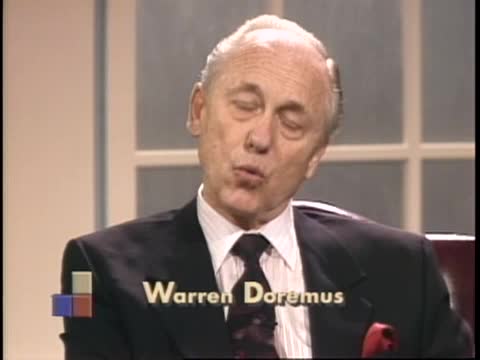
The Rochester I Know; 208; Warren Doremus
- Transcript
Musical Intro Local radio audiences heard his first professional words in the summer of 1946. In the 45 years since then he has been a part of the rise of journalism in first radio then TV. For both, he has interviewed the famous and soon to be infamous. He was on the scene during upheaval and after the [Narrator]: rage [Guest]:One man was assigned to each hostage. [Narrator]:To kill him?' [Guest]:To kill him.[Narrator]: Did you hear them say they'd kill him? [Guest]:Ah yes, a man and I had at his neck
a knife pressed against my neck. [Host]: News has brought him around the world 'Although the subject of the hostages is one of continuing American concern and discussion it is not one that you will regularly find on the minds and lips of the people in the streets of Germany even though...' War time and the capture of his brother took him to negotiations in Paris. Today, Bill Pearce talks with Warren Doremus about the Rochester he knows. [Host]: Warren, before we get to some essential things about your beginnings, let's go right to that last a remark a there in that introduction about your brother ah who was MIA in Vietnam. He was... First of all he was listed as MIA, And then KIA - The Navy inspection team that investigated this shooting down of the plane that my brother was flying in said that no one could have survived a surface to air missile explosion in that proximity. So they listed him as killed in action. And the North Vietnamese let us believe that for one and a half years. It wasn't
until January of 1967 through means we have never been able to ascertain, ah certain ah highly secret means, that we got word that my brother was alive. [Host]: So he was a prisoner of war for 7 and a 1/2 years. Where is he today? [Guest]: He lives in Columbus Ohio with his wife and daughter. He completed his Navy career about 4 years ago. Thirty years. Now, Warren, back to the beginnings this is not "This is Your Life", there's not - a lot of relatives aren't going to run out and embrace you. We're not going to open a book, but you were here since 1946 and you've seen the development of radio and television and and great events in this community and I hope we can get to most of them. But what brought you to Rochester to begin with because you weren't born here, where were - where'd you come from? No I'm a native of New Jersey and like so many millions of young
American males in 1944, I was drafted into the Army and saw service in the European theater. During that time I met another young soldier from Rochester a fellow by the name of Wayne Harris who has become a lawyer and very well-known in the conservation field here. Wayne Harris is the person who led so many of our environmental moves (Yes) in the 60s and 70s. (Yes) And Wayne I presume is still here. He sure is. He's still here practicing law and as a matter of fact they bought the the Sibley building over there on East Avenue you know. His law firm. Well. So Wayne Harris brought you to Rochester. He did; I came over to visit him one, I guess it was around Christmas time in 1945, and shortly after we returned from Europe and I met the young lady who was to become my wife. Was she - and how did you meet her? Well I met her because she
is related to Wayne. She is a relative of his. So Wayne arranged an introduction? So we can blame the whole thing on him. No, I'll credit him for this. Credit - all right very good. All right you're here. [Host]:You came back - you met someone here that you fell in love with and married, then you came back in...? '45? You said this was '45? [Guest]:That was '45 and after we were mustered out of the army back in the summer of 1946 I wound up back here because this is where my wife-to-be lived. [Host]: Did you have a job? Guest]:Didn't have a job. But her father insisted I have one! [Laughs] Jean Schlottman she is the daughter of a ah dental family here. Both her grandfather and her father were dentists and ah Dr. Schlottman said, "Well young Mr. Doremus if you want to marry my daughter you certainly better be prepared to care for her". In those days you know men were the the wage earners in the family. [Host]: A lot of that going around then. [Guest]: Yeah,
So, ah I had to have a job. I had made-up my mind that I wanted to get into this business. And and I did that because when we were in- [Host]: Now by "this business" you mean the radio? [Guest]: the broadcasting business, [Host]: broadcasting, [Guest]: yeah. yes of course. We weren't really thinking about television in those days; television was reserved for a few major cities in this country. It was still in its in its earliest ah days of infancy. But radio was in its golden age, you know that's - Bill, you remember -[Host]: This is late 40's, early 50s [Guest]: in the 50's. [Host]:That's when they had real radio programs. [Guest]:They did! Yes, I often say that's when they had real radio. Ah. What passes for it today and I'm sorry to have to say this because, of course, that's an insult to a lot of the people who are in the business, but ah what passes for radio today is nothing like what we had in those days. [Host]: Now before we get into your radio career, what did you think of Rochester? I have to ask this question of everybody who comes here as an outsider. [Guest]:Yeah. [Host]: You've come to this town, is it a sleepy little village? [Guest]:Yeah. It
It was, it's, one could have called it I suppose a sleepy little town. Ah Not really an accurate description of it, I mean, this even in those days had a highly diversified economy. It had good political structure; it had a couple of decent newspapers, 3 ah respectable radio stations, wonderful colleges and universities and there was a spirit to Rochester and I liked the feel of this town. So when you say a sleepy...ah front-porch-sitting-beer-drinking community. I think we do this a disservice, this whole community a disservice by describing it that way. But people do. Of course the "Smugtown" aspect of it that that a someone has written about ah our good friend Curt Gerling, ah, well he lived here long, he's lived here longer than I have, he probably has good reason for thinking that there is a certain amount of smugness here, but I came from the New York metropolitan area in New Jersey where I live; Montclair, New Jersey it's only 14 miles from New York City. [Host]: So you were immediately suspect when you came here. [Guest]:Oh yeah.Yeah.
Oh yes of course. But I found a town with a great deal of um livability. Even then, you know, 45 years ago the New York metropolitan area, in so many ways Bill, was not a truly livable area. Millions live there or do we say they exist there? You know the old saying "it's a wonderful place to visit, but I wouldn't want to live there". Ah, my little town in New Jersey was much better than living right on the streets of Manhattan, I think. But this looked a little bit like my town. It had a small town characteristic in this, certainly nothing invidious about that comparison. I like this place. I also thought it was a safe place to live. And it was a place that you had the feeling you could come into and be welcomed very quickly. I think that is not true say, in Washington, D.C. ah
maybe Miami, ah Los Angeles, I don't know. There you just blend into the woodwork, you know. [Host]: Now you started a radio career. How did it come about? Did you walk in one day with a resume and say "I want a job in radio" ? Hey, Bill, I didn't have much of a resume when I was a young ex- soldier with no experience very much in anything although I had been shooting movies from the time I was 13 years old. and - [Host]: That's interesting. Did you shoot movies here? [Guest]: No. [Host]:Not to digress from your radio career. [Guest]:Oh yeah, well I did do some here, as a matter of fact. I continued with that; it was strictly an avocation. I had thought at one time of going into that business - travel-film-lecture business - all over the world with a camera then back here and all over the United States. [Host]: Sounds romantic. Thayer (?) Sol (?), Burton Holmes that kind of thing and I was very impressed with those people when I was a kid. But, um that is not conducive to marital stability or
to having a good strong role as a father in raising children. I mean if you're out 3 months, 4 months of the year shooting film in in wherever it may be and then the other 6 months showing these pictures: you're never here. So this appealed to me a great deal and I had done a lot of things - I did, I did closed circuit radio broadcasts when I was in the 7th grade. [Host]: So you did have some experience! [Guest laughs]: Well. It was [Host]:That you proceeded to magnify, and blow up so you could get that first job. [Guest]:Yeah. Right right right. But, but of course, I didn't have any real, uh, resume. [Host]:So your first job was where Warren? [Guest]: It was right where I am today, with those same call letters. [Host]: WHEC WHEC? [Guest]: Hm hmm.[Host]: and it was 1946? [Guest]: '46. I walked in, you know, they say time - who was it?-- Eric Sevareid frequently, as he used the phrase, 'Timing is everything'. I walked in for the the interview, the job interview and the audition. The audition was crucial it
turns out; at just the time they were going to produce a new series of radio shows, 15 minutes a night, 6:30 to 6:45 just before Lowell Thomas, and, ah The program was called the ah Rochester Savings Bank Journal of the Air. It was a variety radio news show with some of the components that we see in television today. You don't see them in radio any longer, for instance, a salute to the citizen of the day. And we would get on the air night after night in those days they would, we would record them on these great big 16 inch platters. You remember those things? [Host]: Oh, yes. [Guest]:There was no audiotape. [Host]:Electrical transcription, we call 'em ETs, I think. [Guest]: Yes,[Laughs] and then they would be presented to the citizen of the day as a little gift you know with our blessings. It was a promotional device, of course, but very interesting. [Host]: Who were some of the people you worked with then Warren?
[Guest]:Well - [Host]:You mentioned this was the golden age of the age of broadcasting so ah, I know we had many famous broadcasters here in Rochester. Ah a You among them, of course. [Guest]: Well if any fame accrued it certainly wasn't until a long time thereafter, but I appreciate the the ah comment, Bill. Well, the people that I joined at that time. Were really wonderful broadcasters. Among them Jack Barry, the guy who did the morning show for many years on ah WHEC radio and also did the Atlantic sportscasts-- a play by play of the Atlantic football games in the Eastern regional network. Ah a man by the name of Bill Despard who went on to CBS in New York and then to CBS in Chicago and wound up eventually in a Los Angeles where he made his home. Roger Goodrich was another fellow who was a very classy broadcaster who went ah to Canada. He was hired there to appear in their 1st ah commercial television
venture on channel 9 in Toronto when that started up in 1960. He'd [Host]: He was also on WHEC. [Guest]: He was there, yes he was he was 1 of those people that was a very small staff, by the way, you know, we today these station's ah luxuriate in large staffs. A particularly the television stations, of course; but in those days where we had about 6 staff announcers, ah a fellow by the name of Bill Demaris was there. I tell you what was really interesting. We had a studio orchestra. I'm talking [Host laughs.] about off a full studio orchestra. We had ah some some of the very best instrumentalists you'll find in the City and all of them were either on their own full time musicians or they were with the Rochester Philharmonic! Now that was quite an [Host]: Now now what kind of program would they be would they be an orchestra program or would they just? [Guest]: Yes! [Host]: Just, would they be doing introductions and [Guest]: No no no no they were doing half hour
shows or hour long programs. [Host]: Yeah. [Guest]:And we also had a Wurlitzer-- a great Wurlitzer organ. This was the only station in town with anything like that. And ah for many years ah I thrilled to introducing musical programs. Jerry Votte -long since gone from the scene. Ah but, Jerry Votte was the organist and he played this absolutely fabulous instrument. Which when the station a finally moved over to East Avenue back in 1958 was sold to somebody out in Denver or there in around Denver, Col- Colorado. And um, so that was the last anyone will ever see of an organ in that great big Wurlitzer studio organ in this community, I'm sure. [Host]: Warren, when did did you get interested in doing news? We're you doing news right from the beginning? [Guest]: From the beginning. [Host] Yeah. [Host]: You know yeah. [Guest]: That that, in fact, that all I said that audition was crucial. I auditioned for The Journal of the Air. And they somehow or another they found something in me that they liked. And so I started out as a result of that got the job because they like the audition for that
particular program. And ah that. really reporting, Bill, has always been of interest to me. I mean, ah back in the in the earliest days in the in the civics classes of the 7th grade when I was doing those closed circuit broadcasts those were, in fact, reports, you know and I would muster my classmates to appear and to recreate little dramas for me. And ah so reporting there, reporting on film, I mean, if I had gone into that field that's reporting too, you know, in the in the travel business. Um ah But, shortly thereafter I began doing traditional newscasts on the station and I've been doing that kind of thing ever since. [Host]: Well, I think when I first came to town in the mid '60s I remember you doing I think regular newscasts [Guest]: Yes, I was. [Host]: and then the Homer Bliss was doing the ah weather in his, was it a Texaco uniform? [Guest]: Ah, Atlanta [Host]: Atlanta well it [Guest]: Atlantic
[Guest]: [Laughs] weather man [Host]: Atlantic weather man.That's what all the television stations had weather that was underwritten or [Guest]: Correct. [Host]: Or it was sponsored by ah gasoline companies. [Guest]: Yeah. Yeah [Host]: So they all wore Texaco or Atlantic or Esso or something or Mobil gas, uniforms standing by a pump. Ah Yeah [Guest]:I have to tell you [Host]: I guess you all went through that too. [Guest]:Oh good heavens. [Host]: What were those days like. [Guest]: Well, I never wore a gasoline attendance uniform, I can assure you; but ah I did do the weather, you know, those who were starting out as pioneers in television did it all! I mean name it -whether it was weather or news or sports or public affairs or hosting a talk show. Any. And, of course, commercials. That was the very 1st thing we ever did back in 1953 when we went on the air in November of '53 with television. Ah the 1st thing we had to do was to memorize that was no teleprompter for us. That didn't come until a long time thereafter; so you memorized I want to tell you 30 seconds of ah
whatever it was ah, you know some ah Palliative or whatever it might be, but not easily done. I found some people found it more easy than I did. [Host]: Well, as I recall in those early days of television that we didn't make the transition from radio to television we'll do that maybe in a minute, but as I recalled it; you sat there and simply read the material on camera [Guest]: Correct. [Host]: Carried away shot and looked up once in a while and then just just read from their notes or from whatever the script was. [Guest]: That's exactly right and you'll recall that Walter Cronkite right up until the day he left which was what 1980 81 something like that that. Had that that ah habit of looking down at his copy. Obviously, it was all right up there on the teleprompter. But he would go down to the copy and then back up and he would read a little bit and he would he would always give you that look back to the copy that stemmed from the early days because that is the way you were trained to do this. [Host]: Ah ah. [Guest]: Now you won't see any anchorman
except when a page is missing something like that [Host laughs] you won't see them going back to that copy that that whole a system of technique is gone. [Host]: What now, ah tel- television started here when '49 -'50 ? [Guest]: '48 1948 WHAM had the first television station, as you know, that was the Strongberg Carlson Company. They were very smart. The Gannett Company was not so smart. Ah. But, a newspapers ah and broadcasting although that was a traditional mix was not what I would call the very best possible mix. The people who ran newspapers were far more interested in newspapers than they were in the broadcasting profit [indistinct] [Host]: So so it was Gannett and Stromberg Carlson [Guest]: No no no Stromberg owned started-up that television station. [Host] Alright, hm mm. [Guest]: But they did it early on. They grasped that television was a way to be 1 of the major forces in communications in the world and they grasped that quickly enough to get in their license application and they were granted their license. Now then
by the time the Gannette Company and and the people who ran WHEC gathered that hey, [Host]: Gannett owned [Host]: owned HEC [Guest]:Gannett owned HEC all that time up until 1979. They didn't grasp that. [Host]: Yeah. [Guest]:and I think it was well, I don't know why it it was. It was just plain stupid not to grasp that. But they didn't. By the time they did, so many people were looking for television licenses all over this country that the FCC froze the applications. [Host]: Ah ah. [Guest]: Well they remained frozen for a long time. And when we finally got the application process through we had to share time to operate Channel 10 in 1953. [Host]: Now why is that there were so many applicants they wanted to kind of parcel it out or [Guest]: If you wanted to you had 2 choices. That is we had the the choice as did W V E T. had the choice of
fighting it out with the FCC to see who would who was going to get that 2nd television license here in in Rochester. Or, we had the choice of wedding the 2 stations together in a joint operation. That is the way we went and it lasted until 1962 when Channel 10. That is WHEC bought out ah WVET's half of Channel 10 and they bought out Channel 8. [Host]: And was that the year also that they finally dropped in the 3rd frequency? [Guest]: Ah, you may be right right; 13 [Host]: WOK [Guest]:may have come around 1962 around that time. [Host]:Finally finally got the 3rd finally got the 3rd station. [Guest]: Yes. [Host]: Now what was your 1st experience on television now here you all you're all reading your copy on radio doing all these wonderful things and a now television comes along. [Guest]:I tell you ah [Host]: You looked at it suspiciously? [Guest]: I looked at it with some fear because this was a whole new idea. You know we weren't as used to the one station in town as we were. It was still a very um ah
young and fledgling effort there ah back in 1953 they'd been on for 5 years and they have done all kinds of things there in those 5 years. Some of them very interesting; some well done, but all of it. You know, this was the this was the television in its infancy. Now, we were in our infancy whole new thing for us. And how do you handle it? How well will you look on the tube? Ah, can you memorize your copy? Particularly, because ah these advertisers, you know, they would come in with as I say these 30 second commercials and they didn't they didn't want you looking, you couldn't look down at a piece of paper to do a commercial. You could do that with a newscast you couldn't do that with a commercial you had to memorize. Not everybody can memorize Bill. We can't all be actors. [Laughter]. And I was a very bad 1, by the way, I think. [Laughs] My 1st experience putting one of those commercials on the air you had to hold this little box; it was Anacin. And it was an Anacin commercial. And you know your tendency is to hold it up here. But, of course, you had to hold it up here because the shot
was tight and they wanted you and the box in the same shot. Really. They wanted the box. Ah, it was a frightening experience I don't think I did it very well. And ah. [Laughs] No videotape, so I can't go back and look at it either. [Laughter].Just as well, [Host]: Not even a photograph, Warren? We we have to get to some to some of the big stories that you've covered right here in Rochester over [Guest]: Hm mm. the years and if you had to pick off the the big stories that come to mind. What are the events that stand out? [Guest]:Um. There are a number of political events, as you know, over the years we've been visited by presidential candidates and by Presidents: um ah Harry Truman came through here on the train. Never forget that that was an absolutely wonderful time. But, I wasn't really a covering that event, so much as, I was a spectator. Ah, but that is certainly that and the events following that with the Kennedy brothers here and the the other presidential candidates all of whom have made ah ah some news in Rochester,
but the biggest news that was political was the 1958 nomination of Nelson Aldrich Rockefeller to be the Republican candidate for governor of New York and as you know he went on to become a governor of New York and stayed in there longer than anybody else, I guess. Wonderful time that convention was held over in the brand new War Memorial. Well, rel- relatively new at the time. I covered that we did kind of gavel to gavel, you know ah [Host]: On television? [Guest]: Uh it Well we did it on radio radio. There was television coverage of it. We didn't do that. But the radio thing I remember Bob Trout in those golden days of radio when he did you know the iron man of radio that gavel to gavel coverage. I loved that, wonderful, memorable and a tremendous experience I think for the whole community. Um. The other major story is the Brighton explosions that took place back in the early '50s. [Host]: These were the gas explosions that I read about. [Guest]:Gas explosions that bulged out the walls of these homes
and 2 or 3 of them were at a state of virtual collapse. I'm trying to remember back on whatever I did cover that. [Host]: That was in over the Early '60s early [Guest]: I think was in the early '50s [Host]: early '50s [Guest]:You're really testing me now. [Host]:and you remember where you were at the time of the Brighton explosions? [Guest]: Well, Well, we were both, of course. I say, of course, there was no particular reason why we would have been in Brighton at the time there was no warning about this, you know. This whole this just happened. And whatever warning was received was from the people who lived in the area and saw some of the walls of the homes beginning to bulge out and sounded the alarm: "Call the fire department" but, of course, by that time it was too late, um [Clears throat] [Host]: Were Were you a reporter at that time? [Guest]: I was a reporter did cover that story and was absolutely bug-eyed to see what can happen when gas comes into a house and the windows and the doors, but the only thing about that story that we all remember so vividly is that it happened during the daytime. Had it happened as I recall mid afternoon had that happened a few hours later when people were asleep a lot of people would have been killed. I think no one was killed in those explosions, but I may stand
corrected on that. [Host]: That was ah. That was a major event. [Guest]:Major event. Talk about explosions there was. There was a social explosion in this City in 1964 and I covered that from beginning to end. I was [Host]: the so-called Rochester riot [Guest]: The riots the riots. Yes people some people still refer to them as race riots. Others including at least 1 former public safety commissioner at the the public safety commissioner at the time said that they were street riots, but not race riots as we might attribute ah ah. The riots say in Watts or in Philadelphia. [Host]: Do you think we've changed since those riots? You think the town has changed? [Guest]: I think we have changed considerably. Lots of mechanisms are in place today to deal with the grievances of black people and other minorities that were not there at the time. Remember the Council of Churches brought in Saul David Alinsky and the Fight Organization all came. [Host]: Warren [Guest]: As a result of that. [Host]: Warren, as you know all too well. Half hours go. [Guest]: Don't
tell me this is gone! [Host]: Like that, [Laughter] you know how fast they go! Warren Doremus, thank you very much for being our guest today on "The Rochester I Know". I'm Bill Pierce. We'll see you next time. [Music] [Music] For a VHS copy of this program send $19.95 plus $3.50 shipping
and handling to "The Rochester I Know" Tape Offer to Post Office Box 21, Rochester, New York 1 4 6 0 1. Include a note with the name of our guest and the program number shown at the bottom of the screen.
- Series
- The Rochester I Know
- Episode Number
- 208
- Episode
- Warren Doremus
- Producing Organization
- WXXI (Television station : Rochester, N.Y.)
- Contributing Organization
- WXXI Public Broadcasting (Rochester, New York)
- AAPB ID
- cpb-aacip/189-07tmph2c
If you have more information about this item than what is given here, or if you have concerns about this record, we want to know! Contact us, indicating the AAPB ID (cpb-aacip/189-07tmph2c).
- Description
- Episode Description
- This episode features an interview with Rochester reporter and broadcaster, Warren Doremus. Doremus recounts his extensive career in both radio and television, as well as his family history.
- Series Description
- "The Rochester I Know is a talk show featuring in-depth conversations with local Rochester figures, who share their recollections of the Rochester community. "
- Created Date
- 1991-05-22
- Asset type
- Episode
- Genres
- Talk Show
- Topics
- Local Communities
- Rights
- Copyright 1991 WXXI Public Broadcasting Council
- Media type
- Moving Image
- Duration
- 00:28:31
- Credits
-
-
Director:
Olcott, Paul J., Jr.
Guest: Doremus, Warren
Host: Pearce, William J.
Producer: Doremus, Wyatt
Producing Organization: WXXI (Television station : Rochester, N.Y.)
- AAPB Contributor Holdings
-
WXXI Public Broadcasting (WXXI-TV)
Identifier: LAC-999 (WXXI)
Format: U-matic
Generation: Copy
Duration: 1800.0
If you have a copy of this asset and would like us to add it to our catalog, please contact us.
- Citations
- Chicago: “The Rochester I Know; 208; Warren Doremus,” 1991-05-22, WXXI Public Broadcasting, American Archive of Public Broadcasting (GBH and the Library of Congress), Boston, MA and Washington, DC, accessed June 4, 2026, http://americanarchive.org/catalog/cpb-aacip-189-07tmph2c.
- MLA: “The Rochester I Know; 208; Warren Doremus.” 1991-05-22. WXXI Public Broadcasting, American Archive of Public Broadcasting (GBH and the Library of Congress), Boston, MA and Washington, DC. Web. June 4, 2026. <http://americanarchive.org/catalog/cpb-aacip-189-07tmph2c>.
- APA: The Rochester I Know; 208; Warren Doremus. Boston, MA: WXXI Public Broadcasting, American Archive of Public Broadcasting (GBH and the Library of Congress), Boston, MA and Washington, DC. Retrieved from http://americanarchive.org/catalog/cpb-aacip-189-07tmph2c