Speaking of Rochester; 112; Jack Hostutler
- Transcript
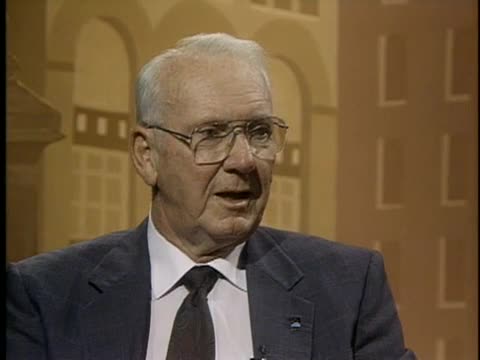
How do you do ladies and gentlemen our guest time speaking of Rochester today is Jack Hostettler. Jack was for 23 years the president of the industrial management council here in Rochester. One of the central institutions for the business community. And Jack in that role played a very important part. In the important the tremendously germinal period of the 60s and 70s and and 80s here in Rochester. He's retired now and lives for the most part in South Carolina which gives him a different perspective on things here in Rochester. And I'm very happy to welcome you to the program Jack. Nice to be here Barbara as you look back at the Rochester I'm sure you have many warm thoughts about the place because you have been an important part of the activity here for a long time. Well it was great. I enjoyed every minute of the years that I was with the industrial management council. It was a job that fit me like a glove I was involved in virtually every aspect of the community knew most of the leaders of the community. And
it was a job but it was also a fun job. Jack you came from outside Rochester originally. Your career started in Ohio as a public relations for a min America Conference and the Ohio University right took a turn when you decided as a result of on coming child. That you needed to make a little more money and you had to work for General Motors and General Motors moved you around and starting in Ohio. You came here to Rochester and then went to New York City and then came back to Rochester in the capacity which we're going to be talking today. That's absolutely on target. Yes. But that raises an interesting question. There are many industrial cities in America where big business has a representation. But which brings people in and out of
the city constantly. Rochester seems to be a self-contained kind of a place both industrial and in other ways. And therefore we seem to have a more stable personnel group here. Our big biz business is. Sited here to a very substantial extent. That makes a difference in the makeup of the community doesn't it. Oh very much so. Rochester basically despite the fact that you've had some large international companies that were in here when I first came into the picture it's basically a community built by Rochester Ariens and business and industry here were built by Rochester industrialists businessmen and so forth. And. And of course there were some very dominant business is Eastman Kodak and Xerox. There are others as well but those are obviously two of the major ones and their role has somewhat
declined as a result of the downsizing it was necessary to make them globally competitive again. All right. The result has been not necessarily an outflow of people from the city. But the creation of a lot of new subcontractors and other high tech businesses that could could also carry a significant industrial punch here in Rochester is that right. Oh there's no question about that. There's been a lot of changes over the past 25 or so years that have in fact created a lot of smaller businesses in the community that are spin offs of some of the big ones. In areas in which they no longer wish to be competitive that they no longer wish to stay in. Johnson and Johnson obviously coming into the health care field that Eastman Kodak was in and now look out located out at Canal Pond Park is a major difference I mean it's a significant
employer in the community. They were former Kodak employees now the Johnson and Johnson employees. We have the same thing with what was formerly General Motors plants. I t t is now the Delco and when I first came here it was Delco appliance and they made furnaces and as well as the windshield wiper parts and so forth. They went through a great transition and literally moved out of the appliance business and dealt primarily in fractional horsepower electric motors. Now they are a division of IPTV because General Motors elected to have them as a supplier rather than as a part a division of that company. So as a major support for Rochester business one of the lessons you had to learn was to stay loose is that right. Well that happened all the time I mean very often and one of the things that we got involved in was helping to move employees with one company was downsizing our business was to know who was upsizing. And where are some of the opportunities were for employees to make the transition.
And especially in many of our skilled trades we went through a number of periods where skilled trades were just in such great demand here we couldn't possibly turn them out fast enough so we had to work with the tool and die industry in particular helping to establish and expand the school facilities that they had the old our campus which was the Alrighty gymnasium. Eventually became the home for Rochester tool and die training center and it came because we all worked together to get to make that happen and that's the kind of things that very often happened in Rochester. Well when you first came here in 1968 one of the first things you had to do was to find two hundred skilled workers for General Dynamics. That's that's right. And General Dynamics isn't even here anymore and they weren't there three or four years after that but they were in a great need for people at that time especially in the assembly area. But when I came we had an unemployment rate of less than two percent and that prevailed a great deal of the time during the late 60s and early 70s so
manpower shortages were very much in the vogue during those periods. What was that one of the major activities of the Industrial Development Council. Very much so. Barber we didn't. Really try it on a constant basis to aid employees in getting jobs. We had a placement service that ran throughout my my years there of trying to help by dealing with the New York State Employment Service dealing with paid employment services and so forth really trying to help people get jobs but we were also very much of a research organization and in the community for business and industries trying to keep them alert to the major changes that were taking place in the human resource field. One of the biggest assets Rochester's had to offer has been skilled employees. They were brought here by Kodak and Xerox when they downsized of course they became available and many of them were entrepreneurial and started their own
businesses. So in a very real sense Kodak and Xerox have been responsible for what came after them. They have as well as many others even the General Dynamics. RF communications are Harris as we know it today was certainly an off shoot of a couple of pretty bright engineers who ended up moving out of General Dynamics and starting out sideband radio technology operations and grew that into a successful business there are another a number of others that did the same thing. Technical people primarily in engineering and inventive fields that were able to grow other businesses in the community. Can this go on. Jack do you think in Rochester continued to maintain its position as a high tech community kind of in a way says here in western New York. Well it's difficult it's a lot more difficult than it used to be. Number one the business climate in New York is still not what it should be. I think there's efforts being made
to improve that. But the only way that we're going to do it is we've done it in the past we've got to grow our own. We are not going to attract major firms into this community. Such as they do in a place where I'm living now South Carolina has been able to get a couple new automobile plants foreign automobiles I might add but they have been able to get those in. This just doesn't happen here. We've had it wrong on taxes generally taxes very often people have felt the business climate has been that strong. We preached that for 23 years I was at the IMC and it's been still being preached on on a regular basis this is a tough state for business it's not tight because people don't want to be better but nobody wants to give up the taxation that is so much a part of New York State. Well then you say it's going to have to be self-generated here in the community. Rochester is a self-contained community a very substantial extent. But that means then does it not. We've got to stress the kind of educational environment
here that will attract young people to get the skills they need. For Rochester's industry they may come in as individuals but we won't attract any businesses. Given the climate the overall climate of the state. That's exactly what we're talking about and that's why the educational institutions here have been a real asset. The U of R T m c c the state university systems here have done a lot to bring about the kinds of people and the training that is very often necessary the retraining. Some of the new things that are being talked about today this whole area every manufacturing that is getting into the picture is very critical I think to the future because what we're doing is learning how to use the parts that have been made before that are still very very good and reuse those and I think that provides a real opportunity in places like alright with their new CMS program. I think will help provide
that you of our and its research area and a highly technical fields that they're involved in will help grow that as well some of the other programs that are in the state university system industrial management council does a lot of research. Does that mean that you do it in partnership with the universities to some extent or some of it too. To that it has also grown. Your staff has grown here over the period of your tenure as well it did during my tenure and it's even growing more now because there is more training development. The outplacement needs for developing organizations like the career Resource Center. All of those fit in and the research that I am see does does tie in with things that I deal very critically with the community in areas of health care in the areas of wage and salary surveys personnel policies practices procedures because really Rochester has been a very progressive community as far as employee benefits are
concerned. Our employees generally have done better than they have in most other parts of the country. But it's also provided us with better employees because the incentives were such that. They can do better here than they can in many other places. Jack tell us about the career resource center that was pretty much your baby wasn't it. Well yes it was very interesting when Kodak had its first cutback back in the early 80s. They had brought in an outside placement organization and they set up over in the old area off of Humboldt strait. And they did the outplacement there and it was only for a short period of time six or eight months and as they finished that up because most of the people that the outside organization was using were people in Rochester for a resource I went to Kodak at that time and I said if you ever have to do this again we would like a shot at it. Well when we when they got up to really having to do some of the cutbacks in the in the
late in middle to late 80s. We had we saw that opportunity we found the place up on culver road and set up the career Resource Center. We did primarily the establishment of it with working with Kodak and then we were able to work with what was then the women's career center and they had done some work in that area and so between us we operated for one year with them as a subcontractor. The second year we agreed to go into partnership with the women's career center and now it's called Career Development Services. So the two organizations still run the outplacement service for most of the companies in Rochester. And what some people felt we would be in business three or four years at the most. I believe it's now about 10 years that that are going to grow to it. Well it's been. It's continuing to somewhat grow. The thing you have to be concerned about is you go through ups and downs. What's good
for that career Resource Center is not necessarily good for business if we're getting a lot of business. It means companies are doing layoffs. So it's sort of one of these that needs a little bit of balance. But there's some balance needed with the public. Placement centers to the career Resource Center is really is there primarily for retraining and outplacement isn't it. Yes it's very much for the role of the employment service. But you know we end up there's an awful lot more personal treatment that people are able to receive at the career resource center there is a very extensive library theres a lot of reproduction services that public employment agencies cant necessarily do. There is telephone services there is computer services that are there available. There is Executive out placement thats available on a regular basis. We do a significant amount of counseling that is
there on a daily basis for the people that are using it. And so both at the executive level and at the non executive level theres a lot of guidance available to people. So the career resource center really is an enrichment program beyond anything you could get from from the state or federal government. Yeah no question about it and its again reflective of Rochester's special concern about maintaining its workforce and finding places for people to work here rather than elsewhere. One of the things that we sort of always tried to pride ourselves on was retaining our workforce here. We dont like to export our people because while we may be a little low today. We could be bombing tomorrow. And so to the extent that we possibly can retaining people in Rochester even though they may move from one employer to another is still very essential if we're going to remain a vibrant community. Jack I know a special interest of yours and one that you spent a lot of time on also
was health care here. Rochester as had the reputation of having a rather advanced health care system and of being because of the consolidation of services here being cheaper than most other places for the same quality of care that other places have. Can you tell us a little something about that and about the industrial management council's role in it. Well this was an area that we that I probably spent 10 percent of my time in because it was it was very essential that with cost growing as they did for the past 25 years up until the last few years by. It's double digit rates throughout the throughout the nation. We were able to hold rates here fairly tight because we did not allow wide expansion of beds. This dates back to Marion Folsom and his early years. And when he came back into town in the in the late 50s early
60s that was one of his real issues that he could see he had a great you know cost money. That's right. Beds cost money and so the basic premise was to hold down beds and have a higher percentage of occupancy. Then you might have in other parts of the world. And it's worked very very well despite the fact that we're grinding of teeth. There were people that say that we shouldn't do it this way that we really needed to take care. We had no evidence during all the years that I was involved that we had anything but outstanding health care. And it's because we've got facilities like the U of our medical school that drove a lot of the quality of care in this community. But we also had to deal with things like low cost care for the indigent for those who could not afford normal health care we were very involved in establishing neighborhood health centers. Explain to me why the industrial management council was so involved in this.
Because. Health benefits were such an important part of the cost of labor is that it. No question about it. It's one of the most significant. It is the most significant cost. Once you get beyond wages. It's the most significant cost as far as benefits are concerned for all of the companies and most of our companies in Rochester paid either all or a significant portion of health care costs. It's because the benefits here were more liberal That's right. Well that's exactly right. It's become more of a shared situation because in the early days many people didn't really worry about health care costs because it didn't cost them anything the companies were Panadol. Well I think there's a better understanding today even though still the bulk of health care costs especially among your major employers is paid by the employer. Some of the smaller employers obviously can't afford that same level. So much more of a shared by the smaller employers.
Well. I know Rochester is held up as a shining example of other places as a place where health care has been kept under control. And that means also that quality has been available at a reasonable price. And it's interesting to know that business has taken such a. Management role in trying to ensure that one of the critical parts of that is that basically we were a community rated and still are primarily a community rated. The only one in the country most of our experience rated programs in health care cost. But because you could buy the same policy whether you were a little X Y Z Corporation or you were Eastman Kodak Company for the same amount of money I think added a great deal to the community that's being tougher today. It's tougher to hang on to that community rating because we're the only one in the country that we're able to do it. And people have constantly come to try to take a look at it but they couldn't necessarily duplicate it. And It
horrified me when I first the first winner in South Carolina when I began to see the hospitals running big ads every day competing against each other they literally spend millions in other parts of the country advertising one hospital and playing it off against another which really doesn't happen here the cooperative between the hospitals. Even though they're competitive they just don't operate the same way and I think that's is a great asset for Rochester. What's the future of manufacturing here. What do you what do you see. It's been a declining part of our total economy. But it still is a very significantly higher rate than for instance a place like Buffalo let's say where there's more service. Employment Well fortunately we still have some very large employers Kodak's Xeroxes the TT's the General Motors plant that's still here. They are significant contributors if we can hold on to those
and then develop the others I think it's very good. But at one time we were close to 40 percent 40 percent. Of our employment was in manufacturing and it was almost double what the national average was during that period of 19 or 20 percent. I believe we're down in the high 20s. As far as manufacturing employment is concerned if we can hold that rate of employment we will still probably run 30 to 50 percent above the national average. And but it's going to take effort. It's going to have make sure that the. Legislature in the state that government in the state understands that they've got to be receptive to what the needs of industry and business are especially in the manufacturing sector because there's still a great deal of competitiveness for us. You still have other states. That are still trying to steel at probably not the right word.
Still trying to entice Rochester businesses into those areas and we've lost them in the past. GUYS IT'S GOOD AS That's right. That's exactly right. And we've got name businesses that are world wide names and that becomes important but the fact that we are a strong export are I think also says a great deal. You think the future of Rochester is still going to be tied very strongly to participation in the global economy just not in the U.S. economy Well I think that's something that. If we aren't able to compete on an international basis we will lose employment. But because we have been so strong and some of the major employers again taken that the two biggies are very much in the international business they're big exporters. And if we don't get too far out of line with the dollar we'll have have some good years. As I look to the future one of the reasons we're still going to be in there is because our big business has been willing to take the steps necessary to remain globally
competitive. Isn't that right. Well no question about it and the little guys too. There's more and more companies that are now looking globally and still involved with a little company in the area. It's not a real big one but they're looking at and they've been over and taken part in trade shows in Europe and are looking into South America. For sales in the future and this is a. 40 million dollar company that feels that their only future is to move in that area so it's unlikely that it Rochester's export leadership is going to change dramatically as long as the big boys pass and trade opportunities to the little boys as well. No that's that's a real asset to the overall community and the opportunities that are provided by the Department of Commerce both at the state level and at the at the international level are still very important as we attempt to open up the global
economy. Jack you're living in South Carolina now and you say you like to see the business coming in there you'd like to see it coming into Rochester more. You haven't regretted coming to Rochester have you. Not for a day. My years here were outstanding years and I loved every minute of it. But when I finished I figured I'd given it all that I had during those years and now I'm given all I have to being retired and and enjoying that way of life. Well the way of life here has something to offer too and I think it is in large part by the kind of contribution that people like you have made to trying to rationalize our business environment in ways that will permit us to remain leaders. Well I had a lot of good trainers with the CEOs of most of the companies that said on my board. They demanded a pretty good performance and taught me how to do it and hopefully it paid off in the long run and the community as well thank you for the work you've done here Jack we are we're
grateful and we are. We do look forward to a continuing and vigorous industrial. Environment here. Building on what you've already done. We wish you well in your retirement and thank you for being willing to be here on our program here today. It's been fun. Thank you very much. If you'd like a copy of this program send 1095 to WXXI. Post Office Box 21 Rochester New York 1 4 6 0 1.
- Series
- Speaking of Rochester
- Episode Number
- 112
- Episode
- Jack Hostutler
- Producing Organization
- WXXI (Television station : Rochester, N.Y.)
- Contributing Organization
- WXXI Public Broadcasting (Rochester, New York)
- AAPB ID
- cpb-aacip/189-07gqnm47
If you have more information about this item than what is given here, or if you have concerns about this record, we want to know! Contact us, indicating the AAPB ID (cpb-aacip/189-07gqnm47).
- Description
- Episode Description
- In this episode, host Barber Conable speaks with guest Jack Hostutler about industry in Rochester. Hostutler, who was president of the Industrial Managing Council, began his career working with a large industry, and when he moved to Rochester he adapted to a smaller environment. He talks about the opportunities for Rochester to strengthen large businesses even with in its close-knit community.
- Series Description
- Speaking of Rochester is a talk show featuring in-depth conversations with local Rochester figures, who discuss the past, present, and future of the Rochester community, as well as their personal experiences.
- Copyright Date
- 1998-00-00
- Asset type
- Episode
- Genres
- Talk Show
- Topics
- Business
- Local Communities
- Rights
- WXXI 1998
- Media type
- Moving Image
- Duration
- 00:26:54
- Credits
-
-
: WXXI-TV
Guest: Jack Hostutler
Host: Barber Conable
Producer: Wyatt Doremus
Producing Organization: WXXI (Television station : Rochester, N.Y.)
- AAPB Contributor Holdings
-
WXXI Public Broadcasting (WXXI-TV)
Identifier: LAC-827 (WXXI)
Format: Betacam: SP
Generation: Master
Duration: 1590.0
If you have a copy of this asset and would like us to add it to our catalog, please contact us.
- Citations
- Chicago: “Speaking of Rochester; 112; Jack Hostutler,” 1998-00-00, WXXI Public Broadcasting, American Archive of Public Broadcasting (GBH and the Library of Congress), Boston, MA and Washington, DC, accessed January 25, 2026, http://americanarchive.org/catalog/cpb-aacip-189-07gqnm47.
- MLA: “Speaking of Rochester; 112; Jack Hostutler.” 1998-00-00. WXXI Public Broadcasting, American Archive of Public Broadcasting (GBH and the Library of Congress), Boston, MA and Washington, DC. Web. January 25, 2026. <http://americanarchive.org/catalog/cpb-aacip-189-07gqnm47>.
- APA: Speaking of Rochester; 112; Jack Hostutler. Boston, MA: WXXI Public Broadcasting, American Archive of Public Broadcasting (GBH and the Library of Congress), Boston, MA and Washington, DC. Retrieved from http://americanarchive.org/catalog/cpb-aacip-189-07gqnm47