Louisiana: The State We're In; UFO's & Fort Pike
- Transcript
Production funding for this program was provided in part through contributions to Louisianians for Educational Television. The following program is a production of Louisiana Public Broadcasting. Good evening I'm Beth George. Welcome to this edition of "Louisiana: The State We're In." This week will give you a preview of some of the issues coming before the Louisiana legislature when they convene on Monday. We'll talk with two men whose interest extend beyond planet Earth. And finally we'll take a trip back in time to a fourth that is a tangible reminder of Louisiana's past. Here at the state capitol there is sometimes a feeling that the past merges with the present. As the legislature gears up for the opening day, there are reminders of other sessions and old political battles fought in the same chambers. To give you a taste of what may be coming up this session LPB's Ron Blome has this
report. The 1978 legislative session opens in this chamber on Monday. And joining us with their own precession analysis is Roy Brightbill of United Press International and John Hill of The Rural World and Shreveport Times. Gentlemen, Governor Edwards has proposed a budget of some 3.7 billion dollars he calls it a standstill budget. Is it that kind of a budget and can he keep the spending down? Well, on the face of it, it looks like a standstill budget. He's adding something like 77 million dollars in new programs, additional spending for existing programs, but the budget, overall, represents an increase of something like 64 million dollars over the current budget which means something got pared along the way. Who are the people that suffered the biggest cuts going from what we heard at the budget hearings and then going to what the document came up? Who got hit hardest? You know Attorney General Gus lost his bid again this year to pick up some money for his crime strike force.
Lots of people suffered, I don't think that anyone got hit the hardest or anything like that. They-- everybody went into the budget hearings this year asking for a great deal of money and nobody came away from there with a great deal of money. Most controversial thing-- new things in the budget I think are probably the state aid to mass transit and the parish road systems. Total 25 million dollar package. 15 million dollars to go to police juries to help maintain those gravel roads and parish-- hard-- other hard surface-- parish roads and 10 million to be divided up among the major cities to help pay the deficits of their mass transit systems. I think those are two of the most controversial things in the new budget. Yeah, I think I would add it in that that 15 million dollars in addition to helping improve parish roads was also obviously intended to help get votes for the mass transit subsidies. Yes and we've seen mass transit aid bills go down in fire for a couple of years running. Especially back in the special session two years ago,
the fall of 1976. Is 15 million going to be enough to buy the support of the rural lawmakers? Well, it's kind of difficult to tell at this stage. Edwards seems to be more confident than in previous sessions about this issue and I think perhaps one of the reasons might be is that there have been some committee hearings in the interim period. Which have indicated there is some sort of need to aid these transit systems in the major cities and there there seems to be a little bit more sympathy now than before. I think a big problem that he's going to face in getting the support necessary to pass these bills is finding a source of recurring revenue to pay the subsidies. There are some people who say they are in support of mass transit subsidies right now but they're concerned about the method of paying for them in the years to come. This first year is pretty much taken care of according to the budget but we don't know how
that's going to sit in in the years following. You also have to wonder how much 10 million dollars can do to aid the transit systems. What are they talking about, some seven cities from New Orleans all the way up to Shreveport. Actually, it can do a great deal. It will pay 50 percent of their operating deficits and the federal government will pay the other 50 percent under the urban mass transit aid bill. So, yes, it would help them them-- it would go a great deal to help right now. The big issue in the session last year was the pay raise and, in fact, it took a special session to get that through. The teachers got a $1,500 dollar raise, the other school employees and other state workers got a $900 year raise, and since that special session, they've been talking about equality and pay. There have been some recent rallies that they have called to try and drum up support for their issue. Obviously, they can ask for more money, do they have a chance? No. In a word no. No, they really don't. There's-- impossible to get raises without raising taxes. It is 1978, the state elections are in 1979. No one, no one wants to vote for any more
tax increases at this time. I thought they-- I think pay raises are out of the question until after the 1979 elections. Don't you, Roy? Absolutely, I don't think anyone wants to go through another round of debating taxes especially after that trauma of having to come back in special session last year with the teachers beating on the capital door. And with elections around the corner who's going to vote for a tax? Absolutely. One of the areas they have talked about to increase the money going into the state coffers is some changes in the energy taxes that Billy ? Thibodeaux wants the first use tax which, in effect, applies a tax to the natural gas produced off shore and shipped up north. It's a tax on the processing of transportation across the state. Do you think the legislature will go for that or will Edwards throw his weight behind it this year? Well, this is something again that came up last year and it kind of got dropped because I think the administration realized at the time the way the bill was drafted it wasn't workable and I think they're going to run into the same problem again.
Plus, we're still talking about a tax you know and that's a-- that's a big ugly word this year. Even if it is theoretically supposed to be passed on to consumers out-of-state and Governor Edwards himself has said he has doubts about the constitutionality of such a tax and also he has doubts that the ultimate end of this tax can be passed on out-of-state and these are the keys that they are counting on for passage. I don't think that they can get that. Even if they could get the tax passed through the legislation, the fact they can spend that money they can appropriate it because already all companies and others who are-- as I said-- if they you do this you pass this tax we're going to file se which means that the proceeds of the tax will be held in escrow while the-- the parties battle it out in the lawsuits-- in lawsuits in the courts. So it will be several years before we could start spending that money. Another proposal whose legality may be a little more sure is to
change the way the severance tax on gas is collected. Right now it's seven cents on a thousand cubic feet that was put in back when gas was selling for 25 or 30 cents a thousand cubic feet. Now the price is up substantially in the state. Some members of the legislature are talking about putting it into a percentage of market value to raise more money. Is there any feeling that you sense that that might be possible. I don't-- I don't really know, I haven't-- I haven't gotten a handle on that... Well Victor Bussie proposed that as I recall about a year and a half ago as a way to fund the teacher pay raises. And there was a howl from industry and from producers that... If you do that, well, you're going to end up taxing Louisiana consumers more heavily than anyone else. How come? Because if the taxes on the value, gas that stays in the state of Louisiana and tri-state gas is selling a higher price. That would really be a tax on the Louisiana consumer and I think that the kind of unpopular. What do you think Roy?
Certainly, I think that would be an unpopular tax and I think also we have to consider in any of the energy bills that we're dealing with in this legislative session, not only taxes but any energy bills across the board, they're all going to be affected by a national energy policy which no one knows what it is yet. We have to wait and find out what what the federal government says we can do or what we're going to have to do before we can really legislate anything in that area. And when they do it we could be fighting windmills. If there is going to be an emotional fight that will come up it could surround the community property laws the state's headmaster concept of how property between a married couple was declared unconstitutional in February, but this past week the state Supreme Court in a 4 to 3 decision kind of sidestepped the issue and upheld the constitutionality of the law. Now the committee's been working for a couple of years here on revising it. Do you think that the women of the state are going to get a sound revision of that law this year out of the session?
I think they can look forward to a change in community property law this year. There seems to be a change-- a general change in attitudes of many legislators. This is something that really that's been under study for I suppose more than 20 years. There's always been recognized the need for this change and in the last couple of years it's gotten-- gotten even more detailed attention more-- more widespread attention and I think that we're headed in that direction and I think we're going to see it come this year. But John hasn't the committee made some promises in the past they are going come up with a bill? Yes, I have a prediction. I think that you'll get a very sweeping change out of the House of Representatives. And the more conservative Senate will sort of patch things back. I'm just unconvinced it will have a sweeping change issue. Well it looks like E.R.A will go down in defeat so they might want to appease the women on the other way. Very quickly we don't have much time, let's go down a couple other things that have come up. The bill to lower the
penalties for pot. You think it'll make it? No chance. Our predictions on what's going to happen, of course, are ours alone and I wouldn't recommend that anyone place any bets on them. Even together it gives 8 in 5 odds. We'll join you again as the session progresses and see how accurate we were. Thank you. Mankind has had an eternal fascination with the unknown. And nowhere is it more evident than in the recent preoccupation with the possibility of life on other planets. Movies like Star Wars and Close Encounters are drawing record box offices. But there are some who see the possibility that we are not alone in this universe as more than an entertaining way of spending a Saturday night. In November of 1973, Pioneer 10 began a journey that will ultimately take it beyond the limits of the solar system. Its primary mission was to survey and relay data on the outer planets but it has a second function as well. On board is a message from the people of Earth. A plaque picturing a man, a woman, and a
map showing the location of our planet. No one knows whether or not this message to the stars will ever be found. But it symbolizes an increasing awareness among both the public and the scientific community in the possibility of life elsewhere. This is the site of the largest high frequency radio telescope in the United States. It is part of a $7.8 million five college radio astronomy observatory located in Massachusetts. Observatory Director Richard Huguenin says that astronomers have unexpectedly discovered complex organic molecules in the deep reaches of space. We knew that simple molecules would exist, hydrogen, carbon monoxide, and other simple, rugged molecules, but the big surprise has been the discovery of very complex organic molecules. Molecules with 1 or more atoms. This was not expected because the regions in which these molecules are formed are really
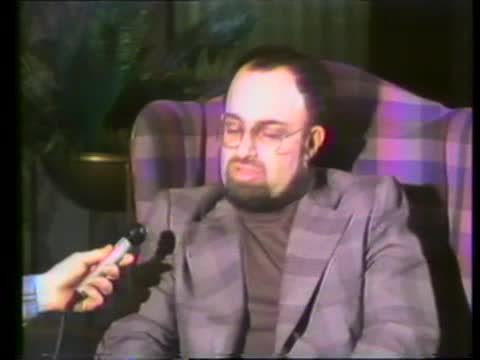
rather hostile. Being very cold, not very dense, lots of radiation, and so on. So the very fact that these molecules form came about somewhat as a-- as a surprise and I think it does impact a lot, as I said, in our understanding of the formation of life on planets because the same material from which the stars are formed, of course, also form the planets. One scientist who thinks there's a lot more than organic molecules in outer space is Nuclear Propulsion Specialist Stanton Friedman. Now devoting full time to lecturing on the subject of UFOs. Friedman believes that the government is trying to cover up the facts. There's no question we're dealing with a kind of cosmic Watergate. I've talked to more than 85 former military people told me of excellent sightings that occurred while they were in the service where the data didn't go to the old Project Blue Book instead typically went to the Aerospace Defense Command or the National Security Agency neither one of which needs to talk to the newspapers. The reasons, it's a worldwide problem.
You can understand all governments on this planet having three good reasons from their viewpoint for not putting the data out on the table. First, I want to figure out how they work because the single most important aspect of a flying saucer is its potential for military utilization. Weapons delivery, system defense systems, we have a big commitment in this direction to other major countries. So you want to set up a secret program to figure out how it works and I want to tell the Russians were working on the next generation of super fast aircraft. Super maneuverable. If you tell the Americans, you've told the Russians. They read our newspapers, listen to our television, and so forth. Same goes for them via the US. The second problem is the other side of the coin. What happens if somebody else figures out how they work before we do? How do you defend against them? Terribly difficult probably. You don't want them to know that you know that they know. The usual weapon counter weapon kind of situation. The third problem is the big one though. Suppose there were to be an announcement tomorrow by two highly trustworthy individuals, trustworthy from a world view point, say the Pope and Walter Cronkite, let's say. That yes, flying saucers are indeed real and extraterrestrial and neutral. If he said they're nasty that changes everything, of course. What would happen?
I think the most important thing that would happen, forgetting stock market effects and you know other trivial, would be that there would be an immediate push especially by the younger generation, which was never alive when there wasn't a space program after all, for a new view of ourselves. Instead of as Russians, Americans, Chinese, the nationalistic labels we have, as Earthlings. Perfectly obvious from the alien viewpoint, we are all earthlings, like it or not. But there's the problem. I don't know of any government that wants its citizens, at this point in our history, to owe their primary allegiance to the planet as opposed to that individual, nationalistic, power hungry group running the show. So I can see where each administration would just as soon defer the problem to the next one. You know it took us what, six months to decide on the shape of the table for the Vietnam negotiations? How much longer to decide who speaks for planet Earth. Let's not kid ourselves into saying what will hold an election. We're not going to give the Chinese four times as many votes as we have. So it sounds like a simple minded question, you know who's that leader to be taken to kind of thing. The answer is there isn't any leader to be taken to and there's nobody who speaks for planet Earth. Do you think it would cause a kind of world community that would break
down the national boundaries? Well, I think it would if governments allowed it. But that's the problem, I don't know of any government that's ready to step aside and give up some of its authority to a world body. And last year, the governments on planet Earth spent approximately 320 billion dollars on military systems. Almost all of those in the service of nationalism. That's a big step from that to a world kind of situation. Don't you think that would cause a terrific cultural shock to the general public? Well, yeah, it would if you replace nationalism with Earthlingism. Yeah, but I don't think there'd be an enormous amount of panic. I think most people recognize that, let's face, it we're a primitive society whose major activity is tribal warfare. We need to get off the tribal warfare kick. The next war is not going to be a fun sort of thing, not that the last one was, but it's going to be hell of a lot worse. And I think that most people recognize this. Some feel, however, that the talk of UFOs is strictly sensationalism. One skeptic is Dr. Robert O'Connell, Professor of Physics at LSU Baton Rouge.
The question as to whether there is life on other planets is a very complex scientific question and there certainly has been no answer to that at the moment. The probability of finding life in other planets is the subject of the bit. So one assist with three pieces of evidence. First of all, there's been no evidence for life found in any of the other planets and in our own solar system where you might think to be a good possibility. Some of the other planets. Then the question is, in what stage of development is this life? When you consider the development of life on our own planet that took thousands and billions of years for human civilization to advance to the stage that we're now in. So, the possibility that you would have found life on some other planet and that the civilization
is as advanced, or even more advanced than our civilization, and that they are capable of sending spacecraft on to us is very remote in my opinion. O'Connell believes there are more logical explanations for UFO sightings. For instance, this newspaper photograph appears to picture flying saucers. Actually, these are rare lenticular cloud formations over Brazil. As to whether there is other intelligent life in the universe, the debate goes on. With the hundred billion or so stars, many of which must have planetary systems, it seems inconceivable to me that there wouldn't evolve life on many of them. And with the evolution of life, I think I would be most surprised if civilizations didn't evolve as well. Whether or
not we'll ever communicate with them is a totally different question. But I think just from the statistics, the number of stars and the-- all the probabilities and so on I just-- my gut feeling that there must be a lots and lots of civilizations in our galaxy. Looking into the future can be an exciting venture, but for some, the records of the past provide more insight into what we were and what we may become. If you journey out to the narrow throat of Lake Pontchartrain out to the Rigolets pass and Lake Borgne, you'll see a reminder that this state was once a tempting jewel. A prize to be coveted in the colonial rivalry for control of the new continent. From this point first the French and then the Americans built their fortifications. Fort Pike once defended the back door to New Orleans, but now its garrison is a team of state
archaeologists and the invaders are tourists and children. After the War of 1812 and the burning of Washington by the British, President Madison began to worry that New Orleans could be taken with similar ease thereby strangling the commerce of the nation's midland. The president turned to Simon Bernard, a French military engineer and dispatched him to the Gulf Coast to design a new system of defense. The result was a network of forts from the delta to Florida. Two of the forts, Jackson and Pike, control the water routes to New Orleans. For Jackson, sitting near the mouth of the Mississippi River control the front door while Fort Pike control the narrow Rigolets pass at the entrance to Lake Pontchartrain. Fort Pike stands is a classic example of French design with a rounded delta shape and battlements set against an invasion by sea. Top priority was given to the project when construction began in 1819. But the first year of building proved to be one of frustration when the first foundation failed to hold up on the marshy swamp land, a new site was chosen and a foundation 10 feet
deep of cypress logs and clam shells laid down. Finally, after eight years of construction at a cost of $635,000 the fort was complete. Unique to Fort Pike was an interior citadel, a barracks within the fort's outer walls that would serve as a place of last resistance. A place where the fort's soldiers could hold off invaders until reinforcements hopefully arrived. For all its guns and soldiers, Fort Pike never saw any real action. Shortly before secession, the outbreak of the Civil War, the state militia took over the fort. Later, as the war progressed, the confederate forces abandoned the fort under the threat of a federal attack. There was some fighting down at Fort Jackson in which the union's iron clad gunboats proved that the old coastal forts could no longer stop an invader. Towards 1890, with the usefulness of the coastal forts in doubt and with maintenance costs
soaring, Fort Pike and others like her were closed down and left alone to battle the forces of nature. The Louisiana State Parks and Recreation Commission owns and operates Fort Pike now and this spring, a team of archaeologists have been scraping away the edges of time. It's a painstaking process that requires a special kind of patience. A state archaeologist, Dr. Allen Toth, oversees digs and restorations and he says new federal laws have brought them a lot of work. The impact of these federal laws has been very great on the field of archaeology. It's enabled funding to be much more readily accessible. In the the older days, older days I mean just five or 10 years ago, one would be pretty dependent upon the National Science Foundation or National Geographic or perhaps private monies through a museum to do any kind of research. The requirements for those type of grants would be a very specific, problem-oriented type of research. Now that the federal money is available to
compensate for the loss of our cultural resources by some public project which is federally permitted or funded, the work is where you find it. It's well financed and it must be done before construction can begin. But on the other hand it doesn't always pertain to the same region of the same point in time and a great challenge in archaeology is to be able to preserve the information, to-- to pull this all together in another 10 or 20 years as great volumes of new data come in. And yet it's very difficult to synthesize because it's sort of hit or miss. Have we already lost some significant sites? Have we already, before all of this came into effect, have we bulldozed some sites away forever lost them? We have lost hundreds in Louisiana as the price of soybeans goes up on the-- on the world market, price per bushel. I'd hate to have to estimate how many sites we lose in areas that were not farmed even 10 or 15 years ago.
We've lost them to highways to treasure hunters to every kind of conceivable construction and this is not unique in Louisiana. It's true of the entire nation and it is one of the the reasons that the-- first at the insistence of the National Park Service and then an at the support of a number of people in Congress over the last say 10 years, these federal laws to think about cultural resources have come about because we find ourselves with-- with only a sample now of the good sites. And if we don't take some action now, it's estimated, at least in Louisiana, that within 25 years there will be no sites left or even worthy enough to make say a commemorative area or a park at. We're not just talking about a "oh they're hundreds of miles and so if we lose a few this year and a few next year there will always be some left." That's not the case. As a matter of fact, most of our most spectacular sites are already destroyed to some extent or another At Fort Pike,
time is running out on archaeologists in another way. State plans to rebuild and restore the old fort are underway and archaeologists have only a few more weeks to complete their studies of areas affected by the building plans. Site archaeologist George Castille explains. We're trying to finish our excavation by the end of April. We're trying to get all the archaeology done prior to the restoration project so there is a time limitation and if we hold up the restoration project, it may be very costly so we're trying to move as fast as we can right now. Most of us have only a passing knowledge of archaeology and we think of people sifting through every little grain of dirt. We see some people digging very vigorously here. Why? Well, in most cases, archaeologists would screen and would sift very carefully, but in this case, these men here are digging into what is part of the wall of the fort and it is simply earthen fill. There are very few artifacts in it and it was probably all dumped in at the same time over
maybe one or two years time. So there's very little in it and very few features in it. For that reason, we're digging a little faster than we would normally. The reason you're digging up these various sides is because when the restoration comes they may be destroyed. Is that it? Right. This whole area that we're standing on will be torn up during the restoration project. And so we're simply trying to map in everything we can. Photograph and drawing everything that we find. This summer, archaeologists will be busy excavating a number of sites throughout Louisiana. And as one archaeologist put it, is an exciting time for those who are concerned about preserving the state's heritage. Next week, we'll begin our special coverage of the Louisiana legislative session. On Monday, we'll present live at two o'clock, the governor's address to the opening day. And next week, at this same time, we'll give you a summary of the week's happenings, an in-depth look at some of the issues, and profile some of the colorful people who make it all happen. Won't you join us then? I'm Beth
George. Good evening. [outro music] The proceeding was an LBB production. Production funding for this program was provided in part through contributions to Louisianians for Educational Television.
- Episode
- UFO's & Fort Pike
- Producing Organization
- Louisiana Public Broadcasting
- Contributing Organization
- Louisiana Public Broadcasting (Baton Rouge, Louisiana)
- AAPB ID
- cpb-aacip-17-623bm45m
If you have more information about this item than what is given here, or if you have concerns about this record, we want to know! Contact us, indicating the AAPB ID (cpb-aacip-17-623bm45m).
- Description
- Credits
-
-
Producing Organization:
Louisiana Public Broadcasting
- AAPB Contributor Holdings
-
Louisiana Public Broadcasting
Identifier: cpb-aacip-1a88fec054e (Filename)
Format: U-matic
Generation: Master
Duration: 00:28:25
If you have a copy of this asset and would like us to add it to our catalog, please contact us.
- Citations
- Chicago: “Louisiana: The State We're In; UFO's & Fort Pike,” 1978-04-20, Louisiana Public Broadcasting, American Archive of Public Broadcasting (GBH and the Library of Congress), Boston, MA and Washington, DC, accessed September 23, 2026, http://americanarchive.org/catalog/cpb-aacip-17-623bm45m.
- MLA: “Louisiana: The State We're In; UFO's & Fort Pike.” 1978-04-20. Louisiana Public Broadcasting, American Archive of Public Broadcasting (GBH and the Library of Congress), Boston, MA and Washington, DC. Web. September 23, 2026. <http://americanarchive.org/catalog/cpb-aacip-17-623bm45m>.
- APA: Louisiana: The State We're In; UFO's & Fort Pike. Boston, MA: Louisiana Public Broadcasting, American Archive of Public Broadcasting (GBH and the Library of Congress), Boston, MA and Washington, DC. Retrieved from http://americanarchive.org/catalog/cpb-aacip-17-623bm45m