Louisiana: The State We're In; 245
- Transcript
Production funding for this program was provided in part through contributions to Louisiana for educational television. The following program is an LPB Public Affairs production, Louisiana, the state we're in, with Beth George and Ron Bloane. Good evening and welcome to this edition of Louisiana, the state we're in. Beth George is on vacation this week, a trend that seemed to be popular in the capital city. At one point, trying to find officials who are not on vacation seem to surpass the operation of the new state phone system in difficulty.
In any event, this week, the state we're in looks to the past as we climb aboard an old passenger train. Visit the archaeological dig at poverty point in Northeast Louisiana. And journey out to Fort Pike at the mouth of Lake Pontchartrain. But first, here's some brief stories worth mentioning. In New Orleans Thursday, some 600 shouting demonstrators took over the mayor's office as part of a protest over proposed job layoffs. Mayor Ernest Moriel set his office belongs to the people and ordered the police to lay off the protesters. When the incident was over, Moriel said he had found enough extra federal money to save those jobs. Over 300 new jobs will be created near the small northwest Louisiana town of Armistead when the state's first lignite strip mine opens in the 1980s. Governor Edward says the Phillips Coal Company will open the mine next to a power plant that cage an electric will build. Lignite is a low-grade form of coal. In Washington, a House Senate conference committee has approved an outer continental shelf bill that could send $400 million to the state over the next 10 years.
The bill would overhaul the federal rules on offshore drilling and give the states a piece of the action. Louisiana Senator Russell Long touted as one of the most powerful men on Capitol Hill told the National Press Club this week that he wants a big cut in the capital gains tax. That's something the president is strongly against. One thing that more people are supporting these days are government and private efforts to preserve the relics of our past. For two years, the people of Baton Rouge have watched an old passenger train turn from a rusting hulk into a shining treasure. That restoration is almost finished. In this week, the state were in received a preview tour. They were the lifeline of the nation, the old railroads, not just the movers of freight but the carriers of people and their dreams. For the very rich, there was the gilded decadence of the private car. And for the common folk, there were the simple coach cars or the cattle cars for the very poor.
America's railroads bred the small towns and helped coin phrases in names like Whistle Stop or Brandy Station and Smith Junction. Somewhere along the years, the magnificence left the railroads, the passenger service rotted, the stations closed up and the tracks got bumpy. The railroad still run, of course, but mostly they carry things instead of people. Louisiana Arts and Science Center is preserving a part of Louisiana's railroad heritage in downtown Baton Rouge at a place called Riverside, according to Adelaide, Britain to the Art and Science Center. It's a new museum, an old depot, with a very old train. Well we've been so fortunate, Mr. W. E. Butler, who is a train buff extraordinaire, who lives in Pancha Toulan, has tally-ho the little train station with his collection of trains. Really came to us and asked about our interests and, of course, we were overwhelmed just full of joy to get it. And they were the ones who really made this car, this 1883 office car available and the male car and the coach, and Illinois Central Gulf gave us the dining car.
So what about the engine, the engine, was given to us by the city, the Mayor Preston, the city council, and Ray Burgess, really were the ones who were the moving force behind our acquiring the engine. It was the one that you probably have seen a dozen times parked at near Ron Field on that spur track, and I think it's about a 19-18 engine. And then the city is really our great benefactor because they have renovated the outside and the inside of the train fires, because as beautiful as they are now, they were in a very poor condition. And the building is parked by as a lot of history, too, part of the old Yazoo in Mississippi Railroad. Yes. The building was built in 1925, and I think people have great affection for it because it was, I guess, one of the first significant buildings in the city then.
It was even impressive, more impressive, then, I guess, in size and the kind of elegant facade. And I think it's still impressive, though, today. Isn't one of the cars, an old private coach, like the old robber barons used to? Yes. The one we're by now is this 1883 private car that was very posh and has a little sitting room and a dining room and little bedrooms, kitchen and bath. It was very elegant, and we were trying to restore it to its original splendor. This is the little living room, and this was originally, the sofa was originally built in, and we found a tiny scrap of the material, and it was just about that color, of course, I'm sure it could be a poster, it could be a poster over the years, but we have a table and some chairs that go in here and some turn of the century, ornaments will be placed in there.
And down here was one of the bedrooms. Yes, we have two state rooms, the little built-in beds, the dresser tape, the dressing tape on the little closet, so really, I think, would have been very comfortable. I don't know how shaky the ride would have been. And this is the dining room, and we have the authentic furniture that we placed in here with some china. Now, this car would have been used by someone of some means. Yes, it would have been used either by some extremely wealthy family, the melons of the Vanderbilt, that ilk are some top railroad officials, both had private cars. And this, as you can see, is the dining car, and yes, there were hundreds of good meals served here. We will have this enclosed table set with the china and the silver from the Illinois Central Golf.
And this is the stainless steel kitchen for the private dining car. It is pretty cramped. Now, when was this coach car in Houston? This was in the 19th, early in the middle 1930s, 1935, 36, and this coach is very much at, well, really, as it was, except for new paint and new upholstery on the seats, nothing has been added on, on change. This is the mail car, I guess, one of the most interesting cars in the whole train, and all of these racks held mail bags, and these were the slots that were coated in number for different stops and route. Did they pick the mail up? Did they sort it?
Did they go along? Was this like a working post office? Yeah, it's like a working post office, and these rubber insets were fused to post-mart. And these are the slots, and you can recognize a lot of familiar names. There's something about an old train that jogs the memory and stirs the imagination. There's a certain romance about it, a magic that pulls us away into another time. There's something about it. There's something about it. There's something about it. There's something about it.
There's something about it. That old train will be furnished and opened to the public in about a month. That piece, by the way, was photographed by Lyle Jackson. Old steam passenger trains may evoke a feeling of mystery, but in northeast Louisiana, a place called Poverty Point, the mystery is genuine, as Rick Smith and Al Godoy learned on a recent visit. 3,000 years ago, a tribe of Indians stood at their city and watched the sun set in a blaze of color, just as we do now. The time has changed and the sun has set a million times since, but the land is the same, and we stand today at their city.
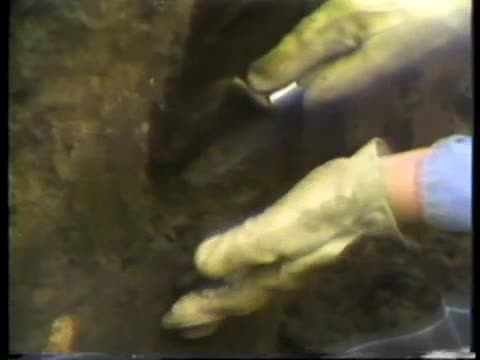
We call it Poverty Point after a civil war plantation. We don't know what they call it, or if they had a language, and the more we dig, the more questions we ask. Who were these people that built a giant mound shaped like a bird? Why did they build six terraces that span three quarters of a mile? Was it a giant solar calendar that guided a race of farmers, or was it a temple for their gods, or a burial ground, or merely just the way they'd built their city? Poverty Point is located in northeast Louisiana near the small town of Epps, and the site enjoys the protection of the Louisiana Park Service. It is a working site where archaeologists dig and rangers guide tourists and schoolchildren over the ancient grounds. What I'm doing here is scraping down the wall of this trench that we've dug with my trowel to get a clear idea of exactly what these soils look like, and what we expect to find when we dig a site like this here at Poverty Point. As you can see here, there's a very dark soil here on top, then a lighter soil closer to the bottom and another darker soil underneath that, and then another light pan soil underneath that.
These two dark soils both represent what we call midden soils, and that is this represents the time period when the people actually lived here. The reason why this soil is so dark is that it contains a lot of organic matter that gives it that dark color and separates it from all other soils. That this organic matter was derived from the trash, from the food remains that these people threw away after they're cooking and eating. These little orange dots that you can see scattered throughout these dark soils are what we call poverty point objects, or sometimes they're called clay balls. Here's one that's broken and two. These were used as cooking stones by the Indians.
At this time there was very little pottery at this site, but they didn't have any containers in which to put their food. They would simply dig pits in the ground, heat up these clay balls and they'd out of just plain old earthen clay. These would get hot similar to the way charcoal gets hot, then they would lay their meat on top of this and cook their food in that way. You can see there are many, many of them in these soils, and their presence helps us identify the exact areas where these people lived. There's another artifact here in this wooden soil, and that is this. It's a piece of stone. It's actually the outside of a cobble that we find here. This is the first step in the manufacturing process toward making arrowheads and other types of stone tools, and that is to knock the outside of that rock off. Then you can do some finer flaking to shape it into the tool that you want.
This is something that they didn't need that they simply threw away, and that's why we find it right here in this wooden soil with all the other trash that they threw away. What I'm doing now is taking some soil samples, which we're going to process back in the lab, and what we hope to get out of these soil samples is food remains. Seeds and pieces of charred wood or other food remains that we can analyze, in which we give us some direct evidence as to what type of subsistence. That is what type of economic base these people have. We don't know for sure whether they live by hunting and gathering wild seeds and roots and wild plants, or whether they were farmers. And if we can find seeds and other plant remains, that can be definitely identified, that will tell us these things. While a small amount of dirt goes to the lab for analysis, most of the debris goes to screening boxes to be washed in search to make sure nothing slips away.
Research is a vital part of poverty point, but so is education, and that's the job of the Louisiana Park Service. Poverty point was a late archaic culture that lived here on the banks of the Old Arkansas River. These people that occupied this area around 1800 BC, everything about this site is very impressive. Such as the earthworks consisting of six concentric ridges and two very large bird effigy mounds that are centered within the ridges. What we've tried doing is scaling the site down to give you an idea of what this would look like through an aerial type view. Because of the farming that has taken place on this site, we have more or less reconstructed the ridges with the idea of these swaths of clover. And here on the left you'll see the first innermost ridge coming across the ridge number two.
Now here on the woods line, you're coming into it, these ridges here haven't been disturbed through the farming that's taken place in the past 178 years. And the ridges are more defined, getting up to six to eight feet in height in spots, still gently rolling. Right into here you can get an idea of where the ridges are running the six of them in front of us. Standing here, the sixth ridge is running in front of us just to the bottom of the tail. You get an idea that appears to be ramped as though there are ceremonies before this was eroded away. We're taking place here on this fan tail of the bird effigy mounds. Standing here were 32 feet high, the tail levels off, and it slopes another 42 feet high up into here. You can get an idea standing here on the tail.
The steps go right up the middle of the bird, and then the wings are falling to the north and to the south. And this here on the right-hand side of the wings, it's sharp slope. It looks as though those were the secondary feathers of this particular bird. They say it's 72 feet in all and it's 1,000 feet, 800 feet at the base. These spear points here will give you a fairly good idea of the types that they were using. What we've tried doing is showing you the different material as well as the different types of points. Some of them they feel as though the gray flint were used by the higher excellent warrior. So the different type points might have been used by different people. The microflint industry here is still somewhat of a mystery because of the use. This stuff occurs here just by the millions. They had taken the course where they were drawing the individual blades.
Then, after drawing the blades, they had fashioned a type of scraper cutting tool. Poverty points stands only two years into its development as a state park. And the plans for the future are being carried out today. One of those helping to shape the plan is shear and Frazier. She works for a Baton Rouge landscape architect firm. Well, right now on drawings, there is a archaeological workshop which the general public can come and visit. It's still in working drawings right now. And we also plan to be building a museum in theater there where people can come and visit. They can see slide shows in the museum. They can hear live lectures and they can go through the museum and look at the visual display. The poverty point is we've been working on it since 1972. And since 1972, instead of finding out everything and having more and more less and less information have it finished, we keep having more and more information.
And it's so hard to explain this to the general public and portray it as exciting as it really is. It's just so interesting and there's so much information. So through our interpretive program that's going to be placed in the museum, we'll be able to relay this to the public in terms that they can understand. We believe in that poverty point here is a very unique place in the history of Louisiana and the history of our whole continent. It's a very unique place. It's the center for a culture at a very early time in North America at about 3,000 BC. It contains some very unique things here. The monumental architecture, the mounds and the earthworks. None of these things occurred anywhere else in North America at this time. There are a lot of questions that we still have about these people who actually lived here 3,000 years ago. And in excavations like this one, we're trying to learn more about them to answer some of these questions that we still have.
And it is through excavations like this one and like others which will surely follow in the years to come, that we will be able to tell more to the people of Louisiana just what was here and what it means in their history. Louisiana's climate is a hostile place for the survival of the relics of history and sometimes man must help as we learned last spring in a visit to Fort Pike. If you journey out to the narrow throat of Lake Pontchartrain, out to the Riggles Pass and Lake Bourne, you'll see a reminder that this state was once a tempting jewel, a prize to be coveted in the colonial rivalry for control of the new continent. From this point, first the French and then the Americans built their fortifications.
Fort Pike once defended the backdoor to New Orleans, but now its garrison is a team of state archaeologist and the invaders are tourists and children. After the War of 1812 and the burning of Washington by the British, President Madison began to worry that New Orleans could be taken with similar ease, thereby strangling the commerce of the nation's midland. The president turned to Simone Bernard, a French military engineer, and dispatched him to the Gulf Coast to design a new system of defense. The result was a network of forts from the Delta to Florida. Two of the forts, Jackson, and Pike controlled the water routes to New Orleans. For Jackson, sitting near the mouth of the Mississippi River, controlled the front door, while Fort Pike controlled the narrow Riggles pass at the entrance to Lake Pontchartrain. Fort Pike stands as a classic example of French design, with a rounded Delta shape and battlemen set against an invasion by sea. Top priority was given to the project when construction began in 1819, but the first year of building proved to be one of the first of frustration.
When the first foundation failed to hold up on the marshy swamp land, a new site was chosen, and a foundation ten feet deep of cypress logs and clam shells lay down. Finally, after eight years of construction, at a cost of $635,000, the fort was complete. Unique to Fort Pike was an interior citadel, a barracks within the fort's outer walls that would serve as a place of last resistance. A place where the fort soldiers could hold off invaders until reinforcements hopefully arrived. For all its guns and soldiers, Fort Pike never saw any real action. Shortly before secession, in the outbreak of the Civil War, the state militia took over the fort. Later, as the war progressed, the Confederate forces abandoned the fort under the threat of a federal attack. There were some fighting down at Fort Jackson, in which the Union's ironclad gunboats proved that the old coastal forts could no longer stop an invader. Towards 1890, with the usefulness of the coastal forts in doubt, and with maintenance costs soaring, Fort Pike and others like her were closed down and left alone to battle the forces of nature. The Louisiana State Parks and Recreation Commission owns and operates Fort Pike now, and this bring a team of archaeologists have been scraping away the inches of time.
It's a painstaking process that requires a special kind of patience. A state archaeologist, Dr. Alan Toth, oversees digs and restorations, and he says new federal laws have brought them a lot of work. The impact of these federal laws has been very great on the field of archaeology. It's enabled funding to be much more readily accessible. The older days, just five or ten years ago, one would be pretty dependent upon the National Science Foundation, or National Geographic, or perhaps private money through museum to do any kind of research. The requirements for those type of grants would be a very specific problem-oriented type of research. Now that the federal money is available to compensate for the loss of our cultural resources by some public project, which is federally permitted or funded, the work is where you find it. It's well financed, and it must be done before construction can begin, but on the other hand, it doesn't always pertain to the same region or the same point in time.
And a great challenge in archaeology is to be able to preserve the information to pull this altogether in another ten or twenty years as great volumes of new data come in, and yet it's very difficult to synthesize because it's sort of hit or miss. Have we already lost some significant sites? Have we already before all of this came into effect? Have we bulldozed some sites away and forever lost them? We have lost hundreds in Louisiana. As the price of soybeans goes up on the world market, price per bushel, I'd hate to have to estimate how many sites we lose in areas that were not farmed even ten or fifteen years ago. We've lost them to highways, to treasure hunters, to every kind of conceivable construction, and this is not unique in Louisiana. It's true of the entire nation, and it's one of the reasons that the first at the insistence of the National Park Service, and then at the support of a number of people in Congress over the last say ten years, they eat these federal laws to think about cultural resources of come about because we find ourselves with only a sample now of the good sites, and if we don't take some action now, it's estimated at least in Louisiana that within 25 years there will be no sites left that are even worthy enough to make, say, a commemorative area or a park out of.
We're not just talking about, oh, there are hundreds of mounds, and so if we lose a few this year and a few next year, there will always be some left, that's not the case. As a matter of fact, most of our most spectacular sites are already destroyed to some extent or another. At Fort Pike, time is running out on archeologists in another way. State plans to rebuild and restore the old fort or underway, and archeologists have only a few more weeks to complete their studies of areas affected by the building plans. The site archeologist George Castile explains. We're trying to finish our excavation by the end of April. We're trying to get all the archeology done prior to the restoration project, so there is a time limitation, and if we hold up through restoration project, it may be very costly, so we're trying to move as fast as we can right now. We have only a passing knowledge of archeology, and we think of people sifting through every little grain of dirt.
We see some people digging very vigorously here. Why? Well, in most cases, archeologists would screen and would sift very carefully, but in this case, these men here digging into what is part of the wall of the fort, and it is simply filled. There are very few artifacts in it, and it was probably all dumped in at the same time over maybe one or two years' time. So there's very little in it, and very few features in it. For that reason, we're digging a little faster than we would normally. The reason you're digging up these various sizes, because when the restoration comes, they may be destroyed, is that it? Right, this whole area that we're standing on will be torn up during the restoration project, and so we're simply trying to map in everything we can, photograph and draw in everything that we find. This summer, archeologists will be busy excavating a number of sides throughout Louisiana, and as one archeologist put it, it's an exciting time for those who are concerned about preserving the state's heritage.
Next week, we'll turn back to the present as we look at the south through the imagination of the medium. Until then, I'm Ron Blom, good night. The preceding was an L.P.B. production. Production funding for this program was provided in part through contributions to Louisiana's for educational television.
- Episode Number
- 245
- Producing Organization
- Louisiana Public Broadcasting
- AAPB ID
- cpb-aacip-17-13zs8bb9
If you have more information about this item than what is given here, or if you have concerns about this record, we want to know! Contact us, indicating the AAPB ID (cpb-aacip-17-13zs8bb9).
- Description
- Credits
-
-
Copyright Holder: Louisiana Educational Television Authority
Producing Organization: Louisiana Public Broadcasting
- AAPB Contributor Holdings
If you have a copy of this asset and would like us to add it to our catalog, please contact us.
- Citations
- Chicago: “Louisiana: The State We're In; 245,” 1978-07-29, American Archive of Public Broadcasting (GBH and the Library of Congress), Boston, MA and Washington, DC, accessed April 2, 2026, http://americanarchive.org/catalog/cpb-aacip-17-13zs8bb9.
- MLA: “Louisiana: The State We're In; 245.” 1978-07-29. American Archive of Public Broadcasting (GBH and the Library of Congress), Boston, MA and Washington, DC. Web. April 2, 2026. <http://americanarchive.org/catalog/cpb-aacip-17-13zs8bb9>.
- APA: Louisiana: The State We're In; 245. Boston, MA: American Archive of Public Broadcasting (GBH and the Library of Congress), Boston, MA and Washington, DC. Retrieved from http://americanarchive.org/catalog/cpb-aacip-17-13zs8bb9