Interview with Henry Fonda
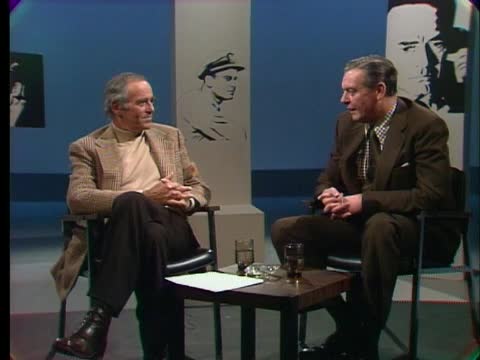
- Transcript
You Nibraska nibraska What's it to me anyway, the brunt of the Hick
Joke wherever I go, green horn, maverick, hazeed, sod buster, where are you from? Nebraska, rowdy now, that's a hot one, but you spend nickel after nickel till the whole dimes gone, plow boy, what's that your smoke and rub, corn, silk or buffalo chips? But they just don't know, do they? They don't know the sights and the sounds and the feelings, what they're like and how they get into you and hang on, whether you stay here or move thousands of miles away in any direction. Nebraska sure hangs on to you in a hundred ways. You can hear Nebraska everywhere in the music of its rambling rivers, loop, Nimaha, big blue, Elkhorn, plat, Neobrara, singing down the narrows of Big Timber, rattlesnake, black mud, bloody, white tail and endless sweetwater creeks and streams that flow on and on through the lyrical towns and hamlets of eagle, freedom, hay mile,
hope, lilac, Maywood, north star, raven, swan, silver thorn, and weeping water in Nebraska. Nebraska? What's it to me anyway? One old timer told me that the young folks here raised more corn and less hell, we'd be in better shape. Can't you just smell those ripe corn fields right after the first sun in the morning on the heels of a gentle all night rain? Nebraska corn. And what's that over there? Milo, of course. And there's no mistaking that special elf alpha aroma. And the best one of all, new moan hay. You must be a city boy, turn farmer. Though else you wouldn't cut it when it's still wet, yes sir, the smells of Nebraska, but not without the pig farms and the feed lots. They're a part of or two, a potent part. But out here, you take Nebraska
all the way, the bitter and the sweet smells of apple orchards and winter wheat, cottonwood, catalpa and Russian olive, turkey farms and grandma grass, slaughterhouse and cider mill, church suppers and harvest moon dances, each fighting to leave its special perfume in the gentle evenings in your memory of Nebraska. That flat state they used to call it a desert, didn't they? You seen one farm, you've seen them all, God must have run out of ideas when he came to shape in Nebraska, but they just don't know, do they? They haven't really seen our earth turn from winter white to green to gold to rainbow autumn. They've never pulled a catfish out of the Pawnee or wandered to the sunset in the wildcat hills, so powerful that chokes you for hours. They've never stood by a sleeping herd in the moonlight or washed a ring -naked pheasant, peck his way through a stubble of cornfield, as pretty as a gal pump and water in the
wind. They haven't walked him on our fields of wildflowers, primrose, purple cactus, sage, snow on the mountain, oxide days, he dutchman's britches, crofoot, mimosa, local weed, milk, porkwort, and mallow. They dropped 15 spring lamb just today more than off the Jensen farm. Maybe God didn't run them ideas as much as he ran out of folks with kids' eyes, folks going too fast in circles instead of forward and up. Go on, look up, breathe in. You don't have to watch your lungs out here from this smoke poison. Have you ever seen such a beautiful cloud puffs? And the great thing is that out here you can really see them in the clean, pure Nebraska air and the wheat field before thrashing. There's the gold that Coronata never found, wave after rolling wave in the late spring wind, and yonder the Indian mounds and bravery trails, windmills and oil rigs suckling the earth,
plow shares and reapers, oxen and angus, dwarf by the towering grain bins scraping the sky, feeding the world, jackrabbits, coyotes, sandhills, shanties, sodhuts, county fairs, rodeos, butte prairie, campus, city, twisters, blizzards, droughts, gallows and altars, center and saint, Nebraska, Nebraska. What's it to me anyway? People, you've got to be kidding. Nebraska's red necked land peasants, horse thieves, savages, half breeds and conservatives. Some lot. They just don't know them, do they? I wonder how many good mornings the outsiders get on any street they're from. Now to hear a stranger's a friend that ain't been introduced yet.
No more stupidity, they don't know them, I guess, because they've never shot a plug of battle ax and talk stumped speech politics across the hobble fence with the real man of the good earth and his wife, the granddaughter of a neighbor's male or a bride, both weather beaten and wrinkled as a pair of old boot tops, but they grew strong together, overcoming whatever dog the weak and wishy washy. They've never known the real people, bear backer and brander, granger and homesteader, plow right and smithy, cowboy, cattleman, rustler, hustler, warrior and wanderer. Nighhart, Cody, spotted tail, sandos, red cloud and cather. Return to the clay that they molded and shaped, and the earth answers back with an echo of names, half forgotten, sculptors of freedom, a heroic chorus, minicons, you and
rosebud, ol' Galala and Oto, Cheyenne, Winnebago, two kettlesoo, Hayward and Zannock and Morton and Lloyd, the Juds and the Smiths and the Joneses, the big names and the small names, the no -account no -names, but Nebraska is by God through and through. Nebraska, what's it to me? The people, the sounds and the feel, the smells and the sights, like the stars and the sea, the more that you look, the more that you see. Just open your eyes of your soul, let them roam, Nebraska, Nebraska. What's it to me? Thank God it's home. The place called the Great Plains
spread the southward from the Upper Sesscatch one river down to the Rio Grande, a high country, a big country of vast reaches, tremendous streams, and stories of death on the ridges, daring dew in the valleys, and a sweetness and heartbreak of springtime on the prairies. Half of this region was the ol' Nebraska territory that lay like a golden hackberry leaf. The veins of it were the long streams rising out near the mountains and flowing eastward to the big muddy, the wild Missouri. The Great Plains spread the southward from the Upper Sesscatch one river down to the southward
or my answers on there too. Some of them. Almost everybody in the world knows this face. It's probably been photographed as often as anyone in the history of men and women on this earth, including presidents and movie stars, and it's been identified as both movie star and president, for it's the face of Henry Fonda, actor, extraordinary, gentleman and friend, my friend. I'm Marshall Jamison, son's producer director, and if you don't know what that means perhaps after this program you will. And I've had the rare experience of
acting with Mr. Fonda, I'm directing him on occasion, but more important knowing him for a good number of years. Henry Fonda, who once played Young Abe Lincoln as well as other great American figures, Tom Joe, Frank James, Lieutenant Doug Roberts, at the incomparable Clarence Darrow, among so many others. The great Broadway producer director Joshua Logan, who's known Hank since they started out in the theater together, described him as a kind of synthesis of all the heroes of Mark Twain, Bret Hart, Hawthorne, Paul Irving, and James Fenmore Cooper. So many brilliant reviews, but one of my personal favorites describes him in this way. It is Fonda with his cat -like walk and his deep -etched gaze who takes on the features of an every man, suffering with grace, and every so often lashing out against exploitation. Hank, it seems to me you lashed out a little when we were working together on point of no return.
Well, it wasn't against any exploitation. Well, I must say I have seen you suffer with grace more than I've seen you lash out. You've probably seen me more on my good behavior than most directors. You know, Son of a gun found he got you here at Nebraska. No, I got you back out here, and surrounded by you and Leland as I was. You were a two -man chamber of commerce for the Cornhusker State. I had to come out and see if everything you said was true. Well, that's every bit more than you said it was. Leland Hayward, how he loved Nebraska. You know, Marshall, I go back a long ways, Marshall, I go back a long ways together to this in this business. I think one of the things we have most in common besides some friendship and love for the theater and television is our love for one of Nebraska's finest, the late Leland Hayward. He played such an important part in both of our careers and lives. He was your very first agent, wasn't he Hank? Yes. I went to him
as a matter of fact, I took Margaret Sullivan to him, and he became interested in Margaret as an agent and a client. And he didn't really become my agent until I'd done new faces, and he saw something in that. I was offered 52 -week -a -year contract by Dwight Wyman, Dwight Deer Wyman, who produced musicals. He was going to send me the course I could learn to dance, and he was going to make a musical comedy comedian out of me. He was going to pay me $100 a week for 52 weeks. This was security, I almost took it. Leland wouldn't let me, and Leland was crazy, and he wouldn't let me sign it. Within a year, he'd sold me, as an unknown, sold me to Walter Wanger as an actor, and I came out and did my first film for Wanger. If I'm not mistaken, there was another well -known Nebraska name that we should all thank for talking to you into your first tryout. Doe Brando, yes, nothing would have happened, none of this would have happened without Doe. She, because I did not spell
theater, let alone have any desire to be an actor, and I was out of college, and I didn't even know the existence of the Omaha Community Playhouse, but Doe was on the board of directors and reactivant. She literally pushed me onto the stage, and I was maybe not kicking and screaming, but I was very unhappy. I was much too shy and self -conscious young man to be an actor, but she's responsible. Well, I can safely speak for people all over the world, Hank, when I thanked Dorothy Brando for seeing that spark of talent. Well, I knew, I knew it was there that first day I walked onto the stage with you and Mr. Roberts. You remember, I think, a little. The thing I remember most of it, Mr. Roberts, was our first run -through performance. We were talking about it the other day. It was an exciting thing. It's the first time for your listeners who don't know what the run -through means. It's the first time that all the actors do the play from beginning to end without starting and stopping
as you do in rehearsals. It's the first time you begin at the beginning and go to the end. It's not with props or waterbending. It's just with the kitchen chairs and whatever is marking your rehearsal area. But it's the first full run -through where you build your emotions and begin to feel it. And I will never forget it. I'm sure you won't know or anybody else involved. It was one of the emotional experiences of my life. And people that see Mr. Roberts or have seen Mr. Roberts and talk about, I was there the night that so and so on. You should have been there the first run -through. Seven days into rehearsals. Yeah, that's right. It was that tremendous experience for both and for everybody who's involved. Of course, that whole cast has gone on to everybody. Yeah, done very well. Well, Henk, to get to the present, you're going to continue with great success and Clarence Darrow. We're going to take the play out on tour again after the
first of the year. Just hit the high spots across the country. And we're going to close it in May and do a two -hour film for television of the ASEAN Suite trial, which was when Darrow defended the 11 Negroes in Detroit. We're going to make a film of that. And it could possibly be a pilot for a proposed mini -series of Darrow trials. I might do two or three or four years. And then in the middle of July, we're going to take it to London for the 10 weeks of the summer. Well, marvelous. I know Nebraska is your home, Henk, and I know why you came back for one reason. But why are you here at this time? Are you here for a special reason for us? Would yes. Public television, maybe? Well, yes. There's a football game this afternoon that may have already happened by the time your audience sees what we're doing now, but that's a fringe benefit. I'm really here, which will mark the formal opening of the
Hilton Hotel in Lincoln, which is for the benefit of public television and the Sun program, educational television that's related to the university, which you are the pop -up. Hardly the pop -up. Well, you are Mr. Sun, aren't you? Well, I'm one of the producers and directors of Sun, but it's a thrilling thing for all of us, and I hope you'll be able to see some of our work while you're here. I think it's very exciting. I look forward to see some of it, and I hope that I can be involved with it later, because I know it's only going up and forward and expand and get bigger. Well, I think President Varna's had a tremendous vision, and he's making it come true, which is, that's really the marvelous thing. Of course, we're in the trenches. We're putting it out if we can, in the best way we know how, but it's a challenge. Hank, what do you plan
after Daryl? I don't really have that net many plans to talk about there, and in the very embryonic state is a project of my daughter, James. She's been working for two years on a project that would be a film, theatrical film, on the American Revolution that would involve the three of us, Jane and Peter and me. It would be the first time they were all together, which will be some sort of a mark, but it's coincidental that it's the bicentennial, because she started thinking of it, and in terms of the story that you don't read in the school textbooks about the revolution, it's still embryonic because she's got a lot of historical research on it, but it hasn't been written in a dramatic form yet, and until it is, it's hard to get a director to commit to it, or studio, or backers to commit to it. But if we get a script, we'll be in production probably this time next year in that film. The bicentennial reminds me of one of our favorite projects here, which is in the planning stage, which is
the Great Plains, which you know a little bit about. It's called The Great Plains Experience, or a cultural history of The Great Plains, but of course, we're hoping to go much beyond The Great Plains, but Hank, would you do me a favor and perhaps read something? It's by another in Nebraska, her name is Marie Sandos, and it kind of sets the flavor of what we'd like to do with The Great Plains. You suppose you could just read that for me. I know you're a great admirer. Yes, I am. I've read the book, the greatest book. The place called The Great Plains spread southward from the Upper Sesskatch one river down to the Rio Grande, a high country, a big country of vast reaches, tremendous streams, and stories of death on the ridges daring dew in the valleys, and the sweetness and heartbreak of springtime on the prairies. Half of this
region was the Old Nebraska territory that lay like a golden hackberry leaf in the sun, a giant curling tilted leaf. The veins of it were the long streams rising out near the mountains and flowing eastward to the big muddy, the wild Missouri. Really tells it like it is, doesn't it? Yeah, yeah. I love daring dew in the valleys. Yeah, yeah. He was a great character. I just been reading a book, his book, or know his daughters or granddaughters, but Marie is daughter or granddaughter, do you know? I don't know. We'd have to ask Ron Hall, who's an expert on this. Yeah. She's Old Jewels daughter. Old Jewels, I've just been reading the book, yeah. Marie is his daughter. Daughter. Well those are the kinds of pictures we like to paint in the Great Plains experience and give people all over the country a feeling for the Great Plains experience. Relating it to our lives the way it is today, the way they are today for a university in general when my English is pretty bad. You might if I say a little bit more about
the course march. Not at all. I love to have you. I guess the Great Plains experience is the dearest to my heart because I was born on the Great Plains of North America. My time I played a number of Americans as Marshall said earlier, young Abe Lincoln, Tom Joel, Frank James, and Clarence Darrell. I've learned a lot of lines in my career to express the thoughts of many men, but these words of my own are an attempt to express the enthusiasm of a native son for a history of courageous people which will illuminate and amplify at long last the heartbeat of a nation's cultural heritage. The Great Plains. What is here today is often good because they knew it could be so. What they found endured, suffered, and changed and died to preserve is brought to our lives much of today's richness, abundance, and beauty. These are the words of a noblest son, words which
echo through each stands of the hymn to yesterday's. This is their song, this is their testament, carved to their likeness speaking in their tongue and branded with the iron of their star. I say you shall remember them. I say when night is fallen on your loneliness and the deep would be on the ruined wall seems to step forward swiftly with the dusk. You shall remember them. You shall not see water or wheat or axmark on the tree and not remember them. The words of Stephen Vincimanese, western star. The Great Plains experience will make those courageous people live again and relate our lives and destinies to theirs. And their behalf, I thank you for remembering them. I wouldn't consider it a challenge and a privilege to take a small part in such an important chronicle. The course of their lives which became our lives.
Thank you. Nobody could have said it better than you and Stephen Vincimanese. I only hope your schedule makes it possible for you to work with us. It would be a great, great thrill for me and I know for everyone concerned. Before you came in, I was looking at the pictures on the columns behind us. Was this one from the Oxbow incident? Perhaps. Oh, I think that's a Cheyenne Social Club. And Jesse James is over behind you. You know Hank, I've been in Nebraska about eight months and you Nebraska's don't have the market on loving the state. I have some words here by another New York transplant. They describe pretty well how we all feel about Nebraska. And that's a vantage point by Lee Benjamin. Now, if we cut here, we can pick up on the reading and I think we'll close it that way. So I think we've got to get you out of here, pal. It's up to Neal. How do you know?
One thing, one thing. I knew Murray sandals very well. Oh, you're okay with me. How long do I go with that? Well, who would have sent me the book? Just. I'm glad I got to hear. Leave you alone if I may. Not yet, huh?
Not leave alone yet. I don't know whether they want any audio over this or not. I think I'm going to leave you alone. If I may, I'm going to move this chair out and leave you by yourself while you read Mr. Benjamin's Vantage. What's your problem?
I don't know. They're discussing something. I don't know how to do it. Oh, let me find out. Neal is starting to make Markle. And he's going to look at the light up here. You
- Program
- Interview with Henry Fonda
- Producing Organization
- Nebraska Public Media
- Contributing Organization
- Nebraska Public Media (Lincoln, Nebraska)
- AAPB ID
- cpb-aacip-16062e7f8db
If you have more information about this item than what is given here, or if you have concerns about this record, we want to know! Contact us, indicating the AAPB ID (cpb-aacip-16062e7f8db).
- Description
- Program Description
- Nebraska native Henry Fonda gets misty-eyed when he reads Lee Benjamin's essay, "Vantage Point", for the NET audience in the 1976.
- Copyright Date
- 1976
- Asset type
- Program
- Rights
- Access to material from Nebraska Public Media’s archival collection is for educational and research purposes only, and does not constitute permission to modify, reproduce, republish, exhibit, broadcast, distribute, or electronically disseminate these materials. Users must obtain permission for these activities in a separate agreement with Nebraska Public Media.
- Media type
- Moving Image
- Duration
- 00:31:38:00
- Credits
-
-
Producing Organization:
Nebraska Public Media
- AAPB Contributor Holdings
-
Nebraska Public Media
Identifier: cpb-aacip-e5607de12f9 (Filename)
Format: Betacam: SP
Duration: 00:30:00
If you have a copy of this asset and would like us to add it to our catalog, please contact us.
- Citations
- Chicago: “Interview with Henry Fonda,” 1976, Nebraska Public Media, American Archive of Public Broadcasting (GBH and the Library of Congress), Boston, MA and Washington, DC, accessed August 27, 2026, http://americanarchive.org/catalog/cpb-aacip-16062e7f8db.
- MLA: “Interview with Henry Fonda.” 1976. Nebraska Public Media, American Archive of Public Broadcasting (GBH and the Library of Congress), Boston, MA and Washington, DC. Web. August 27, 2026. <http://americanarchive.org/catalog/cpb-aacip-16062e7f8db>.
- APA: Interview with Henry Fonda. Boston, MA: Nebraska Public Media, American Archive of Public Broadcasting (GBH and the Library of Congress), Boston, MA and Washington, DC. Retrieved from http://americanarchive.org/catalog/cpb-aacip-16062e7f8db