Black Horizons; 3110; Kwanza Celebration, King Hedley II
- Transcript
I'm not sure if I can do it, but I'm not sure if I can do it, but I'm not sure if I can do it, but I'm not sure if I can do it, but I'm not sure if I can do it, but I'm not sure if I can do it, but I'm not sure if I can do it, but I'm not sure if I can do it, but I'm not sure if I can do it, but I'm not sure if I can do it, but I'm not sure if I can do it, but I'm not sure if I can do it, but I'm not sure if I can do it, but I'm not sure if I can do it, but I'm not sure if I can do it, but I'm not sure if I can do it, but I'm not sure if I can do it, but I'm not sure if I can do it, but I'm not sure if I can do it, but I'm not sure if I can do it, but I'm not I'm not sure if I can do it I'm not sure if I can do it, but I'm not sure if I can do it, but I'm not sure if I can do it, but I'm not sure if I can do it, but I'm not sure if I can do it, but I'm not sure if I can do it, but I'm not sure if I can do it, but I'm not sure if I can do it, but I'm not sure if I can do it, but I'm not sure if I can do it, but I'm not sure if I can do it, but I'm not sure if I can do it, but I'm not sure if I can do it, but I'm not sure if I can do it, but I'm not sure if I can do it, but I'm not sure if I can do it, but I'm not sure if I can do it, but I'm not sure if I can do it, but I'm not sure if I can do it, but I'm not sure if I can do it, but I Welcome to Black Arrivals! I'm your host Chris Mores Thursday. Well for Black Arrials I'm your host Chris Mores. Well for
Black Arrials I'm your host Chris Mores. And we'll let you know about some special programming you'll find right here on WQED. But first, the Cumber Trust works to ensure a strong and thriving black cultural scene here in our region. To that end, they are partnering with area arts and civic organizations to present a city -wide Kwanza celebration that runs from December 16th through January 2nd, 2000. Here to tell us about the Kwanza celebration and the work of the Cumber Trust is executive director Patricia Pugh, Mitchell, and artist and performer, Tracy Turner. Tracy, I'm going to start with you because we've been having so much fun just before we started. You're so animated as an actress and performer, glad to have you here. What does Kwanza mean to you? Kwanza, oh God, what a very special time. It doesn't really matter what ratio are for it to be a special time. This is a time where families get together. We get to celebrate with our
children, teach them principles that we want them to live year round and for the rest of their lives. And Patricia Pugh, Mitchell of Cumber Trust has put together such a fabulous span of performances and creative things to do with our families, our children, some costs, some are free. This is going to be a fabulous time of the year. The fabulous time. We're going to have some fun with this, right? Absolutely. Okay, tell us a little bit about Cumber first and why you decided to focus on Kwanza and all of these events all over the city. Well, first about Cumber Trust, Cumber Trust is an art service and advocacy organization that promotes the creative expression of Pan -African artists in our region. And with regard to Kwanza, Kwanza began, the very first Kwanza citywide, Kwanza celebration began in 1996. And a group of black artists in the community came together and decided that they wanted to celebrate Kwanza within the city and to disseminate information about the African -American holiday
so that everyone, regardless of race or ethnicity, would have an opportunity to participate. So it's not just a black thing. Oh, no. When I was blessed to be six months pregnant performing during that show, the very first one. But it was great because artists had pulled this thing together and then it just got a huge and instep's pat and made it professional and sharp. I mean, people from other cities. Give it that cutting in. Oh my God. The girl can put a show together. I mean, we put, we got people in from out of state to see our festival, how Pittsburgh did it. I understand you had calls from Chicago who want you to come consult. Well, we did get a call from the mayor's office in Chicago. And apparently, some Chicagoans had come to Pittsburgh during the Kwanza celebration last year and they were so overwhelmed by what they saw. They went to Chicago, wrote a letter to the mayor's office and the next thing, you know, I'm getting a call asking us how we managed to get to Pittsburgh. Oh, no. From
Pittsburgh. Get rid of that infuriating conversation. Good for me. It's to understand that. Yeah. This is an opportunity with, with Kuba Truster and Ujima putting this together, Pittsburgh has an opportunity to see their future stars, their people that are going to be performing in this festival, that you get to see for free today. But tomorrow, you won't be able to see this tomorrow, and that sort of thing. Yeah, we're going to find out more about that in our next segment. What's going to happen, Pat? Well, we've got a plethora of activities that are going on. You're a plethora of activities that are going on. I don't want the new work. All right. December 16th, we're going to kick off everything at the Greater Pittsburgh Coliseum with a holiday sale and press party. So we started home, right? That's right. Absolutely. And with a meal now. Yeah. I don't forget food. That's my favorite. Well, while there, you know, folks that come will have an opportunity to sample foods that are part of the caramo feast, which occurs on the 60th of Kwanzaa, which is Kuba, and represents creativity. So not only will they get an opportunity to shop from local artists who are part of
Kuba Truster's membership, but they'll also sample foods and entertainment that will be a part of the overall Kwanzaa celebration. And then we move into a wonderful event, an evening of theater and dance on December 27th at the volume theater. And I'm proud to say that this is our fourth year in partnering with the Pittsburgh Cultural Trust and presenting this event. So that's going to be a wonderful event. And then the Marriott's Cooper, who is one of our board members, and also the chairperson for our event on December 28th. Not to mention a famed depot in the long ride. Yes. Yeah, Pittsburgh would be missing something. And a down -home sister. All right. All right. All right. All right. That's going to be a fabulous event. Well, what happens there? On the 28th, there's this big thing. Oh, I mean, if you've got Pearls Diamonds, Mink, Code, Frog, you've got to put it on it. Come out. I'm serious. Pittsburgh. You are not. You're going to see famous divas and my new word today, divos. Divos. That's a male opera singer.
Come out and perform Flareta Mouse, which will be done here in Pittsburgh as a premiere. These are African -Americans, divas and divas, divos, singing opera in English for us. It is like a gift. It's like what's about... You know, Pittsburgh has a long history of this sort of thing. Musicians Aida has been presented here. Peggy Pierce Freeman reminds me all the time and shows me the pictures, years and years and decades ago, of that grand production. Grand production. Well, and then this past Saturday with Phil Adanko doing their world premiere right here in Pittsburgh. We are a blessed city. We need to really get out there. So how important is it then, Pat, for people to support this? And I don't mean just black people. I mean, everybody in the city. Oh, it's very important that everyone supported. And I can tell you that we have seen an increased audience and increased willingness on the part of other civic organizations each and every year that want to tag along.
And we'll call the Cumbatrust office and say, how can we participate this year? And we're proud to say that we have two new venues this year. Behind's History Center will be joining us in presenting Aquanza Celebration as well as the Jewish Community Center, which will be presenting two events there. And a wonderful event at the Cats Theatre on January 2nd at 6 o 'clock PM. And it's titled Swinging the Arts Our Lives, Swinging, Singing and Dancing in the New Year. And it's a focus on youth and so it's free to the public and we're just encouraging everyone to come. Oh, there'll be magicians. Now, some of these events are free and some are not, is that right? Yes, there are only two of the events. There are approximately a dozen events that will be going on throughout the city during that seven -day period. The two events that there are a fee, require a fee, are the buy -in theater and those tickets are $9 .99 and groups of 10 or more at $750 and the event at the Carnegie Music Hall. So don't wait too late to get your
tickets, right? Absolutely. And there are $5 and they can be acquired through Pro Arts, ticket service, through ticket charge or they can call directly to the Cumbatrust office. Okay, here's the test. All right. Test time. I knew we were going to get it. I don't know when Dr. Karenga found it, Quanzi, if he knew what a test this would ever get for the adults. For the adults, the kids are picking it up right away, right? You're two -year -old here, right? Of course she understands. It's cool to see. The principals of Quanzi are and they're represented here, right? We've replaced our normal signature piece with this and if you would tell it, you can work on this together. All right, here we can have that. This is an open book deck. All right. We're going to join in anytime. All right. All right. The black candle is Umorja and it stands for Unity. I'm color -blad but I'm assuming the one in the middle is the black candle, right? Okay. Then we move to a green candle and that is the second day of Quanzi and it's Kujishat Gullia. I love the way she's known. I had to see it. Kujishat Gullia. I just wanted to say that one is gay and over. You know, just run right through it. But now
we break that down. Okay. I'll do your last one. Go ahead. It means self -determination and one thing about this, speaking of children, is that if we can teach them to live these principles every day of the year, think about what our community would be. Absolutely. You know what I mean? I just figure out. Okay. Kujishat Gullia, self -determination. Third day, we've got Ujima, which is collective work and responsibility. Would you imagine what the Hill District would look like if we thought about collective work and the way it's changing? Absolutely. Absolutely. So a lot of that is going on. Right. And then we've got the fourth day, which is Ujama, which is cooperative economics. That's an interesting one. We're getting there. Okay. And then we've got, well, I want to do three, four, five, the fifth day, which is, what did I say, fifth day? Kujishat Gullia was the last one. No, we got Ujima. Ujama. Ujama, we got Ujama. Then we go to Nia, which is purpose. I'll go for six. I'll go for six. You go for six. You go take up the 10. You're not going to have a six -ish cumba. All right. We're
creativity. If you miss that, it's not always showing out money. You know, sometimes it's just a blessing to get that gift from a heart that somebody made. So I encourage the parents on that, on that, the sixth day, to sit down with their children and let them draw and express themselves. Absolutely. And people need to understand, we're not talking about a religious celebration at all. We're talking about a cultural celebration that brings people together. And that means everyone, everyone in this whole area. In the last word, you'd say to the audience that you're going to wear. Oh, I'm sorry. Emoney, faith. Okay. Without that, none of it wouldn't stand up. Okay. Pat, any last things you'd say to our audience about getting out to any of these varied events? I would just encourage them to continue to support the artists that are members of Goomba Trust and, you know, they'll be glad they did. Absolutely. Glad rags. It's going to dress up, Pittsburgh. Let's go have a good time. All right. We want to thank you both for being here. We hope the celebration is a huge success. We know it will be. Okay. Thank you. The Goomba Trust Annual Quons of Celebration is literally going on all over
town to find out more about specific events and locations. Give them a call at 412 -321 -5194. That number again is 412 -321 -5194. There'll be lots of beautiful music to enjoy this holiday season here on WQED. Make sure you don't miss a minute of the magic. A voice that inspires. The songs that celebrate the season, join Metropolitan Opera Star Denise Graves and her very special guests for a Cathedral Christmas. Join Denise Graves for a Cathedral Christmas Friday, December 24th at 8 p .m. and for more of that hometown flavor, tune in for a special seasonal broadcast of the acclaimed Make A
Joyful Noise, starring some of Pittsburgh's greatest gospel performers. Hi, I'm Chris Moore. Please join us December 24th at 9 p .m. for a special holiday rebroadcast of Make A Joyful Noise, featuring some of the area's finest gospel performers. That's Make A Joyful Noise, December 24th at 9 p .m. here on WQED 13. That's Make A Joyful Noise, the Black Horizons Gospel Special Friday, December 24th at 9 p .m. And for you opera officials, make sure to join opera's Grand Diva, Ms. Jessie Norman, as she hosts a holiday homecoming. The incomparable Jessie Norman sings the season's most beloved songs in a triumphant homecoming. Join Jessie Norman, as she follows her heart during the time of year when all our hearts are calling this home, Jessie Norman, a holiday homecoming.
Don't miss Jessie Norman, a holiday homecoming Christmas morning, December 25th at 9 p .m. The world premiere of August Wilson's King Headly II debuts this week at the brand new O 'Reilly Theatre downtown. Have you seen the publicity about this stuff? As with many of Mr. Wilson's works, the play is set in the Hill District, so you know we're bringing it home, and it tells the story of the neighborhoods, men and women and their struggle to keep body and soul together. Joining us today from the cast is Tony Todd, Tony, welcome to Black Horizons, glad to have you here. It's my pleasure. Okay, great, great. Have you done any of August Wilson's work before? I've seen you've done an Otho figure and that stuff is really powerful too. Yeah, I feel this is my first time doing August's work, of course I've been familiar with him. I've actually auditioned for him on two other occasions, and I just finished his Otho Fougar play at the beginning of the year at the City Kennedy Center, so I feel really blessed to be in the space. For the premiere of August Wilson's King Headly II, man, in the new space. In the new space, but also to be able as a
messenger, to be able to tap into the minds of two of who I feel the world's great playwrights, August certainly being one of the most permanent ones in our culture. How's the new space, have you been rehearsing there? Yeah. You know, our first week was at the old space, which I actually adore because it's charming, it's lived here. We have the ghosts there. We're trying to get some new ghosts in this new Arale theater. Well, you'd be the first one to reveal it, wasn't you? Yeah, well, hopefully. I mean, hopefully. Yeah, that must be something to really set the stage for what has been a tradition and which promises to keep being a great tradition here for Pittsburgh. I've never done that before, so, you know, for that I come, I look at some of that. You've done a lot of movies and a lot of other things. This is really a first one. Yeah, but I started in theater. I think any good actor is his home, his bedroom is in the American theater. That's your heart. That's my heart. The economic situations of the country forced me and I've been lucky to be able to supplement my love for theater with doing film work. So any chance I try to do at least one play a year this year I've done two. What year originally from?
I was born in Washington, D .C. and raised in Harvard, Connecticut. What first bit you had this acting bud first bite you? I couldn't play basketball. I saw it all as you are. Yeah, I thought it was you and I were on the same team, guys with no handle, but you had played. My coach, the high school basketball coach, was also a dramatic teacher, so he said, I'm going to use you for something, right? And he said, once you stop tripping in the hallway and stuff, I'll figure out what to do with you. So he locked me in a locker for a couple of days and I came down to him, merged and all of a sudden I said, you know what, I think I want to be an artist. Well, you got pipes for it too, man. I didn't at the time. I had to squeaky Mike Tyson voice. It will be a little familiar. I'm going to bite you here all over. Well, it's great to have you here and great to have this kind of experience that you're bringing not only from the stage, but movies and acting all over. Now, most of the actors tell me there's a lot of difference between the movies and the stage because in the movies you're sitting around waiting to do your lines, waiting
to the light and there's radio and all that other stuff. But the stage is more immediate. You get that feedback from the audience. It's immediate and you have to do your homework in terms of making sure once you start that interactive run, the audience that the bedrock is there so you know if something new happens, you know where to pull upon. I don't necessarily agree that film is easier because film is permanent. I mean, you can do a performance say five years ago, you have to live with that, which is why I don't watch my own work. You don't watch it? No, I don't do it. The only film I've watched is Night Living Dead, which is my first time in Pittsburgh. It's like we shot in Washington area. You do candy, man. Yeah, I did three of them. Does that bother you? It's paying for my kids' college education. But does it bother you sometimes the nature of work? If you compare what you're doing here in Pittsburgh with the nature of the kind of film work that goes on because it's simply commercial, not necessarily good stuff, does that bother you at all? Well, you know what I have to do? No, I've been blessed. I mean, like I said, candy man is paid
for my kids' college education. It's allowed me to do theater that wouldn't necessarily let me afford to take the jobs. And also, you know, for every candy man, there's been several very, very good independent films that I've done that I'm very proud of, including Three There and The Can. I think I've been on this position. On the board of independent film maker organizations for a long time, and the whole problem of distributing those films, getting that, you birthed the baby. You got enough money to put it together. You got all your friends as actors to work for maybe less than scale or candy bar, what never worked. Oh, or whatever it was. But I know a lot of independence that somehow just barely get stuff together. And then there it is, and you got no venue to show it. That's a heartbreak. Well, that's what Tracy, you can trace that back to the struggles of Oscar Michele, one of our first black pioneering filmmakers in this country, and his solution was to take it to the people. Set up tents, set up sheets, and show the film. In today's economy, you have to do a little bit of wooing. This year I have to go to Cannes. There's a film coming out called The Secret
that I have to go and market and hope to get not a deal for that particular film, but deals with future films as I make a segue into producing and directing on my own. So, you know, there's a bit of a problem. Is that what you want to do? Yeah, I want to make a mark. I want to leave something. I got stories to tell of the communities that I've come from. You know, it wasn't in that sort of an easy struggle. I think people perceive it as being that, but it's been a joyous journey. Are you going to write? I've started writing. You've started writing? I've started it as well. Oh, you've started it as a writer, okay. Have you any success getting it published? I had one play produced at Trinity Rep Theatre in Providence in the early days, and then when I moved to New York, because of my height, because of the classical training, I got snapped up as an actor, but no, it's always been in my heart. But what I'm writing is mostly screenplays now. Screenplays that tell forgotten stories. Okay. Let's talk about this story, King Henry. You play as a title role. That's what they tell me.
I don't know. Is there a scar in my face? I'm sure makeup will be able to do everything. Yeah, I guess. August has created a great symbolic gesture with this character, Maddie. He has an 82 -inch scar in his face, which I sort of relate to some of the travails of the modern black man and modern America. And that is just something that's a little bit off about the things that certain people may take for granted. So here you have this tall, majestic man who can't get a break. And he's delineated those experiences in a wonderful way. I mean, it's not all about whining, and it's not all about anger. You really get to understand the human condition behind this man's struggle, and that's the privilege to be able to be a messenger to communicate. I think that's one of the hallmarks of his work. I remember when I first came to the city years ago, and I saw a community theater production of Jitney. It was my first exposure. This is 20 years ago, and it was my first, a big one.
Is that the Alleghenium? No, it's at a church where in a carlo just, it's not even there anymore, it's in the basement of a church, and a community theater group had put it on, and it ended. And I was like, wow, look at this. And it was truly community theater. It didn't have the sets, it didn't have anything else, but it had the words. And the power of that is what grabbed you. Because as a community theater group, they just didn't have the money, they didn't have the space. It was literally in the basement of a church, but the power and the words and the actors that you say, really just grabbed you, took you for a ride, and then slammed you down in your chair, and you said, wow, it feels like it's not always about the money, it's about it. I think August's gift is that he's been able to tap the hidden language, and it's about the spirit. And hopefully the actors can communicate those ideas, New Orleans is ready to receive it. He's one of my greatest playwrights, I feel, in America. And hopefully this is part of his whole ten -play cycle. I interviewed him about five years ago, and he told me he was planning to write a play for
every decade. What decade is King Hamlin? We take place in Dead Smack in the middle of the 80s and 1985 in the Hill District. So this is going to be a real reason, and it might be something that can really grab people in Pittsburgh. I think it's going to get a lot of the young audience. I think I would be personally pleased if we pull in some people that haven't had a chance of you live theater. I know when we're in rehearsal, and I go on to the street, people actually who like candy man go into me and say, wow, you're here, I can't believe you're doing this, and for everyone I tell them we're doing a live theater experience, please come, because I remember that changed my life. I saw my first live theater, and I said, wow, there's something I, wow, because I hadn't seen anything communicated that would express my growing up as a black man in America. And I saw a production of an obscure play called Trial of Abe Lincoln, and I said, my god, these people are living and breathing, I want to do that. And then the next player saw I was in a place to be somebody by Charles Goudon that I ultimately ended up doing.
So it comes full circle. And I think that's the importance, as you say, of getting a young audience in it, who knows what light and boat is going to strike them, just like it struck me when I saw Jidney, as you say, that's me, or that somebody I know. Well, we're holding the mirror up, and people can look at King Hedley and say, I know this person, or some days I wake up, and I feel like this person. And I think August creates a simple truth. Without revealing much about the play, what do you think audiences will leave with? Well, it's interesting, you know, that you were talking about the Qan's experience earlier, because I think we tap into those very same things. It's about family. We have what, unfortunately, as a dysfunctional family, but somehow, at the end of the experience, that love comes through. And that happens a lot, to a lot of us. Well, yeah, and that's why I think the new audiences that may come in, may see that maybe my life isn't so bad, or maybe I can be inspired by the obstacles that this particular family is facing. How important is it that the public is putting this on, not only in their brand new O 'Reilly theater
space, which is received a lot of publicity over the last week or so, but how important is it that they're doing his work right here in Pittsburgh in that space? Well, I think the fact that he's Pittsburgh's native son says it all. I mean, for him, I know the joy that he's having with the fact that Pittsburgh Public Theater is premiering his newest work, and he's told me himself that he considers King headly the second to be his masterpiece. His masterpiece. And that's saying a lot, if you know plays like seven guitars, Joe Turner's coming gone, fences, that's saying a lot. Everybody should get out and see it. Everybody should be full as tingled as I feel to be doing it. Okay. Well, I'm going to look forward to seeing him myself, and I thank you for getting up and being here with us. Well, we've been going through tech week, you know, and tech week for nobody knows his 12 -hour days, a few days, right? We understand it's rough, so we really appreciate your being here. Well, I enjoy it. Okay, well that's good. It was no problem. You got to hear no problem. Good. Glad to have had you here, man. It's been a pleasure talking to you. I look forward to seeing the play, okay? Thanks. All right. King headly the second will run through January 16th
at the O 'Reilly Theater for a ticket information called the Public Theater at 412 -316 -1600. Well, that'll do it for this week's edition of Black Horizons. During the next few weeks, we'll be broadcasting holiday specials. So you actually won't see me until after the new year. From all of us here at Black Horizons, family and friends, have a good holiday. Bye. What's that? Yeah. Yeah. Yeah. Monkey, monkey. I want to be a headlamp. Wait, wait a minute. Groovy, groovy, jazzy, funky, pounce, pounce, dance, as we did move on melodic scene. Good. Good. Good.
Good. Good. Good. Good. Good. Good. Good. Good. Yeah. Good. Good. You You
You
- Series
- Black Horizons
- Episode Number
- 3110
- Producing Organization
- WQED (Television station : Pittsburgh, Pa.)
- Contributing Organization
- WQED (Pittsburgh, Pennsylvania)
- AAPB ID
- cpb-aacip-15f4efa55fd
If you have more information about this item than what is given here, or if you have concerns about this record, we want to know! Contact us, indicating the AAPB ID (cpb-aacip-15f4efa55fd).
- Description
- Episode Description
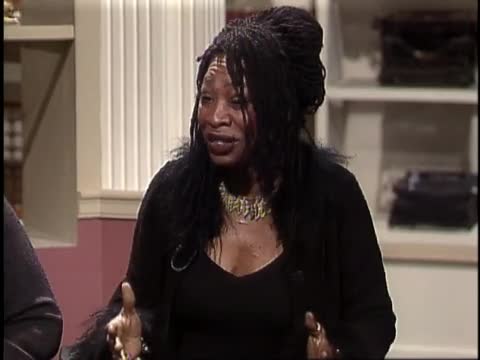
- Episode 3110 of Black Horizons is hosted by Chris Moore and features interviews Tony Todd, star of the new August Wilson play titled, “King Hedley II.” The play is being presented at the new O’Reilly Theatre, home of the Pittsburgh Public Theater. Also appearing on this episode are Patricia Pugh and Mitchell and Tracey Turner of the Kumbaa Trusts, a city- wide Kwanzaa celebration.
- Series Description
- WQED’s Black Horizons was launched in 1968 and was designed to address the concerns of African American audiences. More than just a forum for the community, the series served as a training ground for Black talent in front of and behind the camera. Through the decades, the program featured various hosts and producers until Emmy winning journalist Chris Moore took over the program in the 1980s. He was later joined by Emmy winning producer Minette Seate before the program evolved into WQED’s Horizons in the 2000s.
- Broadcast Date
- 1999-12-17
- Created Date
- 2000-01-12
- Asset type
- Episode
- Topics
- Public Affairs
- Media type
- Moving Image
- Duration
- 00:29:01;24
- Credits
-
-
Producing Organization:
WQED (Television station : Pittsburgh, Pa.)
- AAPB Contributor Holdings
-
WQED-TV
Identifier: cpb-aacip-b74f363f062 (Filename)
Format: Betacam: SP
Duration: 00:25:59
If you have a copy of this asset and would like us to add it to our catalog, please contact us.
- Citations
- Chicago: “Black Horizons; 3110; Kwanza Celebration, King Hedley II,” 1999-12-17, WQED, American Archive of Public Broadcasting (GBH and the Library of Congress), Boston, MA and Washington, DC, accessed July 5, 2026, http://americanarchive.org/catalog/cpb-aacip-15f4efa55fd.
- MLA: “Black Horizons; 3110; Kwanza Celebration, King Hedley II.” 1999-12-17. WQED, American Archive of Public Broadcasting (GBH and the Library of Congress), Boston, MA and Washington, DC. Web. July 5, 2026. <http://americanarchive.org/catalog/cpb-aacip-15f4efa55fd>.
- APA: Black Horizons; 3110; Kwanza Celebration, King Hedley II. Boston, MA: WQED, American Archive of Public Broadcasting (GBH and the Library of Congress), Boston, MA and Washington, DC. Retrieved from http://americanarchive.org/catalog/cpb-aacip-15f4efa55fd