Front Street Weekly; 521
- Transcript
[silence] [beeping] [opening music] In no way am I going to condone snatching children. There's no excuse for parental kidnapping. There's no excuse. [unintelligible] I don't consider it to be kidnapping. No, not uh- not in my case. Not
kidnapping at all. How do you consider kidnapping when you're trying to do the best thing for your own children. Most of the missing children that you see on milk cartons and grocery bags are not taken by strangers. They're either runaways or victims of parental abduction, and that means that some parents are being sought as felons. And Susan Shadburne talks about her work in Oregon's growing film industry. The only place I know where I can do absolutely everything I ever loved. You'll meet the Hams: an unusual foster couple who are raising a helping hand. You'll see those stories tonight on Front Street Weekly, Oregon Public Television's news magazine. Good evening. I'm Gwyneth Gamble Booth. I'm Jim Swenson. Last week, in the beginning of our series, we reported that most missing children are runaways. The second largest group of missing children are those taken from one
parent by another. Hope Robertson reports on a major cause of the tragedy of missing children. It's almost getting to the point where you can't go anywhere without being reminded that we live in a world of many dangers. The faces of missing children seem to be telling us it is a cruel world in which strangers steal away and abuse our young. But, in fact most of those faces are those of children who were snatched, not by someone they've never seen before, but by someone they knew and trusted - by one of their own parents. It's called parental kidnapping, parental abduction, custodial interference, and it may involve 25,000 to 250,000 children every year. The posters that you see out all over the place. The signs you walk by in any grocery store you walk into. The milk cartons. The milk cartons. Zack had his face on a milk cartons, he had his face on grocery sacks, he had is face in a paper- little throw-away
paper down in California. And that got a reaction, because that's when his father took him very deeply into hiding because he was spotted. Zachary spent a lot of time in hiding. He had a lot of different names that I have now documented. When I found him in Tracy, California he had red hair, long red hair. My son's hair is blond. His- he was going by the name of Kevin. Zachary Woods was gone from his mother's life from the time he was 2 years old until Zach was four. Today, just months after his return, Zach and Sue can laugh as they play the game of hide and seek. For two years hide and seek was not a game, but a real life pursuit that cost Sue nearly $20,000 in travel, posters and private investigators. In the end it was a gut feeling, she says, and a good cop that brought Zach home. But otherwise this mother has no compliments for law enforcement officials.
There's a lot of things that are overlooked, there's a lot of things that aren't as important. If I had a car stolen across a state line I would have got it back quicker. Abduction prevention laws aren't enforced. They aren't perfect. They are not uniform, even though it says uniform child custody it's not uniform. It skips states, it skips counties. The Uniform Child Custody Jurisdiction Act should have made it easier for Sue Woods to get cooperation in getting her son back, because as the name explains, Uniform Child Custody means that states have an agreement recognizing each other's custody orders. That way one parent can't just cross the state lines and get a new custody hearing if custody has already been decided in another state. But Uniform Child Custody has only very recently become uniform throughout most of the nation. And Sue Woods is not the only parent frustrated by inconsistencies in the system. I've been in approximately 500 police stations in 17 states. I have had five police departments bend over backwards in an effort to help me. At about five it was mediocre, if we can assist you in some way we will, but the rest of them
was, Don't bother us with it. Far as we're concerned it's a domestic dispute. It's your kids. If you want to hunt for them, fine, just don't bother us. Walt Underwood hasn't seen his two daughters since they were one and three years old. How long have your children been missing? Seven years this time. It didn't surprise me a whole lot because I was afraid she would do it again. She had done it before? She had done it before, and they was gone five and a half months before I found them the first time. The first time his ex-wife allegedly took the children, parental abduction was a misdemeanor. Underwood fought to make it a felony in Oregon. A parent can go in and prove that they have custody, where, under the new law, the way the law is now, they have every right to insist- even demand that a warrant be issued for the offending parent. Once a warrant has been issued for the other parent's arrest the FBI can be called in. Cooperation from police departments and district attorneys across the country can also be tapped.
But parental abduction isn't always a priority case in many jurisdictions where violent crime rates soar. And there are still those who believe that as long as a child's with a parent, what's the hurry. Are parents who do this criminals- are they outlaws? Do they need to go to jail? I think if somebody snatches the child and they know that legal custody resides in the other parent, that is a crime like any other crime, and that person should go to jail. If you don't have jail or the possibility of jail is an option available, you're like a toothless tiger. You have no ability to have a deterrence to others. If people know that they can do things with impunity and that the courts have no real way of punishing conduct, then all the laws in the world won't help you. Well I considered that. I knew from all that I'd studied that if I was caught I could probably go to jail. In fact, I assumed that I would.
But when the safety of your children or people you just care about, if their safety is in danger, you're- you're a bad parent if you don't. At a weekly meeting of Dads Against Discrimination, John Shell explains why he took his two-year-old daughter away from her custodial mother. He tells of the frustration he felt when, after he spent six months in jail, Shell discovered that his ex-wife had already left Oregon with their daughter and no forwarding address. Shell has no legal recourse. Law enforcement won't look for his ex-wife because legally she has custody. How many people have they put in jail for denying visitation lately? There is a lot of bitterness in this room. Perhaps we can see here some of the seeds of parental abduction. It's interesting because I have never done that and I'm pretty sure I never will, but I will tell you one thing - the thought always crosses your mind because when you have a child, or children, you know, the very fact that somebody is keeping them
away for really no reason is enough to just send you over the edge. It's not hard to imagine a father getting terribly frustrated with that, seeing that there's no end in sight, believing that the courts can't be of any assistance, or won't be, and deciding that hey, if they're going to have any role in the child's life the only way they're going to have a role is to grab the kid and run. And I can understand. That's not the right way to approach it, and it's not legally sanctioned, and no one ever will sanction that, but I can certainly see that. Parental kidnapping hasn't been sanctioned by law but a California jury recently ruled in favor of the abductor. When I left there was no- there was no milk cartons, you know, no missing children, you know, on the television. There was nothing like that. And taking your children was not a felony at that time, either, it was a misdemeanor. I believe so, yeah. Ronald Whitelaw lived in Lebanon, Oregon for seven years without anyone suspecting he was hiding from the law. Now, he's well known
as the guy who got away with it. Whitelaw was acquitted of criminal charges for abducting his two daughters and now he's going for custody. It was scary but I, you know I really felt that even though I had to look over my shoulder, you know, now and again, I felt that the children being where they were, with me, was all worth it. And worth it, Whitelaw says, includes the million and a half dollar civil judgment that's hanging over his head. Whitelaw's defense that he was trying to protect his children from his wife's threats kept him out of jail. But he may yet have to pay damages to her for the seven years she spent searching the nation for her children. The possibilities of jail and civil lawsuits aren't the only costs of parental abduction. Psychologists tell us emotional expenses for children run even higher. I often look to our parents to do the right thing and when our parents have done something that is criminal, is traumatic,
that is often a betrayal of trust in a way that is very serious because if we can't trust the people who we feel are supposed to take care of us and do the right thing, then how can we trust strangers? How much would a child of say, 18 months old, really be aware of what was happening during a parental abduction? A child doesn't have to be very old to be aware that they have been taken away from all that's known and familiar and kept away from it. We talk about it when he brings up the questions- when he asks the questions I answer it, otherwise I don't mention it. What kinds of questions does he ask? Why did my daddy steal me? He tells his dad on the phone, you can come and visit me Daddy but I don't want you taking me. You can't take me. He used to just hide. Go wide-eyed, white, and duck when he heard a siren or heard the police coming.
It's the police. We have to hide, you know, because police were bad. That's what he was told. And you say, well the police are good. You know the bad police took my daddy. The bad police threw my daddy in jail and I'm going to go down there and punch that jail down. Often there's a great preoccupation with good and evil. Who's a good guy, who's a bad guy. Though we often see children who, in their play, have great concern about being strong and being able to fend off with their strengths those people who might do them harm. Because they felt powerless. Yes, exactly, and often a child is terribly confused because they have some positive feelings towards that parent but may not like what that parent has done. It's traumatic for the child. It's illegal. It's a bad example. It victimizes many others. The parent who is left behind, the family who is left behind. That child is not abducted in a vacuum. What about grandparents, aunts, uncles,
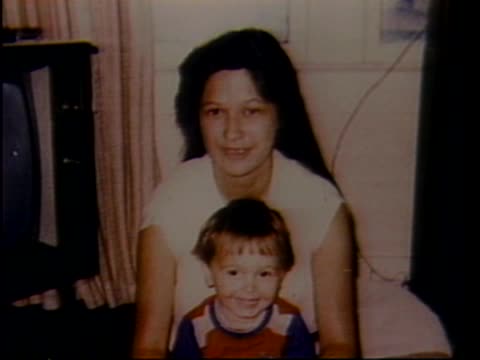
cousins, friends. All of those people suddenly have a precious child or children snatched from them. Many victims are left in the wake of an abduction. When I tried to leave the house the night that I left him, he looked at little David and he said do you want to go with mommy or daddy? Now what kind of a question is that for a three-year-old. He said- he said you can go with mommy, and you'll never see daddy again. Or you can go with daddy and you'll never see mommy again and he didn't know what to do, he just started crying. That was two years ago. Patricia last spoke with her son at Christmas by phone, on the condition she wouldn't ask where he is. This is all Patricia has to remember her son David by, one photograph. She says her ex-husband took the rest along with their son. We're always going to have parental kidnapping. I think to the extent that you have acrimony and bad feelings, and when marriages and relationships break up between parents you're going to have snatching of children. They either want to reconcile with the parent and they think if they take little Joey that that's the way to
get Mom back or their ex-wife or their ex-girlfriend back, or they take the child because they really want to hurt that other parent. And they know that taking the child is the way to do it. But in the process children are often hurt the most. Confused about how they're supposed to feel. Insecure if they're constantly on the run. Saddened and grieved if they've been told the other parent is dead or doesn't want them, and maybe afraid to really trust again. The Hide and Seek's chapter in Portland not only provides many of the photos for grocery bags and milk cartons, but it also actively searches for many of the missing children. Well, she calls herself a live action animal. Susan Shadburne, producer, director, writer, has found her niche in live-action feature films here in Oregon. Reporter [Kya?] [Zeledeck?] talked with Shadburne about her work. I think film is the most -by far, the most powerful contemporary medium. But to sit in a dark room and let those images-
allow them in, has a tremendous impact on people. and ever since I was little, I remember, I always wanted to move people, when I was playing the piano it had to be something like Chopin, you know, to move.. [laughs] Everything I wrote I wanted to move people.. Today, Susan Shadburne is trying to make an impact on audiences through her work in film. As a writer and a director, Shadburne's Shadburne's career has been going strong for nearly 15 years in Oregon. Some of her early projects go back to a time when she and two associates were producing educational films in Portland. Shortly after that, Shadburne turned to dramatic films out of what she calls a passion. A half-hour docudrama called A Family Affair, about domestic violence, was the result of that passion. The - it was two-fold for me, the rest are really exciting, dramatic material. It had to serve a lot of functions. It wasn't just drama, it had to cover, it was to be educational. Actually it's perfect to educate judges as to, as to the circle, the cycle of family violence. It was an opportunity to work in that medium
again. Dramatic subject for me, and also that I would have an impact on people's lives. It's a real pleasure. I always took pleasure in doing subjects that I thought were going to make a difference. She had a bruise on her forehead. She had the beginning of a black eye. Is the man who assaulted you present in this courtroom, Mrs. Mason? Yes. It's been mostly feature work for the past four years, including some work with Will Vinton, writing for his claymation films. The initial interest, Shadburne says, came from her fascination with this new technique. Well, I remember the first time I saw Closed Mondays. Knocked my socks off, I mean, I think Claymation is a superb technique. And it was brand new. Nobody'd ever seen anything like it. So writing for the medium was lots of fun. Shadburne has written for a number of Vinton's projects over the years: a documentary telling about the process of Claymation, numerous short films - among them Rip Van Winkle, The Little Prince, The Great Cognito, and Vinton's latest work - a full length Claymation film called
The Adventures of Mark Twain. 'I came in with Haley's Comet in 1835, when I was born, and I expect to go out with it'. You know, the whole point is to get exposure on the film, so what's, what's the best category? Where do they talk about that? In 1981, Shadburne formed a partnership with Will Vinton and Dan Biggs. The result of that collaboration of talent is a production company called Millennium Pictures. The company's first effort is a full-length feature film called Shadow Play. Shadburne wrote and directed. In casting she looked for well-known actresses to play the lead roles. The impressive script attracted Dee Wallace of E.T. fame, and Cloris Leachman. Right from the start, I decided the only way that I could make this happen was to write a drama that an actress couldn't turn down. So I met with Dee and her response was 'I was born to play this role'.
And that's what you want to hear. Shadburne wrote a script that allowed the female lead to not only carry the storyline, but also display her talents. I've spent enough time going to movies that I had seen women, always seen women through men directors' eyes. And it occurred to me that it was time that an audience saw men through a woman's eyes. The film was three years in production. A local crew spent six weeks shooting the film on location in Washington State and parts of Oregon. Shadburne talks about directing Cloris and Dee in the film. Dee is one of the most disciplined people I've ever worked with. Dee knew every line. Dee was a one or two-take actress. Cloris on the other hand, has this wildly exuberant appreciation for everything in the world, including, you know, dancing at a club until three o'clock in the morning and throwing down B-52 as fast as she can. I mean, the woman is just - she's a mad woman. But it's just
life to her. It's just, it's like a big lunch and she's just going to get as much in her mouth as she can, [laughs] you know. Which created a different, a whole new energy on the set. I mean, she didn't believe in learning lines, because she said if she learned them then she wasn't going to be spontaneous. I need two more rehearsals and I'll be perfect. For Shadburne, Shadow Play is not really a personal triumph - just another step forward. And there isn't really, It isn't really dreams come true, it's a series of tasks completed and you're pleased with it, and you know you gave it your absolute utmost. There was not a thing you could have done that you didn't do. The tremendous satisfaction in that. Whoever it was that said it, god bless him. If you're not, for all the talk about all of our learning how to relax, I mean there is something to be said for learning to be comfortable with yourself. And that's, that's wonderful. That's the goal. But being comfortable with myself has to do with knowing that if there's insufficient anxiety in my life then I'm not having any fun. [laughs] To be successful in the film industry, Shadburne says, you have to handle the nuts and bolts
while never losing sight of the need to be creative. The film, the film's the only place I know where I can do absolutely everything I ever loved. I've always written- written music, acted, it's everything, for me. It doesn't mean that there aren't moments when you wonder why you're doing it, but it's the culmination..I never wanted to have to make a choice. You know, I loved it all. And in film you don't have to. Mark, mark. [clapboard sound] Action! Well, we've learned that Millennium Pictures has just signed with New World Pictures to distribute Shadow Play, and Shadburne says that she expects a theatrical release of the film sometime in the fall. Jim? You know, that's great news. There are so many people locally here that worked on that film and they're really looking forward to seeing it. Good. That'd be good. Next, we have some unusual foster parents. The Ham family of Albany. For three years they've been sharing their home with a baby monkey named Katie. Later, Katie will be trained in the east for a very special
career as a helpmate for a quadriplegic. But for now, the Hams are helping her to become what they call a little person who loves and trusts humans. This is the house where Katie lives. A happy, lively Capuchin monkey. Betty Ham is her mother. [Wendy?] ham is her father, and Hans is her playmate whom she likes to torment from time to time. It's time for her daily weigh-in. In February Katie arrived from a breeding colony in Argentina. A few weeks old, and weighing only seven-and-a-half ounces. The Hams were nervous about being parents. What am I going to do with this little bitty thing which had no hair on her tail, no hair on her face - but she had to have somebody to love her? Betty held Katie in her arms the first 48 hours to establish a bond with the tiny orphan. Because she was abandoned as an infant. She was born during a hurricane- during Hurricane Kate,
That's why we named Katie. After going through quarantine three other monkeys arrived in Oregon with Katie, all now in foster homes where they're treated like human babies. Playpens, toys and all. At the moment, Katie likes cutting up more than anything else. Betty and Wendy say their daily routine which begins with a bottle and vitamins at 6:00 a.m. and ends with bedtime at eight isn't difficult, since they're retired and have the time. I needed this. I needed something to do. I was a little tired of crocheting and yard work, and this is like having a grandchild around but she's prettier than some of them! [laughs] Katie stays close to Betty and Wend. I can make beds, do dishes, fold clothes with Katie riding right on my arm. But, as I say, she wants to be with one or the other of us. Okay, you like that honey, don't you? Mmmm Mmmmm. Right now, Katie's on formula with a little cereal in it, also lots of fruit. But she
likes treats. Her favorites - Oreo cookies and Cheerios. Her diet must agree with her because she's full of energy and curious about everything, like the telephone for example. Well, Katie is this a call for you? I don't think its a call for you, Katie. A few years from now, after six months of training in Washington, D.C., Katie will be bringing the phone to a quadraplegic when it rings, and that's not all. She'll fix microwave meals, serve water or pop, vacuum, brush teeth, comb hair, and operate cassette tapes. And she'll even find the right book on a shelf cued by a chin-operated laser light beam that the quadriplegic aims at the object that he wants. So now everything Katie plays with helps her to learn. Dave Parker, the Ham's son, is president of Paralyzed Veterans of America in Oregon. His organization donated $60,000 to the Helping Hands program which trains the foster monkeys and places them with quadriplegics. [monkey screeches]
Oh, I think it's a neat program, you know, to state it very simply it's just a neat program. Dave says when quadriplegics have live-in monkeys they don't have to rely on constant human care. For Katy's 25-year working career she'll handle the day shift with ease, a free gift from Helping Hands. You know, if I were a quadriplegic I think I would like to have a monkey to help me with some of my basic needs. The Ham family is already thinking about the day that Katie leaves for Monkey college to begin a new life. It will be hard to take. I know it was a sad parting when my son went away to college [laughs] and I imagine it will be very much the same. Knowing what Katie's going to do makes it all worthwhile. And we hope that we can take her back to the institute ourselves and see the training program and maybe bring another infant back with us.
Will Katie miss them? Wendy thinks so but he's optimistic. They adapt very readily, at that age, to other people. In fact, they say that they have more problem with the foster parents than they do with the monkeys. Already there is a waiting list of families who want to be foster parents for the Helping Hands program in Oregon.Well, Front Street Weekly will not be seen next Tuesday due to a special program- 'Shoot Don't Shoot'. But we will be back the following week, Tuesday, May 6, with another addition of Front Street Weekly. We hope to see you then. Good night. Good night. [outro music] Oh.
- Series
- Front Street Weekly
- Episode Number
- 521
- Producing Organization
- Oregon Public Broadcasting
- Contributing Organization
- Oregon Public Broadcasting (Portland, Oregon)
- AAPB ID
- cpb-aacip/153-97kps2b1
If you have more information about this item than what is given here, or if you have concerns about this record, we want to know! Contact us, indicating the AAPB ID (cpb-aacip/153-97kps2b1).
- Description
- Episode Description
- This episode features the following segments. The first segment, "Parents As Criminals?," investigates cases of parental abduction, one of the largest causes of missing children. The second segment, "Susan Shadburne," is a profile on filmmaker Susan Shadburne and her work in Oregon's growing film industry. The third segment, "Helping Hands," is a profile on the Hams, a foster couple raising a baby monkey so she can one day be a service animal for a quadriplegic.
- Series Description
- Front Street Weekly is a news magazine featuring segments on current events and topics of interest to the local community.
- Broadcast Date
- 1986-04-22
- Created Date
- 1986-04-21
- Copyright Date
- 1986-00-00
- Asset type
- Episode
- Genres
- Magazine
- News Report
- Rights
- Oregon Public Broadcasting c. 1986
- Media type
- Moving Image
- Duration
- 00:27:05
- Credits
-
-
Associate Producer:
Condeni, Vivian
Director: Graham, Lyle
Guest: Booth, Gwyneth Gamble
Guest: Shadburne, Susan
Host: Swenson, Jim
Producing Organization: Oregon Public Broadcasting
- AAPB Contributor Holdings
-
Oregon Public Broadcasting (OPB)
Identifier: 113114.0 (Unique ID)
Format: U-matic
Generation: Original
Duration: 00:26:33:00
If you have a copy of this asset and would like us to add it to our catalog, please contact us.
- Citations
- Chicago: “Front Street Weekly; 521,” 1986-04-22, Oregon Public Broadcasting, American Archive of Public Broadcasting (GBH and the Library of Congress), Boston, MA and Washington, DC, accessed June 8, 2026, http://americanarchive.org/catalog/cpb-aacip-153-97kps2b1.
- MLA: “Front Street Weekly; 521.” 1986-04-22. Oregon Public Broadcasting, American Archive of Public Broadcasting (GBH and the Library of Congress), Boston, MA and Washington, DC. Web. June 8, 2026. <http://americanarchive.org/catalog/cpb-aacip-153-97kps2b1>.
- APA: Front Street Weekly; 521. Boston, MA: Oregon Public Broadcasting, American Archive of Public Broadcasting (GBH and the Library of Congress), Boston, MA and Washington, DC. Retrieved from http://americanarchive.org/catalog/cpb-aacip-153-97kps2b1