Front Street Weekly; 505
- Transcript
Did the punishment of this young girl's killer fit the crime? Her mother says "no", [mother]: but I think that by walking at 21, yes, he's getting away with murder. If you're here just for a TV show on a one-night stand, it isn't gonna cut it. We have gotta determine that want to take our community back, want to take our streets back, we live here and we're going to control the streets of our community. Residents in Northeast Portland take to the streets to protect their neighborhood. And then some Oregon blacksmiths bend hot steel and make it look easy. I'd have to say that- that- that you've got to be basically a hopeless romantic. You know, to want to get into this business. Good evening, I'm Gweyneth Gamble Booth. I'm Jim Swenson and you'll see those stories tonight on Front Street Weekly; Oregon Public Television's news magazine. Oregon's Department of Justice reports that more than 1,800 juveniles were arrested for robbery, forcible rape, assault, and murder in 1984. In just the first six months of 1985, over
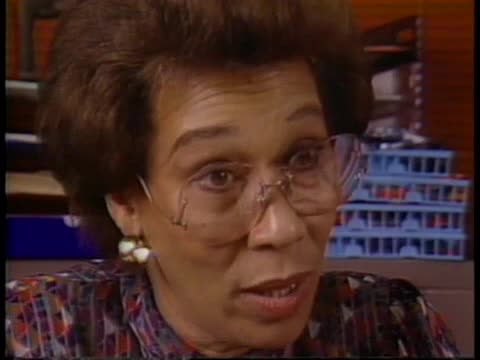
1,100 juveniles were arrested for violent crimes. Juvenile crime has caused many people to ask: how can the law provide treatment for these young offenders and still protect communities? [Woman]: Um, my daughter was murdered. May 3rd, 1982. She had gone to a neighbor's house to take a picture to a- a girl that she went to school with. And she was murdered by that young girl's brother. He was 15 at the time, almost 16, he turned 16 in September. Ann Harris's daughter Wendy was 11 years old when she left home to go to a friend's house. He used his fist and hit her. And from this, according to the coroner, was knocked unconscious and he took her body from
the front door of the house to his bedroom which was on the lower level and used a hockey stick to murder her. And he was sentenced to the maximum allowed under the juvenile laws. [Swenson] Because Eric Merrill was 15, he was tried in juvenile court. He was sentenced to McLaren Training School, the state's reformatory for boys, until his 21st birthday. The biggest problem that I have is that he will be released at 21. There is no consideration given to the fact that he may not be ready for release. That doesn't matter because under the juvenile system you walk, you are out the door. And I find that unacceptable. I did then and I still do. [Swenson] The 15 year old boy who murdered in 1982 will be a free man in 1987.
The law does not ask for evidence that the accused will not kill again. The only thing Eric Merrill must prove is his date of birth. [Different speaker] Um, if they go out and steal a car, if they go out and rob, you know, stick a gun in somebody's ribs and say "give me your money", and they're under 18 ah, at the time they do that and at the time that they're discovered, in other words, they're arrested, as long as they're arrested prior to age 18. The juvenile court has exclusive jurisdiction over that case, unless they're remade into the adult system. The state uses remand to make a juvenile subject to the same criminal laws and penalties as an adult. Boys remanded on felonies can be sentenced to prison at OSCI, the Oregon State Correctional Institution. To those who have learned the ropes of Juvenile Justice, "remand" and is a familiar word. [Inmate] Oh, I was 16 at the time. Just- just 16 and, uh, well I did a burglary. More than one actually. I was sent to McLaren. At McLaren and I got remanded and
put in county. [Different speaker] When I done the ?inaudible? and then I got remanded and got the robbery and extortion County Jail. [Different speaker] The fires on campus and control this place. I had to proper remand and, made sure they did their time for the stuff they did to other people. Eric Merrill was too young to be remanded a few months short of 16 which was the minimum age for remand in Oregon. A growing number of states have turned to remand as a way to deal with younger delinquents and many Oregonians have urged the state to follow this trend. This gives- gives us then the capacity to deal with a youngster who isn't responding to the juvenile programs. In some senses, the juvenile system has less to offer than the adult system in corrections, because McLaren for example, has no actual vocational training. On the other hand, OSCI does. They have, I think
10 or more programs that you can actually graduate and get a certificate of some sort for vocational training. [Swenson] Prosecutors worry that without remand, the state is forced to release young people who might be dangerous. They want the option of OSCI because the reform schools may not be able to provide the treatment some delinquents need. In addition, more hardened juveniles can disrupt treatment for other children at the schools. But civil rights lawyers argue for more treatment and dispute the belief that juveniles are increasingly responsible for violent crime. A study put out in March 1985 by the Crime Analysis Center, the Oregon Department of Justice compared the number of arrests for serious felonies, um, for juveniles, um, aged 17 or younger, um, and in the period between 1975 and 1984, the total number of arrests decreased some 20 percent. [door opening]
What I think is so important and so critical about the remand issue is that one of the few remaining differences between the juvenile and the adult system is this right to treatment. You have the right treatment and services. If you're a juvenile and you don't have that right, um, it is purely subject to budgetary constraints whether you get any treatment services as an adult. The Juvenile Rights Project has brought suit against McLaren training school in federal court. The lawsuit charges many constitutional law violations including a lack of treatment and educational services. [Different speaker] In the front cottages where we're housing 30 youth, ah, on our best shift, currently we have two staff to serve those 30 youth and I think if you look at some of the private agencies and some of the other child caring facilities in the state of Oregon it's easy to recognize that we're totally understaffed for the kind of youth we have and the kind of programs we're trying to offer. [Different speaker] Their parole officers, you know, they're not strict at all. [Different speaker] My parole officer, when I was at McLaren, he didn't do nothing.
You know, he just- walked out on the street and I didn't see him, I didn't talk to him. I didn't- I just stayed out of trouble he was just gone, wasn't there. McLaren has developed a plan to improve its program, but the state plans to gradually reduce the school's population, then close it altogether. The most difficult residents will go to Hillcrest which is now the state's coed reform school. Most of the rest of the McLaren and Hillcrest populations will go to community treatment programs. I support downsizing McLaren; provided that the means that they use to do it, is to set up their local programs and send the youth into those programs at a time when they can demonstrate those programs are effective and that they're provided effective protection to the community and effective treatment to- for- for the youth they're assigned to. [Swenson] Even without McLaren, remanded boys can still be sent to OSCI; which suffers its own budget crunch. The prison
houses roughly twice the number of inmates it was designed for. Prisoners must go on waiting lists for almost all training and treatment programs and the average inmate doesn't stay long enough to earn a vocational certificate. Two teenage inmates talk about what it is like to be in the prison. [Inmate] Um, ?inaudible? it's a lot more people, you know No hard time. That's about it. [Different speaker] In county jail, they tell you all these stories, you know, and It's just- it's not true. You know what they say, raping's you know, all that. You came in, you know, like when I came in, when I first walked throught the door, uh, they was having chow and these guys were running down the hall and they started whistling and stuff, you know, and that scared me quite a bit. Compared to other institutions of this size and this nature, uh, we have very few assaults- assaults of inmates on inmates and on- of inmates on staff. If we- If I were to compare this institution to, uh,
an institutions in California where they have two or three murders a week, uh, uh, daily assaults on staff. Uh, just doesn't exist here. More prisoners are coming here for violent crimes and new maximum security measures reflect the changing prison population. A boy can become a victim among criminals in a prison or in a reform school. But it's too easy to forget this is more than a housing problem. People on all sides agree on one thing: whatever we've been doing with juvenile delinquents, it hasn't been enough. [Different Speaker] And if we're not going to fund treatment for these kids in either system, we haven't solve the problem at all. Because whether they walk at 21 from the juvenile justice system or 31 from the adult system; if they haven't had treatment, we are all in trouble, not just that child. [Different Speaker] I think that by walking at 21, yes; he's getting away with murder. There will be no record. He's a juvenile. He was tried as a juvenlie. There is no record. That's getting away with murder.
[Swenson] Well after her daughter Wendy was killed, Ann Harris lobbied to get the remand age lowered and the 1985 legislature passed a law lowering the age to 15 for murder and other serious felonies, Gwyneth. [Gamble Booth] And now an inside look at a part of Portland you don't see unless you live there. Some call it Portland's ghetto. For others, it's simply Northeast. And those who live in Sabin, King, or Albina say that this is their community. Reporter Hope Robertson takes us into this area of Portland which is fighting to remain a neighborhood. [Different Speaker] A lot of people like to, um, say we're living in a ghetto, but in a ghetto I think is just in the minds of people. [Different Speaker] You know, this is our territory, this is our community. [Different Speaker] I like living in this neighborhood because it has a lot of interracial families. [Different Speaker] I have put 29 years of my sweat into my home. Why should I move? I like Northeast. Why should
I have to go to any place else? [Robertson] Has this neighborhood changed a lot over that 29 years? Did it- did it start off being a lot different place for you to raise your children that- than it would be now if you were raising children? [Different speaker] Yes I think that, um, I have watched the neighborhood go from, ah, one that I think everyone would have liked to have raised their kids in, to one that we have had lots of concerns and lots of frustrations. And it's a neighborhood that we would love to be proud of but, in the past three years I think that we have dealt with more drugs, prostitution, than ever before. I have had to go out with sticks just make them remove themselves in front of my door. And I'm not too sure that that is really all of my job. But when I called the police, and we don't get a response, then we have to do the best that we can. [Reporter] You don't get a response, you mean the police don't show up? [Different speaker] That's right. [Kids singing America the Beautiful] [Different Speaker] This is Jeanette Fegan School and I'm Betty Jeannette Fegan Smith and our
location is what 606 North Fremont. I have lived in this area for 30 years, nearly. I'm a mother of four. My youngest daughter who works here, Deborah, we're pretty family oriented, because I know most of these parents. I've known them since they were small and so most of them grew up here in the neighborhood with my kids as they grew older, as they grew up, rather, so it is, pretty much, a neighborhood type of school. There, uh, a lot of good people live here, a lot of good things are going on. Ah, it's a safe place to be. [Robertson] A lot of people would- would not believe you if you said it's a safe place to be. [Fegan Smith] Well they wouldn't know unless they lived here or came into the area and worked in the area. They only know what they've heard on television or read in the newspaper. Ah, but it isn't as bad as it seems. 'Course those things that's happening on Union Avenue, with the prostitutes and, uh
Alberta street with the dope pushers. That's just one small area of this neighborhood. You know, if it's as bad as they say it is here, then a few blocks down the street, you know, Lloyd Center should also be as bad. But because it's not a predominantly black area then it's not considered a bad area and I think a lot of people are fearful of the ar- area simply because it is a black area. This is my neighborhood and I like it. [Sirens, officer speaking] Mr. Winnicker, who's is this? It this Yours? [Different Speaker] No, that's not mine. [Officer] Mr. Winnicker, I'm advising you of your rights also, sir. You do have the right to remain silent. Anything you say can, and will be used in a court of law. This is her one and this is what, free-based ?inaudible? cocaine? OK. Of course you don't mind if I lab test it to make sure. Where'd you get the cocaine from? [Different Speaker] Same guy, the same guy,
he's there all the time. [Different speaker] I live in the surrounding area, I have family, I have friends, I have a mother in law that lives in the neighborhood here, I grew up in the neighborhood and, uh, I just have a certain, I don't know, affinity attachment to this neighborhood, I like it. Well, for one thing I think it's important that the kids haveta have some type of role model rather than just that pimp, the prostitutes, the dope peddler. If a child just sees all that, then when they become older they believe "ah jeez, when I was younger and how they think it's socially acceptable. Now that I'm older and things become difficult I can't make it in life, I'll do the same thing." [Robertson] What's it like to drive through your own neighborhood and see people like that out on the streets selling drugs and, turning tricks and they're not afraid when you come by? [Different speaker] It's somewhat disheartening, you know, because you hate to see any human being involved in something like that. You know, sometimes I drive through that area and I look and I can reminisce and I can see myself down on the corner, walking down the street. I see
myself walking from Humbolt School down the street going home, you know. And, ah, you just look and you say "jeez, by the grace of God or for some reason, I didn't turn out like a number of people did." These guys are always up here standing on the corner, allegedly selling. That's why a lot of times you have with these guys that will run up cars that're just driving by, and you'll have two or three people. And it'll be just like brokers on the, uh, floor of the New York Stock Exchange. They'll sit there and they'll be, uh, bargaining for, uh, how much they'll sell him bag for. [ Reporter] The old curbside service, there. [Different speaker] The old curbside, drive-up service. I love when you got a camera, they don't want to stick around. It's like they're ashamed for some reason. Ok, why can't- why not go to your own neighborhood and do it? But people up here do care about their neighborhood and they are willing to become involved in it. They're ah, they're not content to just sit, sit down and watch the neighborhood deteriorate. [Different Speaker] Don't seem like the police gonna do anything about it. The
citizens got to take it upon themselves to try to, eh, stop it from going on. 'Cause we got kids we gotta try to protect them. [Reporter] Well surely you can't afford to stay out here every day, though. [Different speaker] Well, if we have to, we will until we can get this cleared up. [Different Speaker] This is my son, Donald Page Jr., and he's out here- he's out picketing because he's tired of of having all these drugs in his community and they're so close to his school and him and others, friends. You know they can see what's going on and these people are really bad example for the children that Martin Luther King Elementary School. [Reporter] You know what they say, right? [Child] Yeah, "you go home and we'll go home." [Reporter]. What does that mean? [Child] Just go some- far far away, alright. Where there isn't any Children. [Different Speaker] My heart hurts when I come out here, but how else am I going to get some money? [Different Speaker] If we not robbing, we not stealing, It is a lot of these people out here who got kids and taking care of family, how is they eating? Like, we ain't having no jobs
we aren't out here robbing, we not out here stealing nothing. You know, we just have a legit business they giving us money. [Different Speaker] If you're getting over means that we have to suffer as a community, you can't get over like that! [Cheering] You going to have to find some way else to get over. You can't get over by putting us down. People up on Council Crest don't have to stand out in the rain like this about dope, right? I hope everybody realizes that people out in Eastmoreland don't have to get wet making speeches like this about dope, right? I hope everybody realizes that when you go in some of these other rich parts of town, people don't have to walk up and down the street, carrying signs about prostitutes. [Chanting] "Push the pushers out! Push the pushers out!" [Different Speaker] We build up our jails and our police have had to resort to issuing citations to people who should have wound up behind bars. [Different Speaker] Now we understand about jail space, we are now ready to go get some of these empty school buildings and man them ourselves to put these people- locked up. [Crowd cheers] [Different Speaker] You're
going to arrest them and you say you're giving them community work; get them down Union avenue. Give them a broom, a damn shovel, give them a garbage can- [Crowd cheers] [Different Speaker] Drug dealers now are getting so bold that they come out while we out there protesting, they don't care it's cause- the police, when we request that they come and patrol area while we're out here and we have been physically threatened. [Different Speaker] I don't think we have an answer for you right now. I think you're giving us the answers right now. We're going to do something; I'm not sure what it is. [Crowd murmurs] [Inaudible] You got to do something because I'm not going to move. [Fegan Smith] I feel it's a good place to live and a good place to work. There a lot of negative things, a lot of things that are going on visibly. Of course, but, I don't- this is not the total area. There are families here, that are raising their kids here and they're doing a good job raising, you know, with their children. And, uh, I really love the area I wouldn't live any other place.
[Gamble Booth] Well, we saw the man who spoke out at the mayor's meeting, suggesting that the prostitutes and Johns get out on Union Avenue and literally sweep the streets to pay for their offenses. Well Portland has recently hired someone who will supervise that kind of work for those convicted of street crimes. [Swenson] It's my understanding is also that there are plans for training citizens and for setting up a street crime control center, among other things, so that people will have a place to coordinate the various efforts that they have underway. [Gamble Booth] Jim that's true, but it's slow work turning a neighborhood around and many of those neighbors have reached a point of exhaustion. They've spent months just trying to get someone to pay attention to them- to listen to them. [Swenson] Well, it sounds like people are listening but it doesn't sound like there's any immediate happy ending in sight. [Gamble Booth] Until the mid 19th century, every American community depended on a blacksmith. He made and repaired everything; from iron skillets and door hinges to plow shares and wagon wheels. Well the industrial revolution and mass production caused blacksmithing to almost disappear. But since the 1970s, a generation of younger
'smiths have breathed new fire into the Old Forge. When Louis Weissenfels died, he took his anvil with him. Weissenfels worked hot steel for 60 years in his Mount Angel blacksmith shop that Adams has run the shop since 1982. [Adams] So far, as we've been able to figure out, we are the oldest operating blacksmith shop in Oregon. We've been around since 1905. We're 80 years old this year. Uh, there may be older ones in the state but I don't think any of them are working. [banging sound] A blacksmith is a man or woman who will forge something from nothing. [banging] Well the basic principle is heat it and beat it. You just get it hot. And you start pounding on a piece of steel until it looks like what you want it to look like. It is a very, very plastic medium. It will move, you know, all you got to do is point it in the right direction, and it will just go anywhere you want it to.
[Gamble Booth] Dan Adams makes it look easy, but he claims to be just a beginner. [Adams] I can not consider myself any journeyman, really. I'm just kind of barely getting out of the apprenticeship stages so, because you know, you got to do it on your own. You don't have anybody to learn from, so you learn by mistake. [Gamble Booth]. Adam's helper, Ivan [Inaudible] doesn't speak English very well so the two speak Spanish as they work together. [Different Speaker] [Speaking in Spanish] [Adams] You'll notice, you work an anvil; you don't just stand in one spot. You work every point of that anvil and go all the way around. Um I'd have to say that- that you've got to be basically a hopeless romantic. You know, to want to get into this business and you can't be afraid of work. This is a very labor intensive job, you can't just, you know, put in eight hours a day. You put in ten, 12, 14, 16, sometimes 18 hours a day when you're trying to get a job out. [Gamble Booth] That Adams does all
kinds of jobs--from repair to on a metal work. Local farmers come into the shop for tools. [Adams] We sell a lot of hoes, Garden hoes. In my opinion, we make the best hoe in the world. For the amount of work that is put into a piece, you don't get the price. You get about two thirds of what it's worth. But then again, you're not really worried about- about that. What you're worried about is putting out the finest piece that you possibly can, you know. Because, hey, it's going to be there a lot longer than you are. [Gamble Booth] Retired blacksmith Harry Robinson says customers will always appreciate quality. [Blacksmith] To me it- it's just the idea of saying "well. Oh well, I've got something nobody else has. Uh- it's not massed produced and that's what really, I thank us for the, where it will be, where the blacksmithing is. [Gamble Booth] David Thompson of Eugene calls himself an artist blacksmith. He finds the quality is its own reward.
[Thompson] I quit worrying about money once and then I didn't need to worry about it anymore. [Gamble Booth] Often forges what he likes when the mood strikes him. This day, he'll create a sculpture from a piece of scrap metal. [Thompson] Once you get started, pounding on some steel, you know that you'll never learn everything that there is to know about blacksmithing in one lifetime, you just can't. [Different Speaker] I think that these younger men probably know more about it than I do because they go to the libraries, they study up and of course, they'd say "well, we'll pick the old timers brains, which there's not many of us left. [Thompson] That's really where you learn, you can buy books. You can take some courses, the best places from the old boys. One thing about blacksmiths is they - they're real open to Showing you their secrets or of things they've learned. That's not true with a lot of the trades in art. [Gamble Booth] Thompson says a helper like Eric Ziner is hard to find. [Thompson] I feel that Eric came here, you know. Was sent here. We've got something going on,
we're not exactly sure what it is but its, uh, going to be good for both of us. Blacksmiths like to wear ragged shirts, you know. You have to like getting hot and dirty. They're real read, I would say, satisfaction. I love it. I, uh, was born to do this. [Gamble Booth] Seems like blacksmiths are prospering in the 20th century. We're told that they've been recruited to forge parts for the NASA's space shuttle program. [Swenson] And the local craftspeople have formed the Northwest Blacksmith Association. You, or you, can call him for more information. And speaking of information, here's what you'll see in the next edition of Front Street Weekly. Meet Portland's homeless women. They now account for perhaps 15 percent of the city's homeless population. These women are a relatively new phenomenon but social workers worry they could have staying power. [Gamble Booth] And it's being called the state's most critical housing issue. Older mobile home parks are
shutting down and tenants are being handed eviction notices. [music] [Swenson] And Oaks Amusement Park in the Sellwood area of Southeast Portland is 80 years old this year. We'll tell you why many call it, an historic institution. And that's our program for this evening. [Gamble Booth] We hope to see you next week for Front Street Weekly. Good night.
- Series
- Front Street Weekly
- Episode Number
- 505
- Contributing Organization
- Oregon Public Broadcasting (Portland, Oregon)
- AAPB ID
- cpb-aacip/153-60cvdv0m
If you have more information about this item than what is given here, or if you have concerns about this record, we want to know! Contact us, indicating the AAPB ID (cpb-aacip/153-60cvdv0m).
- Description
- Series Description
- Front Street Weekly is a news magazine featuring segments on current events and topics of interest to the local community.
- Broadcast Date
- 1985-11-12
- Created Date
- 1985-11-08
- Topics
- News
- Local Communities
- Media type
- Moving Image
- Duration
- 00:28:45
- Credits
-
- AAPB Contributor Holdings
-
Oregon Public Broadcasting (OPB)
Identifier: 113127.0 (Unique ID)
Format: U-matic
Generation: Original
Duration: 00:28:11:00
If you have a copy of this asset and would like us to add it to our catalog, please contact us.
- Citations
- Chicago: “Front Street Weekly; 505,” 1985-11-12, Oregon Public Broadcasting, American Archive of Public Broadcasting (GBH and the Library of Congress), Boston, MA and Washington, DC, accessed May 26, 2026, http://americanarchive.org/catalog/cpb-aacip-153-60cvdv0m.
- MLA: “Front Street Weekly; 505.” 1985-11-12. Oregon Public Broadcasting, American Archive of Public Broadcasting (GBH and the Library of Congress), Boston, MA and Washington, DC. Web. May 26, 2026. <http://americanarchive.org/catalog/cpb-aacip-153-60cvdv0m>.
- APA: Front Street Weekly; 505. Boston, MA: Oregon Public Broadcasting, American Archive of Public Broadcasting (GBH and the Library of Congress), Boston, MA and Washington, DC. Retrieved from http://americanarchive.org/catalog/cpb-aacip-153-60cvdv0m