Front Street Weekly; 426
- Transcript
[Intro Music] Good evening. Welcome to another edition of Front Street Weekly, Oregon Public Television's news magazine. I'm Janice Gambl Fu. I'm Jim Swenson and here's what you'll see on tonight's show. Later in the program a group of nationally known craftspeople will share with you why rural Yamhill County offers both a home and inspiration for their art. And then we'll take you to a public school in eastern Oregon where Algebra and English include room and board. It's the Crane Union High School and it's probably the only coed public boarding school left in the U.S.. But first, what if a World's Fair was held and the exhibitors couldn't show up? Oregon is slated to have a display at Expo 86 in British Columbia next year, but the
state legislature is having second thoughts about funding the 3 million dollar expenditure. We recognize that instead of trying to pretend things that we aren't, or spend money that we we can ill afford we'd be better to invest slowly, wisely, and with a good deal of common sense. Last week, we showed you how the convention business is indeed big business. Well tonight in the second part of our series on Tourism in Oregon, we'll look at why economic development has become the watchword for the 80s. The Oregon Economic Development Department has some ambitious plans for an exhibit at the World's Fair in British Columbia next year. And city leaders have already begun planning the Columbia River bicentennial celebration for 1992. That event would commemorate the discovery of the Columbia River by Captain Robert Gray in 1792. Well, the reason of course, is to lure visitors. And to tell the world that Oregon is open for business. Steve LaBelle reports.
During the 70s, Oregon rolled up its welcome mat. with it's visit but don't stay ethic. Now a decade later with a sagging economy and the realisation that tourism is a big business, the philosophy has become "reach out, reach out, and lure someone". To make sure the world gets the message, Oregon is open for business, A four million dollar dollar venture is planned for the World's Fair in Vancouver, British Columbia next year. It is not just a public relations effort in Vancouver. We're up there to make business contacts. We're up there to sell Oregon products. We're up there to help existing Oregon businesses to tell their story. And with the 35 to 40 countries that are participating, all of whom are operated by trade delegations and it will be visited by trade delegations from their countries. We're going to make contact with those people. We're going to set up shop, and we're gonna send a team Oregon up there and we're going to do some business. The city of Portland too has high hopes of reaching out. It has been a promise of the
progressive Clark administration to put Portland back on the map. Already the mayor has a committee hard work planting the seeds for a Columbia River bicentennial celebration in 1992. Maritime historian Sam McKinney, who heads up the bicentennial celebration commission envisions that event as a regional exposition - one which will help write the history of the northwest. We have, an opportunity I think, for Oregon, Washington, Idaho, Montana, bits of Wyoming, parts of southern British Columbia. To relate themselves to their true identity, which is a river - the Columbia River. The Columbia River watershed. And, to focus on the importance of this river to the people of this region. The commission will work for some time as an ad hoc group until preliminary plans and financing are considered. McKinney has high hopes for the exposition to be developed on some 60 acres of river frontage. To produce something of lasting value
not just a high cost extravaganza. The boosters of both the Expo 86 exhibit and the Columbia River bicentennial say the private sector is eager to help finance the projects. Stevens already has pledges from industry to help underwrite the Vancouver exhibition. He wants to raise about one million dollars. It is the three million dollars from the state coffers that is going to be hard to get. And State Senator LB Day thinks the Expo 86 venture is nothing more than chasing windmills. (Senator) If you're talking about best investment of dollars, then we don't have a wealth of dollars to go running around on booths of this nature. I believe the better investment is to actually put together an advertising program for Oregon and go after the major markets of people who visit Oregon. So I'm not for the project. I don't think it really is a cost benefit to the state and I believe we can spend the money more wisely elsewhere.
We would probably generate about 40 million dollars of impact through our Expo 86 effort. And you have to have a combination of things. Through the, If we were to land two very small companies, and their payrolls and now again the impact would be, you know, in the millions. So we know that you never know who's walking through the pavilion in his Bermuda shorts. The little data compiled from the 62 Seattle World's Fair and the Spokane exhibition 12 years ago, substantiates that tourism in Oregon during those years was up 20 percent. Stephen says the Oregon presence in those fares was minimal compared to the 30,000 square foot exhibit planned for Vancouver. So the Oregon Economic Development Department line has become this is the greatest bang for the buck. The failures of the expo in Knoxville, Tennessee and last year's fiasco in New Orleans have compounded the problems of both
Stephens and McKinney. Civic leader Bill Naito says Pacific Rim nations know more about Spokane than Portland because of the successful fare in that city. Portland did host the Lewis and Clark exhibition in 1905, almost nothing remains in the Geils lake industrial area from that exhibition. Stephens and others conservatively estimate any fair venture by the city of Portland to cost about 100 million dollars. However, no budget has yet been established. The Vancouver show has a budget of some 600 million. Most of that pledge by the Canadian government. The Louisiana World exhibition had a three hundred fifty million dollar budget, ran deeply in the red. So, then why does the city of Portland think it could even pull off a smaller show? Number one, you learn from others mistakes. You find out where they went wrong, how they went wrong, you rectify that area, coupled with the talent that we have in the northwest. We have been a wealth of talented individuals here, both
corporate leaders, political leaders, private citizens, the can-du ethic that typifies the Northwest attitude, is present not only in Portland but in that whole Columbia region. And when you put both of those things together you've got a good marriage going. In the wake of municipal budget cuts, City leaders are looking for participation from the private sector, help from the state and even, perhaps, Uncle Sam, to get a financial network established. Someone must have heard that the good fairy had come down here to print money for us. We are not in a situation where there's an abundance of money. No more spending sprees, says Day. There are better ways to tell the world about Oregon and that the state is open for business. Day has his own plan to heal the state's sick economy - and fairs don't even enter into it. And so I think if we're going to have programs that are aimed at bringing tourism here, and aimed at encouraging smaller
businesses to grow, which I don't think we have a good program yet for, then I think we've got to aim it for that in target, not have fairs of this nature because I don't I think the we are saturating the country with such things and I think we're better off. launching into it with private industry and major advertising programs looking for tourism. I I think we've got a lot to sell there. If Day and others are in the majority, Stephens will be out of a project and the state of Oregon will once again have egg on its face from an ill fated sales pitch. Thus far the Expo 86 Commission has spent nearly $50,000 of the one $150,000 appropriated for planning. Stephens is now getting a little nervous over the final funding. As for his critics, he says, this is more than just a fair. The governor's planning to do an international maritime and trade conference to coincide with that period. Other things we're talking about doing is taking the engine 44-49 that pulled the freedom train across the
country. We ought to take that across the state, and, you know. have it specially staged to Vancouver to participate in the specialized period up there called Steen Expo. The Columbia River bicentennial celebration commission members tout much the same playbill. The twist here though, is the incorporation of events in four other states - Washington, Idaho, Montana and Wyoming along with the Province of British Columbia. All are in the Columbia River basin. These governments too will be asked to pick up part of the tab. Preview who we are to ourselves - to develop this intense Sectionalism if you will, Regionalism, pride of where we live, which to me means all sorts of possibilities. Investments in our area; simply that we live here. But this is a great place in today's market. These are immensely saleable ideas. They attract industry. Whether your name is Bob Stevens, Senator L. B. Day, or Sam McKinney; there is no argument about one
thing. Oregon is a great place to visit, spend a vacation dollars, raise a family, and even locate a business. The argument is clearly drawn over how to get that message out. And how much to spend telling the world about it. [JIM SWENSON]: The final vote on the appropriation to go ahead with the Expo 86 exhibit is expected this month. The Ways and Means Committee delayed the vote in order to consider the entire budget for the economic development department and those hearings are about to conclude. The State of Washington budget for its exhibit at Expo 86 is about 3 million dollars, roughly the same as Oregon's. During the last two years, Oregon spent about two and a half million dollars to attract tourists, compared with four and a half million for Washington and California's five million. And although the Columbia River Bicentennial exhibit is just an idea at this point, a commission meeting on that subject is scheduled this month. So we look forward to that. [GWYNETH GAMBLE BOOTH]: To see what happens -- it'll be interesting. Well, produce farms and orchards cover much of Yamhill County in the gently rolling hills of abundant scenery draw thousands of visitors each summer. During the last
decade the region has gained a reputation as wine country. And a dozen wineries can easily fail a day's touring. But Yamhill County is also producing another harvest. A bumper crop of nationally known artists have put down roots in this region where the beauty of the land feeds them well. [Guitar strumming] Life in the foothills of the Coast Range is peaceful. Fruit and nut orchards and vineyards spill across the countryside. A moderate climate changes slowly through the seasons. It's a good place for an easy way of life. [Guitar music] [Birds chirping] In this area, where the land itself is a work of art, a number of nationally known artists have made their homes and workplaces. While they take time to appreciate the natural beauty around them, they also work hard at their crafts, because national recognition is not easily won.
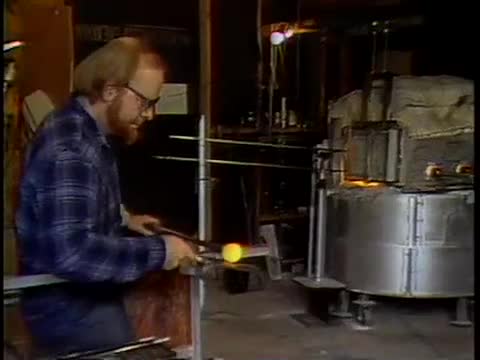
Their works are contained in hundreds of public and private collections nationwide. Closer to home, the Lawrence Gallery on Highway 18 outside of McMinnville surprises travelers with their regionally flavored works. Among the successful artists now living in Yamhill County are Charles Gliscoder: ceramic artist. Bill and Nan Bullstead: woodworkers. Brewery porcelain artist: Jim Kingwell. well. Glass blower: Leroy Setziol. Woodcarver and ceramicist: Neils Lou. In January of '77, Neils Lou flew to Oregon from the Midwest, for a month long visit to help a friend build a kiln. He found the region so much to his liking that he and his wife moved there for good. (Nils) It happened that it was 20 below zero in St. Paul, Minnesota when we left in January. And when we got here, it was-well-pretty much like today: it was sunshine and about 60 degrees. And it dawned on me that there was a lot less
energy out here trying to keep warm and-and so on. So, we looked at it seriously as a place to move. Neils Lou lives off of 40 acres of woodland outside of Willamina. Elk and other wildlife fill the area. He feels that rural living gives him the time he needs to concentrate deeply on his work. (Nils) It's a lifestyle; which is one that I'm choosing because I came from a teaching career. I taught for about 10 years at Hamline University in St. Paul. And the thing that characterizes my life right now, I think, is the freedom that it gives me. I can deal with-with things that are important to me at my pace, and that's more and more important to me. Glass artist Jim Kingwell shares Lou's land as well as his enthusiasm for the region. He moved to Yamhill County after living in Portland and on the Oregon Coast. (Jim) For me,
I came out here, partly seeking a bit of isolation, just so that I could do my work. My first glass blowing studios were set up closer to the public. And I found quite often my time being spent dealing with people who were interested in the work. But I was spending all of my time dealing with people who had access to the studio. And when my work advanced to the point where I understood it, and could begin a series of experiments and trying to develop some ideas that I had, I found that I couldn't spend my time always talking with the general public or even spending my time with innumerable friends who would- would pop over in an afternoon. But one of the other things I found after living here for a while was the contact with other artists and craftspeople. I anticipated that with Mills. But then there's been contact
with other people in this area and that has been a plus, and one of the reasons for staying. Woodcarver (Le)Roy Setziol sets all lives on a farm in the hills outside of Sheraton. A self-taught artist, he specializes in large architectural designs. His pieces decorate several hospitals around the state as well as the Salishan Resort on the Oregon Coast. (Leroy) I made a decision about my sculpture a long time ago: that whatever happens, the sculptor comes first. So, I don't, except one thing in an emergency situation. I find I spend the best part of my day in the studio. But there are times when you need to plow and till and plant and cut weeds and grass and stuff. A few years back Setziol, planted black walnut seedlings on his land. Walnut is one of his favorite local woods, and it grows quickly. The trees may be ready for
sculpting in as few as 10 years. (Leroy) It's quite a thrill though I think to plant seeds and watch it sprout and grow, and if it's nourished well it does well. If you're doing your job, it'll do it's job. You have to be- know about plumbing, electricity and tractors and cars and plants, trees and oh- [laughs] yeah. But it's wonderful because we wouldn't, except for infirmity, we'd never move. Never. Ceramicist Charles "Glesscoder?" produces unusual glazes which uses the region's red, iron rich soil as an ingredient. "Glesscoder?" built his home and studio in an 80-year-old cherry orchard outside of Sheridan. (Charles) I think a person's work is really a reflection of
the way he lives. I think it's hard to do good work if you're not living comfortably and relaxed. So, living out here gives me that environment that I feel like I'm working best. During the course of the day, I work alone all day long. I find that what I do, I'll usually take a break during my work, say at midday, and I'll get out and just kind of walk through the orchard and maybe walk down to my mailbox, which is probably a quarter mile away. And it's really something nice to focus on and to sometimes get my mind off of my business and my work. [Guitar music] Woodworkers Bill and Nan Bolstad followed Neils Lou west from Minnesota, seeking a less harsh climate. Because the Bolstads sell their work in 38 states, often they're too busy traveling to be much concerned about isolation. On the other hand, porcelain artist "Rory?" spends a lot of time alone, on her 10 acres. ("Rory?") I think my case is, since I live alone,
I feel more lonely, especially after work. You know it's a long way to go to Portland, 55 miles. Every single call I make is normally long-distance calls. But one thing I always tell myself is I can get on top of everything. At times "Rory?"and the other artists struggle with loneliness. Nevertheless, they value the opportunity, to work in peace, as they strive to increase the quality and value of their artistry. I think one of the things an artist has is time, you know that's really his currency. Time is what artist's values and uses as much as possible. [REPORTER]: The region between Portland and the Oregon Coast gives artists that time to focus on their work, and time to recharge in a rich, natural environment. ("Rory?") Honestly, especially I really enjoy looking at the hills and the clouds you know like, lots of what I do- if you can see them, you can really tell
kind of a reflection where I am. And that kind of elements are very important to me. So, if I live in the city, maybe I'm doing something totally different. And I really like to make something related to nature. I think nature has everything. [Guitar music] All 3 Lawrance gallery locations in Portland and Sheraton, Salishan regularly
feature works by Yamhill County artists. The Lawrence Gallery in Salishan on the Oregon Coast will show work by another regional artist, metal sculptor John Richen, June 8th through the 30th. And Jim, I can certainly see why these artists feel inspired to create, that countryside is absolutely beautiful. (Jim) It is. It's gorgeous and in another part of the state that is also beautiful in another way, is Southeastern Oregon. Right. Which is where this next story comes from. Before the 1920s, it was uncommon for children of ranchers or farmers to go on to high school. The schools were just too far away from home. So back then, a handful of public boarding schools sprang up. Most of them died out about 20 years later when schools started consolidating and road transportation got better. But there's at least one of these coed public boarding schools left. Marilyn Deutsch takes us to Eastern Oregon. It's a 40-mile drive from David Mayers Don Valley Ranch to his high school in Crane, Oregon.
Crane is home to what may be the only public boarding school in the U.S. Three-quarters of Crane Union High School students sleep, eat, and study here 'round the clock at least five days a week. It's been this way since 1922, a matter of necessity, then and now. To understand why, just take a look at Eastern Oregon. Everything's spread out. Crane Union High School students live as far as 150 miles from their local school. Daily transportation would be impossible to run. It's cheaper to keep the kids overnight. So what you have here are, 60 teenagers from all across Harney County, now under one roof. Most had never before been off the ranch. Do you ever miss home? Yeah. Once in a while. I get home about once or twice a month. It's a longs way away. I kinda like it. You don't have to have Mom and Dad yelling at you all the time. [laughs] Right next to the school, around campus, there are cars that you can checkout
and go whereever but here, you're pretty well confined. Kind of like a little prison really. [chuckle, background noise] If there's a warden it's Louis Ash. The dorm patron, a former drill sergeant in the Marines and a graduate of Crane, class a '49. Ash's command extends over the boys' floor. Bertha Robinson's queen bee in the girls' quarters, inspections a daily routine. [REPORTER]: Fifteen steps are what separate the boys from the girls. The boys live down here on the first floor, the girls upstairs. And if a boy so much as puts one foot on the very first step, well that's one wrong step. The first time he gets a warning, the second time, a little extra KP duty, and the third time he's grounded. Girls have to watch where they walk to. And they all have to watch where they put their lips. If you're caught kissing OK, they get potatoes. Peel potatoes. And I've got a list, a good long list here.
And they don't peel potatoes with their own boyfriend or girlfriend; it's with somebody else's. But they go sit in a corner and peel potatoes. So, you keep track of who's kissing whom? [laughs] I sure do. If kissing is forbidden, well what about other friendly gestures? If they got an arm around each other that's fine. If they got an arm around, and her head's all pulled around and everything, then that's a little different. They can sit there with their arm around each other. One arm. Not two. It's hard not to have two hands around somebody. What happened to you after you got caught? I had to peel potatoes. Chewing tobacco is okay. Spitting isn't. The biggest drug problem here- alcohol. Not marijuana or anything harder. Sure, there's going to be drugs everywhere. But it's just here it's more put down. They say at Crane there are kid problems, not adult problems. That's the way it's been for three generations. Todd Carson's parents were here in the 1960s.
I really think that's where you know, I really would prefer to send my children. Yeah, I would because I think you got a little better control of them in there than you would anywhere else. Unless you just really stood on them. [door knobs turning, typewriter clacking] [door knobs turning] There are a lot of grown-ups standing over kids. The student teacher ratio's eight to one, individual attention sometimes helps. Sometimes it doesn't. But of course, what makes Crane unique is what goes on after classes. Then Crane's more like a summer camp than a high school. These may be traditional ranch kids, but in this generation only about half will return to the ranch. Well, after high school, I'll live in Burns for like a year
then go to junior college, and then go to the art school, and then I hope to live in Miami. I really don't want to ranch. It's probably the only thing I know how to deal. But I really don't know. [FEMALE STUDENT]: Yeah, I'm gonna become a doctor. I-I don't really plan on to come back and ranching. But you know, from going to college and gettin' some career- mechanics or somethin' like that. Yeah, where did she move to? About 40 percent of Crane's graduates go on to college. But for now, their concerns are more immediate. The senior prom's this weekend. That's right. You're gonna wear a white one. From morning until night. Crane students stick together. Parting company is not easy. In just a little more than a week, Crane Union High School will graduate its 63rd class,
and there are no plans to change Crane, except of course to improve the education there. (Gwyneth) Next time on Front Street Weekly, we're going to conclude our three-part series on tourism in Oregon with a look at how visitors are attracted to an area, and why image is the best welcome mat that a city can buy. (Wendy) When a little girl is born, she needs good parents. And from 18 to 25 she needs good looks. From 25 to 45 she needs a good personality. From 55 on, she needs cash. (Jim) You'll meet Portland actress, Wendy Westerwelle. And we'll take you up the Columbia River, where trouble lies between cultures. [JIM SWENSON]: Well, that's our program for this evening. Thank you for joining us. We're going to leave you now with some of those beautiful impressions of Yamhill County. We'll see you next week. Good night. [JIM SWENSON]: Good night.
- Series
- Front Street Weekly
- Episode Number
- 426
- Producing Organization
- Oregon Public Broadcasting
- Contributing Organization
- Oregon Public Broadcasting (Portland, Oregon)
- AAPB ID
- cpb-aacip/153-57np5q80
If you have more information about this item than what is given here, or if you have concerns about this record, we want to know! Contact us, indicating the AAPB ID (cpb-aacip/153-57np5q80).
- Description
- Episode Description
- This episode features the following segments. The first segment, "Fair Game," interviews members of the State Legislature as it reconsiders whether to fund an exhibit at Expo '86 in British Columbia. The second, "Room and Board," is a feature piece on the Crane Union High School, a co-ed public boarding school in eastern Oregon. The final segment, "Rural Artists," is a look at artists living in Yamhill County.
- Series Description
- Front Street Weekly is a news magazine featuring segments on current events and topics of interest to the local community.
- Broadcast Date
- 1985-05-14
- Created Date
- 1985-05-10
- Copyright Date
- 1985-00-00
- Asset type
- Episode
- Genres
- Magazine
- News Report
- News
- Rights
- An Oregon Public Broadcasting Presentation c. 1985, all rights reserved.
- Media type
- Moving Image
- Duration
- 00:30:25
- Credits
-
-
Anchor:
Swenson, Jim
Anchor: Booth, Gwyneth Gamble
Associate Producer: Condeni, Vivian
Director: Graham, Lyle
Executive Producer: Graham, Lyle
Producing Organization: Oregon Public Broadcasting
- AAPB Contributor Holdings
-
Oregon Public Broadcasting (OPB)
Identifier: 113082.0 (Unique ID)
Format: U-matic
Generation: Original
Duration: 00:29:49:00
If you have a copy of this asset and would like us to add it to our catalog, please contact us.
- Citations
- Chicago: “Front Street Weekly; 426,” 1985-05-14, Oregon Public Broadcasting, American Archive of Public Broadcasting (GBH and the Library of Congress), Boston, MA and Washington, DC, accessed June 7, 2026, http://americanarchive.org/catalog/cpb-aacip-153-57np5q80.
- MLA: “Front Street Weekly; 426.” 1985-05-14. Oregon Public Broadcasting, American Archive of Public Broadcasting (GBH and the Library of Congress), Boston, MA and Washington, DC. Web. June 7, 2026. <http://americanarchive.org/catalog/cpb-aacip-153-57np5q80>.
- APA: Front Street Weekly; 426. Boston, MA: Oregon Public Broadcasting, American Archive of Public Broadcasting (GBH and the Library of Congress), Boston, MA and Washington, DC. Retrieved from http://americanarchive.org/catalog/cpb-aacip-153-57np5q80