Folk Guitar; 15, 16
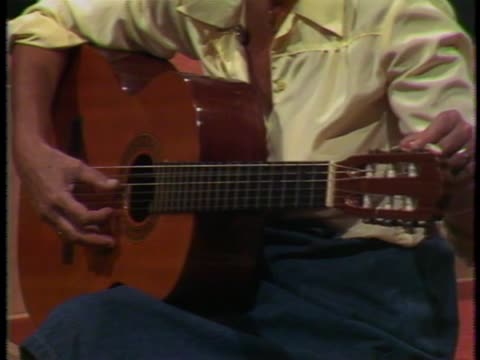
- Transcript
Hi, this is Folk Guitar. If you want to learn how to hammer and pull, get out your axe and get ready to go. There's a new world coming and it's just around the bend, there's a new world coming. This one's coming to an end, there's a new voice calling. You can hear it if you try and it's growing stronger with each day that passes by, there's a brand new feeling, rise and clear and sweet and free. There's a new date on it that belongs to you and me, yes, a new world coming. Hello, this is the second lesson of the Intermediate Series of Folk Guitar and we're learning
some nice hard things. You've got the first session under your belt, I'm sure. So today we're going to learn some interesting techniques for the guitar, hammering and pulling with some good songs too, but first let's tune. There's your low E and an A. The point of tuning, by the way, with me is so that we can all play together. The real thing is that if your strings are in tune with themselves, you can play solo
and do fine, but I tune with you so that you can play along with me because that's fine. That was a G, here's the B. And a high E, okay, good, all right. Before we sing, we're going to sing farther along in a minute so you might get yourselves organized for that. I'd like to just quickly go over what we talked about in terms of transposing. Something you remember was taking a song out of one key and putting it into another key. For many different reasons. You might want to play along with another instrument. You might want to sing in a key that's better for your voice. You might like the way the guitar chords lie on the instrument itself, just if you're playing an E chord, for instance, you have the use of all the strings and you might like
that particular sound. We did it with farther line, I'd like to do it now, again with you with an easier song, for instance, like down in the valley, old song that I know you don't have to play by now. Those two chords were D and A, and we had a 1-2-3 strum, as you remember a long time ago. And it went down in the valley, valley, so I'm going to change to A, hang your head over here, the wind, glow, all right, that's all of that, that's as much as we'll do. All right, now suppose that we're not good for my voice. It is marvelous, my voice, but it's a pose, but you weren't. I want to pick another key. I want to do it in, now again, as I said last time, it's arbitrary. I can do it in C, I can start any place I want. All I have to do is move everything the same amount. Let's move that to the key, it's now a key of D because it begins on D and ends on D.
Let's move that to the key of G, if you practice on your G chord, all right, how many letters is it between D and G, we're starting with D and we're moving to G, D, E, G, all right, so we're going to start on G, all the D's will become G's, and then how many, where's the four above A, A, B, C, D, so the two chords we're going to use now are G and D, let's try it, starting on G. Down in the valley, let's see what I mean, valley solo, hang your head over, I sound like an operatic soprano here in the wind below, that's all that we're going to do, I think that you're probably catching on, we're going to leave it at that, if you're not, let me
know and I'll help out, okay, but I'd like to do now with you just because it's a very nice song, you're singing farther along as it is in the book in the key of A, and we're just singing for fun, okay, begins on A, let's give ourselves a little introduction with nice alternating baseless, tempted and tried, we're often made to wonder why it should be us all the day long, while there are others living about us, never molested, blowing with the wrong, remember to keep doing your bass lines farther along, we'll know about it, farther along, we'll understand why, cheer up my brothers, live in the sunshine,
we'll understand it all by and by, okay, that's a nice song, all right, now on to the new stuff, the new stuff, I'm going to let you rest a second and I'm going to play something nice, no one, no one, let me come in, door is all fast and the window's pinned, keep your hands on that floor, hold on, hold on, keep your hands on that floor, hold on, what was I doing, what was I doing, sounded interesting, what I was doing was called hammering
and I'm going to show you how to do it, the sound of hammering is, okay, and you are literally hammering a finger on a string, okay, so first of all, get yourselves on an A minor chord, all right, got it, good, now strum from your A string, we'll do this with the brush strum, strum from your A string, brush down, and then pick up your second finger, play the D string open, then hammer, that second finger down, all right, watch again, we'll do it again, get on the A minor chord, strum from your A string first, one, two, all right, now strum from your D string and pick up your second finger, and then hammer that down, did you see that hammer, just slam that finger down, that's it, all right, now what you have to do is really mash it down, you cannot just do this, listen to this, I'm going to
look the same but it will sound funny, I hope, it's supposed to sound funny, see all you've done there is just stop the string, that's not good, you have to really slam that second finger down, really bang it down, okay, one, two, hammer, two, one, two, do it with me, okay, on the A minor chord, are you getting it, that's right, the second sound is made with this left hand, you see, the first sound of the hammer is made with the right, the second sound is made by mash it down, all right, let's try the song together with the words, we'll sing it all the way through, both verses, if you can't hammer this minute don't worry about, just alternate your bass note and do the best you can, when we get to the D minor chord, keep your hand on that plow, just strum straight down, which is
again for contrast, keep your hand on the plow, hold on, okay, now maybe you look at the words, okay, no one, no one, let me come in, doors all fast and then the windows open, keep your hands on that plow, hold on, hold on, hammer the same finger, hold on, keep your hands on that plow, just straight down, hold on, let's take the next verse, let's stand this A minor chord forever, every word, feelings are changing, every link
was Jesus' name, keep your hands on that plow, hold on, hold on, hold on, hold on, keep your hands on that plow, hold on, okay, all right, you can hammer on any chord at all that you want and how do you decide where to hammer, most often as it turns out, you can hammer on with the middle finger, okay, we did it in this song with A minor, we did it with E7, we did it with, oh no, we didn't, we didn't did it, but I'll show you, we
do it with a C chord, for instance, here's a C chord, see, and a G chord, that wasn't clear, wasn't it, okay, and one of the chords A, A major, you do it with the first finger, and then when you want to get very fancy, for instance, what I do sometimes in the midnight special, I really get carried away, I go, let the midnight special, see what I'm doing, I'm doing all three hammer, that gives it a nice train sound, shine a light on me, let the midnight special shine, it's ever a light on me, I love that song, okay, all right, another one that I do, sometimes more, let's see, more than one at a time, again, it's
a very, as I've told you, 8,000 times, the guitar is a very personal instrument and you have to kind of experiment with what I give you, learn it first, and then experiment with it, and try other things, and whatever you do will be terrific, I'm sure, like in the song, get you, I've got some hopper, get up, get you a topper, it's a chord, other chord, it's more important, and never bore you tall, you just leave me by the juniper, while the moon shines bright, watch that new job, that feeling, by the pale blue light, that's a neat song, and we have more time, I'll sing that whole song for you, because
it's really fun, that was collected, I think, I don't think it was written, but it was collected by a man named Frank Beto, who lives in Texas, or did the last time I heard, okay, now that you've got hammering under your belt, I will teach you something else, I'm going to teach you another technique, which is exactly the opposite of hammering, and it's called pulling, okay, when you want hammer a string, you take a string, say the high E string, and if you want a hammer, you'll go, you just play the opening, and just smash your finger down, or whatever, okay, pulling is exactly the opposite, and in this little break I'm going to show you, and then I'll sing a song, you have to join me, you have the finger on the string, and then you just pull it off, pull it off, with that left hand, again, this is left hand technique, you have fun, okay, opening E, second fret, then pull, all right, let's do that with me, just that much, open E, second fret on the E string, then pull off with your left hand, all right, I'm going to do the whole break for you,
and then I'm going to sing the song, it's high E, second fret, then pull off, then the third fret on the E, excuse me, third B string, second fret on the B string, open B, do an A chord, let's do that again, because that's a neat break, and it can be used in several different ways, it's open high E, second fret on that string, and pull off with your left hand, third fret on the B string, with the third finger, second fret, with the second finger, open B, leading to an A chord, all right, interestingly enough, in this particular song, the basic meter of the song is 1-2, it goes 1-2, 1-2, 1-2, 1-2, okay, and so the break in that rhythm is, oops, badly played, I do that on purpose so that you won't feel good, okay, that happens in the chorus, it was seven, seven, seven, seven, seven,
seven, seven, seven, seven, seven, seven, seven, seven, seven, seven, seven, do the bottom of the, and it goes on, you'll hear the whole thing in a second, however, interestingly enough, you can use that same break in a 1-2-3 rhythm by varying the accent, and then it would sound, that's 1-2-3, remember I told you a long time ago that there were just two basic rhythms, 1-2, 1-2-3, so in this one we will do to the bottom of the, okay, all right, now you've probably figured out that the song we're going to do is about the Titanic, and the Titanic, the largest luxury line of our time struck an iceberg and sank on her maiden voyage in April 1912, I believe it was, remember the movie? The sinking was an almost classic tragedy as a matter of fact, the Titanic's builders were so certain that
the ship was unsinkable, that there were too few lifeboats on, lifeboats on the ship itself, and there were no escape drills, they didn't do any of that stuff, so people really didn't know what to do, and the passengers were just running around wildly. Some of them were among the wealthiest people in the world at that time, including John Jacob Astor, the famous New York Astors, and Benjamin Guggenheim. The worth of the ship, the amount that it was worth, was supposedly estimated at $250 million. The verses of the song, a fairly accurate as a matter of fact, and this is one of those songs that tells the story of what happened, and in later shows we'll talk about folk music in terms of reporting an actual event and reporting it quite accurately, in fact. In addition to the wealthy people, there were also people in second class and third class, and the poorest ones, of course, were the ones that sank first,
and they never stood a chance, because they were all way down underneath the lowest part of the ship, and many, many children died, which was really very sad. Two-thirds of the third class children, in fact, died, and the wireless procedures, when they tried to wire to get help, they were very unclear, and then they hadn't rehearsed the properly. Anyway, it was very badly done, and as far as the historians know today, the band did indeed play well into the emergency, because that's in all the accounts of the Titanic, that the band kept playing. So I'm going to sing you the song all the way through. We're going to start on an A chord. I'm going to start on an A chord. You're going to watch. Oh, they built the ship Titanic to sail the ocean blue, and they thought they had a ship, that the water would never leak through, but the lords all might end. New the ship would never stand, it was sad when that great ship went down.
Oh, it was sad. Oh, it was sad. It was sad when the great ship went down to the bottom of the husbands and wives, little children lost their lives. It was sad when that great ship went down. Oh, they sailed from England, and were almost to the shore, when the rich refused to associate with the poor, so they put them down below, where they were the first to go. It was sad when that great ship went down. Oh, it was sad. Oh, it was sad. It was sad when the great ship went down to the bottom of the husbands and wives, little children lost their lives. It was sad when that great ship went down.
Oh, the boat was full of singing, and the sides about to burst, when the captain shouted, oh, women and children first. Oh, the winds were all on fire, when the captain made the wire. It was sad when the great ship went down. Oh, it was sad. Oh, it was sad. It was sad when the great ship went down to the bottom of the husbands and wives, little children lost their lives. It was sad when the great ship went down. Oh, they swung the life boats out, or the deep and raging sea, when the band struck up with an ear of my god to the little children, wept and cried as the waves swept or the side. It was sad when that great ship went down. Oh, it was sad. Oh, it was sad.
It was sad when the great ship went down to the bottom of the husbands and wives, little children lost their lives. It was sad when the great ship went down. I don't know why I'm smiling. It was very sad when the great ship went down. Okay, I'd like us all to do it together with words. When I teach this sometimes in a classroom, people are always making a funny word. Some kid once said, uncles and aunts, little children lost their parents. It was sad. Very funny. But actually, as I said before, this is a true story and was sung probably very reverently at first and very dramatically when it was first written. Okay, let's start. Let's do it more slowly. Remember the break? That's to the bottom of the, and then you go right into the egg bottle.
One other thing I didn't tell you, it was sad. It was sad when the great ship went down. You strum straight down on the down. That'll remind you down. Then you get ready for the break to the bottom of the, okay, how about us just going right into it with the words nice and slow. Oh, they built the ship Titanic to sail the ocean blue and they thought they had a ship. That thought water would never leak through, but the Lord's almighty hand knew the ship would never stand. It was sad when that great ship went down. Oh, it was sad. Oh, it was sad. It was sad when the great ship went down to the bottom of the husband's not bad wise little children lost their lives. It was sad when the great ship went down. Okay, you have three reverses to get it. Keep it slow.
Oh, they sailed from England and were almost to the shore when the rich refused to associate with the moon. So they could then download where they were the first to go. It was sad when that great ship went down. Oh, it was sad. Oh, it was sad. It was sad when that great ship went down to the bottom of the husband's not wise little children lost their lives. It was sad when that great ship went down. Okay, now take it slow. Take it easy. And this time see if you can put in some of the bass lines that you know so well. The boat was full of sin and the sight about to burst when the captain shouted, women and children burst. Oh, that something tried to wire, but the lines were all on fire.
It was sad when that great ship went down. Oh, it was sad. Oh, it was sad. It was sad when the great ship went down to the bottom of the husband's and wife's little children lost their lives. It was sad when that great ship went down. How was that better? Oh, they swung the lifeboats out or the dark and raging sea when the bang struck up with an ear of my god to me. Little children wept in pride as the waves swept or the sight. It was sad when that great ship went down.
It was sad when the great ship went down to the bottom of the husband's and wife's little children lost their lives. It was sad when that great ship went down. Okay, I keep mixing that up. I keep thinking it's oh, the firemen tried to wires a captain tried to wire, but the lines were all on fire. I never remember that word. All right, you've learned quite a bit today. You've learned two new techniques, hammering, pulling. You can apply them to other zones. In fact, I wish you would. I hope you will. I also hope that you will practice intelligently. I know I keep saying that, but it's very important. Take little parts of songs, go over them, take little parts of techniques and go over them, and experiment. Do all kinds of stuff on your own that you can do.
All right, maybe we can do a little hush little baby with a new strum as a review. We can walk out on that one. Remember that was that long when it goes on and on and on. Okay, but the strum was nice. It's thumb together, thumb one, two, three, thumb together. We can just go out on that and I'll see you next time. Practice like man, will you? Hush little baby, don't say a word. Mama's gonna buy you a mockingbird. If that mockingbird won't sing, Mama's gonna buy you a diamond ring. If that diamond ring turns fresh, Mama's gonna buy you a looking glass, or two face notes. If that looking glass gets broken, Mama's gonna buy you a billy goat. If that billy goat won't sing, Mama's gonna buy you a gold ring.
From colorado, Kansas and the Carolinas to Virginia and Alaska from the old and to the new Texas and Ohio and the California shore. Well, he who could ask for more. For this angel and for the power and for me, you need that words cannot recall. Overpower shall let's run. Hello there. This is your big day. Today you're going to learn to read music on the guitar and hear a special classical guitarist guest. There's a new world coming and it's just around the bend. There's a new world coming. This one's coming to an end. There's a new voice calling.
You can hear it if you try and it's growing stronger with each day that passes by. There's a brand new feeling, rise and clear and sweet and free. There's a new day gone and that belongs to you and me. Yes, a new world's coming. The one we have visions of coming in peace, coming in joy, coming in love. Hi. All things come to the point where the big moment arrives and today is that big moment. We're really going to learn to read music on the guitar.
No, don't touch the set. Hang in there. It's going to be very easy. It's going to be a lot of fun. And then we have a special guest who's going to show you what great things you can do when you know how to read music. Alright, let's tune first. There's your low E. That's the peg. Alright, then A. You might even learn another way to tune the guitar. I don't mean other notes. I mean a different method. All sorts of goodies are going to happen. That's your D because you G. Your B. And finally, your high E.
Okay, that's good. I'd like to go over briefly what we learned last time. I'll be sure you know what I'm sure you do. We learned how to hammer and we learned how to pull on the guitar. Remember hammering on an A minor chord was the way we learned it. You strum the A minor chord with a 1-2 plucking strum. And then you lifted your second finger at the same time as you strummed your D string. And you hammered down and then you finished the strum. And it sounded like this all together. Hammer 2, 1, 2, 1, 2, 1, 2, 1, 2. That's how we do it. We hit it hard or else it's going to sound B. So you don't want to sound B. Alright, let's try the song.
Which is hold on. And I'm sure you know it will all beautifully by this turn. Let's just do the first one. Let's go to it. Here we go. Good. Hold is it E7 on. Hold on. Keep your hands on that D minor chord, low, hold on. Oh, OK, that's all of that with that. Sometimes we'll have a whole lesson of just every single song in the book. Just one right after another, that would be a good idea.
I mean, we'll do them at the end of the series. OK, that was hammering. Why do you hammer, do you suppose? Did we discuss this last time I can't remember? Because of variety, you're on that A minor chord forever. D-D-D-D-D-D-D-D-D-D-D-D-D-D-D-D-D-D-D-D- You could alternate your bass start for interest, but the hammering gives it yet another kind of interest. Or the other technique we learned last time was called pulling, opposite of hammering. And the little break that we learned with the pulling was that we started with the high E string. Then you put your finger in the second fret on that string. Then you pulled it off. This hand is not doing anything. Just pulling off with the left hand. I'll do that again. Open high E, second fret, then just pull it off. That's it. Then the third fret on the B, second fret on the B, open B. And that led you to an A chord. I'm not going to do that again. You should have learned it.
Let's just do it in the song. And that was the high time. We have so much else wonderful stuff to do again. I want to take too much time with you. Oh, they built the ship Titanic to sail the ocean blue. And they thought they had a ship that the water would never leap through. But the lords on my hand knew the ship would never stand. It was said when that great ship went down. Oh, it was said. Oh, it was said. It was said when the great ship went down. Here we go, to the bottom of the husbands and wives, little children lost their life. It was said when that great ship went down. If you're very good, I'll show you
how to do that some other time. All right, I think you've probably got that pretty well under your fingers. If you don't, keep practicing it. There's nothing I can do about it. I showed you how to do it. My job is done. The rest is up to you. All right, now let me tell you about the musical alphabet. The musical alphabet. And don't touch that dial. Has seven letters. They are A, B, C, D, E, F, G. Can you say that? Let's say it. A, B, C, D, E, F, G. OK, but music, as I'm sure you know, if you think about it for a second, goes in two directions. It goes up, la, la, la, la, and it goes down. And sometimes it even stays the same, the little, little, little. And any of the tunes that you know, do all of those things, some of them, or all of them. OK, so you also have to be able to say the musical alphabet backwards, which is G, F, E, D, C, B, A. Let's do that together. G, F, E, D, C, B, A.
And that's the kind of thing that you have to really deal with, A, B, C, D, E, F, G, G, F, E, D, C, B, A. It has to become absolutely automatic. This is the beginning of learning about the musical language. Another thing you might practice as you're writing in the bus or in your car, or taking a shower, is skipping letters, starting with any of them. Let's start with A, though. A, C, E, G, B, D, F, A. That's skipping forward and skipping backward. A, F, D, B, G, E, C, back to A. I made it that time. OK, that's just dealing with the symbols of music. And they're not difficult. It's like dealing with anything. You just have to learn how to do it. It's like learning how to speak any language, learning how to walk, learning anything. It's just a matter of doing it enough times. OK, that's that. Now, the closest interval, and an interval is a distance between one place and another place,
or one tone and another tone, which is what we're talking about in music. Closest interval we have in Western music, Western, not cowboy western, but as opposed to Oriental, or Eastern music, is called a half step. In Oriental music, they have things that are called quarter steps, or quarter tones, and they kind of bend tones. You've probably heard those when you've heard people playing. What is that Indian instrument called? Sitar. Thank you. Sitar. You've heard that sound, or some Chinese or Japanese music that has quarter tones. You're not quite sure it sounds sort of odd. In our system, we deal with whole steps and half steps, generally speaking. Well, what's so wonderful about the guitar is that the guitar is laid out in half steps. Isn't that neat? Terrific. Each fret is a half step. Not nice. That just goes up and half steps. And when I say goes up, I mean, I'm making the tone higher.
As I move up the fingerboard, that's going up, and that's going higher, OK? All right. What I'm literally doing is shortening the string. At the moment, the string is vibrating from the bridge to the nut. Yes, OK. As I put my finger in a fret, it gets shorter and shorter and shorter. OK, so far. Now, there are two natural half steps in our system. They occur between the letters E and F and the letters B and C. So from E to F is a half step. From B to C is a half step. If you want to make a half step above any other letter, raise any other letter half step, you have to call it a sharp. And that's what a sharp is, isn't that nice? OK. So for instance, let's take the A string. Play your A string with me, OK?
All right. If you put your finger in the first fret of the A string, you have the note called A sharp. You've raised the A one half step. If you put your finger in the second fret of the A string, you have the note B, because that's a half step above A sharp. If you put your finger in the third fret of the A string, you have the note, all right? Not B sharp, but C, because remember, I told you that between B and C is a half step, right? Right, OK. Then you have C sharp, the next fret. And then you have D. And that's why you tune the guitar in the fifth fret, because that note is the same as the note on the next string. Ah, the light is flashing. You can keep going up that same string. D sharp, B, F, because between E and F is a half, F sharp, G, G sharp, A. And I will just throw
a little bit of information your way and tell you that at the twelfth fret, which in a classical guitar and in a folk guitar usually, is at the end of the fingerboard, right, where my finger is, is the octave. That's called an octave. Listen, his open A, and here's the octave above. It's an A, a higher A. All right. Close your eyes and think about that for a second. OK, don't worry. As you know, I will ultimately explain everything 600 more times than you're going to get it. I know you will. All right. What I want to show you now, and have you pick up a guitar and play with me, is a particular arrangement of whole steps and half steps that's called a scale. And a scale in our system of music goes da da da da da da da da da da da da da da da da da da da da da da da da da da da or do re mi fazala. Te do, that's a scale. Do te la so fa me re do you not have to learn that? But I want you to learn how to play a scale on the guitar. It's going to be called a G scale.
And the reason it's called a G scale is that you're going to begin on the note G. Isn't that nice? OK. Play your G string. Are you playing a G string? That's your open G, you know what that is. All right. Now put your finger in the second fret on that string and play that note. That note is A. All right. Now play your open B string. Put your finger in the first fret on the B string and play the note C. It's in the first fret because it's a half step. Third fret on that string is called D. Open E is your next note in this group. Second fret on the E string is called F sharp. Don't worry about why. I'll tell you some other time. Just play it. And put your finger in the third fret and play your high G. All right.
Now what I'd like to do is have you look at what that looks like when that's written down in music. All right, so maybe we can take a look at that now. You know that music is written on a particular arrangement of lines and spaces. There are five lines and there are four spaces. And you can write notes on any of those lines and spaces or spaces and spaces. All right. In guitar music, at the beginning of this group of lines and spaces, there is a symbol. And it looks like this. And it's called a G clef. Clef is a French word for key. And I suppose that indicates what key something is. Not really. It's just what a clef really does is identify one particular line. And then once you know the name of one of the lines, you know the names of all of them. If you've done what I told you, learn your musical alphabet. Because this clef is called a G clef.
And the reason it's called G is that it curls around the second line, count from the bottom, count from the bottom. So the name of the second line is G. And that's your open G string. So you know that already, right? OK. So you can play. If you put a note on that G line and you play your G string, you see that note on that second line? And you play that G string. Isn't that simple? It really is that simple. All right. Proceeding, if you put a note in the next space, after that line, second space, right after the line, you have the next note, you have the next note of your scale, and you have the next note in the alphabetical series, which is A. And that's when you put your finger in the second fret on your G string. And it's also in the second space on the staff. And that's called A. Let's play that. Good.
OK. If you put a note on the third line, you have your next note in the series, and that's called B. That's your B line. You play that. Good. So you see, you're looking and seeing what you're playing, and you're playing it too. See, reading music already. If you put a note in the next space, these go right in order, line, space, line, space. The third space, you have the next note in the series, and that's right after B. That's called C. Now it was in the first fret of the B string. All right. Then you put a note on the next line, and that's called D. Then you put a note in the next space. That's called E. And on the next line, it's called F sharp. It's some kind of F. That is an F line. It may be a sharp or it may not be a sharp. In this case, it has a sharp added, but it's always written on that top line of that staff with the G cleft in front of it.
And then in the next space, that's right above the top line, is a high G. There you go, and that was a G scale. You just played a G scale. All right. We can do that again. Let's do it again. Looking at the notes, and occasionally at my finger, so that you're sure you're doing the right thing, we'll start on your open G. That's the second line on the staff and your open G string. Good. Put your finger in the second fret on that string, and that note is in the second space, A. Open B, which is the third line. First fret on the B string, which is the third space on the staff, is C. The next note in this series is D, and it's on the fourth line. Then you have the note E, which is in the top space on the staff, and your open E string. Second fret on that E string is called F-sharp,
and the third fret on that string is called G, and that's in the space right above the staff. The point really is that you have to play your G scale forward, and backward. Looking at the notes as you play, and trying to get a feel for where they are on the strings, and that will be helpful. If you do that lots of times, but looking, don't just do it by ear. Then we get to our first piece, which will be very nice, and it's an old favorite of everybody's, I'm sure, called Twinkle, Twinkle, Little Star. The reason I did this is that it's a familiar piece. It's something that you'll know if you make a mistake, and I hope you'll do it with reading music, not just by ear. So let's look, first note are Gs, both of them. See that? Second line? All right, let's play that G. That's your open G string, ready? Twice, go.
G, G, all right. Your next two notes are Ds, and after a while you'll be able to figure that out very quickly yourself, and that there are two of them. So let's play those twice. D, D, and then the next note is right next to it, it's in this top space, and it's your open E. Play that twice. E, E, and then get back to your D, which is on the fourth line, and it's also in the third fret of the B string, and it's only played once. D, so far so good. Let's finish it. The next note is C, which is in the third space, and that's also played twice. C, C, and the next note is on the third line, and that's B, B, B, and the next two notes are on the second space, which is A, A, A, and then the last note is back home again to your second line, which is G. All right, that's pretty good.
I rest you through that somewhat, but I think you can do that very well. And I'm rushing you through for several reasons. One is that I think you have to do this on your own, and second, I'm dying to have you meet our guest. This is James Collins. Hi, Jim, glad you could be here today, really. What we're going to talk about mostly is the differences between classical guitar and folk guitar. The basic differences, they look the same pretty much. I mean, the instruments themselves. They're nylon string, they're sin, they vibrate and so forth. What are the basic differences, as you see them? Well, in the guitars, as you've said, there isn't really much difference. The real difference is in the technique. Classical guitars are not interested in a strumming sort of technique, but rather plucking one or several notes at a time in order to get more complex musical effects. Oh, very good. What about tuning? I promised them I would show them a different way of tuning, so we have to do that, keep my promises. Generally, how do classical guitars tune their instruments?
Well, generally, they tune just like folk players. Any way they can get it in tune. But there is a very good technique that we have called tuning by harmonics. And as maybe your students know, at several points on the guitar, the octave, the fifth fret, and the seventh fret, by lightly touching the string with your left hand and playing a note with your right hand, you can make an artificial sound. That sound is very accurate musically. And so when it comes to tuning your instrument, by matching various sounds, such as on the fifth fret of the E string and the seventh fret of the A string, we can tune the instruments with a precision that sometimes isn't possible using that kind of technique. Oh, very good. And there's a whole pattern for it, just as there is, which I think should I mention there? You might go through, just quickly do it. OK, there are several ways to do it. The way that I do it is to play the fifth fret on the E string
and the seventh on the A. The fifth on the A string, the seventh on the D. The fifth on the D string, the seventh on the G. And then the seventh fret of the low E string again gives you open B, exact, the octave, or unison. So it's quite easy to recognize. And the seventh fret on the A string gives you open E. That's very good. I've seen that done a lot. And I'm sort of tried it, but it never works well for me. I'm going to practice, and maybe I can do that. Try that on our next lesson. What about fingernails? Right. It's another difference. The big difference. Most classical guitars, with almost no exception, use the fingernails on their right hand to produce the sound. It's a fairly new technique. New as far as classical music goes, say, 1860s or 1870s, because when it was first really made full-time, old players,
loot players, for instance, didn't use that idea. The reason that classical guitarist went to the nail was to get an increased volume so they could compete with other orchestral instruments. Oh, a logical, a logical. We're going to play a duet for you, because we tried it before, and we loved the way it sounded, didn't we? All right. This is very simple music. James brought it with him, because we had been talking on the phone about it. And it's something that you will be able to do very soon, I think. You felt that way after learning. So maybe let's do it. This is just a duet for two guitars in single notes, and you might just listen and watch. I'm going to play a duet for you, and I'm going to play a duet for you, and I'm going to play a duet for you.
Oh, it was lovely. That was really, really very nice. I felt so classical. You could hardly stand it. No, that's very nice. And that isn't difficult, is it? It's not. Hopefully more and more people, through the kind of reading lesson that you've given today, will be able to play this, and be able to sit down and play some music with their friends. That's wonderful. That's what it's all about, isn't it? It really is. Now, there was other techniques in classical guitar that are similar to folk guitar, but used in other ways. One was another one we learned today. We actually learned last time we reviewed today. We're called hammering and pulling. That's what they call them in folk guitar. And what do they call them in classical guitar? Now we call them the slur. It means to just simply slide over from one note to another.
Could you demonstrate some of that? Sure. The techniques are identical to those that Laura has shown you. Classical guitarists use them for exactly the same reason that folk guitarists do, to add color, to bring emphasis to certain passages. One that I can demonstrate is a little passage that played straight. Sounds a little thin, but when you play it accenting it by using the slur, you get an interesting effect. Yeah, that's one idea. That's one idea. That's what accents. Yeah. There was another one that you played before that sounded interesting. Sure, this is one that's very like the A minor chord that Laura did where these slurs have been added for just color. This is an excerpt from a piece by Cuban guitarist Leo Brower. Oh, that's great.
That's nice. I love that music, too. He's a very good composer, isn't it? Yeah, he's a very modern. Oh, yeah, actually, he's 34. Oh, a kid, a kid. Lovely. What other differences or similarities could we talk about? Well, I think it's good to focus on the similarities. At some point, you either have taught or are teaching your students how to do a free stroke. Oh, right. And it's the kind of stroke that's used in playing arpeggios, for instance. Sure. They know better than issues. That stroke enables us to clear the other strings and allow the instrument to ring. A stroke that we both use, in fact, for playing twinkle, twinkle today, with a stroke where your finger lands against the adjacent string. And we call that in guitar a supported stroke, or sometimes a rest stroke. It gives you a little different texture, and it also gives you a little more power. Great, great. Would you play us out? Please? It would be so nice. OK, what are you going to play? Can I play the little Brower? Would you like that, or would you rather have the Taraga?
Whichever. OK, I'd love to play the Brower. Oh, I'm sure. Sure, why don't you? This is a simple a-tude by Leo Brower. Oh, I'll be right there. Good night, everyone. Time to play the piano then get on the couch. Well, he who could ask for more, For this is a land full of power and glory, You believe that words cannot recall.
Overpower shall rest on the strength of her freedom, Her glory shall rest on her soul, Yet she's only as rich as the poorest of the poor, Only as free as the padlocked river, Yet she's only as free as the poorest of the poor, Yet she's only as free as the padlocked river, Yet she's only as free as the padlocked river,
- Series
- Folk Guitar
- Episode Number
- 15, 16
- Contributing Organization
- Oregon Public Broadcasting (Portland, Oregon)
- AAPB ID
- cpb-aacip-153-35gb5rvq
If you have more information about this item than what is given here, or if you have concerns about this record, we want to know! Contact us, indicating the AAPB ID (cpb-aacip-153-35gb5rvq).
- Description
- Episode Description
- 2 "Intermediate Series Folk Guitar" shows by Laura Weber, Programs 15&16-Lessons 2&3.
- Episode Description
- 00:00:01:00-00:29:44:00-Program 15-Intermediate series,Lesson 2-hammering, pulling, breaks, E*; 00:29:51:00-00:59:10:00-Program 16-Intermediate series,Lesson 3-harmonic tuning, slurs, strokes, comparison to classical, guest guitarist.
- Episode Description
- 1978 OEPBS, KOAP-TV.
- Created Date
- 1978
- Asset type
- Episode
- Genres
- Instructional
- Topics
- Education
- Performing Arts
- Music
- Media type
- Moving Image
- Duration
- 00:59:21.759
- Credits
-
- AAPB Contributor Holdings
-
Oregon Public Broadcasting (OPB)
Identifier: cpb-aacip-18f18511a13 (Filename)
Format: U-matic
Generation: Original
Duration: 01:00:00:00
If you have a copy of this asset and would like us to add it to our catalog, please contact us.
- Citations
- Chicago: “Folk Guitar; 15, 16,” 1978, Oregon Public Broadcasting, American Archive of Public Broadcasting (GBH and the Library of Congress), Boston, MA and Washington, DC, accessed April 4, 2026, http://americanarchive.org/catalog/cpb-aacip-153-35gb5rvq.
- MLA: “Folk Guitar; 15, 16.” 1978. Oregon Public Broadcasting, American Archive of Public Broadcasting (GBH and the Library of Congress), Boston, MA and Washington, DC. Web. April 4, 2026. <http://americanarchive.org/catalog/cpb-aacip-153-35gb5rvq>.
- APA: Folk Guitar; 15, 16. Boston, MA: Oregon Public Broadcasting, American Archive of Public Broadcasting (GBH and the Library of Congress), Boston, MA and Washington, DC. Retrieved from http://americanarchive.org/catalog/cpb-aacip-153-35gb5rvq