Oregon Art Beat; #730; Thormahlen Harps
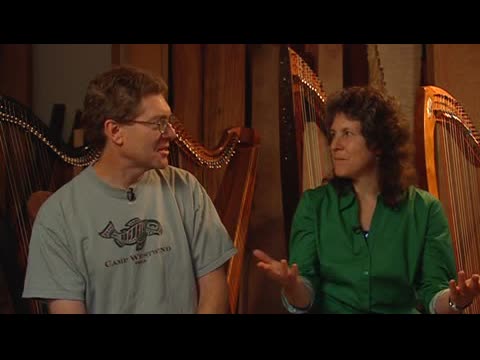
- Transcript
And then hopefully we'll schedule it, so I'll just kind of keep you in the loop. Okay, so we won't get any of this footage until at the may bring their artistry and raise it to a whole other level. So I put our name at the top. Yeah, go ahead and put both your names. We're just going to assume that Mr. Nunn wants to sue us later for putting him on TV in the nation. It would be seen by judges in Minnesota. Does that happen? Yeah, we do submit stories and shows for our families. I didn't win last year. I got beat up by this guy who had a stroke who was an unbelievable artist with typewriter. He put in his unbelievable story, this man. He was terribly handicapped. And yet he put a piece of paper, this typewriter, and he would beat it. And I mean, he was like, you know, you go, how are you able to go, I mean, he really stroked out. And he would do the frickin' Mona Lisa, just beating on
a typewriter and adjusting it. Yeah. And you look at those and you just go, oh, yeah, yeah, so he won the Emmy for Best Art Story. And then when I saw that I was up against him for this other category or for this other award, I just didn't even bother to go to the dinner because I knew he was going to win. And he did. So. Okay, Dave, you want to come and sign it? Yeah. Can I make a copy of this? Sign your life way. Oh, absolutely. Yeah, just above here. Just above here. It's fine. Yeah. All righty. Yeah. New good girl, you're being such a good girl. Yeah. Yeah. So, what kind of heart did you write? She has two. She has two of yours. No, she has a wallet
one like this. Yeah. This one. Yeah. And then the other one is me. Co -op. Oh. Yeah. Yeah. Did one with this inlay. So, um, so I have people have liked that in like so. Yeah. We actually have two more. Two more and then like four more of them. So Sharon is in the process of picking out the best co -op heart with all the human. Ah. Now you don't. You don't tend to do the inlay on the front piece of the signets because they're a little smaller. It's very narrow. Yeah. There are patterns we can do there. The nice thing about doing it on the side is the player gets to see it. Yeah. That's true. So, website and see the different things that we're willing to do. And actually even that we can do custom stuff.
You stay. You stay. Good girl. Oh yeah. The way of the world. Yeah. Well, if you want this to be a good story on you, it's going to cost more and take longer. And take longer. Yeah. Because that's the way it works. By the way, have you joined OPV? Yes, we have. That's right. You are members of OPV. Because this story will never be a big ol' world. I don't know. Ooh, I'm down to my last four sheets. Do you need some copy? Yeah. Can you make some copies for me? Like five would get me through this shoot. I didn't even think about that when I set up. Oh. That gives us a free DVD, right? Oh, I'm sure. Stay, girl. You good girl.
Good girl. And you are on the list, I don't remember, thank you so much. If I sent or somebody else said, but then when I was planning this trip, the other thing was we were going to do this symphony, because it's 100 and that's the other story we're shooting down here. And so he said, so I was going to do that story and he said, oh, if you're going to go down there, then you should do this one as well. So that's why I'm doing the tour here while I'm here in Cordova. It's great and we're going to co -kill one night, Wednesday overnight, and doing a glass artist there. This originally, my trip was going to be all on the coast as it is by the one day on the coast and then we're coming back here. That's just the way it worked out. No biggie. I've got to bend just about every year to do some stories. I'll probably find another trip to the coast, but I don't know, I'm going to go to the city, kind of a little vacation in August 22nd, and that seems odd, but I won a free trip or a free stay at this fabulous hotel, Grand Badger, the
new old hotel, yeah. And I won three days and two nights at this hotel for my sister and I'm going to go and it has to be, couldn't be this weekend because I'm seeing some auction, some art auction in Vancouver. I never know. I'd like the information in the file, I'll look at it Friday night and I'll know what I'm going. And it couldn't be last weekend and then maybe I'll go back to our next spring or summer and see what a great job. Because we try and get around the state. Well, you say that? Yeah. I have not personally, but we have been out there twice with other producers. I think I'm coming up Joseph, and we have one producer who's just sort of a south hotel, just finding people in the middle of nowhere, you know, people in the metro area, before I, I mean, I have a staff that's five stories I could do, they know how to smoke themselves. You go back here. You have to get those people out there. Yeah. There's a guy out in code. Yeah. Jerry Maltese is 50 mixed cars and fiddles, and it's like all
by hand and then a symphony. Not bend. No, just the symphony. Symphony in us. Yeah. No, I'll go to bend in May. Oh. Perfect. Okay. So I'm just thinking there's got to be some interesting story about how the two of you got together a heart, wait, I want to move that because that it's just like a really noisy Oh, yeah, sure. Yeah. Yeah. Should we put the phones somewhere else? Oh, we're just going to hope they don't ring. All right. Yeah. We can. We don't really need to. Maybe it'll be. We have answering machine. Yeah. It's a business call then we'll get you on the phone. Okay. So I'm just I'm just thinking there's there's got to be a story about how you two met heart player, heart maker, how that all come together, which came first, the chicken or the egg, the egg. Yeah, the egg. I was a man, a limb player, so I am and started making instruments, taught a class and a guy wanted to make a harp and kind of opened my eyes to that instrument. Wow. This is kind of neat. So I had been making harps for what we
met as music, you know, because we both play music and played music together. And it wasn't until years and years later that Sharon took up playing the harp. She's been playing for what? Nine years. Nine years. Nine years. So I've been making harps for 23 years. For a long time there it was a little embarrassing. Do you play the harp? Well, no. Let me hear you play it. Well, okay. So it's much better now with a harp player in the family. Well, sure. What did you play? I played guitar. And we actually met by introduction of the same person who came to Dave's class to build the harp. To make that first harp. I also knew that person and when I moved to Corvallis we were introduced to each other through him. And so we started playing together as a duo, Mandolin and guitar. And then I took up the bass and we got another guitar player.
And then we formed a band called The Swing Beans. That was back in the late 80s, early 90s. And we toured through the Oregon Arts Commission all over Oregon for a couple years. Did you want to stop something here? Okay. Just bring... Yeah. That's better. Yeah. Okay. So I think it was the swing music that we were sort of into that kept me from approaching the harp because harp music is so different. It is. Very different. So what finally? Well. We had a child, a little girl, Rosie. She's now 13. And she went when she started kindergarten, was when it sort of opened the space for me to learn to play the harp. We had stopped doing the band. We weren't doing the band anymore. And so I started doing lessons. And I've always been composing. I always composed. And I would write songs for The Swing Beans and all. So when I started playing the harp, I started composing melodies
on the harp. And I'm still doing that and having my books published by Afghan Press. Yeah. I saw them. We'll get some pictures of those. So how hard is it to play the harp? I think it's not that hard. You know, once you get the coordination of your fingers together, it flows. Do you play professionally other places? You do. Tell me about that. Well, I play at the book bin. Once every maybe three or four months, they have a schedule rotating. I play it at a lot of personal parties, private parties. I play for hospice. So I play for patients. And where else do I play? And in between that, you also are the business side of this partnership. Yes. That's right. And you have the all -important job of stringing the harps. Stringing the harps and answering the phone and maintaining the website.
Was this a planned thing or did it just sort of evolve? It just sort of happened. I came to Corvallis to go to graduate school, found that they had a craft center on campus and I was loved woodworking, so I started making instruments for fun. When I got done with my masters, the job was not waiting for me. So I decided, well, I'll just keep doing this and see if it works. And it just kind of happened. You know, I just kept plugging away at it and people kept buying them. So here we are, 23 years later, still at it. His masters was in geology. And would you, if the job came up now, would you give it all up and become a geologist? No way. I got a much better life than those guys. It is a good life. It's great. I work at home. I could set my own hours. I make a product that makes people happy. And then they get to use it to make other people happy. How could you do any better? Exactly. So let me go back here.
This is called a lever or lever? A lever. A lever harp. In Canada, it's a lever harp. Okay. Of course, those Canadians, they always say things backwards. Explain that it's between a lever harp and, you know, like the orchestral harp. Well, the difference is a lever harp, like these, they have sharping levers that you flip by hand on the symphony, the harp that you see in the symphony or at the opera is called a pedal harp. And they have a mechanism where you can do that with your feet. They have seven pedals so that each note, each string can have a flat, a natural, and a sharp. So they actually have two sets of sharping devices. So with this harp, you have one sharping device on each string, so you can tune your string to a natural and then get a half step up. And another difference is that with the pedal harp, when you sharp or flat a note, it sharps or flats all of those, for example, where on the lever harp you can actually set one or two Fs
that you want to have sharp and have the others still be flat. Also, it's one row of strings versus two or no. No, it looks terrible. Pedal harps typically have one row of strings. Some of these, actually, we make with two rows. The big difference in appeal for people with the pedal harp, you're looking at an instrument that's over six feet tall and costs $20 ,000 or more. Plus, yeah. It is a more versatile instrument in terms of having those notes available to you, but the smaller harp is much more intimate and it's more responsive to the player. So we find we have a lot of our clients, our pedal harp players, who want one of these, because to them it's more fun. It also doesn't weigh as much, where a pedal harp weighs 50 to 80 pounds, these weigh 20 to 30, so you can take it places by yourself.
Yeah, and put it easily in the car. Right. And so on. And yeah, if I was reading correctly on your website, almost one completely out, they almost became extinct. They almost went out of fashion. That's right. I don't know if it was a deliberate move, but I think as a late 18th century, they invented the pedal harp, invented this mechanism. And so the harp became that. And the lever harp, actually, I'm not sure they really had very sophisticated levers back then. So the harp that was typical Irish harp was a diatonic instrument and it just played in one key, and it pretty much died out. And a lot of that was because the harp was this favorite instrument of the aristocracy and the common folk just didn't have it anymore. And it was in the 1960s that a couple of guys in California got interested in what they called folk harp back then. And they started making instruments from pictures
they could find. Or one guy had been to South America where the folk harp is a big deal. This is Robbie Robinson. Is that? Robbie Robinson, yeah. And he was actually a diplomat. And he had been sent to South America and he saw that, wow, everybody here is playing these harp, so I'm going to do that. So he got a par -go -am harp, brought it back, started making copies of it, got interested in the Irish harp, found pictures of old ones and tried to recreate things that looked like it. And then it kind of grew from there. At the time that I got interested there were maybe three harp makers in the U .S. and since then, it's grown to where there's, well, 20, you know, but it really is. It's a thing that a lot of people are getting interested in and the quality of the instruments has just gotten way, way better in the last 20 years. Are they very
much like the ancient harps, or do we even know? There are relics of the ancient harps. There's one in the library at the Trinity College in Dublin that is supposedly the oldest Irish harp. And it is actually, the scholars say, well, it's actually parts of maybe three or four different instruments. They were strung with wire strings, had a very different sound. But there were folk harps all throughout Europe, and really there's like a folk harp in practically every culture. They look really different. But these sort of look like Irish harps, but there's a difference because we're using pretty neat ideas on how to make them sound better. So we don't really have the old ones to compare with, but, you know, they're different, but the tradition is, the
traditional look is still there. Shown over the years that you've been seeing your husband make them and you've been playing with them, tell us about the sound of an Irish harp. I mean, sometimes you have to describe it over the phone to people. Oh, it's like, it's like talking about wine because you're, you know, you talk about the warmth of what some of the woods sound like. You talk about the brightness, the resonance, the sustain. There are just all different combinations that happen with different woods. The cherry harps tend to be the warmest and boobinga, which is an African wood, tends to be the brightest. Maple is brighter. Walnut, yes, has an open sound. Coa has a real clear tone to it. Yeah. I'm amazed. Do you have a favorite? My favorites are Coa and Walnut,
and usually we do cedar soundboards with our Walnut harps that give, I think that's what gives it that open sound. And the Coa harps have a spruce. It's red spruce from the Adirondacks. And it gives it a real sparkly tone. In fact, sometimes when I'm playing it, it's just so delightful, you know, to hear that sparkle. Now you're kind of the actual final say, or the final tester on the harps, once they come to you to be strong in play, is that right? That's right. I go through every one of them. And have you ever found one where you feel like giving it back to Dave and going, I don't think we can sell this one? Well, actually, there was one recently that we re -strung it in folk gut. It was in nylon. We re -strung it in folk gut. I just had a feeling that it would sound better with gut strings on it. And I was right. Dave concurred with that. He said, yes, let's do that.
And we both agree that it sounds much better in the folk gut strings. So there's a little wiggle room in every one of these in terms of the sound that you're going to get. Well, it appears that way. Most of them, though, most of them. They're pretty consistent. Pretty consistent. They're really consistent. They're pretty consistent. And actually, that harper was kind of odd. It sat around way too long. And I couldn't figure out why, you know, why is nobody buying this? And the hogging is kind of plain looking. Maybe that's it. And Sharon had the idea of re -strunging it and gut, and it sounds a lot better. Of course, it's still here, but I have felt, like, the hogging heart sound good. That's not... Yeah, it's beautiful. So, yeah, I can't say we've ever really had a dog. But do you sell them all sight unseen or are people come here? How does this happen? We do a combination of... We have several retailers that we supply, East Coast, Texas, California.
They have harp specialty stores, and they often have mail order catalogs. They develop a word -of -mouth trade. We also have... We go to harp convention pretty much every summer, and they tend to be in different parts of the country. We'll go there with a bunch of harps. People will try them out. It's a word -of -mouth thing. Harp players have their own chat list on the internet, and they write in and say, oh, I just got this, and I really like it. So you get calls. Typically, they'll have workshops for healing harp or something. Chicago has a big healing harp community. If they have a workshop and somebody brings one of our harps, Monday morning, the phone will be ringing people saying, oh, it's... I just got this morning, while you were here, was from somebody that is in Rape Ron Price's Healing Hearts Group. She had been to a harp circle,
and there was a harp there, one of our chery -signets that she tried, and that was what she was calling about. So... That's amazing. Yeah, and so people fly here. When we have a large amount of harps here, they'll arrange to fly here. We've had people fly from Hawaii, from... East Coast. East Coast, Montana, and they'll come and try all the harps. To find the one that tried to... If they come to our shop, they get free shipping. Well, that seems only fair, after all. Now, I know there are competitions for violin makers and things. John Frankie was telling me about some awards that he had won. Do they have a similar thing for Harps? They don't. They don't. Do you think you ought to start that? Well, I don't think I'd be the one to start it, but I'd be happy to participate. What they do have is they have a harp tasting. I think that one of the things that there's not a competition is that heart makers really are friends. We have a lot of friends that are
heart makers. In fact, we have sent people to other heart makers when we couldn't help them if we felt that someone else had something that might accommodate them better. But we have, at the conventions, we have harp tastings and 25 harps will be behind the curtain. And I've often been one of the players in the harp tasting. And there'll be two players and we'll play... I'll play the harp and then the other person will play the harp and the people in the audience will be rating them... Not really rating them, but writing down comments about how they feel about the harp. And it's amazing how one person will just love that harp and someone else will not like that harp as well. So the competition is... It's very personal. It's very personal. Very subjective. You like might not be a harp that someone else likes. So that's why if someone comes here and tries your harp, I just know these sea rides... I need something that's brighter or something. Or we had one guy actually came down from Portland and he said, well, the other harp I loved was this
dusty strings and I just loved it. And he sat here all day playing our harps. And I could just tell, he's not going to buy one. You know, he loved that other thing and this is not like that. And it's really interesting in the harp world I was telling you earlier that we're sort of inventing as we go. It isn't standardized like the violin or the pedalharps. Pedalharps, there are slight differences between the different brands, but they're all working within a very narrow framework. In the folk harp world, lever harp world, every harp maker has different ideas and we're stubborn, individualists and so I'll present a workshop to the other harp makers on soundboard woods. And I'll bring 15 different varieties of spruce, cedar, redwood, whatever I've got. And they'll argue with me. You know, they'll say, oh, that's not true, plywood's better. You know, so everybody has their different ideas and they make completely
different looking instruments, different sounding. There's very few rules and there's seem to be people who appreciate each of those. And there are there is no one standard for the perfect car. There's no one standard. And like Sharon said, most of the makers or friends when we go to these conferences, we all go out to dinner together and have a good time. We went on a sailing trip. Yeah, we went sailing in the Caribbean with one of my one of my biggest competitors. Yeah, that's wonderful though. I kind of love this. It is. Yeah, so what do you think makes a great sounding harp then? You play them. Oh, that is such a good question. I like projection. I like a sound. I like an open sound like I was talking about the walnut harp. It's just, to me, it feels like you've climbed up to the top of the mountain where I guess actually it's on the way back down from the mountain where you can finally breathe. You know, and you can just breathe all the way through. And that's what
the sound coming out of the harp. That's what I like in a harp. And that's what I feel we get in our hearts. What do you think it is that people respond to in it? You talk about using it in healing and using it as people are transitioning into death. What is it about harp music? I think it's the vibration. I think the vibration of the sound waves going through the air. Sound is movement. You don't have sound unless you have movement of some kind. So when you pluck a string and that vibration starts happening, I think it's ever so subtle, but I think it just goes into your being. And that's what people feel in the healing of the instrument. And you were saying that so many people who do this are women. It is. It's just, it's the strangest thing. And in South America, they're all men. So it's a cultural thing.
I think it's a Western culture thing. In Europe and in the US, it's almost all women. And there are a few guys. Yeah, definitely. There are a few guys. And they're good. But dominantly, it's a 98 percent of my... Yeah, 95, 98 percent of my customers are women. That's amazing. It's just an instrument that appeals to them. Yeah. I don't know why I get it. I don't know why I get it. I don't know why I get it. I don't know why I get it. I don't know why I get it. Oh, about making them. What's the most difficult part? The finish. Getting the lacquer to look just absolutely beautiful. The preparation of sanding and finishing. It's kind of ironic because it doesn't really matter in terms of the sound. The finish doesn't make it sound better. But it makes a world of difference to the people who are looking at buying it and spending a lot of money if it has a shiny finish. They're much happier.
So that's the most painstaking part of it is getting it to look perfect. It's kind of a satin finish, really. I mean, it isn't a high gloss. We don't really go for the high gloss because it's such a large thing. If you go for a gloss, then every little tiny ding, dent, scratch, shows. Now, on a piano, you can have gloss because you don't move it around. But harps, they go in the car, out of the car, through the rain. So it's kind of, we're dealing with the industry standard and lucky for me, the industry standard in harp is a satin. And even though there's no standard of how we make it, does that mean that you're always looking for ways to improve it or change it? Oh, yeah. It's pretty much every year. I take some time off in December or January and revise all my patterns to incorporate whatever changes I've thought up. And that's when I get a new heart. Yeah, because I have to be current.
Because it's not standardized, there's a lot of freedom to do that, to keep improving and keep pushing it in the direction that you think it ought to go. And growing as an artist. Right, yeah. Which is really cool. What's your favorite part about making them? I think my favorite part is buying the wood. I just love the shop for beautiful wood. Sometimes we go out, we'll take the pickup truck and a chainsaw and go out in the forest and get a spruce tree or something like that. It's just a gas. With a permit, of course. Oh, yeah. And then you dry it? We do. Well, if we, in the case of getting a log, what we do is we go out and we cut it up, it looks just like firewood. Most expensive firewood you've ever bought. And then we bring it back. We saw it all up and we stack it and stick it and we may air dry it for five years. And then as you get to it, you get the next batch of wood out. And each, each log is a little different. That's the fun part.
Anything else, either of you want to tell me about making harps, playing harps that we didn't touch on? I think that one of the other things that is critical in a harp is how it feels. How it feels when you're playing it, how it responds to your touch. So I think how it looks, how it sounds, and how it feels are the three significant pieces of buying a harp. I think that feel thing is really big for people. And I have, as a person who doesn't play the harp, sometimes people wonder, how can you make them if you don't play them? Well, you ask a lot of questions from people who are good players and you listen to their answers. And you place a mean arpeggio. Yeah. So I have done that. I talk to people who impress me with their skills at playing the instrument. And I'll say, you know, check this out. What do you think I should do different, or I'll ask them what they're looking for and incorporate those ideas into the design. And she's so handy. She's right here. That's right. Yeah,
constant feedback. It is good. Yeah. Yeah. What a great partnership you guys have. Yeah, it is. It works. All right, great. Thank you. That was great. All right. Now that we've done something, all reporters have to learn how to do not your head and look intelligent. When they're really thinking about, oh, I should have done laundry last night. Yeah. Yeah. So, that extra capital. So who do you want to shoot first? Get somebody talking. All right. Tell me how hard it was to learn to play the harp after you've been playing, because you played what before the guitar and the bass. Yeah. So playing the harp was like putting those two instruments together in a way. Although I never really played a melody instrument, guitar, I really just did folk chords and things. But on the harp, you play the melody and the bass. So putting those two octaves of music together was quite a challenge, but one that I just embraced. I just, I love to
write melodies and I love to arrange the music for the harp. Um, so that's my books. It was. You were just writing there. Okay. That's right. Okay. Now we'll get one of you. And, uh, let's tell you about the first harp you ever made. Oh, the first time I made, it still works. And, uh, it was actually, I took a picture of an antique and took one of those opaque projectors and shined it up on the wall and drew lines. And then went out and cut it out and made a harp. And I wouldn't say it was the best harp I ever made, but it still works. Wow. And, uh, it actually comes back. It lives in Eugene and it comes back every five years or so and somebody needs me to. I mean, you sold that harp. I did. Yeah. Oh, sure. Yeah. Oh my gosh. I'm impressed. Give me a one, two, three, go.
One, two, three, go, go. Are you hearing that squirrel? No, it's, uh, it's a jane. I'm trying to break something. Hey! Shh! Yeah! I'm not here! I'm not here! I'm not here! Come here! Stay funny with everyone! Hey!
Hey! Hey! Hey! Hey! Hey! Hey! Hey! That was beautiful! How much? I'm almost okay. Almost okay.
Yeah? Okay. I'm rolling. You just start when you feel ready. Hey! Hey! Hey! Hey! Hey! Hey! Hey! Hey! Hey! Hey!
Hey! Hey! Hey! Hey! Hey! Hey! Hey! Hey! Hey! Hey! Hey! Hey! Hey! Hey! Hey! Hey! Hey! Hey!
Hey! Hey! Hey! Hey! Hey! Hey! Hey! Hey! Hey! Hey! Hey! Hey! Hey! Hey! Okay. Even with a score? Let's do the whole song. Ready?
We'll just get quiet here... Okay I'm sorry, I got changed tapes.
- Series
- Oregon Art Beat
- Episode Number
- #730
- Segment
- Thormahlen Harps
- Producing Organization
- Oregon Public Broadcasting
- Contributing Organization
- Oregon Public Broadcasting (Portland, Oregon)
- AAPB ID
- cpb-aacip-152f30cd47c
If you have more information about this item than what is given here, or if you have concerns about this record, we want to know! Contact us, indicating the AAPB ID (cpb-aacip-152f30cd47c).
- Description
- Raw Footage Description
- B-roll interview about Thormahlen Harps 3 Tom/Bill
- Created Date
- 2005-10-10
- Media type
- Moving Image
- Duration
- 00:39:34;26
- Credits
-
-
Copyright Holder: Oregon Public Broadcasting
Producing Organization: Oregon Public Broadcasting
- AAPB Contributor Holdings
-
Oregon Public Broadcasting (OPB)
Identifier: cpb-aacip-b3fad1da8b2 (Filename)
Format: Digital Betacam
Generation: Original
Duration: 00:30:00
If you have a copy of this asset and would like us to add it to our catalog, please contact us.
- Citations
- Chicago: “Oregon Art Beat; #730; Thormahlen Harps,” 2005-10-10, Oregon Public Broadcasting, American Archive of Public Broadcasting (GBH and the Library of Congress), Boston, MA and Washington, DC, accessed April 3, 2026, http://americanarchive.org/catalog/cpb-aacip-152f30cd47c.
- MLA: “Oregon Art Beat; #730; Thormahlen Harps.” 2005-10-10. Oregon Public Broadcasting, American Archive of Public Broadcasting (GBH and the Library of Congress), Boston, MA and Washington, DC. Web. April 3, 2026. <http://americanarchive.org/catalog/cpb-aacip-152f30cd47c>.
- APA: Oregon Art Beat; #730; Thormahlen Harps. Boston, MA: Oregon Public Broadcasting, American Archive of Public Broadcasting (GBH and the Library of Congress), Boston, MA and Washington, DC. Retrieved from http://americanarchive.org/catalog/cpb-aacip-152f30cd47c