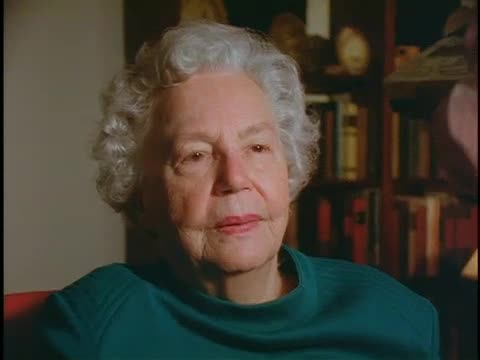
The Great Depression; Interview with Elizabeth Wickenden. Part 3
- Transcript
INTERVIEWER:
Again, place me back in 1934 and what, then, people, they've had their hopes raised a little bit by CWA and now their hopes are shattered again. What are they, what was the conditions like?
ELIZABETH WICKENDEN:
In 1934, unemployment was still widespread. Millions were still unemployed. The FERA was still giving relief, but CWA, the big work program that it employed four million people, had come to an end, and there was a sense of despair that this hopeful program existed no longer. But at the same time, there was planning for a new work program which became the WPA, or Works Projects Administration. Other projects were also going forward for new and more permanent programs, particularly the planning for the Social Security Act, which went on in 1934. That program, as you know, provided insurance against long-term unemployment, old age insecurity, and—
INTERVIEWER:
If you don't mind, I'm going to ask you again to tell me what Social Security encompassed, because you referred to \"as you know,\" and you're speaking to me for the first—you could actually be speaking to me like you're talking to me.
ELIZABETH WICKENDEN:
Well, I'm trying to get into that, but I'll do it again. Where, where do you want me to start?
INTERVIEWER:
What Social Security encompassed.
ELIZABETH WICKENDEN:
The Social Security Act, in its original form, covered three general types of protection: social insurance against long-term unemployment, against old age needs, and against people who were in actual need, immediate need, because of old age, death of the family breadwinner, really life insurance, and blindness.
INTERVIEWER:
What's the concept of Security, the Social Security, social insurance? Was that a new concept at that time?
ELIZABETH WICKENDEN:
It was, the concept of social insurance was new for the United States, but had actually been initiated in Germany by Bismarck in around 1875, and had also been started in England and many other countries, but for us it was a new concept. The concept was that during your working years you contributed to a fund out of which you were paid benefits in your—
INTERVIEWER:
We'll begin again with the concept of social insurance.
ELIZABETH WICKENDEN:
The concept of social insurance is that during your working life you and your employer contribute into a fund, out of which you are paid on retirement because of old age. Well, the original act was only for old age. So it was a kind of deferred wage. The program was small in the beginning, because it only covered industrial workers. It was later to undergo a great enlargement. But it, the principle of insurance was established in 1935. There was also a related program of assistance for needy people who were in aid because of old age, widowhood, or blindness.
INTERVIEWER:
Place me back, though, in 1934, and, and, I mean, was this really like significant? Was this something that was never done before that, in the United States, about social insurance? Was this like a revolutionary, almost, new [inaudible] project?
ELIZABETH WICKENDEN:
Oh, I didn't mention unemployment insurance, did I?
INTERVIEWER:
You can mention it when you [inaudible].
ELIZABETH WICKENDEN:
All right. Should I go?
INTERVIEWER:
Yes.
ELIZABETH WICKENDEN:
The insurance program also included a program of unemployment insurance which had started in Wisconsin, and therefore the Wisconsin program had a considerable influence on the long-term program of unemployment insurance.
INTERVIEWER:
Let me just go back to what I was asking about, what it may have felt like to have this programs in 1934. Was it a, just a complete change in the united states from what had happened before? Were people, did, did ordinary people really feel that this was going to make a difference in their lives?
ELIZABETH WICKENDEN:
Yes. You want me to start as if I had not mentioned social insurance before, all right?
INTERVIEWER:
You have to address the impact, the importance of, of the, the concept again.
ELIZABETH WICKENDEN:
In 1934, when the big Civil Works Administration program, employing four million people, came to an end. There was a rather despairing discouragement what was going to follow. However, at the same time, there was the beginning of planning for a new program of social insurance which we had hitherto had on a national level. We had had a small program in Wisconsin for unemployment insurance, but otherwise it was new to the United States. It had existed in Germany under Bismarck and forward from about 1875, so it was not new to the world, and it had also been developed in England. But people in this country did not know much about it, since it was a brand new idea to us, so there had to be a considerable period of education, reassurance. Another problem about insurance was, since it was based on contributions from one's working years into a fund out of which payments would be made when your work was interrupted, it involved a period, it was a future thing and not an immediate thing. People were worried about their immediate needs, which continued to be met by the FERA, but they had to learn about what was going to come to them in the form of social insurance after this fund had had time to build up.
INTERVIEWER:
OK. I'm going to ask you still, in a slightly different way, if, if I am, you know, a, a person of, you know, 40 years old, in 1934, and so, so, and, I start hearing Roosevelt talking, giving speeches about the idea of social, you know, insurance, does this, the, does it impact me? Do I think that maybe I'm going to have a new future? That, is there a feeling that, that it removes some of the insecurity, you know, in life?
ELIZABETH WICKENDEN:
There is this problem of delay that I tried to refer to. Should I just assume I'm going on from there?
INTERVIEWER:
Yes.
ELIZABETH WICKENDEN:
Well, at the same, at the same time that there was this looking forward to the future, people did begin to feel some, some reassurance. But here was a permanent program of the federal government that would protect their old age when they retired or would give them benefits when they became unemployed.
INTERVIEWER:
We talked a little bit about some of the goals of the FERA, but what, what I want to know is what was your, what, what, when you were working for the FERA, and when you were, you know, thinking about the ideas of Social Security and for the Committee on Economic Security, what vision did that give you of a new, of a society? Did you, could you at that time see a different kind of society than you were living in at that point? Did you have a vision of what it would look like.
ELIZABETH WICKENDEN:
Well, during the early years that I was working for the FERA, are whole attention was centered on the fact that people were hungry, didn't have a place to live. We had to get the money out to get them over the hurdle, [clears throat] but at that time—
INTERVIEWER:
So, I was asking you about in your own personal vision.
ELIZABETH WICKENDEN:
In the early days of the FERA, we were so aware, so constantly besieged by the needs of people for food and clothing and shelter. I was personally responsible for, among other things, for supervision of the mail room. We received 3,000 letters a day, and many of them, most of them were extremely pitiful. I used to read through a cross-section of them, pick out samples of letters that were vivid, and pass them on to Aubrey Williams and Harry Hopkins and to Mrs. Roosevelt and to President Roosevelt, because I felt that gave the, the real flavor of what was actually happening. After the remarkable program of CWA, Civil Works Administration, when four million people had been given work with wages for a short period of time in an effort to stimulate the economy, there was a feeling of great discouragement, that this program on which we put so much hope had come to an end. But at the same time, we were beginning planning for a new work program which became the WPA and for permanent measures that were incorporated ultimately in the Social Security Act. A committee on economic security was established with funding from the FERA. Frances Perkins was the chairman, Harry Hopkins was a member, and it was there assignment to plan a permanent social insurance program. Social insurance had existed in Germany from Bismarck's time in 1875 and in England and other countries, but it was a new idea for the United States. We really had had only a small program for unemployment insurance in Wisconsin, but no national program. The idea of social insurance is that workers during their working years and their employers make contributions into a fund and out of that fund payments are made when they become unemployed or retire in old age or the family breadwinner dies, and it becomes a kind of insurance like life insurance. This program was enacted in 1935, but it was relatively small in the beginning, and people had to think into the future. So a big educational effort was undertaken, but I do think they began to feel that this was permanent, it was part of the federal structure, that it was something on which to build, as indeed it has been.
INTERVIEWER:
That's great. Tell me, what, did you, did you have an idea like what you thought the United States would look like in five years from then, ten years, twenty years.
ELIZABETH WICKENDEN:
Well now I know what happened on the Social Security, so it's very hard to say.
INTERVIEWER:
I mean, did you have, I mean, could you formulate a picture in your mind of what you were striving for personally?
ELIZABETH WICKENDEN:
Well, during all this period,
I was personally hoping that we would achieve a nation in which there was no insecurity, where people would have a dependable source of support in times of unemployment.
Of course, we also hoped there wouldn't be unemployment on the scale we'd had it, that the economy would be regularized, and that we would have only intermittent, transitional unemployment, or employment, unemployment due to old age, disability, and so forth. That was our hope for the Social Security program, that that would take care of that, as indeed it has.
INTERVIEWER:
Great. You mentioned Frances Perkins. And I think that I asked you, well, I'd like to ask you, sometimes they say that, that, sometimes you hear that, that Roosevelt didn't necessarily to enact the Social Security program, that he had to be pushed into it. What do you, what do you feel about that, and, and, and please, if you can, mention Frances Perkins in your answer?
ELIZABETH WICKENDEN:
Well, Frances Perkins, who was Secretary of Labor, and who became chairman of the Committee on Economic Security, had worked for Roosevelt in New York, and he knew her, and she knew him, and she certainly had this vision of a permanent Social Security Act in her mind during the whole emergency period from the 30s forward. So she must've discussed with him, with Mr. Roosevelt, and he must've been aware of it. I don't of my own knowledge know the details of that, but I'm sure he did know.
INTERVIEWER:
So, so you believe, and then can you refer to \"he\" as, as Roosevelt or FDR.
ELIZABETH WICKENDEN:
Right. I'm sorry.
INTERVIEWER:
—in your answer. So you believe that, that in appointing Frances Perkins to be Secretary of Labor, that he understood that part of her agenda would've been [inaudible].
ELIZABETH WICKENDEN:
Yeah, that's right. You want me to just go over and do it all over again.
INTERVIEWER:
Yeah.
ELIZABETH WICKENDEN:
Well, Frances Perkins, who had been appointed Secretary of Labor by Roosevelt, had worked for him in the state of New York as a labor commissioner, and she had this idea of a permanent Social Security Act in her mind. She must've discussed it with him and with Mrs. Roosevelt, and therefore I'm sure that he was ready when it was proposed by the Committee on Economic Security, which planned the, came into being, that he was prepared for that. Certainly, his speeches were very supportive of the concept.
INTERVIEWER:
Do you think that FDR was influenced by the national election in 1934 to pass Social Security? Did that have any impact?
ELIZABETH WICKENDEN:
In 1934, and again in 1936, we were very nervous about the elections. We didn't realize the extent of the support that the New Deal had achieved. So—
INTERVIEWER:
I'm going to ask you to start, start that again, and just refer, in this case, just refer just to '34, because—
ELIZABETH WICKENDEN:
Well, '36 was the more important elections. That was the, '34 was just congressional, but I'll—
INTERVIEWER:
Yeah, just because in my show I end before '36.
ELIZABETH WICKENDEN:
we were very nervous that we might lose our majority, though it seems ridiculous to think so now. But we were unaware, really, of the extent to which the New Deal had seized the imagination and hopes of the people.
Whether that, once we knew that we had a continuing majority, we were more ready to begin on long-term planning, which we did through the Committee on Economic Security.
INTERVIEWER:
So, you felt, did you feel that, that kind of gave life, that, that gave the, the, that when the, the elections, when, when the Democrats, the New Deal Democrats, received the majority in the 1934 election that, that Social Security was going to be right around the corner, that it was near being enacted?
ELIZABETH WICKENDEN:
All right. It's hard for me now to recall how terribly insecure we were. We were very fearful we would not win the elections for Congress in 1934. When the elections went in support of Roosevelt and the New Deal, we faced the future with more sense of confidence. Does that fit in?
INTERVIEWER:
Very good. Can you tell me about, do you think the Townsend Plan influenced, had any influence on the pass of Social Security?
ELIZABETH WICKENDEN:
The, the Townsend movement was a very widespread and strong movement that proposed that old people be paid $200 a month, and the only condition was that they had to spend it within the month. Petitions were circulated in Congress to bring the Townsend proposal before Congress for enactment, and they often got up to the necessary number of signatures, then somebody would withdraw. It was a very popular political idea, and in that sense I think it had a great deal of influence on the passage of the Social Security Act, even though the act did not follow in the pattern of the Townsend proposal.
INTERVIEWER:
You said to me the other day that you felt that—
- Series
- The Great Depression
- Raw Footage
- Interview with Elizabeth Wickenden. Part 3
- Producing Organization
- Blackside, Inc.
- Contributing Organization
- Film and Media Archive, Washington University in St. Louis (St. Louis, Missouri)
- AAPB ID
- cpb-aacip/151-3r0pr7n868
If you have more information about this item than what is given here, or if you have concerns about this record, we want to know! Contact us, indicating the AAPB ID (cpb-aacip/151-3r0pr7n868).
- Description
- Episode Description
- Interview with Elizabeth Wickenden conducted for The Great Depression.
- Asset type
- Raw Footage
- Genres
- Interview
- Rights
- Copyright Film and Media Archive, Washington University in St. Louis. Licensed under a Creative Commons Attribution-NonCommercial-NoDerivatives 4.0 International Public License (https://creativecommons.org/licenses/by-nc-nd/4.0/legalcode).
- Media type
- Moving Image
- Credits
-
-
Interviewee:
Wickenden, Elizabeth
Interviewer: James, Dante J.
Interviewer: Goldfarb, Lyn
Producing Organization: Blackside, Inc.
Writer: Shepard, Robert
- AAPB Contributor Holdings
-
Film & Media Archive, Washington University in St. Louis
Identifier: cpbaacip151k93125qx25__fma257734int20110812_.h264.mp4 (AAPB Filename)
Generation: Proxy
If you have a copy of this asset and would like us to add it to our catalog, please contact us.
- Citations
- Chicago: “The Great Depression; Interview with Elizabeth Wickenden. Part 3,” Film and Media Archive, Washington University in St. Louis, American Archive of Public Broadcasting (GBH and the Library of Congress), Boston, MA and Washington, DC, accessed June 11, 2026, http://americanarchive.org/catalog/cpb-aacip-151-3r0pr7n868.
- MLA: “The Great Depression; Interview with Elizabeth Wickenden. Part 3.” Film and Media Archive, Washington University in St. Louis, American Archive of Public Broadcasting (GBH and the Library of Congress), Boston, MA and Washington, DC. Web. June 11, 2026. <http://americanarchive.org/catalog/cpb-aacip-151-3r0pr7n868>.
- APA: The Great Depression; Interview with Elizabeth Wickenden. Part 3. Boston, MA: Film and Media Archive, Washington University in St. Louis, American Archive of Public Broadcasting (GBH and the Library of Congress), Boston, MA and Washington, DC. Retrieved from http://americanarchive.org/catalog/cpb-aacip-151-3r0pr7n868