Vietnam: A Television History; Tet, 1968; 107; Khe Sanh Air Drop
- Transcript
All of this is down for a case on tons of ammunition and other supplies to be parachuted into the Marines sometime later today or tomorrow. Resupply from the air. Now just about the only way to get material into the Marine outpost after take off load masters check the cargo each man has made eight runs over a case on in recent days being shot at every time having their planes hit once or twice but so far staying lucky. Getting back every time and now into the final run over a case on. OK have I want to get there where you are. OK I'm here tonight because I'm going to marry Graham about America they are good by the way I think coming around to having a problem how the 130 is now doing just about one hundred seventy miles an hour. Only 500 feet over the ground low and slow. A perfect target. Five seconds. 30. Ready.
For a night. Just after the drop a wild twisting climb for altitude caisson falling away behind us. The pilot taking violent of Ace's action to keep from being hit. Now that the job has done a good portion of Kazan's defenses are manned by the South Vietnamese Rangers elite troopers from the black tiger battalion the Rangers have among the almost hard pressed sectors of the case on perimeter. They've sustained more ground attacks and probes than any other unit here. The enemy is close during the day even closer by night by night. The enemy digs his trenches like this one. A line of reddish brown earth have now reached the first strands of the perimeter wire. It's a source of pride to the Rangers that they hold the most exposed positions and that the American Marines are behind theirs. Also once darkness
falls the Rangers are not permitted to enter the Marines perimeter even if they're being overrun. Captain Walter Gunn of Greenbrier Tennessee the Rangers advisor says that's the way the Vietnamese want it. They will stay in a hole and they'll fight to the last man it has to be. And I've gone around here and listen to some of the little troopers talk. And. They accepted. But despite their isolation the Vietnamese troopers know they are powerful supporters these airstrikes only a couple of hundred yards away from their parameter demonstrates. One of the most remarkable things about Khe Sanh is the fighting spirit of the troops. They're just itching for the enemy to make his move. The sooner the better. And nobody here seems as eager for the fight to begin as the Vietnamese Rangers George seawards and CBS News and case on. Why.
They're using all kinds of sophisticated devices in this war but here at Case on they've got one of the Old Black Magic which is tools. The divining rod. They use them for detecting enemy tunnels and they say they work the North Vietnamese have been digging furiously in the case on area. The Marines here know they dug tunnels several miles in length into the French perimeter Denby and food and they're on their
guard. Every day they sweep the area in front of their wire and frequently they hit something. Have you found anything out there yet. Well yes and we found out. Places we thought were tunnels and would dig for would dig down about. Six feet below the deck and figure nothing there and quit. So we kind of skeptical. But then about a week ago when incoming rounds down here right from our wire and covered one and we discover the reason we haven't find it is because they're about seven feet down that's six and we just didn't weren't patient enough we're quick to click. The divining rods are made of two lengths of gas welding rods about two feet long. The Marines have scrounged other devices for tunnel detection as well including the old fashioned doctor's stethoscope. But on top of eight foot stakes driven into the ground they sometimes produce clear digging noises. Another way of discouraging the North Vietnamese tunnel builders is airpower airstrikes with high explosive burns off a protective cover for the
entrances and in some cases of caved in hidden bunkers and tunnels. Digging tunnels around here is dangerous business as you can see. But the enemy has determination and no one here doubts right on Lake. George seawards and CBS News and case on. The.
French are surprised psychologically and physically strong. Within hours the the men get yours the first of eight strong points to cast rather romantically named for former girlfriend. The French reply with their own artillery. But it is not nearly so. Much planes dropping napalm like wood fire. Was now the punch to end on that one. I mean yeah now aircraft fire also on expect the calls Frank Bures. Again where's the. Planes going oh my. Oh my God this must be brought in through a back the way.
They are carried to the airfield from a nearby. Your hospital unloaded and often under fire. From some top spot in the PM in guns cleverly hidden in the hills. Of the unequal duel continues in communist fire predominates French artillery commander has been pursuing. Russian tanks cannot stop the man from closing and through a maze of French enemy shot done again as close as 10 yards from the French line. Despite heavy losses they overrun the French position one by one. Myself to be a doctor I know. And what are you and what are the No. David. Radio communication. So I think we could hear the noise. I mean by
that I mean we are the voice of saying like you know I mean. I must. Say I went. Whoa. Whoa. The Marines and embattled Kazan are fighting an enemy that is usually invisible. Back in the hill
there are casualties and there are peril up to now are the result of North Vietnamese rockets and mortars. In effect the Marines are virtually surrounded by communist forces. Now the communists have not yet chosen to assault them with a ground attack. In this situation the Marines closest allies are the pilots and the planes that conduct air strikes on enemy positions a mile or so outside the Marine perimeter. And this is perilous country for the planes. A helicopter can be shot down as it comes into the landing zone by North Vietnamese mortars or by small arms. These two choppers were hit during this latest scene. Learning a foreign fighters were involved in the strike. One was hit probably by a communist machine and its pilot bailed out. Fortunately the parachute brought him down just inside the Marine base perimeter. If he landed outside major bill a lot of jazz going on I might easily have been captured. This was a close call in many ways and major Loftus shaken but unhurt. Happy to
survive and ready to help out his Marine buddies another day as they defend the strategic outpost of Jaison eagle or organise of CBS News the US Marines and I call get us off and his film crew arrived in case on aboard an ammunition in a dangerous way to travel because of increasingly accurate communist rounds like the feeling we have on the ring in the full light of the night. The Marines hit during the previous night heavy shelling. The story had come to report several mortar shells. Close by one of the continually communist harassment of the movie you know everybody made it to the bunkers except organise on it quiet piece of shrapnel as he ran for cover. There was no way to tell if or how badly he did it. As Marine doctors worked over in preparing him for evacuation by air through a hospital and in it there it turned out his wound was not critical. The projectile passing through the flesh and muscle at the back of his
neck close a doctor told me very close indeed. Yes. CBS News denying all. Oh. Getting in and out of case on is even more dangerous than just being there and the metal
airstrip case on shows why the runway is now littered with the wreckage of airplanes and helicopters. Some were hit on takeoff. Others on landing. Some while standing on the airstrip and others while flying over the North Vietnamese on the surrounding hills now have the airstrip Well zeroed in with their mortars. When a plane does land much of the activity stops while everyone watches to see if the plane makes it. This is all that's left of a C-130 that landed loaded with gasoline. It burned and exploded when hit by enemy fire. Some insight escaped. Others did not. This is the residue of a C-H 53 helicopter the biggest the Marines have. About the time this was being filmed another helicopter was being shot down just a few miles from case on killing all 22 Americans on board. Mine indicates I'm the most dangerous mission we've had here in Viet Nam. Did our relatively slow air speed there we're vulnerable to ground fire both on takeoff and landing and once we get on the ground they have our offloading areas zeroed in
with the mortars and they chase us around the field with the mortars as we try to offload on load before we get off again. As long as the Marines are going to remain in case on then they're going to have to be supplied by air. And as long as the communists around case on and things like this are going to happen making it one of the greatest challenges ever for the men in the Air Force in the Vietnam War Don Webster CBS News at the Marine outpost of case on South Vietnam. With the. With.
That. Yeah. But you know he is. That good. This is the first clear day in weeks and Lorain an Air Force pilot celebrated by working over the slopes of the hill 10 to 15 that dominate the camp. This is Kay side of the dike bird of north west south Vietnam. The usual quick step of landing and taking off under enemy fire. A 1 0 5 howitzer coming in. Case on has been under siege since January 21st.
What's your general impression of the place. It's good it's good isn't good really good. Corporal Charles S. Martin of greenfield Tennessee has just come in from an outpost outside of case I want to do is get off the hill where everybody has a no water to wash and no shave for Steve nothing like that. And this is comparatively plush living back here. OK son no place is bless living on hearsay so comparatively This don't look nothing like you did a month ago or so I have to say. What do you think of the what do you think of the chance. What do you think of the chances of this place getting overrun. I would not say say. I couldn't say I don't love the night we stand a hundred percent watch all night long and try to get sleep going to daytime and working parties are so many kind of Zana by stars being in Barker's up
there just like they do here going to sandbags digging trenches deeper That's about our. Thanks and I hope you have a good Arnaud. I like to say hi to my back at home I know she's worried about me I had no mail resupplied so to mama back I think you're going to say Hello Mom. The defenders of case on expect an assault by the North Vietnamese but waiting for it is nerve wracking. Everyone wonders whether the next enemy shell is meant for him. They wait for that familiar warning incoming. OK their reaction is you know where the rockets and the mortars have harassed nearly every airplane that has attempted to land the case on with additional supplies for the coming to seem to work on a schedule. You get far more one part of that rather well myself I think it's just when the 130 zirconium planes are a minute course you can always count on that either but myself I think that's when they
mostly come in whenever a 130 comes in. That's an LEO ad for government 1 3. Your scenario here comes a mortar magnet. Everybody hits Oh. I go back we're half our job to doing take you hours doing it just doing five his workmen in the hole wait 15 minutes run back out you know the fireman's workman run back to you know the Marines along on courage and short and dug in positions. How much of a day's work at the sand bag stuff. Just about full day long long. How come you fellows haven't got sick a cover of the staff you've got about two layers here. All we got about think about the fourth the fifth layer we got right now besides that was made out of steel. Six layers right around when Matt Cooper out right now should stop a small order.
What about a big one. I'm not sure though. American military commanders say that case on is no DND DND fool. But with the Marines here it's just as badly situated the enemy looks down their throat. 360 degrees and while they'll tell you that case on is no battlefield of their choosing. They're anxious for the North Vietnamese to launch their all out attack case on is a trap. But with 5000 marines through the North Vietnamese division on that I am so many lives many military reputation and perhaps the outcome of this war would depend Peter Calisher CBS News case I. Fear. And see what do you think.
Oh. The. World attention was riveted on the case on earlier this year as 6000 Marines and a battalion of South Vietnamese Rangers successfully withstood a 76 day siege by superior North Vietnamese forces. The base absorbed cruel punishment. Over 10000 rounds of enemy artillery rocket and mortar fire. Over 200 Marines and South Vietnamese soldiers died defending case sun. More than 2000 were wounded.
Now in less than three months later the Marines are preparing to abandon the ground they fought so hard to hold. The bunkers that shelter them from the enemy's barrages are being torn down. Discarded equipment is being buried. Steel planking from the airstrip that was their sole link with the outside world is being torn. And loaded aboard trucks areas that look like a city of sandbag bunkers are cleared and level when these films were made. The operation was still a secret. Marine officers refused to discuss the evacuation but privately there was consternation and some bitterness among the Marines. Why did we fight so hard to keep it if we're going to give it up like this was the question some ask so. Others were relieved. Because they privately believed caisson was of
marginal strategic importance anyway. Case on was once a valuable piece of real estate part just with the biggest investment of troops materiel and prestige of the entire Viet Nam war. Today it looks more like a junkyard than a fortress. And soon it will take its place in the history books says another of those spots singled out by the fortunes of war. As a battleground. George Stephenson CBS News In case on. Whoa whoa whoa whoa. Whoa. Her
throat. It takes 40 minutes to fly from denying to case on an AC 123 40 minutes of tension stomach turning anxiety wondering if this plane with its load of artillery shells is going to make it or whether it's fated to join the graveyard of twisted wrecks along caissons runway. So it is like at the stop. All I want to say. The head shot right back there again. I want to close the door and as a patient
let it go. I don't think you have a pretty good cause at heart or start the pilots and passengers who've made the trip before spend the time figuring their chances of making it. How low are the clouds. If they're down to a thousand feet or so the enemy's mountainside observation posts may not see us if they've just put in this air strike. They may still have their heads down when we come in but then they may have heard it coming on the radio and are just sitting there waiting to add another US Air Force bird to their bag. The plane lets down it breaks through the clouds descends into the saucer of menacing hills surrounding the airstrip. A brief prayer of thanks is in order. The Fifties haven't opened up. Yet. OK. The plane makes it to the unloading apron the cargo is dumped and passengers run
frantically for the nearest hole and make it. But it's not always so easy. This Air Force C-130 has just been hit by North Vietnamese mortar fire. It's elevator and rudder been blown away. It's got some flat tires it's sitting in the middle of case on the runway. Enemy Gunners are zeroing in on it right now. Minutes before enemy fire took its toll of another C1 23 loaded with troop replacements it crashed about five miles east of case on with 44 persons aboard. The next morning the mortars finish the job. A well-placed around sets the left wing tank afire and this tired old aerial workhorse casts a pall of smoke over the defenders of case on as it dies. But the workaday business of supplying caisson goes on even while it.
Rain helicopters keep coming in with their life supporting burdens and braving enemy fire when they land. To see one twenty three days in one day is a pretty good bag for the communist gunners. And from now on it's going to take even more courage for air force pilots to fly in the case of. George Stephenson CBS News In case on. A. This is the first line of defense a case on seven strands of barbed wire forming the
outer perimeter. But now the North Vietnamese have gotten so bold that one soldier has actually penetrated all seven strands and the minefields and actually entered the Marine base a case on. He didn't get very far gunned down just a few feet inside the perimeter. But it is the first time the North Vietnamese actually entered the base. Is the 5000 or so U.S. Marines that case on there are about 300 South Vietnamese troops guarding the perimeter at one end of the runway. It was here the North Vietnamese launched their attack US advisor to the South Vietnamese Army Captain Walter Gunn. What about this one man that actually got into your camp through all the barriers. Well the one he got through it was by sheer luck because he really crawled in and was real sneaky about it but the guard on Fance got him you know in 10 meters and if you get inside you expect more attacks in the middle of the night like this actual attempts to invade. Yes I do because this is a pattern that my counterparts say is that they will try to do about five days in a row and then it will go launch a big attack
at nights and I get them these of them busy in other ways too right over there shaped like the letter L is a North Vietnamese trench. Each night they were digging a little more until it now comes within perhaps 150 yards of the Marine's own perimeter trench. These Marines watching through binoculars have been seeing the trench grow longer and longer. Then a few days ago they sent out a patrol to see what it was all about. One of the men that went up to the enemy trench the other day what does it look like. It's similar in the trench and standing in two and a half feet wide three and a half miles long. The enemy want to trench three and a half miles long coming your line. So they can bring their troops getting to make a hit is from artillery. What are we able to do with a trench built that close to us we can get bombarded with artillery mortars and everyone around it with airstrikes to close the enemy trench line closest to case on is too close to be hit with airstrikes but the rest of it isn't.
Recently when the weather's strikes into the trenches. Artillery batteries a case and also I did and when I went out anyway. And I've always thought OK yeah you might call it out of always felt in the middle small firing machine one of the artillery man suddenly spotted the communist motor position. The rest OK. At a glance the spy briar may not look very formidable but there are a claymore mines and other devices in there to help stop the enemy. But already one communist soldier has gotten through what the Marines are waiting for is for ten or twenty thousand of them to try. Don Webster CBS News at the Marine base a case on so good no. Way.
No. Way. Getting in and out of case on is even more dangerous than just being there and the metal airship the case on shows why the runway is now littered with the wreckage of airplanes and helicopters. Some were hit on takeoff. Others on landing. Some while standing on the airstrip and others while flying over the North Vietnamese on the surrounding hills now have the airstrip Well zeroed in with their mortars. When a plane does land much of the activity stops while everyone watches to see if the plane makes it. This is all that's left of a C-130 that landed loaded with gasoline. It burned and
exploded when hit by enemy fire. Some insight escaped. Others did not. This is the residue of a C-H 53 helicopter the biggest the Marines have. About the time this was being. This is an Air Force sea one twenty three. It had landed moments before hastily unloaded and tried to take off again. But as it rolled down the airstrip on takeoff the communists lobbed in a mortar round which apparently hit the right engine. The planes were about the runway to its right. Tipped over and burned. It's fortunate the plane was hit after the ammunition was unloaded otherwise the crew might have been blown to bits. Case on has its own little fire department which here works feverish lay on the burning plane. Suddenly tragedy struck. The Communists who had a direct hit on the plane opened up on a group of firemen a newsman standing around the burning wreckage. Two mortar rounds were right
on the mark. One of the more seriously wounded was rushed Ben's Lee producer of The CBS Evening News with Walter Cronkite. He was hit by shrapnel in both arms one leg and five. Ben's only had been in case on to help produce news stories but earlier CBS soundman Devi high had also been injured and had been evacuated. So Ben's Lee was also acting a sound man with the sound gear box still around his neck. Also did the CBS cameraman John Smith. He kept shooting the film and shouting encouragement to Ben's Lee even though he'd been hit by fourteen pieces of shrapnel. This film was shot by John Schneider another cameraman on the scene. Later in a deny hospital tensely described his experience. What did it feel like when you were hit. I didn't feel like much I heard the explosion and I thought a burning sensation in the leg I thought maybe it was just a flash from the explosion. I don't under the ambulance that we were standing right next to the transmitter the cameraman and he asked me if I was sad and I thought about it a bit on the side and maybe I
was the thing that surprised me the most was that we crawled out a corpsman pulled me out the other side of the ambulance and I'm lying there and I look up and there's Smith with blood running down his neck with his camera taking pictures of me. And that amazed me. Back in the United States the Viet. War is so controversial. Some people favoring it some people opposing it here almost all the soldiers seem to be in favor of it. Do you think coming here and having the enemy shooting at you and in your case almost killing you do you think it changes your perspective on the war itself. I'm sure of what if you were here long enough I was up there one day. I think what it is is that the moral and ethical questions would probably become irrelevant after a while. Survival becomes relative. But I rather suspect that being here is probably the worst place on us to try to make moral or political judgments about the war in Vietnam is just too close to less than 12 hours after the report you just saw was filed the communists demonstrated that under the new war in Vietnam no place is safe.
Last night they attempted to rock at the Marble Mountain base the big Marine camp where so many helicopters have been damaged in the past. But one of the hundred twenty two millimeter rockets hit the naval support activity hospital just across the street. Hit just outside the ward where rust pens lay and others were asleep. Seven men were wounded. Three hospital corpsman and four patients. One of the corpsman lost and I eventually was the most seriously wounded of all today in surgery. Doctors removed his spleen and he has a badly ruptured colon. It will be many months in the hospital but eventually he will recover. The irony of it is that for several weeks now we've been planning to do a report about the new war in Vietnam. The fact that the enemy now has weapons every bit as good as the Americans. The fact that the enemy now is attacking with a new boldness and daring like never before. And the fact now that Vietnam is a much more dangerous place than ever before. It's sad that our graphic example has to be the producer of The CBS Evening News Dan Webster CBS News at the naval support activity hospital in denying South Vietnam.
A case on weights. It has been waiting for an into supported attack for months digging in building up reinforcing for what would undoubtedly be the most significant battle of the war. The question is will the attack come. And if so can case on hold. The fortified Marine combat bases sprawled across the floor of the longest valley leading to the lotion border five miles to the
west. From a conventional military view case on as an essential border stronghold designed to detect and block enemy infiltration into South Vietnam. But since the North Vietnamese began their massive build up started shelling a month ago and captured the nearby Special Forces camp at Lang day. The Marines have been forced to pull back into defensive positions to prepare for an attack. Reconnaissance patrols have stopped and case on is no longer an effective roadblock against the enemy. From the North Vietnamese point of view case on is an easy target for its mortars and rockets. A convenient place to bleed the Marines. And what may be most crucial tied down and isolate six thousand American troops and another 20000 reserves far from the unprotected coastal plain. For 20 years General Giap has used the same tactics. Draw the opposing forces away from his centers of strength. Isolate his up
close spread his troops thin our asses flanks and rear and then attack. Where he is weak. The same tactics are being applied today. Jap who commanded the Viet Minh at the end been food must see dissimilarities a case on. But there are as many differences as similarities between case on and been food. And the biggest is air sickness. The French had fewer than 100 planes. The US Air Force believes it can blast an attacking enemy force out of action in good weather or bad. I personally believe that air support is going to either win or lose the battle of there. I think there were going to be the prime controlling factor of it as a matter of time. This is the part of Khe Sanh known is that the ring and the impact zone for most of the
incoming enemy mortars rockets and artillery. It's the home of the third recon Bravo Company. And even in the the ring life goes on a case on one line with one. Are we. Are we do you what. How do you manage to survive in the ring. How do you keep your spirits up and. Oh yes we play cards we sing at night. It's about you how do you manage to keep your spirits guard. So many ways you are. So that is pretty pretty irritating on how you have like I live together and everything you kind of crabby and everything start biting and we manage.
I wonder night helps you. Oh let's see. Oh oh oh oh oh oh you know. Where. Do you learn to take the danger of death which is not a present all around you can you take that in stride. Yeah you just got used to it you just accept it. You know you still you jump everything when mortars rockets come in but you just accept that after a while so your buddies get blown away just the next day just just like you have a wall between yourself and reality. I notice you sing out.
When will they ever learn. This is probably the favorite song around the ring. The words have special meaning or. Or is it just a good song for homesick soldiers homesick Marines I'm sorry. Well I suppose it's a little bit of both I mean it sort of makes sense to us anyway that people should catch on what's going on here. I was a protester back home kind of bothers but you'd think they'd learn after a while. But these wars and stuff. 1 0 6 0 0 0 0 6 0 6 0 0 0 0 0 0 0. This is just gone come during the day.
- Program
- Tet, 1968
- Episode Number
- 107
- Raw Footage
- Khe Sanh Air Drop
- Producing Organization
- WGBH Educational Foundation
- Contributing Organization
- WGBH (Boston, Massachusetts)
- AAPB ID
- cpb-aacip-15-m61bk1701n
If you have more information about this item than what is given here, or if you have concerns about this record, we want to know! Contact us, indicating the AAPB ID (cpb-aacip-15-m61bk1701n).
- Description
- Description
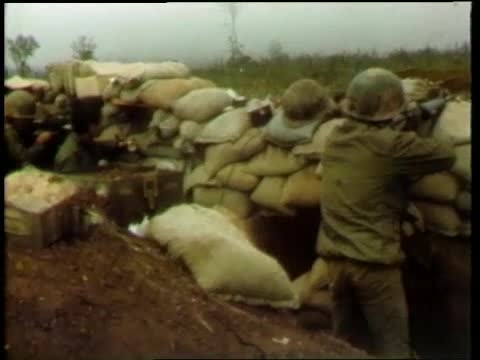
- Plane comes into Khe Sanh, men run, supply drop. Crashed flaming plane. Khe Sanh runway scenes. (Best for interior plane.) Visuals: Airplane; Artillery; Base; Body; Bullethole; C-130; Haircut; Jeep; Marine; Mountain; US Soldiers; Truck; Wounded. This item consists of raw, unpackaged, news materials relating to the Battle of Khe Sanh.
- Date
- 1968-03-09
- Date
- 1968-03-09
- Asset type
- Raw Footage
- Topics
- Global Affairs
- War and Conflict
- Subjects
- Khe Sanh, Battle of, Vietnam, 1968; Vietnam (Republic); Vietnam War, 1961-1975; Antiaircraft artillery; Military bases, American; combat; Military supplies
- Rights
- Rights Note:,Rights:,Rights Credit:CBS News,Rights Type:,Rights Coverage:,Rights Holder:CBS News
- Media type
- Moving Image
- Duration
- 00:45:28
- Credits
-
-
Distributor: CBS News
Producing Organization: WGBH Educational Foundation
- AAPB Contributor Holdings
-
WGBH
Identifier: cpb-aacip-96dc9b77a9e (unknown)
Format: video/quicktime
Color: Color
Duration: 00:00:00
If you have a copy of this asset and would like us to add it to our catalog, please contact us.
- Citations
- Chicago: “Vietnam: A Television History; Tet, 1968; 107; Khe Sanh Air Drop,” 1968-03-09, WGBH, American Archive of Public Broadcasting (GBH and the Library of Congress), Boston, MA and Washington, DC, accessed April 10, 2026, http://americanarchive.org/catalog/cpb-aacip-15-m61bk1701n.
- MLA: “Vietnam: A Television History; Tet, 1968; 107; Khe Sanh Air Drop.” 1968-03-09. WGBH, American Archive of Public Broadcasting (GBH and the Library of Congress), Boston, MA and Washington, DC. Web. April 10, 2026. <http://americanarchive.org/catalog/cpb-aacip-15-m61bk1701n>.
- APA: Vietnam: A Television History; Tet, 1968; 107; Khe Sanh Air Drop. Boston, MA: WGBH, American Archive of Public Broadcasting (GBH and the Library of Congress), Boston, MA and Washington, DC. Retrieved from http://americanarchive.org/catalog/cpb-aacip-15-m61bk1701n