Invitation to Art; 2; Love and Marriage
- Transcript
The next time we pull up in love and what many think is the logical conclusion to this most illogical of emotions matter and often. Well what is love anyway it's the creation the confections something made up by the imagination which is as delightful and substantial I suppose as whipped cream or a French pastry uh this very room this French room in which we stab the love has to be in Maine because we speak of making the imagination create an image of the beloved and then we fall in love with it. Girls are much less susceptible I think in this way. Men is that week six if you want to prove it by statistics women live longer and therefore more durable than men. Well now we have here in the Museum of Fine Arts I walk by an artist whose pictures have come to stand as the perfect expression of ideal and romantic love. With what. We enter a world which is like that of no other
artist. A world which is complete in itself which imposes its values upon the SO world in which we can enter and live and breathe and share and it's built on an ideal relationship between men and women. A perfect relationship it's always in the open where the landscape becomes to the mood of the figures and nearly always it's bringing becoming the summit that the gun Corps Brothers wrote. Well nearly a hundred years ago about this well of what to love was the like of this well they said and that looks have no fever in them and embraces no impish that is desire without appetite and pleasure without desire. What we're looking at is the spiritualization of love and will. What have we seen we have seen a few couples talking to each other walking along the grass we have seen one man making music and always that is music in mottos picture. It's in the brush stroke as well as in the mandolin these and the others that we see. And
back you know the weather is back again but the villian just slips down the prospectus and this picture is cold a lot of us and these are the props that Watto uses again and again. Recombines them these few bricks to come up with new answers new invention invention as a part of you. And now this man is a giant He's a great artist and he stands. Like a scene in which one cent. moves to another the 17th becomes the 80s and we look down the perspective of the 18th century and what those sets the pace so he follows a long line of painters from his pupil to a bush a Fragonard and he initiates the rococo wonderful by a local CO with like wedding cake. That's style which is as elegant and graceful as a pretty ankle and which succeeds the spin and pretentious machine of a of the classic which is beginning to creak dangerous. Well now. We've all got all the artists have many for this they have many men
who influence that are one man who influenced what great play was ruled. And here we see a Rubens Garden of Love This is a Watteau theme but here is Rubens painting and an influence you know is something that you know you would not that you were used by so he punctured Ruben was swilling pneumatic women and reduce them to a slim elegant Is it a juiced Ruben's a minced busting vitality to a witty sophisticated gay it is like a rapier to Ruben's bludgeon. I always remember TS Eliot's he whines about when I see a Rubens woman you know Bush going is nice. A Russian I underlined for emphasis and cross the friendly bus gives farmers of the pneumatic lifts pneumatic lifts that's Rubens and now Watto painted this picture here. Towards the end of his life but 17 16 17 18 and he was a sick man most of his life died of tuberculosis and he died young.
And what sort of man was this giant. Well he was medium size thin sort of face and he didn't like meeting people he difficulty talking to people and he was that letter to Bill sometimes when he met them because he was going into it if as so many people use a great reader of books and he never met this man. What. Well now this picture we know where he painted. We know that at this time he was staying with his patron an extraordinary man named close up and these are the gardens of closeouts house at Moema city. And there through the back perspective you can see the entrance pavilion to the Chateau Margaux. See because there was a great influence on Moto because they had a magnificent collection and what it would see the stuff something like 19000 drawings and 500 paintings. Well no. Let us look at these delicate figures of what goes again and how complete Do they
reflect what goes on. Each Just jerm mean something when they do gesture as they do on early and communication more often seems to be through glances through new ones just this is a subtle art which is Father was what to make too obvious by overstating a thing you can destroy it if it is a delicate thing that has to be said. And all these gestures are so on headed that they seem to be premeditated as if this were a scene from the theater which water loves so much. Each of the participants seems to know what comes next in this exquisite game of love. And the raised hand of that man on the left you see and just there at the left problem. He gestures towards a distance out of the picture where we cannot follow and where they show presently will see that we build up a mood of Tom expectation in which there is always the certainty of fulfillment. What is most famous picture this is the sequence of courtship is shown with exquisite protect and grace and perhaps it's the most beautiful sequence of love and
courtship in all out here. Beloved importuned these ladies if you prefer to get a line and she untied and he had listened and Hubert is down there at the bottom right with his quiver of arrows watching curiously the calls watching the effect gently the lever lifts his lady to a seat gently again he leads it away. Although she looks back to the left and play with the beautiful tilt of the pin perhaps with some misgivings. That's his favorite model that go the picture embarkation for the Isle of set I one of the greatest moments and painting in the eighteenth century and over in the misty distance towards the lift lies the Isle of Cythera the island of love and at the shore the boats wait to take the lovers across. An out of men take a lot of us a long long history and it goes back a long way. This game of love in which each sex knows little worlds so they know what to expect from each
other. You know if you don't know the rules of Europe it's like being in an exclusive restaurant if you haven't got the Table manners you're out and both the exclusive restaurant and not. They cater to a highly sublimated appetites. Well we all know this convention of the Lebanese lady as she breathes when she sighs. You die and when she smiles he flips the swings like a seagull use so he spit it as exalted. And. If you met it that was the end you know Petrarch wouldn't matter as a lot and done well when he was praising Beatrice he got a family and a wife and when in a we used was asked in marriage she said No my lord I would rather be your mistress then yours so if it mattered it was a low estate. Your so mad IJ had no future in it apparently because this was too real. It destroyed the green.
And we talked of Petrarch and he's a lot of what he influenced the English poets a lot the Elizabeths NS And of course the volume's remember the Elizabethan magnetics sort of volumes with us and there is none of them so typical. The UN court here on the young gentleman the young lover the young soldier as Philip Sidney So Philip said he was an Oxford boy he was also a Cambridge boy so he wouldn't care when the growth rates but I think one of the neatest of poetic conceits is my true love f my heart and I of his his heart in me keeps him in me and one my heart in him is talks and senses guide he loves my heart for once it was his own. I cherish it because they need it and I threw it out and I have his that's made it beautiful beautifully knitted together that attend graceful elegant that it Amanti.
Well the romantic idea of love ran into a lot of trouble with John most of us. And after that what has happened to a man to love well it has been their fight in Hollywood we've still got it in Hollywood but they're up in Hollywood. They believe in it. Jonah this is this idea of romantic love is taken seriously it's not a game anymore. And this is a dangerous thing believing in an illusion. It's like mixing your drinks you can need to travel. We're talking about love. And we need something to bring us back from this wonderful dream to reality. And we have chosen something two centuries away in time so we shall step over two centuries to come to this little piece here from France other countries. Time about 15 20. It's an ivory. It's part of a bead you can see the way you can hang the bead here and here are two levers affectionately joined together in the conjoined world of love. And reflected in the mirror here in the background behind them like an
emesis is dead. It's cold amorous couple and death. And the inscription reads Oh death how bitter it is to be reminded of the. And so it is. Gathered in the shadow behind the back is death. Well we are coming back to no such shocking reality as that that reality that we are coming to is merely matted and that is plenty of reality for young love. Because Robert Buckman is Anatomy of Melancholy it said that this is one of the cures for the lab sickness and he devoted 30 pages to it and came to the conclusion well Matt it manages is a cure. And you know one of the most pessimistic points in English language are the same idea how to end a houseman when he said that when Adam day by day woke up in paradise he always used to say oh well this is very nice. But he from scenes of mists transported him for like. A mold I think of this mole. I beat my wife. Well.
The symbol of method is that we look at this ring very carefully because a ring one student at There's no way out. A symbol of perfection and there is no way out of this ring. And since we hope in this next half hour to move from courtship through marriage to the family and to the family we have to get married and so what you have is a lady who was very gracious to me been waiting for the reversing the usual process it's usually the man to wait in that waiting for us to come along and perform this matter in a very beautiful lady she is. She's wearing a beautiful she's a French girl and she is wearing a dress from about early 18 25 sort of in transition from the Empire to what comes after and that wonderful tinsel is still untarnished still bright after all that time and that place is transitional you see has the high end waist and then the these and all this stuff from the city. Well now we are waiting to be mad. So with this ring let us win. For better us for richer or poorer in sickness
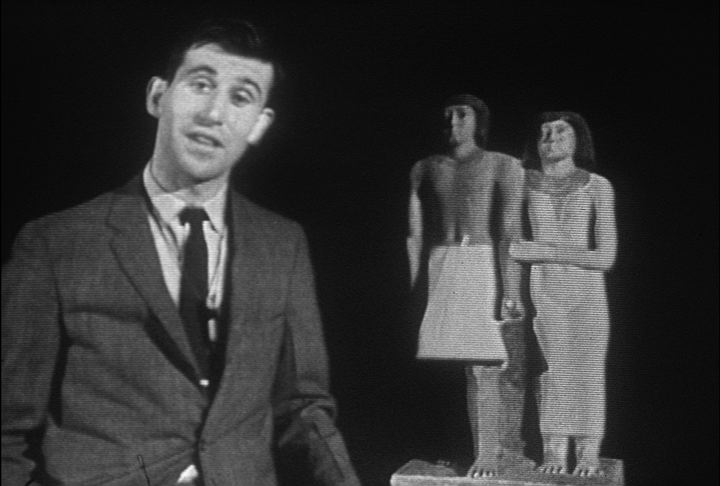
and in health. You know matter does a crisis manages a crisis and we look back and beautiful and everyone who has ever mattered as a vague sense of import the feelings of unease and when we are troubled we fall back on have have what comforts us. Another union of two individuals into one vicious From the earliest times been surrounded with all and superstition and out of that has come of the church and ritual is the habit of the community so that in the time of crisis such as manage society bears us up with its ritual. This habit of a community with. The dignity and solemnity of union is expressed with tremendous abstract force in Egyptian. Here we and he's right stared out at us with something of the blank impersonality of a wall. But as we watch gradually it
begins to relate to pot and perhaps to the whole until we begin to see and ever so distant the. Feelings behind this rigid and formal. So much of the art of the Egyptians is hidden behind a form of face that faces mysteriously composers of their never felt illness sickness and been subject. To the exigencies of time. This comes from Dynasty 5 in the Old Kingdom. The Dynasty which succeeds the age of the pyramid the fourth dynasty the greatest of all the dynasties ability to the age that gives us the grand bit of the edge which sets this great and monumental the which we have in this museum in the great my serving us and his queen which is the origin for this in the latter half of the fifth Dynasty this unique piece in its color and preservation always the lady on the left and these are few Mary statues put in the too and the art of Egypt moves and circulates
around the Tumut is an art of the tomb and not for eternity and not seeking for immortality and see how formal and rigid it is it is it is as formal and rigid as the pyramids themselves. This geometric koan. These arms of stiff and rigid like the frame of a door. Angles rectangles and the wonderful play lying and surface. Here you see that line it is. It is subtle and moving that feminine line in contrast to the harsh then the attitude of the male and that of the contrast of lying which is almost like a modern abstraction and look at us so let's look at the surface here at it's it's dissolved away every detail until we are left now with this new blend is this move the richness which is the tunnel possible I suppose. Gyptian. Well. What I eat is the spice of life and contrast is perhaps part of my life in life.
So from the rigid geometric you Gyptian this stone and form a lot that is done to another whole because man's thought is to oppose and so as these are to an art which is in movement always in rhythm always carving and carving gracefully always dancing. We are India and once again we come to him who are joined together affectionately and this is luck to me and not a young man and what greater contrast to Egypt than this he had in the 12th century A.D. and look at the decoration the richness the opulence of this the bodies trussed forth from the stone with a vitality and energy which bursts through all the tough skin. For here stone becomes a soft just flesh. And you almost expected to yield to the finger. Well out of the mindless mind emotions as the Indians thought life emerged out of the cosmic flux into energy which interpenetrate all thing the
other substance of the universe and this stone as in it the breath of light life breath swelling the vessel of the body. Prochnow they called it and that's a concept associated with the ideas of breath control and meditation for which the artist identifies himself with the object becomes the one with the object and gives it to him. Always when we want to understand not that of any other not that is foreign to us. Let us go to the ideas behind it because we all share the same human situation our reactions to this situation may be different but they have this fundamental connecting point that we share the same fundamental things. So the idea is that often the key to the. Well now we should do with these two things because they come trust a great place. And that it just perhaps. Composed of contrasts managers very often where a toe a person seeking that office and very often it is a person seeking that. Same identity same as
themselves. Well now that we are indeed in India I think perhaps we should have a look. At the greatest monument of a man is none other women. And this of course is the Taj Mahal built as a mausoleum by Sharjah Han Chinese right. That's how it got its name. Now how does a palace and touches the diminutive. So there we have it touches us and after all the exhibit and decoration of Indian art here is a little strained classicism which is doubly impressive for these four chase towers and minarets reflected in the water and the landscape reflects the building tools so that both are brought into a unity and the tension and I'd always been there. This pessimism is wonderful to see in Indian art that goes so well in Indian art seems to be putting in too much while the kneading up and good taste I suppose is the art of needing out. And this was no rush of romantic love. For this woman of brown
the. 14 children and she died in childbirth shortly after we came to the throne and 16 31. And what sort of a man is it who has the impulse to on out a right with such a monument Well here is the Rod of the well that faces as always in profile delicately outlined that that wonderful miniature of skill building the traditional flower and the globe of the halo behind his head. To accent his importance. Well looking through the marriage of the great men of talent they don't seem to have had a talent for picking out their wives some of them never mattered like Michelangelo and Leonardo and of course those who specialize in explanations of explanations for that raft will never mattered he was having to wait a time and some like draw to chose why it was who drove them to destruction. The literary men
don't seem to have much better. For instance Thomas Carlyle gave his wife or that a bad time. And beside all his volumes on the shelf she has left Jenny she has left us one sentence she said never marry a genius. The Puritans were hard and their wives too were desperately John Ruskin and John Milton who were very unpleasant husbands but I think the most savage and bitter epitaph of all is the one that John Dryden wrote on his wife he said. Here lies my wife here a little lie. Now she's at rest. And so. You know he wrote that before she died. This verse is sort of wishful thinking. Well now after all this it's a pleasure to turn to a man whose marriage was happy and who was looking at the most of us he had to have to matter to us. And this is a lady when I saw first even though she's another man's wife I fell in love with it at first sight and you will too. There is Isabella brand the young girl you met it as flawed as springtime and
Rubens as a man with vitality and life in him. He he's like a great mountain set down on the lower ends of the land. Which changes the course so northern european is the sessile be the middle of the 17th century who can set a great sheet of machinery in motion and it doesn't matter. Creek you can carry it all. When I was a big man a man who sees expensively in great glee. So this picture has a bigness about it to which she seems about to burst out to be too big for the frame and you see how that effect is it's difficult to invent poses it's difficult to take one that hasn't already been invented. And you see the way the head is thrust out the shoulders for a way to trust the head out further and there she is like something coming out of a shell of something beautiful and soft and she comes out with a twist in its motion which seems to be summarized like a stylistic epigram in the twists of the hat.
Well. Overwhelmed loves the love of God and He has a lover with a paintbrush filling up touch touched this wonderful not reckless envelope of police and more than that he builds up around it again and he builds up the warm air which she breathed. This is a very warm winter about everything else. Reuben these I think is what. So that is a Isabella brand. The young girl he married at 18 and when he married he was just back from Italy. He was aged thirty two. It got a great career ahead of me was the young man everyone was talking about and they made it and they lived happily until she died at 35. The idea they had a family too and that seems to be bringing us along to the family so let's talk about the family. When we're talking about something we should know something about and quite often often it's not necessary but we should know something about the family so I've got an expert here and will describe it to us.
And here is an expert's definition a sociologist of the family. The family is here defined as a social group constituting consisting I should say of one or more men living normally in the same habitation with one or more women and the children at least during their youth. But ever exulted appear not to be connected with their union. So that's the family reality parents always seem to run when they meet the family. It's hard to be difficult about it. All the fairy tales and they lived happily ever after and perhaps with a wise discretion they don't. Grow beyond the successful wing of the lovers. Artists have been family men too and have raised their eyes from their paper on their canvas to the little instances in the cut and those which make up all the tissue and texture of domesticity. Remember the very domesticated man
and he often lifted that wonderfully keen eye of his to the family around and held with such intensity with such quickness. A moment to see that he possesses it for us and we shared it with him. Suggestion in the drawings is as the main means of expression on the part here is greater than the whole. Well here it shows us one of the first great moments in life when we learn to walk and hear the little child looks not a hair at his feet as one would expect he looks fixedly ahead anyway as a little crash helmet to protect him from all the polls that he may have and a few broad lines on either side suggests the solicitous inclination of the adults who support him. Rembrandt makes everything human and everything it touches seems close to us when copying Leonardo's Last Supper he had a
dog when stitching from other artists he often had children and animals. The family unit was one that another artist M.A. represented again and again. Father mother son as if this were a reality as if when representing this they were touching supreme natural troops as if you know you what just of the meaning of life and the reason for living here and a father becomes a solid image of paternity of male nice man the provider and he seems to experience this so deeply that he wants to make this single father stand all told is fatherhood so he generalizes from the particular figure to make it a symbol it's a hard thing to get away with and very often he's not successful and sometimes a year and look at a night in this drawing is a man a generation before the Impressionists showing an interest in light and this light is the cord on which the family I gather. So the shadows spread out from it like the spokes of the wheel and everything appears as
solid as part of it and you see the struts radiating from it looks like the arrangement of petals in a sunflower the way iron filings dispose themselves around the pole of a magnet. Well now. The family has our first apprenticeship to living and loving and of the Duke of Wellington said that water was one of the playing fields of Eton perhaps we can say that many of the battles of later life run the living room. Well we're going to end with a family here as a family and like a cross in the family has a single identity which you can see running through all this. It was the family of Joseph Moore seen by R Us just solve the body feel and they are crimped and neat and tidy. As if cut out untroubled and pasted against the canvas and its fresh direct honest and it is all full of New England virtues is the primitive artist whose strength versus weakness whose weakness is also his strength. Rest US soldiers body for you.
The family it dissolves and breaks up and other families begin. And here we come to a great neck for two but parents don't choose the children the children don't use up. It's very simple and very difficult to understand. And perhaps to understand that is to understand all family descent and all family. But all of us who have been part of a family we keep it intact I think always that the family be gone in some warm pocket. We have had a busy hour. We have fallen in love. We got married. We have had a family and to all this. The artist has been both halves of a midwife. This is a National Educational Television.
- Series
- Invitation to Art
- Episode Number
- 2
- Episode
- Love and Marriage
- Producing Organization
- WGBH Educational Foundation
- Contributing Organization
- Library of Congress (Washington, District of Columbia)
- WGBH (Boston, Massachusetts)
- AAPB ID
- cpb-aacip-15-dv1cj87t6b
- NOLA Code
- IART
If you have more information about this item than what is given here, or if you have concerns about this record, we want to know! Contact us, indicating the AAPB ID (cpb-aacip-15-dv1cj87t6b).
- Description
- Episode Description
- Dr. O'Doherty traces the ideal of romantic love from the Troubadours, Petrarch and the Elizabethans poets to Hollywood. He leads the viewer on adventures through the exquisitely stages, sublimated dream world of Watteau. Sculpture form India and Ancient Egypt lead to discussion of varying marriage customs. Poetic quotations and other literary references deepen the scope and impact of this program, which shows a definite change in mood from its lighthearted beginning to a more serious conclusion. (Description adapted from documents in the NET Microfiche)
- Series Description
- This series explores man and the world around him through the eyes of artists, past and present, and aims to develop an understanding of art as a direct expression of universal emotions. As the host, Dr. Brian O'Doherty, young Irish poet, painter, and art critic, brings a fresh, witty and warmly human point of view to the visual arts. In the first season (episodes 1 - 15), O'Doherty follows, through these arts, the cycle of man from childhood to old age and explores the society in which man lives in all its aspects - tragic, comic, and mundane. Dr. O'Doherty uses works of art now on display in the galleries of the Museum of Fine Arts, Boston, MA, to illustrate the episodes. Patricia Barnard of the Boston Museum of Fine Arts supervises production. Her assistant is Thalia Kennedy of the Museum staff. In the second season (episodes 16 - 30), each episode either examines in detail the work and thought of one of the great artists of the past, or consists of skillful and sympathetic interviews by Dr. O'Doherty of distinguished living artists who have had a powerful influence upon the art of today. In the third season (episode 31 - 34), Dr. O'Doherty interviews a distinguished American artist who have had a powerful influence upon the art of today. In the fourth season (episodes 35 - 41), a pattern of ideas evolves, revealing the various roles of the artist. This series was originally record in black and white on kinescope. (Description adapted from documents in the NET Microfiche)
- Broadcast Date
- 1960
- Date
- 1959
- Date
- 1958
- Asset type
- Episode
- Subjects
- marriage; Art & Arts; Museum of Fine Arts, Boston; PAINTING; sculpture; Field, Erastus Salisbury, 1805-1900; weddings; Love; O'Doherty, Brian
- Media type
- Moving Image
- Duration
- 00:28:53;18
- Credits
-
-
Host:
O'Doherty, Brian
Producing Organization: WGBH Educational Foundation
Publisher: Presented by the Museum of Fine Arts, Boston and the WGBH Educational Foundation
Writer: Kennedy, Thalia
Writer: O'Doherty, Brian
Writer: Vento, Frank
Writer: Noble, Paul
Writer: Barnard, Patricia
- AAPB Contributor Holdings
-
Library of Congress
Identifier: cpb-aacip-c6f5c759043 (Filename)
Format: 16mm film
Generation: Master
Color: B&W
-
Indiana University Libraries Moving Image Archive
Identifier: cpb-aacip-4301dfdc89b (Filename)
Format: 16mm film
-
WGBH Educational Foundation
Identifier: cpb-aacip-ba229e7d903 (unknown)
Format: video/mp4
Generation: Proxy
Duration: 00:28:53;18
-
WGBH
Identifier: cpb-aacip-1033d2e475a (unknown)
Format: video/quicktime
Color: B&W
Duration: 00:00:00
If you have a copy of this asset and would like us to add it to our catalog, please contact us.
- Citations
- Chicago: “Invitation to Art; 2; Love and Marriage,” 1960, Library of Congress, WGBH, American Archive of Public Broadcasting (GBH and the Library of Congress), Boston, MA and Washington, DC, accessed May 25, 2026, http://americanarchive.org/catalog/cpb-aacip-15-dv1cj87t6b.
- MLA: “Invitation to Art; 2; Love and Marriage.” 1960. Library of Congress, WGBH, American Archive of Public Broadcasting (GBH and the Library of Congress), Boston, MA and Washington, DC. Web. May 25, 2026. <http://americanarchive.org/catalog/cpb-aacip-15-dv1cj87t6b>.
- APA: Invitation to Art; 2; Love and Marriage. Boston, MA: Library of Congress, WGBH, American Archive of Public Broadcasting (GBH and the Library of Congress), Boston, MA and Washington, DC. Retrieved from http://americanarchive.org/catalog/cpb-aacip-15-dv1cj87t6b