War and Peace in the Nuclear Age; Air Force Class on Soviet Threat Awareness
- Transcript
A tanker and I'm not really any classes to learn really beyond going to continue or threat awareness class start talking about the Soviets for teachers defense forces. Soviet strategic defense initiative is by far the most expensive. Soviets have. Penetrated in their territory to be particularly if. The Soviets have more than 7000 early warning. And drug control intercept radar systems. Throughout the country. They even have newer systems. That have the capability and they're operational at this time have the capability for low altitude detection. As you know the ones primary ingress in infrastructure. Will be a couple as. Well. We. Are lost. In the maze. In terms of airborne early warning the mainstay is a new the newest Soviet neighbors. Has a look down radar and is able to detect. And track the wealth of
competitors. Once a target is detected they're sophisticated Soviet fighters when moving to intercept. The first part of them that discusses the 331 parts and. This is their first. True look down shoot down a fire. And that is able to look down low enough to. Detect. And track. Onto an enemy or. To enhance the capability of this system is due primarily to the post office radar. Now the air speed for this aircraft is about Mach 2.4. And often. Has a combat radius. Of eleven hundred. Miles so there's a. Long range system. The newest generation pipes they've come out with a new generation tires the first one being the big 29 fall. In appearance the MiG 29 focused very similar to or if they take the exception is that it has much more powerful power plant engines to give it a better thrust to weight ratio. Greater than one toward.
The other fighter is the SU 27 because it made the flanker. The flanker also has a good look down shoot down weapon system it's a supersonic all weather interceptor and it has beyond the visual range here to air missiles. The advanced capabilities of these two fighter systems give a good potential against low flying aircraft. And cruise missiles. This concludes the portion of this class. Are there any questions. From those around the world ours you believe. To be. The way. To life. Yes they can be so be it. Soviets have an air defense. System that they communicate. To a great extent. With each other. They do it by ground units Q By land lines or telephones. The ground the air units to buy shortwave radio and they also do it by dabbling in the more capable systems are going to data which is a much.
Better Way. Of transmitting information. Very closely together. Taking notes. I'm sorry. It's classified to. Tell You. Your. Next question. Take. A class. It's time. For. My casting. Airspeeds here. Pulls. Out the army radio. It's a classified. But. It's it's not an easy thing to summarize. Like this. Yes very high indeed you want to look like a fool than to tell me to answer your question it in less than a minute. We can just live you know young. Lawyers.
Or some shit. Sorry. About. That. A little. Better. Than you were. Oh oh.
OK next hour. What you know what we would still. Pay A. Dollar. This is. Really. Hard. It is because you're looking towards the ground. You have run. Wires. Are. All. Around. We are. All in. One. Oh my. God. Oh.
OK next one. Where would you convert these times. So. This is just close to. Cuba and. These are new systems and they're still mainly stationed inside the city. So. They are getting ready here. Already it's one. For. Me. It's scaled down you know and you know all the black boxes. And starch. Just ask your questions. Why don't you end up.
Okay for the last. Year alone. And watch. Then the SU 27 life isn't all weather supersonic interceptor. And has a look down shoot down weapon system. And beyond the horizon. Beyond the visual range here. This. Includes the information for this force. Training Are there any questions. We know the. Story far. More. Just. What. Do you want to know more. My personal. More. Embrace is a good question. Itself. It's a multifaceted. QUESTION And the answer. When you think of the B-1 and the feds you. Really Think of it. Tony had a major injury so you. Know when it comes to the B-1 that's really a very small part of it. What also plays into the. In the calculation is radar cross-section or RC
Yes the V one was developed with a lot of curves not so that the airplane is a boxer and reflects back the radar energy that's projected at it so that's a very big part. Of the one is also used radar absorbing material in certain portions of the aircraft skin. On the radar waves contact the airplane. Some of it travels along the airplane and is transmitted at the trailing edges but the radar absorbed the temp radar absorbing material captures it and keeps it from being reflected back. So if. There's numerous other errors so that sums it up. Yes it was. To. Think about how high acid. You know. It was good. But. You know. That you. Love them. Go to. OK. So what is the combat radius of some of the
newer fighters that we've just been talking about. Where do you. Have any idea what their combat radius is some of the newer fighters are the Soviet fighters. Yes we do. I'd make to mention the MiG 31 the fox now. It had a combat radius of about eleven hundred nautical miles and that's long range or higher. The newer generation fighters are shorter range. The MiG 29 far from is a fairly short range system and only has a combat radius of about 600 15 article Miles the SU 27 flanker is a little bit longer leg and that has a combat radius of eight hundred fifty not a comma. And as you know those numbers are really a lot smaller. They've got to come down to a low altitude to try to find those so. That's exactly true. Those numbers are based on optimum altitude cruise altitude. And. A lot has to play on how fast they have to react to the area where we're penetrating and what kind of maneuvers that we make that fighter go through to try to achieve a successful attack.
Could we get these when they get to the plane. Do we have any idea what what kind of time. It was. Put up with. Oh. But. Imagine then that the combat radius of these fires and be a lot less than what you mention if they've got to come down to low altitude to try to find us. That's very true. A lot of. Plays into the calculation you have to take into consideration how much how fast he has to get out to the area that the target airplane is penetrating. That's going to take up their speed if he's not able to fly at the optimum cruise altitude that's going to burn up fuel. And. If the penetrator the B-1 has to make that fighter resort to maneuvers to try to achieve a successful lock on one. That's going to burn up so it's going to probably be a lot shorter than that. Most of these figures are based on optimistic.
Characteristics. What type of missiles do they carry. Air to air. Heat seeking radar missiles. They usually carry a combination of both both semi active radar where they get radar. Guides the missile and infrared which is a heat seeking. The Soviets are trying now to. Build their missiles to the weapons system that they're going to be on to. So for these new generation fighters they seem to have. The new generation missiles and they seem to be tailored more closely to the radar systems that they're going to be working. With. Yes they carry a mixture of both. In case. They have to resort to either one where there are there are ECM has degraded their radar or the heat signature is not significant enough to get a successful engagement. They also have can and. Most of them have cannons there are some of the older generation fighters that do not have cannons internal cannons and we will cover that later. In the fall
plank or do they. Yes they do. Do the air Kara craft fly out in two ships like your slide depicts there are then multiple or aircraft formations. First. A lot has to do it's a heart that's a hard question to answer. A lot has to do with the tactical situation and how they were tasked to respond. They try to travel in at least pairs. But right now we don't have a real good answer. Yes. I've heard that there's been a shift in Soviet doctrine spars the ground controllers controlling the fighter interceptors telling them where to go when to run the intercept and whether they're actually cleared whether or not they can fire on on whatever they're running man or so. Don is it true that some of that. Starting to go away now and that these Soviet fighter pilot is now being allowed to make decisions for himself.
Yes that's true. They used to be that they were rigidly controlled by GCI around. Actual interceptor site intercept sites but now with this. With the capability of their advanced weapons systems and their change of philosophy we have seen their exercising exercises such as the pilots have been able to use more freedom. During their engagement. So. You know you can expect to see more and more of that. In the future. With. A change in Soviet doctrine I've heard that the Soviet fighter pilot day. As opposed to say 10 or 15 years ago. A Soviet fighter pilots were more heavily controlled by the ground controllers than for the GCI in that the GCI ran the intercept told the pilots where to go and also when to walk on fire. With the today's.
New fighters are they given any more flexibility or freedom to go ahead and run their own intercepts and shoot down. Possibly you know. What enemy fighters or bombers. Yes they have. That's that's. That's a good point. They used to be real rigid GCI control the fighters. With tight control. We've seen exercises in the past in recent past. That. Have proven that the interceptors now have more freedom to act on their own. And. We feel that it's going to continue to get even more free for them. To do that. So. Don't count. On the ground sites. Controlling them like an IRA. And. They're showing it. So. So what we used to think about being able to if we could. Possibly take out the GCI sites or or jam them to take that link away from the ground to the Soviet fighter pilot. But now. With. The fighter pilot being able to exercise more freedom more chances. Are.
Somewhat changed now in that we need to be able to adapt to the new year a new threat that's posed. Exactly. You can't count on them being controlled anymore. By the ground. And they've become more predictable. If you had a two ship boardroom. Intercept. Can one. Act as. A way X for another. Other works could. Get one of the. Hall from us. Handling the intercept. And direct the. Wing Manning and. On the target. From higher level. Yes they can be with the new generation fighters they all have deadly capability. Their sophisticated radar systems are able to simultaneously track multiple engagements or multiple targets so they can use those radars and their data link capability to transfer information to other fighters or even to the AWACS.
Which will probably be the battle battle area commanders. Will it. Be possible. For. Us a lead to run an intercept using using his wing man. And the wing man running silent. Is that. That what you're saying. Yes. That is very good. Very good possibility. And they're going to try to use any sort of tricks that they can to. Try to. Keep the element of surprise on their side. So without visual. And we would be. Concerned with the airplane the status as an item of interest. While ignoring the airplane was a Norie layer of the plane that is moving around behind you for an optimum. Along that same line. Well they are hopeful that with some of the older fighters. Might help the. Long. Range. U.S. interceptor get little. Engine. And. Come out. For range. We have a it's the best of my knowledge we haven't seen any exercise that show this. Is
the most logical thing for them to do. The Soviet doctor is such that it's going to try to tie together the limited resources that it have because right now the they can't the mainstay. A West is a very capable system but very few in numbers. So they need to take the systems that do have a good Texan capability which are the new fighters space them out around the frontier of the terror into the territory and have them act as a mini AWACS feeding information as I mentioned once before back to the mainstay the AWACS but also feeding information to its complement of fighters. And they're going to use the older generation of fighters to. Beef up their area around. Is there an optimum altitude of which the range they operate. I could check into that for you but I'm not sure. I have that information that.
Hanssen.
- Raw Footage
- Air Force Class on Soviet Threat Awareness
- Producing Organization
- WGBH Educational Foundation
- Contributing Organization
- WGBH (Boston, Massachusetts)
- AAPB ID
- cpb-aacip-15-b853f4ks1n
If you have more information about this item than what is given here, or if you have concerns about this record, we want to know! Contact us, indicating the AAPB ID (cpb-aacip-15-b853f4ks1n).
- Description
- Episode Description
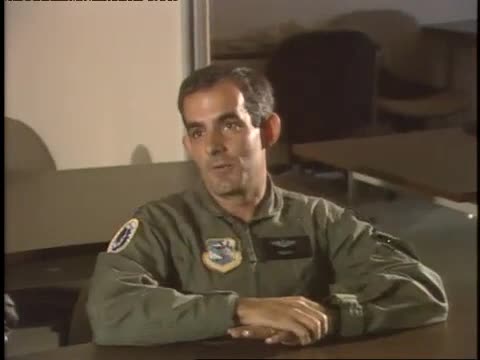
- Classroom scene with lecture and slide show on Soviet Strategic Defense Forces, followed by an extensive question and answer session.
- Date
- 1987-05-28
- Date
- 1987-05-28
- Asset type
- Raw Footage
- Subjects
- United States; Soviet Union; nuclear warfare; B1 bomber; nuclear weapons; United States. Air Force
- Rights
- Rights Note:,Rights:,Rights Credit:WGBH Educational Foundation,Rights Type:All,Rights Coverage:,Rights Holder:WGBH Educational Foundation
- Media type
- Moving Image
- Duration
- 00:19:00
- Credits
-
-
Producing Organization: WGBH Educational Foundation
Publisher: WGBH Educational Foundation
- AAPB Contributor Holdings
-
WGBH
Identifier: cpb-aacip-9afb7985aa2 (unknown)
Format: video/quicktime
Color: Color
Duration: 00:00:00
If you have a copy of this asset and would like us to add it to our catalog, please contact us.
- Citations
- Chicago: “War and Peace in the Nuclear Age; Air Force Class on Soviet Threat Awareness,” 1987-05-28, WGBH, American Archive of Public Broadcasting (GBH and the Library of Congress), Boston, MA and Washington, DC, accessed March 7, 2026, http://americanarchive.org/catalog/cpb-aacip-15-b853f4ks1n.
- MLA: “War and Peace in the Nuclear Age; Air Force Class on Soviet Threat Awareness.” 1987-05-28. WGBH, American Archive of Public Broadcasting (GBH and the Library of Congress), Boston, MA and Washington, DC. Web. March 7, 2026. <http://americanarchive.org/catalog/cpb-aacip-15-b853f4ks1n>.
- APA: War and Peace in the Nuclear Age; Air Force Class on Soviet Threat Awareness. Boston, MA: WGBH, American Archive of Public Broadcasting (GBH and the Library of Congress), Boston, MA and Washington, DC. Retrieved from http://americanarchive.org/catalog/cpb-aacip-15-b853f4ks1n