Say Brother; Cleve Sellers interview
- Transcript
Listening. Okay. To want the, you know, the free and independent Africa. [Interviewer] Well, one final [Interviewee] No. That everything in terms of- of- of history that we know about by and large is of a European origin and it's always highlighted with the white Superman. It's always- everything centers around an individual, not a group of people, not any thing that's collective. It's always individually inspiring. And we have to begin to get away from that. That's why we have to begin to see ourselves developing institutions that are independent of the present institution- I mean the educational intuitional structure. [Interviewer] So you think that a thrust should eventually be made in the North to develop substantial numbers black colleges. [Interviewee] If they're totally independent and away from the you know the Ford Foundations and away from
the services that usually act as cooption agents. Agents that, you know, will give you in order to control you. Those schools have to be totally independent. Totally independently financed. Totally independentally conceived up. Totally independently developed. A curriculum has to be one, I think, of nation building. We have to begin to develop new concepts like, for example, we an African people. We have to see ourselves as much much more than just the population within the confines of the United States. We are not a minority. We are in fact a majority. We have to see our relationship to our brothers wherever they might be. In the West Indies, in Brazil, in Cuba, or wherever they might be. We have to begin to understand that in order for one to have power, he has to have land. And
that there is a natural origin of black people, and that is in Africa, and that Africa is very plentiful in terms of resources, natural resources, and that there are some basic things that we have to be able to do. One of them is that we are gonna have to be able to provide goods and services for our people. We gonna have to be able to to control force and violence. And what I'm talking about here is that we don't control any of the police, we don't control the Army, we don't control the national guard, we don't control NATO. We don't control any of those agencies. Subsequently they're always use against us. We have to be able to control that, so that we can control whether or not black people can live. We have to be able to control the minds of our own people. That they do not - [beep] [cuts out for a seond] 45 women. [unitelligible] [Interviewer] You may want to go with the last point about controlling education, controlling
black people's minds. [Interviewee] Yeah, well, uh- Controlling our minds. We have to be able to to, you know, have people at least consistent. That they understand the contradictions inside the society and they you know, that they'll begin to deal with those contradictions. We have to be able to do all 3 of those things in order for us to survive, and in order for you to have power, you have to have land, like I said initially, and that we have to see, you know, like Africa has being that particular landbase. That once it becomes free and independent will provide those 3 things. It will provide the resources for us to produce goods and services for our people, it will provide resources for us to employ a certain amount of control as protection- protection for our people, and it will also provide us
with the resources so we can provide the material tha black people need to read and know about in order for them to be free and independently, psychologically, intellectually, and philosophically so. So our efforts and energies have to be towards you know develop it: a free- [Interviewer] Who have dropped out of say the public eye but that doesn't necessarily mean it's any less effective- [Interviewee] Right. [Interviewer] any harder or any less hard, excuse me. [Interviewee] The organizations- well, let's say it like this the mass media has a way of projecting certain organizations that they want projected, and they have a certain way of dropping others out of the public eye, as you said. SNCC has always been an organization of organizers. It's it's basically you know in and in and around the South at this point. The staff is not extremely large. One of the reasons being that when it began to drop out of the public eye,
the government and the state, local and, federal government began to exert a lot of pressure on people who were either members of or affiliated with the organization. Subsequently a lot of people are doing time in prison. They are being attacked as, you know, organizations which are in the public's eye today are being attacked. And they have a program in Atlanta, Georgia around the H Route Brown Center there. They do still have the national office in Atlanta, and they still have a substantial staff. So they're still operational. I am not a member of the Student Non-Violent Coordinating Commiting at this point. But, I do thinnk that my situation in relationship to South Carolina is an example of what I'm trying to
raise, and that is that the media has a tendency to catch our eye and we begin to focus on the specific. And at this point the specific is in fact the Panthers and the death of the 28 Panthers. Now, I understand, you know, I understand black people's commitment to black people dying. But I think that we have to understand that in the process of that particular 28 black people dying, there are numerous other black people dying all over. And that the mass media has managed to to get us to focus in on that specific, and while we're focusing in on that specifically, they have an op- the government has an opportunity to move around and deal with all the other brothers who are actively engaged in struggle, who may not be a part of that particular organisation. And we have to- we have to emphasize that because that's what's
happening. We get picked off while everybody is projecting into you know into let's say the death of Fred Hampton, you know the raid on the Los Angeles Panther office. And you know I don't say that in you know in terms of of trying to downgrade any of that that has happened to the Panthers. I'm saying that so that the black people can begin to see that they have to have a wider presepect- perspective. And it has to be much larger than a news service because we have to understand that a news service work in the interests of White America. It does not work in our interest by and larg. It does not work in our interest. And we have to begin to be more analytical of those kinds of situations. [Interviewer] Thank you very much. African history.
- Series
- Say Brother
- Raw Footage
- Cleve Sellers interview
- Contributing Organization
- WGBH (Boston, Massachusetts)
- AAPB ID
- cpb-aacip-15-9gt5ff6t
If you have more information about this item than what is given here, or if you have concerns about this record, we want to know! Contact us, indicating the AAPB ID (cpb-aacip-15-9gt5ff6t).
- Description
- Episode Description
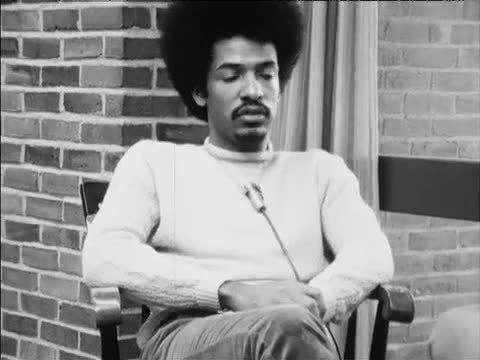
- Outtakes from Ray Richardson interview with Cleve Sellers, recently paroled from prison for his part in the so-called "Orangesburg (SC) Massacre" in which South Carolina State Police fired on, and killed, three black protesters; interview c. 12/1969. This portion of the interview contains Sellers' thoughts on separate educational facilities for blacks. Remaining portions of the interview can be found within Say Brother program #412, Blast From The Past segment; and within Say Brother #407, Blast From The Past segment.
- Date
- 1969-12-01
- Topics
- Race and Ethnicity
- Public Affairs
- Subjects
- Race; race relations; Demonstrations; police brutality; Education; School integration
- Rights
- Rights Note:It is the responsibility of a production to investigate and re-clear all rights before re-use in any project.,Rights Type:All,Rights Credit:WGBH Educational Foundation,Rights Holder:WGBH Educational Foundation
- Rights Note:Media not to be released to Open Vault.,Rights Type:Web,Rights Credit:,Rights Holder:
- Media type
- Moving Image
- Duration
- 00:09:45
- Credits
-
- AAPB Contributor Holdings
-
WGBH
Identifier: cpb-aacip-c2f2d1c87e7 (unknown)
Format: video/quicktime
Color: B&W
Duration: 00:09:45;26
-
WGBH
Identifier: cpb-aacip-37f10afa43d (unknown)
Format: video/quicktime
Color: B&W
Duration: 00:09:45;26
If you have a copy of this asset and would like us to add it to our catalog, please contact us.
- Citations
- Chicago: “Say Brother; Cleve Sellers interview,” 1969-12-01, WGBH, American Archive of Public Broadcasting (GBH and the Library of Congress), Boston, MA and Washington, DC, accessed April 2, 2026, http://americanarchive.org/catalog/cpb-aacip-15-9gt5ff6t.
- MLA: “Say Brother; Cleve Sellers interview.” 1969-12-01. WGBH, American Archive of Public Broadcasting (GBH and the Library of Congress), Boston, MA and Washington, DC. Web. April 2, 2026. <http://americanarchive.org/catalog/cpb-aacip-15-9gt5ff6t>.
- APA: Say Brother; Cleve Sellers interview. Boston, MA: WGBH, American Archive of Public Broadcasting (GBH and the Library of Congress), Boston, MA and Washington, DC. Retrieved from http://americanarchive.org/catalog/cpb-aacip-15-9gt5ff6t