City Makers; 105; Julian Bond
- Transcript
Julian the public uh knows you as a young man who had a high position in the pre-Stokely Carmichael SNCC and as a young man who had a rather controversial entrance into Georgia State politics and most recently as a young man who entered, really, the national political scene with a rather spectacular meteoric rise in the last Democratic convention. What I do not believe is generally known about you. Some things about your own personal and family background. You want to tell us a little about that? Let me see. I was uh I grew up in Georgia where my father was. Where were you born? Born in Nashville Tennessee. But my father was then president of Fort Valley State College which was a segregated State College in south Georgia and we lived there till '45 when I was five we moved to Lincoln University of Pennsylvania where he became president again. That's where I
first met you by the way, when you were 5. And, uh, stayed there until 1957. I attended the local public schools there and then went to a private school near Philadelphia - the George School in Bucks County, Pennsylvania. Graduated from high school in 1957 which was the year he accepted, my father accepted, a position of dean of the School of Education at Atlanta University. We moved back to Atlanta. Entered Morehouse College and stayed at Morehouse for three and a half years until the end of the first semester of my senior year, when I left first to work for a newspaper, a little weekly black newspaper in Atlanta and then to work for SNCC and stayed with SNCC for six years until after I had first been elected to the legislature and refused my seat. Elected a second time and again refused my seat. And just before being elected the third time I left SNCC and uh I've been a freelancer ever since then. I see. Uh How did you get involved in, uh, SNCC, uh, initially. Well I was- you were the son of a college president uh.
rather stable substantial middle class family background. Why were you concerned with uh protests? Well I got involved in the Atlanta University Center a student organization you know in 1960 there was a student sort of anti-segregation group on almost every Southern black college campus in the Atlanta University Center college's, Morehouse, Spellman ?Maurice? Brown Clark and Atlanta University had one. And I was deeply involved in that a series of demonstrations against the downtown lunch counters and we were part of a group of some 300 students who came from all over the South on Easter weekend of 1960 to Raleigh where the Student Nonviolent Coordinating Committee was founded and we fought a big fight with the students from Nashville who wanted the SNCC office to be located in Nashville but we convinced them that Atlanta was the hub of the South, and any office of any kind ought to be there and it did locate in Atlanta and it was always a very close relationship between the SNCC office and the local Atlanta student movement office. And uh for a time in fact we shared the same rooms.
And when I left Morehouse after having worked for this paper for a year and a half off and on - I grew dissatisfied with it and wanted to continue in the same sort of feel - writing and publicity and SNCC was there I was interested in what SNCC was doing. It was just then starting to spread out, getting a field staff in southwest Georgia and southeastern Mississippi and up in the delta in Mississippi and in parts of Alabama and it seemed to me, at the time that that was that was it. That was what was going on in the South. That was where the aggressive action was and I wanted to be close to it. I'm still fascinated by this phenomenon which is becoming increasingly clear. I think of the protest leadership among Negro youth the below 30 and the college-age youth in spite of the rhetoric of uh the masses. This leadership is still predominantly uh coming from uh young people
from middle class Negro families uh middle class backgrounds, prep school. For example in the northern colleges now the black student's associations making rather militant demands upon college administration in talking about the masses - generally these are young people from middle class backgrounds and families. How do you account for this. I think it may be one or two things. First, I like to think that all of the college protests stem from the southern student movement. The movement that grew up on the campus but was not concerned with campus affair as much as it was community affairs and a movement which really moved way off the campus into rural communities. I working on the right to vote, working on trying to work on organize sharecroppers. Really moved itself far away from academia. And then as young white and black students from the north would come down and experience a summer of this. They took back say to Berkeley or Columbia or NYU
or Harvard or any of the several schools; some of the ideas they had gotten. And techniques - and techniques - and protest methods- right and just sort of grew from there. I like to think that a lot of the good things in this country come from the south. And I think the student activism came, but I don't know why it is that in 1960 particularly you would have had this sudden outgrowth of student activism on the black college campuses. Uh You had these four young men in Greensboro, North Carolina who all of a sudden sat down at the lunch counter and began a movement that is still in a great different, many different variations still going on. And I can't decide what it was that made them do it at that particular time and what was it that made it catch on as it did. But Julian, you know you really are not getting at on my question of how does one reconcile. And maybe I didn't make it clear enough the anti-middle class rhetoric of. The black student protest movement which is also brought by the white student protest movement with the fact uh that the leaders of the black student protest movement and as
well as the leaders of the white student protest movement are -- almost exclusively -- middle class in their own background. I don't think it's two two things. I think some of it is rather superficial and that is sort of a glorification of lower class people. Which I would think would be rather insulting to lower class people sort of the uh the uh attractive beast. the noble savage - the noble - Right exactly. So I think that would be rather insulting to lower class people. But some of it, I think, probably a majority of it is a feeling of that if you're black particularly in middle class and you may come from an educated family or a family where there's been some college training over one or two or more generations that in a great many things in this country doesn't make any difference. If you're black, it's just as though you never went to school. And I think some of these kids may feel some guilt about it, the fact that they are privileged college educated black young people are - really a talented tenth. Dr. DuBois used to think about it. They may feel a little guilt about it and feel the necessity
to involve themselves much more than they would, were they not in the position they find themselves in. Yes. Is this a part of the reason for your decision to cast your lot. in the South and particularly in Atlanta. In terms of your own political future. Well mine honestly mine has to do with the fact that first I think politically our future as a race is in the south and we've got the numbers there. We're 40 some percent in Mississippi, over 30 in Alabama and Georgia uh and South Carolina. And the opportunity for building a either strong or black political movement or an interracial political movement that has a strong black component in it is much greater in the South. For instance in Georgia. Now you've got 14 black state legislators more than any other state except Illinois. And those records will never be equaled by - I don't think New York State or Massachusetts or California or any other state in the union. And the reason is because we've got the concentration of black people there. Now they're largely
unorganized, largely unregistered but the potential is there if it can be harnessed. And I think it is a great future in that section of the country. How do you square that though with the fact that as of now the majority of Negroes living in the United States are living in northern, urban, centers. I saw a report, uh, I guess in the early part of last summer, issued by a commission that ex-Senator Paul Douglas was head of, which said in effect that the population trend of south to north was being reversed. If it had not been reversed already. And that part of the black population was beginning to go back south that the opportunities were there, the employment is beginning to be there. And particularly for the college educated young people. And there is a kind of a future there that you don't find in the north -- but they're going back south to the cities in the South. Oh yes definitely they're not going back to the rural areas. What's happened to the rural Negro? Is he the forgotten man? When I was your age and or uh younger in college
our major concern, those of us, who were pretending any sort of social sensitivity, was for the sharecropper - the rural depressed negro. Who was whose condition was not beyond, very much beyond that of a slave. WI haven't heard about him in the last 10, 15, 20 years. I think that was the beginning, not the beginning concerns, but one of the concerns of SNCC and say in the period from 1961 through 1965. And I think one of the tragedies of the last 10 years is that the Congress of Racial Equality, the Student Nonviolent Coordinating Committee and to a lesser extent, but almost the same extent, the NAACP have really in my opinion abandoned the south, particularly the rural south. SNCC and CORE, which in the summer of '64 had over 1500 to 2000 people working in all the states in the south are just not there now. You don't see them there anymore. Part of it is I think there's this great upsurge of interest in the cities and very properly so, but it ought not come at the expense of rural
people. Now there is this migration from the rural to the urban but all of those black people who live in the delta in Mississippi and Alabama and Arkansas who live in the bayous of Louisiana they're not going to leave. They have no desire or they don't have the ability to go to Chicago or Memphis or Detroit. And something's got to be done about them. Some kind of movement's got to be put toward working for their benefit. Julian, Do you believe that the peak, that we've passed the peak of Southern rural negro migration to southern or northern cities? You know do you have? I don't know if we have passed the peak. I think you may have passed the peak of the migration south to north but I don't think you passed the peak of migration from rural to urban. That is people who live in rural South Georgia coming into Albany or Macon or into the city of Atlanta. People living in rural Alabama coming to Birmingham and Montgomery. Whereas in a few years back they would have gone to Chicago or Detroit. Ah So you may have a more localized migration but still I think a great many people are going to stay on their farms. They are going to eke out a
very very meager existence living on federal commodities where they have it, on welfare where they can get on it. And they'll probably just going to remain there in sort of a suspended state half between living and dying because there is no attention being paid to them either by the federal government or by the kinds of private groups - SNCC and CORE, the NAACP. And what you have on the scene in the South in rural areas now, this indigenous leadership which is very alert and very aggressive but somewhat limited - doesn't have the funds that SNCC and CORE and the NAACP can bring to bear on those questions, doesn't have the national prominence. And really the rural south I think has been abandoned by the movement very long. You're a representative to the Georgia state legislature from Atlanta. Right. An urban - in an urban area - your constituents are, for the most part if not exclusively Atlanta negroes. Yes. uh Do you see any role that you can play to increase the opportunities or the living conditions of the Atlanta negro as a state legislator?
Well my experience has been, I think the experience of the other black legislators has been, rather frustrating more than that is that we have never been able to really initiate anything tremendously progressive. At best we're able to defeat measures that would hurt our constituents. We were able to beat down for example a very vicious piece of welfare legislation that would have allowed the state to sue the estate of deceased welfare recipients to reclaim the money that had been paid to them over the period they were on welfare. We were able to stop that. But we were not able to really put forward any progressive measures. And I don't think we will be able to unless we can form some kind of working coalition with the kinds of white people who represent the same kinds of poor white people. White people who fit in the same economic bracket that my constituents do. The average income per family in my district is $2500 a year. And on some few occasions...Only $2500 a year average per capita income? per family in Atlanta - in Atlanta Georgia, the Queen City of the South. Well how do you deal with that phenomenon?
What can you as an elected public official do? The best thing I can do and it's a sad thing to admit - the best thing I can do is to get the city government of the city of Atlanta, the county government of the county of Fulton, the state government of the state of Georgia to unbend a bit and offering the kinds of services that the citizens of most cities - the more affluent citizens of most cities seem to take for granted. For instance my constituents complain about something as relatively minor as garbage collection and by making a bit of noise I can get their garbage collected. They complain about the lack of paved streets and with another little bit of noise I can get the streets paved. But I really cannot do anything in my position as a legislator to improve their economic condition. I can't do much to improve their housing situation beyond getting the city to inspect and probably condemn their houses. Which means they've got to move out someplace else. That really is a very frustrating role to play. Well your Your. Your constituents expect you to be able to help them. Certainly do. uh And you tell me that
the average income of your constituents, per family is twenty five hundred dollars per annum. Right. Well. In what way can you help as when the Office of Economic Opportunity tell us that the poverty level in the United States is $4000 per family income. uh What. What realistically can you do? Well again not very much and I found in my experience, the experience of other black legislators in Georgia as well as those of others I've talked to in other parts of the South is that we become sort of a negotiator between our constituents and all of the kinds of agencies of the city and county governments, the state governments, the war on poverty, OEO. That we become a negotiator between these agencies and our constituents - A broker. And we are put ourselves in the position of having to go before uh all of these different groups and agencies and beg and plead and ask and demand, that they do something. Whatever it is they're
equipped to do to help out the people we represent. And usually we get minimal, really minimal help. But Julian we've been told you know, uh that Atlanta uh is the symbol of the new south. That uh in terms of race relations and progress of the negro that uh actually Atlanta has been held up as uh uh the symbol that negroes really don't have to move to northern cities. Because here in Atlanta there's been rapid movement. Are you saying that this is sort of a myth? Well I'm saying that that's true when Atlanta is compared with Jackson, Mississippi. Or when Atlanta's compared with Birmingham, Alabama or when Atlanta's compared with. Albany or Savannah or any of the other towns or cities in the state of Georgia. A in that kind of situation Atlanta certainly is a beautiful and wonderful place to live in - comparatively speaking, but I think were Atlanta to be compared to San Francisco or Los
Angeles or I'm not sure about New York. But with any of most of the major cities of this country then it comes off lacking. The difference between Atlanta however and other cities is there's has been a kind of of uh old political coalition between all the black people, some of the white people. What it's done is kept in office for about 30 years, moderate city governments. City governments that had some responsiveness to the needs of the Negro community. And so the kinds of really vicious uh government racism that you might see in a Birmingham or a Jackson, or a Memphis or any of the other several cities in the South. You don't see that in Atlanta. Well - you see - it's a paradox - its paternalism. You mentioned the number of northern cities such as San Francisco and Los Angeles, and others, that are clearly superior to Atlanta in terms of the predicament of the urban Negro. But almost every one, in fact I think every one of the cities you mentioned has
had, riots. Yeah - And disturbances, and Atlanta has had its sort of avoided one - right. How do you account for the fact that in these so-called northern cities where we, actually, not psychologically, but actually, the predicament of the Negro is superior to his predicament in the southern cities. Well - We have eruptions. I think it's for two reasons I think is because geographically Atlanta is different from all of them. Atlanta does not have the equivalent of Harlem or Bedford-Stuyvesant and it doesn't have one large, sprawling slum. What it has is a series of rather small slums. And I think that argues geographically against the kind of large uprising that you had in New York or Watts. Or any of the places where you have this enormous collection of black people herded together. Uh Middle class? - It's interspersed. You have a very nice neighborhood and a very poor neighborhood and perhaps a very - a white neighborhood and a poor black neighborhood, another neighborhood here and so on. So I think that argues against the sort of sustained and
long range and two or three day eruption that you have had in some other cities. The other thing I think is something very peculiar and I'm not absolutely convinced in my own mind this is true. It seems to me a black person living in the city of Atlanta, Georgia can say to himself, that in the past 10 years of my life I have seen with my own eyes my circumstance change in a way that can only be assumed by me to be for the better. It may not have lifted my standard of living. It may not mean my children are getting better education. My house may be in a bad shape but I've seen some visible changes. I see - like the removal of white and Negro signs. Exactly so. But if you live in New York or in St. Louis or in San Francisco.- or Boston - or Boston. You can't say those same things. You cannot say that my life has changed. If you came to New York City 25 years ago; you could then eat at lunch counters. In Harlem at least; you could then ride on buses and sit any place you pleased. You'd do all the sorts of things you'd wish to excuse me. And so you haven't been able to see with your own eyes any visible changes. And I think there may be a little
more hopefulness in a city like Atlanta. Where change has been visible and open and some things may be said to have improved. More than it would be in a city like New York where you cannot say that things have gotten better. Do you think the factor of a more visible and relatively prosperous negro middle class in southern cities such as Atlanta might be a factor too? I think it has been. I think in the fast in the future rather it's going to be a detriment that the large underclass is going to say that we want the things as middle class has. And we don't have them. They're going to get visibly more angry. Whereas in the past they've been able to say; " well here are people much like ourselves who for one reason or another have improved themselves, have nice homes, some with swimming pools inside in their basements, some with fancy two and three car garages." Sust as I'm - running and owning banks - oh yes, newspapers, insurance companies. All of the trappings of a very successful
financial life. And in the past I think that's been something to look up to, something to aspire to something that a people upwardly mobile can say well if I work hard and send my children to school then I can get that way too. In the future however, I don't think they'll say that. I think they'll be irritated by the sight of that influence. Has there been any serious encroachment of black separatists, black militant approach the Atlanta or southern city scene?. No, not anywhere close to what you might find in New York City. Not at all. This too might be another factor although I think it ought to be certainly clear that the black separatists are not the agents of violence although some of them would want to give that impression. The mood as I see it in northern cities among Negroes is, at least on the part of certain more
articulate, militants is a rejection of the prior integrationist thrust of the civil rights movement, And an attempt to make a virtue out of segregation. under the guise of bla- black separatism, black control. Is that moot? No again you don't find that same notion for instance in Atlanta. Right now there's still a tremendous amount of interest in school integration. And I think part of it may be that the schools in Atlanta are so terribly overcrowded that that is the only possible avenue of relief as they integrate, to send black children into white schools which are terribly undercrowded not even full to capacity. So still very much interest in integration as a philosophy as a goal as the aspirations of the the kinds of people who are really suffering daily because they're squeezed in their housing, they're squeezed out of jobs. It's still very much interested in integration. Not quite I don't think as much as they may have been five years ago
but certainly have not been turned off by it. Or are not interested in moving away from it. They're still very much interested in it. Well I must say that in my observation of the concern of negroes in our cities in the north. In terms of this very important function of education. During the past two or three years it seems pretty clear that they are moving away from integration and uh trying to increase the quality of education for their children through decentralization, community control. And are not even permitting themselves to discuss the fundamental problem of this being another guise of separate but equal. Right exactly so. It's a it's very understandable on the one hand why people would want to control particularly in a system as large as New York where the individual parent or a student must be really lost. But at the same time it's rather dangerous to think the day may come when we'll be told that now you've got your
school and you can run it yourself and be happy with it, take it. I sometimes wonder you know. Why we believe that uh separate but equal will be any more successful demanded by Negroes than when it was being imposed. And I suppose it's still being imposed fairly, in the south and the north. But one of the things that really disturbs me is the extent to which the decentralization or community control thrust can become really perverted into a more insidious form of segregation. And the paradox that this might have a greater impact in the north than in the south. Again I think the difference north and south is that the dangers of the paradox you speak of much greater in a system as large as New York's or Chicago's or Boston's. Atlanta although really a major city in the southeast is still relatively small as cities go. And I don't think people feel the same need to
control community school districts. The system is manageable and so on. And you feel that they are still - the negroes are still inclined to emphasize desegregation. Oh, very much so. Very much so. What do you think are their chances of success? Well again that depends on a very dangerous political game that the politicians, black politicians including myself in Atlanta are playing and that is we are racing against the day - toward the day rather - when our numbers in the population will enable us to at least have control of the city. And we're racing against the day when the city of Atlanta may become although I doubt if it will maybe come a city like Newark. A hulk. A place where the population doubles during the day when white people come into work and and goes in half in the evening when they leave work. Where movie theaters are closed down. Where banks are folding down. Where train stations are being locked up. Ah so we're racing. We're playing with those two factors. We're forty eight percent of the population now. We have minimal representation in city government. We hope that if we become a majority of the
population, if we can change the system of elections in the city, we'll be able to run the city and hopefully. There is a chance of a negro mayor of Atlanta? Ah yes, in 10 years, no question about it. If we can contain the city limits and the state legislature controls that and we beat back an attempt to expand the city limits three times during this last legislative session. I'm sure the city wants -- to incorporate the white Suburban ?range? as a political force in the running of the city. Right. That would have decreased our percentage of the population to about 25 percent. And I think rendered us comp- politically impotent and useless. So in effect you do see the movement toward Metropolitanization you know regionalism is- oh yes, Atlanta - city as a threat. negro political power Trying to do in Atlanta, have done it in Nashville with the Dade County - not Dade County but the uh Davidson County Nashville Metro government and done it Miami with the city of Miami Dade County, done it in Jacksonville. Are discussing it in Birmingham. And I really think that all those cities certainly -- I think it's going to move north too - oh yes, no question about it.
cities need that expanded tax base certainly but they also need I think in the back of their minds to diminish the black population. And that's the quickest and easiest way to do it. It's faster than urban renewal. But Julian, uh, on the other side of this metropolitan regional approach would you get certain advantages such as a broader tax base to provide more efficient services and education and sanitation control. And that's why I say it's a game, it's a race. And the question is whether the point at which we take control is still the point at which the city that exists now is a viable object, is able to begin to solve its problems. if it is then we could then begin to expand and take in the base and still retain some of the control that we had. If its not I think we will have lost the game. Atlanta will be Newark, will be a hulk, a shell. What do you see as the major, urban problems that
confront Atlanta? That must be dealt with in some positive way? I think with us it's - racially speaking- it's it's our inability to have any control over the things we want to control. We cannot direct where a street will or will not go. We cannot decide where a school will or will not be built. We cannot decide whether a factory will tear down a nice neighborhood or a bad neighborhood. We can't make any decisions about anything that goes on in the city. We have some influence. It's true. It's wrong for me to suggest that we don't. We do have some influence but we don't have this real say that any people ought to, particularly if they're 48 percent of the population. In a sense you have 48 percent of the population in essentially the predicament of the colonial subjects. Exactly so. Without power and control. How does this influence services such as uh sanitation? As far as they go. well it does in a very peculiar way. We have one black alderman who
ordinarily is the official who takes care of of city matters like that. But because I'm a state legislator and because I have the say more than the alderman does about how much money the city of Atlanta will get from the state about what uh shall be the term of the mayor. How often and how frequently he shall be elected, how much his salary will be. I'm actually more powerful in an indirect way than that alderman is. So my constituents come to me not asking me about state sales tax and not asking me about questions of consolidations of schools in Merriwether County Georgia. They come to me asking for their garbage to be collected and they come to me asking for their streets to be paved so I occupy, although I'm a state officer, I occupy a position of uh of an alderman. Do they come to you with uh problems of welfare? Yes. All the sorts problems that normally a citizen might go to his alderman with or his mayor with - my constituents come to me with those kinds of things. But what can you do about it? Given for example Maddox, given uh. Well, with those kinds of problems,
I don't deal with him. I deal with the mayor of Atlanta or with an alderman and I call him on the telephone and I say this is Representative Bond speaking and I imagine what goes through his mind. Uh so - Are you calling a white alderman - yes - or a black alderman now. Well probably a white alderman. My district is in two wards. Most of it is a ward represented by a white alderman. Part in a ward represented by the lone black Alderman. But I usually call the white alderman and I say this is representative Bond speaking and I imagine what flashes through his mind is: this is, I'm talking to a man on the telephone who controls the amount of money I make as salary as an alderman. I'm talking to a man who will decide whether I will run ward-wide or citywide. I'm talking to a man who will decide lots of things about my city and so I ought to pay some attention to him. And so I say garbage is not being picked up on Chestnut Street and he says; " I'll take care of it, Representative Bond". And he does. Alright now. You call him about a problem that requires money. What can he do if the available funds will not
permit uh the street to be paved or a school to be built or urban renewal, really to make a difference in terms of the conditions. Well in that case I wouldn't call him. I'd call the mayor. And the mayor, I think we're fortunate in Atlanta we have a mayor who's better than most mayors. And he'd I think really make an effort to find the money. If he couldn't find it I don't know what could be done. When the legislature came back in session we'd fight for an appropriation and the boys from the rural counties in south Georgia would tell us that that appropriation be better if it went toward eliminating the boll weevil or something like that. Julian, but you were one of the first uh negros or whites for that matter involved in the problems of civil rights of the city, to raise the question of the affect of the Vietnam War and the tremendous financial burden in support of that war in blocking meaningful financial commitment of the federal government with the resolution of
urban problems. Have you changed your - this position? No. I've begun to be less optimistic about the money that now goes into the war being put into the cities.Were the war to end automatically, or were the war to end just this moment while we're sitting here. It seems that some of the congressmen who say well we can't fund the job corps as much as we'd like to because of the war, wouldn't fund it anyway if there were no war. Some of them I think would but I'm not as optimistic about that as I used to be. I think the war had another kind of effect, an unintended effect and that is the kind of energy that's gone into the peace movement. I think is energy that might have gone into the civil rights movement. And I think it has been proper for it to go into the peace movement, the anti-war movement, but Had there been no war you might have been able to corral that same force, those same monies that have gone into very militant demonstrations on the one hand to rather ordinary campaigns like Senator McCarthy's, on the other. That money, that energy, that thought, that dynamism, that feeling of concern in the white liberal community might have been
put into some concern for the black community had there not been this war. But I do sense and you must correct me if I'm wrong, that you don't seem as, uh exercised about the displacement of financial resources that could be available for solving urban problems through the Vietnam commitment. Well - As I did once - once were - well if I did I think it's because in say 1965, '66 I had a feeling I had to convince other people that my position was right. Now I have a feeling they're all convinced, If not all convinced, but more of them are. All right let me keep pushing uh - does that mean that you giving up really on ever getting for the cities in northern and southern. The amount of federal financial commitment necessary to solve the - No it doesn't but it it means this that uh when I used to say make a speech to an audience in 1966 or even '67 and
used to say that one of my disagreements about the war and I have many. One of my disagreements about the war is exactly what you've said, that it drains funds that might be spent here. I'd get some opposition. Now I get almost none - that people accept that. That is true. That there will be no funds for the city. There will be no guns and butter too. But will there be butter and uh an attempt on the part of our government to strengthen our cities through providing for human beings the minimum conditions- Well that's what I'm not as sure about as I used to be. I used to think if only this country were committed to ending the war then it would therefore be committed to saving the cities. Now I think many more people are committed to ending the war. But they have not adopted a commitment to save the cities. A great deal of rhetoric particularly from politicians in Washington about re-application of uh the war funds to the cities. But I- I tend not to believe most of them. Nixon for instance talks about, I forget what he calls it, the peace surplus - which he estimates it's some 20 billion and I've heard him say he wants to spend 16 of it, 16 billion of it and
building a stronger nuclear defense for the United States. Two billion of it for paying off the national debt and 2 billion - the 2 billion that's left for the cities. And how much better uh if you could spend 2 billion for national defense, 2 billion for paying off the national debt, and 16 billion for saving the cities. What do you expect, By way of, not only concern for the problems of the cities in an attempt to really deal with them seriously, but also in terms of civil rights from the administration of President Nixon. Well as - president-elect Nixon - one one thing, uh, that the Republicans might be admired for is that they seem to be big uh big guns in favor of uh efficiency. uh Vice President-elect Agnew for instance has suggested that there be a national welfare standard as opposed to the hodgepodge system you have in each of the 50 states. What frightens me is I'm afraid he'd want to set the national standard at the level of Mississippi. Well, let's say Maryland - uh Maryland
rather than at some high standard as it ought to be - a decent standard of living. But I think that's a good idea on the face of it. That there ought to be a federal standard of welfare. The other thing that impresses me about uh Nixon particularly and doesn't impress me a great deal is he seems to be much more deliberate man much calmer man than he used to be and I'm sure I rather I hope he's not going to rush off in all directions at once as he once may have done. But I'm not very optimistic about the Republicans. Nixon said he wants to cut out the HEW's power to withdraw funds from Southern school districts. That's the only effective weapon That this country has found to integrate southern schools. I think he is uh, in the latter part of the campaign. I'm not too certain and confident but I have somewhere vaguely in my mind that uh Mr. Nixon pulled back on that. Well I hope so. uh That really frightened me because I- I saw that as the only effective weapon in the south and in the north as well for integrating school systems, is pulling that money back and if he stops that then you
just stop the intent of the '54 Supreme Court decision forever. On the other hand Mr. Nixon has made very clear his uh desire to try to build eh entrepreneurship and production and e- a higher economic base in the negro ghettos. - Yet again I'm not altogether sure what he means by it, And I think a great deal of it's rhetoric. For instance he once I heard him in a speech describing what he meant by black capitalism and what it amounted to was white capitalism. In the ghetto it was uh white ownership of of uh rather small industries that would certainly provide employment, provide training provide jobs and management for Negroes.But would not provide opportunity for black capitalism to be black capitalism. Now I think Roy Innis uh would disagree with you on that uh Roy Innis is uh taking credit for converting Mr. Nixon to his, Roy's, uh position on the role
of black capitalism in raising the standard of living of the negro in the ghetto. And Roy's position is that uh the federal government, private foundations and uh white capitalists should join together to provide negroes with the tools and machines of production. You, I don't know whether you've talked to Roy Innis recently but he is very clear on his belief that the salvation of the negro ghetto is to uh bring into the ghetto Negro-owned businesses, Negro-owned factories, stores, etc. - let me - Mr. Innis, Mr. Innis is telling everyone that uh Mr. Nixon has bought his decision. Well, I hope he's right. But if Roy made up the term black capitalism let me inject another. And that is community socialism. I know socialism is a tainted word but I like the kind of You don't expect Mr. Nixon to buy that. No not at all. You could change the name but I like the kind
of enterprise that Reverend Leon Sullivan is engaging in in Philadelphia. And he's gotten large numbers of relatively uh, - unskilled - unskilled people, the poor people rather to contribute to a fund and now they own jointly about a thousand members of his church own a shopping centre. Nixon has been there in fact and looked it over and apparently was impressed by it. But I'd much rather see that kind of large based ownership of an individual enterprise rather than single ownership of it. I think it's fine as a money making venture for an individual black man to own a factory. He's going to get wealthy. But I think it's better for the community as a whole if the ownership is joint, is shared by large numbers of people so that none of them depends on the profits from that enterprise for his own living. uh And so that the profits can then be turned back into another kind of community enterprise rather than having the money being challeng- channeled into one man's pockets. Well the Innis-Nixon approach to making the northern ghettos more
viable, this approach did not seem to me unlike what now exists in Atlanta, where Negroes, given the heritage and history of racial segregation, Negroes have built certain kinds of business. Oh, yes, certainly. Uh Do you think that uh importing that southern pattern of economic segregation to the extent that it's possible to have economic segregation into the north, will make the predicament of the Northern negro more palatable? I think it will with two exceptions. What's happened in Atlanta is that as say integration has come, there's a kinds of Negro businesses that are not competitive just had to fold up and go away. A great many of these businesses sprung up in the days when say restaurants, when you couldn't go downtown and eat at a very fine restaurant and those that didn't come up to standard have disappeared. Others that are far superior to most that you find
downtown have remained a very fine restaurant and a hotel motel nightclub complex in my district built by two men who really pulled themselves up by their bootstraps, the Pascual brothers. I don't think it has its equal in any Negro community anywhere in the United States. But the- and the other exception is that this kind of economic development the sort of economic segregation, has resulted in building a class - a very strong middle class in Atlanta. And in fact a sort of an upper class of rather wealthy men. More black millionaires in Atlanta than ?the others?. But it hasn't really I don't think improved the economic condition of those people on the very bottom. They are still largely dependent upon white people for their sustenance, for their jobs. And there's not enough. There are not enough job openings in the black community and the segregated economy to absorb them. There may be if this black economy could expand itself but its bankers, it's heads of its insurance companies that savings and loans coming in. Tend I think to be almost as conservative as are some white bankers. They are not willing to risk the kind of capital that we complain white bankers are not willing to risk.
It's interesting that uh you discussed ideas about the Nixon administration. We we seem to have moved away from the traditional way of discussing civil rights into the area of economic -yes- development. It may very well be that this would be- will be the thrust of the Nixon administration maybe dealing with civil rights problems uh instead of dealing with civil rights problems dealing with uh economic development problems. Maybe, there may be a lot of young men who are now coming out of college who wish they had majored in economics, [laughs] rather than political science. Julian, what do you see as your own political future? Do you intend to devote the next 10 years of your life to uh politics and Georgia, Atlanta or uh are there some ideas about the new politics of the national level?
Well I'm I'm very interested in what goes on all over the country. But my primary interest is in Georgia. First I'd like to see much more liberal political climate. I'd like to see the Democratic Party become a a much more democratic organization uh nationally. But my major interest is in Georgia and I'm hoping that I can participate or join in the building of a statewide liberal political machinery in the state. We have a nucleus of people who were engaged in the challenge at the Democratic Convention last August. And we hope that from that nucleus can be built a statewide integrated political movement and empathize integrated - what would you do with a person like Maddoxs as your governor. Well he can't succeed himself. And uh one very peculiar thing about him that I don't think is evident to people outside Georgia is that he is a peculiar mixture of two strains of Southern politics - racism and populism. And the populism sometimes is dominant. Not often, but sometimes, and when it is he's rather a decent man. When it's not, he's not decent - Do you have any uh personal or political contact with
Maddox? Well during the legislative session which in Georgia is only 40 days per year I would guess I see him almost every other day. He's cordial he's friendly, he's like uh, he's a politician You are- he's nice to people he might not like You are a fact. You are a reality. He cannot go out - he is a reality of my life as a politician. He is the governor of the state in which I live He is a major factor in the legislation that comes before us. Does he understand uh the complexities of the nuances of the problems of the cities? I don't believe he does. I don't believe he does. I don't believe he understands the complexities of government. I do believe however that he knows what it means to be poor. He comes from an extremely poor family. He's a classic American story of a poor boy who by his own hard work made himself into a very successful man. He doesn't believe, as a great many self-made men do that every man can be a self-made man which I think is to his credit and he does know what it means to be poor.
He does have some sympathy for poor people - Julian, I get the feeling as you talk about him that uh you have a compassion that transcends the trite racial polarization. Right. Well I once read an interview that had been done with him by some student at Emory University in Atlanta and in the interview it said that Maddox as a young boy used to have 2 paper routes to raise money, not for himself, but for his family and when he got through selling his papers he used to go into downtown Atlanta and look at the people he admired the most. Who do you imagine they were? They were the clerks in Rich's department store. And the reason he admired them more than anyone else in the world is because they wore neckties and they handled money. And I thought how pathetic that is and here's this poor young white kid who is really out there hustling on the streets scuffling and this is uh his aspiration to be a clerk in a department store. But your perspective of Maddox does not seem to be dominated by Maddox the holder of the axe handle. Or the shotgun, who's saying the niggers shall not pass. It's a perspective of a poor,
white youth seeking to move up the economic That's what he- ladder. He was ah in many ways victimized. He victimized himself in that situation. The negro militants you know will repudiate your sentimental compassion. Well I hope it's not sentimental it may be compassion but not sentimental. And I think he victimized himself in that situation he put himself in that situation. He caught himself in it. He couldn't escape from. He had to pull out that axe handle. There's nothing he could have done. Like George Wallace, who I have no sympathy for whatsoever. Wallace had to stand in that schoolhouse door. He could not escape it. He couldn't stand aside. Let's get back to your future. uh Do you see the possibility of uh going beyond state politics in Georgia to the national Political areana?. Well I know I'm I'm not so sure. I know I'll never take Governor Maddox's place. uh Or Herman Talmadge's or Richard Russell's. There might be a possibility for some black person to be elected to Congress from Atlanta in three or four years or from
south Georgia for that matter. And I'd be interested in that. But I'm sure I'd have a great deal of competition. Something that the local political people in Atlanta would have to work out among ourselves so I'm I'm just not really sure. - Well. What. Would you like to do beyond Georgia, beyond the state legislature? I think I'd like to be in the Congress and that's about as high as I'd expect to go, the U.S. Congress. You recalled the Democratic convention in ill-fated Chicago. You were put up uh as a possible vice presidential candidate. Not again was- without anyone recognizing your age limitations. Well the people who put me up recognized it, we all recognized it. uh And that would not have happened had they not already asked 2 senators. What they wanted to do was extend the time of the convention. They'd asked 2 senators if they'd put their name in nomination, both of them said no, they knew Senator Muskie they didn't want to do anything to offend him and they asked me and I said I'd never met Senator Muskie and I was sure he
wouldn't be offended anyway. That's how that came about. It was just sort of a fluke of history and uh I doubt if it'll happen again. Uh You're 29. 28. 28. Which means that in 1972 you still will not be of legal age either for vice presidential or presidential. By the way would you be a legal age for the Senate? I have to be 25. Don't you? Yes. I'm past that. Oh, that's right. Ted Kennedy was of legal age when he was elected. So actually in '72 you will, whatever role you play in uh national Democratic politics would have to be restricted from national office. To wait till 76 or perhaps 1984. 1984 would be an appropriate time to have our first Negro vice
presidential or presidential candidate. uh Who are some of your political heroes now. At the time of the convention I had a feeling that Senator McCarthy was uh at least a limited hero. Yes he has a limited - some some few things about Senator McCarthy weren't entirely appealing to me but I really admire the courage of this man to step out and long before anyone else did to oppose President Johnson. I took it - and it took a certain something that apparently others didn't have. And so That was one dimensional, right - uh to be the president of the United States requires at least as many dimensions as Mr. Nixon - right - I admired Senator Kennedy Robert Kennedy and Edward Kennedy uh and then I have different kinds of political heroes. I really admire Adam Clayton Powell, especially as a younger man the kinds of battles he must've put on in Harlem and in the Congress since. And uh, It is strange and - And it's fascinating.
Well the bit I've read about him uh as a younger man he really must have been fascinating and uh really a tremendously aggressive young man to struggle as he did. His fights for employment on 125th Street in Harlem. those kinds of thinks. - Are you going to correct my history - Adam and I was a direct observer there Adam didn't struggle in those days - Oh he didn't, well - he was a happy warrior. You shattered the image. You shattered flamboyant in his operation. But what are your feelings about Adam now? Well I think again he's he's caught himself up in his own history. He's a- I think had an opportunity to straighten out his difficulties with the congress and uh didn't do it and put himself in a bad position. But I still have a- in spite of what you said and shattering my illusions. No I didn't intend to shatter the illusion. But I've know Adam for my since a kid for a long long time and I've never known him to struggle. [laughs] In fact it may have been that one of
the essential ingredients of the tragedy of Adam now is that he never really learned to struggle. He too made from - perhaps that why- a privileged middle class, upper middle class - perhaps that's why he finds himself in the difficulty he does now. Yes. I'll tell you I admire Hatcher a great deal. Richard Hatcher, the mayor of Gary, a great deal seems to be, I think unique among all American mayors, white and black, to be a fighter and a struggler and someone extremely conscientious. I know he has called me to fulfill speaking engagements for him that he didn't want to take, not because he didn't want to travel or he didn't want to speak, because he didn't want to leave Gary and felt -at the same time - way. same time he's being criticized for being an absentee mayor - he doesn't leave as often as some others do. He certainly does not. And he's really a good man. But most of my heroes are old heroes and dead heroes. Frederick Douglass. is my hero. In terms of your own political future, do you have a a model uh
you would seek to emulate, or? No not really. Unless it was someone like Douglass who had a lot of faults but I think is really the kind of person you can't help but admire. Julian, you are usually seen and discussed as a leader among the new politics, particularly the under-30 contingent of the new politics. It's interesting that you have not uh mentioned any of the cliches that are usually associated with it. Does that mean that - The system if you like- I haven't heard you say anything about or against the establishment or the system or the need for total destruction of the present system in order to rebuild something brand new. How do you avoid the cliches of the political approach which excepted you or you ?used your name? - Well first, because I think a lot of that is is just rhetoric and I'm anti- an anti-rhetoric man. Well
how do you maintain your credibility with the new- I'm not sure I always do in 2 years. I won't be able to lead the under-30s because I'll be 30 years old myself. I'll have passed into limbo. uh But I'm just very much against rhetoric uh First I think in the black community I have a lot of what you can only call maumauing, you know a lot of aggressive jousting to see who is the blackest among all black men. And you never seen whites competing for that? Oh yes. I uh in the 201 community control decentralization uh struggle. It was a white Protestant minister who would come to the local governing board meetings with two black power buttons one on either label with his collar sandwiched in between. He wanted to be blacker than the blackest black militant there and he had a difficult time. If you have the maumauing as in Kenya. On the black and the black section of the population you have a maumauing as in China in the white section
of the population and there's a great deal I think is made of the appearance of radicalism and the revolutionary activity and not much of the of the actual fight. What do you see in terms of the future of our cities given all of the forces which seem to be converging. This time the civil rights movement, the New Politics movement, the uh dawning awareness on the part of business and industry that uh something has to be done. Well I think it's a series of ifs. You know if something doesn't happen then something else will. If things go as they are just now with the kinds of federal help that's been poured into some cities beginning to be cut back as Nixon seems inclined to do without having private industry or..or some force in the society taking up the slack,
I think things can only get worse. There's no question about they'll have to get worse. If on the other hand you have a sustaining of the federal interest while you have the private interest while you have some calm and deliberate discussion in black and white communities about a course for the future I think there may be some hope but I tend to be optimistic and pessimistic day by day and usually more pessimistic than not. Thank you very very much. I think that you certainly have indicated the rational basis for some sort of optimism. Well. I don't know. All right. And he will splice it in the appropriate place in. And Mr. Morganthal seems to be disturbed by the fact that we want to rest, eh?
No no no. ?I know? I'd rather deal with this than this rest. Take big breaths. Julian do you uh believe that the political development among Negroes, north and south, will go in the direction of uh black bloc voting for black and white candidates? I think so. Ah. A lot of it I think depends on what kinds of candidates are going to be offered on the national level. For instance this might be a fantasy but suppose in 1972 Nixon runs again. Ah. Suppose he selects as his vice presidential candidate Edward Brooke, the senator from Massachusetts. Is this a wish? Uh. No it's a thought I've had that uh from a certain point of view Brooke would make an ideal uh vice presidential candidate. He is a man who made his reputation as a crime fighter. And
certainly that's uh a major preoccupation with a great many Americans now - crime in the streets, uh with both racial and non-racial connotations. He's a man who obviously has some abilities or he wouldn't be in the United States Senate. And he also is a colored man. He's a colored man who however does not polarize uh- exactly so - white/black voting in terms of making -that's why I said - his color dominant. That's why I said colored man. Ah. So I think he'd be - you're making a difference between colored and black man. So I- I think he'd be really the ideal candidate. Now if he were on the Republican ticket say in '72. And who knows who the Democrat will be - Edward Kennedy, Edmund Muskie, maybe even Hubert Humphrey again. I think you'd have some splitting off of the black vote that went so heavily for the Democrats this time. Ah. But I think given normal sets of circumstances that black people are going to vote all the same way. We will all vote for this man and then we'll all vote tomorrow for that man. I don't think we're going to vote for black people just because they're black. Although we will the first couple of times around. How are you going to handle the problem of
bloc white voting with the increasing reality of bloc black voting? I don't know. In- how are you going to handle polarization in American politics- in a national election, a presidential election I I don't think that'd be as much a problem because then you'd have people voting not just on issues of race as much as you would on issues of economics as well. I think you have to worry about that more on local elections, on state elections where you may have two candidates for governor, one who may be considered a liberal and the other a moderate. And where issues of class and issues of uh economic advancement or issues like taxes for the schools are not predominant in the minds of the voters. He's concerned about race. If you have a Lester Maddox running against a- Or say a George Wallace running against a Richmond Flowers in Alabama. It's obvious Flowers got all the black vote uh and Mrs. Wallace the late Mrs. Wallace, got all the white vote and you had that clear cut polarization. But I assume, that had the two of them been running for president and not for governor of the state of Alabama that all the black vote still would have gone to Flowers but so would a great many white votes in this country.
Do you think that with the increasing registration of Negro voters in the uh southern states, the Black Belt states, that you will see within the next 8, 10 years, a relaxation on extreme racism on the part of white candidates in the south? Oh I think so. I think you've seen it already. Um. Lester Maddox did not run a racist campaign for governor of the state of Al- of Georgia. Not the same as he would have had he run 6 years ago. But uh the Wallaces - Laureen and - I think that's a special situation that's due to them particularly. Wallace is, is just so much of a racist that he is a man unique I think. His type is found all over the south - he's more of a racist than uh - than a populist and more of a racist than Maddox. Oh much much so. Although I never deny that Maddox is a racist and a bigot. uh, but uh. I think Wallace is a man unique in the south. He's a special kind of man. uh. His
type is found in a great many parts of the South, but he is unique. Uh. But I think that kind overt racist - You are optimistic, Julian because you're almost saying that we are seeing the last of the the Wallaces if the uh negro vote and registration increases. Am I jumping to conclusions? Well, I think you'll see the last of that type, that overt appeal to racism. Now 10 years ago a George Wallace would have said nigger. He doesn't say that now he can say crime in the street. He can talk about busing children across town. Sort of the same sorts of things Mr. Nixon let slip on occasion during his campaign. Ah. So the level of racism is much more sophisticated now. But I do think a guy like Wallace, I think his appeal is rather limited. Ah. He's too- You notice the Harris poll said that a great many Americans thought he was a radical. Ah. Which surprised me a great deal but I'm sure it's true. Think he's an extremist. Oh, they'll probably want us to sit for 5
[rustling] ?We may smoke? Vote even though we didn't during the program. Really. Colleges. Yes I will offer courses in African history and Asian history as well. Uh.
You have a library which is going to be more than just a museum. Collecting all the papers from King's uh involvement all over the south and Chicago. It's really going to be quite a place. Mmhmm. There are going to be as many Martin Luther King's- and this is going to be one- memorials than there are John Kennedy memorials - this is going to be the one- that is going to be the major one. Yeah. This is the one that Mrs. King is recognizing. And uh It's going to be much more than just a room with some books in it. A maze we have a board obviously Dr.- Mrs. King is on it, Dr. Maze, Dr. Manley ummm My father, quite a few people. It's really going to be something. Ralph Abernathy on it? Yes. I wish that it were possible...to
- Series
- City Makers
- Episode Number
- 105
- Episode
- Julian Bond
- Producing Organization
- WGBH Educational Foundation
- AAPB ID
- cpb-aacip-15-9639k51g
If you have more information about this item than what is given here, or if you have concerns about this record, we want to know! Contact us, indicating the AAPB ID (cpb-aacip-15-9639k51g).
- Description
- Episode Description
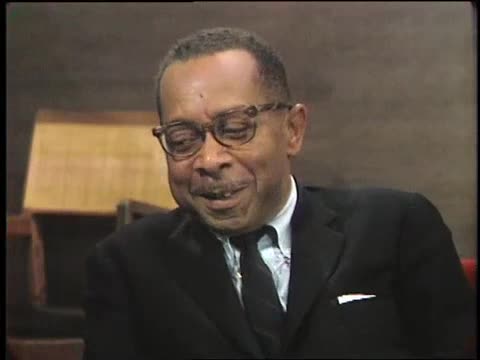
- Georgia state legislator Julian Bond discusses the life of the black man in America's southern cities with program host Dr. Kenneth B. Clark. Bond and Clark cover a wide range of topics, including black attitudes in the South concerning integration versus those in the North; Atlanta as the South's more progressive city; Bond's effectiveness as a black lawmaker in a white legislature along with his role as a community leader among black people; Bond's estimation of Georgia Governor Lester Maddox; and Bond's assessment of his political future. Some highlights of the program follow. The desire for integration is very much alive among black people in the Southern cities, says Bond, in contrast to the cynical mood of the black populations of the North, where large-scale disorders have occurred and the tendency is toward separatism. An obvious reason for the disparity, according to Bond, is that the North has the big sprawling slums. Possibly another reason, he adds, is that while social conditions have remained largely stagnant in the North in recent years, there have been some "visible changes" in the South. These changes have been superficial for the most part, he emphasizes. They include, for example, the abolition of "Negro" and "White" signs, segregated lunch counters, and Negro sections on buses. Nevertheless, Bond concludes, "It seems to me a black person living in the city of Atlanta, Georgia, can say to himself that in the past 10 years of my life I have seen with my own eyes my circumstances chance in a way that can only be assumed by me to be for the better. I may not have lifted my standard of living, it may not mean my children are getting a better education, my house may be in bad shape, but I've seen some visible changes." Bond is asked by Clark what he can hope to achieve for the black man so long as Maddox is governor. This leads bond into a description of Maddox, which Clark says is marked by "Sentimental compassion" and which "transcends the trite racial polarization." Bond recalls Maddox's difficult boyhood when, he says, the future governor was struggling to help support his family and improve himself economically. Maddox as governor says Bond "is a peculiar mixture of two strains in Southern politics, racism and populism. And the populism sometimes is dominant- and when it is, he's rather a decent man." Of Bond's own political goal, he says: "I think I'd like to be in the Congress and that's about as high as I expect to go - the United States Congress." Bond, 28, though a state lawmaker, has been a nationally-known political figure since the controversy that surrounded his election to the Georgia House of Representatives in 1965. The house, at that time, refused to let Bond take his seat because of his outspoken condemnation of America's involvement in Vietnam. Eventually, Bond was seated with the aid of a U.S. Supreme Court Order. Today, Bond is one of the best-known spokesmen for the so-called "new politics" faction of the Democratic Party. At last summer's party convention in Chicago he was entered for the Vice-Presidential Candidacy, although Bond Concedes on this program that this effort was little more than a tactical maneuver by the anti-Humphrey forces. Bond is also one of the Nation's best-known Negro politicians, representing an Atlanta constituency that is mostly black. A Former officer of the Student Non-Violent Coordinating Committee (SNCC) which, under the leadership of Stokely Carmichael, spearheaded the black power movement, Bond nevertheless is not generally considered to be in the same camp with Northern "militants." City Makers is produced for National Educational Television by NET's Boston affiliate station, WGBH, on the campus of Brandeis University, Waltham, Mass. Producer: Henry Morgenthau, Associate producer: Nancy Hafkin (Description from NET Microfiche)
- Series Description
- In City Makers, an 8-part series, Dr. Kenneth Clark conducts half-hour interviews with important figures discussing the troubles plaguing American cities. Dr. Clark was a professor of psychology at City College of the City University of New York, and was also visiting professor at Brandeis University, Waltham, Mass., when he hosted this series, which was recorded in color.
- Broadcast Date
- 1968-12-06
- Asset type
- Episode
- Genres
- Talk Show
- Subjects
- Civil Rights; civil rights leaders; Urban youth; Bond, Julian, 1940-
- Media type
- Moving Image
- Duration
- 01:13:12
- Credits
-
-
Associate Producer:
Hafkin, Nancy
Executive Producer: Morgenthau, Henry, 1917-
Guest: Bond, Julian, 1940-
Host: Clark, Kenneth B.
Producing Organization: WGBH Educational Foundation
- AAPB Contributor Holdings
-
Identifier: cpb-aacip-c4688c0ed5a (unknown)
Format: video/quicktime
Color: Color
Duration: 01:13:12;18
-
Identifier: cpb-aacip-0953c53e05f (unknown)
Format: video/mp4
Generation: Proxy
Duration: 01:13:12
-
Identifier: cpb-aacip-7a7f646efc9 (unknown)
Format: video/quicktime
Duration: 01:13:12
If you have a copy of this asset and would like us to add it to our catalog, please contact us.
- Citations
- Chicago: “City Makers; 105; Julian Bond,” 1968-12-06, American Archive of Public Broadcasting (GBH and the Library of Congress), Boston, MA and Washington, DC, accessed April 16, 2026, http://americanarchive.org/catalog/cpb-aacip-15-9639k51g.
- MLA: “City Makers; 105; Julian Bond.” 1968-12-06. American Archive of Public Broadcasting (GBH and the Library of Congress), Boston, MA and Washington, DC. Web. April 16, 2026. <http://americanarchive.org/catalog/cpb-aacip-15-9639k51g>.
- APA: City Makers; 105; Julian Bond. Boston, MA: American Archive of Public Broadcasting (GBH and the Library of Congress), Boston, MA and Washington, DC. Retrieved from http://americanarchive.org/catalog/cpb-aacip-15-9639k51g