North Carolina Now; North Carolina Now Episode from 05/02/1996
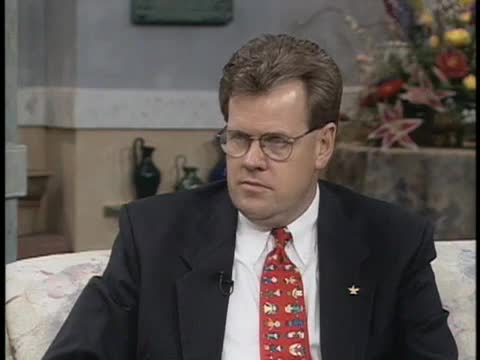
- Transcript
It is Thursday May 2nd. Tonight following the political money trail in North Carolina now. Good
evening I'm reading it right. Thank you for joining us for this Thursday edition of North Carolina now. Tonight's program features the just unnamed North Carolina teacher of the year you'll meet the fifth grade teacher from Gaston County. In our interview segment Also tonight we'll take you to the school of the Arts where production of Brigadoon is currently underway. But our first story tonight we're going to take a look at how the monetary donations from individuals and interest groups affect state politics. Now the News Observer reports that state treasurer Harlan Boyles has received tens of thousands of dollars in campaign donations from groups which have received lucrative state contracts from Boyle's office. His challenger in the Democratic primary is also receiving funds from groups he might regulate if elected. Boyle says there is no wrongdoing and political watchers say it would be very hard for people running for offices like Treasurer or insurance commissioner to get financing from sources outside the industries they would oversee. But with ever increasing amounts of
money flowing into campaign coffers from interest groups there is growing concern that con contributors may be trying to buy some influence. Tonight Bob Garner house the first of two reports examining campaign financing and its possible effect on the legislative process. We think that big money is corrupting American politics both because of the influence that it that it has take to say by but the influence that it seems to by as well as the fact that it is causing a tremendous amount of sort of cynicism in the American public. The biggest issue in the money and politics debate is the question of access. If I have money and I can afford to contribute to a candidate of my choice regardless of who it is and I can afford to contribute whatever the going rate is to get my phone call returned in these days it's sort of commonly thought to be about $10000.
Then I will have more access than someone who does not have the price of admission. There is a price of admission to the big show we call the political campaign whenever it rolls around. It's noisy. It's often nasty and the cost of putting it on spirals continually upward. Besides the visible campaign there's a secondary campaign that takes place largely out of sight of the average voter. It's aimed at the contributors who supply the incredible amounts of cash it takes to pay for the campaign ads and all the rest of the visible campaign. And what's said to those contributors may not be exactly what's said to the voters in public. There's really no way of knowing what may be promised or implicit in a candidate's accepting contributions from interest groups or wealthy donors. And precisely because of the unknown relationships and understanding between contributors and office holders. Studies indicate that nearly nine in 10 Americans say they're convinced large contributors get special favors and consideration from politicians. Many citizens feel shut out of the process that's supposed to serve them ever. The people are out
of the loop on the electoral side in terms of deciding who their representatives are going to be because money's limiting their choices. And on the legislative side the money buying access once again means that citizens ordinary citizens are out of the loop on a lot of what is going on in terms of the writing of the laws. Even though there are limits on individual contributions a thousand dollars for federal elections four thousand for state contests. The limits are easily avoided through the practice of bundling where members of a family or a company each write a check for the maximum amount and the checks are bundled together for presentation. But in certain studies 88 percent of Americans say they think political action committees or PACs are the single biggest problem in campaign financing and that legislators routinely vote in favor of the interests whose PACs give the money PAC money quickly flows to those in power even if they've only just arrived there and it's use for retiring campaign debts or starting to build a war
chest for the next election. Alex Bennett is a managing director with the Center for Public Integrity a Washington Research Organization. The freshman class this year in this Congress and one in fourth Congress came with ideals held high. And said they are not going to fall prey to special interests. They are not going to fall prey to business as usual. And what we see and I don't know of this is direct evidence that they have or have not. What we see is that they have set a record in accepting PAC contributions which is an indicator that they are playing the game at least. But it works both ways. The PAC contributions are often solicited according to Joshua Goldstein of the Center for Responsive Politics in Washington. You can talk to any PAC director or any lobbyist in town and they will tell you they are on the receiving end as much as they are on the end you know on giving on the giving end that they are being in a sense having their arms twisted. Yeah well maybe argue that tighter limits
should be placed on PAC contributions. Supporters say PACs are merely a way for Americans with common interests rich or poor to pool their resources and have their voices heard. John Francine a Washington media consultant feels the best way to offset the influence of big money interests is to encourage more small contributions through a tax credit. If you could write that off as a direct credit against your taxes owed reducing your taxes dollar for dollar that would mean I think that we'd have a strong incentive for average citizens to contribute to political campaigns and they would be making the choice where the dollars go. And it would be in a roundabout way public financing of campaigns because it would involve the tax system. Others argue that old contributions should be limited. He dug in worked with the U.S. Public Interest Research Group in pushing campaign finance reform including a proposal to limit individual contributions to $100. You would see more people giving money because they think their $20 is going to make an impact because
the millionaire across town can only give $80 more if not a big difference. And I think that it will empower a lot of people to feel like they're having an impact to feel like they have as much access and as much right to count on their representative. And. And make a difference. The idea of limiting campaign spending has a lot of immediate appeal to people. But I think it's the wrong way to go. I think that what you're going to wind up doing with that approach is simply helping to ensure the re-election of even more incumbents because they have all the natural advantages to start with. They have the name recognition out there they can get on the news because their members of Congress and so on. And it's going to make it much much harder for the any challenger to really get into the race. There are also frequent calls for total public financing of campaigns or restricting the percentage of the candidates funds that can be raised out of state and for tighter regulation of money contributed to parties rather than candidates so-called soft money. Alex
Bennett says the evidence shows that legislative campaign finance reforms have never worked in the past because someone always figures out a way to get around them. He argues that the best solution is to require much more detailed reporting of contributions and to get the information out to the public. So you as a candidate as a public servant as my employee essentially must tell me where you got the money and what your relationship is with those who gave it to you. Why you vote in a certain way. You gotta explain yourself. Consider the campaign as you would a job interview. You're the employer. You're hiring a candidate. If the candidate for the job only answer the questions why would you hire them. That's the issue. While there is widespread agreement on the need for some kind of campaign finance reform there is no consensus on any particular proposal. In North Carolina money is flowing into this year's campaigns at an unprecedented rate. And tomorrow night Bob Garner will look at some of the trends that have
watchdog groups alarmed about the role of big money in Tarheel politics. Well coming up meet the North Carolina teacher of the year. But before we do that we're going to check in with Michel Louis of the North Carolina now news desk. Good evening. Mitch thanks Zoraida. Good evening everyone. Topping our news according to a staff economist with the state a two hundred forty five million dollar tax cut approved last year by the legislature went unnoticed by many working North Carolinians. Apparently many companies have not adjusted the amount of state taxes withheld from employee paychecks meaning the benefit of that cut will not be seen until next year's refund checks. State lawmakers from both parties are finding some common ground where North Carolina waterways are concerned. The lawmakers say they're backing a proposal that would compensate property owners who agreed to keep land along waterways undeveloped. Governor Jim Hunt is also supporting the plan introduced by Senate pro tem Mark bass night. The State Board of Education has approved changes in sex education classes for grades 7 8
and 9. The changes will stress abstinence from sex until marriage. Students will also be informed that homosexual acts are illegal in the state and can transmit such diseases as the virus that causes AIDS. Critics say the directive falls short and that it does not provide provide rather School Health instructors with an effective approach to teaching young people about sex. And now for a look at Friday's weather temperatures climb into the low 80s tomorrow reaching a high of 83 degrees in the triangle and the Fayetteville area. The coast will have a high around 80 cloudy conditions in the mountains with a chance of showers will be quite a bit different from the Partly to mostly sunny skies everywhere else. In today's business news some encouraging news for North Carolina North Carolina State University economist says the state's economy will continue to grow slowly and steadily through the end of this year. Michael Walden attributes the revised forecast to stronger retail sales and job creation across the Tar Heel State. And now for a look at what happened on Wall Street today.
With within the State Board of Education took a high tech approach today to informing teachers throughout the state about the new ABC education improvement program. A statewide a school faculty meeting was held here at our UN CTV studios and broadcast on
our 10 station network statewide teachers and school staff members were able to call in or fax in questions to education officials about the new initiative the ABC plan it calls for giving local schools control over how their students are taught and how the individual schools are run and return the schools are held accountable for the progress their students make in basic subjects. One of the 70000 North Carolina teachers who will be held accountable to the ABC s of Education is this evening's guest at a ceremony held this afternoon he was named the 1996 North Carolina teacher of the year. Richard Scott Griffin a fifth grade teacher from my Reagan Elementary in Gaston County. Congratulations and welcome to the program. Thank you very much. What an exciting day what was that feeling like when you heard your name announced. It's really kind of overwhelming because all of the teachers they were up all six of us excellent teachers I had a chance to eat breakfast with them this morning
and that's when I realized I was really in the presence of greatness. These are fine fine people. And last year's group of six also. So as I said in the room with those 12 it was just kind of overwhelming to know that we had so many wonderful teachers and these are just samples of of some of the great teachers that we actually have in our school system. Let's talk a little bit about the APC's of education earlier this afternoon you and see television provent presented a teleconference involving that topic and we also had a short story prior to this interview. What is your view of this reform plan. Well of course reform is it's something that is sweeping the nation. I think all of our schools public schools are really called up and it is something that's going to happen has to happen. My feeling is that for the first time our legislators or are trying to empower our state school board to actually come up with a plan rather than
other people trying to ride it. And I think that's really neat that we're we're turning this over to two educators and. And then we're going to empower teachers and I think one of the things that we really need to understand is teachers that this is really going Power us and give us the voice that we've been asking for for so long and stay in North Carolina. Is there any concern though that this accountability that you're going to be held to a certain standard and the people who are judging that standard may not be aware of what you deal with on a day to day basis you know. There seems to be they're trying to to set it up so that we were actually competing against our sales. The standards are going to be such that they take a look at where we are and a particular class of kids and then we measure how they're doing at the beginning and how they're doing at the end of the year so you're not you're not being held responsible for somebody else's teaching. And the primary focus is how we each school can improve not comparing school against
school but this is where you are and this is where you need to be and trying to get us to move in that direction. So I think that when teachers realize and have a better understanding of exactly how it's going to be placed in our school they will not fear it so much because I think good teachers know that if we know what they expect from us and what it is they want us to teach we can do the job. Recently on our program we aired a story about teacher retention about how so many teachers are leaving North Carolina's classrooms. But you have been a teacher for 23 years now what is kept you in the classroom. While think students the love of students certainly keep us in the classroom. I think you have to continue to grow. It's very easy to become stagnant and complacent in the classroom if you do the same thing year after year. And that means that you have to stretch beyond the classroom. You need to stretch out and work with other teachers share ideas in-service training involvement sometimes in state committees. We can all live in a cardboard box in the classroom it's that were shielded from the
rest of the world and if we can break away from that cardboard box and and begin to see that there network with other teachers and begin to share ideas and look at this as a team effort and not just me against the world and just this one little plasticky it's and it's just mine and either I make it or can't. And I think that has empowered me to be able to get out and and work with other teachers and learn from them. You have to be a learner to be a teacher. At the beginning of your answer you had talked about your love of students and I found it quite interesting that you brought along with you to this afternoon ceremony as one of your students and none of the other nominees did that. Why was it important to you to have that student there with you. Well first off I think probably all our nominees know that children are first. I don't know exactly how it struck with the idea but we were allowed to invite guests actually not counting our sales and trying to come to narrow that list down to nine people is really difficult those are so many people that are important in your life. But as I got down I was looking at my list I realize that
the people that are important our students are first and I decided that we needed to have them represented so we had a random drawing in our class and Chris Pierce each name was drawn out of the hat and he attended and has been very excited about the whole process and wonderful day for him and for me. Mr. GRIFFIN We have one more minute left but I wanted to ask you in that short amount of time the legislature is going to be starting up here in a couple of weeks if you had a message that you wanted to give to our lawmakers on behalf of all of North Carolina's teachers what would that message be. I sat in yesterday with the state board and I was impressed with the work that they are doing it and the plan that they've come up with. I was really impressed with it more so than just reading it on paper I began to understand it and it was most impressive to know that it was the school board who was writing the program. My message stand would be please continue to empower that state school board to write that plan and then adopt that plan as they submit it because this is being written by professional
educators. And I think it's going be a great plan and they need to really give teachers the opportunity to to have the power and the focus to to make changes for our children. On that note we'll end it sir and I want to thank you for being here this evening and congratulations once again the 1996 North Carolina teacher of the year. Thank you very much. It's hard to believe the North Carolina School of the arts in Winston-Salem is 30 years old and to celebrate the presenting one of the all time favorite musicals. Our story tonight was
produced by Bill Hannah and narrated by Maria long Berg. The sleepy Scottish town of Brigadoon only comes to life every 100 years. And tonight Lerner and lows Mystikal town will awaken again here at the Stevens Center in Winston-Salem. You hear that over there. And it looks like a bullet. Yeah but I thought you said that there were no towns listed on them around here. It was the weekend with the US was with the US was it with this
production of Brigadoon. Isn't our production of the North Carolina School of the arts. Well it means that the School of Drama School of Music School of Dance School of Design and production have all come together crossed their disciplines as it were and collaborated on this kind of musical which needs that kind of collaboration and that's been a wonderful experience. The students you know meet each other in cafeteria what have you but you don't often work together and that's made a big difference in the atmosphere and respect for each other's discipline. Talented students from North Carolina and the nation tried out for parts in the production. Jerry Friedman dean of the School of Drama is the director of the musical is one of his favorites and one he knows well. I was lucky enough to do a production of it about 10 years ago. I'm not exactly sure at the New York City Opera. They began to do a
wing of American theatre musicals great musicals I did Brigadoon and I did South Pacific. Jerry Friedman and Jim Z don't laugh at the first of these revivals. She has been a lead dancer on the show and has helped to stage several New York productions this year. She has been at the School of the arts recreating Agnes DeMille original choreography and then of course she always would get specialists and whatever the field was like Scott's dancing. And James Jamison assisted her on that and he was a champion Scotch Highland Fling dancer all over the world even in Scotland. The only
thing that's really hard is for. Just normal dances to learn to do. Highland flame is one of the real people spend years from as from childhood learning to do that sort of dance. So it's a lot to ask a Broadway dancer to do. Lap is very impressed with the North Carolina dancers. They're comparable to Broadway dancers and we were one of the things that a show like this does is it gives them a chance to act and to learn that dancing is not just pure wets and big jumps it's also motivation because every step and one of these dramatic shows has a meaning behind it a motivation behind it is. Just that this production of Brigadoon is in celebration of the 30th anniversary of the North Carolina School of the arts. When the school of the art started it was a radical concept in education it offered a
professional degree in the arts and was the first school of its kind sponsored by a St.. Competition between cities and North Carolina for the school was stiff and spirited but Winston-Salem had a double approach. They offered great high school as a plant and launched a telephone campaign that raised over one million dollars in 48 hours for dorm construction. Well I think it all started with a couple of wonderful people and wonderful people have wonderful ideas. One of those people was Jeannie and I think another person was the governor Terry Sanford was the governor at that time and he responded. And Johnny Lee was his secretary and he was with the governor spoke to him. He took up the ball and ran with it. So I think that like so many things went back to some wonderful people some good ideas.
Brigadoon is a show about believe that if you believe hard enough and something it will become real Vittorio g and he and others in North Carolina believed in a state supported school for talented young people and 30 years ago just like Brigadoon their dream became a reality. Brigadoon will be presented May 2nd through the 5th and May 8th through the 12th that the Stevens Center in downtown Winston-Salem. Tickets are available by calling 9 0 1 0 7 2 1 1 9 4 5. Tickets are twenty one dollars for adults and 19 dollars for students and senior citizens. That's our program for tonight tomorrow night. Robin Hayes the Republican candidate for governor will be our guest as well as Charlie Sanders the Democratic candidate for U.S. Senate. Thanks for watching tonight we'll see you back here tomorrow night. Good night everyone.
- Series
- North Carolina Now
- Contributing Organization
- UNC-TV (Research Triangle Park, North Carolina)
- AAPB ID
- cpb-aacip/129-9673nktc
If you have more information about this item than what is given here, or if you have concerns about this record, we want to know! Contact us, indicating the AAPB ID (cpb-aacip/129-9673nktc).
- Description
- Series Description
- North Carolina Now is a news magazine featuring segments about North Carolina current events and communities.
- Description
- Richard Scott Griffin - 1996 NC Teacher of the Year; Political Money Trail #1 (Garner); Brigadoon - NC School of the Arts (Hannah)
- Created Date
- 1996-05-02
- Asset type
- Episode
- Topics
- News
- Local Communities
- Media type
- Moving Image
- Duration
- 00:26:35
- Credits
-
- AAPB Contributor Holdings
-
UNC-TV
Identifier: NC0547/2 (unknown)
Format: Betacam: SP
Generation: Master
Duration: 00:25:47;00
If you have a copy of this asset and would like us to add it to our catalog, please contact us.
- Citations
- Chicago: “North Carolina Now; North Carolina Now Episode from 05/02/1996,” 1996-05-02, UNC-TV, American Archive of Public Broadcasting (GBH and the Library of Congress), Boston, MA and Washington, DC, accessed December 15, 2025, http://americanarchive.org/catalog/cpb-aacip-129-9673nktc.
- MLA: “North Carolina Now; North Carolina Now Episode from 05/02/1996.” 1996-05-02. UNC-TV, American Archive of Public Broadcasting (GBH and the Library of Congress), Boston, MA and Washington, DC. Web. December 15, 2025. <http://americanarchive.org/catalog/cpb-aacip-129-9673nktc>.
- APA: North Carolina Now; North Carolina Now Episode from 05/02/1996. Boston, MA: UNC-TV, American Archive of Public Broadcasting (GBH and the Library of Congress), Boston, MA and Washington, DC. Retrieved from http://americanarchive.org/catalog/cpb-aacip-129-9673nktc