North Carolina Now; Neverending; Interview with James Weeks
- Transcript
The It's Wednesday April 24th. Tonight new hope for the frustrated grass grower in North Carolina now. Hello everyone I'm reading the trite welcome and thank you for sharing your Wednesday evening with us on tonight's edition of North Carolina now will help all of you frustrated homeowners who have spent many a Saturday afternoon in your yard
sitting and waiting and trying to grow grass. Well profile an NC State research project that is aimed at improving our state's grass. Our interview guest tonight will be Dr. James weeks a dean of u and C Greensboro business school. But first we start the show by exploring a very serious topic. Today marks the beginning of a unique summit in North Carolina which aims to decrease domestic violence statewide for the first time ever members of the state's law enforcement agencies judicial system and victims assistance groups are gathered in Raleigh for a three day summit on domestic violence. They hope to use this time to develop a cohesive action plan for each community. Tonight Shannon Vicary shows us the reality of domestic violence through the eyes of those who know it best. You know how threatening this woman is in her late 50s and what she's describing is her life. For more than 30 years as a victim of domestic violence first
you think it's a law does it because the laws and they own you. You're not a person. You're just a puppet. We'll call this woman Jane. She's asked us not to use her real name. Jane and her husband were married in the late 1950s. They quickly had children and her husband started little by little to control every aspect of Jane's life was what he wanted me to bake and was how he wanted me dressed and I did what he wanted me to do you know. And day by day this controlling behavior turned into violent physical attacks. I had to speak out inside that he was well aware that his father was capable of killing me and he had expected to come in and he left town and he had expected to come in time and find me dead. But after 38 years of abuse Jane's health started to fail and she
finally decided to leave. My choices was either to leave or die. It's kind of like man in a blind rage when you do do it because. You don't realize you've done it until it's already done and over with and it's kind of like your dream in any wake up. Eric Greenlee is 27 years old and at MIT's he's an abuser. His wife divorced him about three years ago because of his physical abuse and now the violence is continuing in his current relationship. Most of the time I just you would would pull her hair or. Or maybe smack her. What kind of things get you so angry that you end up beating your girlfriend or your ex-wife before it was with my ex-wife It didn't take anything. Insufficient I answer with my ex-wife would build it for me as
a way of saying I'm the boss and you know I have control. Eric and Jane represent both sides of North Carolina's domestic violence problems. But in this case both are getting help both at the same place mainstay is the domestic violence program serving hinders and County in western North Carolina. Here they offer a safe shelter for domestic violence victims and a counseling service for abusers. Unfortunately Jane and Eric stories aren't unusual. However what is unique is that for the first time programs like mainstay here in Hendersonville are bringing the problems of domestic violence out of the private homes of North Carolina down to 9st. We've for a long time have thought that part of the problem the of the mess about us is the secrecy that surrounds it and we believe it until a community takes a stance and says you know we've had enough we will not tolerate domestic violence in our
community any longer that there's no hope of doing to stop it. You have to treat domestic violence as you do every other crime. I mean it's no different than murder it's no different than rape is no different than robbery Henderson County Sheriff George Orwell is on a crusade to decrease the number of domestic violence cases in his county. He says he remembers all too well how domestic violence hurt his own family. I saw my mother going to the hospital. Solitary my brothers my sisters. Why would the most calls come into the wonderful County Sheriff's Office. They're taken very seriously. If there are signs of domestic violence the perpetrator is arrested if there are signs that both people have beat on one another both people are arrested. Sheriff York and Jane all represent three very typical cases of domestic violence in North Carolina and like most people on the front lines of the state's battle against domestic violence they believe much more needs to be done before breaking the cycle of domestic violence.
Statewide the people Harrison County would be surprise if I knew the real stats. I mean even when there are in just the scanning I think North Carolina it's an astounding amount. It's four to me once too many. According to state statistics more than 400 women and children leave their homes every night in North Carolina as victims of domestic violence. If you would like more information on the domestic violence summit you can call the North Carolina Victim Assistance Network at 1 800 3:4 8 5 0 6 8. Well coming up our grass isn't a greener but maybe one day it will be what check out a research project that hopes to accomplish that goal. That right now the recovered Mitchell Lewis has returned to the North Carolina now news desk feeling better match much better Merida. Good to have you back. Thanks I appreciate it. Good evening everyone. The press secretary for House speaker Harold drew Baker admits making a racial slur and defends his remarks saying
they were in jest and were made as part of a private conversation. The incident happened last Wednesday during a protest at the General Assembly by a group of University of North Carolina housekeepers and students. Don Farmer the speaker's press secretary was in the office of a reporter when the reporter asked what the noise was about. Farmer responded with the slur calling the group quote niggers and wormy kids. When another reporter nearby asked farmer if he had just used those names Vollmer said he had brew bakers and he doesn't know anything about the remarks and that his staff is quote colorblind. Three more health maintenance organizations or HMO those have been accepted into the state Medicaid program. The state division of medical assistance has already conditionally accepted for HMO into the system. The move is a step forward and in the state's efforts to move 33000 Medicaid patients in Mecklenburg County into HMO by the 1st of July Mecklenburg is the first county in the state in which HMO membership will be mandatory for most Medicaid recipients.
The state does plan to extend the program to other metropolitan areas. State transportation officials are promising to streamline the Division of Motor Vehicles. An independent audit criticized the DMV for being filled with political patronage WTVG and Durham obtained a draft of the report which recommends the top DMV position should be eliminated along with the jobs of two assistant commissioners. The audit was conducted at the request of legislators and specifically criticizes DMV commissioner Alexander Killen's for his management style and use of state employees. A DMV spokesperson says the audit contains some accuracies. The U.S. Department of Agriculture says it has uncovered more problems at Duke University's Primate Center. Officials discovered three new violations of the Animal Welfare Act during an inspection last month. The report cites several problems in the Primate Center including wires sticking out of several of the lemur cages and trash left inside the enclosures. Duke has until May 1st to fix the problems. The report also noted that hundreds of the
animals aren't adequately sheltered from bad weather. Twenty seven animals suffered frostbite or burned themselves on heating lamps during last month's cold weather. Memorial services were held today for Charlotte singing cowboy Fred Kirby Kirby his yodel and his horse calico were well known to generations of Piedmont children. He began his broadcasting career on the radio in the 1920s and later moved on to television when he retired from his show called Junior Rancho on Charlotte's WB TV in 1976. He had earned the title of the longest running children's show host in America. Fred Kirby died in his sleep Monday at his home in Indian trail. He was 85. Now for a look at tomorrow's weather expect high temperatures in the 70s everywhere except Boone where it may not get out of the high 60s and the shore where it may touch the 80 degree mark. The western half of the state will experience mostly sunny skies with an increase and cloudiness as the day goes on. From the triangle to the coast sunny
skies will abound throughout the day. In business news Lorillard Tobacco Company appears close to making a decision about moving its headquarters from New York City to Greensboro Lorillard currently maintains a plant in the city. If the move is agreed to. The company reportedly plans to build a 12 million dollar facility in Green Valley office park. Lorillard is expected to make an announcement tomorrow. The chairman of nation's bank sends a stock split may be in order. Hugh McCall told shareholders today that the value of the bank's stock has grown so quickly that the split may soon be under consideration by a nation's bank's board of directors. The nation's bank stock increased more than 50 percent last year and about 15 percent so far this year. And now here's a look at what happened on Wall Street today. It
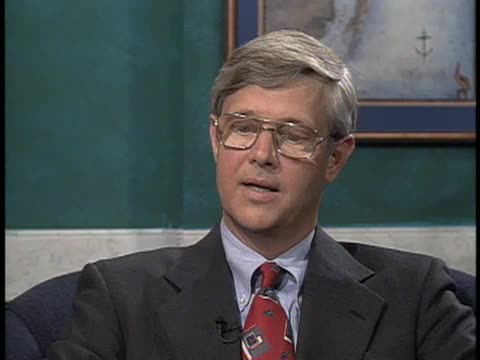
was more and more companies going international business schools are realizing the need to train their students to work in a global marketplace. In tonight's business interview Christina Copeland talks with the dean of one of North Carolina's business schools that is taking a big step in that direction. The Bryan School of Business at USC Greensboro decided two years ago to internationalize its programs. Now it's expanding even further announcing plans to create a center for global business education and research. And joining me to talk more about that is the school's dean Dr. James weeks. Dr. Weeks Thanks for being with us. Thank you Chris. Let's see.
By talking a little bit about the purpose for the center Well the purpose for the center is to enhance and expand what we've already started two years ago. We looked at what we were doing and just as many other business schools throughout the United States how we could respond to the changes in the business world and the way we came to the conclusion that enrich our current activities in our current programs particularly focusing on our instructional programs but also our plant research and our public service programs that we needed a center to complement those activities. Why do you feel the need for this growth in international business education. Well the world has certainly changed in the past decade and that has had dramatic impact. You know in the world of business we've seen the dismantling of communism in the rush to market economies all over the world particularly in Asia. We've seen the declining trade barriers but also the rise of trade blocs. We've seen the your industry the communications technology advances and communicate and transportation have almight the business world a much smaller place
in WI. It's a cliche but it's a cliche because it's truly we are we're in a global economy and as a result we have to respond to those new eat. Whether you're importing or exporting increasingly your business is being affected by what's going on in the international environment and you need your managers your employees to to be educated to not only have the basic business skills and knowledge but to complement that with the international knowledge and skills. One of the things you have done it is set up an exchange program for students and faculties with colleges and other countries. Tell me a little bit about that. Yes we've spent the past two years searching out partners or foreign business schools to stablish bilateral agreements. We have a very large office of international programs where university campus and using them as a kind of a platform and going out and meeting other business school faculty and Dean. We've established partnerships we
have manned partnerships now we have we'll have three more by the end of this year. Our goal is to have roughly 20 to 30. And the purpose of those are partnerships are to match our students with their students. Where there are similar academic programs and similar faculty interest in teaching research and service So a student from the NC Greensburg can decide to go to a school in Paris or Germany or London. Sounds like fun. I wish I had had that opportunity at it when I was an undergraduate. That's absolutely right. Our students on the exchange can literally get to abroad for fun for a semester or for an entire year at the same cost of staying. If you NCG the the exchange arrangement is set up so that their tuition and all their for these their room and their board they pay the student in it the foreign business copartner does the same thing and they simply swap places. This also works for faculty too because I would imagine that there's a lot of faculty that
came into academia possibly after the growth of the global marketplace. How does this help them. Well one of the one of the critical things that we're focusing on is our faculty development you're absolutely right. When I went through my Ph.D. program and when most of the professors and business schools went through Ph.D. programs international business was given very little if any attention at all. So as a result it's important for them to broaden for all of us to broaden our focus in in our teaching and as well as in our research. And so we are trying to provide faculty with the same opportunities that the students have. That is to switch places with faculty members at foreign institutions and we have faculty exchanges that range from one week all the way up to one year. All of this takes money. I know that part of your funding for this comes from a bequest from the man who the business school is named after Joseph Brian the same man that his name is on the building we're sitting in right now. Can you tell us a little bit about the funding where
the rest of the money is going to come from. Well in the short term the seed money in the the money to get us up and running as soon as possible we hope that significant portion of that will come from the income of the family in dollars requests from Mr Brime. That was announced last year for the long term the permanent financing However we hope is going to come from designated endowments that will come from the universities. Forty two plus million dollar capital campaign that was announced publicly just a couple of weeks ago. All right let me ask you one last question because I think there is a concern among some people in the U.S. that as more American companies become involved with companies overseas they're seeing American jobs go overseas. What kind of benefits do you see from educational programs that prepare students for a global marketplace what how does it help people here in North Carolina. Well at North Carolina I think it has a special opportunity to be a major player in the world economy in fact out that I think there are some statistics that would
suggest we already are major player particularly this this region from the Triangle for the triad to the Charlotte area it's an intense manufacturing. International trade area. There's no question that with this restructuring of the global economy some jobs will be destroyed some jobs away created. Instead of focusing on the low wage jobs that are being destroyed waiting going to say the Far East at a dollar a day or not whatever the wage rate is and in China or wherever it is we should be focusing on the creation of the high wage to have value added jobs. And that means that our educational system has to respond to that need. There will be some dislocation but the the answer to that in my view is not to try to build walls and protect ourselves from the inevitable that's occurring in the in the world economy but rather to prepare ourselves to be a major player in it.
You've also been working with businesses I know in the Greensboro in the Triad area and they have been very concerned about the quality of high school student is coming out and going into the job market. Have you been aware of how we're working with the local businesses. We're working in a variety of ways at the Bryant school is in the university and several other of the triad educational institutions there are many initiatives that are. Being undertaken you're absolutely right. The number one issue with business in every survey both in the Triad the state and the nation is the quality of Pre K through 12 as well as our community college for training purposes in our our universities. We've been working with them in a variety of ways in fact our move towards an international focus came about as a result of their very strong advice that that we needed to do that if we were going to be relevant to the very important topic. I wish I had more time to talk to you about it but I wish you the best of luck with the center is going to open this fall
so you have a really busy schedule ahead of you. Thanks for being with us. Thank you for having me. With the arrival of the warm weather you may be finding yourself spending your weekends doing yard work trying to get your grass to grow in some places and trying to a lemonade in others. Whether you do it yourself or hire a lawn service achieving and maintaining a healthy green lawn is one of the greatest challenges for homeowners in North Carolina.
The heat combined with the humidity causes brown patch and that'll just kill al little spots in the grass 20 years of experience as a groundskeeper. Martha McMillan knows full well the frustrations of trying to grow grass in North Carolina. Well with fish skews only in the summertime hot part of the summer. Their cool season grasses and so they they really suffer in the heat of the summer and warm weather grasses like Bermuda problems too in the winter time it goes dormant and stays Brown and in areas you know where you may want green. I'm ashamed to admit it but this is my lawn in the two years that my husband I have lived here we've hired three different lawn services and we still don't have any grass. North Carolina State University is coming to the aid of homeowners like myself by starting a genetics and plant breeding program aimed at improving the existing varieties of grass grown in our state.
We're going to be looking at. We hope most of the turfgrass spaces that are grown in North Carolina that'll include some of the species that grow well in cold weather like the fescue and some of the species that do well in warmer weather. Like there's always a grass in Bermuda grass finding grasses that grow well in North Carolina as fluctuating temperatures is just one of the goals of this project. And sea state scientists will also use molecular genetics in an attempt to grow breeds of grass that are resistant to disease fungus and insects and that are tolerant of drought. In order to do that what we envision happening here is that the laboratory and the workers here would isolate and characterize genes of interest that might be useful in improving our grandmama performance of the grasses. And those would be transferred into the gene into the grasses by genetic engineering procedures typically desired characteristics of a particular plant are bred by constant selection through a series of sexual crosses
but oftentimes that process can take up to 20 years. So instead of going through a laborious and time consuming series of crosses sexual crosses we get the gene mechanically introduce it into the grass and then put it right back into the breeding program ready to go. The process of genetically engineering grass involves a gene gun that literally shoots the desired gene inside the grass. The genes are attached to microscopic gold particles that are accelerated to very high velocities in the gene gun. One shot those particles penetrate inside the grass cells. The DNA is then integrated into the genetic material of the grass. Give you give you some indication of the power involved. The partially started with are now the floor the grass research has yet to begin. But this process of molecular genetics is currently being used in tobacco and peanut research at NC State. The grass breeding program
is being initiated because of two main factors. Economy and ecology economy because the turfgrass industry the business of installing and maintaining landscapes from golf courses to home lawns is estimated to be worth as much as 1 billion dollars annually to North Carolina ecology because developing a breed of grass that is resistant to insects and disease will reduce or eliminate the need for lawn chemicals and pesticides. If we could do anything to alter that requirement to reduce the requirement for pesticides we think that we would be able to eventually have some effect on how much power is applied for example to golf courses that keeps the ground water and that's all in a better situation. And sea state is currently in the process of hiring a geneticist to head up the turfgrass turfgrass a breeding program. Actual research is expected to get underway in early fall. Well that's a pro. Graham for tonight make sure to join us tomorrow when we start
our State Park series back up again you remember last summer we presented this series of stories with Audrey Cates Bailey touring North Carolina's beautiful state parks but we're going to bring that series back starting tomorrow. And Maria Lundberg will profile East Carolina University School of Medicine a couple of events to look forward to coming up moral fest 96 starts tomorrow at Wilkes community college and Beaufort by the sea. Music Festival starts on Friday in Beaufort. Make plans to attend those events and join us tomorrow for another edition of North Carolina now. We'll see you then. Good night.
- Series
- North Carolina Now
- Episode Number
- Neverending
- Episode
- Interview with James Weeks
- Producing Organization
- UNC-TV
- Contributing Organization
- UNC-TV (Research Triangle Park, North Carolina)
- AAPB ID
- cpb-aacip/129-43nvx7vw
If you have more information about this item than what is given here, or if you have concerns about this record, we want to know! Contact us, indicating the AAPB ID (cpb-aacip/129-43nvx7vw).
- Description
- Episode Description
- An informative report on local North Carolina news. Topics in this episode include an interview with Dr. James Weeks (Dean, UNC-G Bryan School of Business) about the new center for global business education and research; the Domestic Violence Summit in Raleigh, and the grass growing research program at NCSU.
- Series Description
- North Carolina Now is a news magazine featuring segments about North Carolina current events and communities.
- Created Date
- 1996-04-24
- Asset type
- Episode
- Topics
- News
- Local Communities
- Rights
- The UNC Center for Public Television, 1996.
- Media type
- Moving Image
- Duration
- 00:26:45
- Credits
-
-
Anchor: Lewis, Mitchell
Director: Massengale, Susan
Guest: Weeks, James
Host: Matray, Marita
Interviewer: Copeland, Christyna
Producer: Matray, Marita
Producer: Vickery, Shannon
Producer: Copeland, Christyna
Producing Organization: UNC-TV
- AAPB Contributor Holdings
-
UNC-TV
Identifier: NC0544/2 (unknown)
Format: Betacam: SP
Generation: Master
Duration: 00:25:46;00
If you have a copy of this asset and would like us to add it to our catalog, please contact us.
- Citations
- Chicago: “North Carolina Now; Neverending; Interview with James Weeks,” 1996-04-24, UNC-TV, American Archive of Public Broadcasting (GBH and the Library of Congress), Boston, MA and Washington, DC, accessed April 3, 2026, http://americanarchive.org/catalog/cpb-aacip-129-43nvx7vw.
- MLA: “North Carolina Now; Neverending; Interview with James Weeks.” 1996-04-24. UNC-TV, American Archive of Public Broadcasting (GBH and the Library of Congress), Boston, MA and Washington, DC. Web. April 3, 2026. <http://americanarchive.org/catalog/cpb-aacip-129-43nvx7vw>.
- APA: North Carolina Now; Neverending; Interview with James Weeks. Boston, MA: UNC-TV, American Archive of Public Broadcasting (GBH and the Library of Congress), Boston, MA and Washington, DC. Retrieved from http://americanarchive.org/catalog/cpb-aacip-129-43nvx7vw