Black Horizons; 3009; Educate Us
- Transcript
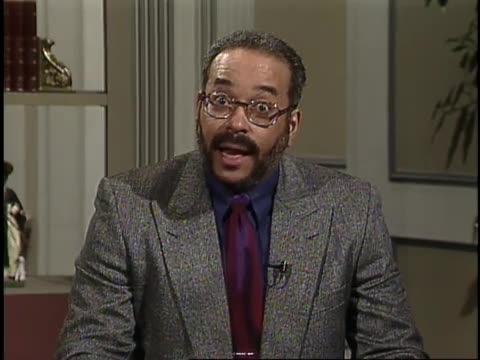
I'm Chris Moore and this is Black Horizons. Even though we're taping this program in December by the time you see it, it'll officially be 1999. So happy New Year and to help bring in that New Year we've lined up a pretty good show for you tonight. For instance, we'll meet with the new head of the African American Chamber of Commerce who'll tell us all about their plans for the future and how your business can get involved. But first, Greg Kinney is an actor on a mission. Through his company Educator's Productions, Greg is bringing some of America's greatest Black heroes back to life and imparting their messages to area audiences. His one -man shows feature the likes of Dr. Martin Luther King and baseball pioneer Jackie Robinson. Here's Greg as Powered Great Roberto Clemente in Roberto. Chat with an Angel. I'm in Roberto Clemente. And yes, I used to be the starting right filter for the Pittsburgh fires. But on December 31st, 1972, I was killed in a plane crash in San Juan, Puerto Rico. But sometimes my friends
after 25 years, the powers that be. They allow for you to come back and tell your story as an Angel, of course. At the end of the 1954 season with the Montreal Royals, the Pittsburgh fires, there were very issues that ended driving me. Mr. Branch Rikki, he was the general manager of the Pittsburgh fires at that time. He had been keeping a close eye on me. Yes, my friends. The same Mr. Branch Rikki, who 10 years before had discovered the great Jackie Robinson, the first black man who played in Major League Baseball. And now, he would show that same confidence in me, the pirates. They would drive me number one at the end of that season. They would want for me to become their starting right filter and I only have one question for them. Where is Pittsburgh? Now, when I first moved to Pittsburgh, it was a city that was full of steel mills. My friends, they smoked from the mills, would cover the whole entire city. At that time, Pittsburgh was known as a blue -collar town, simply for my young friends,
many very hard working town. Most of the population, it was white. Most of the black people that I meet, they live in a certain section of town called the Hill District. And in 1955, my friends, I have to tell you, my career in Pittsburgh, we get off to a very rough start. You see, in 1955, there were still a lot of white pop players in the league that didn't know what to play with the black pop player. I heard it, white pop players, as they would talk about me. Sometimes, they would even talk about me right in front of my face. The newspaper. They would make fun of me for the way that I thought. Obviously, these things, they didn't hurt me inside because, you know, I could understand a little bit about why they were saying about me and put a rico. I had always been raised never to see color and put a rico. Black and white live work played together. To be very honest with you, my friends, I didn't know about all these things when I come to America. To make matters worse, before the season has started, I have been in a car accident, injured my back pretty bad.
That injury would stay with me for the first four or five years of my career, whenever I did not play because of the pain, the newspaper, some of my teammates. They would actually say that I was faking the injury. That I was making that injury up. I just wish I could have lived in this body for one day. There was one thing that didn't make me very happy about playing Major League Baseball. And that was defense. You see, my friends in any of the city we playing, the fans they were lying about sighting ballpark after the game, just waiting for the autograph. And sometimes I would stand for hours, designing the for the fans, the kids, yes, the kids. They were the ones who truly made me happy. You see, because I know deep in my heart that the kids they don't care about black and white, the kids they love baseball. So yes, it would take me time to be used to my news surrounding. It would take me time to learn what to say and what not to say to the newspaper and it would take me time to learn how to become a professional at least. But by 1960, everything would
start to fall into place. In 1960, my batting average would never drop below 300 feet whole entire season and in the field. I would try to be as competitive as possible. Oh, yes, I was known for my basketball catch. Yes, I was known for my rugged arm. But sometimes when I do these things, some people they would actually call me a Puerto Rick and a hot dog. That was the way I have played the game all my life. In 1960, we would win 21 games in the bottom of the 19. The most important of those wins coming in the World Series against New York Yankees. The series was tied at three games a piece. The final game, the seventh game, it would be played right here in Pittsburgh in Forbes Field. And that I'll never forget. Ralph Terry, he was on the pitchers, my own. Bill Masler -Roskey, he stepped up to the plate, bottom of the 19 and the score was tied at 9 .9. Ralph Terry, he fired Masler high fastball Masler -Roskey with that ball. He hit that pitch 400 -6 feet over the left of the wall. We won the World Series.
My teammates and me right now on to the field, the fans have the out of the stands on to the field and now Masler. He got to fight through the fans in order to touch on play and make it official. In the club, I got dressed, I went around, I congratulate each and every one of my teammates. And then, I went out and I walked the streets of the city. For hours, I was celebrated with the fans. Now some of my teammates, it would be mad at me for leaving that club house. But you see, it was the fans who had been there for me in the beginning of my career when the times were truly rough. It was the fans I knew were the ones who truly fed my salary. I had to be there for the fans. At the end of the 1960 season, and I had a wonderful year that year. I had batted 3 -14, knocked in 90 for runs, hitting every single game of that World Series. There would be serious talk around and leave my friends that I would be named the most valuable player in Major League Baseball. But instead, my teammates ticked growth. They would win that award. That was
vying with me. You see, ticked growth, he was my teammate. The one thing that did upset me was the fact that I had finished eighth and he voted for that award. I was sitting at home in Carolina, Puerto Rico when the award was announced. And yes, I was. I was very disappointed. But my father, Melkor, he would tell me very lovingly about very sternly, Roberto. Life is difficult. Life is not always fair. But a person must keep on working. Now that little pep talk to my father, not winning that award. These two things were helped to motivate me in 1961. Here tonight to talk to us about the great Roberto and other heroes is Greg Kinney. Greg, welcome to Black Horizons. Thank you. Well, life in heaven for that angel must be good. The food up there looks like it's good. Roberto's put on low weight, huh? Yeah. Roberto's put on a little bit of weight, you know, we're going to try to take that off before we get right back into the season again here in January. Okay. Your season is going to start in January and February because Black History Month coming up.
Dr. Martin Luther King's birthday. You're probably going to be pretty busy with some of these things. How did your company start? You're trained actor, right? I am. I am a trained actor having studied at Point Park College some 15 years ago. And I started the company, Chris, three years ago. This will be our third year going into the schools. And I felt it was important to have programs on African -American figures in history in the schools. And that's why I wrote the program on Dr. Martin Luther King, my first program that I did in the schools. You do all the research yourself? I do. I do all the research and I write the programs myself and you play all the parts, at least up until this point, right? Yes. Okay. How did you select which characters you would portray? Well, I tried to go with the most popular people to get the company started. So it would get recognized. That's why I started with Dr. King, Jackie Robinson, and especially in Pittsburgh with Roberto Clement. To get the company recognized. And then after we get in, you know, after this third year, next year we'll be doing a program on Rosa Parks and, you know, doing some
people that are familiar with, so that we can get it recognized and get it out there and have people come out and see the programs and all the bookstores and you get it going. As you get into the schools, how do the young people receive these historical figures that they may just be able to really to through old film and in their textbooks? It's pretty intriguing. Bringing the people to life actually is a very exciting experience for the young kids and for the teachers also. Because it's something that nobody's doing in the schools actually. It's very different in the one -man show going into the school, being that person, opening up a whole new world for the kids. Do the kids know about these figures or have they studied them before you? You've come in. I imagine with Martin Luther King and Roberto Clemente, especially because he's local, they would know about some of these folks, but I don't know if they know about all of them. I read one article about you that talked about how when you do Jackie Robinson, that they are aware of P .W. Reese's role as the first white to really accept him and what
some of the other roles were. Yes. Yeah, they are. They know Jackie Robinson. I was real surprised with that they actually studied Jackie Robinson in the schools. As I started to get involved in the schools, I found out that they were reading the story of Jackie Robinson and that made it even all the better. Doing the Robinson and the kids were asking great questions about Jackie Robinson every school I go to. After you come out of character, you do come out of character, do you talk to them then or do you stay in character to talk to them? No, no. I come out of character at the end of the program because we always have that 15 minute question and answer period for the kids. And I feel it's important for me to answer the question to let them know that it is a play and that these people have moved on and that it's very important to answer their questions as great Kenny now the person who did all the research on the program. Now, did you get involved in this in part because it's tough as an actor, especially in this town, or you got tired of playing all the roles of drug dealers or whatever else. I hear many other national, nationally acclaimed actors talk about the roles that are offered to them as black men. Yeah, exactly Chris. I felt it was, you know, I
wasn't doing the work I wanted to do as an actor. I've always liked going into the schools to do program. I've done it before with another company here in Pittsburgh and I enjoyed it very much. I enjoyed the kids, you know, going in and just doing the programs for them. So yeah, I really enjoy just going into the schools, doing the programs. It's an opportunity to act. And it's a wonderful opportunity to act to do some wonderful people and portray more positive role models. Exactly. Exactly. And that's very important, positive role models in a time when there aren't many. What are you learning as you do the research on these folks? Oh, quite a bit. I learned so much every day, you know, like with the Jackie Robinson, I learned that, you know, P .W. Reese had come into his life at Stanky, a gentleman who didn't even want him on the team in the beginning. Actually, he came to his aid and took on a whole Philadelphia team when they had abused Jackie Robinson with a Roberto Clemente, you know, there's just a whole nother candidate. Are you able to relate this to the young people about how
certain people can make a difference and how attitudes can change, even if they're holding stereotypical attitudes, that these attitudes can change with communication, with dialogue. Well, I think the shows actually open up. They open it up for the kids, that they let them know that you can change it. At the end, some of the questions are such, you know, that people should be a little more open about accepting people of color, you know, about working with people and not coming down on them because of the color of their skin. And it opens up a lot of things in the schools, a lot of discussion actually with that question and answer period about those subjects. Do you hope that young people will learn more and then do more study about these figures and that they will learn from American history, what's gone on in our recent past? Yes, and that's the idea. To do the people from the past to open up the present, to deal with what we are dealing with in society, racism -wise and things like that. To just let them know,
it's important for the young people to know that they are the future, that they can change the way the world is now, that's totally up to them. We talked about some of the characters that you are doing like Dr. King and others and ones that you want to do Rosa Parks. You intend evidently to let the company grow and add more actors, right? Oh yes, oh yes indeed. Probably after the year 2000, we'll probably try to add some more actors to the company and do a variety of shows. A lot of different shows definitely. I know it can be tough sometimes in the schools, man, they can be a tough audience. Well, you know, you have problems. That's what a lot of people say, but you know, I have not had a problem in any of the schools that I've had that opportunity to go to. It's been a wonderful experience and actually going into the program, some of the teachers say, well, I don't know how you're going to be accepted in this school, but it turns out that you could hear a pin drop in any of the schools I could go to, and I attribute that to the fact that a lot of the kids have not heard of these people. I've not seen anybody come into the school and do the people that I do with the program. Well, that's good. Yeah.
Thanks a lot for being here. We wish you much success. Thank you very much. Thank you for having me here for all of this. Thanks for going back. And I hope that people will learn, okay? I hope so too. All right. Thank you. To find out more about Educate Us Productions, why don't you give them a call? The number is 412 -835 -2282, that's 412 -835 -2282. PBS has some great programming plan for 1999, like the Our Long Documentary, Mississippi, River of Song, a thought -provoking look at the birthplace of much of America's music. From the powwow drums of the North to the brass bands of Norlands, the Mississippi is a river of song. Join host Ane DeFranco for a trip down the river, where each band brings another surprising encounter with the music of America. The Mississippi River of Song. That's Mississippi River of Song, airing Wednesday, January
6th, at 10 p .m. here on WQED -13. Lots of us dream of being our own bosses, but having your own business can be a lot harder than it looks. On to our credit, we'll meet some folks who have braved the world of business on a ship and lived to tell about it. Mersha DeBega made beautiful scarves, but loan sharks ate up all her profits. Cheryl Taylor started a business to support her children, but she couldn't get a loan from a bank. And the things we weren't even looking for a lot, maybe one of the thousand dollars. Find out how a new strategy is helping low -income people create their own employment. Watch Two Our Credit, a two -part series only on PBS. Don't miss Two Our Credit Sunday, January 10th at 4 p .m. here on WQED -13. Speaking of business, our next guest is the executive director of an organization that strives to promote business in our region, particularly African -American business. Please meet from the African -American Chamber of Commerce, Miss Doris
Carson Weebs. No strange to black horizons. Hi, welcome back. How you doing? Hi. How's the new role going as the chairman, chairman, man, woman? I'm the executive director. The executive director? Oh, that's a great job. That's a great job. That's it. Okay. Do you like it? I enjoy it. You've been in banking. You've been at one of our big institutions here that has done a lot. You've been around the corporate area for a long, long time. Why is there a need for an African -American Chamber of Commerce? Access for business opportunities, promoting African -American businesses and professionals, so that they have a level playing field, not only have an opportunity to bid on some of these contracts and do business with corporations, but to bring smaller companies along and partner with them. So there's definitely a need. A lot of people think that the playing field is leveled. Why do you think that they operate under that misnomer? In fact, they think they're disadvantaged and groups like yours probably serve to give black folks another leg
up that's not needed. They're not competing on their own. How would you add to that? Well, there's many that would take objection to that. There's been a number of disparity studies done here on this region, and it highlights the fact that there has not been equal access and opportunity for African -American businesses. The numbers bear the truth. The African -American Chamber of Commerce is looking at establishing a network of companies to come together here in Western Pennsylvania that will do that. And the Chamber is the central nucleus for making it happen, both in the public and private sectors. So a lot of it just has to do with who's the last person you talk to. When you go in major corporations, they're not aware of who some of the different vendors are that can provide products and services to them, but they do know of those that they currently work with. So the African -American Chamber of Commerce is giving them a formal organization that they can come to identify the businesses and hopefully not only gain access to doing business, but if they don't get it, provide them the opportunity to understand why, come back, hopefully get the
business, and take a smaller company because we have many different levels of black businesses out there. So some companies might not be ready to compete, so you might help them get ready for the market. But a larger black business can. So the smaller business can then partner with one of the medium to larger size businesses and do a joint venture together. So you're having a lot of events, I guess, to bring these smaller and medium -sized businesses together with the larger business. That is what we are planning for this year for 1999 on doing mentoring programs, having educational seminars. They have, we have the Power Breakfast, which actually highlights different businesses that are either doing business in this area or in the case of the one we just had with Joe Graff, I'm a Graff, the president of the Greater Pittsburgh Convention and Visitors Bureau, talking about what business opportunities are available for tourism in the convention center. And that way people can not only increase their awareness about what's
going on, but then they can get into the system. I have heard from various people who work in industry that there is somewhere in the neighborhood of two to three and a half billion dollars in contracts that are let both by private industry and by government, if you count it all together. That's a lot of business and that less than one percent of that is going to African -American companies. Which speaks to the issue that there is in parity. And that's what the Chamber seeks to improve and make sure happens. That there's actually parity in the business workplace. Opportunities are equal and a lot of it is just knowing what's out there. The Chamber serves as the advocate. I meet with a lot of the corporations with the head of some of the public authorities with government officials to talk about how can we increase black business participation in their area. Are the amenable to hearing what you have to say? The reception has been overwhelming. Many of them said, fine, how do we get started? They just don't know where to find them. And there are many different chambers.
Most burrows and cities have a chamber. As a matter of fact, there is also a Hispanic chamber and an Italian -American chamber. The African -American Chamber of Commerce in Western Pennsylvania is really the central center for where businesses can establish their association or club, if you will. They come together with similar interests, share ideas, talk about success stories, talk about failures, but talk about how to grow not only black businesses, but allow professionals also to participate in a process. How often do you meet with corporate heads and heads of institutions like universities, those big time employers in the city? Every week I'm meeting with people. So I have meetings every day. It's my understanding, though, that many of them have the same attitude of many of the people who call me on KDKA, that time for affirmative action kinds of programs are over. You should compete on your own merits. We're not going to give you any sort of set aside,
and we're just not going to do business, but we don't particularly care. And I don't disagree with that. This is not a set aside program. This is not a permative action. No, it's not a permative action. Okay. This is about it makes good business sense. And why would it make good business sense, or a democrat it makes a sense to do business? Why would it make good business sense for the University of Pittsburgh to hire a black business to provide some of its service contracts? The business is located here in the area. They have access to the materials. Hopefully they can provide a product, a service. So the way that we finish, I'll tell you. They can provide a product and a service. They will hire people from their communities. Those people will, in turn, hopefully send their children to school and raise them to stay here. Part of what we're trying to do is spur the economy, so that minority businesses, they want to hear the same thing. But minorities have not had the opportunities to get in there and do business. How do you convince them of that? It's not a matter of convincing them. It's about telling them that they have a central place
from which they can draw information on what businesses are available. That is not a permative action. That makes good business sense. Many of them want to do business with African American companies, but they don't know where to find them. Isn't that an old bugaboo? We'd hire a qualified black person if we just knew or anywhere. Is the same thing now being applied to people who are black entrepreneurs? I don't know that, because I've not had anyone say that. What I've had them say is, we don't know how to find black architects. We don't know of many black printers. We don't know of people in different industries. Do you have a directory, do you have a web page? Twenty -fourth is in it. Twenty -fourth is in it. If they're talking about what a property or membership that form a chamber to do business with these companies, that is a listing. What we're talking about is business opportunities that they provide to corporations. It's different than putting out a book. Anybody can put out a book. What we're talking about is those that have services that they're providing. They have references
from companies that they're doing business with, and they're looking to grow the opportunity to access to a formal association. That's what most chambers provide. regardless of whether it's Black or White. What do you hope for the future? What do you hope 1999 is going to bring for the Chamber and for Black businesses and their relationship with the Pittsburgh business community? It's going to increase the membership right now over about 1 ,400 businesses that are located in the Seven County region. There's about 150 members. So I'm looking to dramatically increase the membership, provide membership benefits, which is what a formal organization does other than just a club. We have health care benefits for them, do seminars and training, mentoring, and then do co -sponsorships with some of the local organizations that provide financing opportunities, technical assistance services to the businesses. That sounds promising, especially for a small business owner, health care benefits alone, because most of them can't afford it. The Chamber, because it is a Chamber of Commerce and is chartered that
way, has access to, we've set up an insurance program for Black businesses. So if they join the Chamber, they can take advantage of the health care benefit. You've got about 30 seconds to make an appeal to others, although you've made a good case now, to why they should join the African -American Chamber of Commerce. Because it's a formal organization for African -American businesses to come together, share their ideas, and grow. Help this region to prosper, but at the same time partner with the major corporation, because it makes good business now. Come let us network together. That's right. All right, thank you, Doris Carson. Thank you. Always a pleasure to have you here. I know she's about business. For more information on the African -American Chamber of Commerce, contact them at 412 -392 -0610. That number again, 412 -392 -0610. Well, that about does it for this edition of Black Horizons. Be sure to join us next week, and in the weeks ahead, as we continue to celebrate
our 30th season of Black Horizons. And remember, I can also be heard on KTK81020 on the EM dial Saturday nights at 7, and Sunday afternoons at 4. So if I don't see you here next week, I'll hear you there. Bye. Set Pieces Donated by Macondo, South Craig Street, Oakland. What's that? Yeah. Yeah. Yeah. Monkey. Monkey. I bought a big hat there. Wait. Wait a minute. Gooby -gooby. Jazzy. Monkey. Pounds. Dance. As we dip in the melodic scene. Little things flow in the drips that I don't see. Sweet sugar pops, sugar pop, rocks pop. You don't stop till the sweet beat drops. I show improve if I stick and move. If it pulls, we're signing up on top of the pool. It's moving mine. Loathing like a butterfly. Instead of bloat. Something like a lullaby brace itself.
As the beat hits your dip trick. Get in there, change up. What's that? Did it hit your body? Yeah. Did it hit your body? Monkey. It will be dropped. Jazzy and hip hop tripping in the dormant zone. You You
You You
- Series
- Black Horizons
- Episode Number
- 3009
- Episode
- Educate Us
- Producing Organization
- WQED (Television station : Pittsburgh, Pa.)
- Contributing Organization
- WQED (Pittsburgh, Pennsylvania)
- AAPB ID
- cpb-aacip-12757ad0625
If you have more information about this item than what is given here, or if you have concerns about this record, we want to know! Contact us, indicating the AAPB ID (cpb-aacip-12757ad0625).
- Description
- Episode Description
- No description available.
- Series Description
- WQED’s Black Horizons was launched in 1968 and was designed to address the concerns of African American audiences. More than just a forum for the community, the series served as a training ground for Black talent in front of and behind the camera. Through the decades, the program featured various hosts and producers until Emmy winning journalist Chris Moore took over the program in the 1980s. He was later joined by Emmy winning producer Minette Seate before the program evolved into WQED’s Horizons in the 2000s.
- Broadcast Date
- 1999-01-01
- Created Date
- 1998-12-16
- Asset type
- Episode
- Topics
- Public Affairs
- Media type
- Moving Image
- Duration
- 00:30:39;24
- Credits
-
-
Producing Organization:
WQED (Television station : Pittsburgh, Pa.)
- AAPB Contributor Holdings
-
WQED-TV
Identifier: cpb-aacip-ac60af8e784 (Filename)
Format: Betacam: SP
Duration: 00:26:39
If you have a copy of this asset and would like us to add it to our catalog, please contact us.
- Citations
- Chicago: “Black Horizons; 3009; Educate Us,” 1999-01-01, WQED, American Archive of Public Broadcasting (GBH and the Library of Congress), Boston, MA and Washington, DC, accessed May 1, 2026, http://americanarchive.org/catalog/cpb-aacip-12757ad0625.
- MLA: “Black Horizons; 3009; Educate Us.” 1999-01-01. WQED, American Archive of Public Broadcasting (GBH and the Library of Congress), Boston, MA and Washington, DC. Web. May 1, 2026. <http://americanarchive.org/catalog/cpb-aacip-12757ad0625>.
- APA: Black Horizons; 3009; Educate Us. Boston, MA: WQED, American Archive of Public Broadcasting (GBH and the Library of Congress), Boston, MA and Washington, DC. Retrieved from http://americanarchive.org/catalog/cpb-aacip-12757ad0625