The Fascination of Our Past
- Transcript
. . . . . . . . . . . . . . . . . . . . . . . . . . . . . . .
. . . . . . . . . . . . . . . . . . . . . books from stories handed down from generation to generation. But what about the people who can't speak to us? The people who lived before there were films or books, even the old stories can't always tell us much about the way they lived. Luckily for us, human beings leave traces of themselves behind wherever they go. It might be a broken tool thrown on a scrap heap, a lost arrowhead, or a piece of jewelry left in a grave as a gift for the dead. Today we leave behind traces of ourselves just as our ancestors did. In some day, some future archaeologists might look at our throwaways and try to figure out
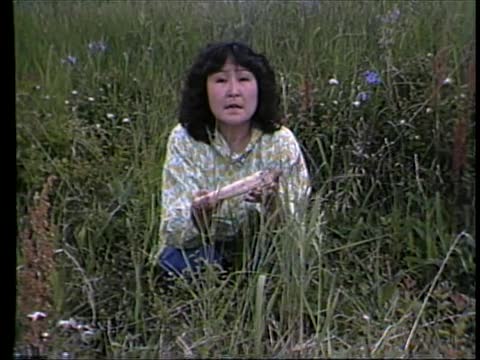
what our lives were like. That's what archaeology is. It's a way of studying the past by looking at objects once used by former generations. History is especially important to us in western Alaska, because our ancestors didn't leave behind them written records of themselves or their lives. The only way to know them is to study the objects made and used by them. In a way, archaeology lets us travel back through time. It helps us to see what the world was like when our ancestors lived in places like this, the site called Glumavic. Some of these settlements were used thousands of years ago. How can archaeology make them come to life for us today? Think about it. Isn't it easier to imagine your great-great grandmother if you have something of hers? A knife, for example. Something you can hold and look at.
An object like that can tell more than memories or traditional stories. It can give us a great sense of how a woman like your great-great grandmother must have felt as she held that knife. Or how about a carving, an ivory figure of the walrus he hunted, as it was seen by the craftsmen who carved it hundreds or even thousands of years ago. Looking at that carving, you might get the feeling that you really may know things about your great-great grandfather. If we were to begin digging around the site, we might find some things like these. But what would they tell us? These are several different types of spare points and arrowheads. By digging these up, do we really learn anything about the person who made and used them? Not necessarily. A person who was trained in archaeology, though, might be able to tell us a lot. An archaeologist could tell us about how old the point was and what it was designed for. He or she might even be able to show us how the point was made by chipping or grinding
certain kinds of rocks. By piecing together bits of information like these, we can learn how our ancestors hunted and how they survived. There's more to excavating on old site, though, than just using a pick and shovel. Archaeologists have scientific methods for digging so that they don't miss any information. Bob Shaw and archaeologist Torx in our area recently spent several days talking about archaeology with the students at Good News Bay Rocky Mountain High School. The things are changing rapidly for you here, aren't they? Well, they changed in the past in the same way. The artifacts that we find in the old village sites show us how life changed in prehistoric days. You need to understand one thing very clearly is that you don't just collect the artifacts when you do archaeology.
You have to collect information on where the artifact is located. Let's say you have a house, okay? That's your house, okay, and what might your house look like? It's a door there, maybe? A bed? Okay, there's a bed there. I better label these. You won't ever know what they are, will you? Okay, bed, and maybe a stove over here? Okay, well, let's not get everything in there. Okay, there'd be a wall, maybe here? Bathroom, okay, now let's say that it's 5,000 years from now, and all the walls have tumbled out, and you can't see any of this, there's grass growing over the top of it, and you start to excavate it, okay, and you're going to excavate that, you're not going
to excavate just the house. Well, what might you find under the table? You might find a spoon, a cup, okay, there's a cup, oh what, a tea bag, okay, there's a tea bag, okay, so you will find things scattered around, you know, by your beds you might find one of those shoes, okay, so you would want to know what people were doing in these various rooms, oh of course the TVs over here isn't it, okay, so what you would do is you would, you would do a map of this house, you would make a map of where everything occurs in the house, if you found an object right here, let's say we found the stove, and you wanted to record this information, and draw a map of this house, you would set up a reference
point here, okay, and you would measure over along this line to the corner of the stove, and then you would measure down, okay, so you have two coordinates, you have an east coordinate and a south coordinate, you understand that, yep, okay, let's say that this is east two meters, two point zero meters, okay, and this is south point five meters, zero point five meters, okay, and let's say that this, these are meter squares, okay, in here you would transfer that point two meters and down one half meter, so in this new grid system the corner of the stove is located right there, if I found the stove and just took it and
ripped it out of the ground and didn't measure it any of it in, I would have the stove, right, it wouldn't tell me very much about where you lived and what your house was like, because if I pulled your stove out and didn't make a map of where your stove was and your bed and your table, I wouldn't know very much about how you lived, what I, okay, that's what's happened to these artifacts that we have in the box back here, you know, we have the artifacts but we don't know how they were distributed in the people's houses, we just have the artifacts, and that happened when the airport was built, you know, when the bulldozer made the flat place for the airport, it plowed away one of the old villages, okay, we now have a program to keep from plowing away the old village
sites and an archaeologist from the state comes out before any airport is built or any new road is built and we'll look at the area where the construction is going to take place and if they find an archaeological site, they will excavate the site, okay, so they're trying to recover as much information as they can about the old lifeways. The program Dr. Shaw mentioned is based on the Alaska Historic Preservation Act, that's a lot designed to preserve and protect the state's prehistoric and historic resources from lost or destruction. There's the wealth of scientific, historic and cultural heritage information in these resources. We want to make sure that they're passed on to future generations. That's why it's against the law for anyone to remove objects or to tamper in any way with
places like this, places that have historical significance. It's also against the law for anyone to buy or sell artifacts. Archaeological sites in our area have been discovered in many ways. Sometimes hunters or trappers use the remains of an old camp or village. In some cases, construction workers have discovered old sites while they are moving earth for airstrips or buildings. Whenever someone discovers a possible archaeological site, it should be reported to the Alaska Department of Natural Resources, the Department will arrange for trained people such as archaeologists to visit the site and do the necessary work. In a way, an archaeological site is a little like a jigsaw puzzle. The archaeologists has to find and fit all the bits of information together to produce a picture of what life was like. Archaeologists artwork all over the world.
In some cases, they've uncovered the ruins of entire cities. The biblical city of Jericho, for instance, existed 9,000 years ago. Archaeologists found the ruins of it buried in rubble 50 feet beneath the modern city of Jericho. These trade beads were found on the southwest coast of Alaska, strung in a pattern you see here. I sometimes think about the first woman who are these beads over 200 years ago. What was she like? What did the beads mean to her? What similarity is there between her life and mine? As time goes on, more and more people are learning how important it is for us to understand our past. The everyday things our ancestors made and used are treasures to us today. Archaeology can help us find and enjoy those treasures and pass them along to our children. Archaeology can bring all the generations of our human race together, from the distant past
to the distant future, and it enriches our lives right now. Thank you.
- Program
- The Fascination of Our Past
- Producing Organization
- KYUK
- Contributing Organization
- KYUK (Bethel, Alaska)
- AAPB ID
- cpb-aacip-127-504xh5k8
If you have more information about this item than what is given here, or if you have concerns about this record, we want to know! Contact us, indicating the AAPB ID (cpb-aacip-127-504xh5k8).
- Description
- Program Description
- Tape #1 LKSD Archaeology Series; Master.
- Program Description
- Lower Kuskokwim School District, KYUK TV Productions. With Ina Anaver on archaeology in the Yup'ik setting.
- Asset type
- Program
- Media type
- Moving Image
- Duration
- 00:14:31.038
- Credits
-
-
Copyright Holder:
KYUK-TV, Bethel Broadcasting, Inc., 640 Radio Street, Pouch 468, Bethel,
AK 99559 ; (907) 543-3131 ; www.kyuk.org.
Producing Organization: KYUK
Speaker: Anaver, Ina
- AAPB Contributor Holdings
-
KYUK
Identifier: cpb-aacip-5108681dae8 (Filename)
Format: U-matic
Generation: Original
Duration: 00:13:11
If you have a copy of this asset and would like us to add it to our catalog, please contact us.
- Citations
- Chicago: “The Fascination of Our Past,” KYUK, American Archive of Public Broadcasting (GBH and the Library of Congress), Boston, MA and Washington, DC, accessed April 2, 2026, http://americanarchive.org/catalog/cpb-aacip-127-504xh5k8.
- MLA: “The Fascination of Our Past.” KYUK, American Archive of Public Broadcasting (GBH and the Library of Congress), Boston, MA and Washington, DC. Web. April 2, 2026. <http://americanarchive.org/catalog/cpb-aacip-127-504xh5k8>.
- APA: The Fascination of Our Past. Boston, MA: KYUK, American Archive of Public Broadcasting (GBH and the Library of Congress), Boston, MA and Washington, DC. Retrieved from http://americanarchive.org/catalog/cpb-aacip-127-504xh5k8