Delta Digest; Qanemcikat
- Transcript
Hello, welcome to Delta Digest. I'm Rhonda McBride. And I'm Jeff Kennedy, in our magazine segment, a conversation with cellist as new president. Two weeks on the job and he's already downsizing the corporation. Now a review of the week's top news stories. Bethel police are investigating two deaths this week. A body was found in a creek near the Bethel landfill Wednesday afternoon by two men scouting places to trap a mink. Police Chief Chris Lewis says the body was badly decomposed. That suggests the person had been dead for quite some time. Investigators haven't determined the sex or the identity of the person. The body was found off Harrelson's subdivision road east of the Bethel landfill. The Alaskan National Guard Health Police removed the body by supplying track vehicles in other equipment.
The body will be sent to Anchorage for autopsy. Police are reviewing reports of missing persons and are asking for information about any cases that might not have been reported. Investigators are treating this case as a homicide. Well Bethel police are also investigating another death out of a chafornic man at the Bethel Inn this Wednesday morning. Medics and police were called to the Inn when a guest reported that his roommate 65-year-old Ralph Kyloep had died suddenly apparently from a heart attack. Medics say when they arrived it appeared Kyloep had been dead for at least a few hours. Police don't believe that there was any foul play, but the body will be sent to Anchorage for autopsy. An demonic family lost their home in a house fire on Saturday. So member sixth, fire broke out just before midnight and Nicholas Tucker Sr.'s home. No one was harmed. Damage is estimated at $30,000. Investigators say there was an electrical short in one of the bedrooms. Villagers say firefighters got a late start in battling the blaze. The battery in the village fire engine apparently died and volunteers couldn't get the
truck started. Well much of the local news this week came from of all places. Anchorage, Senator George Jacko was in the glaring media spotlight for three days as he was grilled about ethics charges that ranged from sexual harassment to abusive power. While the hearings drew statewide attention they were somewhat a low key affair in Jacko's own district. Although the hearings were conducted in Anchorage you could listen in on the proceedings at the local legislative information offices. In Bethel only six people attended the first day to the second and three on the last day. And all only seven people went to the Bethel legislative information office to monitor the hearings. Bethel City Councilman Dave Trantham sat through the entire proceedings. He said he felt it was his duty as a citizen. Well on the streets of Bethel it was hard to get an accurate reading on just how people feel about this issue. When we took an informal poll many people told us that they weren't even following the hearings and those that did had this to say.
I gather from his complaints that the board the ethics committees being pretty effective in their questioning it seems to me that his lawyer's defense is pretty technical by just saying that an attempt isn't an ethical violation. So I would hope that he wouldn't get off on such a technicality as that. Do you have any opinion on whether or not you think he can effectively represent our area? Probably not. And I don't really know much about it but my feeling would be probably not. My opinion of the hearings are that they're being conducted in a very ethical and straightforward professional manner. I think Mr. Jacko is a professional liar. I think he's a human being. I think he's a person however there's politics could be involved. I guess if he's on campus, I feel that he's got to be removed.
I think it's a shame that he's representing this region. I'm sorry to say that but we don't need the bad press. I mean I heard about what he did but I never really read it or anything. So I don't know. I was seeing you better than that though you know if he's going to be working for the state government. But I can't say about him. I have a whole lot to say except that I think that he probably is a lot healthier than he wants people to think. And we want to remind you that this is not a scientific survey, just a random survey of people that we met out on the street. Jeff? A battle couple may have beaten a bootlegging rap but they can't keep the booze. Eleven cases of vodka are at issue. Alcohol that Dominic Milage and Gene Simon were accused of bringing the battle to sell. In Anchorage jury acquitted them of that charge in January, Milage claimed he intended to use the vodka to celebrate a family reunion.
Although Milage and Simon won their criminal case, the state recently won a civil case on the matter and that gives the state the right to the booze in a civil trial, the state doesn't have to prove guilt only the likelihood of intent to sell. Meanwhile Milage was in Bethel Court Monday for a hearing on another bootlegging charge in which he's accused of selling a single bottle of vodka to a man near the QFC in August. An NBC movie aired this week about a former Bethelite. The movie was called Victim of Love, the Shannon Moore story. It's about a man who almost commits the perfect crime. That man was David Davis, known to people in Bethel as Bush pilot David Bell and he also went by the nickname of Rip. Juan Peltola hired Bell out of Hawaii eight years ago to work for Bush Air on the recommendation of another pilot. He had no idea that Bell was on the run for murder. Peltola says that Bell seemed like an easy-going guy who of all things liked to knit hats. Bell or Davis spent two summers working in Bethel and the movie makes no mention of that.
Its focus is on his parents or rather his wife's parents who work for seven years to convince authorities that he killed their daughter Shannon. The murder weapon was an injection of a serum that induces paralysis, a serum that was untraceable at the time. Authorities later found a way to detect the chemical and Shannon's body. Davis might have gotten away with the crime if he had been able to cremate his wife's body as he tried to do just after she died. No, Shannon would never have said that, she wouldn't want to be cremate. I'm her husband and I'm going to see that she guess what she wanted, but you can't stop me. I'll get it. I have to. Is everything okay? Give her back to her parents. You've only had her for ten months, let her go. Davis, is it the money for the burial? What about insurance? Well, what about the insurance, Davis apparently had six life insurance policies on his
wife. The murder took place in 1980. Authorities caught up with Davis and American and American Samoa several years ago when a girlfriend found out about the case from watching the TV program unsolved mysteries. No mystery. The city of Bethel has flunked a federal water quality test, recent monitoring found more lead and copper and Bethel tap water than the federal environmental protection agency allows, but there's no cause for alarm. There's nothing wrong with Bethel water itself. It's what happens to the water after it gets into your home that you have to worry about. The lead and copper apparently leeches from water pipes inside your house. Water particularly picks up lead particles from the solder used to join the copper pipes, but it's very easy to protect yourself. Those stokes with the Bethel office of the State Department of Environmental Conservation has these recommendations. Try not to drink water directly from the tap, especially if it's been standing in your water pipes for six hours or more.
Never draw hot water from the tap for your drinking or cooking water. Hot water's more corrosive, and that means it's more likely to pick up the lead. Draw water from the cold water tap and let it run for a while. The best time to draw your drinking water is after you've used a lot of water, like after washing dishes. At that point, your pipes have been fleshed clean. Then you can store this water in the refrigerator to drink later. Well, federal officials are downplaying recent water testing in Annie Act. Kathy Benedictson of the Federal Aviation Administration says the test were merely routine precautions that the FAA takes to safeguard the environment. The federal agency tested the area after a former employee said he buried 10 gallons of the pesticide malayathon on FAA land in the village a couple of years ago. The agency personnel used ground radar to search for the very 10 gallon jug of the chemical, but they couldn't find them. They tested the water and several wells in the village as an extra precaution. Environmental engineer Walter Williams says that the test show no traces of the pesticide
in the wells. The FAA is serving 67 of its sites in Alaska for possible contamination. When Maya Athanas graduated from Bethel Regional High School 1989, she was voted the most athletic girl, and she lived up to that title this year as one of the star players of the UAA Women's Volleyball team. She was recently selected as a player for the second team of the Pacific West All Conference team. Ken Garland of KIMO TV caught up with the Fannis while she and her team were practicing. Maya Athanas has a lot to smile about. She has quietly but effectively become one of the top players on the C-World's team. She is second on the squad and kills, digs, and bases. That's all over. It is in the top ten of fools to just go categories in the Pacific West Conference. I had focused so hard for like two years on this position where I'm at right now, and so I'm very proud of where I'm at. She should be, especially since this is Maya's first year as a starter. She registered it two years ago and was a backup player last season.
She's come a long way considering she never played volleyball in high school and has had to learn the game as she's gone along. This was probably one of the hardest goals I've had to work for most definitely, because it's coming in in a college level and really not knowing that much about volleyball anyway it was just really difficult. She really wants it. She loves volleyball and she can eat, drink, and sleep volleyball. She loves the sport. Notice about being a starter this year, Athanas has found a home as one of the C-World's middle hitters. Her play is impressive, her statistics are impressive, and she's getting all the help she needs. It's the team this year though makes it really easy. It's not just, it's like the whole team together has really binded well and we all stick together so they make it really easy for you to play your hardest. And Maya's play has made it easy for the C-World's to win. Reporting for KY UK, I'm Ken Garland in Anchorage. Athanas is a junior, the C-World's wrap up their season this week. Well, the new president of Trilista wasted no time in getting down to business.
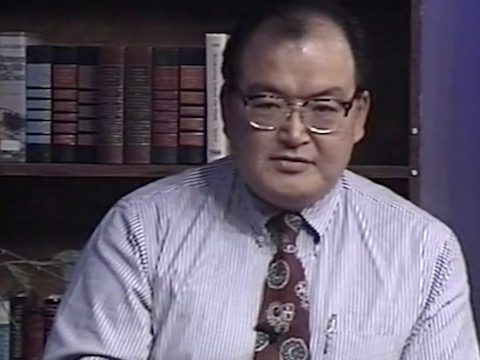
Their only two weeks on the job, P.O. Park has begun a major reorganization of the company. Trilista's chain of six newspapers, Alaska newspapers incorporated, was the hardest hit. A&I, Alaska's largest rural newspaper chain, has been operating in the red and park ordered the chain to cut its losses by 90%. When Park was here in Bethel this week, we talked about the reorganization and he says until he can stem the flow of losses, there will be no dividends. As soon as possible, I would like to do it this month, but I can't, you know, to do that, we're going through quite a major restructuring and downsizing as major. And hopefully, by next year, we'll get an indication on the third quarter to all dividend declares go to heaven, not necessarily.
But what I regional corporations is unique because it belongs to the people. They are more than shareholders, even though we have structured it into a corporation, it belongs to the people. So I have a socio-economic mission to attain, and one of the socio is to pay dividends. But at this point, we'll have to wait till the third quarter, next year to determine when this could happen. Well, is there a danger that if you do try to pay dividends when you're really not capable of doing it, that this could cause a problem? That's what I meant by, to all dividend declares go to heaven, that people who declare dividends when they kind of afford to, and they don't go to heaven on that point. Well, you mentioned that there has been some major restructuring taking place since you arrived. Can you tell us a little bit more about what that entails? It entails elimination of departments, streamlining layers of management, centralizing
control to the CEO's office, and doing the same with the subsidiaries to cut that evil word, fixed cost. First of all, you have to reduce the fixed cost in order to run an efficient company. Variable cost is a cost of sales, I don't mind. But it's the fixed cost that has to be cut, and that's what we are doing right now. Well, when you hear cutting fixed costs, it usually means layoffs, what subsidiaries are being impacted? Our biggest money loser is A&I, Alaska newspaper ink. There are a lot of good people out there, but at this time, it is not in the crystal ball for us to, that we can afford to carry those people. And you have to realize it's not just the Tundra drums.
We are talking major regions here, all the way from Barrow, Cotsibew, Artic Sounder, to Bethel-based Tundra drums, Dillingham, newspaper, Down the Chain, Dutch Harbor Fisherman, all the way to Prince William Sound, and it's quite a big vast area, and the printing cost and paper costs is exorbitantly expensive. And you know, to gather the news for the localized paper, they had to run a bureau office, but they had to work out of their house. We just kind of afford this fixed cost of running an office in all those areas. So what does that mean? Does that mean you're going to phase out the offices in the communities where the papers are phased? Yeah, we are going to run in like a bureau office, which means the editors expected to bring the computer home, he's got a phone and the fax. We've got no business paying rent when we can not afford it, because most of the sponsors up there are quite, you know, they are not supporting the newspaper in terms of advertising
etc. I intend to bring this up in my regional president's meeting also to give us their support in being a proper corporate citizens by carrying ads for their respective regions, like Artie Slope, Nana Corporations. So where will we see the cutbacks in the bush or in the Anchorage office of Alaskan newspaper? Both. Both. The cutbacks are in the bush and mostly in the Anchorage offices. And to what extent are the cuts being made? 90.1% to be exact. We had to raise our subscription from 50 to 75 cents because we have to justify the expense in running a good newspaper. And we ask for the people's understanding on that. And I'm going to personally get involved in monitoring the receivables.
They've got some bills out there that has not been paid since last year. And I'm going to talk with some of the major vendors. Alaskan commercial has always been good to us, but we ask them for the more continuous support. And I understand car gas is planning to come in, but more so than that, you know, newspapers are good media. And we have a duty for the people out here to carry good newspaper. It's not for the tundra drums, but other newspapers except for the Anchorage Daily News out. The next question is, will we see the tundra drums office closed as well and turned into a bureau? No. On the tundra drums office, there's going to be a cutback, but we will be maintaining an office here because this is our flagship newspaper. Now many people were a little concerned in Alaskan newspapers early days when they began expanding their Anchorage office and expanding.
Was this a problem of too much growth too fast? When a person is hired, that person tend to emphasize what he or she knows best. And it is my pragmatic approach, my observation that the man in charge honest to God tried to make a good newspaper, and by doing that, he hires on or he improves, which is all cost items. And you're speaking of Dave Hunter, General Manager and the executive staff over there. And I said, you have reached that goal now. Let's look back at what you're doing is we're not running it at an even at a break, even point. And it's eating to a cholista's operational money, which is the people's money. So come up with implementation, and Dave was good enough to work with us, and we have implemented it.
And as of yesterday, it is done, and we're going to monitor it. What about some of cholista's other subsidiaries? It sounds like Alaskan newspapers was the first to hit your chopping block. What's going on with those subsidiaries? Other subsidiaries. We have some profitable subsidiaries, namely a real estate subsidiary, except for one unit which I intend to address. I have to go one at a time, and we have a highly profitable title company, our real estate division, some are profitable, some are not, because it goes back to 10 years ago. We got into a deal that we cannot extricate out of. And I'm going to approach this people, it's both government and finance company. By saying, I'm sorry, we cannot run a business at a loss, you have to come to your senses
and help us in a research solution. And that's what I mean by communicating. Make them an offer, they can refuse. So what you're saying is you approach the subsidiaries that are the most trouble first, systematically go through them. So basically what you're doing in your first few weeks is pairing the corporation down and size. What next? Next. After pairing down and cost reduction, refurbish our strategic plan and bring it up before the board and propose what we plan to do in the next three to five years. And one of them would be soliciting support from a huge region, the village corporations, the AVCP, the YKHC, respected village coalitions, IRA, a traditional government.
And what we are planning to do is bring a region oriented capital project. And then my main point is to generate this capital project, which is a business. And at this time, for the money to flow back, as to list I have no competing in a localized construction business, it is our business to help convey the contrast to the village corporations. And then by arranging that, maybe we can be given a management fee. Or if we make a profit by a joint venture, share equitably, hot luck. So you are seeing Chilista as a broker of projects. Clearing house. Clearing house of projects. Because Chilista corporation, whether some people like it or not, is a regional corporation. Representing the region.
It has, as its shareholders, the village members. And in as much as we are a representational regional corporation, we have to be upfront with the other business communities and other regions. To watch out for the best interest of the region, which is conveying businesses. And in the process, make some profits, which will be put into a cover of dividends and scholarship funds and whatnot. And redistribute it back to the region. Well, this is always a hard question, but to be realistic, what is Chilista's potential? For a long time, it's kind of been the four step child native corporations. Where can it go? And maybe you can give us five years down the road, ten years down the road. As far as if Chilista stays on a good course, what is the potential? May I have my imagination run? Let your imagination roll.
Three years, I foresee a coalition of regional corporation and village corporations. Within that three years, I foresee the village corporations on an equal standing business relationship with the region. I foresee one of those companies to be importers for wholesale. There's no reason why Chilista corporation with the support of the villages. Be a wholesaler to Alaska commercial or fantastic. We have all the rights in the world to be in business like that. I foresee a supplying wholesale merchandise, equipments, fuel, at a good price. And out of the profit, we pay back or we share the proportion to the consumption. So keep the money within the region.
I foresee that. I foresee capital projects. I foresee capital projects in the much as, utilize a Bethel oil and gas potential. I foresee Chilista approaching world fortune 500 companies in order to drill for gas. Utilize a gas for electric utility. I foresee a inter-type project, which is another regional oriented capital project. I foresee a clearinghouse of getting water and sewage treatment for the villages to name a few. OK. And you said it was in your three-year vision, further down the road, maybe down the road? Maintaining and managing those capital projects, with shareholder trained technicians, efficient billing for utilities, efficient maintaining those operations from the capital projects, and then keeping the money within the region and opening up communications within
the region by sharing the same electric line, supplied by on-own and operating cooperative. It is a nation for the lack of better work. We have 300-mile wide between the Yukon-Cusco cream, 56 villages, besides the original core shareholders we are talking close to 20,000 U.P. Gaskimos and Athabaskans shareholders. Let me, as an example, why it can be done is my native country, Korea, it had nothing but rocks and people after the war, and what they did was they did a new village movement and they united, and what they did was under the unified arrangement, people helped each other in terms of part-law concept and helped create an enterprise or industry. And now they are going to be one of the industrialized nations by year 2000.
They have one of the highest per capita income now, but if you look at their resources, they have nothing. It's people and rocks on the country smaller than the tourist region. Next week, we'll hear more about PO Park's business philosophy. And we'll hear from a group of Russian doctors who came to the YK Delta to find out how the UConn Cusco Coim Health Corporation delivers health care. And that will do it for this edition of Delta Digest. Thanks for joining us. We'll see you again next week, goodnight. . .
. . .. .. .. .. .. .. .. .. .. .. .. .. .. .. .. .. .. Uh, of course we want to proceed.
All different institutions, there's very much very information within the local community. and the
operation a a a a a a a a a a a a a a a a a a a a a a a a a a a a a a a a a a a a yeah it tastes good, too, good, sad.
For example, there is a serious third I am working with I-10 targeting one Cure your Per On-call placement I spend a few time I still drink this water a summer and I dance with my Emirate and my mun and I did and together. the
K his
this is K
- Series
- Delta Digest
- Series
- Qanemcikat
- Producing Organization
- KYUK
- Contributing Organization
- KYUK (Bethel, Alaska)
- AAPB ID
- cpb-aacip-127-17crjjnr
If you have more information about this item than what is given here, or if you have concerns about this record, we want to know! Contact us, indicating the AAPB ID (cpb-aacip-127-17crjjnr).
- Description
- Episode Description
- This is a dub or dub master of the English and Yupik language versions of the public affairs program Delta Digest and Qanemcikat. 1993
- Episode Description
- Delta Digest Qanemcikat 11/11/93
- Broadcast Date
- 1993-11-11
- Date
- 1997-11-12
- Asset type
- Episode
- Media type
- Moving Image
- Duration
- 00:56:00.661
- Credits
-
-
Copyright Holder:
KYUK-TV, Bethel Broadcasting, Inc., 640 Radio Street, Pouch 468, Bethel,
AK 99559 ; (907) 543-3131 ; www.kyuk.org.
Producing Organization: KYUK
- AAPB Contributor Holdings
-
KYUK
Identifier: cpb-aacip-01ae3fdc31b (Filename)
Format: VHS
Generation: Original
Duration: 01:00:00
If you have a copy of this asset and would like us to add it to our catalog, please contact us.
- Citations
- Chicago: “Delta Digest; Qanemcikat,” 1993-11-11, KYUK, American Archive of Public Broadcasting (GBH and the Library of Congress), Boston, MA and Washington, DC, accessed April 5, 2026, http://americanarchive.org/catalog/cpb-aacip-127-17crjjnr.
- MLA: “Delta Digest; Qanemcikat.” 1993-11-11. KYUK, American Archive of Public Broadcasting (GBH and the Library of Congress), Boston, MA and Washington, DC. Web. April 5, 2026. <http://americanarchive.org/catalog/cpb-aacip-127-17crjjnr>.
- APA: Delta Digest; Qanemcikat. Boston, MA: KYUK, American Archive of Public Broadcasting (GBH and the Library of Congress), Boston, MA and Washington, DC. Retrieved from http://americanarchive.org/catalog/cpb-aacip-127-17crjjnr