Eyes on the Prize II; Interview with Clory Bryant
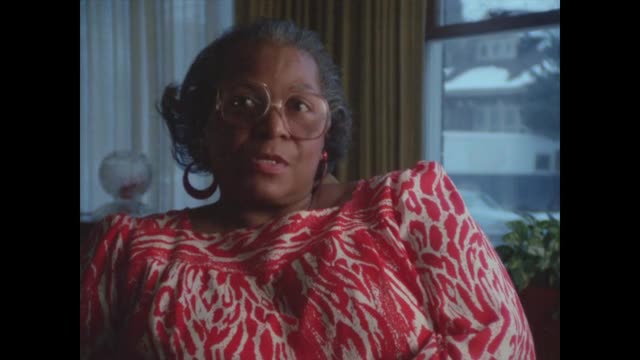
- Transcript
What was your first impression of Chicago coming here as a 17-year-old? Well, I thought Chicago was one of the most— I would just practice it with my own kids, 17, however, to get your age in this school. Well, when I came here I was 17 and I was just out of high school and very young and idealistic and I thought I was going to really go to Chicago and knock them dead. The beautiful tall buildings I thought they were just fascinating. The bright lights, because I lived in the country and I was not used to lights. And to see lights burn all night long, I would just get up and look out of the window and look at the lights. I thought they were just beautiful. And talk about what your family was coming with. I mean, what were they leading behind in Arkansas?
What did they expect? What was the dream of Chicago? Well, we didn't leave much behind. We did have a house. Sorry. Something about what you left in Arkansas. What we left in Arkansas was segregation, poverty, lack of job opportunities. There was very little to offer us at all. And when we came to Chicago, we thought, you know, here's the land of opportunity. And as a little girl, I had seen people come home on vacation from Chicago and they had on pretty clothes and they drove shiny cars and they had money. And I thought, yeah, I want to go there and enjoy some of that. But when we got here, it was different. It was not that at all. I guess those people must have saved a lifetime to come home and spend that kind of money. Jobs were hard to find and housing was really poor.
And even when they was housing, you couldn't meet the rent because you didn't have a job. Educational opportunities was also very poor. You could go to high school. But after that, then college, there was just no way. You might say, how was it different from the housing you had in the South? Well, if you could end with that, but I also want to... More too. Okay, how was housing different from what you found as a black family moving in from what white people had in Chicago at that time? Well, most blacks lived in KitchenAid apartments. And these apartments were normally when whites hid. They were six room flats. And when blacks took over those communities, they became apartments about four to each flat cut up apartments. And you had to share a common kitchen between four different families.
If there's a way that you could save it as a gorgeous dress for this, it looks great. Yeah, and we're marking it. Okay, how was the housing different from the way whites had it and the way it was for blacks when they arrived? Well, when whites had it, they were six when whites had the houses. They were like flats, six room or seven room eight room flats. When blacks took over that housing, each bedroom became an apartment where you shared a common kitchen and you shared a common bathroom with four and five sometimes six individuals or families. And was that different from the way you would know it from? Oh, sure. Even in the South, you probably had a shack, but it was your shack. You didn't share it with anybody else.
Okay, okay. Yeah, I think that's fine. Okay, how was housing different from what it had been for whites and blacks when they arrived? Well, in those communities where apartments were like flats, they were six, seven, and eight room flats when whites had it. And when the blacks moved into those same housing, each bedroom became an apartment. And so consequently, you shared the kitchen and bathroom with five, six other individual families. Even in the South, you had maybe a shack, but it was your own shack and you didn't share it with anybody else. And that made an awful lot of difference. Lovely, yes. That's fine. You get your car soon. That's right. Yeah, one more. One more five. In a couple of choices, how would you describe the daily machine? Well, the daily machine was, well, I guess I could do their best by trying to describe me your daily.
He seemed too many to be omnipotent. He took a matrivali approach to government. He was in control. He was strong, demanding, and ruthless. And certainly racist. Why do you say that he was racist? Because blacks who were here in this city and who worked and to support the machine always wound up getting the crumbs. While someone else ate at the banquet table. We got what was thrown as that, the bones and the crumbs. And you had some particular instances where you remember specifically being running as an independent and you mentioned some specifics of that daily power. You talked about a neighbor who needed Christmas tree. I was wondering if you could talk about that story. Yes, that was in the early 60s.
I was running for a public office. And I had asked her neighbor of mine. I was running as an independent in the early 60s. I was running as an independent against the daily machine. I had asked her neighbor of mine, was she going to vote for me? As a matter of fact, I said, I know you're a vote for me. And she said, no, I'm afraid I can't because my alderman always gives me a Christmas tree for my vote. And I know you can't afford to go around buying these mini trees. So I'm just going to vote for him because I have to have my tree. And so I didn't get her a vote. And talk about what happened in terms of the public housing when you were in public housing. And you had a problem because you got to meeting anything? Yes, well, having run for public office, a lot of people in the community saw me as a leader. And of course, if something would go wrong, they would come to me.
And this group came to me about housing. They were being asked to move. And I went to that meeting that night and addressed the group. And in doing so, I said a few things that might have not been right with the powers that be. And of course, by Tuesday, I had a notice in my mailbox that my rent had gone up from $61 a month to $178. Okay, good. Mark six. Okay, talk about what happened when you spoke out of the local meeting. Well, it was during the time that I was living in Chicago Public Housing. And there was some people had been asked to move and they didn't want to move or couldn't move or whatever. They asked me if I would come to this rally that night and help them to organize and to protest that move and I did. On Tuesday, I had a notice in the mail to come down to the Chicago Housing Authority office. And I was informed when I arrived there that my rent was going from $61 up to $178.
And I'm sure it was because of the statements that I had made at the meeting several nights before. Good. Okay, Mark seven. Okay, talk about running again as an independent and the problems you had in speaking at your own church. Again, when I was running as an independent, I had approached to my minister and asked him if I could speak five minutes before I have to service on Sunday morning to drum up votes. And he said he would discuss it, you know, with some of the church members and see what we could do. But then I was denied. And when I was told why they said that the ward balls had bought the very seats that we sat in on Sunday morning. And that I had a lot of nerve to ask them to stand in that pool pit and to speak against him.
And of course, I was denied the right speak and that was in my own church. Okay. Sure, no, I had a good for us. It's wonderful. I'm going to ask you that. And the problems you may have had with where he based his support. Okay. Mark. Okay. What problems did you have in terms of where Dr. King based his support from in the Chicago campaign? There were, there was a group of people who were concerned that Dr. King did not work as close with the grassroots as they had hoped. There was influence from some of the city's biggest universities from some of the political bosses in the black community with whom he aligned himself. That we were, well, I don't know if they were political bosses, but let's say they, they called, they were set up as brokers for the black community.
And they were not always as we used to put it on the square. And we had reasons to, to mistrust them. And we had hoped that Dr. King would not align himself with those people. But he did. I don't know if it was because he was not well informed. I'm sure that's, that's probably the reason why. Because I can not think of another person on earth who was in more fear than Dr. King. Did you have any problems with the summit agreement with the courts that reached around housing? Oh, yes. You know, when you say summit agreements, that's the problem I had. I don't like summit agreements and covenants and things like that because they're too easy to duck out on. I would like to have seen something much more concrete. A contract, an agreement, a with a timeframe and some signatures.
Okay. Mark, not him. Tell me why you had some problems with those who were deciding things at the summit. Well, we first of all, we felt they were deciding for us. We lived. Oh, because they don't hear your question, right? Okay. Ask me again. Why did you have problems with the people who were at the summit deciding issues for you? The people who sat on the summit with the housing department were not the people of our choice. We felt that those people who lived in Chicago Public Housing, those people who were emotionally involved. Those people whom Chicago Housing was a way of life should have been involved and who were articulate enough to say what the problems were. We were involved enough to know and concerned enough to care.
And those are the people we had wanted because we don't care about summits taking place without us. We don't care about covenants. We want contracts and black and white with some hard answers for us, with some signatures and some people we can hold responsible to and some time frames. And none of this was there. Again, it was just another piece of paper. And you said something about the people there didn't know public housing except the movies. Except that those people did not know who sat in on those summits and negotiated these deals for us. Nothing whatsoever about public housing except what they had learned from the movies and from what they had read in the papers. And that is the extent of their knowledge. Good. Yeah.
Lord, hit it. Monten. Okay, give me a description of the staging of the Cicero March and how you didn't think you were going to go and you would just bring your daughter. Okay. Well, we had kind of agreed that we went to the March on Cicero. With my daughter, both of us wouldn't go to jail. Sorry, let me start in the beginning. You know what? You asked me the other day. That was good. Wait a minute. You said, oh, how did you ask me that? I used to go, you know. So, where are you going? Yeah, you said I was going to say the day the Cicero March might go in and myself. Oh, yeah. What did you say? The day of the Cicero March on my daughter. Okay, yeah. Back 11. So, the day of the Cicero March, what happens with you and your daughter? The day of the Cicero March, I went to take my daughter to the March. And I was not to March. Only she was going to March. And I was going to take names of people who were going to go into Cicero.
And then we'd be there when they come out to take their names to be sure that all of our people came back safely. And we got there and it was such a few. We became a little frightened. And we kept standing around and finally it was 12 o'clock. I believe it was 12 o'clock. And all of a sudden, guys start getting out of cars and people start coming out of doorways. And they said, okay, Lucas, step off time. And I just couldn't believe it. All these beautiful warm bodies were there to support us. And we didn't know it all this time. So they started to march and I felt so good. I said to my friend, let's walk over and see what's going to happen. So we went in behind them a little piece. But by the time we got there, we noticed that the National Guards and Cicero Police, Chicago Police, and everybody else was there with guns and bayonets pointed at the marches. And instead of pointing at the people who were throwing the bricks.
So we were afraid to go back. So I was forced in to go on. But I'm glad I went. It was a beautiful experience. I was scared all the way. But we kept walking. And people from the post office where Lucas worked, joined us later on into the march. And when we knew anything, there were just thousands. And it was one of the most successful marches that had taken place in the city of Chicago. Now why was the character of that march so different from Dr. King's marches? Well, it was not a King March. We just went out there on faith. And we didn't have the big wigs flanking us on either side. We just went little people. And Dr. King's marches were kind of staged. Where you knew who was going to be involved. Everybody who was going to be involved in organizations, the ministers, and the other people. We're there to support him.
We didn't have that kind of support. The only support we had was those community people who just heard about it and saw it on TV and on the radio and just gotten their cars and came. And that was the difference. It was a groundswell of grassroots people. And was, talk about the difference between the nonviolence and then throwing the grass back? Well, and that's another thing. Cicero March was different. In that nobody there really believed in nonviolence. We went along with it. It was not our really, that was not our belief. And when they threw bricks, they got them back. We caught them and we threw them back. And so it was given take in Cicero for a mile or so. And I'll never forget it. It was one of the most outstanding things that I have seen accomplished in the civil rights movement. You don't know what Cicero meant to people in Chicago.
What did it mean? You don't go under the Vidoc honey because if you do you may not get back. Cicero was on the other side of the Vidoc. And you didn't walk through Cicero alone. You didn't let your car break down in Cicero and get out to change your tire. You just didn't go in Cicero if you were black. So what did it mean to march through there? It let the world know that together we can do anything we want. If you can march through Cicero, you know, you can accomplish almost anything. And I think people felt that. And from that point on, there was no turning around. We really went on and began to accomplish things like electing a black mayor. Did you think that by going to Cicero you were saying something to the people of Cicero too? Yes. To the people of Cicero and the people outside of Cicero. You know, we were marching through Cicero. I think we made a statement to those people who lived in Cicero. And to those people who did not live in Cicero.
Because for those blacks who told us we were foolish to go, we made a statement that we can go if we go together. To the people in Cicero, we made a statement. We were coming. And we are here. And nothing happened. Do bricks? People in Cicero were not. What we thought they were. Okay. Let me just answer one question of the producer. Okay. I'm going to ask you to just do the last thing about why this march was different from the K-March. It was exactly the interview that is because the march took on the character of the leaders. Okay. It was different because it was led by K and it had a certain character to it. First thing. It was Ed. More cool. Okay. Why was this march? The Cicero march different from Dr. Kim's marches. The Cicero march was different from Dr. Kim's march because it took on the character of the leaders.
And those were local people and were militant people. And people who did not necessarily believe that none violent was the only way. You know, it might have been one way, but then there might have been other ways. And they tried the other way.
- Series
- Eyes on the Prize II
- Raw Footage
- Interview with Clory Bryant
- Producing Organization
- Blackside, Inc.
- Contributing Organization
- Film and Media Archive, Washington University in St. Louis (St. Louis, Missouri)
- AAPB ID
- cpb-aacip-0ed658bd3c4
If you have more information about this item than what is given here, or if you have concerns about this record, we want to know! Contact us, indicating the AAPB ID (cpb-aacip-0ed658bd3c4).
- Description
- Raw Footage Description
- Interview with Clory Bryant conducted for Eyes on the Prize II. Discussion centers on the civil rights march held on September 4, 1966 in Cicero, Illinois, living conditions in Chicago and the difficulty of running for office against the Daley political machine. Interview was also used in America's War on Poverty.
- Created Date
- 1989-02-17
- Asset type
- Raw Footage
- Topics
- Race and Ethnicity
- Subjects
- Race and society
- Media type
- Moving Image
- Duration
- 00:20:57:01
- Credits
-
-
:
Interviewee: Bryant, Clory
Interviewer: Richardson, Judy, 1944-
Producing Organization: Blackside, Inc.
- AAPB Contributor Holdings
-
Film & Media Archive, Washington University in St. Louis
Identifier: cpb-aacip-e77e59ca7e1 (Filename)
Format: 1/4 inch videotape
If you have a copy of this asset and would like us to add it to our catalog, please contact us.
- Citations
- Chicago: “Eyes on the Prize II; Interview with Clory Bryant,” 1989-02-17, Film and Media Archive, Washington University in St. Louis, American Archive of Public Broadcasting (GBH and the Library of Congress), Boston, MA and Washington, DC, accessed April 4, 2026, http://americanarchive.org/catalog/cpb-aacip-0ed658bd3c4.
- MLA: “Eyes on the Prize II; Interview with Clory Bryant.” 1989-02-17. Film and Media Archive, Washington University in St. Louis, American Archive of Public Broadcasting (GBH and the Library of Congress), Boston, MA and Washington, DC. Web. April 4, 2026. <http://americanarchive.org/catalog/cpb-aacip-0ed658bd3c4>.
- APA: Eyes on the Prize II; Interview with Clory Bryant. Boston, MA: Film and Media Archive, Washington University in St. Louis, American Archive of Public Broadcasting (GBH and the Library of Congress), Boston, MA and Washington, DC. Retrieved from http://americanarchive.org/catalog/cpb-aacip-0ed658bd3c4