Eyes on the Prize II; Interview with Roxanne Jones
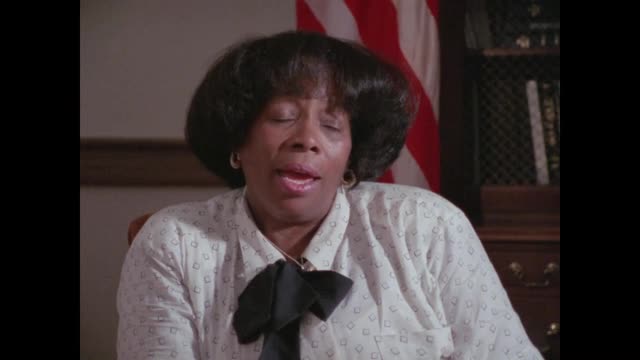
- Transcript
Okay, we're back, back more than 20 years ago in the 1960s. How did you get involved in it? I mean, you were never acted beforehand. How did you become involved? Well, I came involved because I had to get on welfare. I had a broken marriage, and I had two children, and I was working as a waitress. I became sick, and a doctor told me, you know, I should go and get help from welfare. At the time, I had a constable sign on my door. That's when they let all your neighbors know you're rent. And I had my lecturers being threatened to be cut off, and I went to the welfare department. I didn't know that much about welfare at that time, because I came from a working family. I had heard the welfare word used in the block where I lived. One lady was supposed to be on welfare, and I just not knowing much about it,
but the doctor saying they would help me. I went there with the idea I was going to get help, and I'll never forget that day as long as I live. How was treated? The disrespect. Not only me, but everybody was sitting around in that office, and I didn't get welfare that day. As a matter of fact, it took two weeks. As a matter of fact, I didn't get welfare until I talked to a lady in the building where I lived, knew a politician, and I went to see him. And he told me that when I go back the next day, if she began to treat me bad again, for me to ask to see her supervisor. And that's exactly what happened. And when I asked to see her supervisor, I became Mrs. Jones with the smile, and all of a sudden, I got help. I got welfare that day. And that's the day when I got home, I fell on my knees, and I thanked God for the check. And I told him if he would just allow me to do the best I could for my kids,
that I promised him that I would be a good mother, that I would be both mother and father to my kids, and I would do whatever was possible to change the way that I was treated that day. You hadn't been active before. How did you become active? I became active because several months after I started to OIC, an opportunity industrialization center. I took the printing course, and then I found a job in the paper, said, print is helper. And I went and convinced that printed that I was a person for him to hire, and he hired me. And unfortunately, I worked for three months, and my daughter's godmother took sick with the stroke, and I was thrown back home again with my youngest daughter, who was only two at the time. And I had to stay home and take care of her. There wasn't any childcare around at that time. And so a leaflet came into my door one day, and that leaflet said, if you're on welfare, you have some rights.
Would you like to have more money to live on? Would you like to be treated indignity? And I kept on reading, and I saw down there, a welfare rights organization was holding this meeting at South Oak Reed. And I went to that meeting that day. It was a community center. And I guess I was so vocal that I became the chairperson that day. They elected me that day to become chairperson. We organized, and immediately you say, how did I become active after being treated the way I was? After a couple meetings here and how those other women were treated, we began to write then organized to try to change the system. First of all, we wanted to bring about dignity to ourselves, because we knew we were somebody, we were mothers. We loved our children just like a working person, love their kids. And we wanted to be respected that way, and we began to organize. Then that's how I became active, being a welfare mother, being mistreated. Are you ready to back down?
I was very angry, because as I said earlier, I was to come from a working family, I come from a religious home. I love my brother and sister. I realize I'm their keeper, and I feel like, why should I be treated this way? I haven't done anything to cause me to have to be treated this way. Why do they look down on us? Why do they say all welfare mothers are bad? And I thank God for the movement, Dr. George Wally, who helped start this movement. And Philadelphia, though, it started with some social workers, and ministers got together. It was called Crusade for Children, under the auspices of Hazel Leslie. My predecessor, she's deceased. She was the first chairman. And then it became welfare rights after they met Dr. Wally. Let's cut for one second. Sure. I want to pursue that. I just want to make sure that the sound in it. Market? Sound too. What sorts of things was the welfare rights organization in Philadelphia doing in 66 and 67? Well, one of the first things President Hazel Leslie did,
they wanted to show the deficiency in the diet, so they had went to sell blood. And it was only one, I think, of those ladies whose blood was apropos. So what happened? They were shown to an adequate welfare grant. That's what they did just before I joined. Got involved. Immediately when we organized, my group was called the Southworth Regroup. One of the first things we did, we had one of the young ladies come in. Young mothers came in, and she had went to the Salvation Army to get help. And they had denied her help. And I just could not believe this and nor could any other members. So we immediately agreed to go to the Salvation Army the next day. Why did they deny her help? Because she was on with mother. So can you start again and talk again? Yeah, oh, I'm sorry. What happened? One of the first actions that we took was, at the meeting, it was a young lady who had went to the Salvation Army. She was on with mother.
She had two children. And she went there to get some help for Christmas because we organized around November. And so she went there and they denied her help because she didn't have a husband. So one of the first things we did decided to move on there and to go there the next day. And we did that. And about 50 of us mothers went down there and we changed their policy. So that was an action that immediately got around in the community. And other welfare mothers who hadn't joined, immediately came to join the group. And that was one of the first things we did to more or less advertise where we were. And we gained the victory, which was good. The first thing we did was gain the victory. Then we began to move on the fact of rotten meats in our area. We lived in South Florida. I feel where where it was. A lot of stores that had rotten meat and given fear of meats to welfare people. And we immediately got meat and we had a big church that we organized. And then we set up and we had Illinois there and the health department. And we exposed those stores that had rotten meat that night and changed that policy in the community.
And other welfare mothers like that. Then we began to talk about jobs, the lack of day care, the lack of jobs, and the lack of being able to go to college. And at this point, we're really organized. Then we, this is the next year, we've joined national welfare rights. And January of 1968, Hazel Leslie, president of welfare rights, passed away that April. And I was elected chairman, that June. I mean, citywide chairman. And six months later, I was a member of national welfare rights, a coordinating member. And then things were really moving. In Philadelphia, we were tired of dealing with the door to door salesmen. And so I said, well, about three or four of us welfare mothers went down to gimbals. And we were called stupid for wanting a credit.
Who do we think we was? And so we immediately decided to set up a demonstration. At this point, we had organized friends of welfare. People like Dr. David Gracie and Father Paul Washington. They had begun to organize a friends of welfare rights groups. These were people that wasn't on welfare, prominent people. People on the main line that was really feeling sorry about Dr. King's death. And they really began to see that we had been treated so unjustly as mothers loving their kids, like working people. And also mothers saving taxpayers money. Because if we had to throw up our heads and say we couldn't cope, then these cities would have to pay more money to the foster mothers to take care of their children. So what happened after we organized this group, and we wanted credit, we informed them. And I called Dr. Wally and told him I would always call him and let him know what we were doing in Philadelphia. And he thought it was a great idea. And as you know, we won that victory within one hour after demonstrating at lip brothers, then all the other stewards fell in line.
All the other stewards fell in line, even Sears here in Philadelphia. They had trouble with Sears, other parts of the nation. But we won victory at Sears. One store was called Grants. And we had trouble there. We had to turn white to get credit there. So the thing you were doing, you were watching. Occupy. Okay, we're back. We were talking about 1966 actions in the 1967. A lot of things that have to do with economic issues, day to day issues. Some people think this is a very different kind of movement than the kind of sort of movement that people think of when they think of the early 1960 civil rights movement. And the doctor came was into in the early 60s.
And what way was it there? Because we're talking economics here. We're talking about actual survival people being able to eat. So you got to put your frame of mind into a frame where you're a mother left by a husband with two children. And now you're not used to that check even though he might have been a drunk when he bought the money home enough for you to try to survive. But you're dealing with a totally inadequate welfare check. And you have to think about the fact that you're in a grocery store market. And you need to buy milk and juice for your kids, but you got to decide on one. And you got to put your frame of mind to the fact that your rent is due. And you need oil. You need to pay your electric bill. You need to pay your gas bill. And you have to decide which one of these you can pay. And you have to set yourself there so you can really understand being able to go sit and eat where you want to eat is fine if you have the money. But here you're talking about not having that money.
Not having to live on pedants so to speak. Not even enough money to exist on. And you have to put yourself in that frame to understand the difference in the civil rights movement. And this aspect of survival is what I'm talking about. Survival. How did your program differ than let's say Dr. King's program at that time? Well, at that time Dr. King was fighting about the right to go sit in the restaurant. So to school, get a good education. Nothing's wrong with that. That's fine. I subscribed to that. As a matter of fact, I had nothing but great admiration and respect for Dr. King. But again, you got to understand these are welfare mothers who have been left as I said by the wayside to provide for their kids to be both mother and father. And we're talking about having that food on the table for existence. They need to eat. And we have to make those decisions on how they can eat on the little money across the country. Welfare payments was at low all over the country. As a matter of fact, in Pennsylvania, we ranked 27 low and welfare payments in 1967.
27 low for the fourth largest city in the nation. So we were all bitter and not to take away from Dr. King's movement. We were a part of that movement. But we just saw our survival. We were talking about life. This is now. Yeah, I'd like to go downtown and sit in the movie or eat in the restaurant. But what about not having the money to eat there? So we were talking about life living. To me, that was the difference. Having the right to get a job, to be trained. You know Dr. Wally Slogan was. Our Slogan was adequate training, adequate jobs, adequate pay. And I didn't see nothing wrong with that. And our other Slogan was welfare is a right and not a privilege. And that's true. Can we cut? Sure.
That was wonderful. Yeah, it's a matter of fact, we love Dr. King. As a matter of fact, a lot of us was part of that movement. But we in Philadelphia somehow upset because Dr. King had not. We felt spoke out on the welfare movement in this country. All the things he did was good. But we felt like he was a little lax there. So we heard he was coming to Philadelphia at St. Thomas Church. And so Dr. I mean, I'm sorry. He's a lesbian, a chairperson. It was a live then. So she appointed me to be the one to ask him the question about why he had not got involved. You know, an adopted national welfare rightsist philosophy on welfare mothers. And so he came. We went to the meeting. And when my chance came around for the question, I got up and I immediately asked him, I understand how come you have not, you know, fought.
Why are you not helping us fight this fight? Why are you not talking about welfare mothers? And I went into the whole bit, you know, not exactly like as if I was talking to a welfare secretary. But here I'm talking to this man who I had great admiration for. Who my love so much, who I felt has done such a good job. But I still had to be honest with him. I felt he had not addressed the question about my life. And what I'm trying to do. And about all these other welfare mothers was there in the room. And so I went through the whole bit. And he sat down, looked at me and listened just as polite. And the most earnest as I guess he could have. And when I finished he informed me that he had left Chicago last week. And that he had indeed addressed the welfare problem. And that welfare rights was indeed a good organization. And he subscribed to everything that we were about. And yes, he was with us 100%. And I felt like a fool because nobody had told us in Philadelphia.
George hadn't got to us that he was at that meeting. And they had met in Chicago and Hazel didn't know it. So therefore, you know, he I was confronting this great man with this question. And then but he was so polite and so gracious about in his answer to me. And I just will never forget him because that's the day he told me. He said, you're going to be a great leader. I didn't even understand. I didn't even subscribe to that when he was saying it. And I asked him, could I have the pencil he had? And he handed it to me. And I said, I'm going to take the glass too. So I have them to this day. And I just think about him doing the struggle when times have been hard. And it seemed as though I wasn't going to accomplish a accomplishment. And I would think about Dr. King and he has been a great inspiration to me. And that was one of the best and things in my life. But it turned out to be a good thing.
When you first heard about the poor people's campaign, what did you think? I thought it was a great idea, excellent idea. And to this day, I think it was good. Not everything is perfect. I think a lot came out of that movement again. What about it, did you think was good? I think what was good, a lot of issues. If you remember, a lot of issues came to focus. We had people coming from as far as Mississippi and all of this country came. And they were all saying the same things to me. They were saying, we want jobs. We want to be treated as human beings. We want the right to work. We want the right to get an education. And I think when you have that many people coming together, whether you have some little problems or not like flies finding the greens, you know, when it was cooking out there, that was just not even worth mentioning. The thing that I like most about was people came together. They were all saying the same thing. We want our government. We want to petition our government.
And we want this government to be a good government, a fair government, and we want a fair chance. And we want what's rightfully do us because of the Constitution. And I think in spite of all the little problems, I think people need to look at that. That's what came out of that movement, whether or not we got it all. But the point is people came together and they were real about coming together. Now, give me one lead sentence to get into that. That just that when I first heard of the poor people's campaign. Well, in Philadelphia, when I first heard of the poor people's campaign, we immediately had a meeting and we wanted to be involved because we realized it was a good thing. Realizing people were going to come together from all over this country. Poor people. People of all walks of life was coming together. And I thought it was good. Do you think, I mean, when they were in Washington, some things didn't work out for you? Why do you think that was? Well, you got to understand.
That's the same year that we lost a great emancipator, Dr. King. And even though people organized and tried to do their very best, but they were doing it through a great hardship, we had lost our leader. And so I think all those little mistakes that happen have to be just discarded up because people were under great tension, great remorse. And there was a lot of things that probably didn't go right. But I think when you look at the overhaul picture, I think we're foolish to try to look for faults. I think we should look at really the positivness that came out of that movement. And what sorts of positive things came from? Well, look at me. Look at me. Take a look at me. I went from welfare to the Senate. And I was at the poor people's march. Cut for one second. Stunned you on that one, didn't you? What about the folks who thought back then that it was a failure to criticize?
What would you say to them then? Well, I'd like to know what they were looking for. What did they expect to come? I'd have to ask them, what were they looking for? I mean, here are people coming from all over the city to address their government. And a way they felt was best to do it. I would like to say to those people, really, what was you looking for? What did you want to come out of? What did they want to come out of? And I think those people that criticize are just talking because they want to criticize, because anybody with common sense ought to know that that poor people's march was a good thing that happened. I'm not saying everything happened within the march and all the problems, but the concept was a good concept. And those people that did that, I just think they're bunch of phonies. Can you start with by saying I would say that the critics of the other poor people's campaign? Yeah, I would say to the critics of the poor people's campaign that there was full of BS, because I don't know what they were looking for.
They'd have to realize it was a positive thing. Not everything went right, but the concept was right. What about rollout? I want to ask one or two more questions. Camera rolled out. That was $4126. We're going to $4127. What are you guys doing? Market? Sound six. You were telling me on the phone about poor people's campaign being good, because it was going to force the government to do some things. What sorts of things would happen for people coming to Washington to force the government? Well, I felt like that, that with people coming to Washington, addressing the government, talking about jobs, job opportunities that this would happen. And out of that era, some jobs did come for. Yes, indeed, job training came about. We had different organizations that were able to get into different programs, or people that had never worked before.
And I think all that helped. Now, some people would say the government really wasn't in much of a mood to listen to people at that point. Well, I think that's true. The government wasn't. But you see, this is why people like us always had the fight and push and get ugly in order to make the government do anything or legislate anything. They just was about this business as usual. But that's what it took the poor people's movement. The poor people's movement to get a lot of things started in the various different states. So it's important. I think it played its part. And I think it forced a lot of people within the other states to do things. I really think so. If you had to make one statement as to how the National Welfare Rights Organization affected mothers, how it made them overcome barriers and see themselves differently, how would you say it? Magnificent. The best thing that ever happened was Dr. Wiley, the welfare mothers of Johnny, he told me the Buley Sonders and the Matthews, and I could just name them all.
All of them played a big role. I think that's a movement that has been downplayed, that has never been looked at the way it should have been. Dr. Wiley and the welfare mothers across this country. What did they accomplish? What did they do? Well, I think they, first of all, they made the statement that we are to be recognized. We are to be respected. That was number one. We are to be respected. We are mothers. These are the, we have the same sons that when they get 18 years old, you take them, train them, and make them be anything you want them to be. So we are saying now, why are they babies? Give them what they need. Give us what we need to make them strong so they can eat right. They can get the right education. We made a statement in saying that we are going to fight for what we believe is rightfully ours. And we did just that.
And it was one of the greatest movements ever been in this country. And proof of it is that I'm sitting here now as the first black woman ever in the state of Pennsylvania. The first black woman I sit in the Pennsylvania Senate telling that same story. The movement has continued with me right here. What was George Wiley like? Why was he important? A great man. This man was so great. Can you start by saying George Wiley? George Wiley was a great man. Here was a man that was a chemist. He was a married man. And even I think he, I think his, he lost his wife being in this struggle because of his constant pace of being away from home. The man has never gotten a credit he deserves. He is a man that believed in women in a, in women's struggle across this country. And he wanted us to be recognized and have the things that we deserved. And he taught us how to get them. And he was a brilliant man, brilliant. I loved him.
Did people have to make, did they have to jump across a barrier in the way they saw themselves to be able to be active in this kind of movement? No, because as I said earlier, you know, when you're affected by something. And someone comes along and says, hey, I might not have the whole solution. But if you join in with us, we can all fight together to accomplish this goal. And this is the type person George Wiley was. He traveled across this country. And I traveled a lot with him. And he sent me a lot of places. And the fact that it was this was a man that just talking to him, you immediately want to get involved. If you was one of the mothers that sat around all day looking to search for the martyrs daytime stories, after a conversation with Dr. Wiley, you would forget that television. And you could write a join and get involved. And I followed his philosophy. And that's why the movement was so great in Philadelphia. Before hand, were you ashamed that you were poor? Well, I never got poor. I got a welfare.
See, I came from a very rich family, a loving family. We had a lot of love. I never was hungry in my life. But when you... When I... You mean, was I ashamed to get on welfare? Well, yes, because of where I was treated today. I went there. And subsequently, after then, hearing all the things that they were saying about welfare mothers made me feel ashamed. Until I got involved deeply in the movement and realized that welfare was a right and not a privilege. As Dr. Wiley taught us, welfare is a right and not a privilege. And I really accepted that and I knew it was right and I knew it was just. And then we began to learn. We began to learn that if it wasn't for us poor mothers, some of these people wouldn't have jobs. We realized how valuable we was. And we learned all that in that movement and the welfare rights movement. So as you begin to think of welfare as a right and you begin to get into things about economics,
this is very different than a movement which is based on purely integration. That's true. That's why I said the movement never got the exposure it should have with the press. Dr. Wiley, as a leader and a great man, never as far as I'm concerned, got the credit that he deserved for organizing and along with all the great welfare mothers and along with all of the social workers and the ministers that got involved to organize this organization. Why was that? Well, I think that, well, we have to ask the media. I don't know why. I think it was that Dr. King was the issue during that time. Integration was the thing during that time. And I think it was people within the government and the media that didn't want to really bring out this whole inadequacy of the way they were treating people on welfare. Because they took us as being nothing. Who are you? You asked them for a handout.
We giving you this little check, ain't you satisfied? I mean, who do you think you are asking for something? I mean, you ought to be glad you're getting this little check, no matter what it is. This was the attitude of the government across this country. And that's why I love Dr. Wally because we expose, he taught us how to expose the government for not doing what they were supposed to do. Take care of us adequately. You're not going to have it both ways. You either going up to Annie or you're going to give us job training and jobs so we can live and take care of ourselves. For you back then, was integration more important or were these economic things more important? Well, right then, of course, now you know, he was more important to me because what the heck did I care about going to sit beside somebody in a restaurant eating when I couldn't even for it to go in the restaurant? More important to me was my family, was my children getting a good education. For me being able to get the kind of job training I needed to go on a job or for that matter, many of us being able to go into the colleges like we had to knock open the doors to get in there.
We had to fight for everything we ever got, for the right even to go to college, for the right to be in volunteers and service to America. We had to fight for that. We had to fight for right for our kids. This whole government is nuts. I mean, they couldn't even understand prevention. When Dr. Wally and the Legal Committee got together to meet with HEW on early screening and diagnosis prevention, we had to literally almost fight them to make them understand. We're talking about saving money in this country. I mean, isn't it better to correct a illness while a child is young than the weight to that child is 21 and then become permanent disabled? It took us two years to make them understand that. So everything we did has helped. And that's a moment that I still say, lack the recognition it should have gotten. Good.
So this is the 1960s. National Welfare Rights. We went down and we decided to take over his office. Oh, Lord, don't start. 72, man. Probably, it was. 72. Are we ready for? Yes. Hello, Jason. Wally? Sounds good. Tell me about what it was like to go down in something like the Occupation or Nixon's campaign office or the NWR. How did you feel and what sorts of things would you do? Well, I felt great about going down when Dr. Wally called us to come down. And I felt really good when I knew it was going to go down and take over his campaign office and make it National Welfare Rights' office. We felt good because we felt we would get the attention. Now understand me, we always knew that we had to do some outrageous things. We were bringing down a wall in H.E.W. to talk to the employees about different things that we wanted to talk about at that time, early screening diagnosis.
But we had to do these extreme things in order to get the attention and to get the attention, then we were able to express why we were doing those things. I mean, like going to jail here in Philadelphia for knocking my shoot through the window. That was because they were getting ready to cut off old people. And the only way to get the attention was to do something extreme after they had invited us here, told us we would be able to speak and then close the door in our faces. So we just went off. But I think a lot of people look at the extreme things that we did back then. But I think less attention has been paid to the accomplishments. We do those things. But what happened after we did those things? People want to say, oh, she's crazy. She did those things. She's nuts. But look what happened after doing those things. A lot of confidence happened in Philadelphia in Pennsylvania when we did the thing here in Harrisburg.
Old people were not cut off welfare. When we went down to Washington, took over Nixon's office, we were again telling him that your family assistance plan is not going to work. And we're not going to hear it. And it gave us access to the press. Were you down here? You didn't took over Nixon's office? What you got to say? Why are you doing this? Well, then, hey, I got the microphone. Then I'm able to say, look, we're not going to live on $2,400 a year. His dogs live off in $27. Their budget is $2,700. And he wants four human beings to live on $24. This is why we took over this office. We want to address our government. And these are things like we would do to get attention to bring the issues, not personal attention on Roxanne Jones, but attention to the welfare struggle. The fight here is what we're talking about, the right to work, the right to have jobs. It all tied in.
That's great. Thank you very much. You're welcome. I'll try all this highlights. Oh. Just that one word? This is going to be some wild wells for Senator Jones. Well, well, well, well, well. And you want to say to me, you said before, he said, what was the company? You said, well, look at me. Well, look at me. Well, look at me.
- Series
- Eyes on the Prize II
- Raw Footage
- Interview with Roxanne Jones
- Producing Organization
- Blackside, Inc.
- Contributing Organization
- Film and Media Archive, Washington University in St. Louis (St. Louis, Missouri)
- AAPB ID
- cpb-aacip-0c4f5745b68
If you have more information about this item than what is given here, or if you have concerns about this record, we want to know! Contact us, indicating the AAPB ID (cpb-aacip-0c4f5745b68).
- Description
- Raw Footage Description
- Interview with Senator Roxanne H. Jones conducted for Eyes on the Prize II. Discussion centers on her involvement in the welfare reform movement, as a member of the National Welfare Rights Organization (NWRO), as well as discussing the impact of the Poor People's Campaign in 1968. Interview also used in America's War on Poverty.
- Created Date
- 1989-06-05
- Asset type
- Raw Footage
- Topics
- Race and Ethnicity
- Subjects
- Race and society
- Media type
- Moving Image
- Duration
- 00:34:16:36
- Credits
-
Interviewee: Jones, Roxanne H., 1928-1996
Interviewer: Stekler, Paul Jeffrey
Producing Organization: Blackside, Inc.
- AAPB Contributor Holdings
-
Film & Media Archive, Washington University in St. Louis
Identifier: cpb-aacip-e5e54474d00 (Filename)
Format: 1/4 inch videotape
If you have a copy of this asset and would like us to add it to our catalog, please contact us.
- Citations
- Chicago: “Eyes on the Prize II; Interview with Roxanne Jones,” 1989-06-05, Film and Media Archive, Washington University in St. Louis, American Archive of Public Broadcasting (GBH and the Library of Congress), Boston, MA and Washington, DC, accessed June 20, 2026, http://americanarchive.org/catalog/cpb-aacip-0c4f5745b68.
- MLA: “Eyes on the Prize II; Interview with Roxanne Jones.” 1989-06-05. Film and Media Archive, Washington University in St. Louis, American Archive of Public Broadcasting (GBH and the Library of Congress), Boston, MA and Washington, DC. Web. June 20, 2026. <http://americanarchive.org/catalog/cpb-aacip-0c4f5745b68>.
- APA: Eyes on the Prize II; Interview with Roxanne Jones. Boston, MA: Film and Media Archive, Washington University in St. Louis, American Archive of Public Broadcasting (GBH and the Library of Congress), Boston, MA and Washington, DC. Retrieved from http://americanarchive.org/catalog/cpb-aacip-0c4f5745b68